SPI DAEWOO LACETTI 2004 Service Repair Manual
[x] Cancel search | Manufacturer: DAEWOO, Model Year: 2004, Model line: LACETTI, Model: DAEWOO LACETTI 2004Pages: 2643, PDF Size: 80.54 MB
Page 106 of 2643
1.4L/1.6L DOHC ENGINE MECHANICAL 1C1 – 63
DAEWOO V–121 BL4
4. Inspect the dimension for the valve seat width.
S Intake: 1.17 to 1.57 mm (0.046 to 0.062 inch).
S Exhaust: 1.4 to 1.8 mm (0.055 to 0.071 inch).
5. Inspect the assembly height of the intake valves
and the exhaust valves. If the dimension is exceed-
ed, install new valves. Inspect the assembly height
of the intake valves and the exhaust valves again. If
the valve assembly height is still too large despite
replacing the valves, replace the cylinder head.
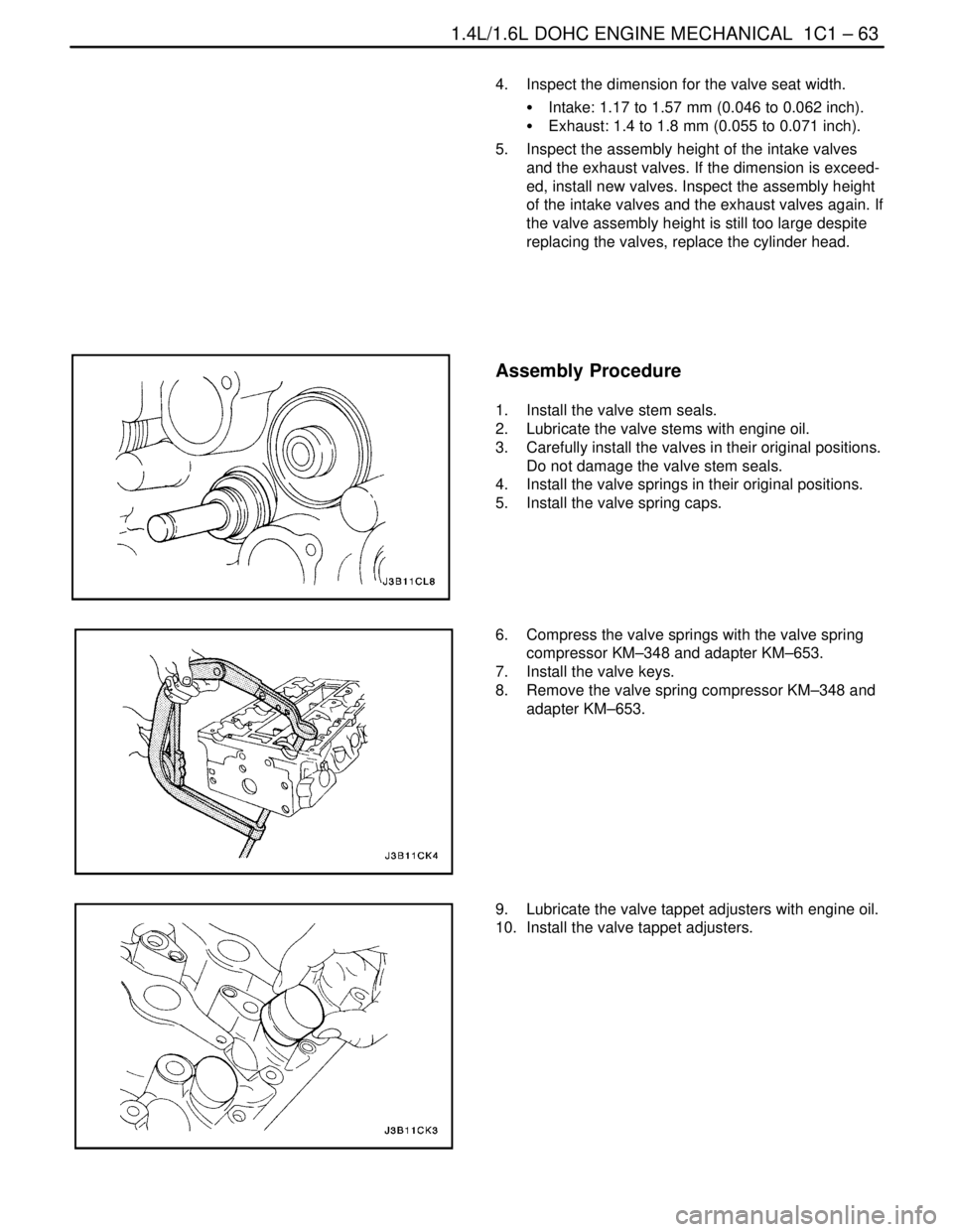
Assembly Procedure
1. Install the valve stem seals.
2. Lubricate the valve stems with engine oil.
3. Carefully install the valves in their original positions.
Do not damage the valve stem seals.
4. Install the valve springs in their original positions.
5. Install the valve spring caps.
6. Compress the valve springs with the valve spring
compressor KM–348 and adapter KM–653.
7. Install the valve keys.
8. Remove the valve spring compressor KM–348 and
adapter KM–653.
9. Lubricate the valve tappet adjusters with engine oil.
10. Install the valve tappet adjusters.
Page 181 of 2643
1.8L DOHC ENGINE MECHANICAL 1C2 – 61
DAEWOO V–121 BL4
4. Inspect the dimension for the valve seat width.
S Intake: 1.2 to 1.4 mm (0.047 to 0.055 inch).
S Exhaust: 1.4 to 1.8 mm (0.055 to 0.070 inch).
5. Inspect the assembly height of the intake valves
and the exhaust valves. If the dimension is exceed-
ed, install new valves. Inspect the assembly height
of the intake valves and the exhaust valves again. If
the valve assembly height is still too large despite
replacing the valves, replace the cylinder head.
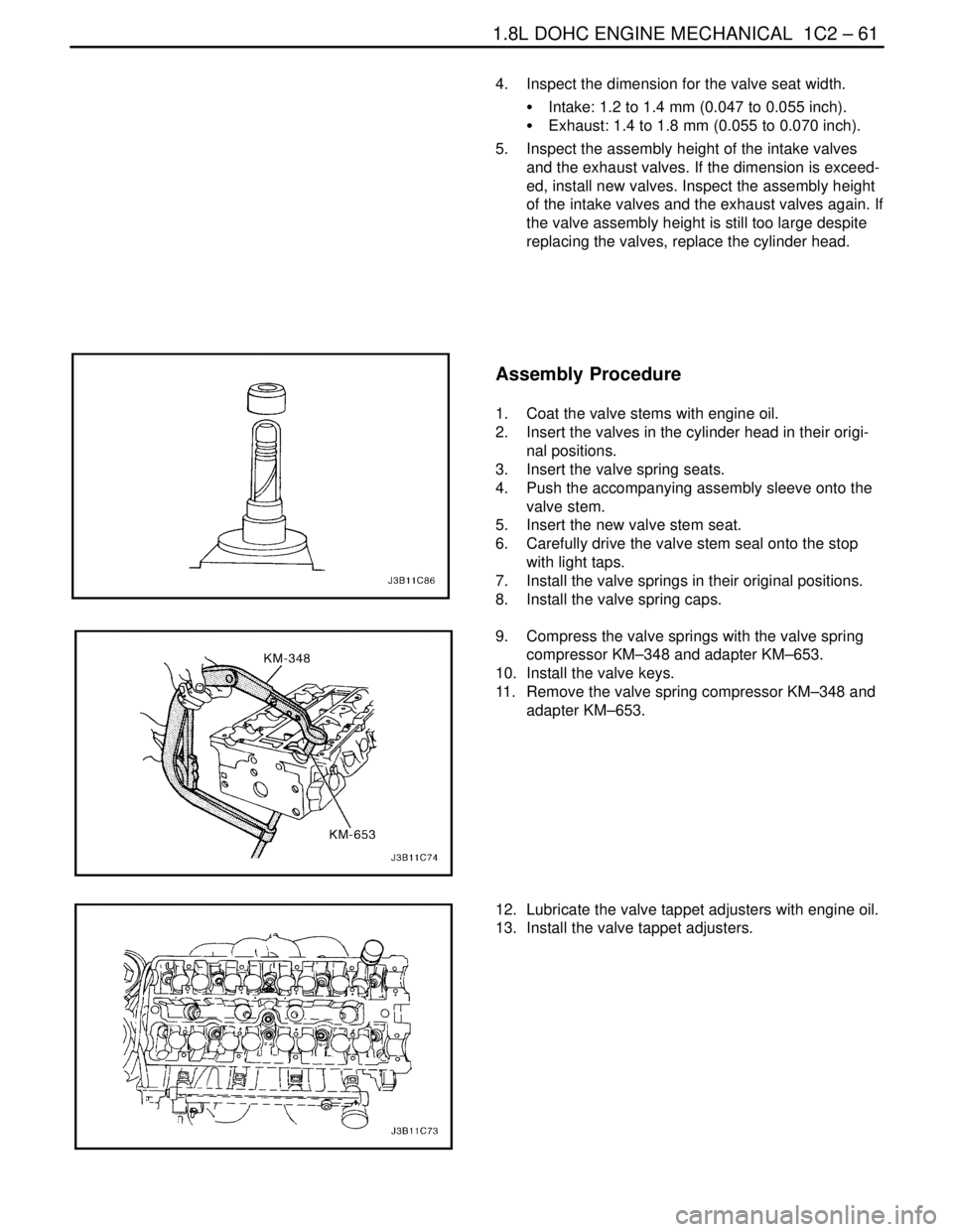
Assembly Procedure
1. Coat the valve stems with engine oil.
2. Insert the valves in the cylinder head in their origi-
nal positions.
3. Insert the valve spring seats.
4. Push the accompanying assembly sleeve onto the
valve stem.
5. Insert the new valve stem seat.
6. Carefully drive the valve stem seal onto the stop
with light taps.
7. Install the valve springs in their original positions.
8. Install the valve spring caps.
9. Compress the valve springs with the valve spring
compressor KM–348 and adapter KM–653.
10. Install the valve keys.
11. Remove the valve spring compressor KM–348 and
adapter KM–653.
12. Lubricate the valve tappet adjusters with engine oil.
13. Install the valve tappet adjusters.
Page 250 of 2643

1F – 4IENGINE CONTROLS
DAEWOO V–121 BL4
DTC P0203 Injector 3 Circuit Fault 1F–414. . . . . . . . .
DTC P0204 Injector 4 Circuit Fault 1F–417. . . . . . . . .
DTC P0300 Multiple Cylinder Misfire Detected 1F–421
DTC P0301 Cylinder 1 Misfire 1F–426. . . . . . . . . . . . .
DTC P0302 Cylinder 2 Misfire 1F–431. . . . . . . . . . . . .
DTC P0303 Cylinder 3 Misfire 1F–436. . . . . . . . . . . . .
DTC P0304 Cylinder 4 Misfire 1F–441. . . . . . . . . . . . .
DTC P0317 Rough Road Sensor Source Not
Detected 1F–445. . . . . . . . . . . . . . . . . . . . . . . . . . . . . .
DTC P0325 Knock Sensor Internal
Malfunction 1F–447. . . . . . . . . . . . . . . . . . . . . . . . . . .
DTC P0327 Knock Sensor Circuit Fault 1F–449. . . . .
DTC P0336 58X Crank Position Extra/Missing
Pulses 1F–452. . . . . . . . . . . . . . . . . . . . . . . . . . . . . . . .
DTC P0337 58X Crank Position Sensor No
Signal 1F–455. . . . . . . . . . . . . . . . . . . . . . . . . . . . . . . .
DTC P0341 Camshaft Position Sensor
Rationality 1F–458. . . . . . . . . . . . . . . . . . . . . . . . . . . .
DTC P0342 Camshaft Position Sensor No
Signal 1F–461. . . . . . . . . . . . . . . . . . . . . . . . . . . . . . . .
DTC P0351 Ignition Control Circuit A Fault
(Cylinder 1 and 4) 1F–464. . . . . . . . . . . . . . . . . . . . . .
DTC P0352 Ignition Control Circuit B Fault
(Cylinder 2 and 3) 1F–466. . . . . . . . . . . . . . . . . . . . . .
DTC P0401 Exhaust Gas Recirculation Insufficient
Flow 1F–468. . . . . . . . . . . . . . . . . . . . . . . . . . . . . . . . .
DTC P0402 Exhaust Gas Recirculation Excessive
Flow 1F–470. . . . . . . . . . . . . . . . . . . . . . . . . . . . . . . . .
DTC P0404 Exhaust Gas Recirculation Open
Valve Position Error 1F–474. . . . . . . . . . . . . . . . . . . .
DTC P0405 Exhaust Gas Recirculation Pintle
Position Low Voltage 1F–478. . . . . . . . . . . . . . . . . . .
DTC P0406 Exhaust Gas Recirculation Pintle
Position High Voltage 1F–481. . . . . . . . . . . . . . . . . . .
DTC P0420 Catalyst Oxygen Sensor Low
Efficiency 1F–484. . . . . . . . . . . . . . . . . . . . . . . . . . . . .
DTC P0443 Evaporative Emission System Purge
Solenoid Control Circuit 1F–486. . . . . . . . . . . . . . . . .
DTC P0461 Fuel Level Struck 1F–489. . . . . . . . . . . . .
DTC P0462 Fuel Level Low Voltage 1F–492. . . . . . . .
DTC P0463 Fuel Level High Voltage 1F–495. . . . . . .
DTC P0502 Vehicle Speed Sensor No Signal
(Engine Side) 1F–498. . . . . . . . . . . . . . . . . . . . . . . . . .
DTC P0506 Idle Speed RPM Lower Than Desired
Idle Speed 1F–501. . . . . . . . . . . . . . . . . . . . . . . . . . . .
DTC P0507 Idle Speed RPM Higher Than Desired
Idle Speed 1F–504. . . . . . . . . . . . . . . . . . . . . . . . . . . .
DTC P0532 A/C Pressure Sensor Low Voltage 1F–507
DTC P0533 A/C Pressure Sensor High
Voltage 1F–510. . . . . . . . . . . . . . . . . . . . . . . . . . . . . . . DTC P0562 System Voltage Too Low
(Engine Side) 1F–513. . . . . . . . . . . . . . . . . . . . . . . . . .
DTC P0563 System Voltage Too High
(Engine Side) 1F–515. . . . . . . . . . . . . . . . . . . . . . . . . .
DTC P0601 ECM Checksum Fault
(Engine Side) 1F–517. . . . . . . . . . . . . . . . . . . . . . . . . .
DTC P0602 ECM Reprogrom Error 1F–518. . . . . . . .
DTC P0607 Lower Power Counter Error 1F–519. . . .
DTC P0700 Transaxle Control Module
Malfunction 1F–520. . . . . . . . . . . . . . . . . . . . . . . . . . .
DTC P1106 Manifold Abosolute Pressure
Intermittent High Voltage 1F–522. . . . . . . . . . . . . . . .
DTC P1107 Manifold Abosolute Pressure
Intermittent Low Voltage 1F–524. . . . . . . . . . . . . . . .
DTC P1111 Intake Air Temperature Intermittent
High Voltage 1F–526. . . . . . . . . . . . . . . . . . . . . . . . . .
DTC P1112 Intake Air Temperature Intermittent
Low Voltage 1F–529. . . . . . . . . . . . . . . . . . . . . . . . . . .
DTC P1114 Engine Coolant Temperature
Intermittent Low Voltage 1F–531. . . . . . . . . . . . . . . .
DTC P1115 Engine Coolant Temperature
Intermittent High Voltage 1F–533. . . . . . . . . . . . . . . .
DTC P1121 Throttle Position Sensor Intermittent
High Voltage 1F–535. . . . . . . . . . . . . . . . . . . . . . . . . .
DTC P1122 Throttle Position Sensor Intermittent
Low Voltage 1F–537. . . . . . . . . . . . . . . . . . . . . . . . . . .
DTC P1133 Front Heated Oxyzen Sensor
(HO2S1) Too Few Transitions 1F–539. . . . . . . . . . .
DTC P1134 Front Heated Oxyzen Sensor
(HO2S1) Transitions Ratio 1F–543. . . . . . . . . . . . . .
DTC P1167 Front Heated Oxyzen Sensor
(HO2S1) Rich in Decel Fuel Cutoff (DFCO) 1F–546
DTC P1171 Fuel Trim System Lean During Power
Enrichment 1F–548. . . . . . . . . . . . . . . . . . . . . . . . . . . .
DTC P1336 58X Crank Position Tooth Error Not
Learned 1F–550. . . . . . . . . . . . . . . . . . . . . . . . . . . . . .
DTC P1391 G Sensor Rough Road Rationality 1F–552
DTC P1392 G Sensor Rough Low Voltage 1F–555. .
DTC P1393 G Sensor Rough High Voltage 1F–558. .
DTC P1396 ABS WSS Signal Variation 1F–561. . . . .
DTC P1397 ABS WSS No Signal 1F–563. . . . . . . . . .
DTC P1404 Exhaust Gas Recirculation Closed
Valve Pintle Error 1F–565. . . . . . . . . . . . . . . . . . . . . .
DTC P1601 SPI Communications Between
ECM and TCM 1F–568. . . . . . . . . . . . . . . . . . . . . . . .
DTC P1607 Lower Power Counter Reset 1F–569. . .
DTC P1626 Immobilizer No Response 1F–570. . . . . .
DTC P1631 Immobilizer Invalid Response 1F–571. .
DTC P1650 SPI Communications Between Error
with SIDM Chip 1F–572. . . . . . . . . . . . . . . . . . . . . . . .
DTC P1655 SPI Communications Between Error
with PSVI Chip 1F–573. . . . . . . . . . . . . . . . . . . . . . . .
Page 308 of 2643

1F – 62IENGINE CONTROLS
DAEWOO V–121 BL4
FUEL SYSTEM DIAGNOSIS
Circuit Description
The fuel pump is an in–tank type mounted to a fuel sender
assembly. The fuel pump will remain on as long as the en-
gine is cranking or running and the Engine Control Module
(ECM) is receiving reference pulses from the crankshaft
position (CKP) sensor. If there are no reference pulses,
the ECM will turn off the fuel pump two seconds after the
ignition switch is turned ON or two seconds after the en-
gine stops running. The fuel pump delivers fuel to the fuel
rail and the fuel injectors, where the fuel system pressure
is controlled from 284 to 325 kPa (41 to 47 psi) by the fuel
pressure regulator. The excess fuel is returned to the fuel
tank.
Test Description
The number(s) below refer to step(s) on the diagnostic
table.
2. When the engine is idling, the intake manifold vacu-
um is high. This vacuum is applied to the fuel pres-
sure regulator diaphragm, offsetting the spring
pressure inside the fuel pressure regulator and low-
ering the fuel pressure.10. If there is fuel bleeding back through the fuel return
outlet, this is due to a faulty fuel pressure regulator.
14. Another symptom often present when the fuel injec-
tors are leaking is hard starting. Leaking fuel injec-
tors can cause a flooding condition.
23. Fuel leaking from the fuel pump inlet is due to a
faulty one–way check valve in the fuel pump.
CAUTION : The fuel system is under pressure. To
avoid fuel spillage and the risk of personal injury or
fire, it is necessary to relieve the fuel system pressure
before disconnecting the fuel lines.
CAUTION : Do not pinch or restrict nylon fuel lines to
avoid damage that could cause a fuel leak, resulting
in possible fire or personal injury.
Fuel Pressure Relief Procedure
1. Remove the fuel cap.
2. Remove the fuel pump fuse EF18 from the engine
fuse box.
3. Start the engine and allow the engine to stall.
4. Crank the engine for an additional 10 seconds.
Fuel System Diagnosis
StepActionValue(s)YesNo
11. Relieve the fuel system pressure.
2. Install a fuel pressure gauge.
3. Turn the ignition ON.
Is the fuel pressure within the values specified and
holding steady?284~325 kPa
(41~47psi)Go to Step 2Go to Step 4
21. Allow the engine to idle.
2. Disconnect the vacuum hose from the fuel
pressure regulator.
3. Connect a vacuum pump with a gauge to the
fuel pressure regulator vacuum port.
4. Apply 41~47 kPa (12~14 in. Hg) of vacuum to
the fuel pressure regulator.
Does the fuel pressure decrease?–Go to Step 3Go to Step 15
31. Locate and correct the cause of the vacuum
restriction to the fuel pressure regulator.
2. Confirm the operation of the fuel pressure reg-
ulator.
Is the repair complete?–System OK–
41. Relieve the fuel system pressure.
2. Install a fuel pressure gauge.
3. Turn the ignition ON.
Is the fuel pressure within the values specified but
not holding steady?284~325 kPa
(41~47psi)Go to Step 5Go to Step 16
5Inspect the fuel lines for a leak.
Is the problem found?–Go to Step 6Go to Step 7
Page 356 of 2643

1F – 110IENGINE CONTROLS
DAEWOO V–121 BL4
FUEL INJECTOR BALANCE TEST
A fuel injector tester is used to energize the injector for a
precise amount of time, thus spraying a measured amount
of fuel into the intake manifold. This causes a drop in the
fuel rail pressure that can be recorded and used tocompare each of the fuel injectors. All of the fuel injectors
should have the same pressure drop.
Fuel Injector Balance Test Example
Cylinder1234
First Reading296 kPa (43 psi)296 kPa (43 psi)296 kPa (43 psi)296 kPa (43 psi)
Second Reading131 kPa (19 psi)117 kPa (17 psi)124 kPa (18 psi)145 kPa (21 psi)
Amount Of Drop165 kPa (24 psi)179 kPa (26 psi)172 kPa (25 psi)151 kPa (22 psi)
Average Range:
156~176 kPa
(22.5~25.5 psi)Injector OKFaulty Injector – Too
Much Pressure DropInjector OKFaulty Injector – Too
Little Pressure Drop
CAUTION : The fuel system is under pressure. To
avoid fuel spillage and the risk of personal injury or
fire, it is necessary to relieve the fuel system pressure
before disconnecting the fuel lines.
CAUTION : Do not pinch or restrict nylon fuel lines.
Damage to the lines could cause a fuel leak, resulting
in possible fire or personal injury.
Notice : In order to prevent flooding of the engine, do not
perform the Injector Balance Test more than once (includ-
ing any retest on faulty fuel injectors) without running the
engine.
Test
1. Turn the ignition switch to ON in order to get the
fuel pressure to its maximum level.
2. Allow the fuel pressure to stabilize and then record
this initial pressure reading. Wait until there is no
movement of the needle on the fuel pressure
gauge.
3. Follow the manufacturer’s instructions for the use
of the adapter harness. Energize the fuel injector
tester once and note the fuel pressure drop at its
lowest point. Record this second reading. Subtract
it from the first reading to determine the amount of
the fuel pressure drop.
4. Disconnect the fuel injector tester from the fuel in-
jector.
5. After turning the ignition switch to ON, in order toobtain maximum pressure once again, make a con-
nection at the next fuel injector. Energize the fuel
injector tester and record the fuel pressure reading.
Repeat this procedure for all the injectors.
6. Retest any of the fuel injectors that the pressure
drop exceeds the 10 kPa (1.5 psi) of the average
pressure drop value.
7. Replace any of the fuel injectors that fail the retest.
8. If the pressure drop of all of the fuel injectors is
within 10 kPa (1.5 psi) of the average pressure
drop value, then the fuel injectors are flowing nor-
mally and no replacement should be necessary.
9. Reconnect the fuel injector harness and review the
symptom diagnostic tables.
10. An engine cool down period of 10 minutes is neces-
sary in order to avoid irregular readings due to hot
soak fuel boiling.
11. Connect the fuel pressure gauge carefully to avoid
any fuel spillage.
12. The fuel pump should run about 2 seconds after the
ignition is turned to the ON position.
13. Insert a clear tube attached to the vent valve of the
fuel pressure gauge into a suitable container.
14. Bleed the air from the fuel pressure gauge and
hose until all of the air is bled from the fuel pressure
gauge.
15. The ignition switch must be in the OFF position at
least 10 seconds in order to complete the Engine
Control Module (ECM) shutdown cycle.
Page 441 of 2643

ENGINE CONTROLS 1F – 195
DAEWOO V–121 BL4
DIAGNOSTIC TROUBLE CODE (DTC) P0327
KNOCK SENSOR CIRCUIT FAULT (1.4L DOHC)
Circuit Description
The knock sensor (KS) system is used to detect engine
detonation, allowing the engine control module (ECM) to
retard ignition control spark timing based on the KS signal
being received. The KS produces an AC signal so that un-
der a no knock condition the signal on the KS circuit mea-
sures about 0.007V AC. The KS signal’s amplitude and
frequency depend upon the amount of knock being experi-
enced. The ECM contains a non–replaceable knock filter
module called a signal–to–noise enhancement filter
(SNEF) module. This filter module in the ECM determines
whether knock is occurring by comparing the signal level
on the KS circuit with the voltage level on the noise chan-
nel. The noise channel allows the ECM to reject any false
knock signal by knowing the amount of normal engine me-
chanical noise present. Normal engine noise varies de-
pending on engine speed and load. When the ECM deter-
mines that an abnormally low noise channel voltage level
is being experienced, a DTC P0327 will set.
Conditions for Setting the DTC
S The knock sensor SPI bus in failure during 8 sec-
onds.
Or
S The knock sensor voltage is less than 0.3V.
S The engine coolant temperature is greater than
60°C (145°F).
S The engine speed is greater than 1,500 rpm.
S The mass air flow is higer than 180mg/tdc.
Or
S When difference between a original signal valve
and filtering valve is less than 5%.S The engine coolant temperature is greater than
60°C (145°F).
S The mass air flow is greater than 180mg/tdc.
Action Taken When the DTC Sets
S The Malfunction Indicator Lamp (MIL) will not illumi-
nate.
S The ECM will store wnditions which were present
when the DTC was set as Failure Records data
only.
S This information will not be stored in the Freeze
Frame data.
Conditions for Clearing the MIL/DTC
S A history DTC will clear after 40 consecutive warm–
up cycles without a fault.
S DTC(s) can be cleared by using the scan tool.
S Disconnecting the ECM battery feed for more than
10 seconds.
Diagnostic Aids
Check and correct any abnormal engine noise before us-
ing the diagnostic table.
Any circuitry that is suspected as causing engine noise
complaint should be thoroughly checked for the following
conditions :
S Backed–out terminals
S Improper mating
S Broken locks
S Improperly formed
S Damaged terminals
S Poor terminal–to–wire connection
S Physical damage to the wiring harness
Page 444 of 2643

1F – 198IENGINE CONTROLS
DAEWOO V–121 BL4
DIAGNOSTIC TROUBLE CODE (DTC) P0327
KNOCK SENSOR CIRCUIT FAULT (1.6L DOHC)
Circuit Description
The knock sensor (KS) system is used to detect engine
detonation, allowing the transaxle control module
(TCM)/engine control module (ECM) to retard ignition con-
trol spark timing based on the KS signal being received.
The KS produces an AC signal so that under a no knock
condition the signal on the KS circuit measures about
0.007V AC. The KS signal’s amplitude and frequency de-
pend upon the amount of knock being experienced. The
ECM contains a non–replaceable knock filter module
called a signal–to–noise enhancement filter (SNEF) mod-
ule. This filter module in the ECM determines whether
knock is occurring by comparing the signal level on the KS
circuit with the voltage level on the noise channel. The
noise channel allows the ECM to reject any false knock
signal by knowing the amount of normal engine mechani-
cal noise present. Normal engine noise varies depending
on engine speed and load. When the ECM determines that
an abnormally low noise channel voltage level is being ex-
perienced, a DTC P0327 will set.
Conditions for Setting the DTC
S The knock sensor SPI bus in failure during 10 sec-
onds.
Or
S The knock sensor voltage is less than 0.3V.
S The engine coolant temperature is greater than
60°C(145°F).
S The engine speed is greater than 1,500rpm.
S The mass air flow is higer than 180mg/tdc.
Or
S When difference between a original signal valve
and filtering valve is less than 5%.S The engine coolant temperature is greater than
60°C(145°F).
S The mass air flow is greater than 170mg/tdc.
Action Taken When the DTC Sets
S The Malfunction Indicator Lamp (MIL) will illuminate
after three consecutive trip with a fail.
S The ECM will record operating conditions at the
time the diagnostic fail. This information will be
stored in the Freeze Frame and Failure Records
buffers.
S A history DTC is stored.
Conditions for Clearing the MIL/DTC
S The MIL will turn off after four consecutive ignition
cycles in which the diagnostic runs without a fault.
S A history DTC will clear after 40 consecutive warm–
up cycles without a fault.
S DTC(s) can be cleared by using the scan tool.
S Disconnecting the ECM battery feed for more than
10 seconds.
Diagnostic Aids
Check and correct any abnormal engine noise before us-
ing the diagnostic table.
Any circuitry that is suspected as causing engine noise
complaint should be thoroughly checked for the following
conditions :
S Backed–out terminals
S Improper mating
S Broken locks
S Improperly formed
S Damaged terminals
S Poor terminal–to–wire connection
S Physical damage to the wiring harness
Page 592 of 2643

1F – 346IENGINE CONTROLS
DAEWOO V–121 BL4
DTCIlluminate MIL Type Description
P1392G Sensor Rough Road Low VoltageCnlNo
P1393G Sensor Rough Road High VoltageCnlNo
P1396ABS WSS Signal VariationCnlNo
P1397ABS WSS No SignalCnlNo
P1404Exhaust Gas Recirculation Closed Valve Pintle ErrorEYe s
P1601SPI Communications Between ECM and TCMAYe s
P1607Lower Power Counter ResetCnlNo
P1626Immobilizer No ResponseCnlNo
P1631Immobilizer Incorrect ResponseCnlNo
P1650SPI Communications Between Error with SIDM ChipCnlNo
P1655SPI Communications Between Error with PSVI ChipEYe s
Page 782 of 2643

1F – 536IENGINE CONTROLS
DAEWOO V–121 BL4
DTC P1121 – Throttle Position Sensor Intermittent High Voltage
StepActionValue(s)YesNo
1Perform an On–Board Diagnostic (EOBD) System
Check.
Was the check performed?–Go to Step 2Go to
”On–Board
Diagnostic Sys-
tem Check”
21. Install a scan tool to the Data Link Connector
(DLC).
2. Turn the ignition ON.
Is Diagnostic Trouble Code (DTC) P0123 also set?–Go to
applicable DTC
tableGo to Step 3
3Check for poor sensor ground circuit terminal 1 con-
nection at the Throttle Position (TP) sensor.
Is a problem found?–Go to Step 7Go to Step 4
4Check the TP signal circuit between TP sensor con-
nector and the Engine Control Module (ECM) for an
intermittent short to voltage.
Is a problem found?–Go to Step 8Go to Step 5
5Check for a poor sensor ground terminal M64 at the
ECM.
Is a problem found?–Go to Step 7Go to Step 6
6Check for an intermittent open or faulty spice in the
sensor ground circuit.
Is a problem found?–Go to Step 8Go to
”Diagnostic
Aids”
7Repair or replace the faulty harness connector ter-
minal for sensor ground circuit.
Is the repair complete?–Go to Step 9
8Repair the intermittent open/short circuit in wiring
harness as needed.
Is the repair complete?–Go to Step 9
91. Using the scan tool, clear the Diagnostic
Trouble Codes (DTCs).
2. Start the engine and idle at normal operating
temperature.
3. Operate the vehicle within the Conditions for
setting this DTC as specified in the supporting
text.
Does the scan tool indicate that this diagnostic has
run and passed?–Go to Step 10Go to Step 2
10Check if any additional DTCs are set.
Are any DTCs displayed that have not been diag-
nosed?–Go to
Applicable DTC
tableSystem OK
Page 814 of 2643

1F – 568IENGINE CONTROLS
DAEWOO V–121 BL4
DIAGNOSTIC TROUBLE CODE (DTC) P1601
SPI COMMUNICATIONS BETWEEN ECM AND TCM
Circuit Description
The Serial Peripheral Interface (SPI) communication is
used internally by the Engine Control Module (ECM) to
send message between the engine processor and the au-
tomatic transaxle processor. Included in each message
sent between the two processor is a checksum of the mes-
sage. Both the engine processor automatic transaxle
processor will compare this checksum value with calcu-
lated checksum. If the checksum do not match, the proc-
essor will review the new data as being corrupted and ig-
nore the value. The processor then use the previous
message. The receiving processor will then send a mes-
sage to the sending processor informing it that its last mes-
sage was corrupted.
The ECM monitor periodic TCM status message and if
message is not received fail counter incremented and
Diagnostic trouble Code (DTC) will stored.
Conditions for Setting the DTC
S Ignition switch is turned to ON.S Ignition voltage is greater than 11 volts.
S Engine is running more than 2 seconds.
S Device Control not active.
Action Taken When the DTC Sets
S The Malfunction Indicator Lamp (MIL) will illumi-
nate.
S The ECM will record operating conditions at the
time the diagnostic fails. This information will be
stored in the Freeze Frame and Failure Records
buffers.
S A history DTC is stored.
Conditions for Clearing the MIL/DTC
S The MIL turn off after four consecutive ignition
cycles in which the diagnostic runs without a fault.
S A history DTC will clear after 40 consecutive warm–
up cycles without a fault.
S DTC(s) can be cleared by using the scan tool.
S Disconnecting the ECM battery feed for more than
10 seconds.
DTC P1601 SPI Communications Between ECM and TCM
StepActionValue(s)YesNo
1Perform an On–Board Diagnostic (EOBD) System
Check.
Was the check performed?–Go to Step 2Go to
”On–Board
Diagnostic Sys-
tem Check”
21. Turn the ignition OFF.
2. Replace the Engine Control Module (ECM).
Is the repair complete?–Go to Step 3–
31. Using the scan tool, clear the Diagnostic
Trouble Codes (DTCs).
2. Start the engine and idle at normal operating
temperature.
3. Operate the vehicle within the Conditions for
setting this DTC as specified in the supporting
text.
Does the scan tool indicate that this diagnostic has
run and passed?–Go to Step 4Go to Step 2
4Check if any additional DTCs are set.
Are any DTCs displayed that have not been diag-
nosed?–Go to
Applicable DTC
tableSystem OK