Solenoid DAEWOO LACETTI 2004 Service User Guide
[x] Cancel search | Manufacturer: DAEWOO, Model Year: 2004, Model line: LACETTI, Model: DAEWOO LACETTI 2004Pages: 2643, PDF Size: 80.54 MB
Page 167 of 2643
1.8L DOHC ENGINE MECHANICAL 1C2 – 47
DAEWOO V–121 BL4
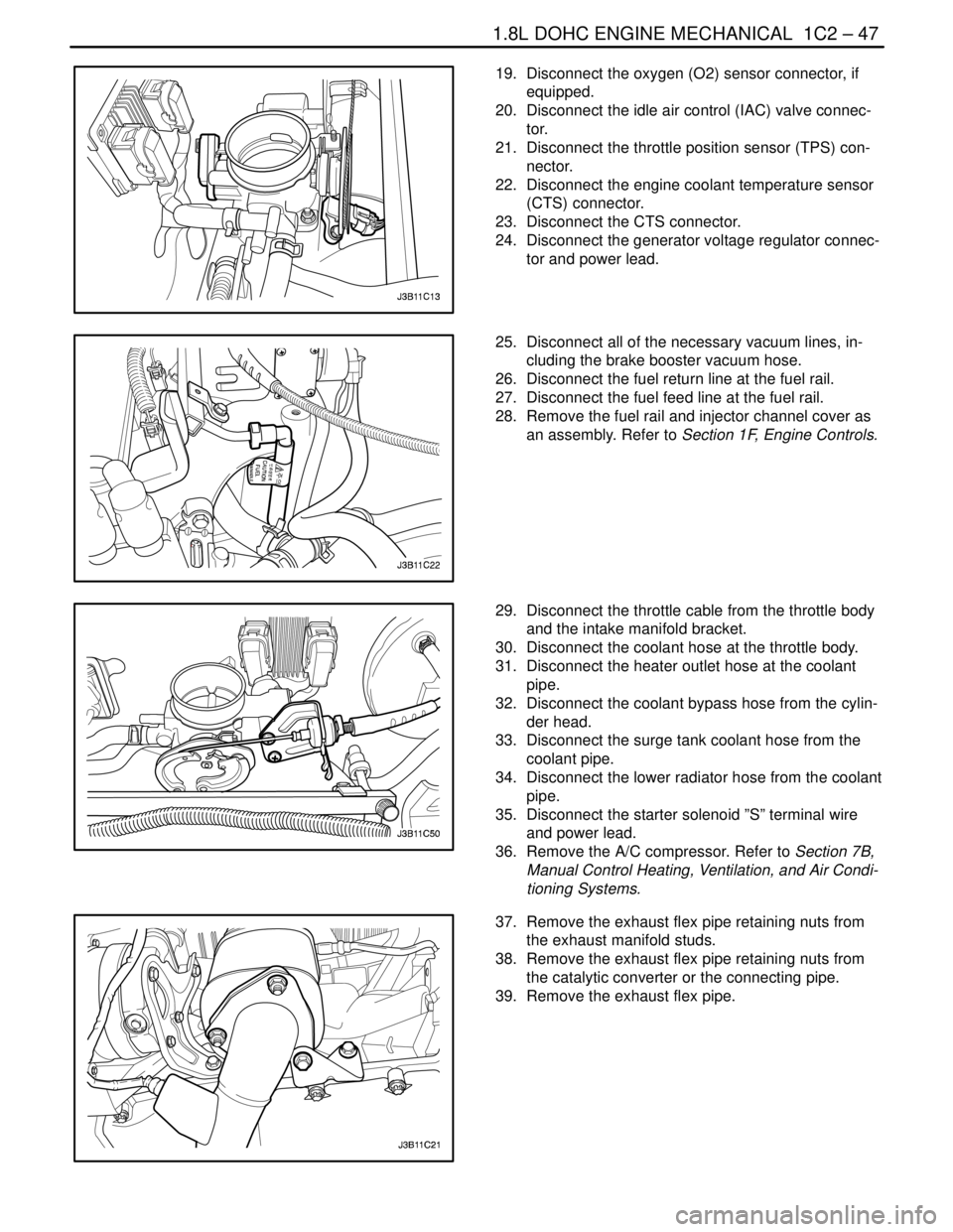
19. Disconnect the oxygen (O2) sensor connector, if
equipped.
20. Disconnect the idle air control (IAC) valve connec-
tor.
21. Disconnect the throttle position sensor (TPS) con-
nector.
22. Disconnect the engine coolant temperature sensor
(CTS) connector.
23. Disconnect the CTS connector.
24. Disconnect the generator voltage regulator connec-
tor and power lead.
25. Disconnect all of the necessary vacuum lines, in-
cluding the brake booster vacuum hose.
26. Disconnect the fuel return line at the fuel rail.
27. Disconnect the fuel feed line at the fuel rail.
28. Remove the fuel rail and injector channel cover as
an assembly. Refer to Section 1F, Engine Controls.
29. Disconnect the throttle cable from the throttle body
and the intake manifold bracket.
30. Disconnect the coolant hose at the throttle body.
31. Disconnect the heater outlet hose at the coolant
pipe.
32. Disconnect the coolant bypass hose from the cylin-
der head.
33. Disconnect the surge tank coolant hose from the
coolant pipe.
34. Disconnect the lower radiator hose from the coolant
pipe.
35. Disconnect the starter solenoid ”S” terminal wire
and power lead.
36. Remove the A/C compressor. Refer to Section 7B,
Manual Control Heating, Ventilation, and Air Condi-
tioning Systems.
37. Remove the exhaust flex pipe retaining nuts from
the exhaust manifold studs.
38. Remove the exhaust flex pipe retaining nuts from
the catalytic converter or the connecting pipe.
39. Remove the exhaust flex pipe.
Page 168 of 2643
1C2 – 48I1.8L DOHC ENGINE MECHANICAL
DAEWOO V–121 BL4
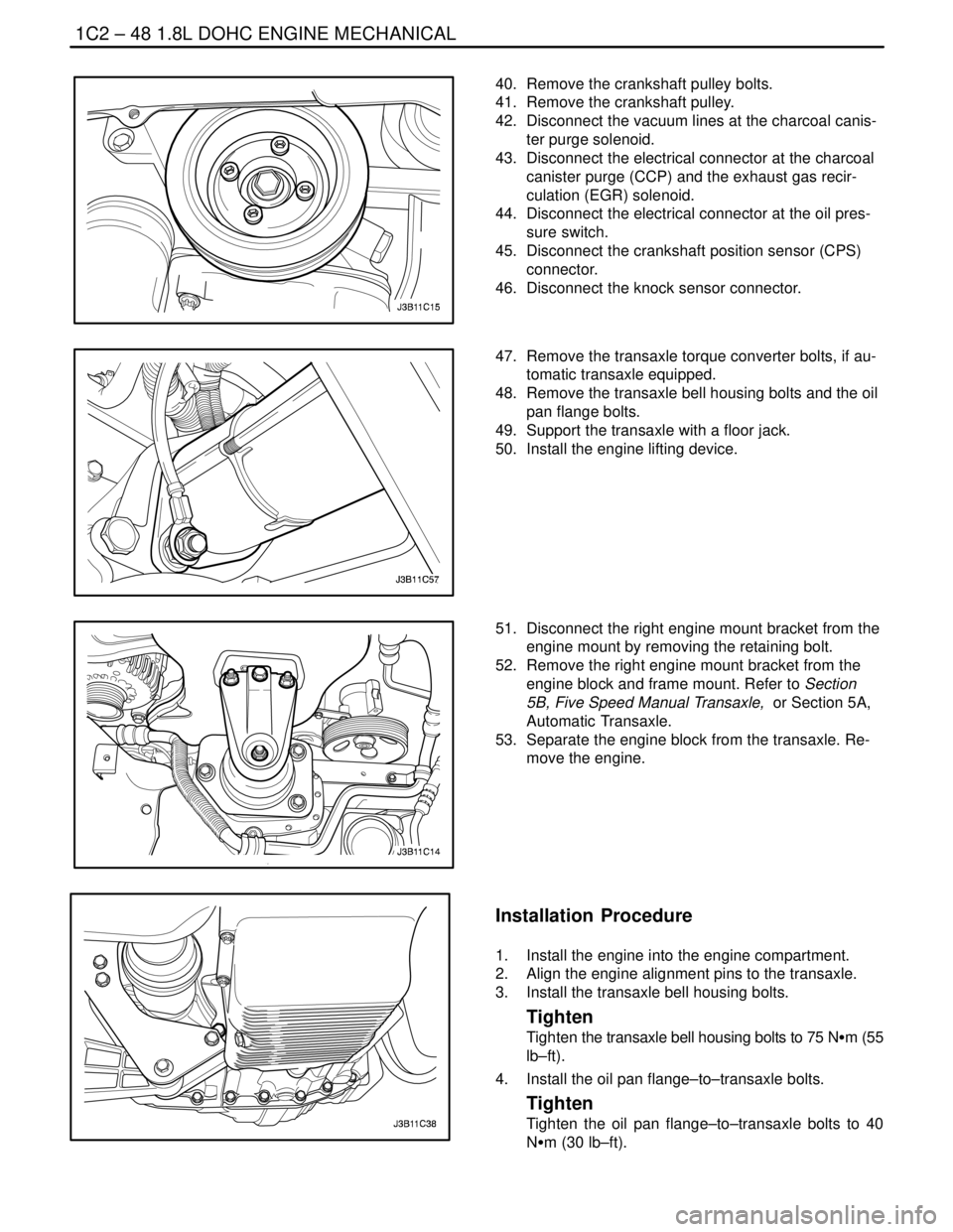
40. Remove the crankshaft pulley bolts.
41. Remove the crankshaft pulley.
42. Disconnect the vacuum lines at the charcoal canis-
ter purge solenoid.
43. Disconnect the electrical connector at the charcoal
canister purge (CCP) and the exhaust gas recir-
culation (EGR) solenoid.
44. Disconnect the electrical connector at the oil pres-
sure switch.
45. Disconnect the crankshaft position sensor (CPS)
connector.
46. Disconnect the knock sensor connector.
47. Remove the transaxle torque converter bolts, if au-
tomatic transaxle equipped.
48. Remove the transaxle bell housing bolts and the oil
pan flange bolts.
49. Support the transaxle with a floor jack.
50. Install the engine lifting device.
51. Disconnect the right engine mount bracket from the
engine mount by removing the retaining bolt.
52. Remove the right engine mount bracket from the
engine block and frame mount. Refer to Section
5B, Five Speed Manual Transaxle, or Section 5A,
Automatic Transaxle.
53. Separate the engine block from the transaxle. Re-
move the engine.
Installation Procedure
1. Install the engine into the engine compartment.
2. Align the engine alignment pins to the transaxle.
3. Install the transaxle bell housing bolts.
Tighten
Tighten the transaxle bell housing bolts to 75 NSm (55
lb–ft).
4. Install the oil pan flange–to–transaxle bolts.
Tighten
Tighten the oil pan flange–to–transaxle bolts to 40
NSm (30 lb–ft).
Page 169 of 2643
1.8L DOHC ENGINE MECHANICAL 1C2 – 49
DAEWOO V–121 BL4
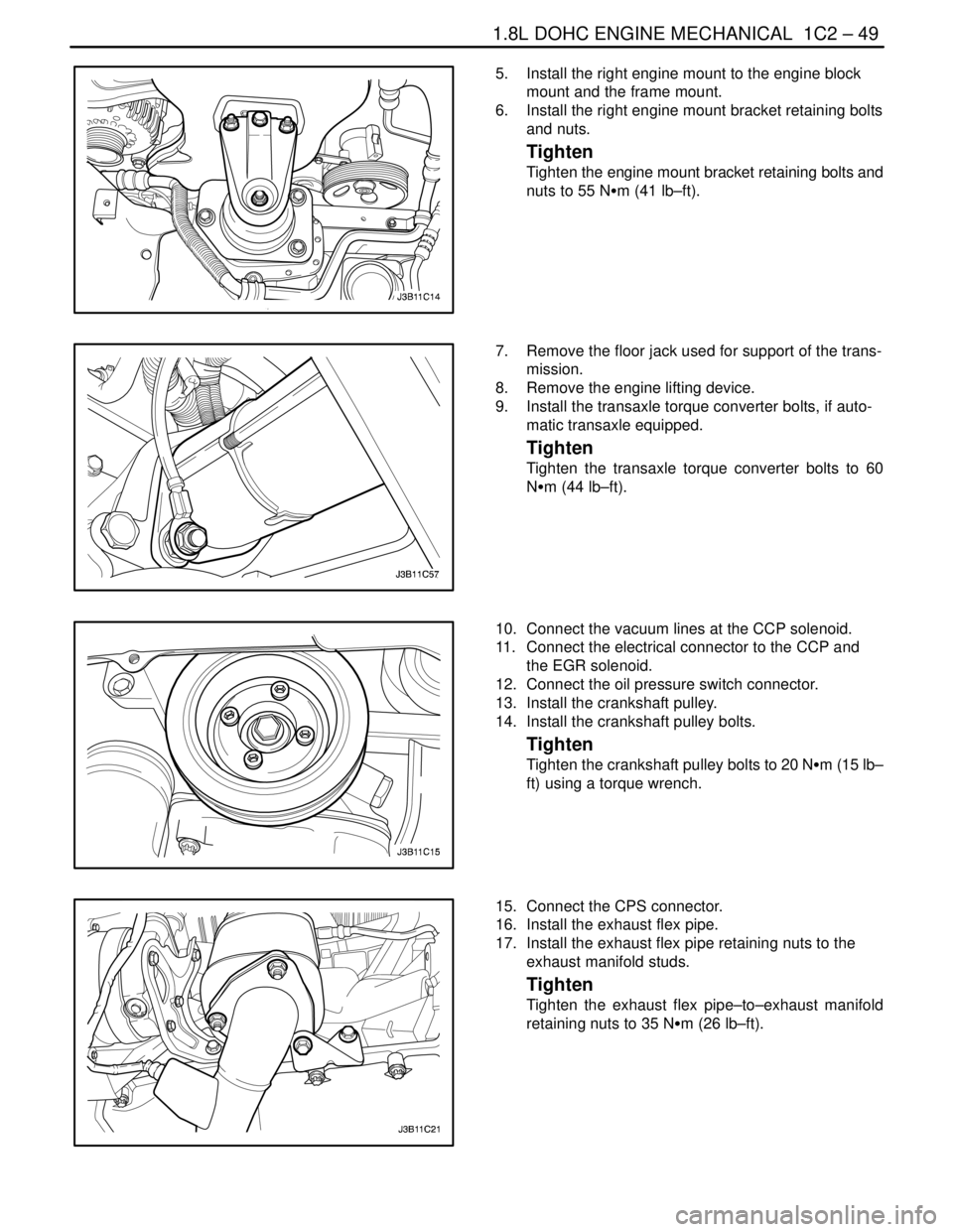
5. Install the right engine mount to the engine block
mount and the frame mount.
6. Install the right engine mount bracket retaining bolts
and nuts.
Tighten
Tighten the engine mount bracket retaining bolts and
nuts to 55 NSm (41 lb–ft).
7. Remove the floor jack used for support of the trans-
mission.
8. Remove the engine lifting device.
9. Install the transaxle torque converter bolts, if auto-
matic transaxle equipped.
Tighten
Tighten the transaxle torque converter bolts to 60
NSm (44 lb–ft).
10. Connect the vacuum lines at the CCP solenoid.
11. Connect the electrical connector to the CCP and
the EGR solenoid.
12. Connect the oil pressure switch connector.
13. Install the crankshaft pulley.
14. Install the crankshaft pulley bolts.
Tighten
Tighten the crankshaft pulley bolts to 20 NSm (15 lb–
ft) using a torque wrench.
15. Connect the CPS connector.
16. Install the exhaust flex pipe.
17. Install the exhaust flex pipe retaining nuts to the
exhaust manifold studs.
Tighten
Tighten the exhaust flex pipe–to–exhaust manifold
retaining nuts to 35 NSm (26 lb–ft).
Page 170 of 2643
1C2 – 50I1.8L DOHC ENGINE MECHANICAL
DAEWOO V–121 BL4
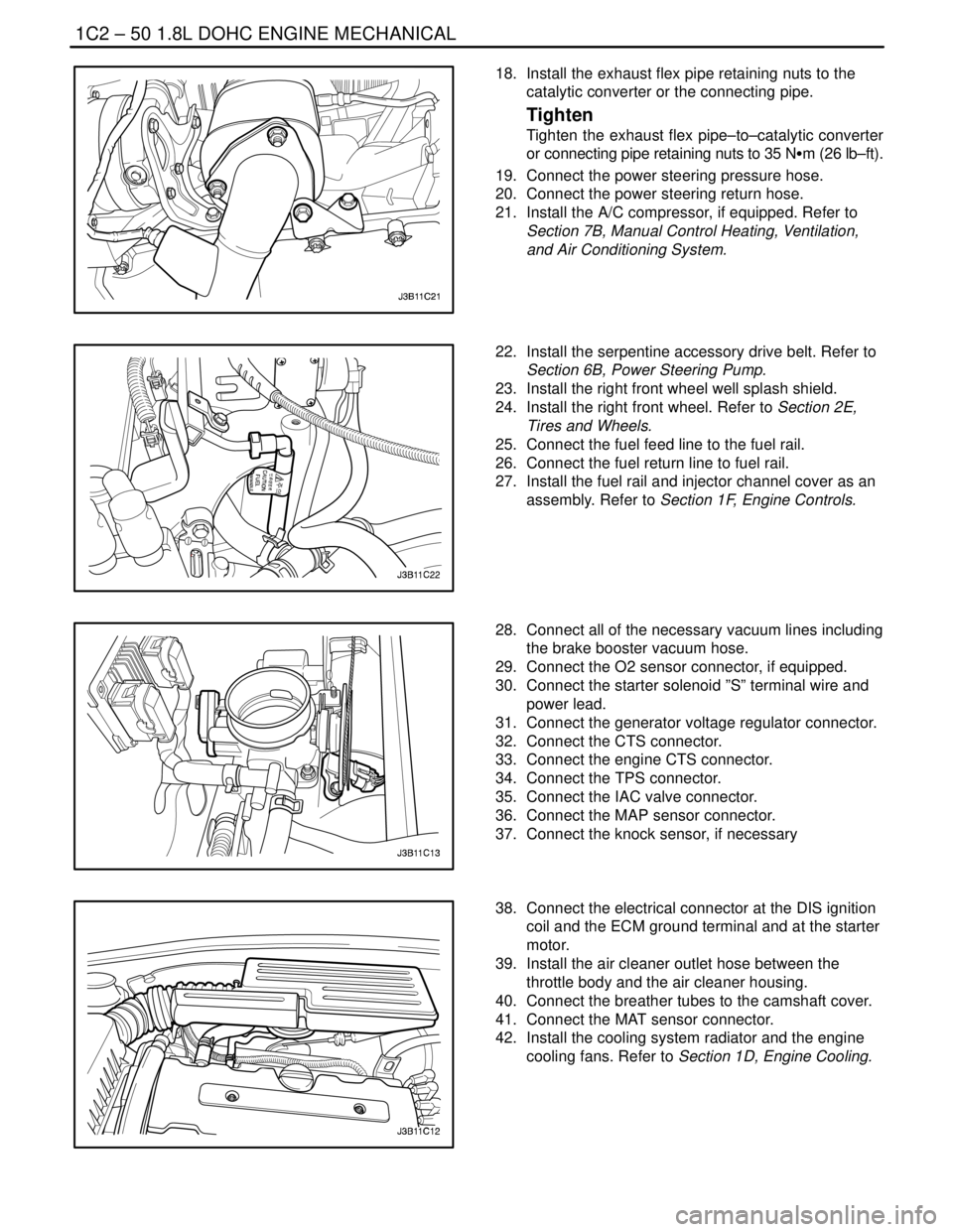
18. Install the exhaust flex pipe retaining nuts to the
catalytic converter or the connecting pipe.
Tighten
Tighten the exhaust flex pipe–to–catalytic converter
or connecting pipe retaining nuts to 35 NSm (26 lb–ft).
19. Connect the power steering pressure hose.
20. Connect the power steering return hose.
21. Install the A/C compressor, if equipped. Refer to
Section 7B, Manual Control Heating, Ventilation,
and Air Conditioning System.
22. Install the serpentine accessory drive belt. Refer to
Section 6B, Power Steering Pump.
23. Install the right front wheel well splash shield.
24. Install the right front wheel. Refer to Section 2E,
Tires and Wheels.
25. Connect the fuel feed line to the fuel rail.
26. Connect the fuel return line to fuel rail.
27. Install the fuel rail and injector channel cover as an
assembly. Refer to Section 1F, Engine Controls.
28. Connect all of the necessary vacuum lines including
the brake booster vacuum hose.
29. Connect the O2 sensor connector, if equipped.
30. Connect the starter solenoid ”S” terminal wire and
power lead.
31. Connect the generator voltage regulator connector.
32. Connect the CTS connector.
33. Connect the engine CTS connector.
34. Connect the TPS connector.
35. Connect the IAC valve connector.
36. Connect the MAP sensor connector.
37. Connect the knock sensor, if necessary
38. Connect the electrical connector at the DIS ignition
coil and the ECM ground terminal and at the starter
motor.
39. Install the air cleaner outlet hose between the
throttle body and the air cleaner housing.
40. Connect the breather tubes to the camshaft cover.
41. Connect the MAT sensor connector.
42. Install the cooling system radiator and the engine
cooling fans. Refer to Section 1D, Engine Cooling.
Page 216 of 2643

1E – 2IENGINE ELECTRICAL
DAEWOO V–121 BL4
SPECIFICATIONS
STARTER SPECIFICATIONS
ApplicationDescription
Starter (1.6L DOHC)1.2 Kw
No Load Test @ 12.0 volts90 amps Max
Drive Pinion Speed at:Min 2,600 rpm
Starter (1.8L DOHC)1.4 Kw
No Load Test @ 12.0 volts85 amps Max
Drive Pinion Speed at:Min 2,550 rpm
Solenoid
Hold–in Windings @ 12.0 volts12–20 amps
Pull–in Windings @ 12.0 volts60 – 90 amps
BATTERY SPECIFICATIONS
ApplicationDescription
Cold Cranking Amps610 amps
Cold Cranking Amps (Extremely Cold Area)610 amps
Reserve Capacity Minimum90 minutes
Load Test270 amps
Minimum Voltage:
9.6
9.4
9.1
8.8
8.5
8.0Estimated Temperature:
21°C (69.8°F)
20°C (68°F)
0°C (32°F)
–10°C (14°F)
–18°C (0°F)
Below –18°C (Below 0°F)
Page 217 of 2643

ENGINE ELECTRICAL 1E – 3
DAEWOO V–121 BL4
FASTENER TIGHTENING SPECIFICATIONS
ApplicationNSmLb–FtLb–In
Battery Cable Nuts5–44
Battery Carrier Tray Lower, Side and Upper Bolts2015–
Battery Retainer Clamp–to–Battery Rod Nuts5–44
Generator Drive End Bearing Nut8160–
Generator Lower Bracket–to–Engine Block Bolts (1.8L Engine)3727–
Generator Lower Bracket–to–Generator Nut (1.4L/1.6L Engine)2518–
Generator Through–Bolts10–89
Generator–to–Intake Manifold and Cylinder Head Support
Bracket Bolts (1.8L Engine)3727–
Generator–to–Intake Manifold Strap Bracket Bolt (1.8L Engine)2216–
Generator Upper Support Bracket Bolt (1.4L/1.6L Engine)2015–
Intake Manifold–to–Cylinder Body Strap Bracket Bolts (Over
Starter)2216–
Starter Field Connector Nut12–106
Starter Lower Mounting Stud Ground Wire Nut12–106
Starter Mounting Studs/Nuts (1.4L/1.6L Engine)2518–
Starter Solenoid Assembly Screws8–71
Starter Solenoid Terminal–to–Battery Cable Terminal Nut5.5–49
Starter Solenoid Terminal–to–Ignition Solenoid Terminal Nut5.5–49
Starter Through–Bolts6–53
Starter–to–Engine Block Mounting Bolt (1.8L Engine)4533–
Starter–to–Engine Transaxle Mounting Bolt (1.8L Engine)5037–
Page 223 of 2643

ENGINE ELECTRICAL 1E – 9
DAEWOO V–121 BL4
STARTER MOTOR NOISE
To correct starter motor noise during starting, use the following procedure:
Checks
Action
Check for a high–pitched whine during cranking, before
the engine fires. The engine cranks and fires properly.The distance is too great between the starter pinion and
the flywheel. Shimming the starter toward the flywheel is
required.
Check for a high–pitched whine after the engine fires, as
the key is being released. The engine cranks and fires
properly. This intermittent complaint is often diagnosed as
”starter hang–in” or ”solenoid weak.”The distance is too small between the starter pinion and
the flywheel. Shimming the starter away from the flywheel
is required.
Check for a loud ”whoop” after the engine fires but while
the starter is still held engaged. The sound is like a siren
if the engine is revved while the starter is engaged.The most probable cause is a defective clutch. A new
clutch will often correct this problem.
Check for a ”rumble,” a ”growl,” or, in severe cases, a
”knock” as the starter is coasting down to a stop after start-
ing the engine.The most probable cause is a bent or unbalanced starter
armature. A new armature will often correct this problem.
If the complaint is noise, correction can be achieved by
proper shimming as follows:
1. Check for a bent or a worn flywheel.
2. Start the engine and carefully touch the outside di-
ameter of the rotating flywheel ring gear with chalk
or a crayon to show the high point of the tooth run-
out. Turn the engine OFF and rotate the flywheel so
that the marked teeth are in the area of the starter
pinion gear.
3. Disconnect the negative battery cable to prevent
cranking the engine.
4. Check the pinion–to–flywheel clearance by using a
wire gauge of 0.5 mm (0.02 inch) minimum thick-
ness (or diameter). Center a pinion tooth between
two flywheel teeth and the gauge. Do not gauge in
the corners, where a misleading larger dimension
may be observed. If the clearance is under this
minimum, shimming the starter away from the fly-
wheel is required.
5. If the clearance approaches 1.5 mm (0.06 inch) or
more, shimming the starter toward the flywheel is
required. This condition is generally the cause of
broken flywheel teeth or the starter housing. Shim
the starter toward the flywheel by shimming only
the outboard starter mounting pad. A shim of 0.40
mm (0.016 inch) thickness at this location will de-
crease the clearance by approximately 0.30 mm
(0.012 inch). If normal starter shims are not avail-
able, plain washers or other suitable material may
be used as shims.BATTERY LOAD TEST
1. Check the battery for obvious damage, such as a
cracked or broken case or cover, which could per-
mit the loss of electrolyte. If obvious damage is
noted, replace the battery.
CAUTION : Do not charge the battery if the hydrome-
ter is clear or light yellow. Instead, replace the battery.
If the battery feels hot, or if violent gassing or spew-
ing of electrolyte through the vent hole occurs, dis-
continue charging or reduce the charging rate to
avoid personal injury.
2. Check the hydrometer. If the green dot is visible, go
to the load test procedure. If the indicator is dark
but green is not visible, charge the battery. For
charging a battery removed from the vehicle, refer
to ”Charging a Completely Discharged Battery” in
this section.
3. Connect a voltmeter and a battery load tester
across the battery terminals.
4. Apply a 300–ampere load for 15 seconds to remove
any surface charge from the battery.
5. Remove the load.
6. Wait 15 seconds to let the battery recover, and ap-
ply a 270–ampere load.
Important : The battery temperature must be estimated
by touch and by the temperature condition the battery has
been exposed for the preceding few hours.
7. If the voltage does not drop below the minimum
listed, the battery is good and should be reinstalled.
If the voltage is less than the minimum listed, re-
place the battery. Refer to ”Battery Specifications”
in this section.
Page 228 of 2643
1E – 14IENGINE ELECTRICAL
DAEWOO V–121 BL4
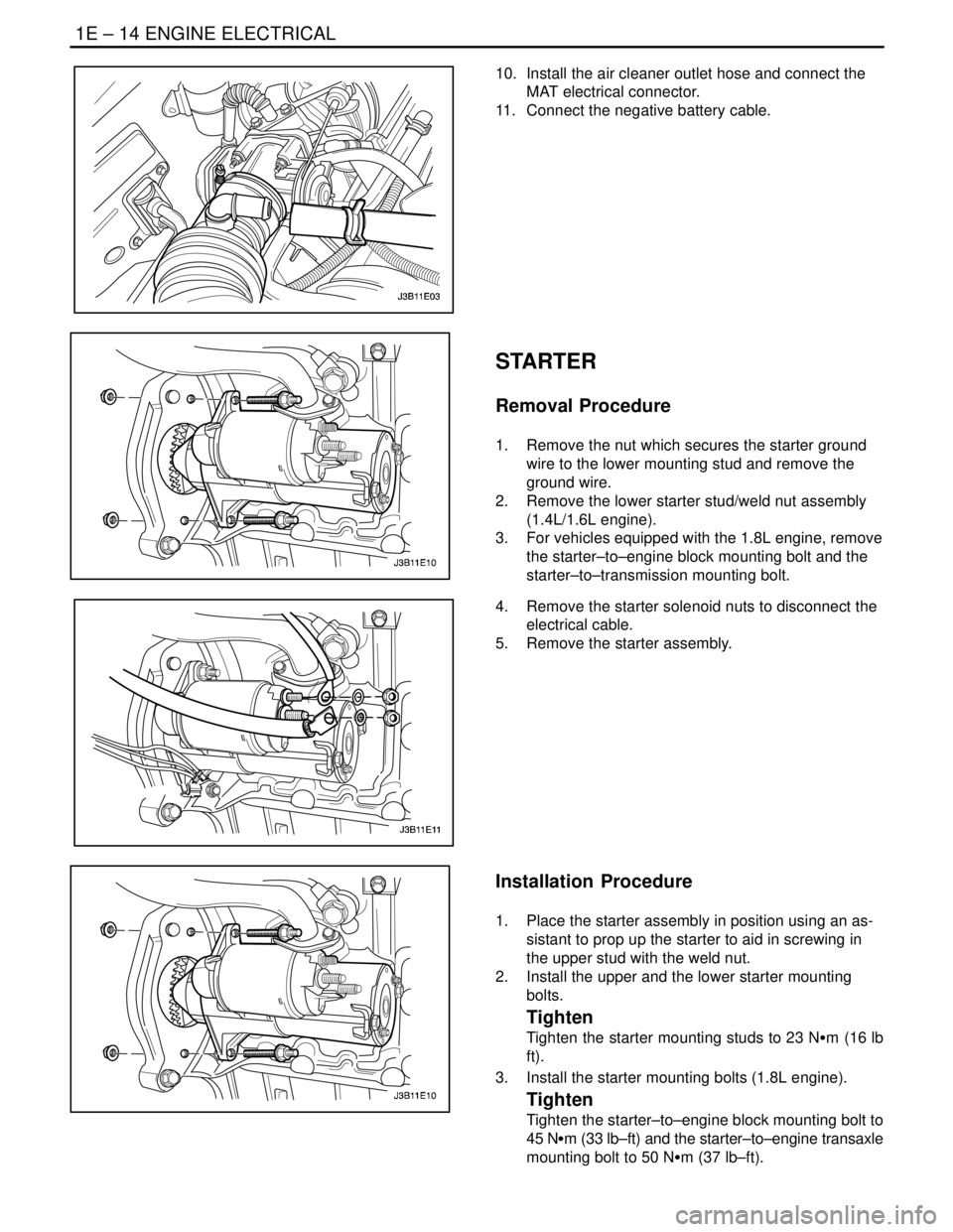
10. Install the air cleaner outlet hose and connect the
MAT electrical connector.
11. Connect the negative battery cable.
STARTER
Removal Procedure
1. Remove the nut which secures the starter ground
wire to the lower mounting stud and remove the
ground wire.
2. Remove the lower starter stud/weld nut assembly
(1.4L/1.6L engine).
3. For vehicles equipped with the 1.8L engine, remove
the starter–to–engine block mounting bolt and the
starter–to–transmission mounting bolt.
4. Remove the starter solenoid nuts to disconnect the
electrical cable.
5. Remove the starter assembly.
Installation Procedure
1. Place the starter assembly in position using an as-
sistant to prop up the starter to aid in screwing in
the upper stud with the weld nut.
2. Install the upper and the lower starter mounting
bolts.
Tighten
Tighten the starter mounting studs to 23 NSm (16 lb
ft).
3. Install the starter mounting bolts (1.8L engine).
Tighten
Tighten the starter–to–engine block mounting bolt to
45 NSm (33 lb–ft) and the starter–to–engine transaxle
mounting bolt to 50 NSm (37 lb–ft).
Page 229 of 2643
ENGINE ELECTRICAL 1E – 15
DAEWOO V–121 BL4
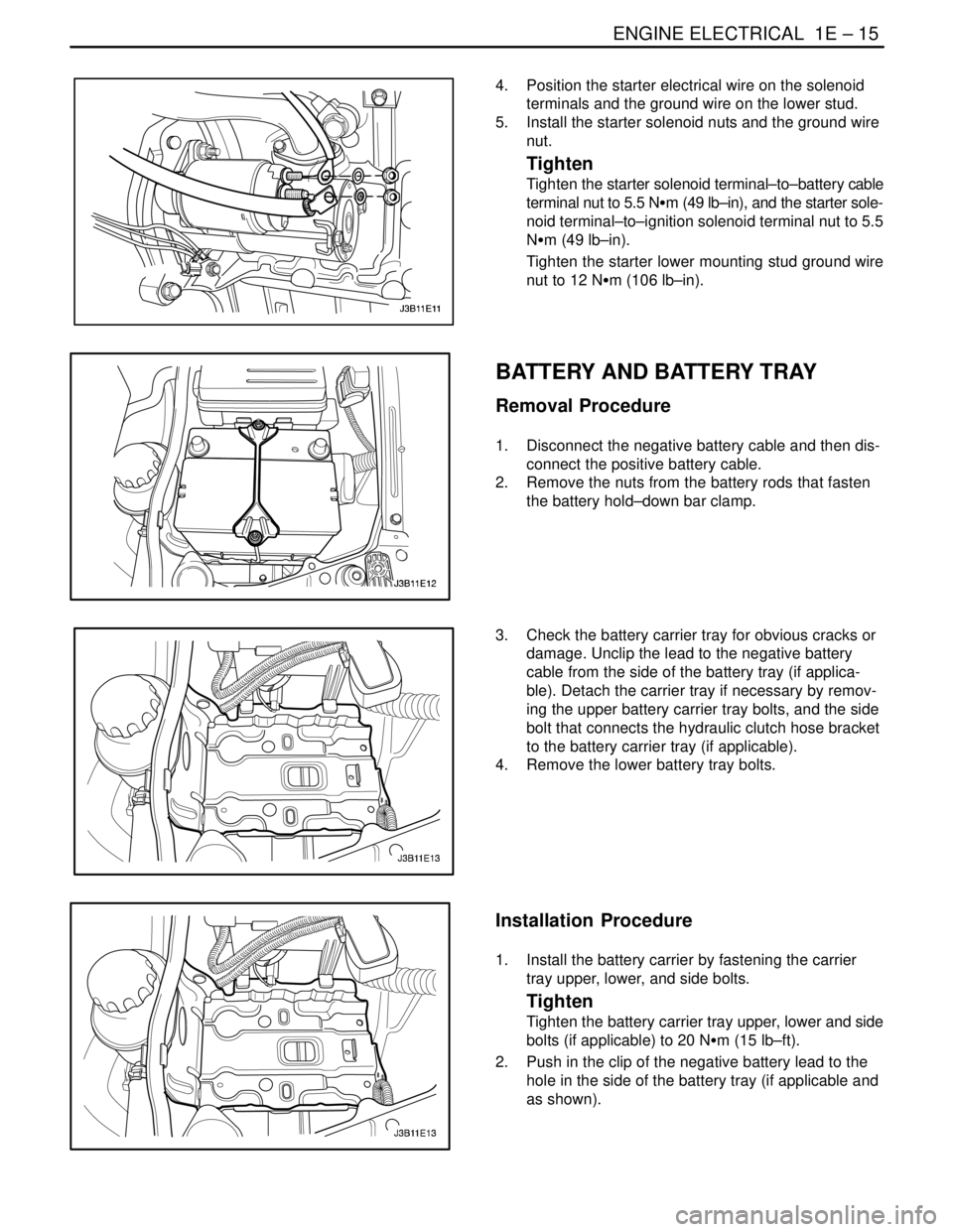
4. Position the starter electrical wire on the solenoid
terminals and the ground wire on the lower stud.
5. Install the starter solenoid nuts and the ground wire
nut.
Tighten
Tighten the starter solenoid terminal–to–battery cable
terminal nut to 5.5 NSm (49 lb–in), and the starter sole-
noid terminal–to–ignition solenoid terminal nut to 5.5
NSm (49 lb–in).
Tighten the starter lower mounting stud ground wire
nut to 12 NSm (106 lb–in).
BATTERY AND BATTERY TRAY
Removal Procedure
1. Disconnect the negative battery cable and then dis-
connect the positive battery cable.
2. Remove the nuts from the battery rods that fasten
the battery hold–down bar clamp.
3. Check the battery carrier tray for obvious cracks or
damage. Unclip the lead to the negative battery
cable from the side of the battery tray (if applica-
ble). Detach the carrier tray if necessary by remov-
ing the upper battery carrier tray bolts, and the side
bolt that connects the hydraulic clutch hose bracket
to the battery carrier tray (if applicable).
4. Remove the lower battery tray bolts.
Installation Procedure
1. Install the battery carrier by fastening the carrier
tray upper, lower, and side bolts.
Tighten
Tighten the battery carrier tray upper, lower and side
bolts (if applicable) to 20 NSm (15 lb–ft).
2. Push in the clip of the negative battery lead to the
hole in the side of the battery tray (if applicable and
as shown).
Page 231 of 2643
ENGINE ELECTRICAL 1E – 17
DAEWOO V–121 BL4
UNIT REPAIR
STARTER MOTOR
Disassembly Procedure
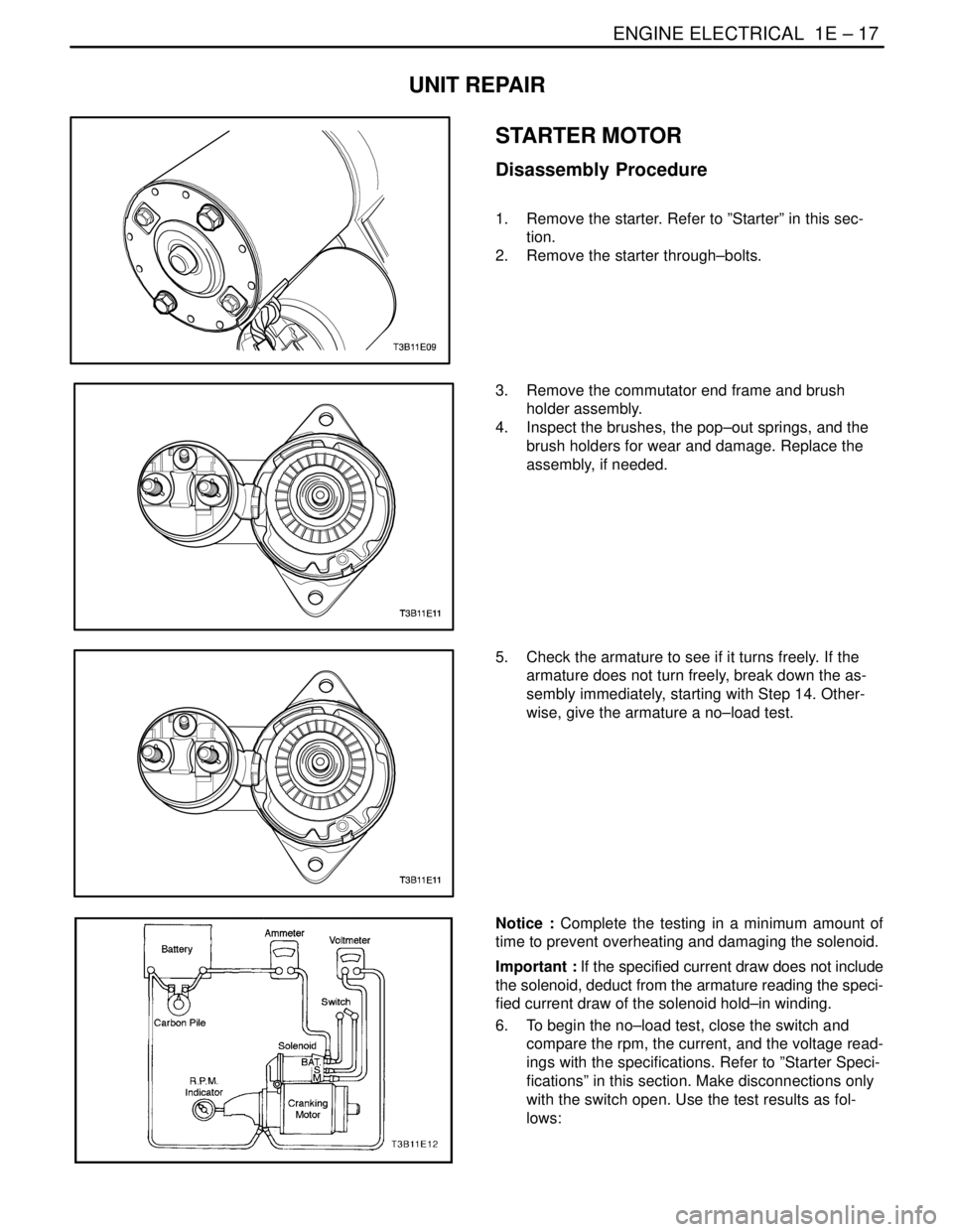
1. Remove the starter. Refer to ”Starter” in this sec-
tion.
2. Remove the starter through–bolts.
3. Remove the commutator end frame and brush
holder assembly.
4. Inspect the brushes, the pop–out springs, and the
brush holders for wear and damage. Replace the
assembly, if needed.
5. Check the armature to see if it turns freely. If the
armature does not turn freely, break down the as-
sembly immediately, starting with Step 14. Other-
wise, give the armature a no–load test.
Notice : Complete the testing in a minimum amount of
time to prevent overheating and damaging the solenoid.
Important : If the specified current draw does not include
the solenoid, deduct from the armature reading the speci-
fied current draw of the solenoid hold–in winding.
6. To begin the no–load test, close the switch and
compare the rpm, the current, and the voltage read-
ings with the specifications. Refer to ”Starter Speci-
fications” in this section. Make disconnections only
with the switch open. Use the test results as fol-
lows: