weight DAEWOO LACETTI 2004 Service User Guide
[x] Cancel search | Manufacturer: DAEWOO, Model Year: 2004, Model line: LACETTI, Model: DAEWOO LACETTI 2004Pages: 2643, PDF Size: 80.54 MB
Page 903 of 2643

2A – 2ISUSPENSION DIAGNOSIS
DAEWOO V–121 BL4
Abnormal or Excessive Tire Wear
ChecksAction
Check the front–wheel and the rear–wheel alignment.Align the front and the rear wheels.
Inspect for excessive toe on the front and the rear wheels.Adjust the toe on the front and the rear wheels.
Inspect for a broken or a sagging spring.Replace the spring.
Inspect for out–of–balance tires.Balance the tires.
Inspect for worn strut dampeners.Replace the strut dampeners.
Check for a failure to rotate tires.Rotate the tires. Replace the tires as needed.
Check for an overloaded vehicle.Maintain the proper load weight.
Inspect for low tire inflation.Inflate the tires to the proper pressure.
Scuffed Tires
ChecksAction
Inspect for incorrect toe on the front and the rear wheels.Adjust the toe on the front and the rear wheels.
Inspect for a twisted or a bent suspension arm.Replace the suspension arm.
Wheel Tramp
ChecksAction
Inspect for an out–of–balance tire or wheel.Balance the tire or the wheel.
Inspect for improper strut dampener action.Replace the strut dampeners.
Shimmy, Shake, or Vibration
ChecksAction
Inspect for an out–of–balance tire or wheel.Balance the tire or the wheel.
Inspect for excessive wheel hub runout.Measure the hub flange runout. Replace the hub as need-
ed.
Inspect for excessive brake drum or brake rotor imbal-
ance.Adjust the brakes. Replace the brake rotor or the brake
drum as needed.
Inspect for worn tie rod ends.Replace the outer tie rods.
Inspect for wheel trim imbalance.Balance the wheel.
Inspect for a worn lower ball joint.Replace the lower ball joint.
Inspect for excessive wheel runout.Measure the wheel runout. Replace the wheel as needed.
Inspect for excessive loaded radial runout on the tire and
wheel assembly.Match–mount the tire and wheel assembly.
Hard Steering
ChecksAction
Check the steering gear preload adjustment.Perform a rack bearing preload adjustment.
Check the hydraulic system. Test the power steering sys-
tem pressure with a gauge.Replace the seals and the hoses as needed.
Inspect for binding or catching in the steering gear.Lubricate the steering gear. Repair or replace the steering
gear as needed.
Inspect for a loose steering gear mounting.Tighten the steering gear mounting bracket nuts.
Page 905 of 2643

2A – 4ISUSPENSION DIAGNOSIS
DAEWOO V–121 BL4
Checks Action
Check the steering gear preload adjustment.Perform a rack bearing preload adjustment.
Check the front–wheel and the rear–wheel alignment.Align the front and the rear wheels.
Erratic Steering when Braking
ChecksAction
Inspect for worn or loose wheel bearings.Replace the wheel bearings.
Inspect for a broken or a sagging spring.Replace the spring.
Inspect for a leaking wheel cylinder or caliper.Replace the wheel cylinder or the caliper.
Inspect for warped rotors.Replace the rotors.
Inspect for an incorrect or an uneven caster.If the caster is beyond specifications, check the frame and
repair it as needed.
Low or Uneven Trim Height
ChecksAction
Inspect for a broken or a sagging spring.Replace the spring.
Check for an overloaded vehicle.Maintain the proper load weight.
Inspect for an incorrect or weak spring.Replace the spring.
Ride Too Soft
ChecksAction
Inspect for worn strut dampeners.Replace the strut dampeners.
Inspect for a broken or a sagging spring.Replace the spring.
Ride Too Harsh
ChecksAction
Inspect for incorrect strut dampeners.Replace the strut dampeners.
Inspect for an incorrect spring.Replace the spring.
Body Leans or Sways in Corners
ChecksAction
Inspect for a loose stabilizer shaft link.Tighten the stabilizer shaft link.
Inspect for worn strut dampeners or strut mountings.Replace the strut dampeners. Tighten the strut assembly
mounting bolts.
Check for an overloaded vehicle.Maintain the proper load weight.
Inspect for a broken or a sagging spring.Replace the spring.
Suspension Bottoms
ChecksAction
Inspect for worn strut dampeners.Replace the strut dampeners.
Check for an overloaded vehicle.Maintain the proper load weight.
Inspect for a broken or a sagging spring.Replace the spring.
Page 962 of 2643

2D – 20IREAR SUSPENSION
DAEWOO V–121 BL4
GENERAL DESCRIPTION
AND SYSTEM OPERATION
REAR SUSPENSION
The rear suspension is fully independent and consists of
a crossmember with four parallel links, two trailing links,
two strut assemblies with coil springs and insulators, and
two knuckles containing the hub and bearing assemblies.
The strut assemblies support the weight of the vehicle us-
ing coil springs positioned around the strut dampeners.The coil springs are seated on insulators attached to the
upper mount and the lower spring seat of the strut assem-
bly. The parallel links and the trailing link bracket have rub-
ber isolator bushings at each end and are attached to the
crossmember and the knuckle. The rear parallel link is at-
tached to the crossmember through adjustment cams that
are used to adjust rear toe. The trailing links are attached
to the body, through the trailing link bracket, and the bot-
tom of the knuckle. A forged knuckle bolts to each strut as-
sembly. Lateral movement of the knuckle is controlled by
the parallel links. Fore and aft movement of the knuckle is
controlled by the trailing link.
Page 965 of 2643

TIRES AND WHEELS 2E – 3
DAEWOO V–121 BL4
MAINTENANCE AND REPAIR
ON–VEHICLE SERVICE
WHEEL
Removal Procedure
1. Loosen the wheel bolts.
2. Raise and suitably support the vehicle.
3. Remove the wheel bolts.
Notice : Never use heat to loosen a tight wheel. It can
shorten the life of the wheel, the wheel nuts and the wheel
bearings. Excessive force, such as hammering the wheel
or tire, can also cause damage and is not recommended.
Slight tapping of the wheel sidewall with one’s hand or with
a rubber mallet is acceptable.
4. Remove the wheel.
Difficulty in removing the wheels from the vehicle can be
due to foreign material or to a tight fit between the wheel
centerhole and the hub or the rotor. These wheels can be
removed by
5. Retightening the wheel bolts on the affected wheel
and then loosening the wheel bolts by two turns.
6. Lowering the vehicle and rocking it from side to side
as hard as possible, using one or more person’s
body weight to loosen the wheel.
7. Raising the vehicle and removing the wheel.
CAUTION : Do not allow the penetrating oil to get on
the vertical surfaces between the wheel and the drum
(or rotor) because penetrating oil in this area could
cause the wheel to work loose as the vehicle is driven,
resulting in loss of control and an injury accident.
Penetrating oil is not effective in removing tight wheels. If
it is used, however, apply it sparingly and only to the
wheel’s centerhole area.
Installation Procedure
Notice : Before installing the wheels, remove any buildup
of corrosion on the wheel mounting surface and the brake
drum or the rotor mounting surface by scraping and brush-
ing them with a wire brush. Installing the wheels without
good metal–to–metal contact at the mounting surfaces
can cause the wheel nuts to loosen, which can later allow
a wheel to come off while the vehicle is moving. Wheel
bolts must be tightened in sequence and to the proper
torque to avoid bending the wheel, the brake drum or the
rotor.
1. Mount the wheel.
2. Install the wheel bolts in the sequence shown. Do
not tighten the wheel bolts.
3. Lower the vehicle.
Tighten
Tighten the wheel bolts to 100 NSm (74 lb–ft).
Page 966 of 2643
2E – 4ITIRES AND WHEELS
DAEWOO V–121 BL4
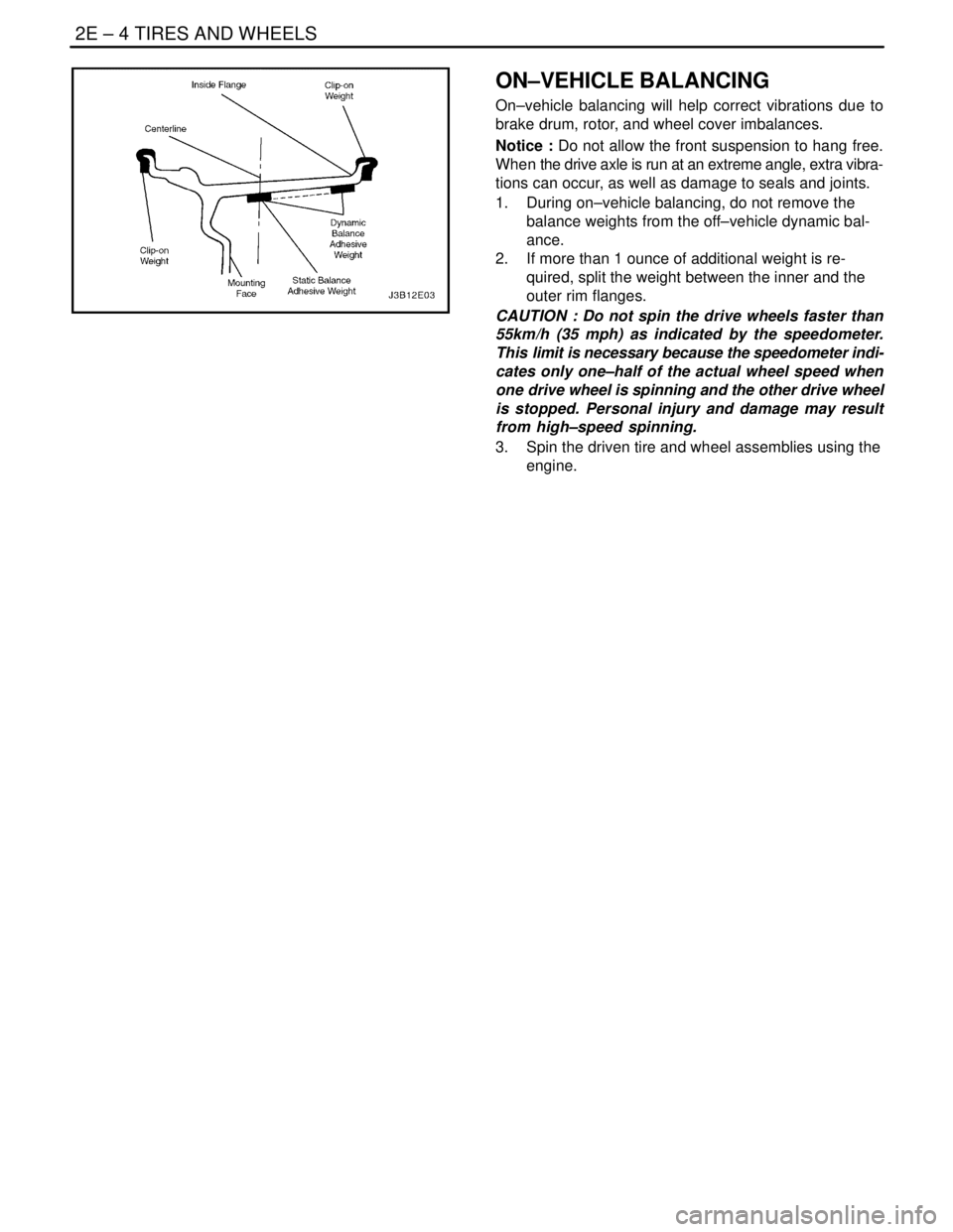
ON–VEHICLE BALANCING
On–vehicle balancing will help correct vibrations due to
brake drum, rotor, and wheel cover imbalances.
Notice : Do not allow the front suspension to hang free.
When the drive axle is run at an extreme angle, extra vibra-
tions can occur, as well as damage to seals and joints.
1. During on–vehicle balancing, do not remove the
balance weights from the off–vehicle dynamic bal-
ance.
2. If more than 1 ounce of additional weight is re-
quired, split the weight between the inner and the
outer rim flanges.
CAUTION : Do not spin the drive wheels faster than
55km/h (35 mph) as indicated by the speedometer.
This limit is necessary because the speedometer indi-
cates only one–half of the actual wheel speed when
one drive wheel is spinning and the other drive wheel
is stopped. Personal injury and damage may result
from high–speed spinning.
3. Spin the driven tire and wheel assemblies using the
engine.
Page 968 of 2643

2E – 6ITIRES AND WHEELS
DAEWOO V–121 BL4
S Amchem Alodine No. 1001. Stock No. DX50T or
equivalent coating chemical for alloys.
S Ditzler Delclear Acrylic Urethane Clear, Stock No.
DAU–75 or equivalent.
S Ditzler Delthane Ultra–Urethane Additive, Stock No.
DXR–80 or equivalent.
Before repairing the alloy damage or the clear coat dam-
age, prepare the wheels and the tires.
1. Remove the wheel from the vehicle.
2. Mark the location of the outboard weights and re-
move them.
3. Wash the wheel inside and out with a water–based,
all–purpose cleaner. Remove the grease and oil
with a solvent cleaner.
4. Mask the tire prior to painting.
5. Using a 400–grit wet or dry sandpaper, sand over
the painted areas that will not require recoloring.
Sanding will promote the adhesion of the clear coat.
Alloy Damage on Wheel Surface
1. Mount the wheel on a brake lathe and spin the as-
sembly slowly.
2. Sand the wheel with a backing block or pad. Hold
the backing block or pad flat to the surface of the
wheel and sand slowly back and forth from the cen-
ter to the outer edge of the tire to remove the dam-
age. Use the following sandpaper grits in the order
listed:
1) 80 grit.
2) 150 grit.
3) 240 grit.
Clear Coat Damage on Unpainted Wheels
1. Apply the chemical stripper Amchem Alumi Prep
No. 33. Use a small 1/4–inch detail brush to apply
the stripper around the perimeter and spoke–like
areas.
2. Remove the stripper according to the manufactur-
er’s recommendations.
CAUTION : To avoid serious personal injury, do not
use engine power to rotate the wheel while sanding.
3. Sand the wheel with 240–grit sandpaper by rotating
the wheel on a slow–spinning brake lathe or by
mounting the wheel on the car and spinning it by
hand. Sanding restores the machined appearance
and promotes adhesion.
After repairing the alloy or clear coat damage, the wheels
must be recoated.
Page 971 of 2643
TIRES AND WHEELS 2E – 9
DAEWOO V–121 BL4
GENERAL DESCRIPTION
AND SYSTEM OPERATION
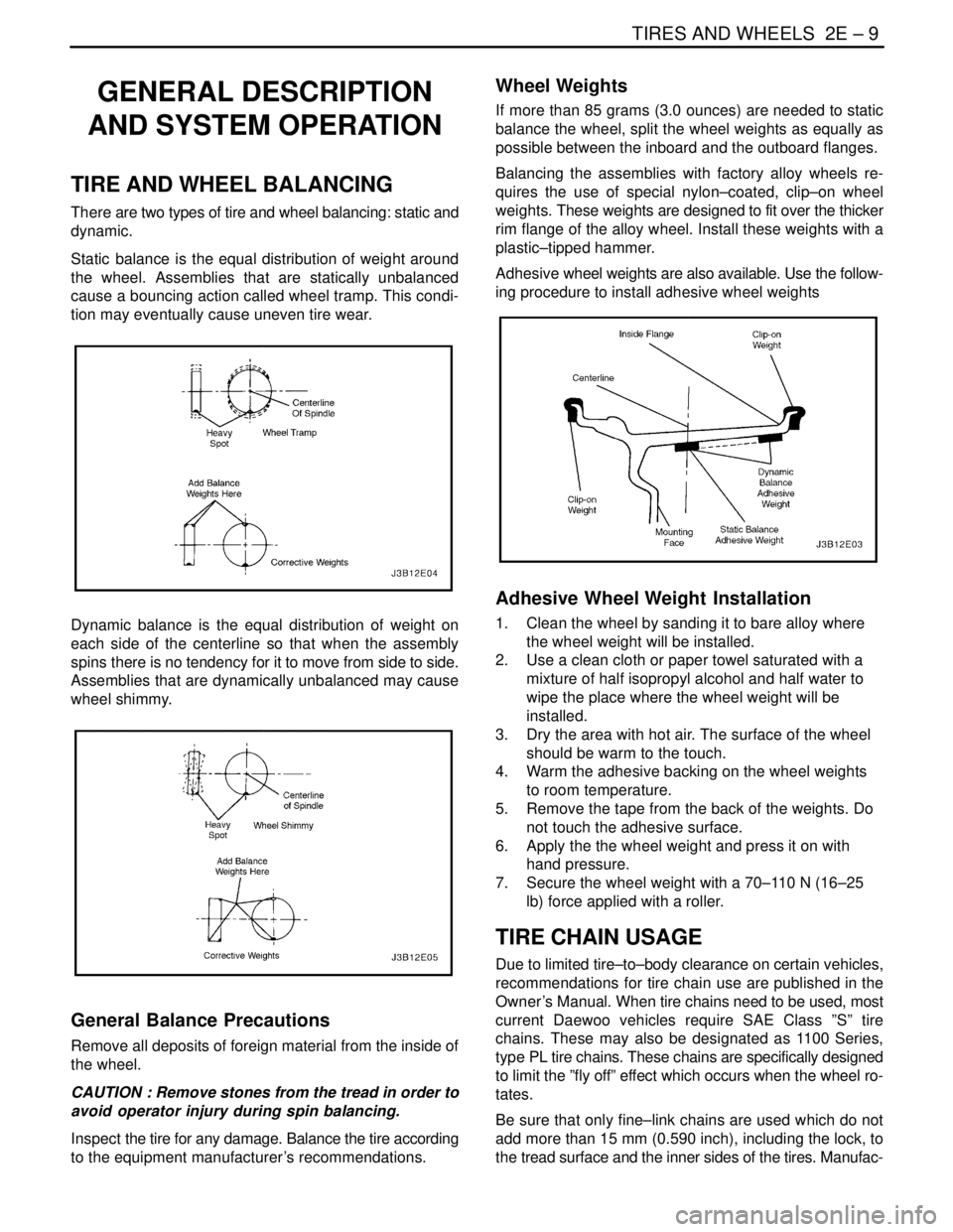
TIRE AND WHEEL BALANCING
There are two types of tire and wheel balancing: static and
dynamic.
Static balance is the equal distribution of weight around
the wheel. Assemblies that are statically unbalanced
cause a bouncing action called wheel tramp. This condi-
tion may eventually cause uneven tire wear.
Dynamic balance is the equal distribution of weight on
each side of the centerline so that when the assembly
spins there is no tendency for it to move from side to side.
Assemblies that are dynamically unbalanced may cause
wheel shimmy.
General Balance Precautions
Remove all deposits of foreign material from the inside of
the wheel.
CAUTION : Remove stones from the tread in order to
avoid operator injury during spin balancing.
Inspect the tire for any damage. Balance the tire according
to the equipment manufacturer’s recommendations.
Wheel Weights
If more than 85 grams (3.0 ounces) are needed to static
balance the wheel, split the wheel weights as equally as
possible between the inboard and the outboard flanges.
Balancing the assemblies with factory alloy wheels re-
quires the use of special nylon–coated, clip–on wheel
weights. These weights are designed to fit over the thicker
rim flange of the alloy wheel. Install these weights with a
plastic–tipped hammer.
Adhesive wheel weights are also available. Use the follow-
ing procedure to install adhesive wheel weights
Adhesive Wheel Weight Installation
1. Clean the wheel by sanding it to bare alloy where
the wheel weight will be installed.
2. Use a clean cloth or paper towel saturated with a
mixture of half isopropyl alcohol and half water to
wipe the place where the wheel weight will be
installed.
3. Dry the area with hot air. The surface of the wheel
should be warm to the touch.
4. Warm the adhesive backing on the wheel weights
to room temperature.
5. Remove the tape from the back of the weights. Do
not touch the adhesive surface.
6. Apply the the wheel weight and press it on with
hand pressure.
7. Secure the wheel weight with a 70–110 N (16–25
lb) force applied with a roller.
TIRE CHAIN USAGE
Due to limited tire–to–body clearance on certain vehicles,
recommendations for tire chain use are published in the
Owner ’s Manual. When tire chains need to be used, most
current Daewoo vehicles require SAE Class ”S” tire
chains. These may also be designated as 1100 Series,
type PL tire chains. These chains are specifically designed
to limit the ”fly off” effect which occurs when the wheel ro-
tates.
Be sure that only fine–link chains are used which do not
add more than 15 mm (0.590 inch), including the lock, to
the tread surface and the inner sides of the tires. Manufac-
Page 1021 of 2643

HYDRAULIC BRAKES 4A – 5
DAEWOO V–121 BL4
DIAGNOSIS
BRAKE SYSTEM TESTING
Brakes should be tested on a dry, clean, reasonably
smooth and level roadway. A true test of brake perfor-
mance cannot be made if the roadway is wet, greasy, or
covered with loose dirt whereby all tires do not grip the
road equally. Testing will also be adversely affected if the
roadway is crowned so as to throw the weight so roughly
that the wheels tend to bounce.
Test the brakes at different vehicle speeds with both light
and heavy pedal pressure; however, avoid locking the
brakes and sliding the tires. Locked brakes and sliding
tires do not indicate brake efficiency since heavily braked,
but turning, wheels will stop the vehicle in less distance
than locked brakes. More tire–to–road friction is present
with a heavily–braked, turning tire than with a sliding tire.
Because of the high deceleration capability, a firmer pedal
may be felt at higher deceleration levels.
There are three major external conditions that affect brake
performance:
S Tires having unequal contact and grip of the road
will cause unequal braking. Tires must be equally
inflated, and the tread pattern of the right and the
left tires must be approximately equal.
S Unequal loading of the vehicle can affect the brake
performance since the most heavily loaded wheels
require more braking power, and thus more braking
effort, than the others.
S Misalignment of the wheels, particularly conditions
of excessive camber and caster, will cause the
brakes to pull to one side.
To check for brake fluid leaks, hold constant foot pressure
on the pedal with the engine running at idle and the shift
lever in NEUTRAL. If the pedal gradually falls away with
the constant pressure, the hydraulic system may be leak-
ing. Perform a visual check to confirm any suspected
leaks.
Check the master cylinder fluid level. While a slight drop
in the reservoir level results from normal lining wear, an ab-
normally low level indicates a leak in the system. The hy-
draulic system may be leaking either internally or external-
ly. Refer to the procedure below to check the master
cylinder. Also, the system may appear to pass this test
while still having a slight leak. If the fluid level is normal,
check the vacuum booster pushrod length. If an incorrect
pushrod length is found, adjust or replace the rod.
Check the master cylinder using the following procedure:
S Check for a cracked master cylinder casting or
brake fluid leaking around the master cylinder.
Leaks are indicated only if there is at least one drop
of fluid. A damp condition is not abnormal.S Check for a binding pedal linkage and for an incor-
rect pushrod length. If both of these parts are in
satisfactory condition, disassemble the master cyl-
inder and check for an elongated or swollen primary
cylinder or piston seals. If swollen seals are found,
substandard or contaminated brake fluid should be
suspected. If contaminated brake fluid is found, all
the components should be disassembled and
cleaned, and all the rubber components should be
replaced. All of the pipes must also be flushed.
Improper brake fluid, or mineral oil or water in the fluid,
may cause the brake fluid to boil or cause deterioration of
the rubber components. If the primary piston cups in the
master cylinder are swollen, then the rubber parts have
deteriorated. This deterioration may also be evidenced by
swollen wheel cylinder piston seals on the drum brake
wheels.
If deterioration of rubber is evident, disassemble all the hy-
draulic parts and wash the parts with alcohol. Dry these
parts with compressed air before reassembly to keep alco-
hol out of the system. Replace all the rubber parts in the
system, including the hoses. Also, when working on the
brake mechanisms, check for fluid on the linings. If exces-
sive fluid is found, replace the linings.
If the master cylinder piston seals are in satisfactory condi-
tion, check for leaks or excessive heat conditions. If these
conditions are not found, drain the fluid, flush the master
cylinder with brake fluid, refill the master cylinder, and
bleed the system. Refer to ”Manual Bleeding the Brakes”
or”Pressure Bleeding the Brakes” in this section.
BRAKE HOSE INSPECTION
The hydraulic brake hoses should be inspected at least
twice a year. The brake hose assembly should be checked
for road hazard damage, cracks, chafing of the outer cov-
er, and for leaks or blisters. Inspect the hoses for proper
routing and mounting. A brake hose that rubs on a suspen-
sion component will wear and eventually fail. A light and
a mirror may be needed for an adequate inspection. If any
of the above conditions are observed on the brake hose,
adjust or replace the hose as necessary.
WARNING LAMP OPERATION
This brake system uses a BRAKE warning lamp located
in the instrument panel cluster. When the ignition switch
is in the START position, the BRAKE warning lamp should
glow and go OFF when the ignition switch returns to the
RUN position.
The following conditions will activate the BRAKE lamp:
S Parking brake applied. The light should be ON
whenever the parking brake is applied and the igni-
tion switch is ON.
S Low fluid level. A low fluid level in the master cylin-
der will turn the BRAKE lamp ON.
S EBD system is disabled. The light should be ON
when the EBD system is malfunctioning.
Page 1352 of 2643

ZF 4 HP 16 AUTOMATIC TRANSAXLE 5A1 – 3
DAEWOO V–121 BL4
Important Measurement/Adjustment 5A1–230. . . . . . .
GENERAL DESCRIPTION AND SYSTEM
OPERATION5A1–232 . . . . . . . . . . . . . . . . . . . . . . . . . . . Mechanical Components 5A1–232. . . . . . . . . . . . . . . . .
Electronical Components 5A1–236. . . . . . . . . . . . . . . .
TCM Inputs That Affect the 4HP 16
Transaxle 5A1–241. . . . . . . . . . . . . . . . . . . . . . . . . . .
INTRODUCTION
ZF 4HP 16 AUTOMATIC TRANSAXLE
The ZF 4 HP 16 is a four–speed automatic transaxle de-
signed for cars with front–wheel drive and a transversely
mounted engine.
The transaxle has a hydrodynamic torque converter with
a controlled slip lock–up clutch.
A planetary gear train establishes the mechanical gear ra-
tios. The integral constant ratio can be adapted to the en-
gine’s power output and the vehicle’s weight. The elec-
tronic–hydraulic control makes controlled power shifts and
various shift programs possible. In selector lever position
”P”, the output is locked mechanically.The special feature of this transaxle is that it operates with-
out freewheels. Shifting between individual gears takes
place by means of overlapping clutch engagement and re-
lease.
The advantage of overlap shifting is as follows:
– The transaxle can be of more compact design
and is lighter on account of the absence of free-
wheels and the lower number of shift elements
– Lower drag losses, i.e. higher efficiency
– Lower peak torques acting on the components
and driveline.
However, overlap shifting necessitates high–performance
hardware and software, and precision engine signals.
Page 1354 of 2643

ZF 4 HP 16 AUTOMATIC TRANSAXLE 5A1 – 5
DAEWOO V–121 BL4
SPECIFICATIONS
GENERAL SPECIFICATIONS
Definition
Transaxle Type4–speed with four–wheel drive and transverse engine
Input Torque240 NSm (177 lb–ft)
Transaxle Weight76kg (168 lb)
Torque Converter Capacity9.72kg (21.4 lb)
Transaxle Fluid Type (manufacture company)ESSO LT 71141 or TOTAL ATF H50235
Transaxle Fluid Capacity7.3qt (6.9L)
TRANSAXLE GEAR RATIO
GearRatio
First2.719
Second1.487
Third1.000
Fourth0.717
Reverse 2.529
Final3.945:1
FLUID CAPACITY
LitresQuarts
Bottom Pan Removal44.2
Complete Overhaul6.97.3
Torque Converter Removal22.1
(Measurements are approximate)
FASTENER TIGHTENING SPECIFICATIONS
ApplicationNSmLb–FtLb–In
Bearing Plate Bolts23.517.5–
Slotted Nut220162–
Rear Cover Attachment Bolts23.517.5–
Baffle Plate Attachment Bolts10–89
Park/Neutral Position Switch10–89
Fluid Pump Connecting Bolts10–89
Fluid Filter Housing Cover Attachment Bolts10–89
Input Speed sensor Attachment Bolts8–71
Output Speed Sensor Attachment Bolts8–71
Valve Body Bolts8–71
Valve Body Upper & Lower Fixing Bolts6–53
Fluid Pan Connecting Bolts6–53
Fluid Pan Drain Plug4533–