Rod DAEWOO LACETTI 2004 Service Repair Manual
[x] Cancel search | Manufacturer: DAEWOO, Model Year: 2004, Model line: LACETTI, Model: DAEWOO LACETTI 2004Pages: 2643, PDF Size: 80.54 MB
Page 2006 of 2643
7B – 4IMANUAL CONTROL HEATING, VENTILATION AND AIR CONDITIONING SYSTEM
DAEWOO V–121 BL4
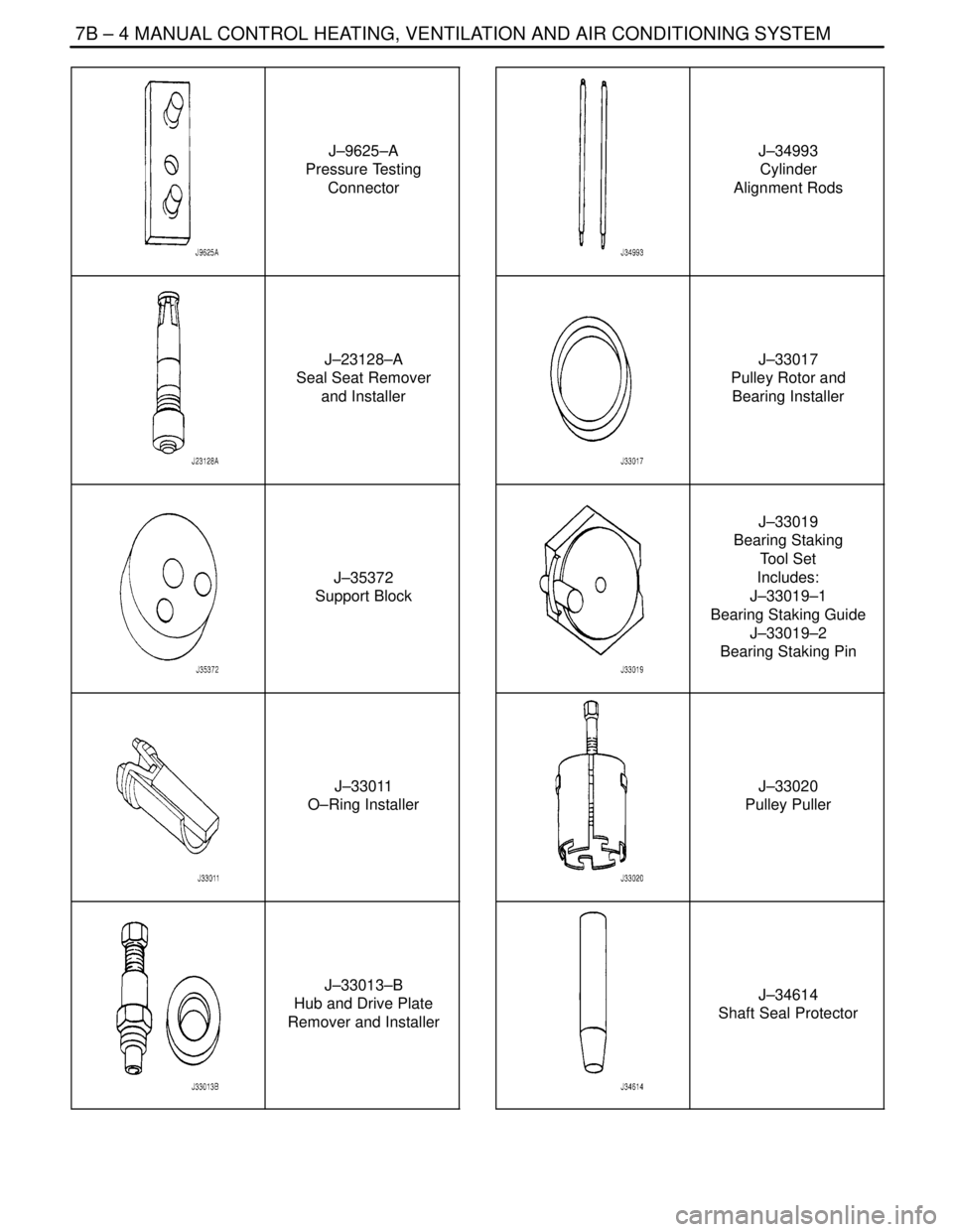
J–9625–A
Pressure Testing
Connector
J–23128–A
Seal Seat Remover
and Installer
J–35372
Support Block
J–33011
O–Ring Installer
J–33013–B
Hub and Drive Plate
Remover and Installer
J–34993
Cylinder
Alignment Rods
J–33017
Pulley Rotor and
Bearing Installer
J–33019
Bearing Staking
Tool Set
Includes:
J–33019–1
Bearing Staking Guide
J–33019–2
Bearing Staking Pin
J–33020
Pulley Puller
J–34614
Shaft Seal Protector
Page 2049 of 2643
MANUAL CONTROL HEATING, VENTILATION AND AIR CONDITIONING SYSTEM 7B – 47
DAEWOO V–121 BL4
REAR HEAD, GASKET, VALVE
PLATE, REED PLATE, AND O–RING
Tools Required
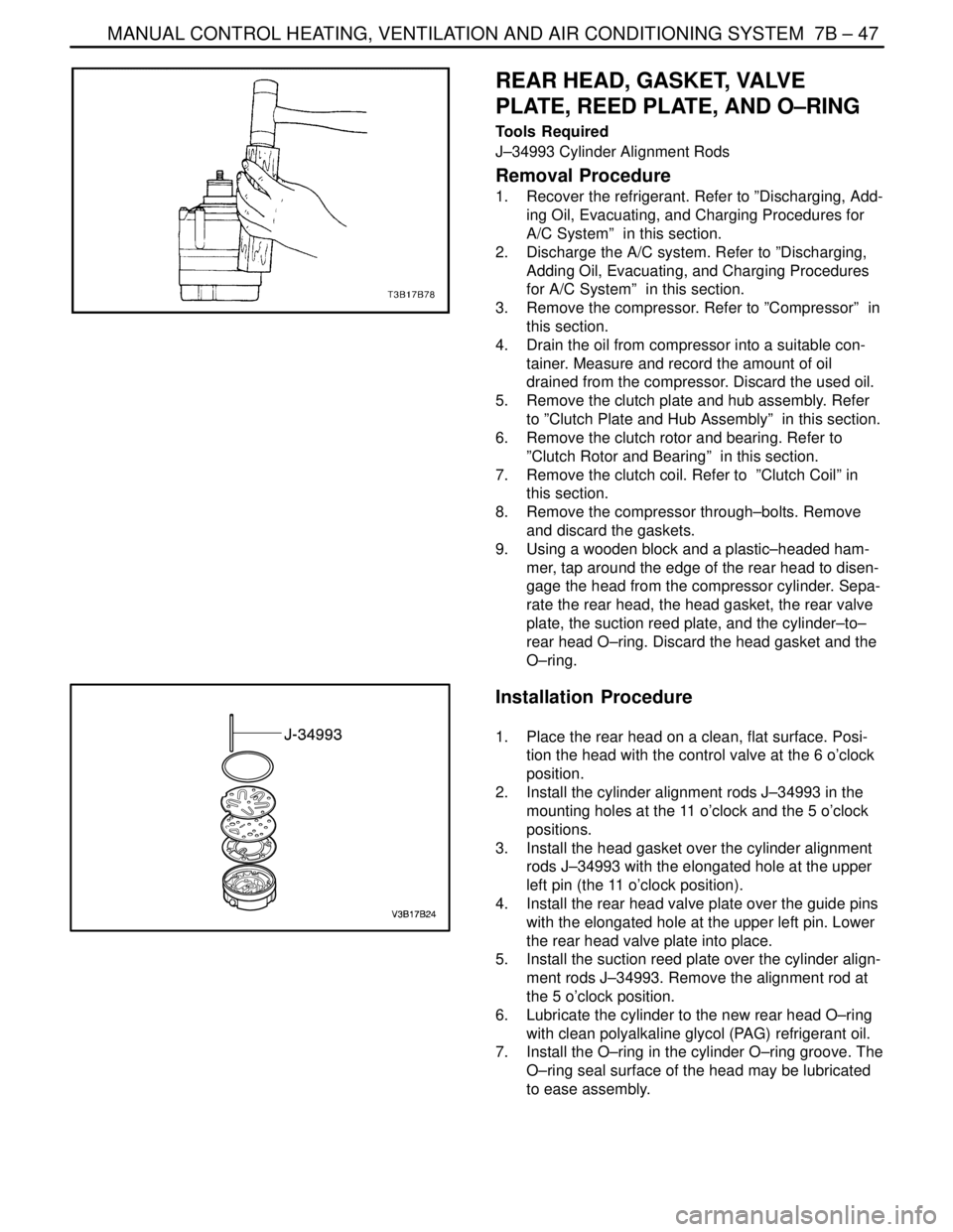
J–34993 Cylinder Alignment Rods
Removal Procedure
1. Recover the refrigerant. Refer to ”Discharging, Add-
ing Oil, Evacuating, and Charging Procedures for
A/C System” in this section.
2. Discharge the A/C system. Refer to ”Discharging,
Adding Oil, Evacuating, and Charging Procedures
for A/C System” in this section.
3. Remove the compressor. Refer to ”Compressor” in
this section.
4. Drain the oil from compressor into a suitable con-
tainer. Measure and record the amount of oil
drained from the compressor. Discard the used oil.
5. Remove the clutch plate and hub assembly. Refer
to ”Clutch Plate and Hub Assembly” in this section.
6. Remove the clutch rotor and bearing. Refer to
”Clutch Rotor and Bearing” in this section.
7. Remove the clutch coil. Refer to ”Clutch Coil” in
this section.
8. Remove the compressor through–bolts. Remove
and discard the gaskets.
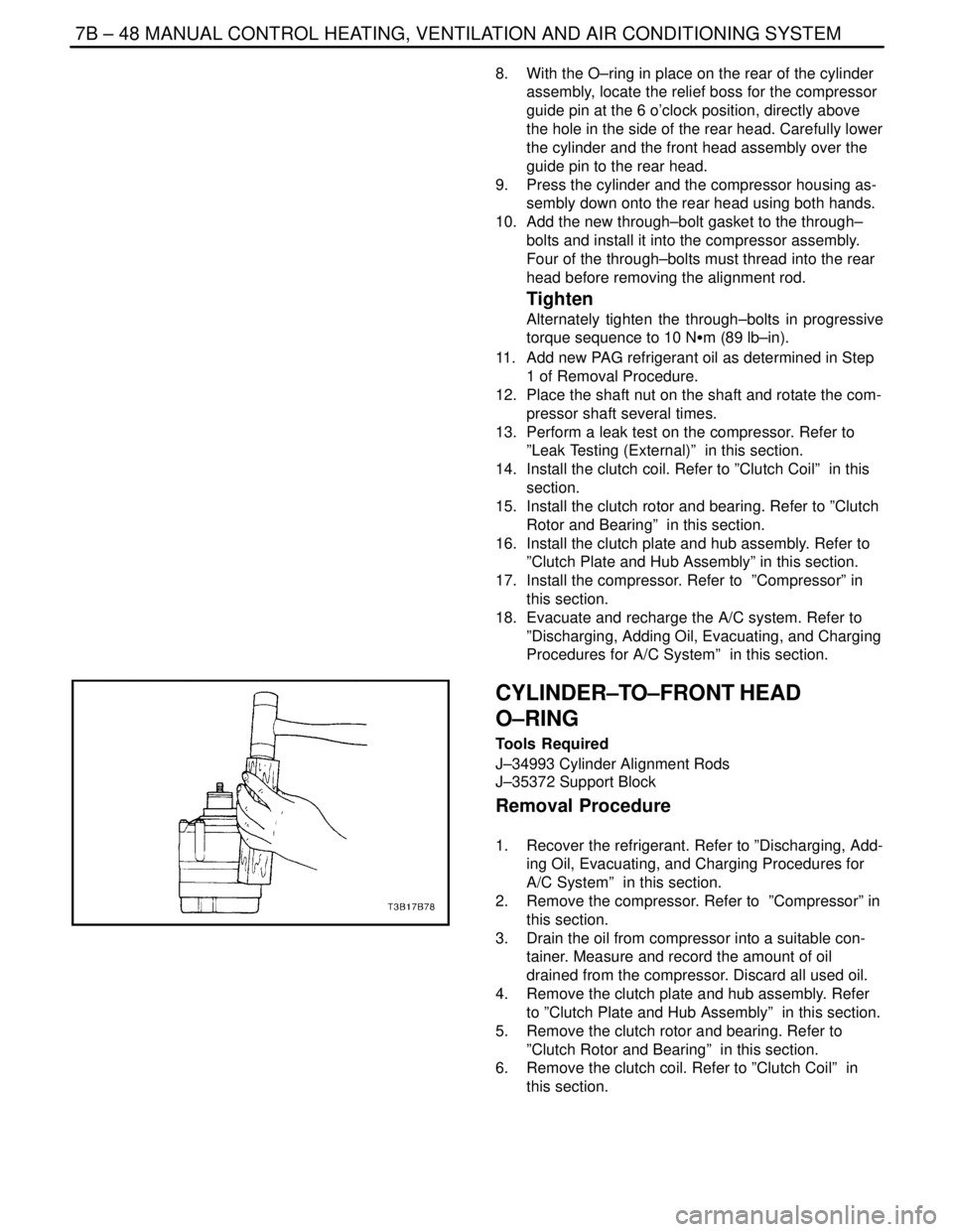
9. Using a wooden block and a plastic–headed ham-
mer, tap around the edge of the rear head to disen-
gage the head from the compressor cylinder. Sepa-
rate the rear head, the head gasket, the rear valve
plate, the suction reed plate, and the cylinder–to–
rear head O–ring. Discard the head gasket and the
O–ring.
Installation Procedure
1. Place the rear head on a clean, flat surface. Posi-
tion the head with the control valve at the 6 o’clock
position.
2. Install the cylinder alignment rods J–34993 in the
mounting holes at the 11 o’clock and the 5 o’clock
positions.
3. Install the head gasket over the cylinder alignment
rods J–34993 with the elongated hole at the upper
left pin (the 11 o’clock position).
4. Install the rear head valve plate over the guide pins
with the elongated hole at the upper left pin. Lower
the rear head valve plate into place.
5. Install the suction reed plate over the cylinder align-
ment rods J–34993. Remove the alignment rod at
the 5 o’clock position.
6. Lubricate the cylinder to the new rear head O–ring
with clean polyalkaline glycol (PAG) refrigerant oil.
7. Install the O–ring in the cylinder O–ring groove. The
O–ring seal surface of the head may be lubricated
to ease assembly.
Page 2050 of 2643
7B – 48IMANUAL CONTROL HEATING, VENTILATION AND AIR CONDITIONING SYSTEM
DAEWOO V–121 BL4
8. With the O–ring in place on the rear of the cylinder
assembly, locate the relief boss for the compressor
guide pin at the 6 o’clock position, directly above
the hole in the side of the rear head. Carefully lower
the cylinder and the front head assembly over the
guide pin to the rear head.
9. Press the cylinder and the compressor housing as-
sembly down onto the rear head using both hands.
10. Add the new through–bolt gasket to the through–
bolts and install it into the compressor assembly.
Four of the through–bolts must thread into the rear
head before removing the alignment rod.
Tighten
Alternately tighten the through–bolts in progressive
torque sequence to 10 NSm (89 lb–in).
11. Add new PAG refrigerant oil as determined in Step
1 of Removal Procedure.
12. Place the shaft nut on the shaft and rotate the com-
pressor shaft several times.
13. Perform a leak test on the compressor. Refer to
”Leak Testing (External)” in this section.
14. Install the clutch coil. Refer to ”Clutch Coil” in this
section.
15. Install the clutch rotor and bearing. Refer to ”Clutch
Rotor and Bearing” in this section.
16. Install the clutch plate and hub assembly. Refer to
”Clutch Plate and Hub Assembly” in this section.
17. Install the compressor. Refer to ”Compressor” in
this section.
18. Evacuate and recharge the A/C system. Refer to
”Discharging, Adding Oil, Evacuating, and Charging
Procedures for A/C System” in this section.
CYLINDER–TO–FRONT HEAD
O–RING
Tools Required
J–34993 Cylinder Alignment Rods
J–35372 Support Block
Removal Procedure
1. Recover the refrigerant. Refer to ”Discharging, Add-
ing Oil, Evacuating, and Charging Procedures for
A/C System” in this section.
2. Remove the compressor. Refer to ”Compressor” in
this section.
3. Drain the oil from compressor into a suitable con-
tainer. Measure and record the amount of oil
drained from the compressor. Discard all used oil.
4. Remove the clutch plate and hub assembly. Refer
to ”Clutch Plate and Hub Assembly” in this section.
5. Remove the clutch rotor and bearing. Refer to
”Clutch Rotor and Bearing” in this section.
6. Remove the clutch coil. Refer to ”Clutch Coil” in
this section.
Page 2051 of 2643
MANUAL CONTROL HEATING, VENTILATION AND AIR CONDITIONING SYSTEM 7B – 49
DAEWOO V–121 BL4
7. Remove and discard the shaft seal parts. Refer to
”Shaft Seal Replacement” in this section.
8. Remove the compressor through–bolts. Remove
and discard the gaskets.
9. Using a wooden block and a plastic–headed ham-
mer, tap the compressor housing at the mounting
locations to disengage the housing from the com-
pressor cylinder.
Important : Note the assembly sequence of the thrust
washer and bearing for ease of assembly.
10. Remove the thrust washer and the bearing.
11. Remove and discard the compressor housing–to–
cylinder O–ring.
Installation Procedure
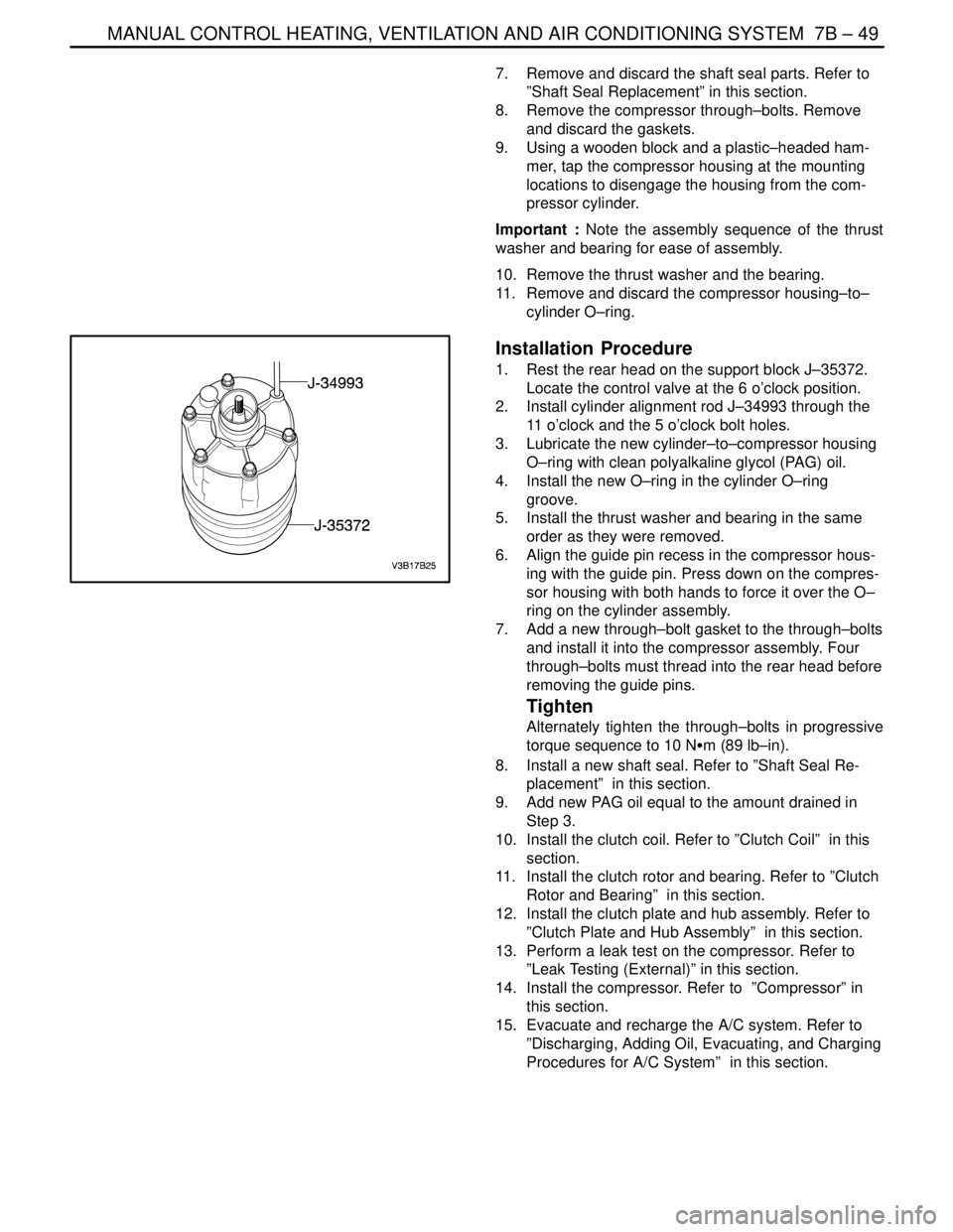
1. Rest the rear head on the support block J–35372.
Locate the control valve at the 6 o’clock position.
2. Install cylinder alignment rod J–34993 through the
11 o’clock and the 5 o’clock bolt holes.
3. Lubricate the new cylinder–to–compressor housing
O–ring with clean polyalkaline glycol (PAG) oil.
4. Install the new O–ring in the cylinder O–ring
groove.
5. Install the thrust washer and bearing in the same
order as they were removed.
6. Align the guide pin recess in the compressor hous-
ing with the guide pin. Press down on the compres-
sor housing with both hands to force it over the O–
ring on the cylinder assembly.
7. Add a new through–bolt gasket to the through–bolts
and install it into the compressor assembly. Four
through–bolts must thread into the rear head before
removing the guide pins.
Tighten
Alternately tighten the through–bolts in progressive
torque sequence to 10 NSm (89 lb–in).
8. Install a new shaft seal. Refer to ”Shaft Seal Re-
placement” in this section.
9. Add new PAG oil equal to the amount drained in
Step 3.
10. Install the clutch coil. Refer to ”Clutch Coil” in this
section.
11. Install the clutch rotor and bearing. Refer to ”Clutch
Rotor and Bearing” in this section.
12. Install the clutch plate and hub assembly. Refer to
”Clutch Plate and Hub Assembly” in this section.
13. Perform a leak test on the compressor. Refer to
”Leak Testing (External)” in this section.
14. Install the compressor. Refer to ”Compressor” in
this section.
15. Evacuate and recharge the A/C system. Refer to
”Discharging, Adding Oil, Evacuating, and Charging
Procedures for A/C System” in this section.
Page 2089 of 2643
7D – 34IAUTOMATIC TEMPERATURE CONTROL HEATING, VENTILATION, AND AIR CONDITIONING SYSTEM
DAEWOO V–121 BL4
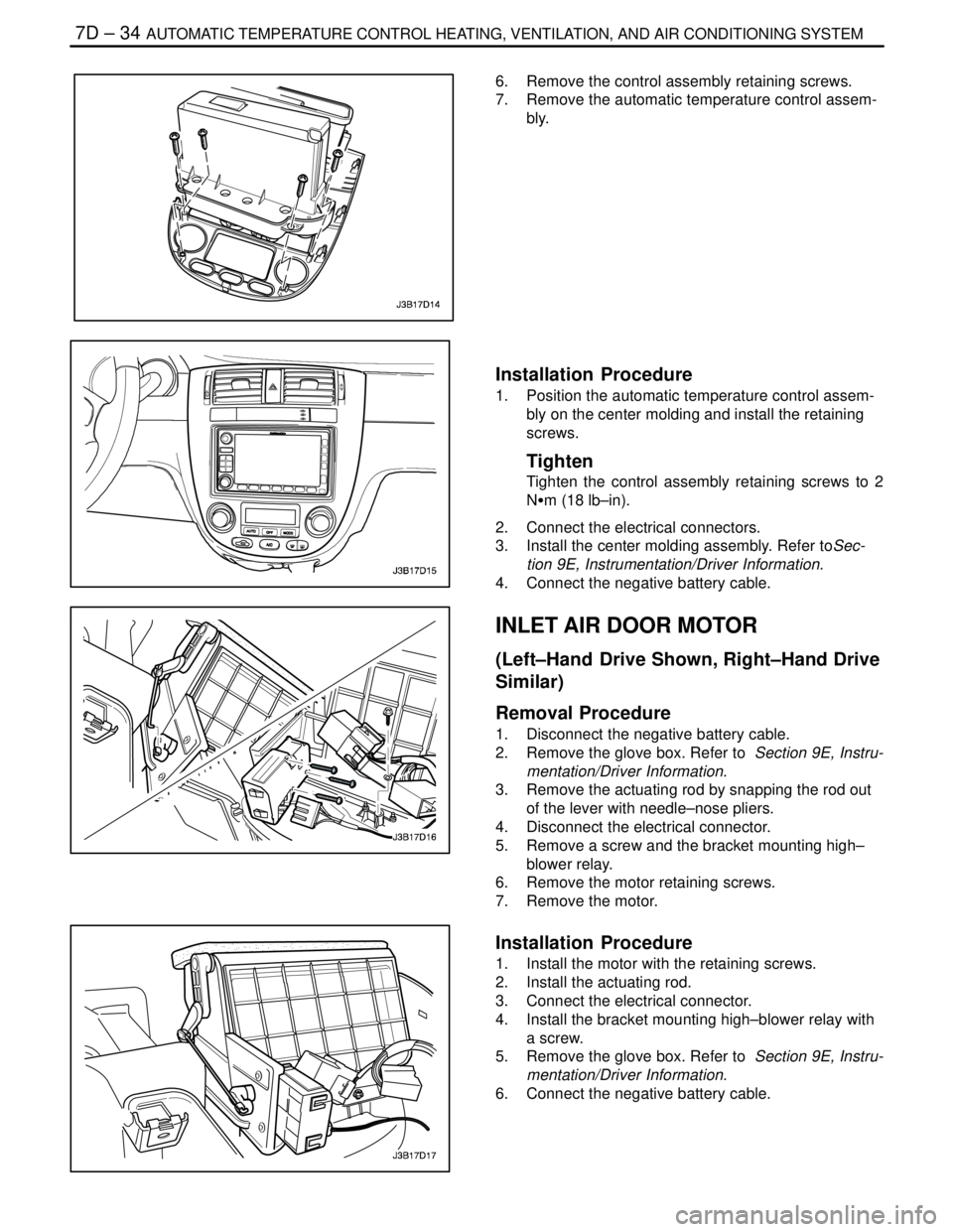
6. Remove the control assembly retaining screws.
7. Remove the automatic temperature control assem-
bly.
Installation Procedure
1. Position the automatic temperature control assem-
bly on the center molding and install the retaining
screws.
Tighten
Tighten the control assembly retaining screws to 2
NSm (18 lb–in).
2. Connect the electrical connectors.
3. Install the center molding assembly. Refer toSec-
tion 9E, Instrumentation/Driver Information.
4. Connect the negative battery cable.
INLET AIR DOOR MOTOR
(Left–Hand Drive Shown, Right–Hand Drive
Similar)
Removal Procedure
1. Disconnect the negative battery cable.
2. Remove the glove box. Refer to Section 9E, Instru-
mentation/Driver Information.
3. Remove the actuating rod by snapping the rod out
of the lever with needle–nose pliers.
4. Disconnect the electrical connector.
5. Remove a screw and the bracket mounting high–
blower relay.
6. Remove the motor retaining screws.
7. Remove the motor.
Installation Procedure
1. Install the motor with the retaining screws.
2. Install the actuating rod.
3. Connect the electrical connector.
4. Install the bracket mounting high–blower relay with
a screw.
5. Remove the glove box. Refer to Section 9E, Instru-
mentation/Driver Information.
6. Connect the negative battery cable.
Page 2090 of 2643
IAUTOMATIC TEMPERATURE CONTROL HEATING, VENTILATION, AND AIR CONDITIONING SYSTEM 7D – 35
DAEWOO V–121 BL4
MODE DOOR MOTOR
(Left–Hand Drive Shown, Right–Hand Drive
Similar)
Removal Procedure
1. Disconnect the negative battery cable.
2. Remove the instrument panel under cover. Refer
toSection 9G, Interior Trim.
3. Disconnect the electrical connector.
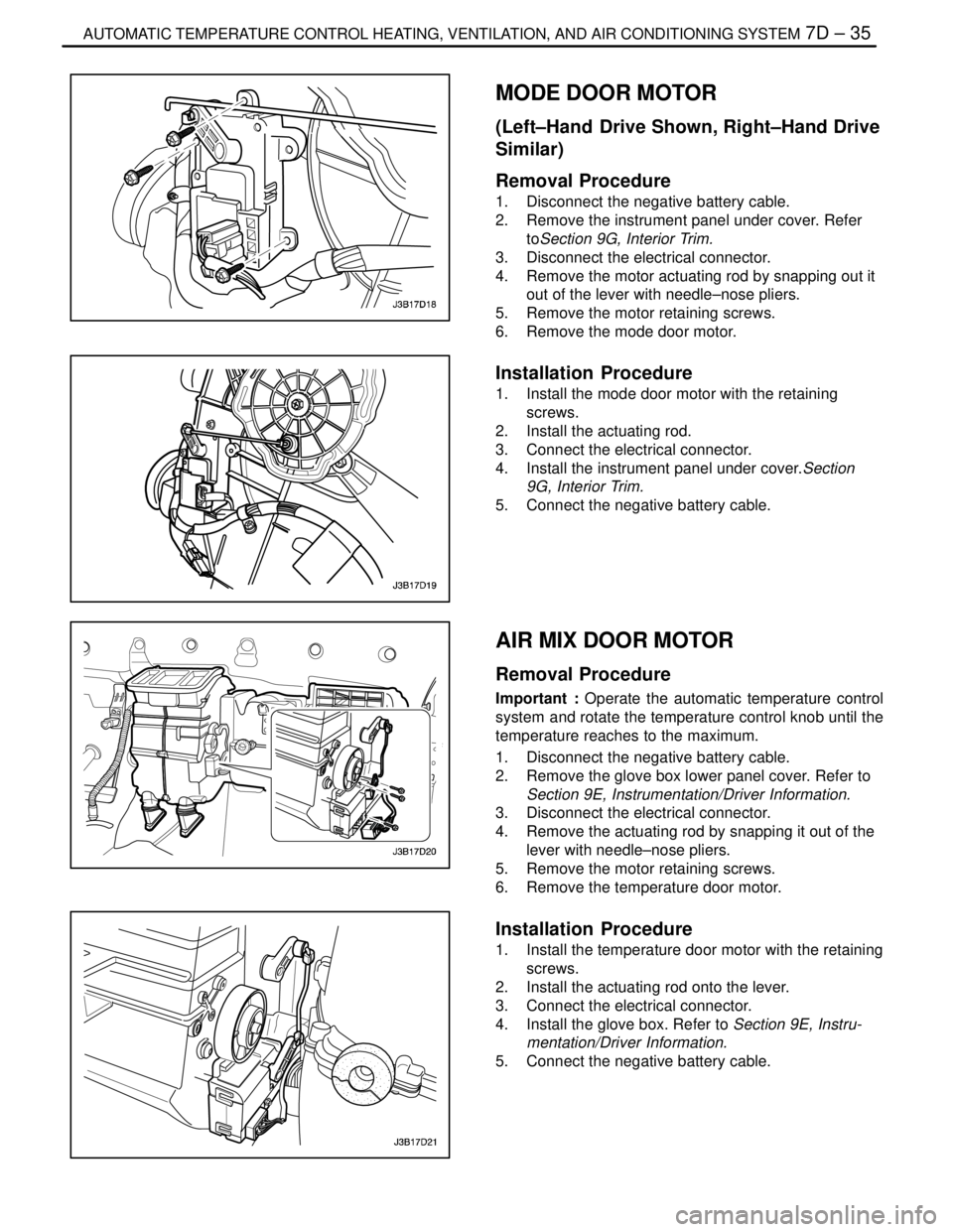
4. Remove the motor actuating rod by snapping out it
out of the lever with needle–nose pliers.
5. Remove the motor retaining screws.
6. Remove the mode door motor.
Installation Procedure
1. Install the mode door motor with the retaining
screws.
2. Install the actuating rod.
3. Connect the electrical connector.
4. Install the instrument panel under cover.Section
9G, Interior Trim.
5. Connect the negative battery cable.
AIR MIX DOOR MOTOR
Removal Procedure
Important : Operate the automatic temperature control
system and rotate the temperature control knob until the
temperature reaches to the maximum.
1. Disconnect the negative battery cable.
2. Remove the glove box lower panel cover. Refer to
Section 9E, Instrumentation/Driver Information.
3. Disconnect the electrical connector.
4. Remove the actuating rod by snapping it out of the
lever with needle–nose pliers.
5. Remove the motor retaining screws.
6. Remove the temperature door motor.
Installation Procedure
1. Install the temperature door motor with the retaining
screws.
2. Install the actuating rod onto the lever.
3. Connect the electrical connector.
4. Install the glove box. Refer to Section 9E, Instru-
mentation/Driver Information.
5. Connect the negative battery cable.
Page 2100 of 2643
SEAT BELTS 8A – 5
DAEWOO V–121 BL4
Installation Procedure
CAUTION : Failure to install the correct retractor
screw can cause the pretensioner seat belt to mal-
function in an accident, possibly resulting in person-
al injury.
Notice : Dissimilar metals in direct contact with each other
may corrode rapidly. Make sure to use the correct fasten-
ers to prevent premature corrosion.
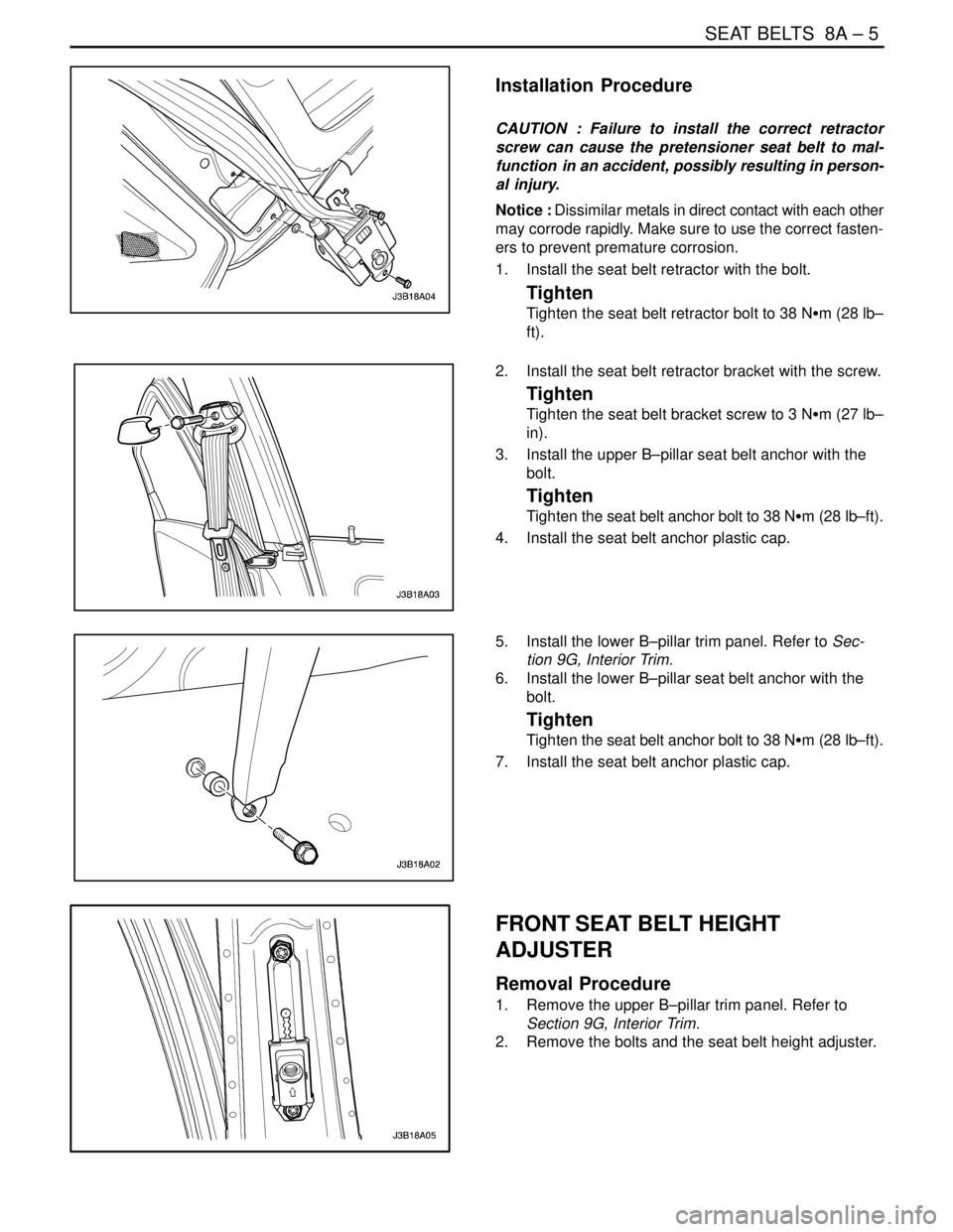
1. Install the seat belt retractor with the bolt.
Tighten
Tighten the seat belt retractor bolt to 38 NSm (28 lb–
ft).
2. Install the seat belt retractor bracket with the screw.
Tighten
Tighten the seat belt bracket screw to 3 NSm (27 lb–
in).
3. Install the upper B–pillar seat belt anchor with the
bolt.
Tighten
Tighten the seat belt anchor bolt to 38 NSm (28 lb–ft).
4. Install the seat belt anchor plastic cap.
5. Install the lower B–pillar trim panel. Refer to Sec-
tion 9G, Interior Trim.
6. Install the lower B–pillar seat belt anchor with the
bolt.
Tighten
Tighten the seat belt anchor bolt to 38 NSm (28 lb–ft).
7. Install the seat belt anchor plastic cap.
FRONT SEAT BELT HEIGHT
ADJUSTER
Removal Procedure
1. Remove the upper B–pillar trim panel. Refer to
Section 9G, Interior Trim.
2. Remove the bolts and the seat belt height adjuster.
Page 2101 of 2643
8A – 6ISEAT BELTS
DAEWOO V–121 BL4
Installation Procedure
Notice : Dissimilar metals in direct contact with each other
may corrode rapidly. Make sure to use the correct fasten-
ers to prevent premature corrosion.
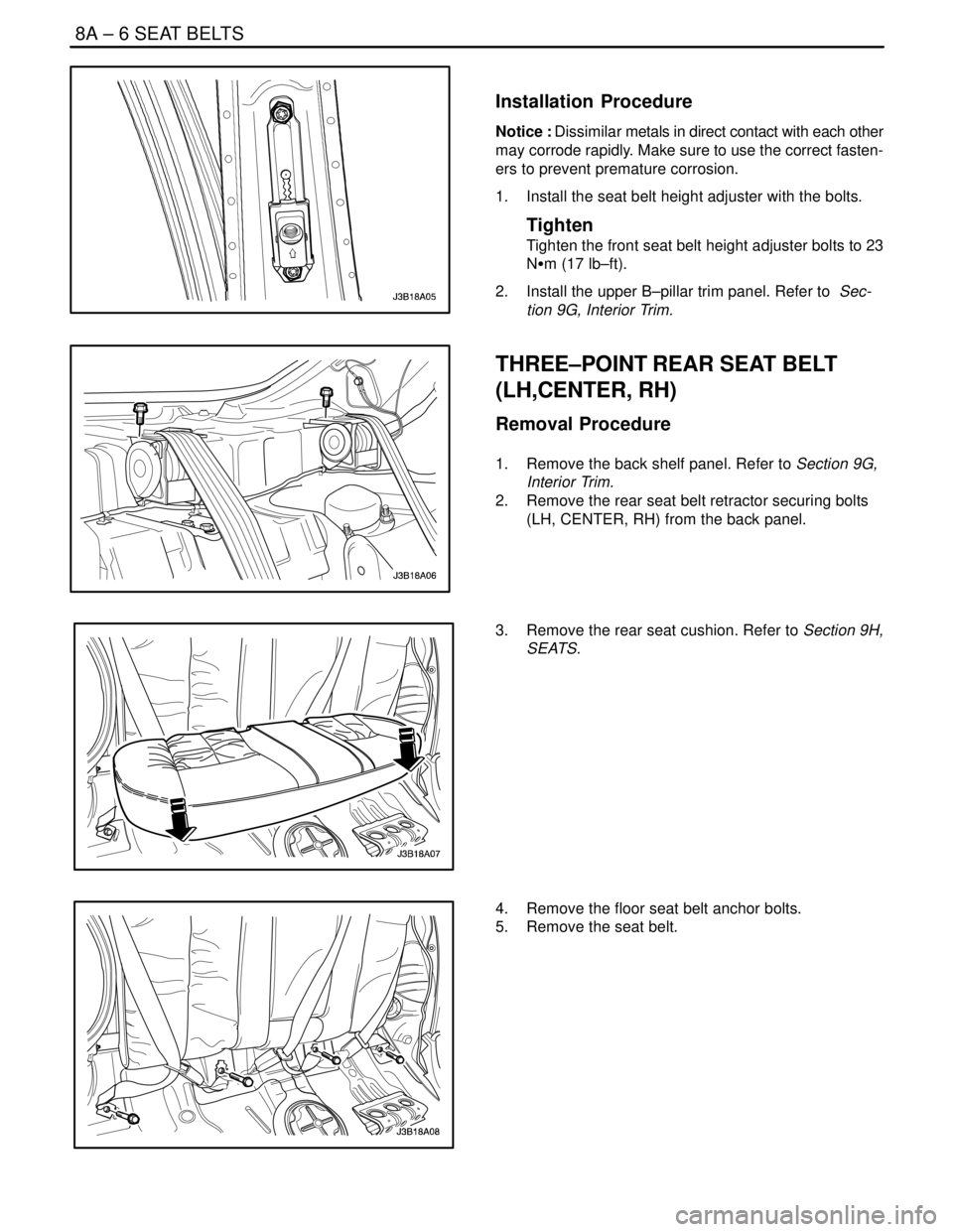
1. Install the seat belt height adjuster with the bolts.
Tighten
Tighten the front seat belt height adjuster bolts to 23
NSm (17 lb–ft).
2. Install the upper B–pillar trim panel. Refer to Sec-
tion 9G, Interior Trim.
THREE–POINT REAR SEAT BELT
(LH,CENTER, RH)
Removal Procedure
1. Remove the back shelf panel. Refer to Section 9G,
Interior Trim.
2. Remove the rear seat belt retractor securing bolts
(LH, CENTER, RH) from the back panel.
3. Remove the rear seat cushion. Refer to Section 9H,
SEATS.
4. Remove the floor seat belt anchor bolts.
5. Remove the seat belt.
Page 2102 of 2643
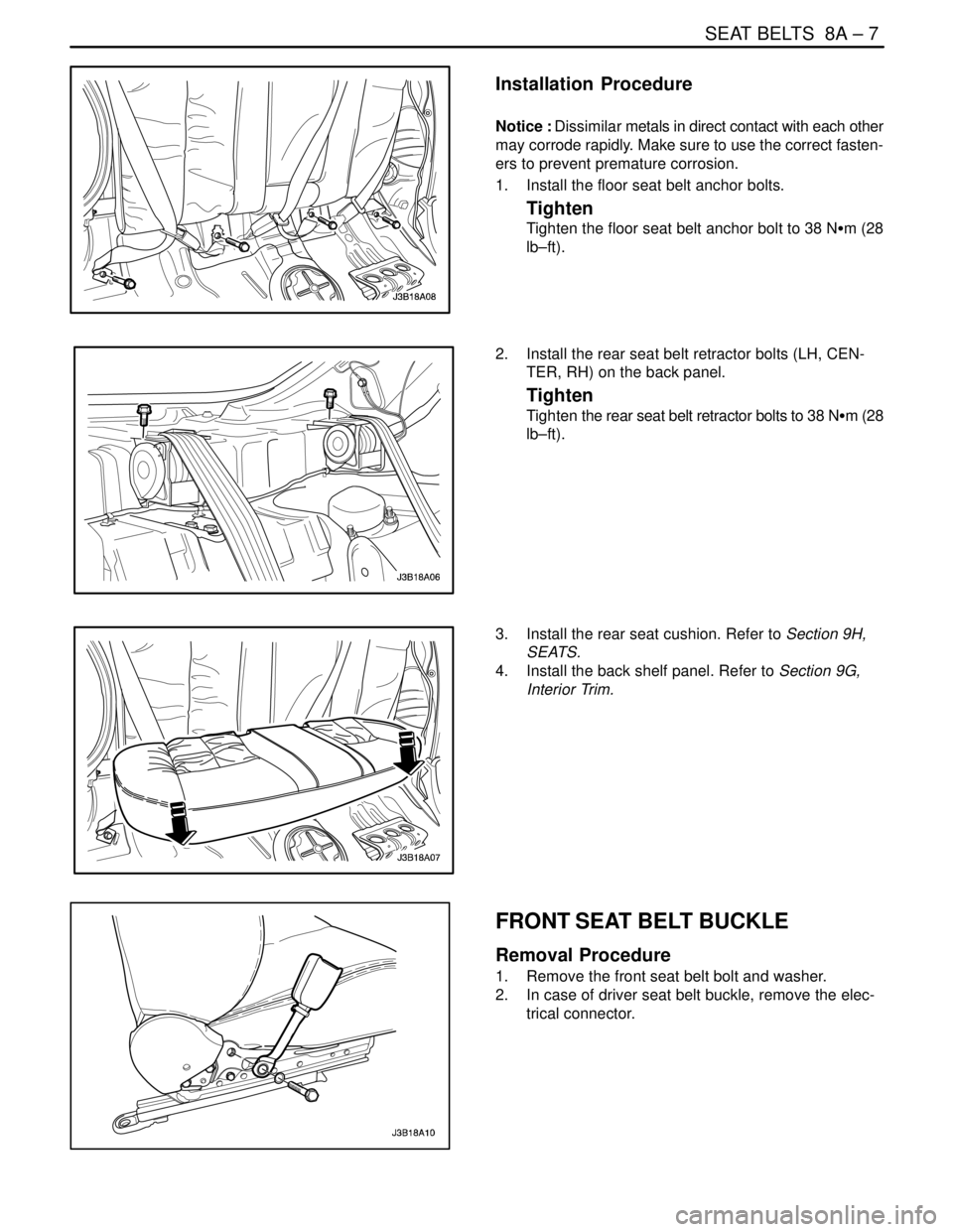
SEAT BELTS 8A – 7
DAEWOO V–121 BL4
Installation Procedure
Notice : Dissimilar metals in direct contact with each other
may corrode rapidly. Make sure to use the correct fasten-
ers to prevent premature corrosion.
1. Install the floor seat belt anchor bolts.
Tighten
Tighten the floor seat belt anchor bolt to 38 NSm (28
lb–ft).
2. Install the rear seat belt retractor bolts (LH, CEN-
TER, RH) on the back panel.
Tighten
Tighten the rear seat belt retractor bolts to 38 NSm (28
lb–ft).
3. Install the rear seat cushion. Refer to Section 9H,
SEATS.
4. Install the back shelf panel. Refer to Section 9G,
Interior Trim.
FRONT SEAT BELT BUCKLE
Removal Procedure
1. Remove the front seat belt bolt and washer.
2. In case of driver seat belt buckle, remove the elec-
trical connector.
Page 2193 of 2643

SUPPLEMENTAL INFLATABLE RESTRAINTS (SIR) 8B – 89
DAEWOO V–121 BL4
HANDLING, INSTALLATION AND
DIAGNOSIS
S Airbag modules should not be subjected to temper-
ature above 65 degrees Celsius(149 degrees Fahr-
enheit).
S An airbag and SDM should not be used if it has
been dropped from height of 0.9 meters(3 feet) or
greater.
S When an SDM is replaced, it must be oriented with
the arrow on the SDM pointing toward the front of
the vehicle.
S It is very important for the SDM to be installed flat
on the mounting surface, parallel to the vehicle’s
longitudinal axis.
S To avoid setting diagnostic trouble codes(DTCs), do
not apply power to the SIR unless all components
are connected or a diagnostic chart request it.
S The SIR Diagnostic System Check must be the
starting point of any SIR diagnostics. The SIR Diag-
nostic System Check will verify proper airbag indi-
cator operation and will lead you to correct chart to
diagnose any SIR malfunctions. Bypassing these
procedures may result in extended diagnostic time
incorrect parts replacement.
REPAIRS AND INSPECTIONS
REQUIRED AFTER AN ACCIDENT
CAUTION : Any repairs to the vehicle’s structure
must return it to the original production configu-
ration. Deployment requires replacement of
SDM, the inflator modules and a dimensional in-
spection of the steering column.
S If any SIR components are damaged, they must be
replaced. If SIR components mounting points are
damaged, they must be repaired or replaced.
S Never use SIR parts from another vehicle. This
does not include remanufactured parts purchased
from an authorized source.
S Do not attempt to service the SDM, the clock spring
or other airbag modules, these items must be re-
placed if they are defective.
S Verify the part number of replaced airbag modules.
Some inflator modules look identical but contain
different internal components.