driver DAEWOO LACETTI 2004 Service Repair Manual
[x] Cancel search | Manufacturer: DAEWOO, Model Year: 2004, Model line: LACETTI, Model: DAEWOO LACETTI 2004Pages: 2643, PDF Size: 80.54 MB
Page 1997 of 2643
HEATING AND VENTILATION SYSTEM 7A – 23
DAEWOO V–121 BL4
Tighten
Tighten the heater/air distributor case assembly
screws to 4 NSm (35 lb–in).
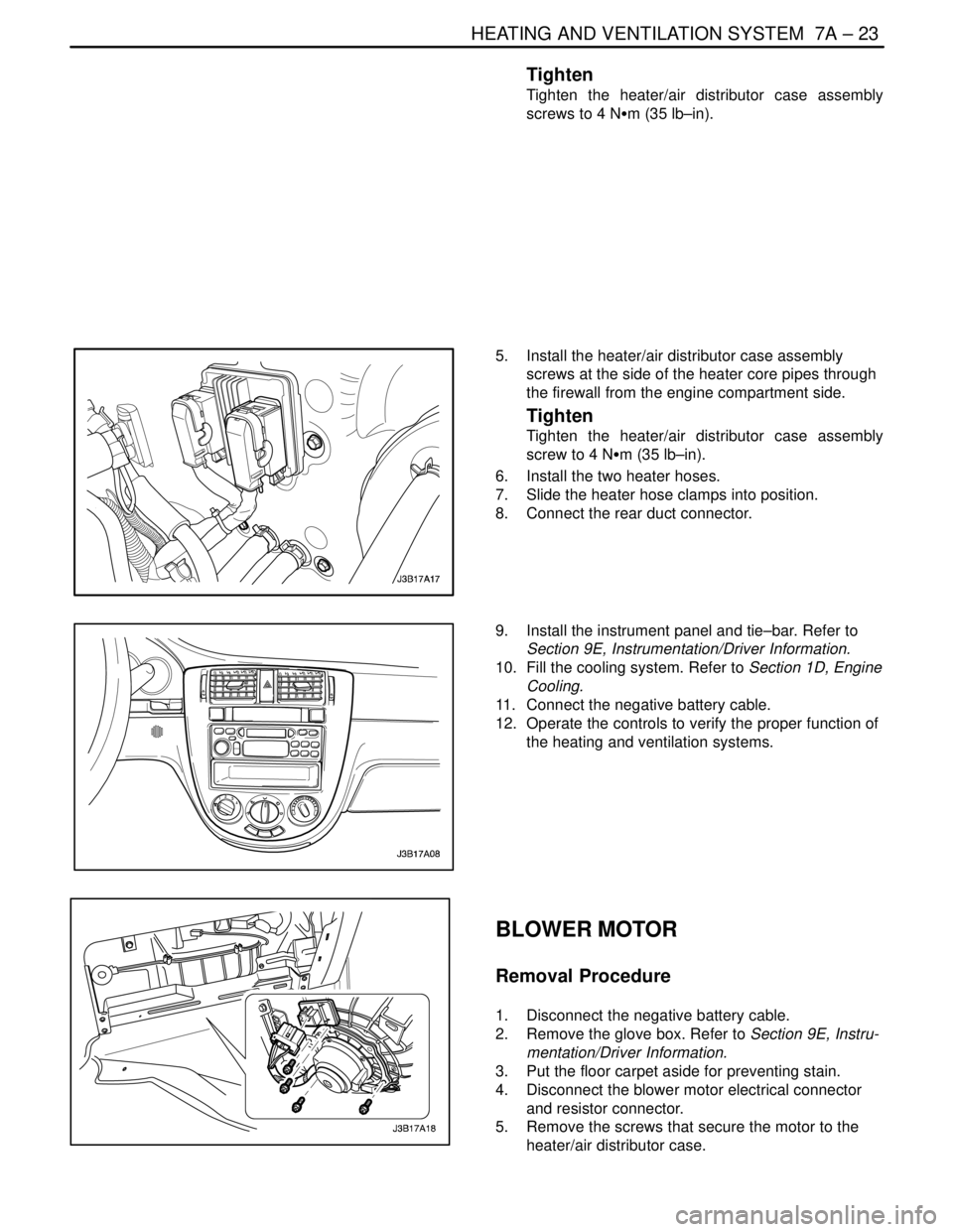
5. Install the heater/air distributor case assembly
screws at the side of the heater core pipes through
the firewall from the engine compartment side.
Tighten
Tighten the heater/air distributor case assembly
screw to 4 NSm (35 lb–in).
6. Install the two heater hoses.
7. Slide the heater hose clamps into position.
8. Connect the rear duct connector.
9. Install the instrument panel and tie–bar. Refer to
Section 9E, Instrumentation/Driver Information.
10. Fill the cooling system. Refer to Section 1D, Engine
Cooling.
11. Connect the negative battery cable.
12. Operate the controls to verify the proper function of
the heating and ventilation systems.
BLOWER MOTOR
Removal Procedure
1. Disconnect the negative battery cable.
2. Remove the glove box. Refer to Section 9E, Instru-
mentation/Driver Information.
3. Put the floor carpet aside for preventing stain.
4. Disconnect the blower motor electrical connector
and resistor connector.
5. Remove the screws that secure the motor to the
heater/air distributor case.
Page 1998 of 2643
7A – 24IHEATING AND VENTILATION SYSTEM
DAEWOO V–121 BL4
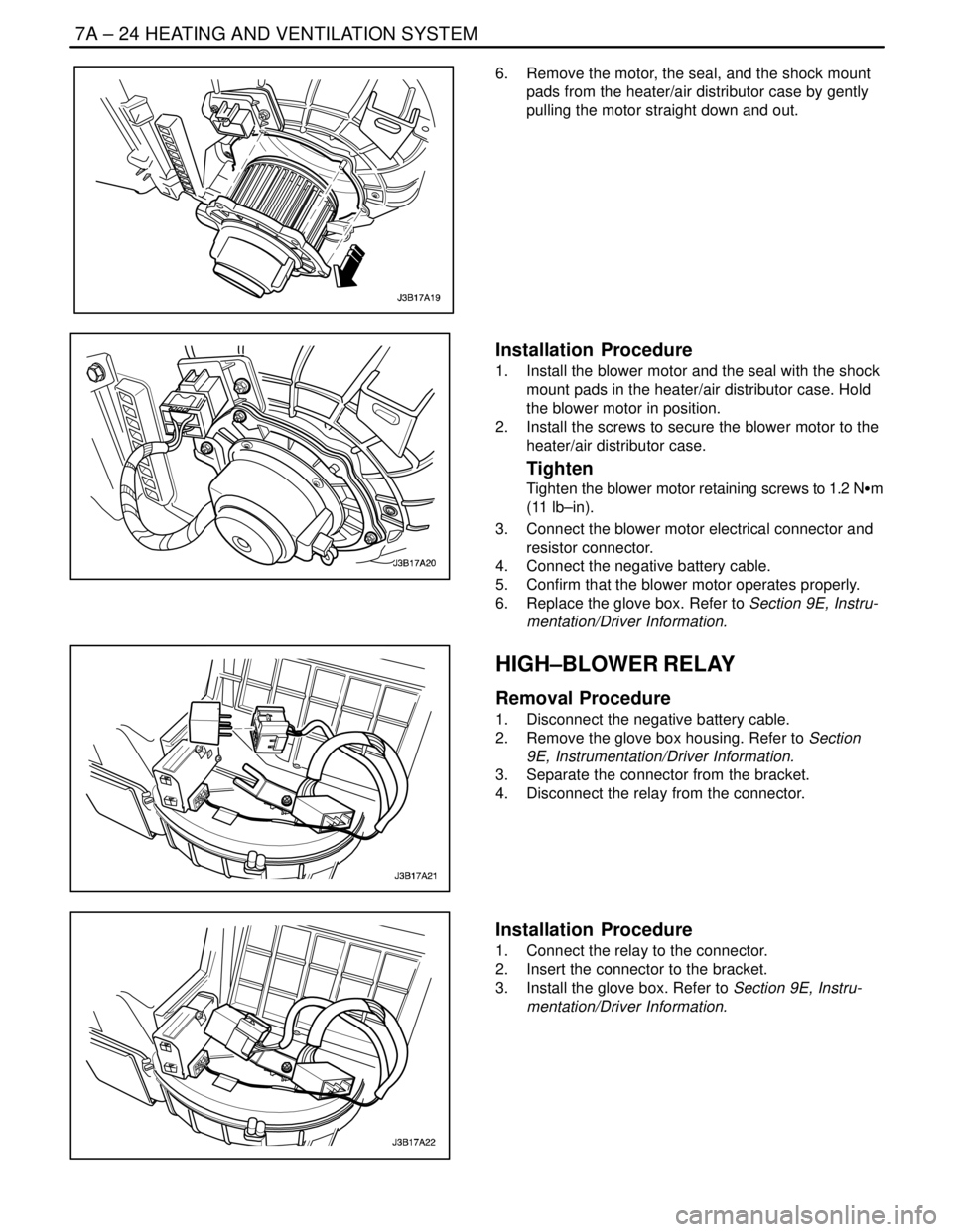
6. Remove the motor, the seal, and the shock mount
pads from the heater/air distributor case by gently
pulling the motor straight down and out.
Installation Procedure
1. Install the blower motor and the seal with the shock
mount pads in the heater/air distributor case. Hold
the blower motor in position.
2. Install the screws to secure the blower motor to the
heater/air distributor case.
Tighten
Tighten the blower motor retaining screws to 1.2 NSm
(11 lb–in).
3. Connect the blower motor electrical connector and
resistor connector.
4. Connect the negative battery cable.
5. Confirm that the blower motor operates properly.
6. Replace the glove box. Refer to Section 9E, Instru-
mentation/Driver Information.
HIGH–BLOWER RELAY
Removal Procedure
1. Disconnect the negative battery cable.
2. Remove the glove box housing. Refer to Section
9E, Instrumentation/Driver Information.
3. Separate the connector from the bracket.
4. Disconnect the relay from the connector.
Installation Procedure
1. Connect the relay to the connector.
2. Insert the connector to the bracket.
3. Install the glove box. Refer to Section 9E, Instru-
mentation/Driver Information.
Page 1999 of 2643
HEATING AND VENTILATION SYSTEM 7A – 25
DAEWOO V–121 BL4
BLOWER RESISTOR
Removal Procedure
1. Disconnect the negative battery cable.
2. Remove the glove box. Refer to Section 9E, Instru-
mentation/Driver Information.
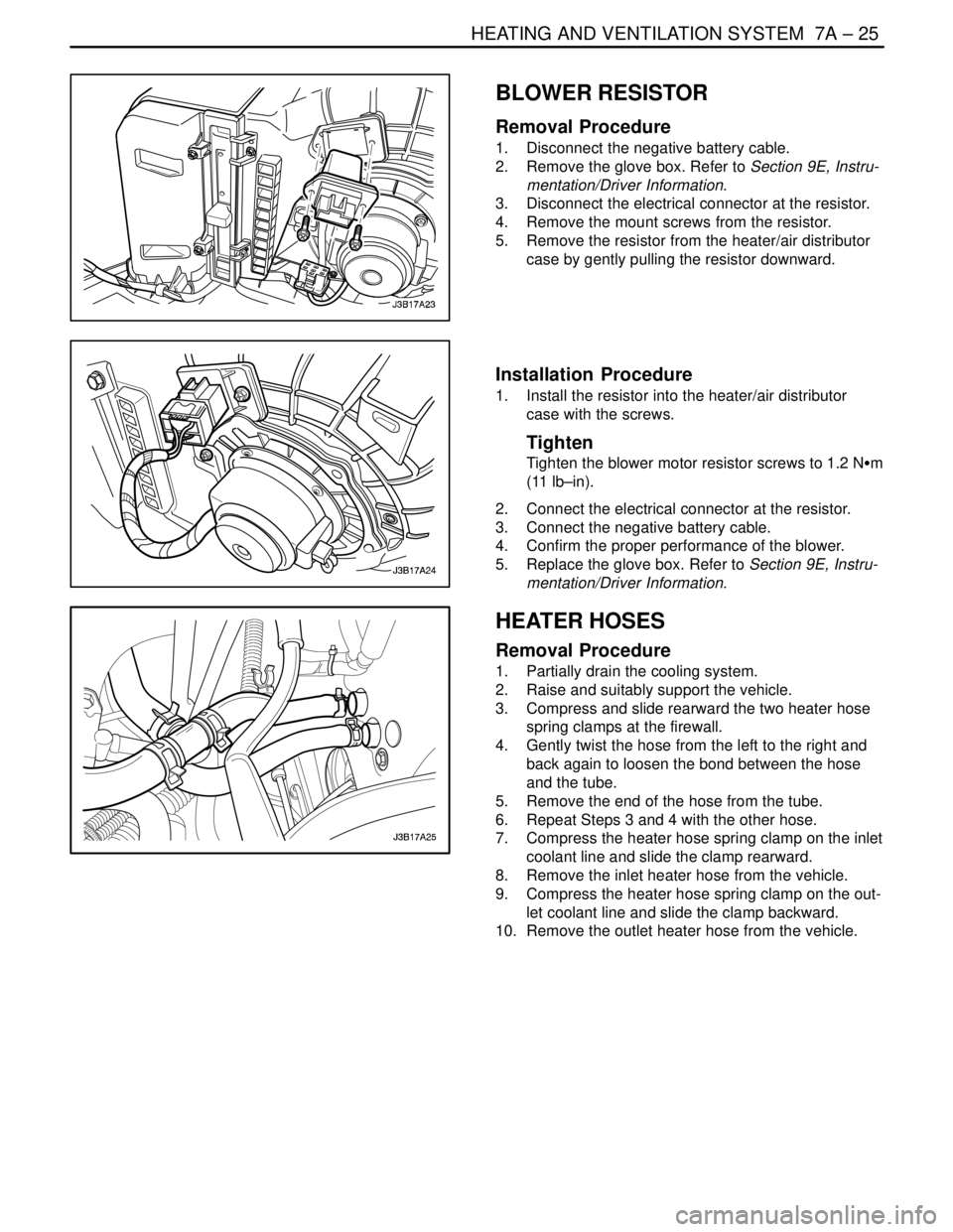
3. Disconnect the electrical connector at the resistor.
4. Remove the mount screws from the resistor.
5. Remove the resistor from the heater/air distributor
case by gently pulling the resistor downward.
Installation Procedure
1. Install the resistor into the heater/air distributor
case with the screws.
Tighten
Tighten the blower motor resistor screws to 1.2 NSm
(11 lb–in).
2. Connect the electrical connector at the resistor.
3. Connect the negative battery cable.
4. Confirm the proper performance of the blower.
5. Replace the glove box. Refer to Section 9E, Instru-
mentation/Driver Information.
HEATER HOSES
Removal Procedure
1. Partially drain the cooling system.
2. Raise and suitably support the vehicle.
3. Compress and slide rearward the two heater hose
spring clamps at the firewall.
4. Gently twist the hose from the left to the right and
back again to loosen the bond between the hose
and the tube.
5. Remove the end of the hose from the tube.
6. Repeat Steps 3 and 4 with the other hose.
7. Compress the heater hose spring clamp on the inlet
coolant line and slide the clamp rearward.
8. Remove the inlet heater hose from the vehicle.
9. Compress the heater hose spring clamp on the out-
let coolant line and slide the clamp backward.
10. Remove the outlet heater hose from the vehicle.
Page 2005 of 2643
MANUAL CONTROL HEATING, VENTILATION AND AIR CONDITIONING SYSTEM 7B – 3
DAEWOO V–121 BL4
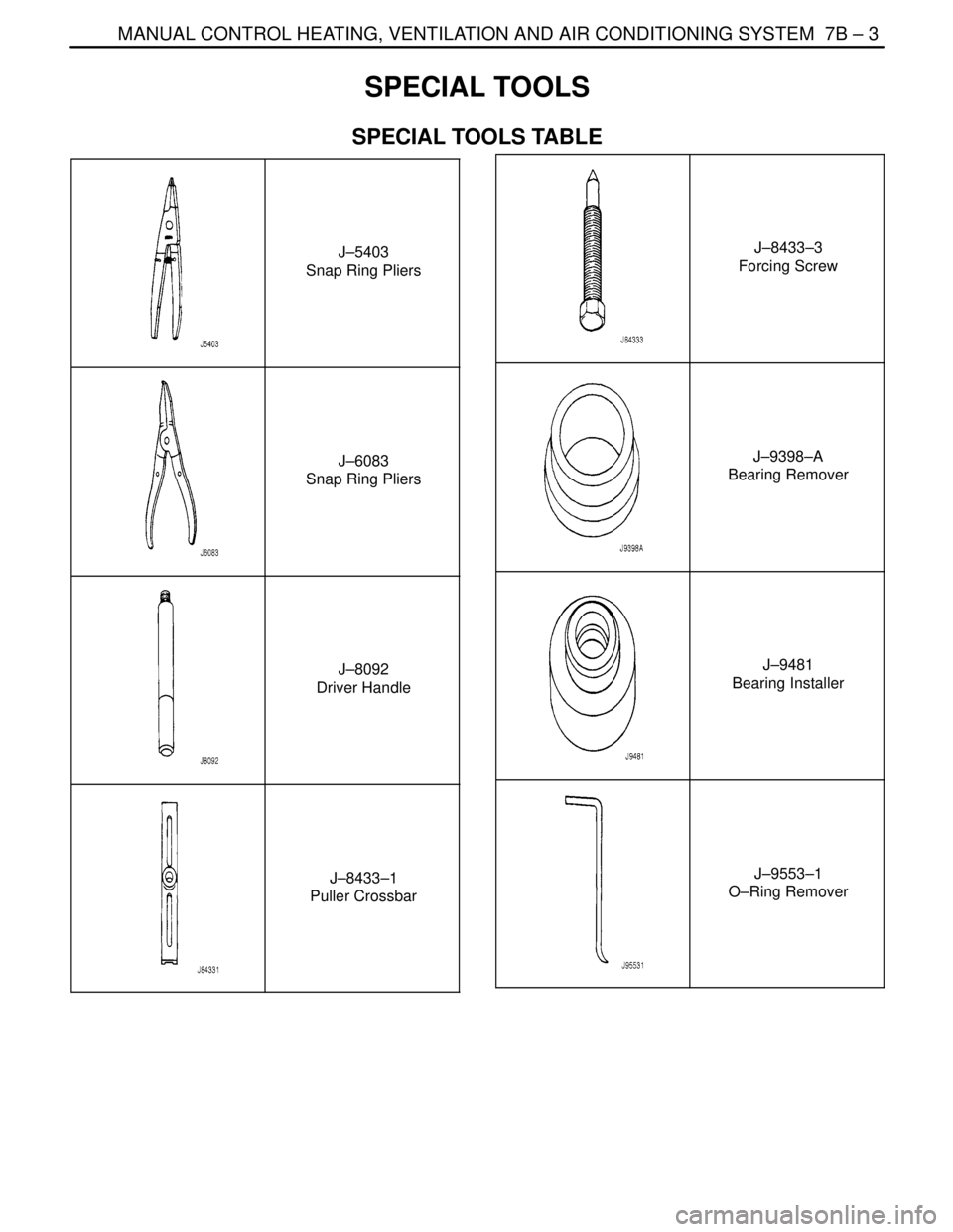
SPECIAL TOOLS
SPECIAL TOOLS TABLE
J–5403
Snap Ring Pliers
J–6083
Snap Ring Pliers
J–8092
Driver Handle
J–8433–1
Puller Crossbar
J–8433–3
Forcing Screw
J–9398–A
Bearing Remover
J–9481
Bearing Installer
J–9553–1
O–Ring Remover
Page 2016 of 2643

7B – 14IMANUAL CONTROL HEATING, VENTILATION AND AIR CONDITIONING SYSTEM
DAEWOO V–121 BL4
StepNo Yes Value(s) Action
151. Record the low– and the high–side pressures
after the A/C system has been operating for 5
minutes or more with the engine cooling fan
ON.
2. Locate the intersection of the low– and the high
side pressures. Refer to ”Low– and High–Side
Pressure Relationship Chart” in this section.
Do the low– and the high–side pressures intersect
in the white area of the chart?–System OKGo to Step 16
16Check the high– and the low–side pressures.
Do the low– and the high–side pressures intersect
in the grey area of the chart?–Go to Step 17Go to Step 20
17Feel the liquid pipe between the condenser and the
expansion valve.
Is the pipe cold?–Go to Step 18Go to Step 19
181. Examine the condenser for any restriction of
the airflow.
2. Check the cooling fans for proper operation.
3. Remove the restriction or repair the fans, as
required.
Is the pipe temperature normal now?At least 7°C
(12°F) below
ambient air
temperatureGo to Step 13–
191. Recover, evacuate, and recharge the A/C sys-
tem.
2. Check the A/C system for leaks.
Is the system free from leaks?–Go to Step 13–
20Observe the readings on the pressure gauges.
Are the A/C compressor high– and the low–side
pressures within the specified value of each other?207 kPa
(30 psi)Go to Step 21Go to Step 26
211. Run the engine at 3,000 rpm.
2. Set the A/C controls to the following positions:
S The A/C switch to the ON.
S The fresh air control switch to fresh air.
S The blower motor to 4.
S The temperature to full cold.
3. Close all of the vehicle’s windows and doors.
4. Turn the A/C switch ON and OFF every 20
seconds for 3 minutes.
Are the A/C compressor high– and the low–side
pressures within the specified value of each other?207 kPa
(30 psi)Go to Step 22Go to Step 13
22Observe the pressure rise on both gauges and the
temperatures of both the compressor suction pipe
and the discharge pipe.
Is the pressure rise on both gauges slow and the
suction pipe warm with the discharge pipe very hot?–Go to Step 25Go to Step 23
231. Turn the ignition switch to LOCK.
2. Make sure the compressor clutch is disen-
gaged.
3. Attempt to turn the clutch driver (not the
pulley).
Can you turn the clutch driver freely by hand?–Go to Step 25Go to Step 24
Page 2027 of 2643
MANUAL CONTROL HEATING, VENTILATION AND AIR CONDITIONING SYSTEM 7B – 25
DAEWOO V–121 BL4
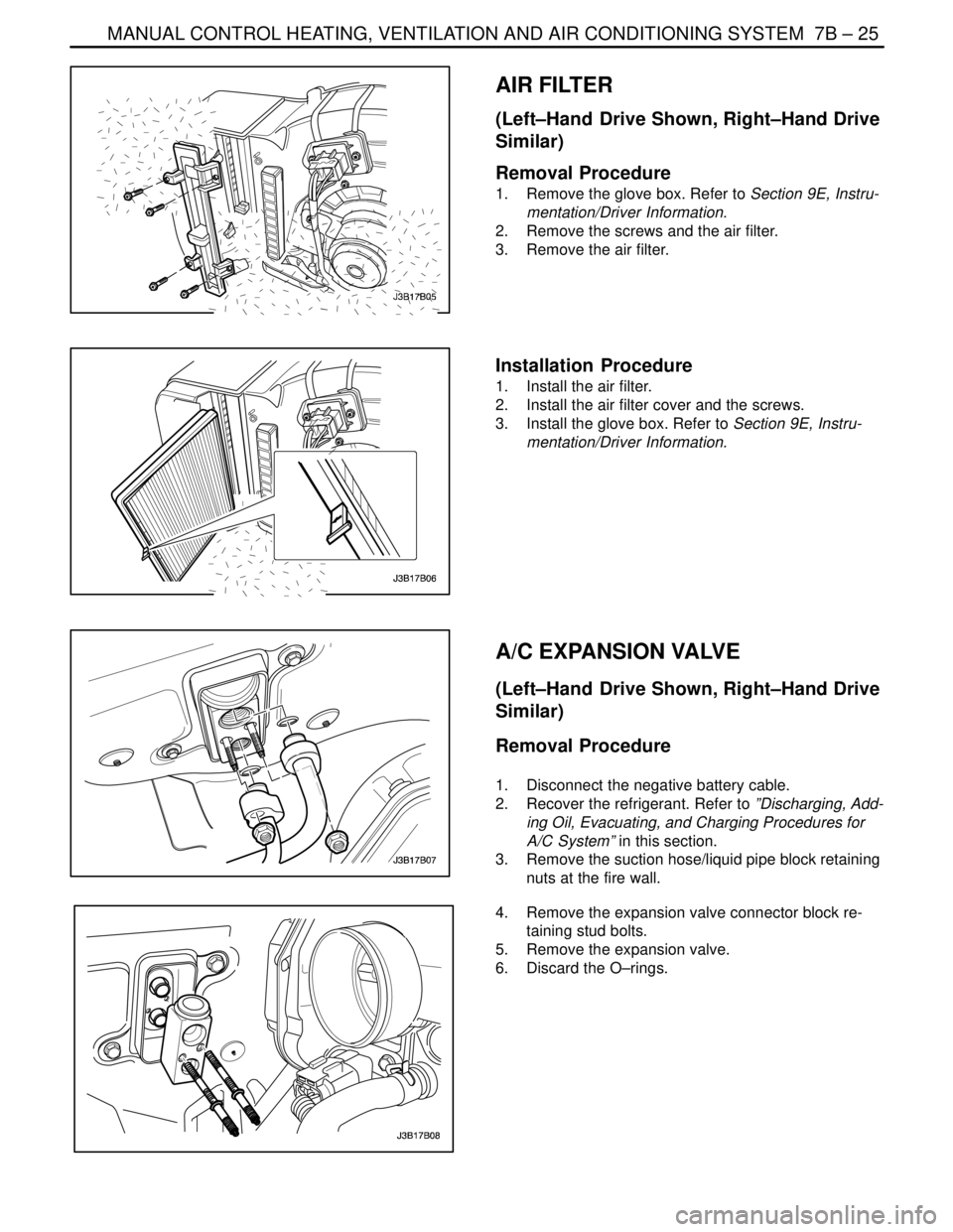
AIR FILTER
(Left–Hand Drive Shown, Right–Hand Drive
Similar)
Removal Procedure
1. Remove the glove box. Refer to Section 9E, Instru-
mentation/Driver Information.
2. Remove the screws and the air filter.
3. Remove the air filter.
Installation Procedure
1. Install the air filter.
2. Install the air filter cover and the screws.
3. Install the glove box. Refer to Section 9E, Instru-
mentation/Driver Information.
A/C EXPANSION VALVE
(Left–Hand Drive Shown, Right–Hand Drive
Similar)
Removal Procedure
1. Disconnect the negative battery cable.
2. Recover the refrigerant. Refer to ”Discharging, Add-
ing Oil, Evacuating, and Charging Procedures for
A/C System” in this section.
3. Remove the suction hose/liquid pipe block retaining
nuts at the fire wall.
4. Remove the expansion valve connector block re-
taining stud bolts.
5. Remove the expansion valve.
6. Discard the O–rings.
Page 2042 of 2643
7B – 40IMANUAL CONTROL HEATING, VENTILATION AND AIR CONDITIONING SYSTEM
DAEWOO V–121 BL4
11. Remove the compressor from the bench vise and
remove the J–34992 compressor holding fixture
from the compressor.
12. Install the compressor. Refer to ”Compressor” in
this section.
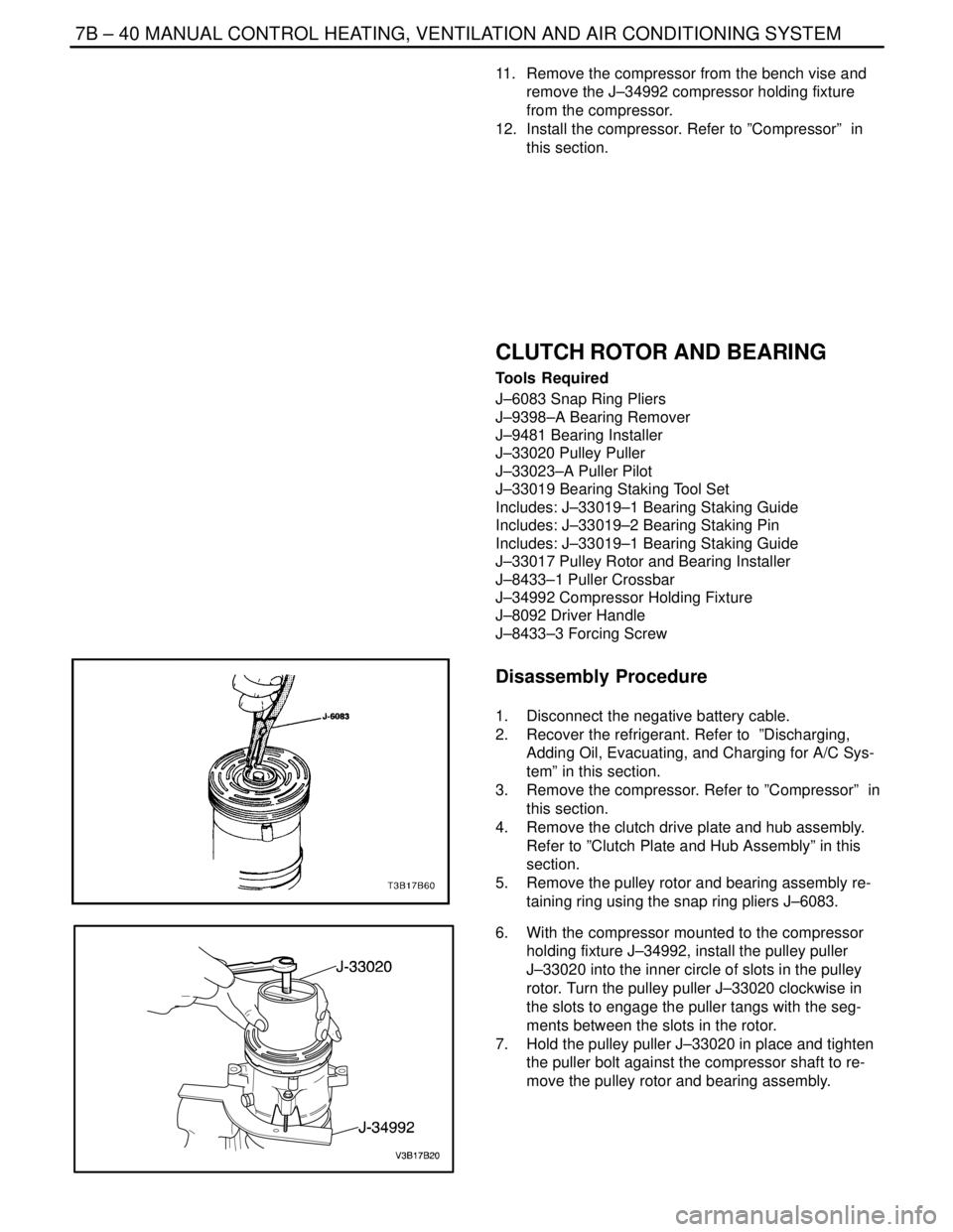
CLUTCH ROTOR AND BEARING
Tools Required
J–6083 Snap Ring Pliers
J–9398–A Bearing Remover
J–9481 Bearing Installer
J–33020 Pulley Puller
J–33023–A Puller Pilot
J–33019 Bearing Staking Tool Set
Includes: J–33019–1 Bearing Staking Guide
Includes: J–33019–2 Bearing Staking Pin
Includes: J–33019–1 Bearing Staking Guide
J–33017 Pulley Rotor and Bearing Installer
J–8433–1 Puller Crossbar
J–34992 Compressor Holding Fixture
J–8092 Driver Handle
J–8433–3 Forcing Screw
Disassembly Procedure
1. Disconnect the negative battery cable.
2. Recover the refrigerant. Refer to ”Discharging,
Adding Oil, Evacuating, and Charging for A/C Sys-
tem” in this section.
3. Remove the compressor. Refer to ”Compressor” in
this section.
4. Remove the clutch drive plate and hub assembly.
Refer to ”Clutch Plate and Hub Assembly” in this
section.
5. Remove the pulley rotor and bearing assembly re-
taining ring using the snap ring pliers J–6083.
6. With the compressor mounted to the compressor
holding fixture J–34992, install the pulley puller
J–33020 into the inner circle of slots in the pulley
rotor. Turn the pulley puller J–33020 clockwise in
the slots to engage the puller tangs with the seg-
ments between the slots in the rotor.
7. Hold the pulley puller J–33020 in place and tighten
the puller bolt against the compressor shaft to re-
move the pulley rotor and bearing assembly.
Page 2043 of 2643
MANUAL CONTROL HEATING, VENTILATION AND AIR CONDITIONING SYSTEM 7B – 41
DAEWOO V–121 BL4
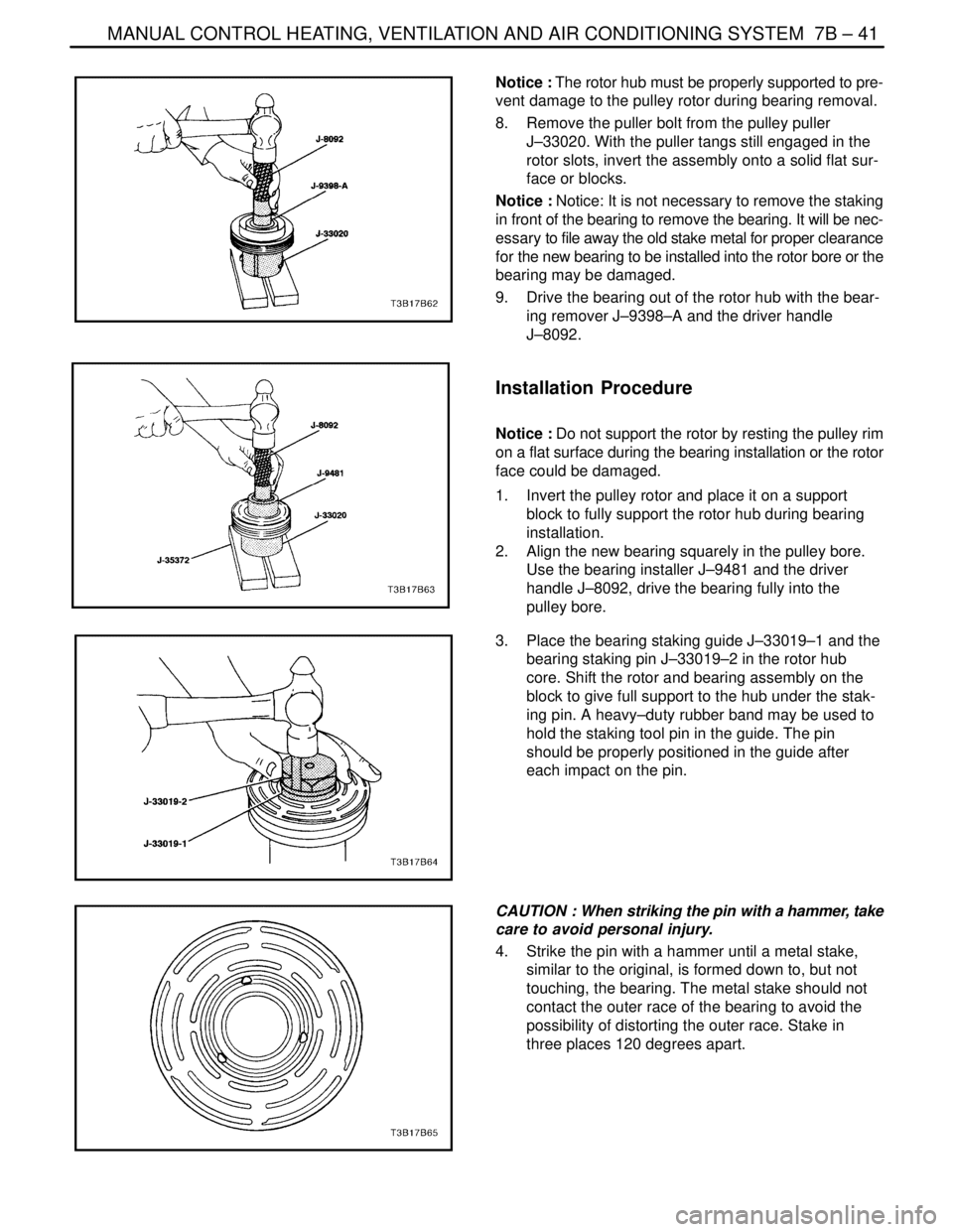
Notice : The rotor hub must be properly supported to pre-
vent damage to the pulley rotor during bearing removal.
8. Remove the puller bolt from the pulley puller
J–33020. With the puller tangs still engaged in the
rotor slots, invert the assembly onto a solid flat sur-
face or blocks.
Notice : Notice: It is not necessary to remove the staking
in front of the bearing to remove the bearing. It will be nec-
essary to file away the old stake metal for proper clearance
for the new bearing to be installed into the rotor bore or the
bearing may be damaged.
9. Drive the bearing out of the rotor hub with the bear-
ing remover J–9398–A and the driver handle
J–8092.
Installation Procedure
Notice : Do not support the rotor by resting the pulley rim
on a flat surface during the bearing installation or the rotor
face could be damaged.
1. Invert the pulley rotor and place it on a support
block to fully support the rotor hub during bearing
installation.
2. Align the new bearing squarely in the pulley bore.
Use the bearing installer J–9481 and the driver
handle J–8092, drive the bearing fully into the
pulley bore.
3. Place the bearing staking guide J–33019–1 and the
bearing staking pin J–33019–2 in the rotor hub
core. Shift the rotor and bearing assembly on the
block to give full support to the hub under the stak-
ing pin. A heavy–duty rubber band may be used to
hold the staking tool pin in the guide. The pin
should be properly positioned in the guide after
each impact on the pin.
CAUTION : When striking the pin with a hammer, take
care to avoid personal injury.
4. Strike the pin with a hammer until a metal stake,
similar to the original, is formed down to, but not
touching, the bearing. The metal stake should not
contact the outer race of the bearing to avoid the
possibility of distorting the outer race. Stake in
three places 120 degrees apart.
Page 2062 of 2643

AUTOMATIC TEMPERATURE CONTROL HEATING, VENTILATION, AND AIR CONDITIONING SYSTEM 7D – 7
DAEWOO V–121 BL4
CONTROLLER DOES NOT ILLUMINATE WHEN LIGHT
SWITCH IS ON
StepActionValue(s)YesNo
1Check other instrumentation lights.
Are those lights also off?–Go to Section
9E, Instrumen-
tation/Driver In-
formationGo to Step 2
21. Remove the controller.
2. Check the voltage between terminals A3 and
A4 of the controller connector.
Is the voltage within the specified value?11–14 vGo to Step 4Go to Step 3
3Repair the wiring harness between splice S204 and
controller connector terminal A4 or between splice
S203 and controller connector terminal A3.
Is the repair complete?–System OK–
4Check the illumination lamps.
Is one burned out?–Go to Step 5Go to Step 6
5Replace the burned out illumination lamp.
Is the repair complete?–System OK–
Page 2088 of 2643
IAUTOMATIC TEMPERATURE CONTROL HEATING, VENTILATION, AND AIR CONDITIONING SYSTEM 7D – 33
DAEWOO V–121 BL4
SERVICEABLE COMPONENTS
COMMON HVAC COMPONENTS
Those components used in non–automatic systems are
covered in other sections of this manual.
Refer to Section 7A, Heating and Ventilation System for
the following procedures:
S Blower Motor.
S Heater Hoses.
S Blower Resistor.
S High–Blower Relay.
S Heater/Air Distributor Case Assembly (A/C Mod-
ule).
S Heater Core.
Refer to Section 7B, Manual Control Heating, Ventilation,
and Air Conditioning System, for the following proce-
dures:
S A/C Pressure Transducer.
S A/C Compressor Relay.
S Air Filter.
S A/C Expansion Valve.
S A/C High–Pressure Pipe Line.
S Evaporator Core.
S A/C Suction Hose Assembly.
S A/C Discharge Hose–Compressor to Condenser.
S Compressor.
S Condenser.
S Receiver–Dryer.
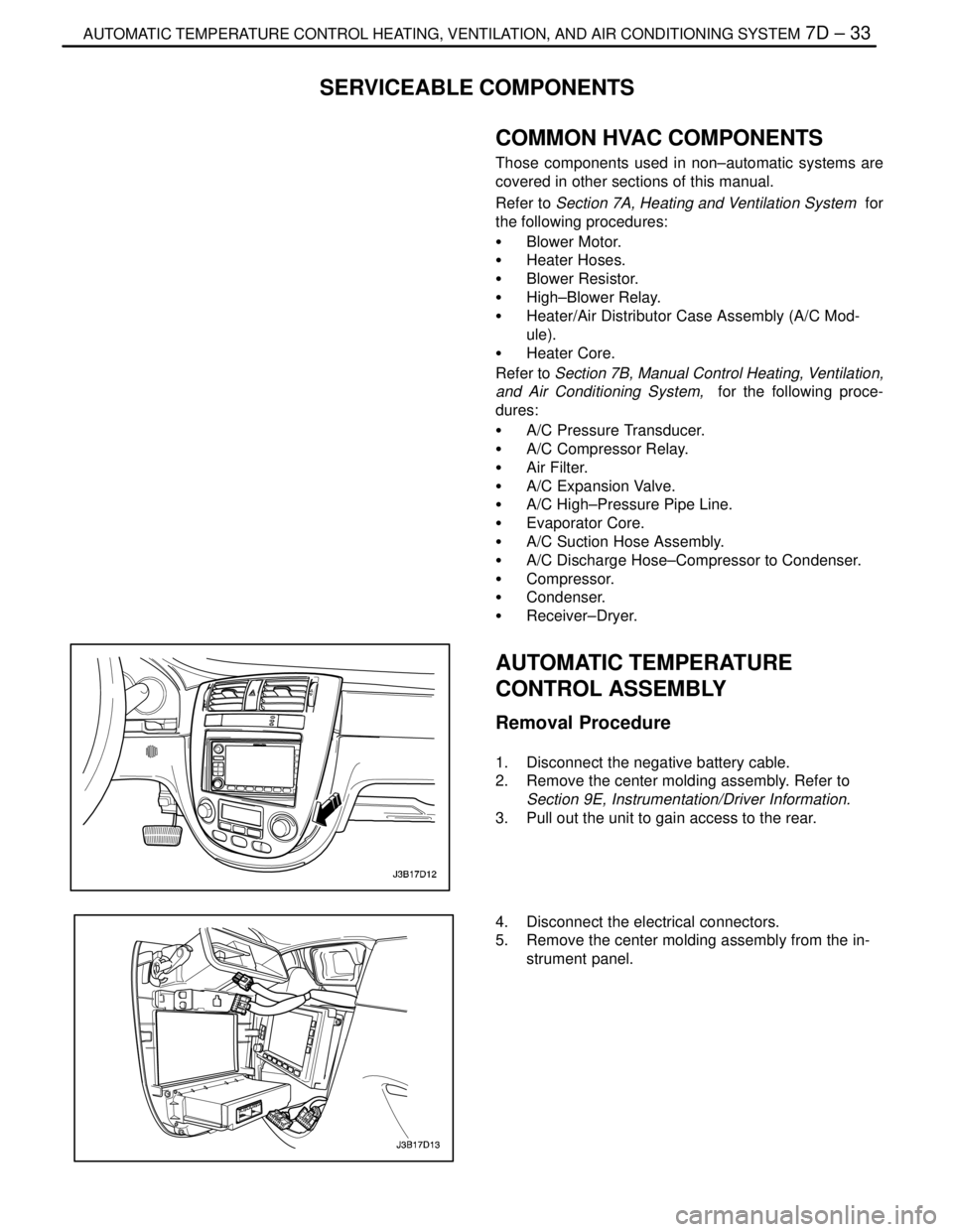
AUTOMATIC TEMPERATURE
CONTROL ASSEMBLY
Removal Procedure
1. Disconnect the negative battery cable.
2. Remove the center molding assembly. Refer to
Section 9E, Instrumentation/Driver Information.
3. Pull out the unit to gain access to the rear.
4. Disconnect the electrical connectors.
5. Remove the center molding assembly from the in-
strument panel.