speed DAEWOO LACETTI 2004 Service Repair Manual
[x] Cancel search | Manufacturer: DAEWOO, Model Year: 2004, Model line: LACETTI, Model: DAEWOO LACETTI 2004Pages: 2643, PDF Size: 80.54 MB
Page 1534 of 2643

ZF 4 HP 16 AUTOMATIC TRANSAXLE 5A1 – 185
DAEWOO V–121 BL4
S No input speed error DTCs P0715, P0716, or
P0717.
S Output speed is greater than 256 rpm.
S Input speed is greater than 400 rpm.
S 4–3 gear shift is active.
S Immediately after the above condition occurs.
Action Taken When The DTC Sets
S The Malfunction Indicator Lamp(MIL) will illuminate.
S The TCM will record operating conditions at the
time the diagnostic fails. This information will be
stored in the Failure Records buffer.
S Adopt Emergency/ Substitute mode and constant
4th gear.S Open lock–up clutch.
Conditions for Clearing the MIL/DTC
S The MIL will turn OFF when the malfunction has
not occurred after three–ignition cycle.
S A history DTC will clear after 40 consecutive warm
up cycles without a fault.
S Using a scan tool can clear history DTCs.
Diagnostic Aids
S When DTC P1884 sets, the possible cause of fault
could be TCM.
DTC P1884 – 4–3 Shift Malfunction
StepActionValue(s)YesNo
1Perform an On–Board Diagnostic (EOBD) System
Check.
Is the check completed?–Go to Step 2Go to ”On–
Board Diagnos-
tic System
Check”
21. Install the scan tool.
2. Turn the ignition ON, with the engine OFF.
Then, start engine and allow it to warm up at
idle.
3. Observe ”idle rpm, TPS” on the scan tool.
Was a problem found?–Go to ”Engine
Diagnostic In-
formation”Go to Step 3
3Inspect ”ECM”. Refer to Section 1F, System Diagno-
sis, EOBD System Check.
Was a problem found?–Go to ”Engine
Diagnostic In-
formation”Go to Step 4
41. Turn the ignition OFF.
2. Disconnect the TCM wiring connector.
3. Measure the voltage between terminal B3 and
B13 of the transaxle wiring connector.
4. Turn the ignition ON.
5. Measure the voltage between terminal C15 and
B13 of the transaxle wiring connector.
6. Measure the voltage between terminal C16 and
B13 of the transaxle wiring connector.
Is the voltage within the values shown?11–14VGo to Step 5Go to ”System
Voltage Low or
High”
5Replace the TCM.
Is the action complete?–Go to Step 6–
61. After the repair, use a scan tool ”clear info”
function and road test the vehicle.
2. Review the ”DTC info”.
Has the last test failed or is the current DTC dis-
played?–Replace the
transaxle as-
semblyRepair verified
exit DTC chart
Page 1535 of 2643

5A1 – 186IZF 4 HP 16 AUTOMATIC TRANSAXLE
DAEWOO V–121 BL4
RangePark/
Neutr
alRever
seD321
GearNR1st2nd3rd4th1st2nd3rd1st2nd1st
Solenoid Valve
1ONON/
OFFON/
OFFON/
OFFON/
OFFON/
OFFON/
OFFON/
OFFON/
OFFON/
OFFON/
OFFON/
OFF
Solenoid Valve
2ONONONOFFOFFOFFONOFFOFFONOFFON
Line Pressure
Control Sole-
noid Valve 3
(EDS 3)OFFOFFOFFONON/
OFFON/
OFFOFFONON/
OFFOFFONOFF
Line Pressure
Control Sole-
noid Valve 4
(EDS 4)ONOFFONONONOFFONONONONONON
Line Pressure
Control Sole-
noid Valve 5
(EDS 5)OFFOFFONONOFFOFFONONOFFONONON
Line Pressure
Control Sole-
noid Valve 6
(EDS 6)ONOFFONONONOFFONONONONONON
Brake BAAAAAAAA
Brake CH
Brake DH
Clutch EAAAAAA
Brake FHHHHHHH
Lock–up
ClutchA
A = Applied
H = Holding
ON = The solenoid is energized.
OFF = The solenoid is de–energized.
** = Manual Second–Third gear is only available above approximately 100 km/h (62 mph).
*** = Manual First–Second gear is only available above approximately 60 km/h (37 mph).
Note : Manual First–Third gear is also possible at high vehicle speed as a safety feature.
DIAGNOSTIC TROUBLE CODE(DTC) P1885
3–1 SHIFT MALFUNCTION
Circuit Description
The special feature of 4HP 16 Auto Transaxle is that it op-
erates without freewheels. Shifting between individual
gears takes place by means of overlapping clutch engage-
ment and release.
The advantage of overlap shifting are as follows:
– The transaxle can be of more compact design
and is lighter on account of the absence of free-
wheels and the lower number of shift elements.– Lower drag losses, i.e. higher efficiency.
– Lower peak torque acting on the components and
driveline.
However, overlap shifting necessitates high–performance
hardware and software, and precision engine signals.
Conditions for Setting the DTC
S Transmission oil temperature is greater than –10°C
(14°F).
S Selector lever is not in N(Neutral), P(Park) position.
S System voltage is greater than 9 volts.
Page 1536 of 2643

ZF 4 HP 16 AUTOMATIC TRANSAXLE 5A1 – 187
DAEWOO V–121 BL4
S No input speed error DTCs P0715, P0716, or
P0717.
S Output speed is greater than 256 rpm.
S Input speed is greater than 400 rpm.
S 3–1 gear shift is active.
S Immediately after the above condition occurs.
Action Taken When The DTC Sets
S The Malfunction Indicator Lamp(MIL) will illuminate.
S The TCM will record operating conditions at the
time the diagnostic fails. This information will be
stored in the Failure Records buffer.
S Adopt Emergency/ Substitute mode and constant
3rd gear.S Open lock–up clutch.
Conditions for Clearing the MIL/DTC
S The MIL will turn OFF when the malfunction has
not occurred after three–ignition cycle.
S A history DTC will clear after 40 consecutive warm
up cycles without a fault.
S Using a scan tool can clear history DTCs.
Diagnostic Aids
S When DTC P1885 sets, the possible cause of fault
could be TCM.
DTC P1885 – 3–1 Shift Malfunction
StepActionValue(s)YesNo
1Perform an On–Board Diagnostic (EOBD) System
Check.
Is the check completed?–Go to Step 2Go to ”On–
Board Diagnos-
tic System
Check”
21. Install the scan tool.
2. Turn the ignition ON, with the engine OFF.
Then, start engine and allow it to warm up at
idle.
3. Observe ”idle rpm, TPS” on the scan tool.
Was a problem found?–Go to ”Engine
Diagnostic In-
formation”Go to Step 3
3Inspect ”ECM”. Refer to Section 1F, System Diagno-
sis, EOBD System Check.
Was a problem found?–Go to ”Engine
Diagnostic In-
formation”Go to Step 4
41. Turn the ignition OFF.
2. Disconnect the TCM wiring connector.
3. Measure the voltage between terminal B3 and
B13 of the transaxle wiring connector.
4. Turn the ignition ON.
5. Measure the voltage between terminal C15 and
B13 of the transaxle wiring connector.
6. Measure the voltage between terminal C16 and
B13 of the transaxle wiring connector.
Is the voltage within the values shown?11–14VGo to Step 5Go to ”System
Voltage Low or
High”
5Replace the TCM.
Is the action complete?–Go to Step 6–
61. After the repair, use a scan tool ”clear info”
function and road test the vehicle.
2. Review the ”DTC info”.
Has the last test failed or is the current DTC dis-
played?–Replace the
transaxle as-
semblyRepair verified
exit DTC chart
Page 1537 of 2643

5A1 – 188IZF 4 HP 16 AUTOMATIC TRANSAXLE
DAEWOO V–121 BL4
RangePark/
Neutr
alRever
seD321
GearNR1st2nd3rd4th1st2nd3rd1st2nd1st
Solenoid Valve
1ONON/
OFFON/
OFFON/
OFFON/
OFFON/
OFFON/
OFFON/
OFFON/
OFFON/
OFFON/
OFFON/
OFF
Solenoid Valve
2ONONONOFFOFFOFFONOFFOFFONOFFON
Line Pressure
Control Sole-
noid Valve 3
(EDS 3)OFFOFFOFFONON/
OFFON/
OFFOFFONON/
OFFOFFONOFF
Line Pressure
Control Sole-
noid Valve 4
(EDS 4)ONOFFONONONOFFONONONONONON
Line Pressure
Control Sole-
noid Valve 5
(EDS 5)OFFOFFONONOFFOFFONONOFFONONON
Line Pressure
Control Sole-
noid Valve 6
(EDS 6)ONOFFONONONOFFONONONONONON
Brake BAAAAAAAA
Brake CH
Brake DH
Clutch EAAAAAA
Brake FHHHHHHH
Lock–up
ClutchA
A = Applied
H = Holding
ON = The solenoid is energized.
OFF = The solenoid is de–energized.
** = Manual Second–Third gear is only available above approximately 100 km/h (62 mph).
*** = Manual First–Second gear is only available above approximately 60 km/h (37 mph).
Note : Manual First–Third gear is also possible at high vehicle speed as a safety feature.
DIAGNOSTIC TROUBLE CODE(DTC) P1886
4–2 SHIFT MALFUNCTION
Circuit Description
The special feature of 4HP 16 Auto Transaxle is that it op-
erates without freewheels. Shifting between individual
gears takes place by means of overlapping clutch engage-
ment and release.
The advantage of overlap shifting are as follows:
– The transaxle can be of more compact design
and is lighter on account of the absence of free-
wheels and the lower number of shift elements.– Lower drag losses, i.e. higher efficiency.
– Lower peak torque acting on the components and
driveline.
However, overlap shifting necessitates high–performance
hardware and software, and precision engine signals.
Conditions for Setting the DTC
S Transmission oil temperature is greater than –10°C
(14°F).
S Selector lever is not in N(Neutral), P(Park) position.
S System voltage is greater than 9 volts.
Page 1538 of 2643

ZF 4 HP 16 AUTOMATIC TRANSAXLE 5A1 – 189
DAEWOO V–121 BL4
S No input speed error DTCs P0715, P0716, or
P0717.
S Output speed is greater than 256 rpm.
S Input speed is greater than 400 rpm.
S 4–2 gear shift is active.
S Immediately after the above condition occurs.
Action Taken When The DTC Sets
S The Malfunction Indicator Lamp(MIL) will illuminate.
S The TCM will record operating conditions at the
time the diagnostic fails. This information will be
stored in the Failure Records buffer.
S Adopt Emergency/ Substitute mode and constant
4th gear.S Open lock–up clutch.
Conditions for Clearing the MIL/DTC
S The MIL will turn OFF when the malfunction has
not occurred after three–ignition cycle.
S A history DTC will clear after 40 consecutive warm
up cycles without a fault.
S Using a scan tool can clear history DTCs.
Diagnostic Aids
S When DTC P1886 sets, the possible cause of fault
could be TCM.
DTC P1886 – 4–2 Shift Malfunction
StepActionValue(s)YesNo
1Perform an On–Board Diagnostic (EOBD) System
Check.
Is the check completed?–Go to Step 2Go to ”On–
Board Diagnos-
tic System
Check”
21. Install the scan tool.
2. Turn the ignition ON, with the engine OFF.
Then, start engine and allow it to warm up at
idle.
3. Observe ”idle rpm, TPS” on the scan tool.
Was a problem found?–Go to ”Engine
Diagnostic In-
formation”Go to Step 3
3Inspect ”ECM”. Refer to Section 1F, System Diagno-
sis, EOBD System Check.
Was a problem found?–Go to ”Engine
Diagnostic In-
formation”Go to Step 4
41. Turn the ignition OFF.
2. Disconnect the TCM wiring connector.
3. Measure the voltage between terminal B3 and
B13 of the transaxle wiring connector.
4. Turn the ignition ON.
5. Measure the voltage between terminal C15 and
B13 of the transaxle wiring connector.
6. Measure the voltage between terminal C16 and
B13 of the transaxle wiring connector.
Is the voltage within the values shown?11–14VGo to Step 5Go to ”System
Voltage Low or
High”
5Replace the TCM.
Is the action complete?–Go to Step 6–
61. After the repair, use a scan tool ”clear info”
function and road test the vehicle.
2. Review the ”DTC info”.
Has the last test failed or is the current DTC dis-
played?–Replace the
transaxle as-
semblyRepair verified
exit DTC chart
Page 1552 of 2643
ZF 4 HP 16 AUTOMATIC TRANSAXLE 5A1 – 203
DAEWOO V–121 BL4
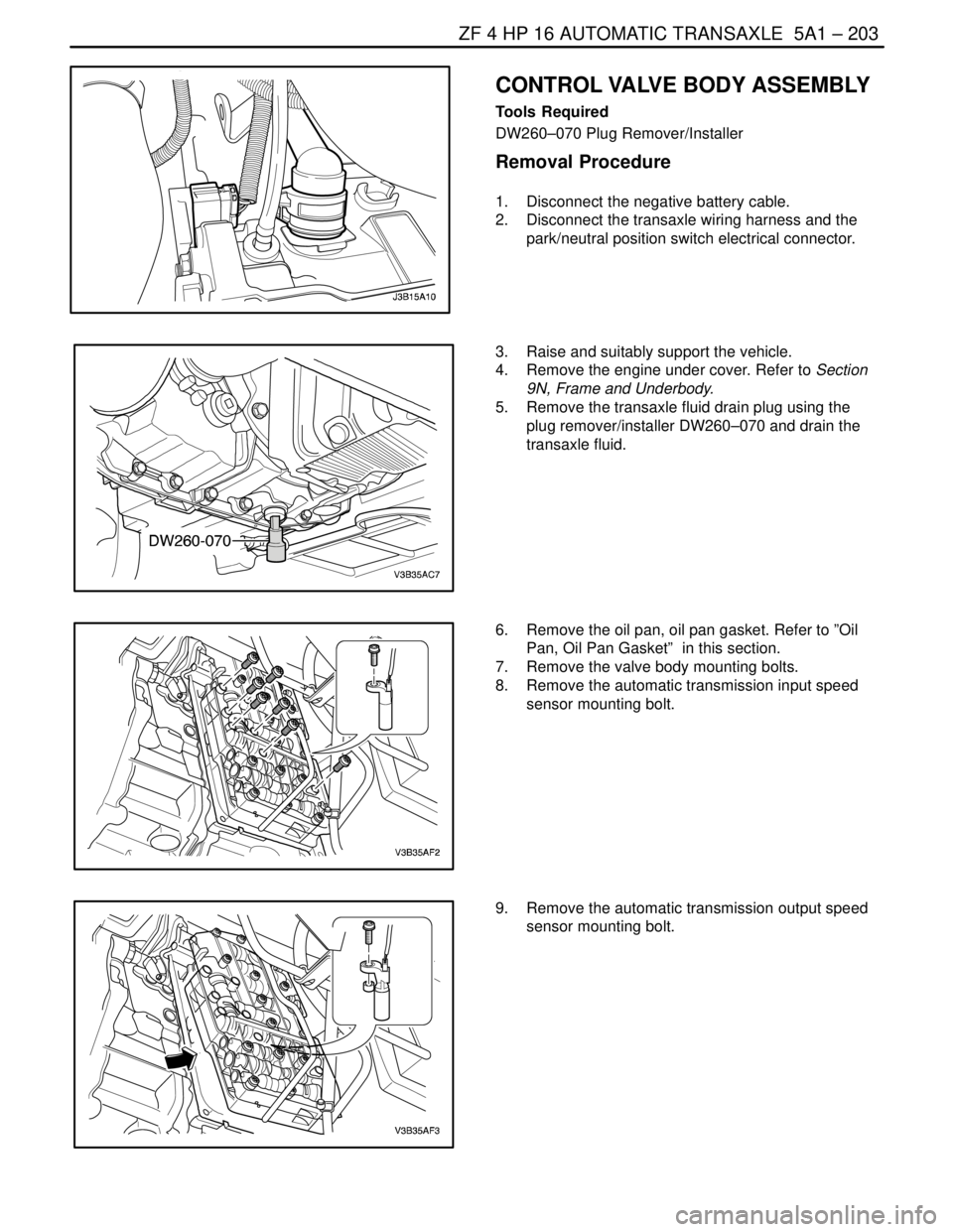
CONTROL VALVE BODY ASSEMBLY
Tools Required
DW260–070 Plug Remover/Installer
Removal Procedure
1. Disconnect the negative battery cable.
2. Disconnect the transaxle wiring harness and the
park/neutral position switch electrical connector.
3. Raise and suitably support the vehicle.
4. Remove the engine under cover. Refer to Section
9N, Frame and Underbody.
5. Remove the transaxle fluid drain plug using the
plug remover/installer DW260–070 and drain the
transaxle fluid.
6. Remove the oil pan, oil pan gasket. Refer to ”Oil
Pan, Oil Pan Gasket” in this section.
7. Remove the valve body mounting bolts.
8. Remove the automatic transmission input speed
sensor mounting bolt.
9. Remove the automatic transmission output speed
sensor mounting bolt.
Page 1553 of 2643
5A1 – 204IZF 4 HP 16 AUTOMATIC TRANSAXLE
DAEWOO V–121 BL4
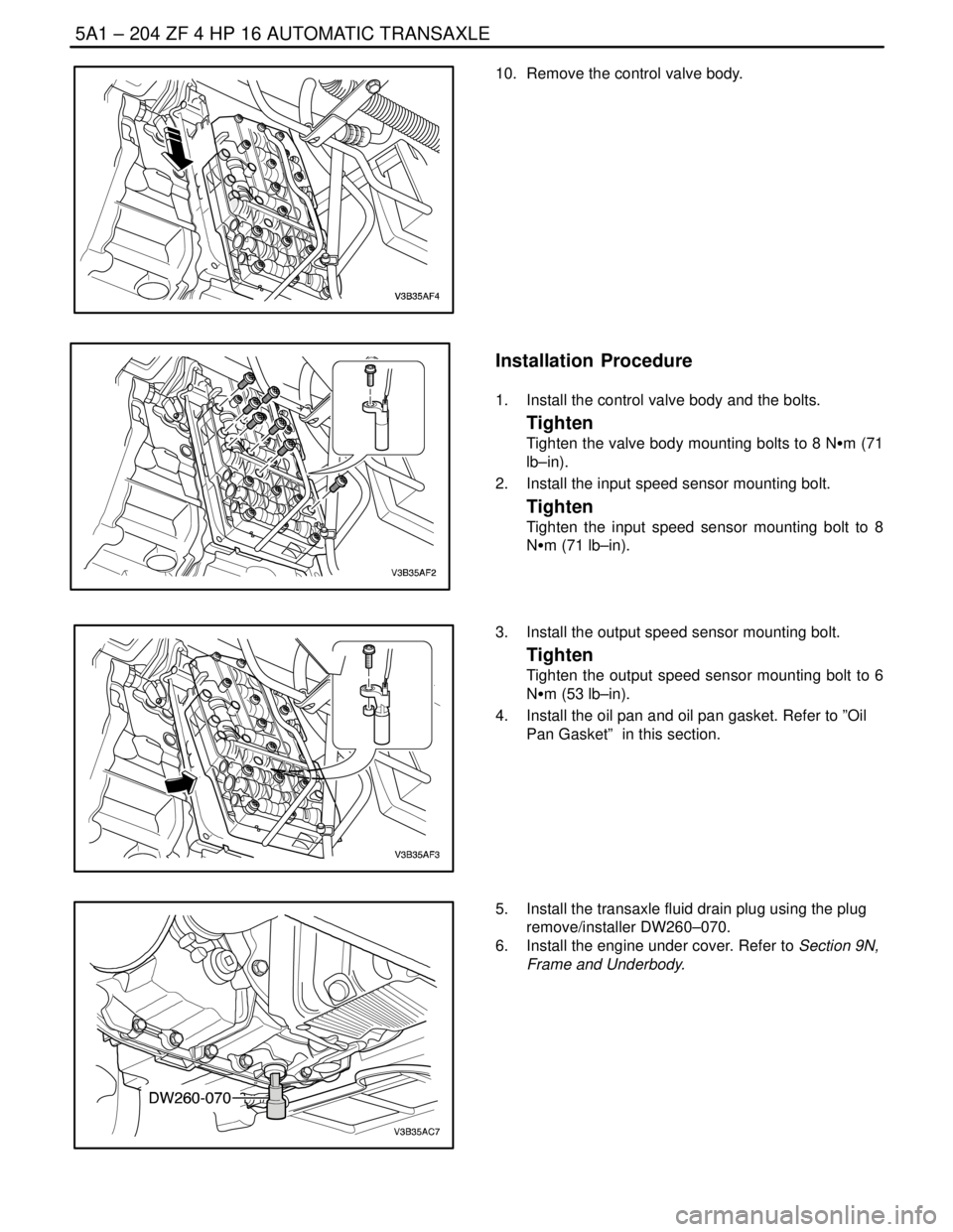
10. Remove the control valve body.
Installation Procedure
1. Install the control valve body and the bolts.
Tighten
Tighten the valve body mounting bolts to 8 NSm (71
lb–in).
2. Install the input speed sensor mounting bolt.
Tighten
Tighten the input speed sensor mounting bolt to 8
NSm (71 lb–in).
3. Install the output speed sensor mounting bolt.
Tighten
Tighten the output speed sensor mounting bolt to 6
NSm (53 lb–in).
4. Install the oil pan and oil pan gasket. Refer to ”Oil
Pan Gasket” in this section.
5. Install the transaxle fluid drain plug using the plug
remove/installer DW260–070.
6. Install the engine under cover. Refer to Section 9N,
Frame and Underbody.
Page 1562 of 2643
ZF 4 HP 16 AUTOMATIC TRANSAXLE 5A1 – 213
DAEWOO V–121 BL4
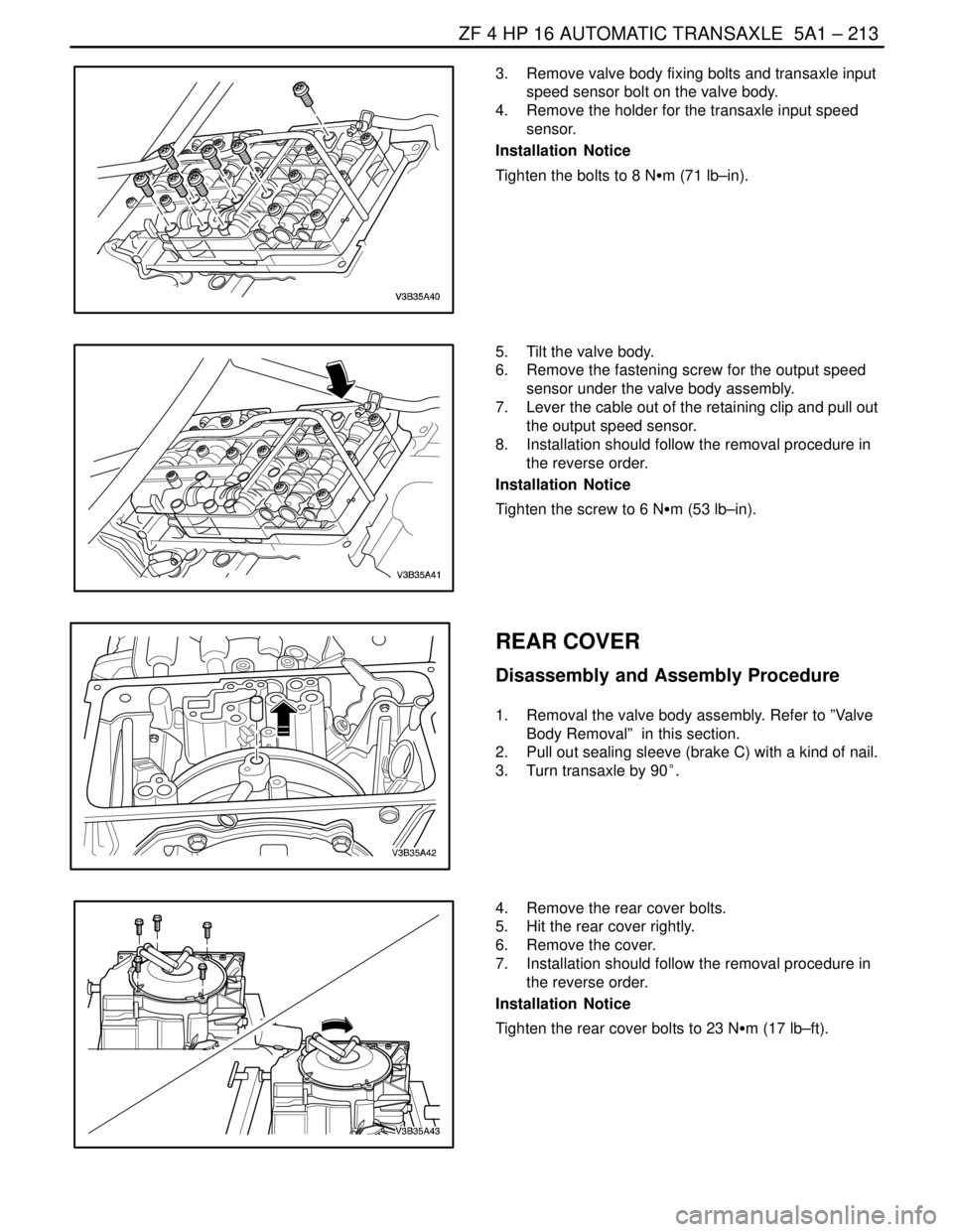
3. Remove valve body fixing bolts and transaxle input
speed sensor bolt on the valve body.
4. Remove the holder for the transaxle input speed
sensor.
Installation Notice
Tighten the bolts to 8 NSm (71 lb–in).
5. Tilt the valve body.
6. Remove the fastening screw for the output speed
sensor under the valve body assembly.
7. Lever the cable out of the retaining clip and pull out
the output speed sensor.
8. Installation should follow the removal procedure in
the reverse order.
Installation Notice
Tighten the screw to 6 NSm (53 lb–in).
REAR COVER
Disassembly and Assembly Procedure
1. Removal the valve body assembly. Refer to ”Valve
Body Removal” in this section.
2. Pull out sealing sleeve (brake C) with a kind of nail.
3. Turn transaxle by 90°.
4. Remove the rear cover bolts.
5. Hit the rear cover rightly.
6. Remove the cover.
7. Installation should follow the removal procedure in
the reverse order.
Installation Notice
Tighten the rear cover bolts to 23 NSm (17 lb–ft).
Page 1581 of 2643

5A1 – 232IZF 4 HP 16 AUTOMATIC TRANSAXLE
DAEWOO V–121 BL4
GENERAL DESCRIPTION
AND SYSTEM OPERATION
The ZF 4HP 16 automatic transaxle consists primarily of
the following components.
Mechanical
S Torque converter with TCC
S Drive link assembly
S Two multiple disk clutch assemblies : Clutch B,E
S Three multiple brake assemblies : Brake C,D,F
S Lock–up clutch valve
S Two planetary gear sets
S One oil pump
S Final drive and differential assembly
Electronic
S Two shift solenoid valve(sol.1,2)
S Four pressure control solenoid valve(EDS)
S Two speed sensors : A/T ISS and A/T OSS
S Fluid temperature sensor
S Automatic transaxle control module(TCM)
S Wiring harness assembly
MECHANICAL COMPONENTS
Torque Converter
The converter consists of the impeller, the turbine wheel,
the reaction member (stator) and the oil to transmit torque.
The impeller, which is driven by the engine, causes the oil
in the converter to flow in a circular pattern. This oil flow
meets the turbine wheel, where is direction of flow is de-
flected. At the hub, the oil leaves the turbine and reaches
the reaction member (stator), where it is once again de-
flected so that it reaches the impeller at the correct angle
of flow.
The reversal effect generates movement in the stator, the
reaction torque then amplifies the turbine torque.
The ratio between turbine torque and torque is referred to
as torque multiplication.
The greater the difference is speed between the pump and
turbine, the greater the torque multiplication; it is at its
highest when the turbine is at a standstill. The higher the
speed of the turbine, the lower the torque multiplication.
When the turbine speed reaches about 85%of the pump
speed, torque multiplication=1, i.e. the turbine torque
equivalent to pump torque.
The stator, which bears against the housing via the free-
wheel, is then rotating freely in the oil flow and the free-
wheel is over–come. From this point onwards, the con-
verter acts as a straightforward fluid coupling.
Space Behind Lock–up Clutch Piston
1. Friction lining
2. Lock–up clutch piston
3. Converter cover
4. Turbine wheel
5. Impeller
6. Stator
7. Turbine hub
8. Torque converter impeller hub
Torque Converter Lock–up Clutch (TCC)
The converter lock–up clutch is a device, which eliminates
converter slip and thus helps to improve fuel consumption.
The previous control principle for converter lock–up clutch
operation has been replaced by a controlling function on
the 4 HP 16. The converter lock–up clutch is engaged and
released in a controlled manner. During the controlled
phase, a slight speed difference between the impeller and
turbine wheel is established. This ensures that the en-
gine’s rotating vibration is not phased on to the transaxle.
The result is optimum shift quality.
An electronic pressure–regulating valve determines pres-
sure regulation of the lock–up converter clutch’s piston.
When open (conversion range), the oil pressure behind
the converter lock–up clutch piston and in the turbine zone
is equal. The direction of flow is through the turbine shaft
and through the space behind the piston, to the turbine
chamber.
Page 1583 of 2643
5A1 – 234IZF 4 HP 16 AUTOMATIC TRANSAXLE
DAEWOO V–121 BL4
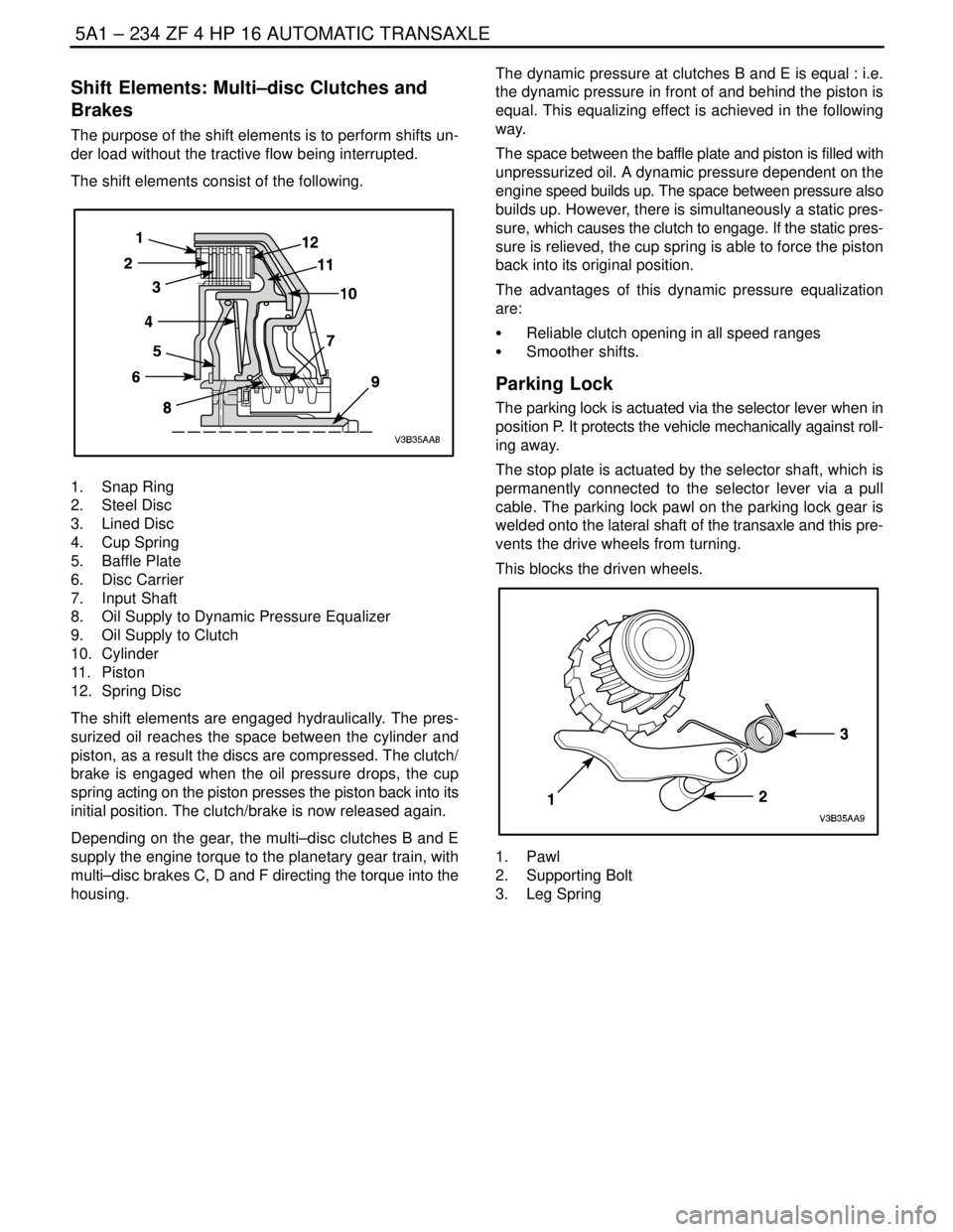
Shift Elements: Multi–disc Clutches and
Brakes
The purpose of the shift elements is to perform shifts un-
der load without the tractive flow being interrupted.
The shift elements consist of the following.
1. Snap Ring
2. Steel Disc
3. Lined Disc
4. Cup Spring
5. Baffle Plate
6. Disc Carrier
7. Input Shaft
8. Oil Supply to Dynamic Pressure Equalizer
9. Oil Supply to Clutch
10. Cylinder
11. Piston
12. Spring Disc
The shift elements are engaged hydraulically. The pres-
surized oil reaches the space between the cylinder and
piston, as a result the discs are compressed. The clutch/
brake is engaged when the oil pressure drops, the cup
spring acting on the piston presses the piston back into its
initial position. The clutch/brake is now released again.
Depending on the gear, the multi–disc clutches B and E
supply the engine torque to the planetary gear train, with
multi–disc brakes C, D and F directing the torque into the
housing.The dynamic pressure at clutches B and E is equal : i.e.
the dynamic pressure in front of and behind the piston is
equal. This equalizing effect is achieved in the following
way.
The space between the baffle plate and piston is filled with
unpressurized oil. A dynamic pressure dependent on the
engine speed builds up. The space between pressure also
builds up. However, there is simultaneously a static pres-
sure, which causes the clutch to engage. If the static pres-
sure is relieved, the cup spring is able to force the piston
back into its original position.
The advantages of this dynamic pressure equalization
are:
S Reliable clutch opening in all speed ranges
S Smoother shifts.
Parking Lock
The parking lock is actuated via the selector lever when in
position P. It protects the vehicle mechanically against roll-
ing away.
The stop plate is actuated by the selector shaft, which is
permanently connected to the selector lever via a pull
cable. The parking lock pawl on the parking lock gear is
welded onto the lateral shaft of the transaxle and this pre-
vents the drive wheels from turning.
This blocks the driven wheels.
1. Pawl
2. Supporting Bolt
3. Leg Spring