Hub DAEWOO LACETTI 2004 Service Owner's Manual
[x] Cancel search | Manufacturer: DAEWOO, Model Year: 2004, Model line: LACETTI, Model: DAEWOO LACETTI 2004Pages: 2643, PDF Size: 80.54 MB
Page 957 of 2643
REAR SUSPENSION 2D – 15
DAEWOO V–121 BL4
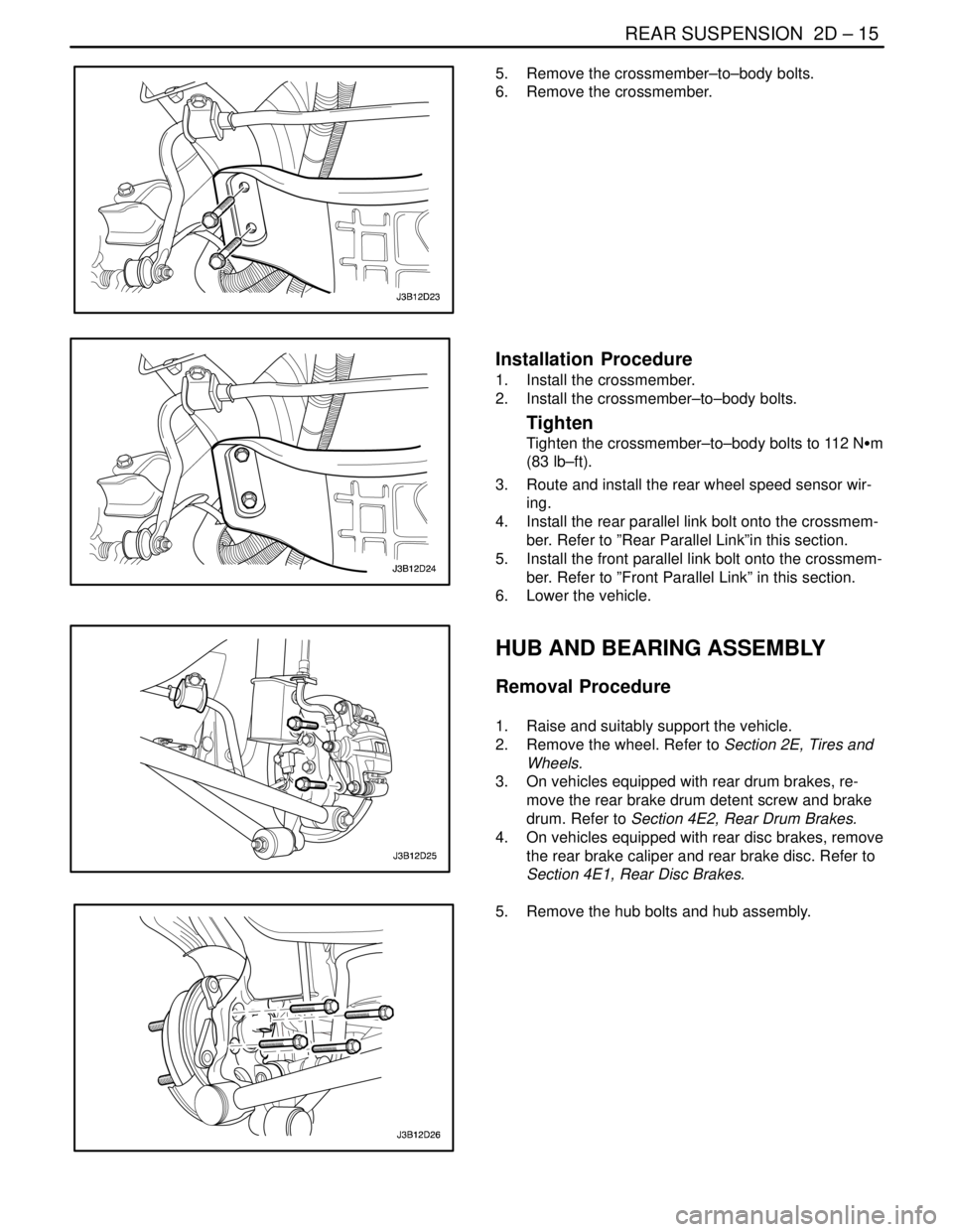
5. Remove the crossmember–to–body bolts.
6. Remove the crossmember.
Installation Procedure
1. Install the crossmember.
2. Install the crossmember–to–body bolts.
Tighten
Tighten the crossmember–to–body bolts to 112 NSm
(83 lb–ft).
3. Route and install the rear wheel speed sensor wir-
ing.
4. Install the rear parallel link bolt onto the crossmem-
ber. Refer to ”Rear Parallel Link”in this section.
5. Install the front parallel link bolt onto the crossmem-
ber. Refer to ”Front Parallel Link” in this section.
6. Lower the vehicle.
HUB AND BEARING ASSEMBLY
Removal Procedure
1. Raise and suitably support the vehicle.
2. Remove the wheel. Refer to Section 2E, Tires and
Wheels.
3. On vehicles equipped with rear drum brakes, re-
move the rear brake drum detent screw and brake
drum. Refer to Section 4E2, Rear Drum Brakes.
4. On vehicles equipped with rear disc brakes, remove
the rear brake caliper and rear brake disc. Refer to
Section 4E1, Rear Disc Brakes.
5. Remove the hub bolts and hub assembly.
Page 958 of 2643
2D – 16IREAR SUSPENSION
DAEWOO V–121 BL4
Installation Procedure
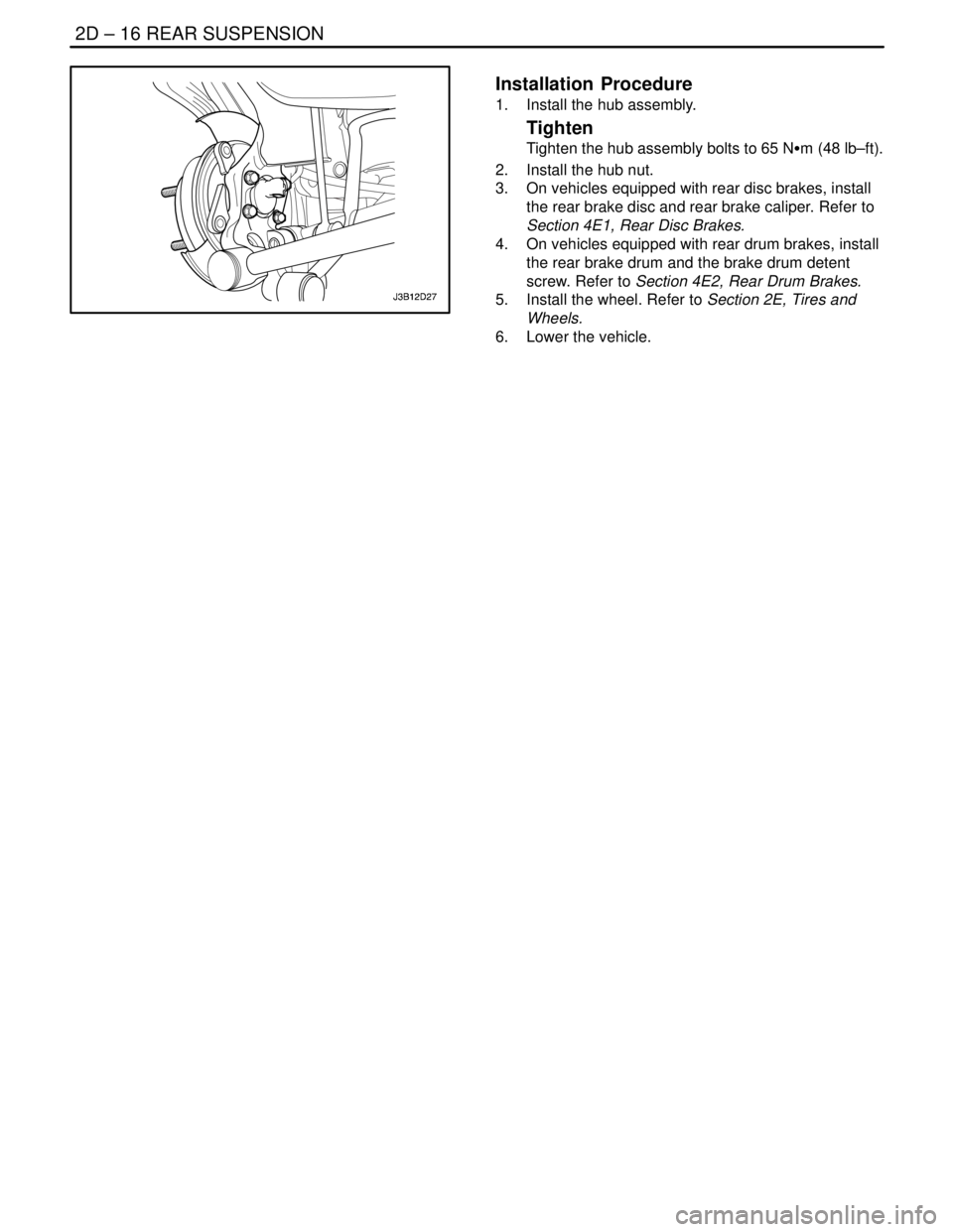
1. Install the hub assembly.
Tighten
Tighten the hub assembly bolts to 65 NSm (48 lb–ft).
2. Install the hub nut.
3. On vehicles equipped with rear disc brakes, install
the rear brake disc and rear brake caliper. Refer to
Section 4E1, Rear Disc Brakes.
4. On vehicles equipped with rear drum brakes, install
the rear brake drum and the brake drum detent
screw. Refer to Section 4E2, Rear Drum Brakes.
5. Install the wheel. Refer to Section 2E, Tires and
Wheels.
6. Lower the vehicle.
Page 960 of 2643
2D – 18IREAR SUSPENSION
DAEWOO V–121 BL4
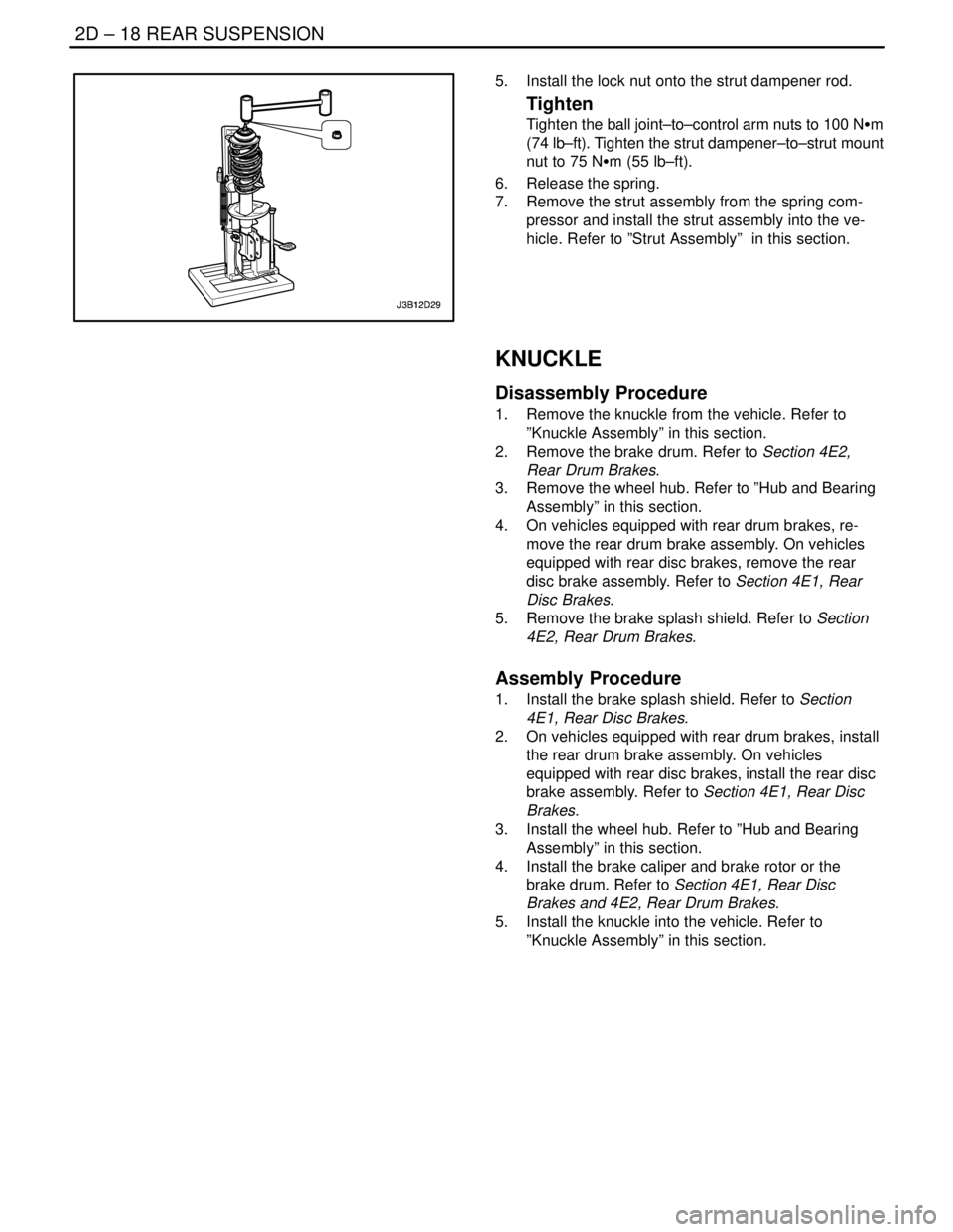
5. Install the lock nut onto the strut dampener rod.
Tighten
Tighten the ball joint–to–control arm nuts to 100 NSm
(74 lb–ft). Tighten the strut dampener–to–strut mount
nut to 75 NSm (55 lb–ft).
6. Release the spring.
7. Remove the strut assembly from the spring com-
pressor and install the strut assembly into the ve-
hicle. Refer to ”Strut Assembly” in this section.
KNUCKLE
Disassembly Procedure
1. Remove the knuckle from the vehicle. Refer to
”Knuckle Assembly” in this section.
2. Remove the brake drum. Refer to Section 4E2,
Rear Drum Brakes.
3. Remove the wheel hub. Refer to ”Hub and Bearing
Assembly” in this section.
4. On vehicles equipped with rear drum brakes, re-
move the rear drum brake assembly. On vehicles
equipped with rear disc brakes, remove the rear
disc brake assembly. Refer to Section 4E1, Rear
Disc Brakes.
5. Remove the brake splash shield. Refer to Section
4E2, Rear Drum Brakes.
Assembly Procedure
1. Install the brake splash shield. Refer to Section
4E1, Rear Disc Brakes.
2. On vehicles equipped with rear drum brakes, install
the rear drum brake assembly. On vehicles
equipped with rear disc brakes, install the rear disc
brake assembly. Refer to Section 4E1, Rear Disc
Brakes.
3. Install the wheel hub. Refer to ”Hub and Bearing
Assembly” in this section.
4. Install the brake caliper and brake rotor or the
brake drum. Refer to Section 4E1, Rear Disc
Brakes and 4E2, Rear Drum Brakes.
5. Install the knuckle into the vehicle. Refer to
”Knuckle Assembly” in this section.
Page 961 of 2643

REAR SUSPENSION 2D – 19
DAEWOO V–121 BL4
HUB AND BEARING
The hub bearing is not unit repair serviceable. If the hub
bearing is defective, the hub and bearing assembly should
be replaced.
Page 962 of 2643

2D – 20IREAR SUSPENSION
DAEWOO V–121 BL4
GENERAL DESCRIPTION
AND SYSTEM OPERATION
REAR SUSPENSION
The rear suspension is fully independent and consists of
a crossmember with four parallel links, two trailing links,
two strut assemblies with coil springs and insulators, and
two knuckles containing the hub and bearing assemblies.
The strut assemblies support the weight of the vehicle us-
ing coil springs positioned around the strut dampeners.The coil springs are seated on insulators attached to the
upper mount and the lower spring seat of the strut assem-
bly. The parallel links and the trailing link bracket have rub-
ber isolator bushings at each end and are attached to the
crossmember and the knuckle. The rear parallel link is at-
tached to the crossmember through adjustment cams that
are used to adjust rear toe. The trailing links are attached
to the body, through the trailing link bracket, and the bot-
tom of the knuckle. A forged knuckle bolts to each strut as-
sembly. Lateral movement of the knuckle is controlled by
the parallel links. Fore and aft movement of the knuckle is
controlled by the trailing link.
Page 965 of 2643

TIRES AND WHEELS 2E – 3
DAEWOO V–121 BL4
MAINTENANCE AND REPAIR
ON–VEHICLE SERVICE
WHEEL
Removal Procedure
1. Loosen the wheel bolts.
2. Raise and suitably support the vehicle.
3. Remove the wheel bolts.
Notice : Never use heat to loosen a tight wheel. It can
shorten the life of the wheel, the wheel nuts and the wheel
bearings. Excessive force, such as hammering the wheel
or tire, can also cause damage and is not recommended.
Slight tapping of the wheel sidewall with one’s hand or with
a rubber mallet is acceptable.
4. Remove the wheel.
Difficulty in removing the wheels from the vehicle can be
due to foreign material or to a tight fit between the wheel
centerhole and the hub or the rotor. These wheels can be
removed by
5. Retightening the wheel bolts on the affected wheel
and then loosening the wheel bolts by two turns.
6. Lowering the vehicle and rocking it from side to side
as hard as possible, using one or more person’s
body weight to loosen the wheel.
7. Raising the vehicle and removing the wheel.
CAUTION : Do not allow the penetrating oil to get on
the vertical surfaces between the wheel and the drum
(or rotor) because penetrating oil in this area could
cause the wheel to work loose as the vehicle is driven,
resulting in loss of control and an injury accident.
Penetrating oil is not effective in removing tight wheels. If
it is used, however, apply it sparingly and only to the
wheel’s centerhole area.
Installation Procedure
Notice : Before installing the wheels, remove any buildup
of corrosion on the wheel mounting surface and the brake
drum or the rotor mounting surface by scraping and brush-
ing them with a wire brush. Installing the wheels without
good metal–to–metal contact at the mounting surfaces
can cause the wheel nuts to loosen, which can later allow
a wheel to come off while the vehicle is moving. Wheel
bolts must be tightened in sequence and to the proper
torque to avoid bending the wheel, the brake drum or the
rotor.
1. Mount the wheel.
2. Install the wheel bolts in the sequence shown. Do
not tighten the wheel bolts.
3. Lower the vehicle.
Tighten
Tighten the wheel bolts to 100 NSm (74 lb–ft).
Page 994 of 2643
AUTOMATIC TRANSAXLE DRIVE AXLE 3A – 5
DAEWOO V–121 BL4
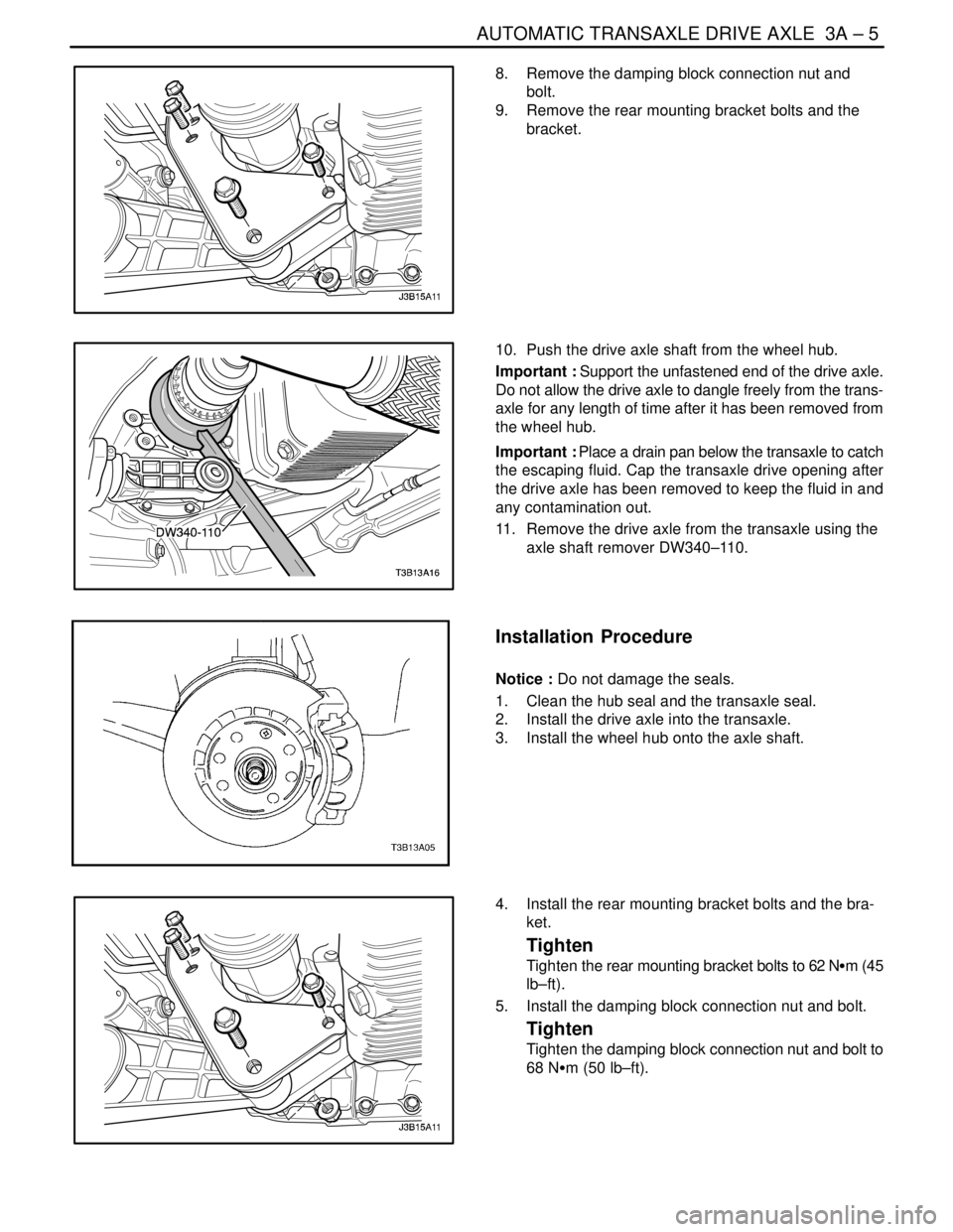
8. Remove the damping block connection nut and
bolt.
9. Remove the rear mounting bracket bolts and the
bracket.
10. Push the drive axle shaft from the wheel hub.
Important : Support the unfastened end of the drive axle.
Do not allow the drive axle to dangle freely from the trans-
axle for any length of time after it has been removed from
the wheel hub.
Important : Place a drain pan below the transaxle to catch
the escaping fluid. Cap the transaxle drive opening after
the drive axle has been removed to keep the fluid in and
any contamination out.
11. Remove the drive axle from the transaxle using the
axle shaft remover DW340–110.
Installation Procedure
Notice : Do not damage the seals.
1. Clean the hub seal and the transaxle seal.
2. Install the drive axle into the transaxle.
3. Install the wheel hub onto the axle shaft.
4. Install the rear mounting bracket bolts and the bra-
ket.
Tighten
Tighten the rear mounting bracket bolts to 62 NSm (45
lb–ft).
5. Install the damping block connection nut and bolt.
Tighten
Tighten the damping block connection nut and bolt to
68 NSm (50 lb–ft).
Page 995 of 2643
3A – 6IAUTOMATIC TRANSAXLE DRIVE AXLE
DAEWOO V–121 BL4
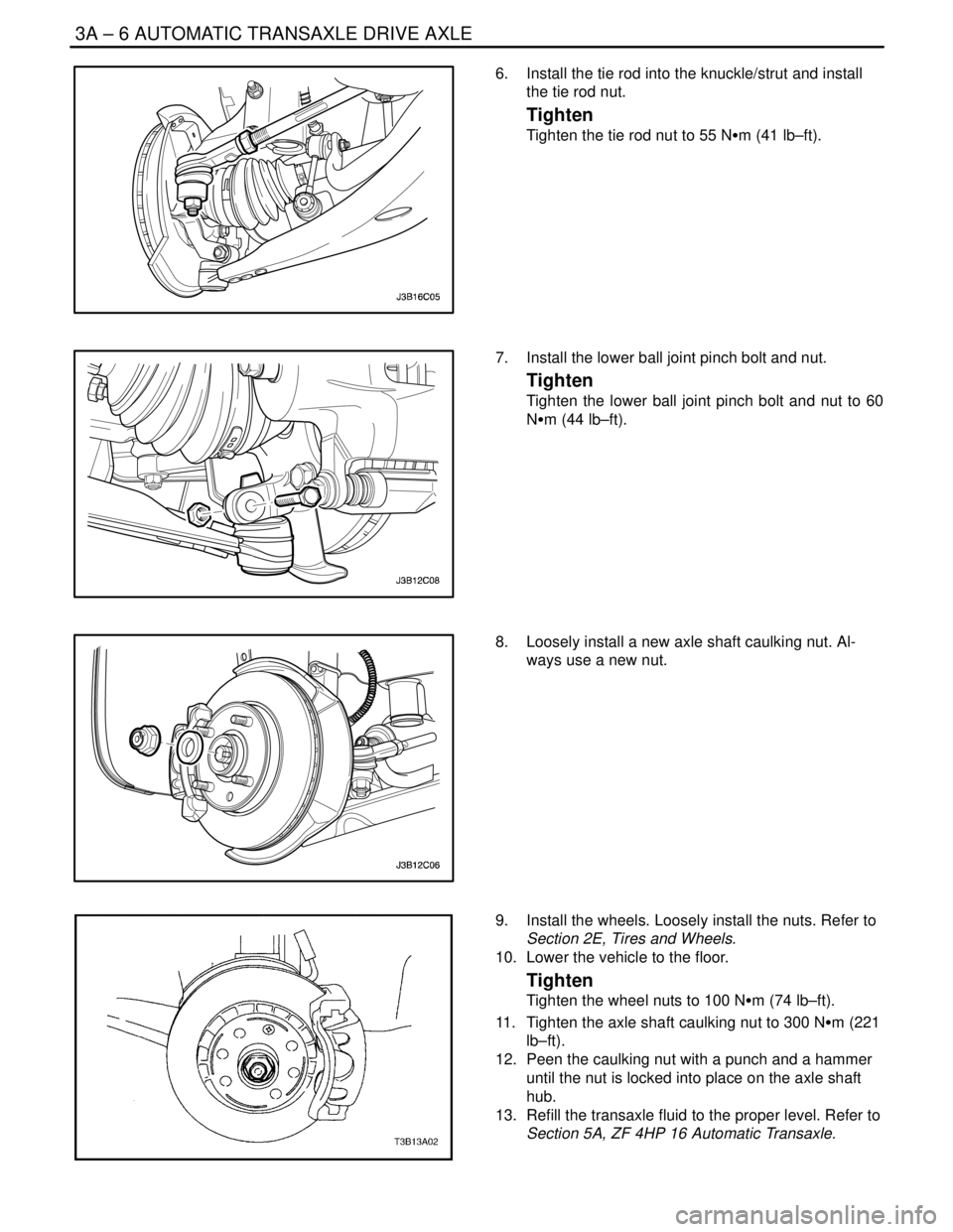
6. Install the tie rod into the knuckle/strut and install
the tie rod nut.
Tighten
Tighten the tie rod nut to 55 NSm (41 lb–ft).
7. Install the lower ball joint pinch bolt and nut.
Tighten
Tighten the lower ball joint pinch bolt and nut to 60
NSm (44 lb–ft).
8. Loosely install a new axle shaft caulking nut. Al-
ways use a new nut.
9. Install the wheels. Loosely install the nuts. Refer to
Section 2E, Tires and Wheels.
10. Lower the vehicle to the floor.
Tighten
Tighten the wheel nuts to 100 NSm (74 lb–ft).
11. Tighten the axle shaft caulking nut to 300 NSm (221
lb–ft).
12. Peen the caulking nut with a punch and a hammer
until the nut is locked into place on the axle shaft
hub.
13. Refill the transaxle fluid to the proper level. Refer to
Section 5A, ZF 4HP 16 Automatic Transaxle.
Page 1005 of 2643
3B – 6IMANUAL TRANSAXLE DRIVE AXLE
DAEWOO V–121 BL4
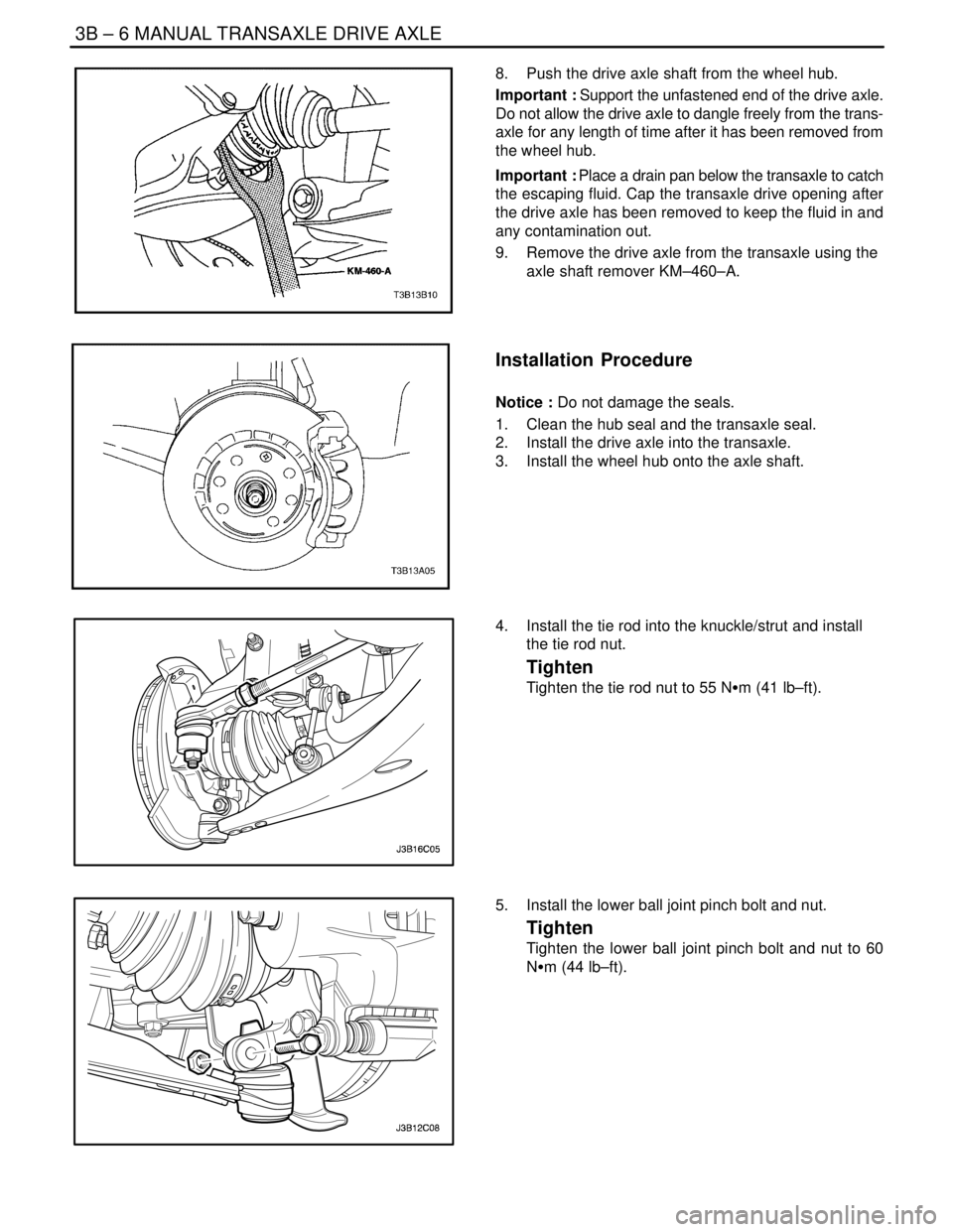
8. Push the drive axle shaft from the wheel hub.
Important : Support the unfastened end of the drive axle.
Do not allow the drive axle to dangle freely from the trans-
axle for any length of time after it has been removed from
the wheel hub.
Important : Place a drain pan below the transaxle to catch
the escaping fluid. Cap the transaxle drive opening after
the drive axle has been removed to keep the fluid in and
any contamination out.
9. Remove the drive axle from the transaxle using the
axle shaft remover KM–460–A.
Installation Procedure
Notice : Do not damage the seals.
1. Clean the hub seal and the transaxle seal.
2. Install the drive axle into the transaxle.
3. Install the wheel hub onto the axle shaft.
4. Install the tie rod into the knuckle/strut and install
the tie rod nut.
Tighten
Tighten the tie rod nut to 55 NSm (41 lb–ft).
5. Install the lower ball joint pinch bolt and nut.
Tighten
Tighten the lower ball joint pinch bolt and nut to 60
NSm (44 lb–ft).
Page 1006 of 2643
MANUAL TRANSAXLE DRIVE AXLE 3B – 7
DAEWOO V–121 BL4
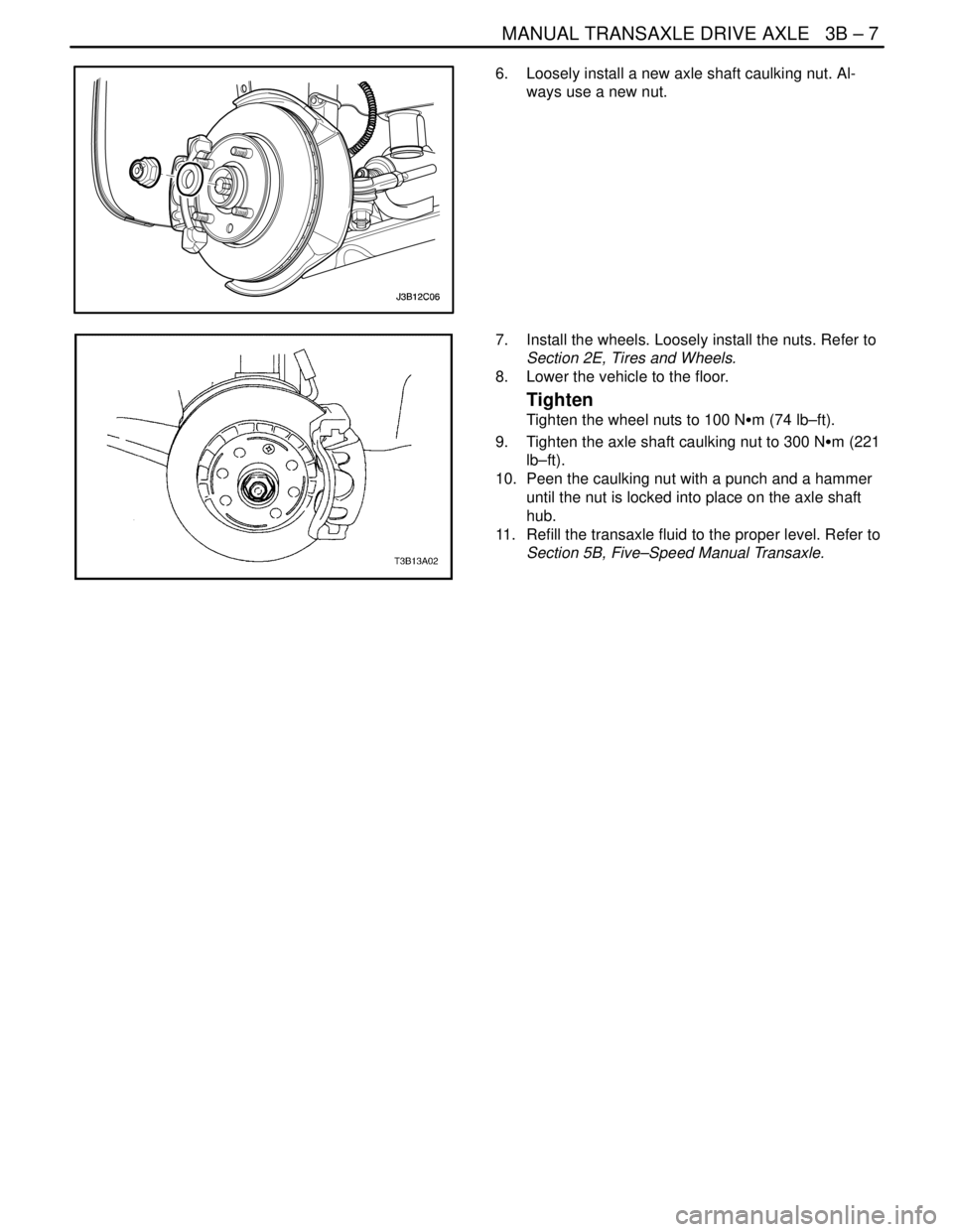
6. Loosely install a new axle shaft caulking nut. Al-
ways use a new nut.
7. Install the wheels. Loosely install the nuts. Refer to
Section 2E, Tires and Wheels.
8. Lower the vehicle to the floor.
Tighten
Tighten the wheel nuts to 100 NSm (74 lb–ft).
9. Tighten the axle shaft caulking nut to 300 NSm (221
lb–ft).
10. Peen the caulking nut with a punch and a hammer
until the nut is locked into place on the axle shaft
hub.
11. Refill the transaxle fluid to the proper level. Refer to
Section 5B, Five–Speed Manual Transaxle.