Hub DAEWOO LACETTI 2004 Service Service Manual
[x] Cancel search | Manufacturer: DAEWOO, Model Year: 2004, Model line: LACETTI, Model: DAEWOO LACETTI 2004Pages: 2643, PDF Size: 80.54 MB
Page 1065 of 2643
4E1 – 8IREAR DISC BRAKES
DAEWOO V–121 BL4
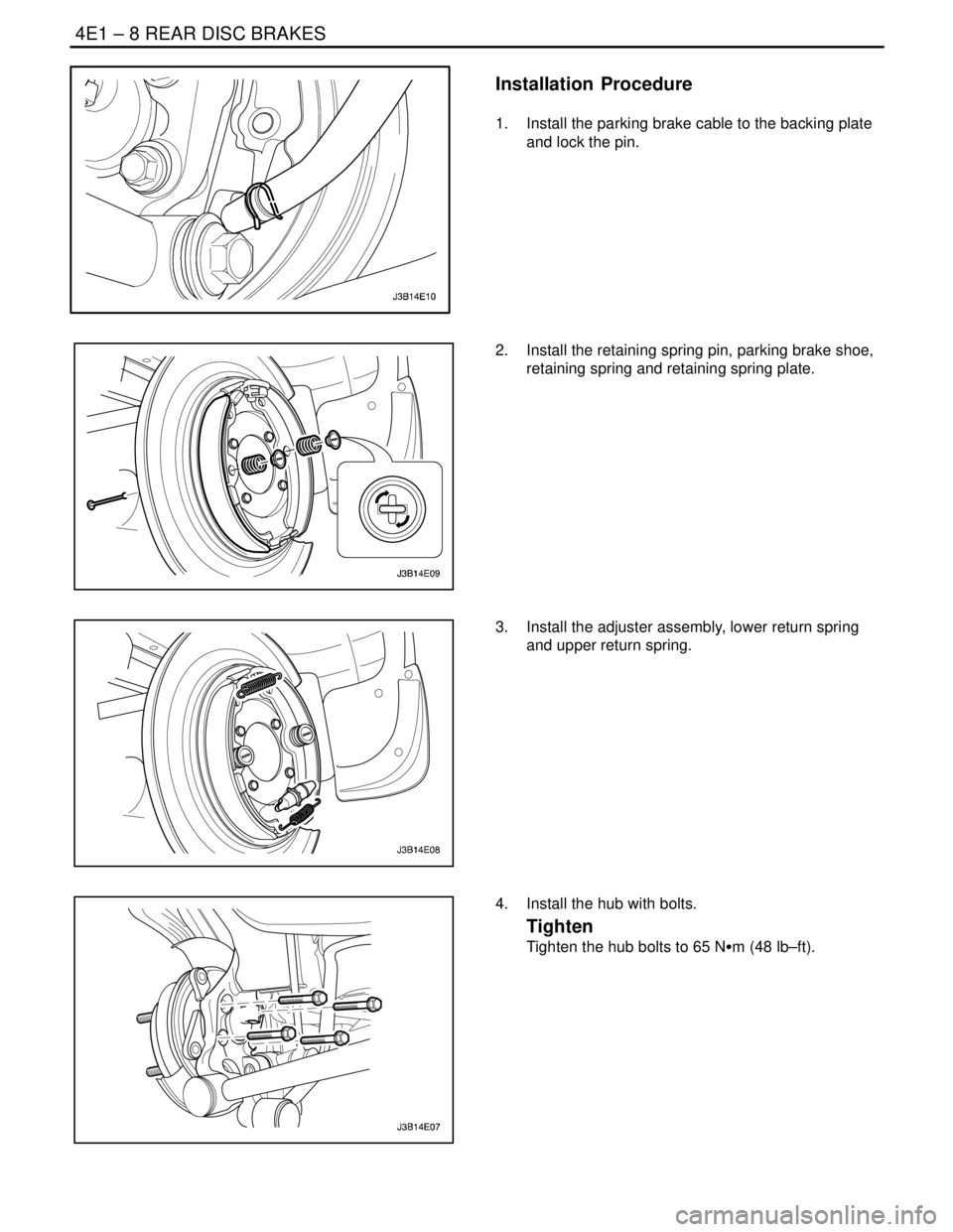
Installation Procedure
1. Install the parking brake cable to the backing plate
and lock the pin.
2. Install the retaining spring pin, parking brake shoe,
retaining spring and retaining spring plate.
3. Install the adjuster assembly, lower return spring
and upper return spring.
4. Install the hub with bolts.
Tighten
Tighten the hub bolts to 65 NSm (48 lb–ft).
Page 1070 of 2643

SECTION : 4E2
REAR DRUM BRAKES
TABLE OF CONTENTS
SPECIFICATIONS4E2–1 . . . . . . . . . . . . . . . . . . . . . . . . .
Fastener Tightening Specifications 4E2–1. . . . . . . . .
DIAGNOSIS4E2–1 . . . . . . . . . . . . . . . . . . . . . . . . . . . . . . .
Lining Inspection 4E2–1. . . . . . . . . . . . . . . . . . . . . . . . .
Drums 4E2–1. . . . . . . . . . . . . . . . . . . . . . . . . . . . . . . . . .
MAINTENANCE AND REPAIR4E2–3 . . . . . . . . . . . . . .
ON–VEHICLE SERVICE 4E2–3. . . . . . . . . . . . . . . . . . . .
Brake Adjustment 4E2–3. . . . . . . . . . . . . . . . . . . . . . . . Shoe and Lining 4E2–4. . . . . . . . . . . . . . . . . . . . . . . . .
Wheel Cylinder Assembly 4E2–7. . . . . . . . . . . . . . . . .
Backing Plate 4E2–8. . . . . . . . . . . . . . . . . . . . . . . . . . . .
UNIT REPAIR 4E2–10. . . . . . . . . . . . . . . . . . . . . . . . . . . .
Wheel Cylinder 4E2–10. . . . . . . . . . . . . . . . . . . . . . . . .
GENERAL DESCRIPTION AND SYSTEM
OPERATION4E2–12 . . . . . . . . . . . . . . . . . . . . . . . . . . . .
Drum Brakes 4E2–12. . . . . . . . . . . . . . . . . . . . . . . . . . .
SPECIFICATIONS
FASTENER TIGHTENING SPECIFICATIONS
ApplicationNSmLb–FtLb–In
Brake Line1612–
Brake Wheel Hub/Backing Plate–to–Rear
Axle Nuts2821–
Wheel Cylinder–to–Backing Plate Bolt8–71
DIAGNOSIS
LINING INSPECTION
1. Raise and suitably support the vehicle.
2. Remove the wheel. Refer to Section 2E, Tires and
Wheels.
3. Release the parking brake.
4. Remove the drum. Refer to ” Drum” in this section.
5. Measure the lining thickness. The minimum lining
thickness is 0.5 mm (0.02 inch).
CAUTION : To avoid injury when servicing brake
parts, do not create dust by grinding or sanding the
brake linings or by cleaning the wheel brake parts
with a dry brush or with compressed air.
Important : Replace the shoe and lining assembly in axle
sets only.
6. Install the drum, if removed. Refer to ”One–Piece
Drum” or ”Two–Piece Drum” in this section.
7. Install the wheel, if removed. Refer to Section 2E,
Tires and Wheels.
8. Lower the vehicle.
DRUMS
Whenever brake drums are removed, they should be thor-
oughly cleaned and inspected to see if the drums are
cracked, scored, deeply grooved, or beyond the specified
out–of–round limit.
S A cracked drum is unsafe for further service and-
must be replaced. Do not attempt to weld a cracked
drum. Smooth out any slight scores.
S Heavy or extensive scoring will cause excessive
brake lining wear and may require refinishing the
drum braking surface.
S If the brake linings are slightly worn but are still re-
usable and the drum is grooved, polish the drum
with a fine emery cloth but do not refinish it. Elimi-
nating all grooves in the drum and smoothing the
ridges on the lining would remove too much metal
and lining. If left alone, the grooves and ridges
match, and satisfactory service can be obtained. If
the brake linings need to be replaced, refinish a
grooved drum. A grooved drum, used with a new
Page 1077 of 2643
4E2 – 8IREAR DRUM BRAKES
DAEWOO V–121 BL4
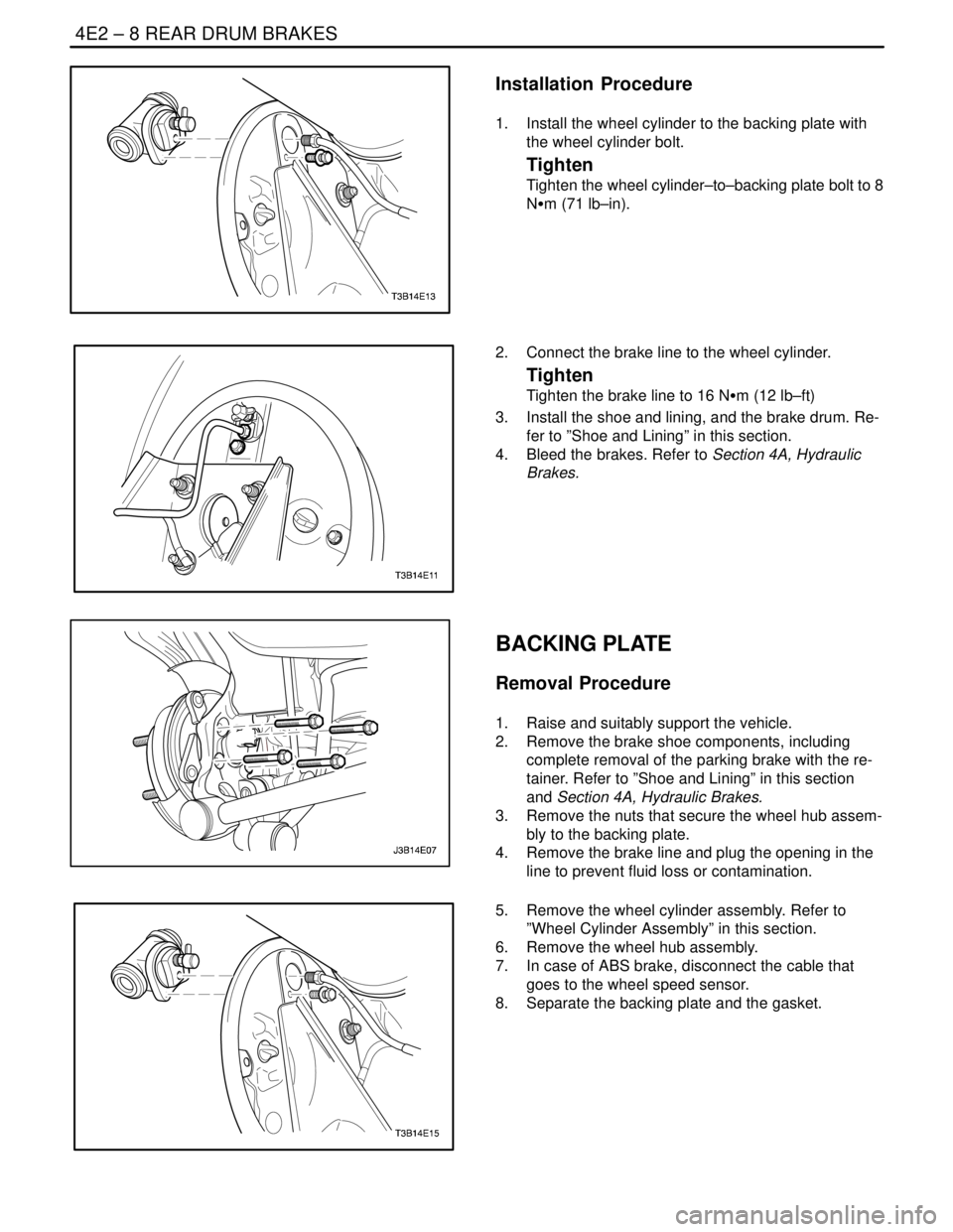
Installation Procedure
1. Install the wheel cylinder to the backing plate with
the wheel cylinder bolt.
Tighten
Tighten the wheel cylinder–to–backing plate bolt to 8
NSm (71 lb–in).
2. Connect the brake line to the wheel cylinder.
Tighten
Tighten the brake line to 16 NSm (12 lb–ft)
3. Install the shoe and lining, and the brake drum. Re-
fer to ”Shoe and Lining” in this section.
4. Bleed the brakes. Refer to Section 4A, Hydraulic
Brakes.
BACKING PLATE
Removal Procedure
1. Raise and suitably support the vehicle.
2. Remove the brake shoe components, including
complete removal of the parking brake with the re-
tainer. Refer to ”Shoe and Lining” in this section
and Section 4A, Hydraulic Brakes.
3. Remove the nuts that secure the wheel hub assem-
bly to the backing plate.
4. Remove the brake line and plug the opening in the
line to prevent fluid loss or contamination.
5. Remove the wheel cylinder assembly. Refer to
”Wheel Cylinder Assembly” in this section.
6. Remove the wheel hub assembly.
7. In case of ABS brake, disconnect the cable that
goes to the wheel speed sensor.
8. Separate the backing plate and the gasket.
Page 1078 of 2643
REAR DRUM BRAKES 4E2 – 9
DAEWOO V–121 BL4
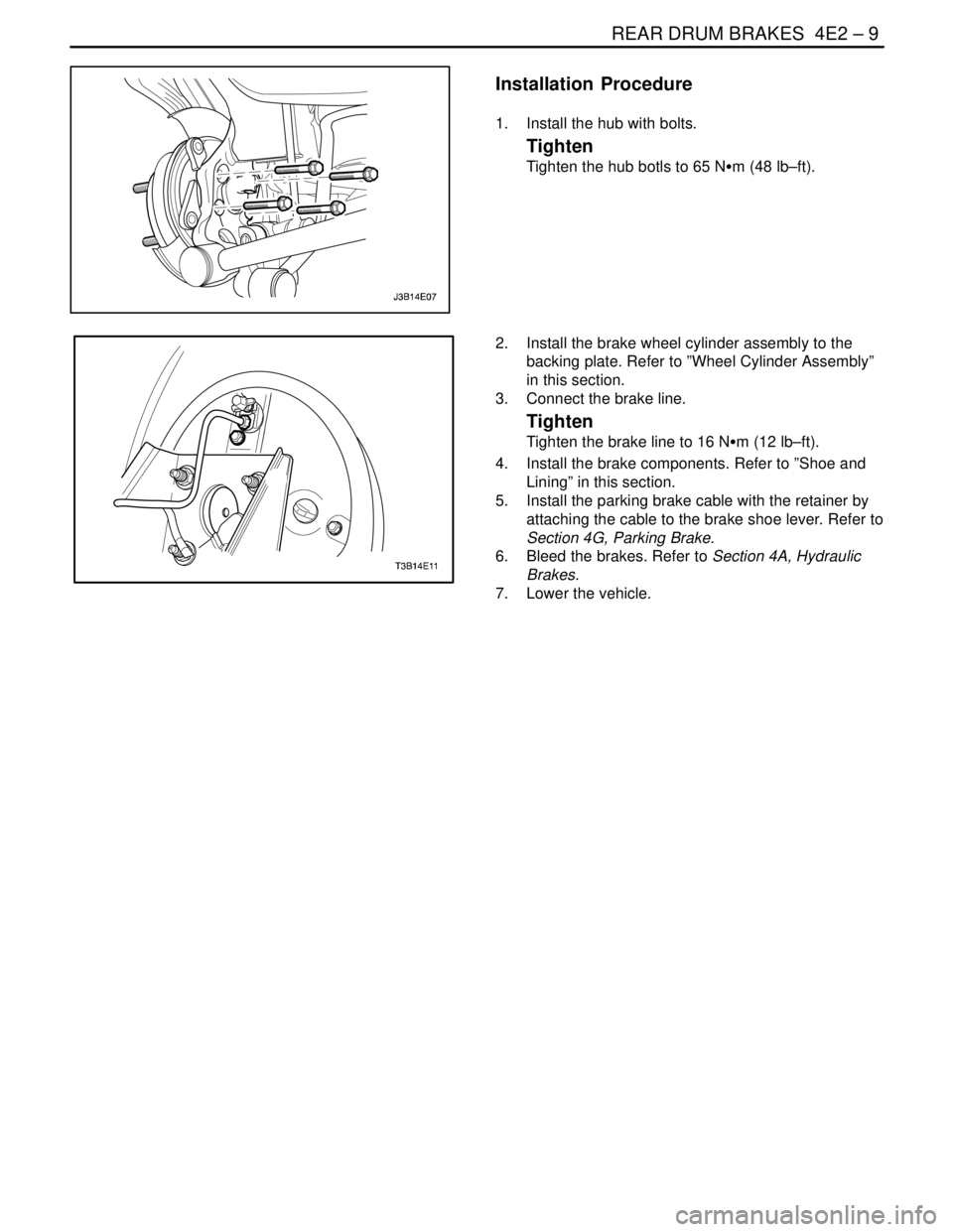
Installation Procedure
1. Install the hub with bolts.
Tighten
Tighten the hub botls to 65 NSm (48 lb–ft).
2. Install the brake wheel cylinder assembly to the
backing plate. Refer to ”Wheel Cylinder Assembly”
in this section.
3. Connect the brake line.
Tighten
Tighten the brake line to 16 NSm (12 lb–ft).
4. Install the brake components. Refer to ”Shoe and
Lining” in this section.
5. Install the parking brake cable with the retainer by
attaching the cable to the brake shoe lever. Refer to
Section 4G, Parking Brake.
6. Bleed the brakes. Refer to Section 4A, Hydraulic
Brakes.
7. Lower the vehicle.
Page 1132 of 2643

ANTILOCK BRAKE SYSTEM 4F – 51
DAEWOO V–121 BL4
Diagnostic Aids
DTC C0245 may be set by running the scan tool auto test
if the throttle angle readings are not updating while in the
data list mode. If this is the case, clear the DTCs, discon-
nect the scan tool, and road test the vehicle to at least 12
km/h (7 mph) to see if the DTC resets.
Check the toothed wheels for any large grooves, gouges,
marks, etc. that might influence the tooth’s signal at the
wheel speed sensor. Also check for a buildup of foreignmaterial in the gaps between teeth in the toothed wheel,
this material may cause this malfunction.
A badly worn hub/bearing assembly may cause this mal-
function. The wheel speed sensor–to–toothed wheel air
gap may change excessively due to bearing play.
If an improper rear hub assembly or front outer constant
velocity joint is installed, one with a toothed wheel contain-
ing the incorrect number of teeth, this DTC can set. Be
sure that the front and the rear toothed wheel have 47 and
29 teeth.
DTC C0245 – Wheel Speed Sensor Frequency Error
StepActionValue(s)YesNo
1Visually inspect the wiring for the front wheel speed
sensors.
Is there any damage?–Go to Step 2Go to Step 3
2Check that the correct outer constant velocity (CV)
joints are installed on the vehicle. The front speed
rings have 47 teeth and the rear speed rings have 29
theeth.
Is the repair complete?–System OK–
3Check fuse EF2 in the engine fuse block.
Is one of these incorrect?–Go to Step 4Go to Step 5
4Replace the incorrect outer CV joint with the proper
unit.
Is the repair complete?–System OK–
51. Disconnect the wheel speed sensor harnesses
from the wheel speed sensor connectors.
2. Measure the wheel speed sensor resistance at
the wheel speed sensor connector terminals.
Does the resistance fall within the specified values
for both wheel speed sensors?1280–1920 WGo to Step 7Go to Step 6
6Replace the faulty wheel speed sensor.
Is the repair complete?–System OK–
71. Disconnect ABS control module connector.
2. Check each wheel speed sensor harness for a
short circuit between its wires with a digital
ohmmeter attached to the two terminals at the
harness side of the wheel speed sensor con-
nector.
3. Also check each wheel speed sensor harness
wire for a short to ground from the connector
terminals.
Is there any short circuit in either wheel speed sen-
sor harness?–Go to Step 8Go to Step 9
8Repair the short circuit in the wiring or from a wiring
harness to ground.
Is the repair complete?–System OK–
Page 1133 of 2643

4F – 52IANTILOCK BRAKE SYSTEM
DAEWOO V–121 BL4
StepNo Yes Value(s) Action
9Check the continuity of the wiring in both front wheel
speed sensor circuits between the ABS connector
and the wheel speed sensor wheel speed sensor
connector on each side of the vehicle.
1. The left side uses terminals 6 and 7 at the ABS
connector.
2. The right side uses terminals 4 and 5 at the
ABS connector.
Is continuity good for both harnesses?–Go to Step 11Go to Step 10
10Repair the discontinuity found in the front wheel
speed sensor harness.
Is the repair complete?–System OK–
111. Visually inspect the wiring for the rear wheel
speed sensors.
2. Check that the wheel speed sensors are prop-
erly mounted and that the retaining bolts are
properly tightened.
Is there any damage?–Go to Step 12Go to Step 13
12Repair or replace components as required.
Is the repair complete?–System OK–
13Remove each wheel speed sensor from the rear
knuckles and inspect the toothed ring through the
wheel speed sensor mounting holes.
1. Check for any damaged or missing teeth.
2. Check that the ring is properly positioned under
the wheel speed sensor.
Is there any damage or other fault with either speed
ring?–Go to Step 14Go to Step 15
14Replace the rear wheel hub with the proper unit.
Is the repair complete?–System OK–
151. Disconnect the rear wheel speed sensor har-
nesses from the wheel speed sensor connec-
tors.
2. Measure the wheel speed sensor resistance at
the wheel speed sensor connector terminals.
Does the resistance fall within the specified values
for both wheel speed sensors?1280–1920 WGo to Step 17Go to Step 16
16Replace the faulty wheel speed sensor.
Is the repair complete?–System OK–
171. The ABS control module connector should still
be disconnected. Disconnect it now if it is not.
2. Check each wheel speed sensor harness for a
short circuit between its wires with a digital
ohmmeter attached to the two terminals at the
harness side of the wheel speed sensor con-
nector.
3. Also check each wheel speed sensor harness
wire for a short to ground from the connector
terminals.
Is there any short circuit in either wheel speed sen-
sor harness?–Go to Step 18Go to Step 19
Page 1145 of 2643
4F – 64IANTILOCK BRAKE SYSTEM
DAEWOO V–121 BL4
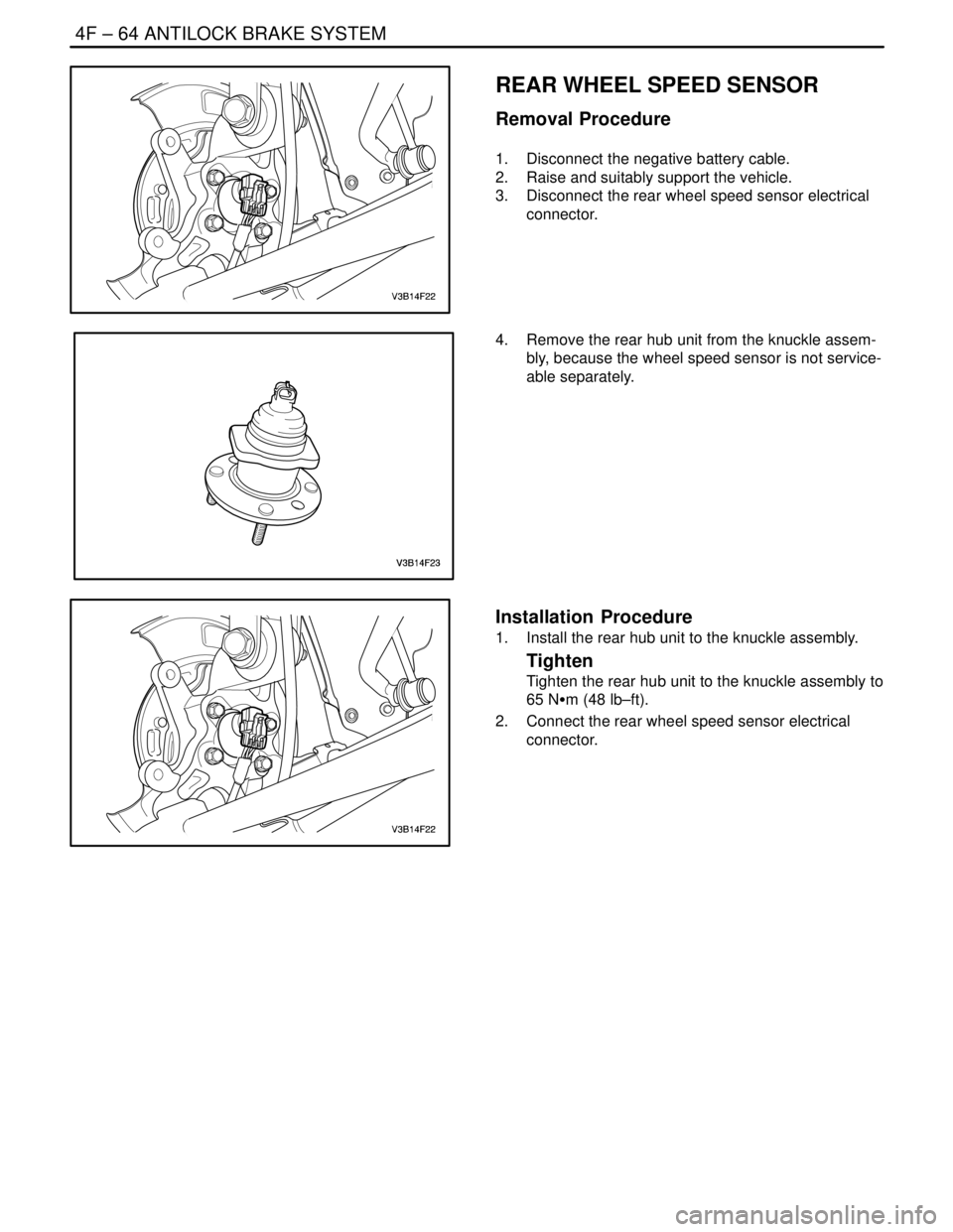
REAR WHEEL SPEED SENSOR
Removal Procedure
1. Disconnect the negative battery cable.
2. Raise and suitably support the vehicle.
3. Disconnect the rear wheel speed sensor electrical
connector.
4. Remove the rear hub unit from the knuckle assem-
bly, because the wheel speed sensor is not service-
able separately.
Installation Procedure
1. Install the rear hub unit to the knuckle assembly.
Tighten
Tighten the rear hub unit to the knuckle assembly to
65 NSm (48 lb–ft).
2. Connect the rear wheel speed sensor electrical
connector.
Page 1152 of 2643

ANTILOCK BRAKE SYSTEM 4F – 71
DAEWOO V–121 BL4
TIRES AND ABS/EBD
Replacement Tires
Tire size is important for proper performance of the ABS
system. Replacement tires should be the same size, load
range, and construction as the original tires. Replace tires
in axle sets and only with tires of the same tire perfor-
mance criteria (TPC) specification number. Use of any
other size or type may seriously affect the ABS operation.
TIRES AND ABS/EBD
Notice : There is no serviceable or removable EEPROM.
The EBCM must be replaced as an assembly.
The EBCM is attached to the hydraulic unit in the engine
compartment. The controlling element of ABS 5.3 is a mi-
croprocessor–based EBCM. Inputs to the system include
the four wheel speed sensors, the stoplamp switch, the
ignition switch, and the unswitched battery voltage. There
is an output to a bi–directional serial data link, located in
pin K of Data Link Connector (DLC) for service diagnostic
tools and assembly plant testing.
The EBCM monitors the speed of each wheel. If any wheel
begins to approach lockup and the brake switch is closed
(brake pedal depressed), the EBCM controls the sole-
noids to reduce brake pressure to the wheel approaching
lockup. Once the wheel regains traction, brake pressure
is increased until the wheel again begins to approach lock-
up. This cycle repeats until either the vehicle comes to a
stop, the brake pedal is released, or no wheels approach
lockup.
Additionally, the EBCM monitors itself, each input (except
the serial data link), and each output for proper operation.
If it detects any system malfunction, the EBCM will store
a DTC in nonvolatile memory (EEPROM) (DTCs will not
disappear if the battery is disconnected). Refer to ”Self
Diagnostics” in this section for more detailed information.
FRONT WHEEL SPEED SENSOR
The front wheel speed sensors are of a variable reluctance
type. Each sensor is attached to the steering knuckle,
close to a toothed ring. The result, as teeth pass by the
sensor, is an AC voltage with a frequency proportional to
the speed of the wheel. The magnitude of the voltage and
frequency increase with increasing speed. The sensor is
not repairable, nor is the air gap adjustable.
FRONT WHEEL SPEED SENSOR
RINGS
The toothed ring mentioned above is pressed onto the
wheel–side (outer) constant velocity joint. Each ring con-
tains 47 equally spaced teeth. Exercise care during ser-
vice procedures to avoid prying or contacting this ring. Ex-cessive contact may cause damage to one or more teeth.
If the ring is damaged, the wheel–side constant velocity
joint must be replaced.
REAR WHEEL SPEED SENSOR AND
RINGS
The rear wheel speed sensors operate in the same man-
ner as the front wheel speed sensors. They incorporate a
length of flexible harness with the connector attached to
the end of the harness. The rear wheel speed rings are in-
corporated into the hub assemblies and cannot be re-
placed separately, but require replacement of the rear
hub/bearing assembly.
VALUE RELAY AND PUMP MOTOR
RELAY
The valve relay and the motor pump relay are located in-
side the electronic brake control module (EBCM) and are
not replaceable. If one should fail, replace the EBCM.
WIRING HARNESS
The wiring harness is the mechanism by which the elec-
tronic brake control module (EBCM) is electrically con-
nected to power and to ground, to the wheel speed sen-
sors, the fuses, the switches, the indicators, and the serial
communications port. The components, considered part
of the wiring harness, are the wires that provide electrical
interconnection, and connectors (terminals, pins, con-
tacts, or lugs) that provide an electrical/mechanical inter-
face from the wire to a system component.
INDICATORS
The electronic brake control module (EBCM) continuously
monitors itself and the other ABS components. If the
EBCM detects a problem with the system, the amber ABS
indicator will light continuously to alert the driver to the
problem. An illuminated ABS indicator indicates that the
ABS system has detected a problem that affects the op-
eration of ABS. No antilock braking will be available. Nor-
mal, non–antilock brake performance will remain. In order
to regain ABS braking ability, the ABS must be serviced.
The red BRAKE indicator will be illuminated when the sys-
tem detects a low brake fluid level in the master cylinder
or when the parking brake switch is closed (the parking
brake is engaged) or EBD system is diabled.
WARNING : EBD INDICATOR LAMP WIRING IS CON-
NECTED TO THE PARKING BRAKE LAMP. IF THE
PARKING BRAKE LAMP IS TURNED ON WHEN YOU
DRIVING, CHECKING ON WHETHER THE PARKING
BRAKE LEVER IS ENAGED OR THE BRAKE FLUID
LEVEL IS LOW. IF THE SYSTEM HAS NO PROBLEM,
THE EBD SYSTEM IS WORKING IMPROPERLY. THE
EBD SYSTEM MUST BE SERVICED.
Page 1158 of 2643
4G – 6IPARKING BRAKE
DAEWOO V–121 BL4
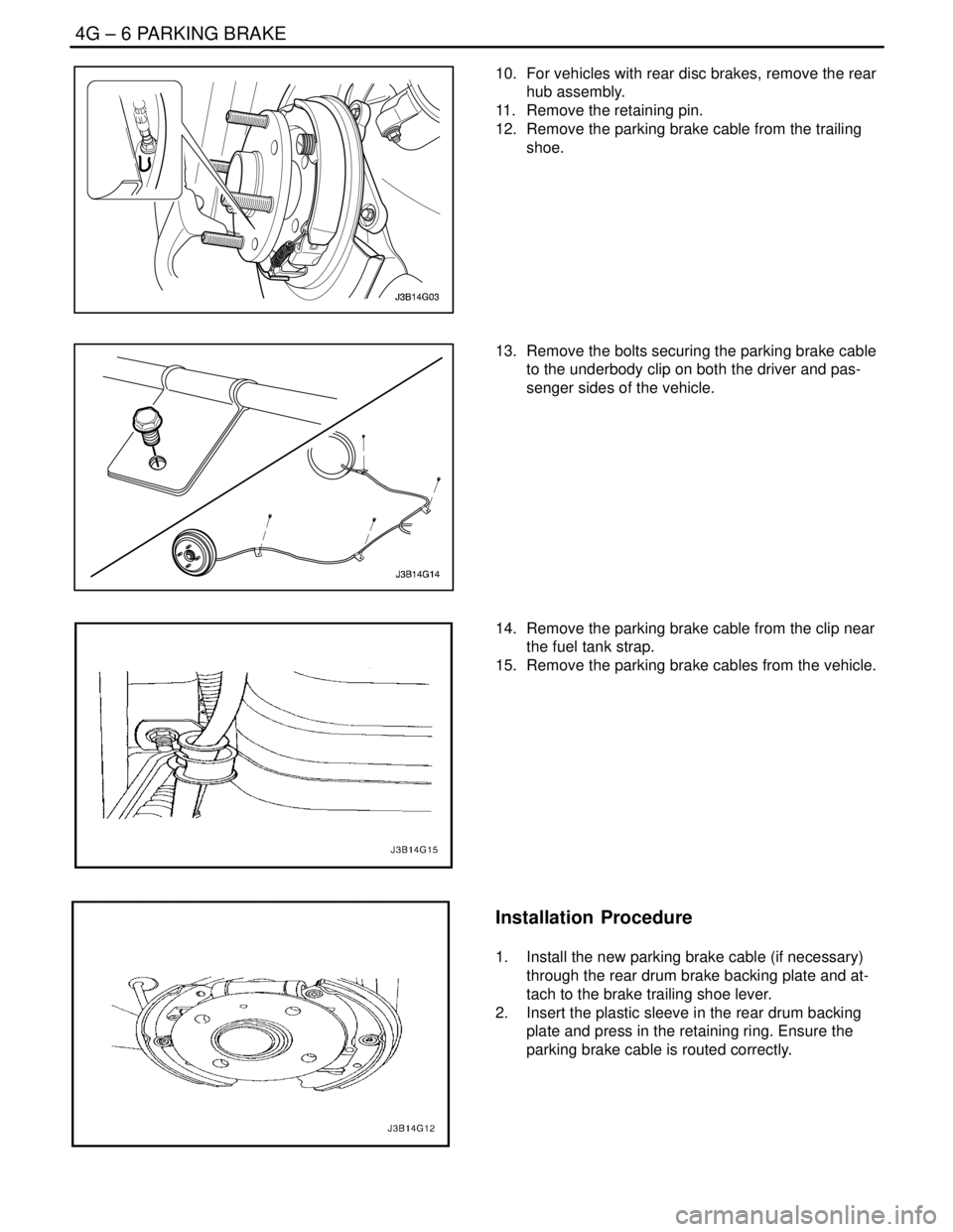
10. For vehicles with rear disc brakes, remove the rear
hub assembly.
11. Remove the retaining pin.
12. Remove the parking brake cable from the trailing
shoe.
13. Remove the bolts securing the parking brake cable
to the underbody clip on both the driver and pas-
senger sides of the vehicle.
14. Remove the parking brake cable from the clip near
the fuel tank strap.
15. Remove the parking brake cables from the vehicle.
Installation Procedure
1. Install the new parking brake cable (if necessary)
through the rear drum brake backing plate and at-
tach to the brake trailing shoe lever.
2. Insert the plastic sleeve in the rear drum backing
plate and press in the retaining ring. Ensure the
parking brake cable is routed correctly.
Page 1159 of 2643
PARKING BRAKE 4G – 7
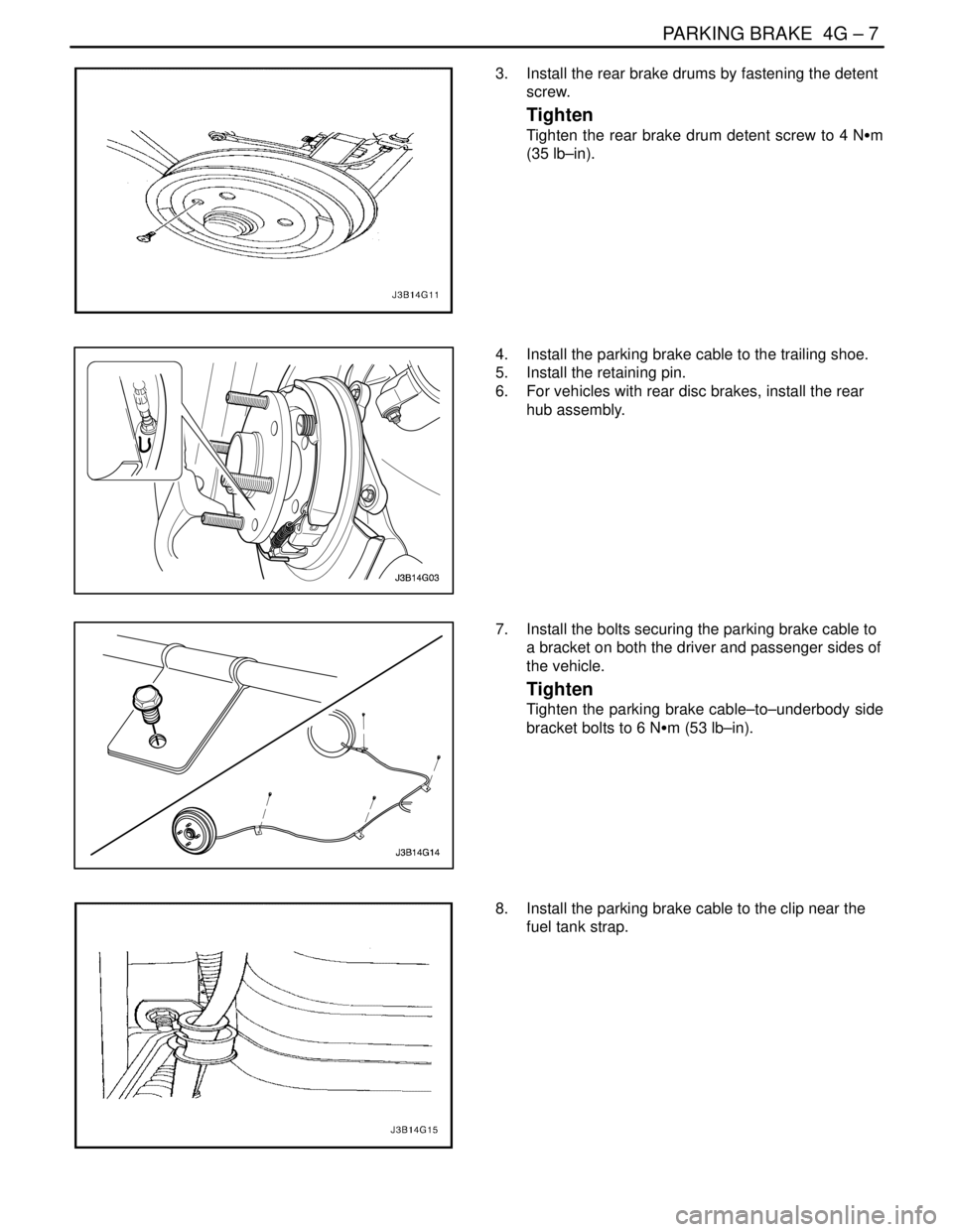
DAEWOO V–121 BL4
3. Install the rear brake drums by fastening the detent
screw.
Tighten
Tighten the rear brake drum detent screw to 4 NSm
(35 lb–in).
4. Install the parking brake cable to the trailing shoe.
5. Install the retaining pin.
6. For vehicles with rear disc brakes, install the rear
hub assembly.
7. Install the bolts securing the parking brake cable to
a bracket on both the driver and passenger sides of
the vehicle.
Tighten
Tighten the parking brake cable–to–underbody side
bracket bolts to 6 NSm (53 lb–in).
8. Install the parking brake cable to the clip near the
fuel tank strap.