Hub DAEWOO LACETTI 2004 Service Workshop Manual
[x] Cancel search | Manufacturer: DAEWOO, Model Year: 2004, Model line: LACETTI, Model: DAEWOO LACETTI 2004Pages: 2643, PDF Size: 80.54 MB
Page 1398 of 2643

ZF 4 HP 16 AUTOMATIC TRANSAXLE 5A1 – 49
DAEWOO V–121 BL4
Functional Check Procedure
Inspect
1. Install a tachometer or scan tool.
2. Operate the vehicle unit proper operating tempera-
ture is reached.
3. Drive the vehicle at 80 to 88km/h (50 to 55 mph)
with light throttle(road load).
4. Maintaining throttle position, lightly touch the brake
pedal and check for release of the TCC and a slight
increase in engine speed(rpm).
5. Release the brake slowly accelerate and check for
a reapply of the Lock up clutch and a slight de-
crease in engine speed(rpm).
Torque Converter Evaluation
Torque Converter Stator
The torque converter stator roller clutch can have one of
two different type malfunctions :
A. Stator assembly freewheels in both directions.
B. Stator assembly remains Locked up at all times.
Condition A – Poor Acceleration Low
Speed
The car tends to have poor acceleration from a stand still.
At speeds above 50 to 55km/h(30 to 35mph), the car may
act normal. If poor acceleration is noted, it should first be
determined that the exhaust system is not blocked, and
the transaxle is in 1st(First) gear when starting out.
If the engine freely accelerates to high rpm in N(Neutral),
it can be assumed that the engine and exhaust system are
normal. Checking for poor performance in ”Drive” and ”Re-
verse” will help determine if the stator is freewheeling at all
times.
Condition B – Poor Acceleration High
Speed
Engine rpm and car speed limited or restricted at high
speeds. Performance when accelerating from a standstill
is normal. Engine may overheat. Visual examination of the
converter may reveal a blue color from overheating.
If the converter has been removed, the stator roller clutch
can be checked by inserting two fingers into the splined in-
ner race of the roller clutch and trying to turn freely clock-
wise, but not turn or be very difficult to turn counter clock-
wise.
Noise
Torque converter whine is usually noticed when the ve-
hicle is stopped and the transaxle is in ”Drive” or ”Re-
verse”. The noise will increase when engine rpm is in-
creased. The noise will stop when the vehicle is moving or
when the torque converter clutch is applied because both
halves of the converter are turning at the same speed.
Perform a stall test to make sure the noise is actually com-
ing from the converter :1. Place foot on brake.
2. Put gear selector in ”Drive”.
3. Depress accelerator to approximately 1200rpm for
no more than six seconds.
Notice : If the accelerator is depressed for more than six
seconds, damage to the transaxle may occur.
A torque converter noise will increase under this load.
Important : This noise should not be confused with pump
whine noise which is usually noticeable in P (Park), N
(Neutral) and all other gear ranges. Pump whine will vary
with pressure ranges.
The torque converter should be replaced under any of the
following conditions:
S External leaks in the hub weld area.
S Converter hub is scored or damaged.
S Converter pilot is broken, damaged or fits poorly
into crankshaft.
S Steel particles are found after flushing the cooler
and cooler lines.
S Pump is damaged or steel particles are found in the
converter.
S Vehicle has TCC shudder and/or no TCC apply.
Replace only after all hydraulic and electrical diag-
noses have been made.(Lock up clutch material
may be glazed.)
S Converter has an imbalance which cannot be cor–
rected. (Refer To Converter Vibration Test Proce-
dure.)
S Converter is contaminated with engine coolant con-
taining antifreeze.
S Internal failure of stator roller clutch.
S Excess end play.
S Heavy clutch debris due to overheating (blue con-
verter).
S Steel particles or clutch lining material found in fluid
filter or on magnet when no internal parts in unit are
worn or damaged(indicates that lining material
came from converter).
The torque converter should not be replace if :
S The oil has an odor, is discolored, and there is no
evidence of metal or clutch facing particles.
S The threads in one or more of the converter bolt
holes are damaged.
–correct with thread insert.
S Transaxle failure did not display evidence of dam-
age or worn internal parts, steel particles or clutch
plate lining material in unit and inside the fluid filter.
S Vehicle has been exposed to high mileage(only).
The exception may be where the Lock up clutch
damper plate lining has seen excess wear by ve-
hicles operated in heavy and/or constant traffic,
such as taxi, delivery or police use.
Lock–Up Clutch Shudder Diagnosis
The key to diagnosing lock–up clutch(TCC) shudder is to
note when it happens and under what conditions.
Page 1581 of 2643
5A1 – 232IZF 4 HP 16 AUTOMATIC TRANSAXLE
DAEWOO V–121 BL4
GENERAL DESCRIPTION
AND SYSTEM OPERATION
The ZF 4HP 16 automatic transaxle consists primarily of
the following components.
Mechanical
S Torque converter with TCC
S Drive link assembly
S Two multiple disk clutch assemblies : Clutch B,E
S Three multiple brake assemblies : Brake C,D,F
S Lock–up clutch valve
S Two planetary gear sets
S One oil pump
S Final drive and differential assembly
Electronic
S Two shift solenoid valve(sol.1,2)
S Four pressure control solenoid valve(EDS)
S Two speed sensors : A/T ISS and A/T OSS
S Fluid temperature sensor
S Automatic transaxle control module(TCM)
S Wiring harness assembly
MECHANICAL COMPONENTS
Torque Converter
The converter consists of the impeller, the turbine wheel,
the reaction member (stator) and the oil to transmit torque.
The impeller, which is driven by the engine, causes the oil
in the converter to flow in a circular pattern. This oil flow
meets the turbine wheel, where is direction of flow is de-
flected. At the hub, the oil leaves the turbine and reaches
the reaction member (stator), where it is once again de-
flected so that it reaches the impeller at the correct angle
of flow.
The reversal effect generates movement in the stator, the
reaction torque then amplifies the turbine torque.
The ratio between turbine torque and torque is referred to
as torque multiplication.
The greater the difference is speed between the pump and
turbine, the greater the torque multiplication; it is at its
highest when the turbine is at a standstill. The higher the
speed of the turbine, the lower the torque multiplication.
When the turbine speed reaches about 85%of the pump
speed, torque multiplication=1, i.e. the turbine torque
equivalent to pump torque.
The stator, which bears against the housing via the free-
wheel, is then rotating freely in the oil flow and the free-
wheel is over–come. From this point onwards, the con-
verter acts as a straightforward fluid coupling.
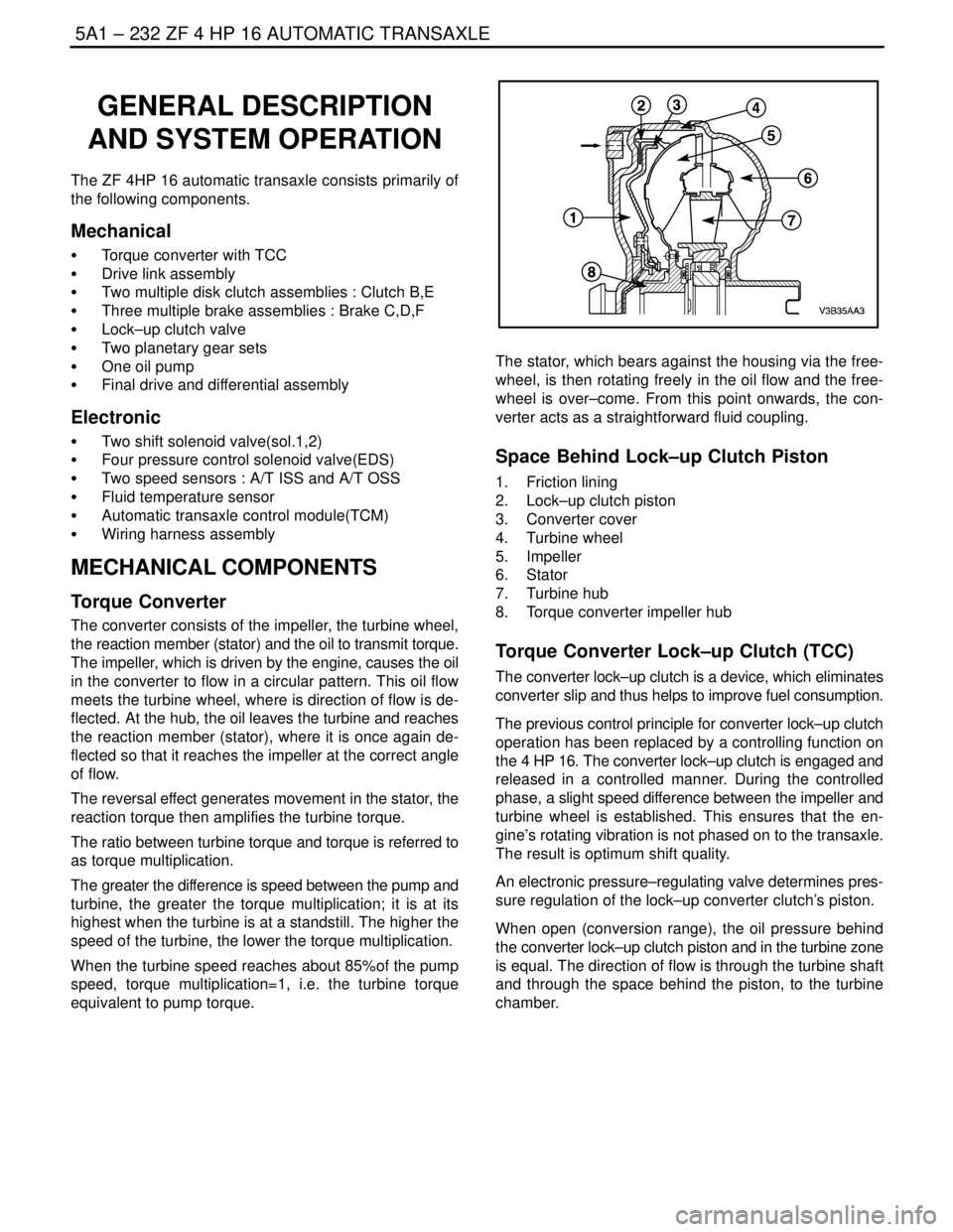
Space Behind Lock–up Clutch Piston
1. Friction lining
2. Lock–up clutch piston
3. Converter cover
4. Turbine wheel
5. Impeller
6. Stator
7. Turbine hub
8. Torque converter impeller hub
Torque Converter Lock–up Clutch (TCC)
The converter lock–up clutch is a device, which eliminates
converter slip and thus helps to improve fuel consumption.
The previous control principle for converter lock–up clutch
operation has been replaced by a controlling function on
the 4 HP 16. The converter lock–up clutch is engaged and
released in a controlled manner. During the controlled
phase, a slight speed difference between the impeller and
turbine wheel is established. This ensures that the en-
gine’s rotating vibration is not phased on to the transaxle.
The result is optimum shift quality.
An electronic pressure–regulating valve determines pres-
sure regulation of the lock–up converter clutch’s piston.
When open (conversion range), the oil pressure behind
the converter lock–up clutch piston and in the turbine zone
is equal. The direction of flow is through the turbine shaft
and through the space behind the piston, to the turbine
chamber.
Page 1612 of 2643

5A2 – 22IAISIN AUTOMATIC TRANSAXLE
DAEWOO V–121 BL4
1. Planetary Ring Gear
2. O–ring
3. 1st and Reverse Brake Piston
4. O–ring
5. 1st and Reverse Brake Piston Return Spring
6. Plate
7. Disc
8. Flange
9. Snap Ring
10. Planetary Gear
11. Thrust Washer
12. No. 2 One–Way Clutch
13. Anti–Rattle Clip
14. Flange
15. Disc
16. Plate
17. 2nd Brake Piston Return Spring
18. O–ring
19. 2nd Brake Piston
20. O–ring
21. 2nd Brake Clutch Cylinder
22. Snap Ring
23. Thrust Bearing Race
24. Front Planetary Sun Gear
25. Thrust Bearing Race26. One–Way Clutch Assembly
27. Thrust Washer
28. Rear Planetary Sun Gear
29. Snap Ring
30. Flange
31. Disc
32. Plate
33. Thrust Bearing Race
34. Thrust Needle Roller Bearing
35. Forward Clutch Hub
36. Thrust Bearing Race
37. Thrust Needle Roller Bearing
38. Thrust Bearing Race
39. Forward and Reverse Clutch Assembly
40. Thrust Needle Roller Bearing
41. Snap Ring
42. O/D Brake Return Spring
43. O/D Brake Piston
44. O–ring
45. Seal Ring
46. Transaxle Rear Cover
47. Apply Gasket
48. O–ring
49. Screw Plug
Page 1613 of 2643
AISIN AUTOMATIC TRANSAXLE 5A2 – 23
DAEWOO V–121 BL4
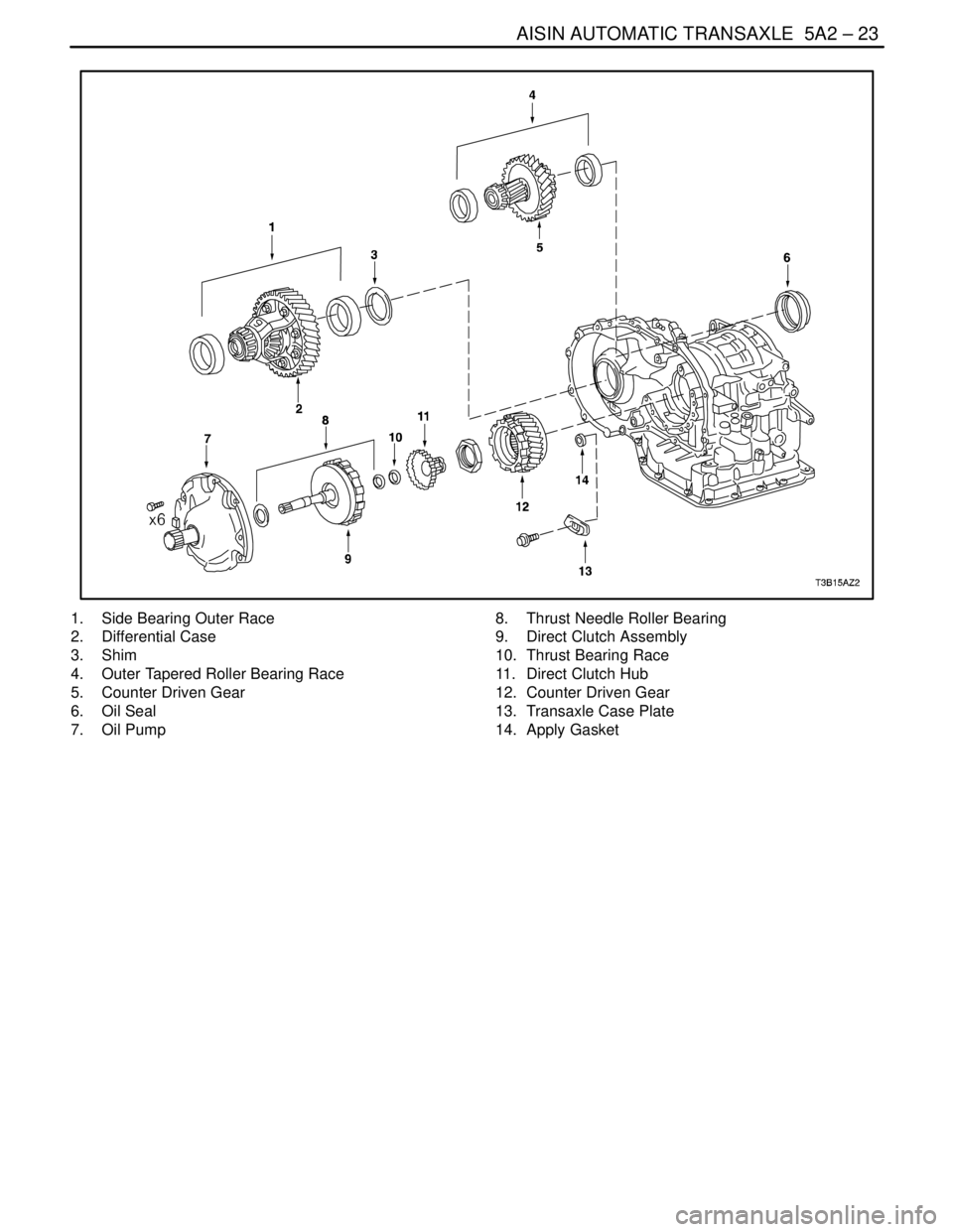
1. Side Bearing Outer Race
2. Differential Case
3. Shim
4. Outer Tapered Roller Bearing Race
5. Counter Driven Gear
6. Oil Seal
7. Oil Pump8. Thrust Needle Roller Bearing
9. Direct Clutch Assembly
10. Thrust Bearing Race
11. Direct Clutch Hub
12. Counter Driven Gear
13. Transaxle Case Plate
14. Apply Gasket
Page 1714 of 2643
5A2 – 124IAISIN AUTOMATIC TRANSAXLE
DAEWOO V–121 BL4
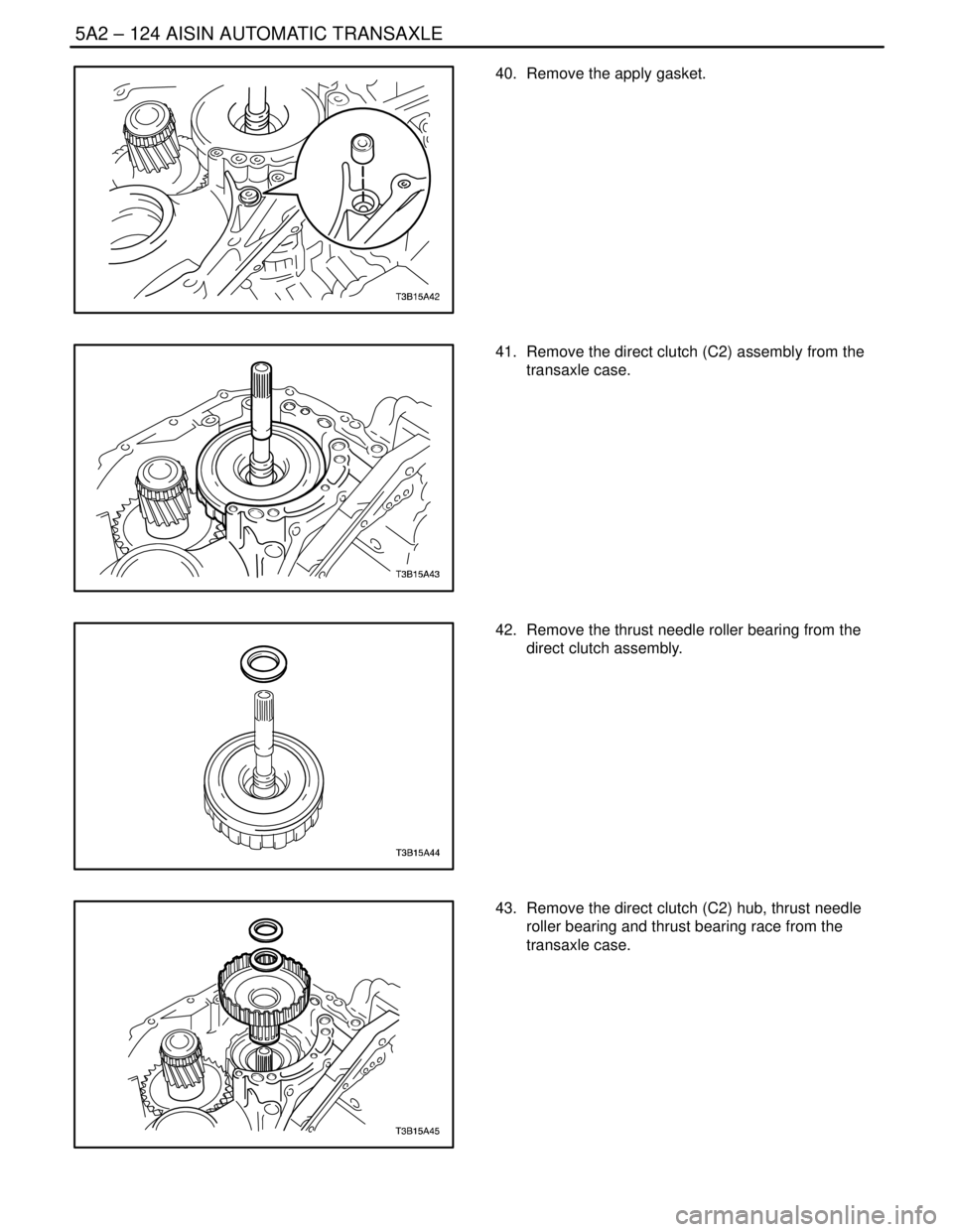
40. Remove the apply gasket.
41. Remove the direct clutch (C2) assembly from the
transaxle case.
42. Remove the thrust needle roller bearing from the
direct clutch assembly.
43. Remove the direct clutch (C2) hub, thrust needle
roller bearing and thrust bearing race from the
transaxle case.
Page 1716 of 2643
5A2 – 126IAISIN AUTOMATIC TRANSAXLE
DAEWOO V–121 BL4
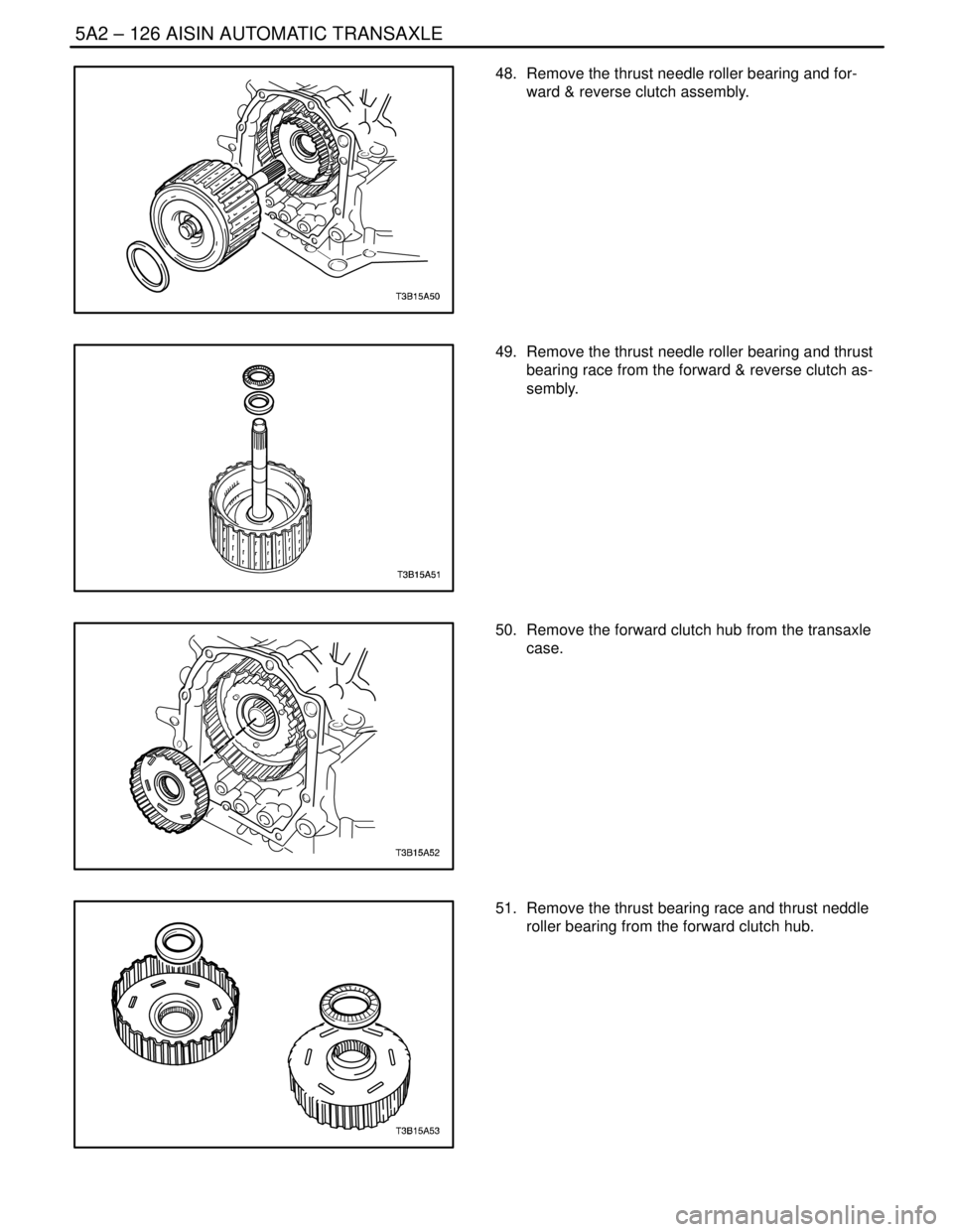
48. Remove the thrust needle roller bearing and for-
ward & reverse clutch assembly.
49. Remove the thrust needle roller bearing and thrust
bearing race from the forward & reverse clutch as-
sembly.
50. Remove the forward clutch hub from the transaxle
case.
51. Remove the thrust bearing race and thrust neddle
roller bearing from the forward clutch hub.
Page 1743 of 2643
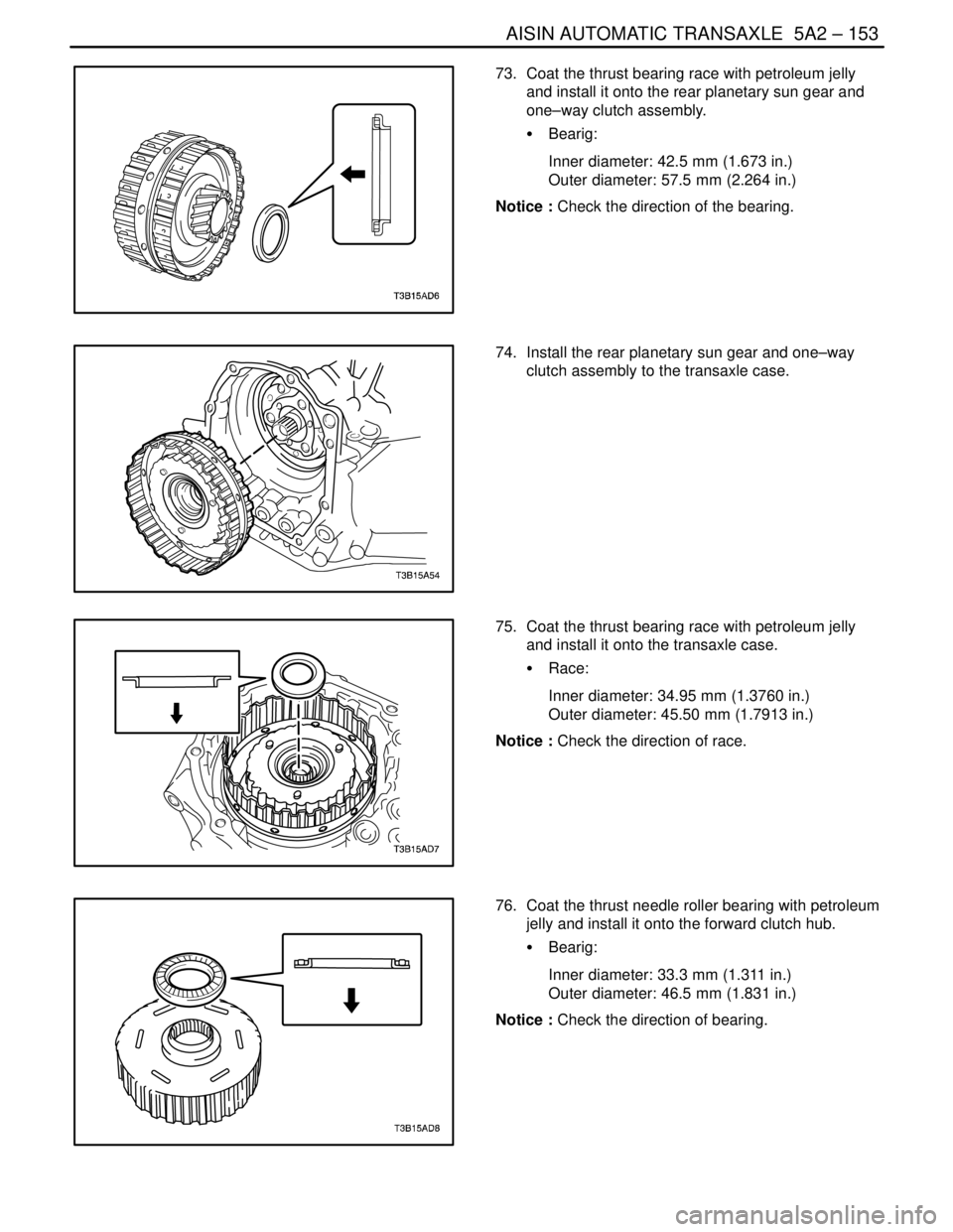
AISIN AUTOMATIC TRANSAXLE 5A2 – 153
DAEWOO V–121 BL4
73. Coat the thrust bearing race with petroleum jelly
and install it onto the rear planetary sun gear and
one–way clutch assembly.
S Bearig:
Inner diameter: 42.5 mm (1.673 in.)
Outer diameter: 57.5 mm (2.264 in.)
Notice : Check the direction of the bearing.
74. Install the rear planetary sun gear and one–way
clutch assembly to the transaxle case.
75. Coat the thrust bearing race with petroleum jelly
and install it onto the transaxle case.
S Race:
Inner diameter: 34.95 mm (1.3760 in.)
Outer diameter: 45.50 mm (1.7913 in.)
Notice : Check the direction of race.
76. Coat the thrust needle roller bearing with petroleum
jelly and install it onto the forward clutch hub.
S Bearig:
Inner diameter: 33.3 mm (1.311 in.)
Outer diameter: 46.5 mm (1.831 in.)
Notice : Check the direction of bearing.
Page 1744 of 2643
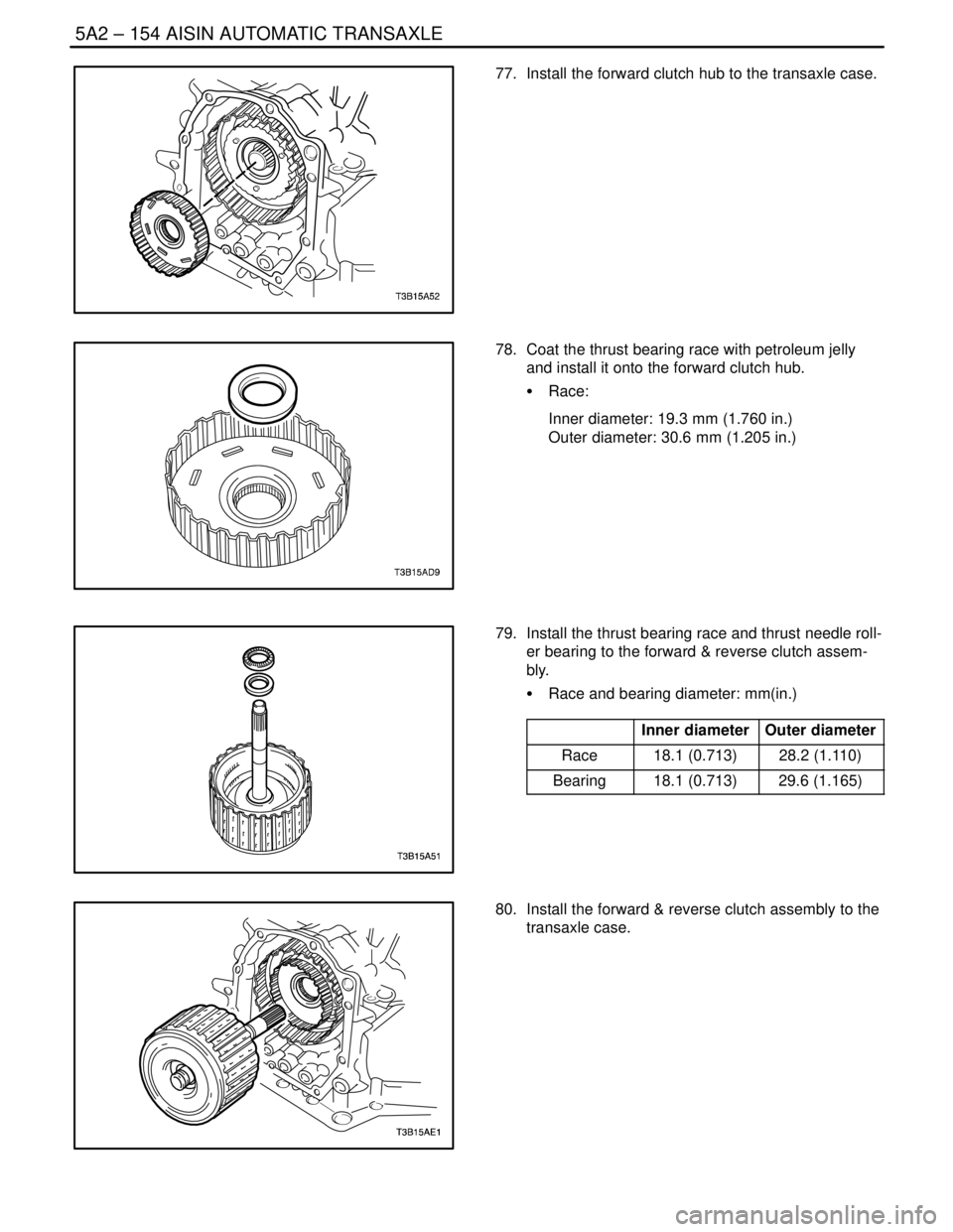
5A2 – 154IAISIN AUTOMATIC TRANSAXLE
DAEWOO V–121 BL4
77. Install the forward clutch hub to the transaxle case.
78. Coat the thrust bearing race with petroleum jelly
and install it onto the forward clutch hub.
S Race:
Inner diameter: 19.3 mm (1.760 in.)
Outer diameter: 30.6 mm (1.205 in.)
79. Install the thrust bearing race and thrust needle roll-
er bearing to the forward & reverse clutch assem-
bly.
S Race and bearing diameter: mm(in.)
Inner diameterOuter diameter
Race18.1 (0.713)28.2 (1.110)
Bearing18.1 (0.713)29.6 (1.165)
80. Install the forward & reverse clutch assembly to the
transaxle case.
Page 1748 of 2643
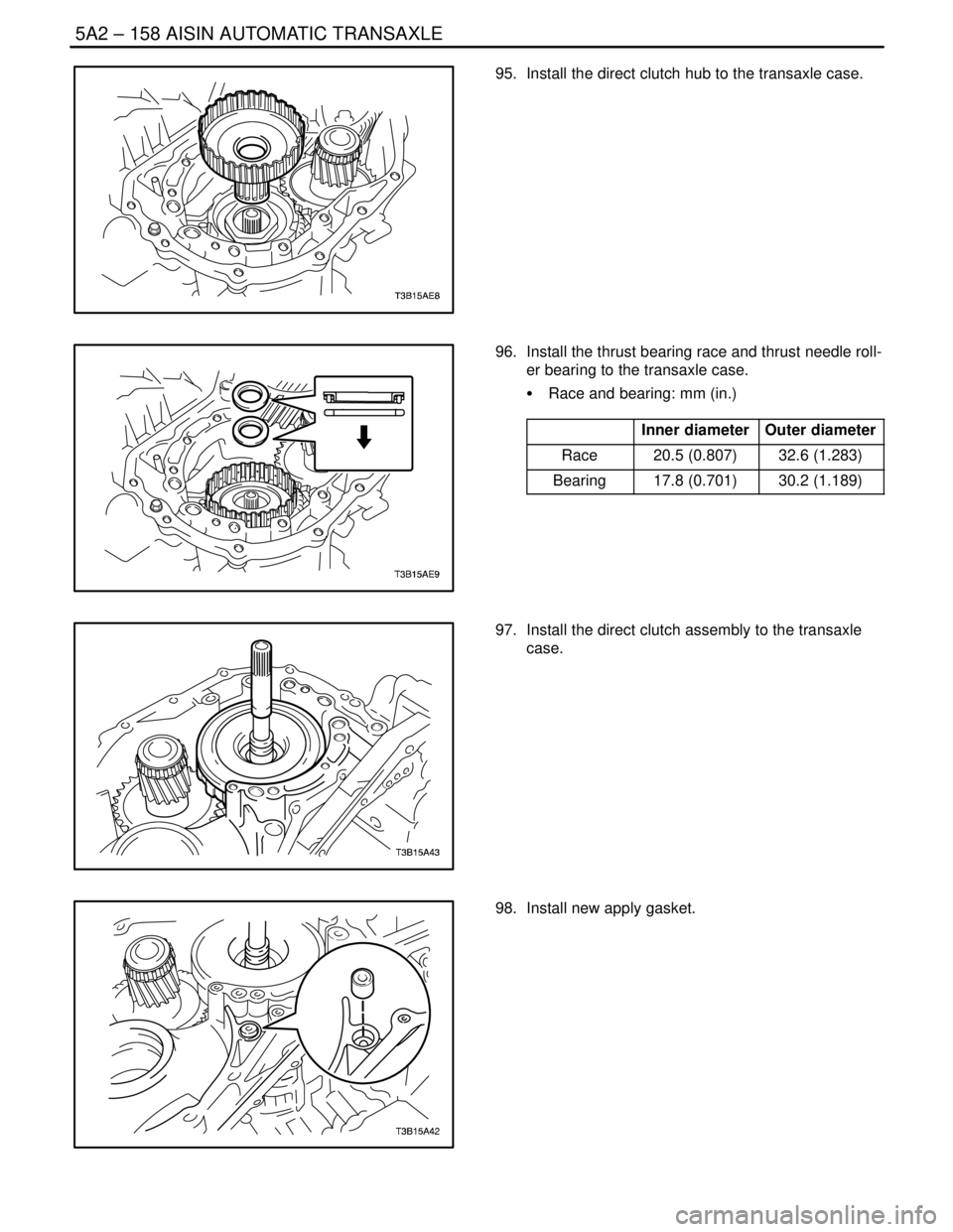
5A2 – 158IAISIN AUTOMATIC TRANSAXLE
DAEWOO V–121 BL4
95. Install the direct clutch hub to the transaxle case.
96. Install the thrust bearing race and thrust needle roll-
er bearing to the transaxle case.
S Race and bearing: mm (in.)
Inner diameterOuter diameter
Race20.5 (0.807)32.6 (1.283)
Bearing17.8 (0.701)30.2 (1.189)
97. Install the direct clutch assembly to the transaxle
case.
98. Install new apply gasket.
Page 1770 of 2643

5A2 – 180IAISIN AUTOMATIC TRANSAXLE
DAEWOO V–121 BL4
ONE–WAY CLUTCH
1. Snap Ring
2. One–Way Clutch3. 2nd Brake Hub
4. Retainer