Jack DAEWOO LACETTI 2004 Service Owner's Manual
[x] Cancel search | Manufacturer: DAEWOO, Model Year: 2004, Model line: LACETTI, Model: DAEWOO LACETTI 2004Pages: 2643, PDF Size: 80.54 MB
Page 1959 of 2643

STEERING WHEEL AND COLUMN 6E – 5
DAEWOO V–121 BL4
Column
Noise in the Column
ChecksAction
Check the steering gear–to–column joints for improper
installation.Tighten the steering shaft universal joint pinch bolts.
Replace the steering shaft joints as needed.
Check the steering shaft bearing for wear or damage.Replace the steering shaft bearing.
Check the spherical joint for lack of lubrication.Lubricate the spherical joint.
Check the steering shaft for lack of lubrication.Lubricate the steering shaft bearing.
Check the shaft lock snap ring for improper seating.Adjust the shaft lock snap ring. Replace the shaft lock snap
ring as needed.
High Steering Shaft Effort
ChecksAction
Check the steering shaft bearing for wear or damage.Replace the steering shaft bearing.
Check for an improperly installed or deformed dust seal.Replace the dust seal.
Check for a damaged upper or lower bearing.Replace the upper or the lower bearing.
Check the steering shaft universal joints for a lack of free
movement.Lubricate the steering shaft universal joints. Replace the
steering shaft universal joints as needed.
Lash in the Steering Column
ChecksAction
Check the steering column bracket mounting bolts for im-
proper installation.Tighten the steering column bracket mounting bolts.
Check for broken weld nuts on the steering column jacket.Replace the steering column jacket.
Check for loose steering column housing–to–steering col-
umn jacket support screws.Tighten the support screws.
Loose Steering Wheel
ChecksAction
Check for excessive clearance between the holes in the
steering wheel support or the housing and the pivot–pin di-
ameters.Replace the pivot pins with pivot pins of the correct size.
Check to see if the upper bearing is seated correctly in the
housing.Correctly seat the upper bearing. Replace the upper bear-
ing as needed.
Check for loose steering column housing support screws.Tighten the steering column housing support screws.
Noise When Tilting the Column
ChecksAction
Check for worn upper tilt bumpers.Replace the upper tilt bumpers.
Check for tilt spring binding.Adjust the tilt spring. Replace the tilt spring as needed.
Page 1970 of 2643
6E – 16ISTEERING WHEEL AND COLUMN
DAEWOO V–121 BL4
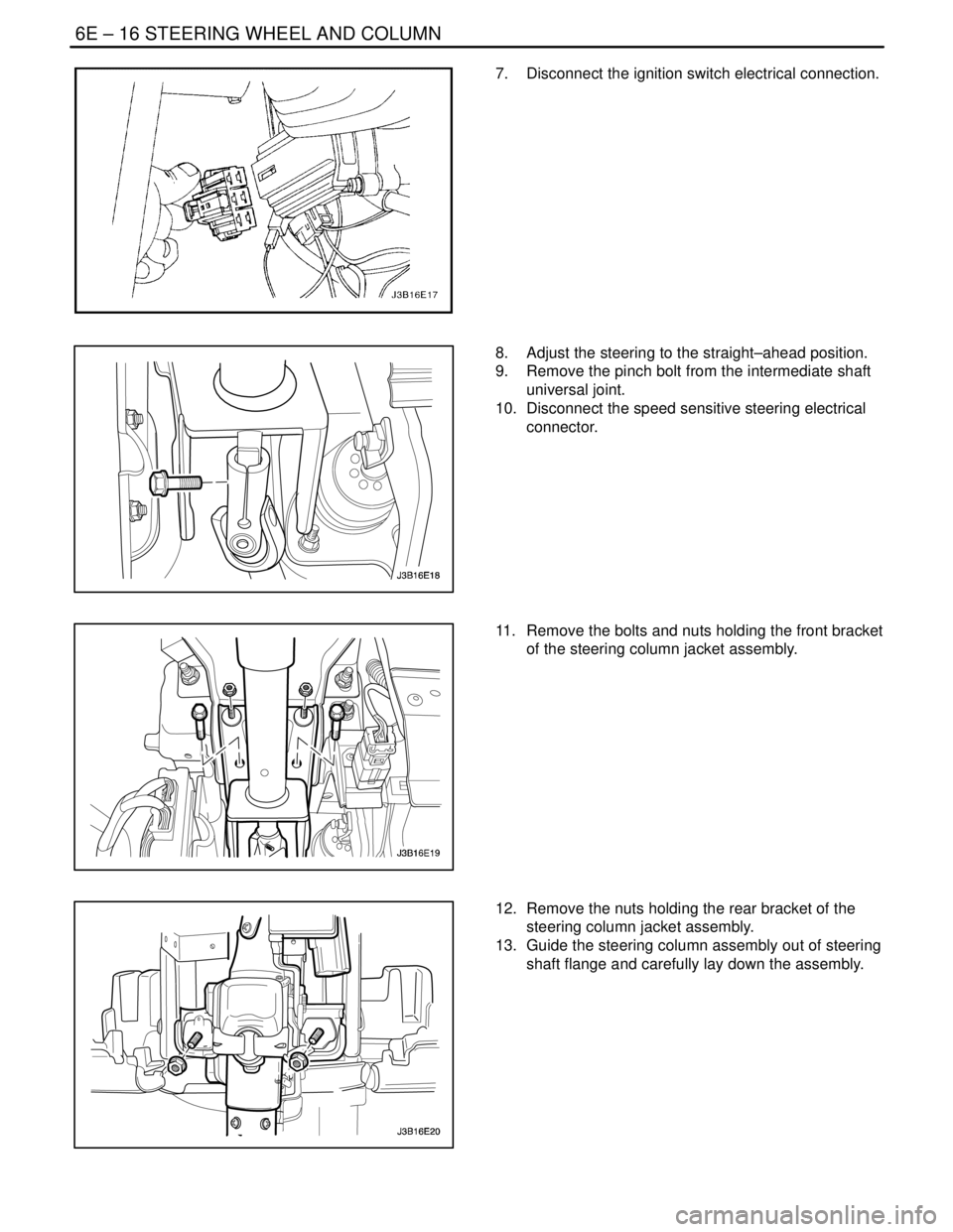
7. Disconnect the ignition switch electrical connection.
8. Adjust the steering to the straight–ahead position.
9. Remove the pinch bolt from the intermediate shaft
universal joint.
10. Disconnect the speed sensitive steering electrical
connector.
11. Remove the bolts and nuts holding the front bracket
of the steering column jacket assembly.
12. Remove the nuts holding the rear bracket of the
steering column jacket assembly.
13. Guide the steering column assembly out of steering
shaft flange and carefully lay down the assembly.
Page 1971 of 2643
STEERING WHEEL AND COLUMN 6E – 17
DAEWOO V–121 BL4
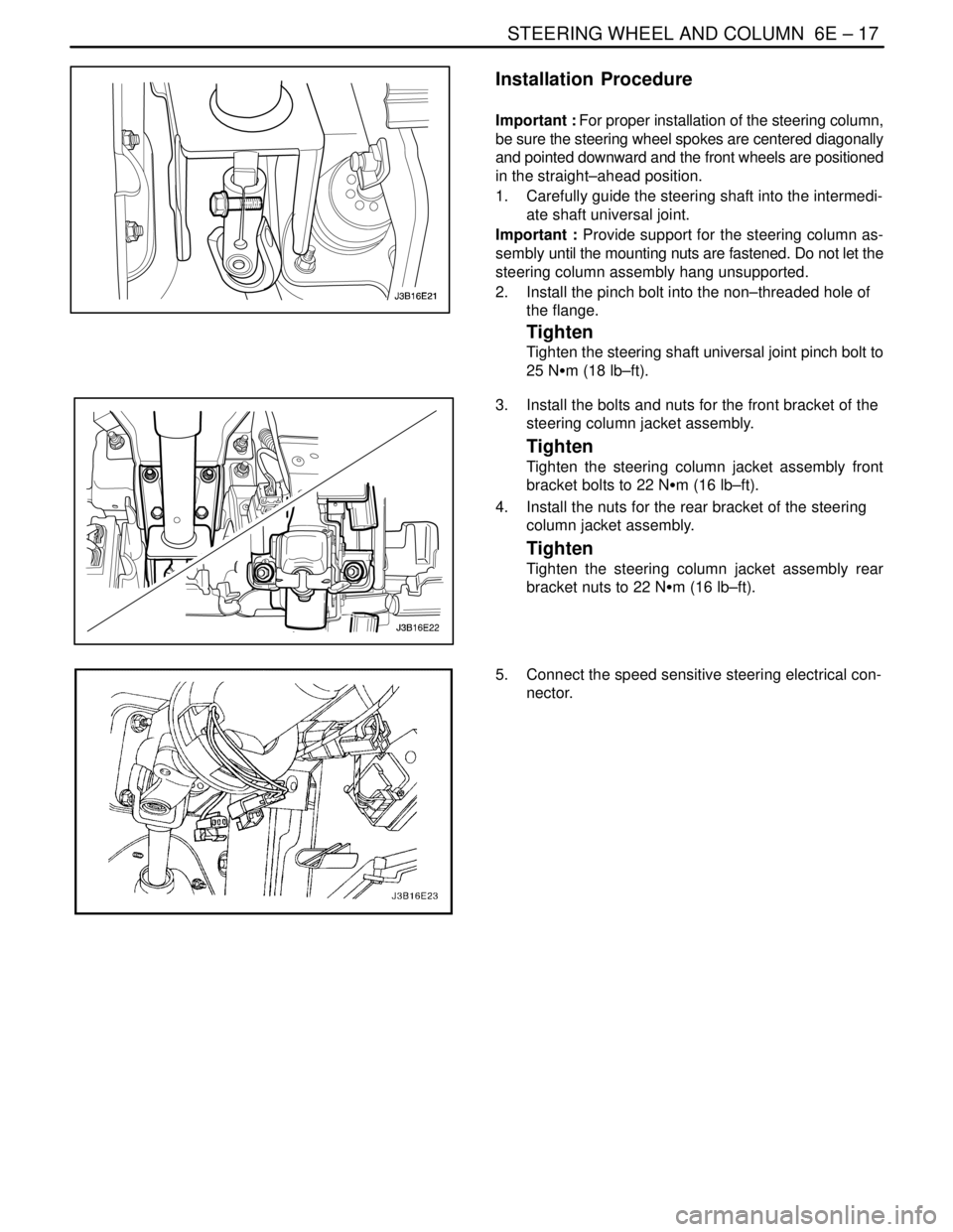
Installation Procedure
Important : For proper installation of the steering column,
be sure the steering wheel spokes are centered diagonally
and pointed downward and the front wheels are positioned
in the straight–ahead position.
1. Carefully guide the steering shaft into the intermedi-
ate shaft universal joint.
Important : Provide support for the steering column as-
sembly until the mounting nuts are fastened. Do not let the
steering column assembly hang unsupported.
2. Install the pinch bolt into the non–threaded hole of
the flange.
Tighten
Tighten the steering shaft universal joint pinch bolt to
25 NSm (18 lb–ft).
3. Install the bolts and nuts for the front bracket of the
steering column jacket assembly.
Tighten
Tighten the steering column jacket assembly front
bracket bolts to 22 NSm (16 lb–ft).
4. Install the nuts for the rear bracket of the steering
column jacket assembly.
Tighten
Tighten the steering column jacket assembly rear
bracket nuts to 22 NSm (16 lb–ft).
5. Connect the speed sensitive steering electrical con-
nector.
Page 2220 of 2643

9A – 14IBODY WIRING SYSTEM
DAEWOO V–121 BL4
I/P Fuse Block
FuseRating/SourceCircuit
F110AIGN 1SDM
F210AIGN 1TCM, ECM, Generator, VGIS, VSS
F315AIGN 1Hazard Switch
F410AIGN 1Cluster, DRL Module, Chime Bell, Brake Switch,
SSPS Module, A/C Control Switch
F5–Spare–
F610AIGN 2A/C Comp. Relay, Defog Relay, Power Window
Relay, Head Lamp Relay
F720AIGN 2Blower Relay, A/C Control Switch, FATC
F815AIGN 2Electric Mirror Switch, Folding Mirror, Sun Roof
Module
F925AIGN 1Wiper Motor, Wiper Switch
F10–Spare–
F1110AIGN 1EBCM, Oil Feeding Connector
F1210AIGN 1Immobilizer, Anti Theft Control Unit, Rain Sensor
Unit
F1310AB+TCM
F1415AB+Hazard Switch
F1515AB+Anti Theft Control Unit
F1610AB+DLC
F1710AACCAudio, Clock
F1815AACCExtra Power Jack
F1915AACCCigar Lighter
F2010AIGN 1Reverse Lamp Switch, PNP Switch
F2115AB+Rear Fog Relay
F2215AB+Clock, FATC, A/C Control Switch
F2315AB+Audio
F2410AB+Immobilizer
Page 2300 of 2643

SECTION : 9E
INSTRUMENTATION/DRIVER INFORMATION
CAUTION : Disconnect the negative battery cable before removing or installing any electrical unit or when a tool
or equipment could easily come in contact with exposed electrical terminals. Disconnecting this cable will help
prevent personal injury and damage to the vehicle. The ignition must also be in LOCK unless otherwise noted.
TABLE OF CONTENTS
SPECIFICATIONS9E–2 . . . . . . . . . . . . . . . . . . . . . . . . . .
Fastener Tightening Specifications 9E–2. . . . . . . . . . .
Instrument Cluster Indicator Lamps
Specifications 9E–2. . . . . . . . . . . . . . . . . . . . . . . . . . .
SCHEMATIC AND ROUTING DIAGRAMS9E–3 . . . . .
Instrument Cluster Circuit (1 of 2) 9E–3. . . . . . . . . . . .
Instrument Cluster Circuit (2 of 2) 9E–4. . . . . . . . . . . .
Cigar Lighter And Extra Power Jack Circuit 9E–5. . . .
DIAGNOSIS9E–6 . . . . . . . . . . . . . . . . . . . . . . . . . . . . . . . .
Cigar Lighter 9E–6. . . . . . . . . . . . . . . . . . . . . . . . . . . . . .
Digital Clock 9E–7. . . . . . . . . . . . . . . . . . . . . . . . . . . . . .
Instrument Panel Illumination 9E–9. . . . . . . . . . . . . . . .
Speedometer 9E–10. . . . . . . . . . . . . . . . . . . . . . . . . . . .
Fuel Gauge 9E–10. . . . . . . . . . . . . . . . . . . . . . . . . . . . . .
Temperature Gauge 9E–11. . . . . . . . . . . . . . . . . . . . . . .
Instrument Cluster Indicator Lamps 9E–12. . . . . . . . .
Chime Module 9E–13. . . . . . . . . . . . . . . . . . . . . . . . . . . .
Chime Module 9E–14. . . . . . . . . . . . . . . . . . . . . . . . . . . .
MAINTENANCE AND REPAIR9E–18 . . . . . . . . . . . . . .
ON–VEHICLE SERVICE 9E–18. . . . . . . . . . . . . . . . . . . .
Center Molding 9E–18. . . . . . . . . . . . . . . . . . . . . . . . . . .
Instrument Cluster Trim Panel 9E–18. . . . . . . . . . . . . .
Garnish Molding 9E–19. . . . . . . . . . . . . . . . . . . . . . . . . .
Ashtray 9E–19. . . . . . . . . . . . . . . . . . . . . . . . . . . . . . . . . . Cigar Lighter 9E–20. . . . . . . . . . . . . . . . . . . . . . . . . . . . .
Glove Box 9E–20. . . . . . . . . . . . . . . . . . . . . . . . . . . . . . .
Notchback Deposit Box 9E–21. . . . . . . . . . . . . . . . . . . .
Notchback Digital Clock 9E–21. . . . . . . . . . . . . . . . . . .
Hatchback Digital Clock 9E–22. . . . . . . . . . . . . . . . . . .
Instrument Cluster 9E–23. . . . . . . . . . . . . . . . . . . . . . . .
Instrument Cluster Dimmer/Headlamp
Leveling Switch 9E–23. . . . . . . . . . . . . . . . . . . . . . . . .
Instrument Cluster Indicator Lamps 9E–24. . . . . . . . .
Instrument Panel 9E–24. . . . . . . . . . . . . . . . . . . . . . . . .
Chime Module 9E–28. . . . . . . . . . . . . . . . . . . . . . . . . . . .
GENERAL DESCRIPTION AND SYSTEM
OPERATION9E–30 . . . . . . . . . . . . . . . . . . . . . . . . . . . . .
Cigar Lighter 9E–30. . . . . . . . . . . . . . . . . . . . . . . . . . . . .
Ashtray 9E–30. . . . . . . . . . . . . . . . . . . . . . . . . . . . . . . . . .
Instrument Panel Vents 9E–30. . . . . . . . . . . . . . . . . . . .
Glove Box 9E–30. . . . . . . . . . . . . . . . . . . . . . . . . . . . . . .
Digital Clock 9E–30. . . . . . . . . . . . . . . . . . . . . . . . . . . . .
Instrument Cluster 9E–30. . . . . . . . . . . . . . . . . . . . . . . .
Speedometer/Odometer/Trip Odometer 9E–30. . . . . .
Fuel Gauge 9E–30. . . . . . . . . . . . . . . . . . . . . . . . . . . . . .
Temperature Gauge 9E–30. . . . . . . . . . . . . . . . . . . . . . .
Instrument Cluster Indicator Lamps 9E–30. . . . . . . . .
Chime Module 9E–30. . . . . . . . . . . . . . . . . . . . . . . . . . . .
Page 2304 of 2643

INSTRUMENTATION/DRIVER INFORMATION 9E – 5
DAEWOO V–121 BL4
CIGAR LIGHTER AND EXTRA POWER JACK CIRCUIT
Page 2537 of 2643
NUBIRA/LACETTIFRONT 4–3
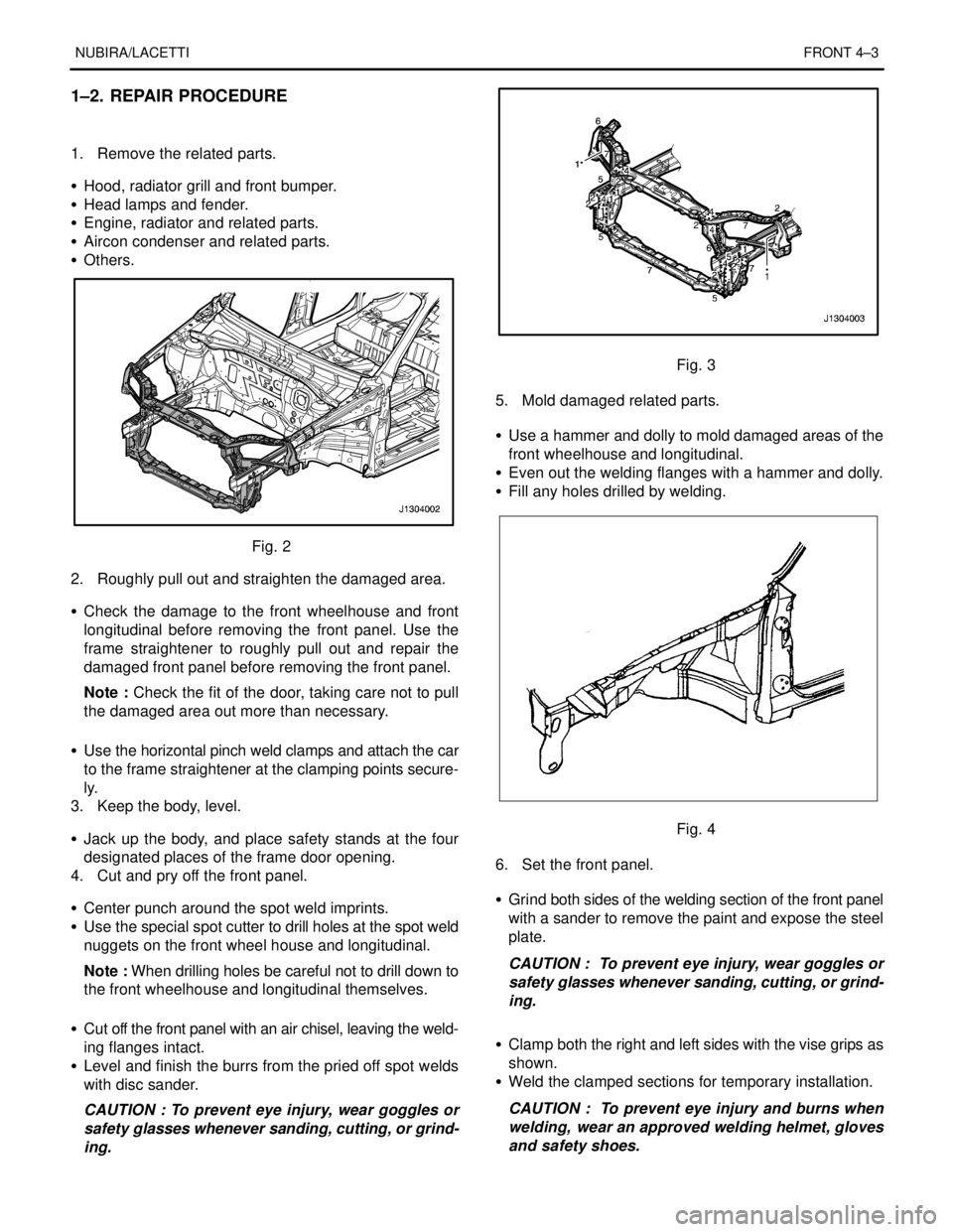
1–2. REPAIR PROCEDURE
1. Remove the related parts.
S Hood, radiator grill and front bumper.
S Head lamps and fender.
S Engine, radiator and related parts.
S Aircon condenser and related parts.
S Others.
Fig. 2
2. Roughly pull out and straighten the damaged area.
S Check the damage to the front wheelhouse and front
longitudinal before removing the front panel. Use the
frame straightener to roughly pull out and repair the
damaged front panel before removing the front panel.
Note : Check the fit of the door, taking care not to pull
the damaged area out more than necessary.
S Use the horizontal pinch weld clamps and attach the car
to the frame straightener at the clamping points secure-
ly.
3. Keep the body, level.
S Jack up the body, and place safety stands at the four
designated places of the frame door opening.
4. Cut and pry off the front panel.
S Center punch around the spot weld imprints.
S Use the special spot cutter to drill holes at the spot weld
nuggets on the front wheel house and longitudinal.
Note : When drilling holes be careful not to drill down to
the front wheelhouse and longitudinal themselves.
S Cut off the front panel with an air chisel, leaving the weld-
ing flanges intact.
S Level and finish the burrs from the pried off spot welds
with disc sander.
CAUTION : To prevent eye injury, wear goggles or
safety glasses whenever sanding, cutting, or grind-
ing.
Fig. 3
5. Mold damaged related parts.
S Use a hammer and dolly to mold damaged areas of the
front wheelhouse and longitudinal.
S Even out the welding flanges with a hammer and dolly.
S Fill any holes drilled by welding.
Fig. 4
6. Set the front panel.
S Grind both sides of the welding section of the front panel
with a sander to remove the paint and expose the steel
plate.
CAUTION : To prevent eye injury, wear goggles or
safety glasses whenever sanding, cutting, or grind-
ing.
S Clamp both the right and left sides with the vise grips as
shown.
S Weld the clamped sections for temporary installation.
CAUTION : To prevent eye injury and burns when
welding, wear an approved welding helmet, gloves
and safety shoes.
Page 2545 of 2643

NUBIRA/LACETTIFRONT 4–11
3–2. REPAIR PROCEDURE
1. Remove the related parts.
S Parts to be removed when removing the front panel and
front wheelhouse.
S Parts on passenger side of dash panel lower which are
especially flammable.
S Instrument panel, wiring harness, related parts and oth-
ers.
Note : Remove according to part damaged.
2. Roughly pull out and straighten the damaged area to
approximately the original shape.
S Attach the car to the frame straightener by tightening the
underbody clamps at the horizontal pinch weld points.
S Before cutting off the damaged sections, pull them out
so that they are restored to the original shape.
S Roughly cut off the front longitudinal according to the ex-
tent of damage before roughly pulling out the damage
makes repair of the related parts difficult.
S Do not pull out more than necessary.
Note : Check the condition of the door and hinges.
3. Peel off the undercoat and sealer.
S Heat the undercoat and sealer at the welding areas of
the damaged parts with a gas torch and peel off the un-
dercoat and sealer with a steel spatula.
CAUTION : Be careful not to burn the fittings inside
the passenger compartment when heating.
4. Cut and pry off the front longitudinal.
Note : It’s not necessary to separate the wheelhouse
from the front longitudinal if the wheelhouse is to be re-
placed also.
S Center punch around the spot weld imprints on the
wheelhouse and other related parts.
S Use the special spot cutter to drill holes at the spot weld
nuggets on the center punched areas.
S Cut off the front longitudinal with an air chisel, leaving the
welding flanges intact.
S Level and finish the burrs from the pried off spot welds
with a disc sander.
CAUTION : To prevent eye injury, wear goggles or
safety glasses whenever sanding, cutting, or grind-
ing.
Fig. 17
5. Mold damaged related parts.
S Fill any holes drilled by welding.
CAUTION : To prevent eye injury and burns when
welding, wear an approved welding helmet, gloves
and safety shoes.
S Reshape the wheelhouse and other damaged parts and
even out the welding flanges with a hammer and dolly.
Fig. 18
6. Cut the new front longitudinal to align it with body, then
set the wheelhouse and front panel.
S Cut the new front longitudinal with a hand saw and it will
be butt welded.
S Grind both sides of the welding section of the front longi-
tudinal and wheelhouse with a disc sander to remove the
paint and expose the steel plate.
CAUTION : To prevent eye injury, wear goggles or
safety glasses whenever sanding, cutting, or grind-
ing.
S Tighten the new front longitudinal against remaining
parts with the vise grips and pliers.
S Place a jack under the front longitudinal end and support
it, and measure the positions for correct setting.
S Set and clamp the front panel in place with the vise grips.
Page 2555 of 2643
NUBIRA/LACETTI ROOF, BACK PANEL AND REAR FLOOR PANEL 5–3
1–2. REPAIR PROCEDURE
1. Remove the related parts.
S Room lamp, door weatherstrip and pillar trims.
S Headlining and wiring harness.
S Wiper, cowl and windshield.
S Rear glass and others.
2. Pull out and straighten the damaged area to approxi-
mately the original shape.
Note : Use heat–resistant protective cover for protect
painting areas, seats, carpets and other parts.
S Attach the car to the frame straightener by tightening the
underbody clamps at the horizontal pinch welds.
S Before cutting off the roof panel, pull them out so that
they are restored to the original shape.
S Do not pull out more than necessary.
S Pull out and straighten the related damaged parts to
approximately their original shape.
Note : Make sure that the right and left pillars are parallel
with the windshield surface. Check the door for proper
opening and closing.
3. Keep the body, level.
S Jack up the body, and place safety stands at the four
designated places of the frame door opening.
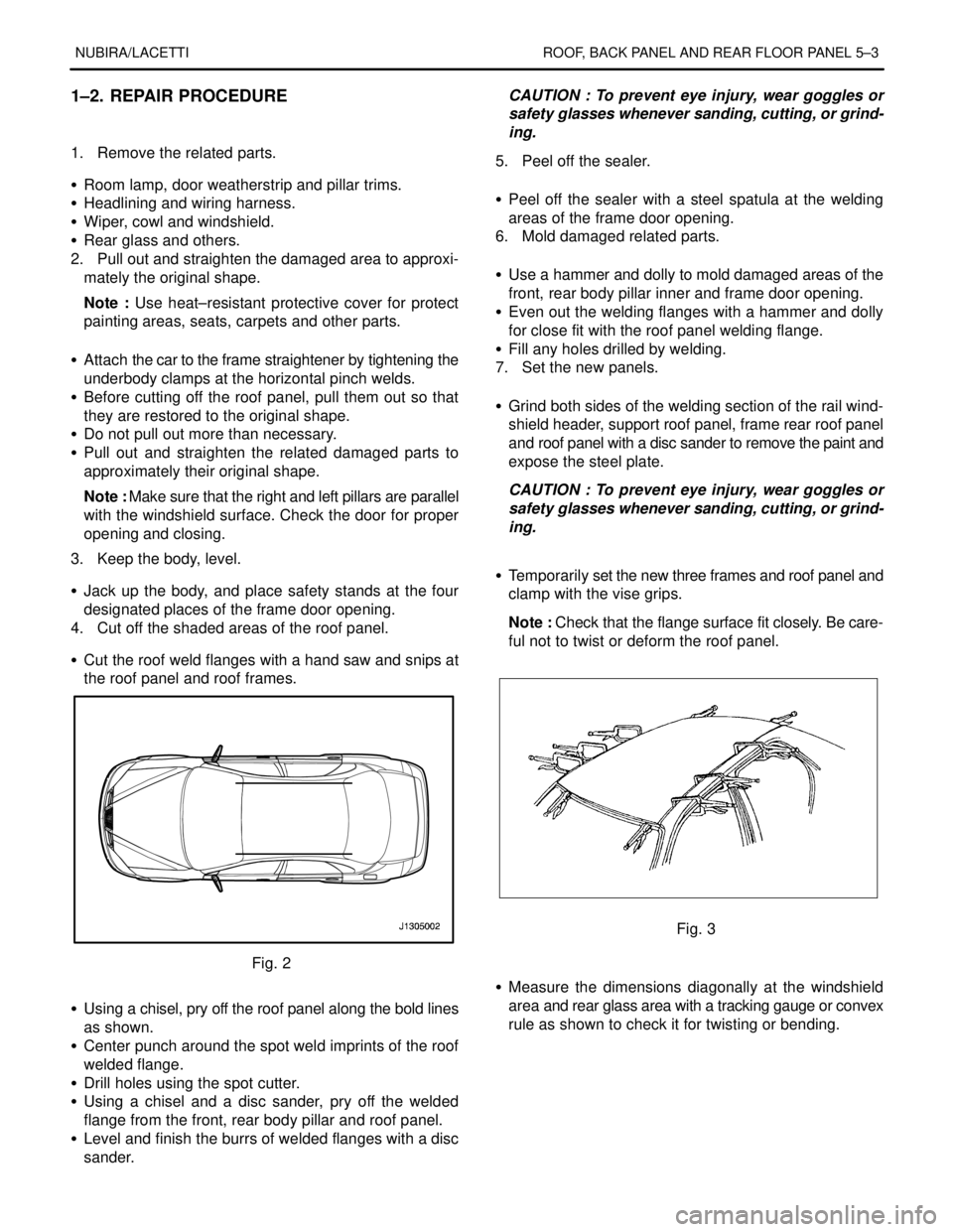
4. Cut off the shaded areas of the roof panel.
S Cut the roof weld flanges with a hand saw and snips at
the roof panel and roof frames.
Fig. 2
S Using a chisel, pry off the roof panel along the bold lines
as shown.
S Center punch around the spot weld imprints of the roof
welded flange.
S Drill holes using the spot cutter.
S Using a chisel and a disc sander, pry off the welded
flange from the front, rear body pillar and roof panel.
S Level and finish the burrs of welded flanges with a disc
sander.CAUTION : To prevent eye injury, wear goggles or
safety glasses whenever sanding, cutting, or grind-
ing.
5. Peel off the sealer.
S Peel off the sealer with a steel spatula at the welding
areas of the frame door opening.
6. Mold damaged related parts.
S Use a hammer and dolly to mold damaged areas of the
front, rear body pillar inner and frame door opening.
S Even out the welding flanges with a hammer and dolly
for close fit with the roof panel welding flange.
S Fill any holes drilled by welding.
7. Set the new panels.
S Grind both sides of the welding section of the rail wind-
shield header, support roof panel, frame rear roof panel
and roof panel with a disc sander to remove the paint and
expose the steel plate.
CAUTION : To prevent eye injury, wear goggles or
safety glasses whenever sanding, cutting, or grind-
ing.
S Temporarily set the new three frames and roof panel and
clamp with the vise grips.
Note : Check that the flange surface fit closely. Be care-
ful not to twist or deform the roof panel.
Fig. 3
S Measure the dimensions diagonally at the windshield
area and rear glass area with a tracking gauge or convex
rule as shown to check it for twisting or bending.
Page 2559 of 2643
NUBIRA/LACETTI ROOF, BACK PANEL AND REAR FLOOR PANEL 5–7
2–2. REPAIR PROCEDURE
1. Remove the related parts.
S Rear and trunk trims
S Trunk lid lock and related parts.
S Rear combination lamps and wiring harness.
S Rear bumper and related parts.
S Other related parts.
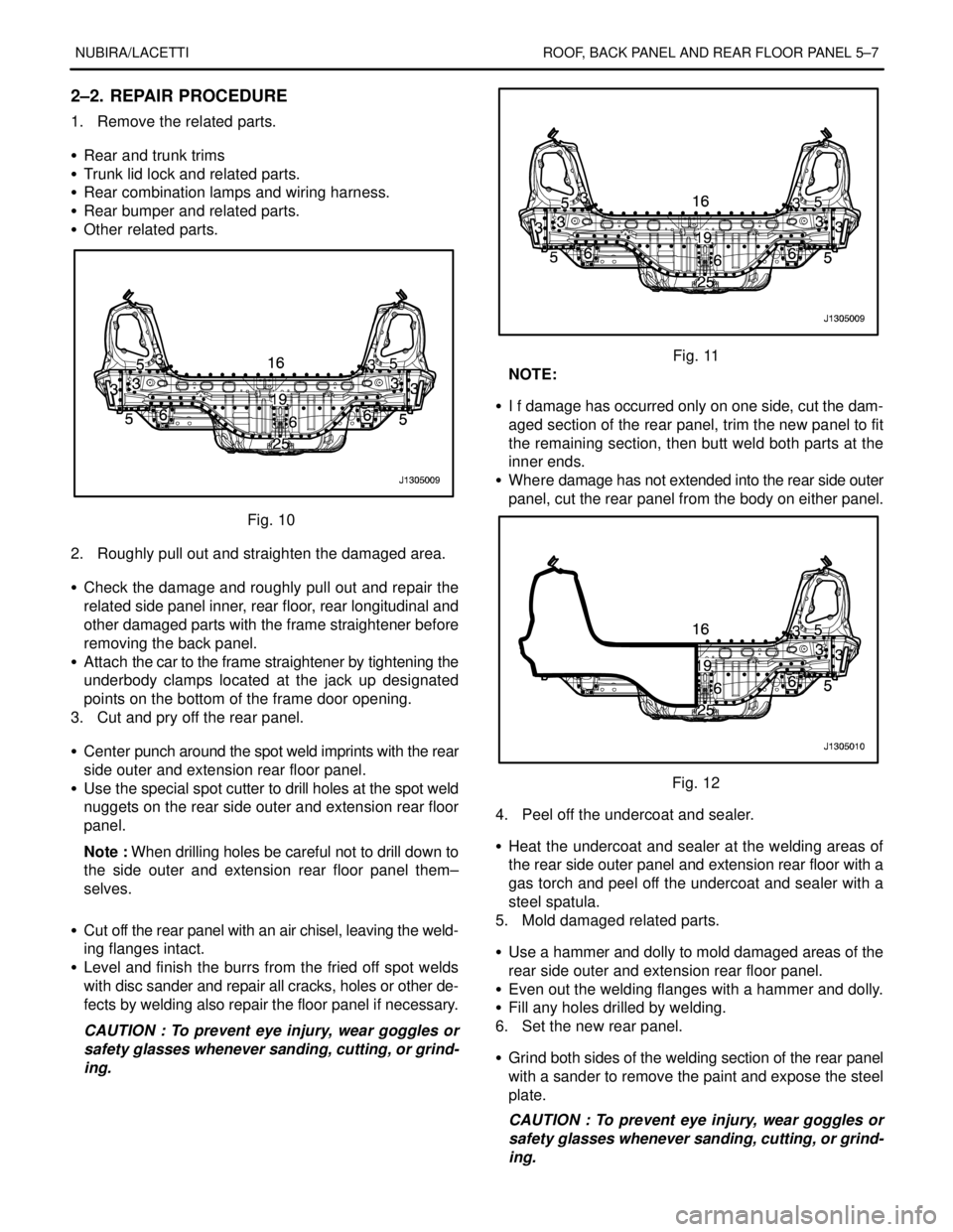
Fig. 10
2. Roughly pull out and straighten the damaged area.
S Check the damage and roughly pull out and repair the
related side panel inner, rear floor, rear longitudinal and
other damaged parts with the frame straightener before
removing the back panel.
S Attach the car to the frame straightener by tightening the
underbody clamps located at the jack up designated
points on the bottom of the frame door opening.
3. Cut and pry off the rear panel.
S Center punch around the spot weld imprints with the rear
side outer and extension rear floor panel.
S Use the special spot cutter to drill holes at the spot weld
nuggets on the rear side outer and extension rear floor
panel.
Note : When drilling holes be careful not to drill down to
the side outer and extension rear floor panel them–
selves.
S Cut off the rear panel with an air chisel, leaving the weld-
ing flanges intact.
S Level and finish the burrs from the fried off spot welds
with disc sander and repair all cracks, holes or other de-
fects by welding also repair the floor panel if necessary.
CAUTION : To prevent eye injury, wear goggles or
safety glasses whenever sanding, cutting, or grind-
ing.
Fig. 11
NOTE:
S I f damage has occurred only on one side, cut the dam-
aged section of the rear panel, trim the new panel to fit
the remaining section, then butt weld both parts at the
inner ends.
S Where damage has not extended into the rear side outer
panel, cut the rear panel from the body on either panel.
Fig. 12
4. Peel off the undercoat and sealer.
S Heat the undercoat and sealer at the welding areas of
the rear side outer panel and extension rear floor with a
gas torch and peel off the undercoat and sealer with a
steel spatula.
5. Mold damaged related parts.
S Use a hammer and dolly to mold damaged areas of the
rear side outer and extension rear floor panel.
S Even out the welding flanges with a hammer and dolly.
S Fill any holes drilled by welding.
6. Set the new rear panel.
S Grind both sides of the welding section of the rear panel
with a sander to remove the paint and expose the steel
plate.
CAUTION : To prevent eye injury, wear goggles or
safety glasses whenever sanding, cutting, or grind-
ing.