Rod DAEWOO LACETTI 2004 Service Owner's Manual
[x] Cancel search | Manufacturer: DAEWOO, Model Year: 2004, Model line: LACETTI, Model: DAEWOO LACETTI 2004Pages: 2643, PDF Size: 80.54 MB
Page 117 of 2643
1C1 – 74I1.4L/1.6L DOHC ENGINE MECHANICAL
DAEWOO V–121 BL4
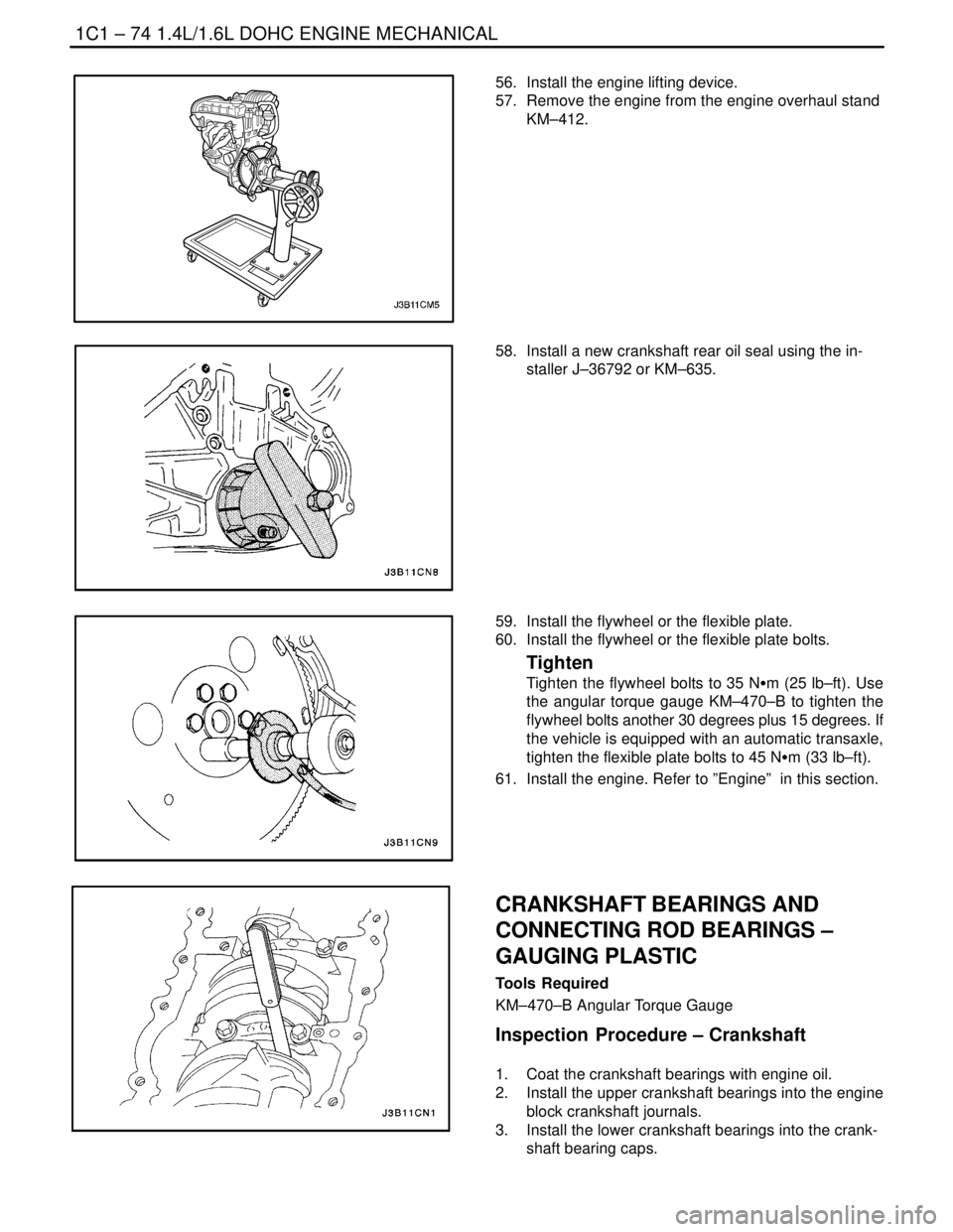
56. Install the engine lifting device.
57. Remove the engine from the engine overhaul stand
KM–412.
58. Install a new crankshaft rear oil seal using the in-
staller J–36792 or KM–635.
59. Install the flywheel or the flexible plate.
60. Install the flywheel or the flexible plate bolts.
Tighten
Tighten the flywheel bolts to 35 NSm (25 lb–ft). Use
the angular torque gauge KM–470–B to tighten the
flywheel bolts another 30 degrees plus 15 degrees. If
the vehicle is equipped with an automatic transaxle,
tighten the flexible plate bolts to 45 NSm (33 lb–ft).
61. Install the engine. Refer to ”Engine” in this section.
CRANKSHAFT BEARINGS AND
CONNECTING ROD BEARINGS –
GAUGING PLASTIC
Tools Required
KM–470–B Angular Torque Gauge
Inspection Procedure – Crankshaft
1. Coat the crankshaft bearings with engine oil.
2. Install the upper crankshaft bearings into the engine
block crankshaft journals.
3. Install the lower crankshaft bearings into the crank-
shaft bearing caps.
Page 119 of 2643
1C1 – 76I1.4L/1.6L DOHC ENGINE MECHANICAL
DAEWOO V–121 BL4
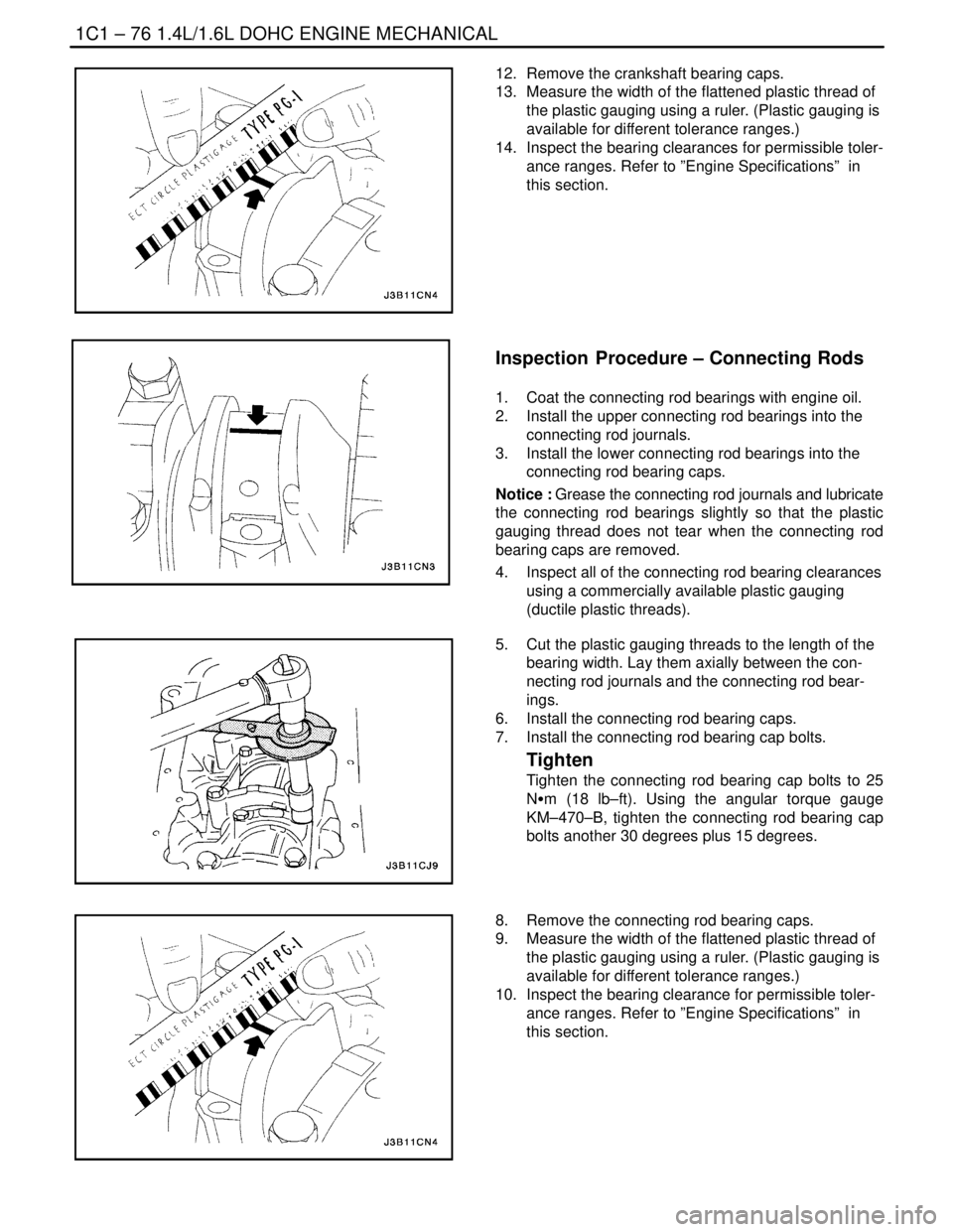
12. Remove the crankshaft bearing caps.
13. Measure the width of the flattened plastic thread of
the plastic gauging using a ruler. (Plastic gauging is
available for different tolerance ranges.)
14. Inspect the bearing clearances for permissible toler-
ance ranges. Refer to ”Engine Specifications” in
this section.
Inspection Procedure – Connecting Rods
1. Coat the connecting rod bearings with engine oil.
2. Install the upper connecting rod bearings into the
connecting rod journals.
3. Install the lower connecting rod bearings into the
connecting rod bearing caps.
Notice : Grease the connecting rod journals and lubricate
the connecting rod bearings slightly so that the plastic
gauging thread does not tear when the connecting rod
bearing caps are removed.
4. Inspect all of the connecting rod bearing clearances
using a commercially available plastic gauging
(ductile plastic threads).
5. Cut the plastic gauging threads to the length of the
bearing width. Lay them axially between the con-
necting rod journals and the connecting rod bear-
ings.
6. Install the connecting rod bearing caps.
7. Install the connecting rod bearing cap bolts.
Tighten
Tighten the connecting rod bearing cap bolts to 25
NSm (18 lb–ft). Using the angular torque gauge
KM–470–B, tighten the connecting rod bearing cap
bolts another 30 degrees plus 15 degrees.
8. Remove the connecting rod bearing caps.
9. Measure the width of the flattened plastic thread of
the plastic gauging using a ruler. (Plastic gauging is
available for different tolerance ranges.)
10. Inspect the bearing clearance for permissible toler-
ance ranges. Refer to ”Engine Specifications” in
this section.
Page 120 of 2643

1.4L/1.6L DOHC ENGINE MECHANICAL 1C1 – 77
DAEWOO V–121 BL4
GENERAL DESCRIPTION
AND SYSTEM OPERATION
CYLINDER HEAD AND GASKET
The cylinder head is made of an aluminum alloy. The cylin-
der head uses cross–flow intake and exhaust ports. A
spark plug is located in the center of each combustion
chamber. The cylinder head houses the dual camshafts.
CRANKSHAFT
The crankshaft has eight integral weights which are cast
with it for balancing. Oil holes run through the center of the
crankshaft to supply oil to the connecting rods, the bear-
ings, the pistons, and the other components. The end
thrust load is taken by the thrust washers installed at the
center journal.
TIMING BELT
The timing belt coordinates the crankshaft and the dual
overhead camshafts and keeps them synchronized. The
timing belt also turns the water pump. The timing belt and
the pulleys are toothed so that there is no slippage be-
tween them. There are two idler pulleys. An automatic ten-
sioner pulley maintains the timing belt’s correct tension.
The timing belt is made of a tough reinforced rubber similar
to that used on the serpentine accessory drive belt. The
timing belt requires no lubrication.
OIL PUMP
The oil pump draws engine oil from the oil pan and feeds
it under pressure to the various parts of the engine. An oil
strainer is mounted before the inlet of the oil pump to re-
move impurities which could clog or damage the oil pump
or other engine components. When the drive gear rotates,
the driven gear rotates. This causes the space between
the gears to constantly open and narrow, pulling oil in from
the oil pan when the space opens and pumping the oil out
to the engine as it narrows.
At high engine speeds, the oil pump supplies a much high-
er amount of oil than is required for lubrication of the en-
gine. The oil pressure regulator prevents too much oil from
entering the engine lubrication passages. During normal
oil supply, a coil spring and valve keep the bypass closed,
directing all of the oil pumped to the engine. When the
amount of oil being pumped increases, the pressure be-
comes high enough to overcome the force of the spring.This opens the valve of the oil pressure regulator, allowing
the excess oil to flow through the valve and drain back to
the oil pan.
OIL PAN
The engine oil pan is mounted to the bottom of the cylinder
block. The engine oil pan houses the crankcase and is
made of cast metal.
Engine oil is pumped from the oil pan by the oil pump. After
it passes through the oil filter, it is fed through two paths
to lubricate the cylinder block and the cylinder head. In one
path, the oil is pumped through the oil passages in the
crankshaft to the connecting rods, then to the pistons and
the cylinders. It then drains back to the oil pan. In the sec-
ond path, the oil is pumped through the oil passages to the
camshaft. The oil passes through the internal passage-
ways in the camshafts to lubricate the valve assemblies
before draining back to the oil pan.
EXHAUST MANIFOLD
A single four–port, rear–takedown manifold is used with
this engine. The manifold is designed to direct escaping
exhaust gases out of the combustion chambers with a
minimum of back pressure. The oxygen sensor is
mounted to the exhaust manifold.
INTAKE MANIFOLD
The intake manifold has four independent long ports and
uses inertial supercharging to improve engine torque at
low and moderate speeds. The plenum is attached to the
intake manifold.
CAMSHAFTS
This engine is a dual overhead camshaft (DOHC) type,
which means there are two camshafts. One camshaft op-
erates the intake valves, and the other camshaft operates
the exhaust valves. The camshafts sit in journals on the
top of the engine in the cylinder head and are held in place
by camshaft caps. The camshaft journals of the cylinder
head are drilled to create oil passages. Engine oil travels
to the camshafts under pressure where it lubricates each
camshaft journal. The oil returns to the oil pan through
drain holes in the cylinder head. The camshaft lobes are
machined into the solid camshaft to open and close the in-
take and the exhaust valves precisely the correct amount
at the correct time. The camshaft lobes are oiled by splash
action from pressurized oil escaping from the camshaft
journals.
Page 121 of 2643

SECTION : 1C2
1.8L DOHC ENGINE MECHANICAL
CAUTION : Disconnect the negative battery cable before removing or installing any electrical unit or when a tool
or equipment could easily come in contact with exposed electrical terminals. Disconnecting this cable will help
prevent personal injury and damage to the vehicle. The ignition must also be in LOCK unless otherwise noted.
TABLE OF CONTENTS
SPECIFICATIONS1C2–2 . . . . . . . . . . . . . . . . . . . . . . . . .
Engine Specifications 1C2–2. . . . . . . . . . . . . . . . . . . . .
Fastener Tightening Specifcations 1C2–4. . . . . . . . . .
SPECIAL TOOLS1C2–6 . . . . . . . . . . . . . . . . . . . . . . . . . .
Special Tools Table 1C2–6. . . . . . . . . . . . . . . . . . . . . . .
COMPONENT LOCATOR1C2–8 . . . . . . . . . . . . . . . . . . .
Upper End 1C2–8. . . . . . . . . . . . . . . . . . . . . . . . . . . . . . .
Lower End 1C2–10. . . . . . . . . . . . . . . . . . . . . . . . . . . . . .
MAINTENANCE AND REPAIR1C2–12 . . . . . . . . . . . . .
ON–VEHICLE SERVICE 1C2–12. . . . . . . . . . . . . . . . . . .
Camshaft Cover 1C2–12. . . . . . . . . . . . . . . . . . . . . . . . .
Cylinder Head and Gasket 1C2–13. . . . . . . . . . . . . . . .
Camshafts 1C2–22. . . . . . . . . . . . . . . . . . . . . . . . . . . . . .
Timing Belt Check and Adjust 1C2–24. . . . . . . . . . . . .
Timing Belt 1C2–28. . . . . . . . . . . . . . . . . . . . . . . . . . . . .
Oil Pan 1C2–32. . . . . . . . . . . . . . . . . . . . . . . . . . . . . . . . .
Oil Pump 1C2–33. . . . . . . . . . . . . . . . . . . . . . . . . . . . . . .
Engine Mount 1C2–37. . . . . . . . . . . . . . . . . . . . . . . . . . .
Intake Manifold 1C2–38. . . . . . . . . . . . . . . . . . . . . . . . . . Exhaust Manifold 1C2–41. . . . . . . . . . . . . . . . . . . . . . . .
Camshaft Gears 1C2–43. . . . . . . . . . . . . . . . . . . . . . . . .
Rear Timing Belt Cover 1C2–44. . . . . . . . . . . . . . . . . . .
Engine 1C2–46. . . . . . . . . . . . . . . . . . . . . . . . . . . . . . . . .
Pistions and Rods 1C2–51. . . . . . . . . . . . . . . . . . . . . . .
UNIT REPAIR 1C2–56. . . . . . . . . . . . . . . . . . . . . . . . . . . .
Cylinder Head and Valve Train Components 1C2–56.
Crankshaft 1C2–63. . . . . . . . . . . . . . . . . . . . . . . . . . . . . .
Crankshaft Bearing and Connecting Rod
Beadings – Gauging Plastics 1C2–72. . . . . . . . . . . .
GENERAL DESCRIPTION AND SYSTEM
OPERATION1C2–75 . . . . . . . . . . . . . . . . . . . . . . . . . . . .
Cylinder Head and Gasket 1C2–75. . . . . . . . . . . . . . . .
Crankshaft 1C2–75. . . . . . . . . . . . . . . . . . . . . . . . . . . . . .
Timing Belt 1C2–75. . . . . . . . . . . . . . . . . . . . . . . . . . . . .
Oil Pump 1C2–75. . . . . . . . . . . . . . . . . . . . . . . . . . . . . . .
Oil Pan 1C2–75. . . . . . . . . . . . . . . . . . . . . . . . . . . . . . . . .
Exhaust Manifold 1C2–75. . . . . . . . . . . . . . . . . . . . . . . .
Intake Manifold 1C2–75. . . . . . . . . . . . . . . . . . . . . . . . . .
Camshaft 1C2–75. . . . . . . . . . . . . . . . . . . . . . . . . . . . . . .
Page 122 of 2643

1C2 – 2I1.8L DOHC ENGINE MECHANICAL
DAEWOO V–121 BL4
SPECIFICATIONS
ENGINE SPECIFICATIONS
ApplicationDescription
General Data:
Engine Type1.8L DOHCT18SED
Displacement1.8L DOHC1,799 cm3 (109.7 in3)
Bore Stroke1.8L DOHC81.6 x 86 mm (3.21 in. x 3.38 in.)
Compression Ratio9.6 ± 0.02:1
Firing Oder1–3–4–2
Cylinder Bore:
Diameter1.8L DOHC81.575~81.625 mm (3.2116~3.2135 in.)
Out of Round (Maximum)0.013 mm (0.0005 in.)
Taper (Maximum)0.013 mm (0.0005 in.)
Pistion:
Diameter1.8L DOHC81.575~82.105 mm (3.2115~3.2325 in.)
Clearance to Bore0.0100~0.0300 mm (0.00039~0.00110 in.)
Piston Protrusion0.5 mm (0.019 in.) Maximum
Piston Taper0.013 (0.0005 in.)
Piston Rings:
Ring, End Gap: Top Compression0.3~0.5 mm (0.011~ 0.019 in.)
Ring, End Gap: Second Compression0.3~0.5 mm (0.011~0.019 in.)
Piston Pin:
Diameter20.9970~20.9985 mm (0.82665~0.82671 in.)
Pin Offset0.8 mm (0.03 in.) Towards Thrust Side
Clearance: In Piston0.0035~0.0140 mm (0.00013~0.00055 in.)
Clearance: In RodInterference Fit in Rod
Length61.5 mm (2.42 in.)
Camshaft:
Lift – Intake9.2 mm (0.36 in.)
Lift – Exhaust9.2 mm (0.36 in.)
End Play0.040~0.14 mm (0.0015~0.0055 in.)
Bearing Journal OD42.455~43.470 mm (1.6714~1.7114 in.)
Crankshaft:
Main Journal:
Diameter (All)
Out of Round (Maximum)57.974~57.995 mm (2.2824~2.2832 in.)
0.003 mm (0.0001 in.)
Main Bearing Clearance (All)0.015~0.040 mm (0.00059~0.00157 in.)
Crankshaft End Play0.070~0.302 mm (0.0027~0.0118 in.)
Service OversizeAvailable in 2 sizes
0.25 mm and 0.50 mm (0.0098~0.0196 in.)
Connecting Rod Journal:
Page 124 of 2643

1C2 – 4I1.8L DOHC ENGINE MECHANICAL
DAEWOO V–121 BL4
FASTENER TIGHTENING SPECIFCATIONS
ApplicationNSmLb–FtLb–In
Air Cleaner Housing Bolts10–89
Automatic Tensioner Bolt2518–
Camshaft Bearing Bridge and Oil Pan Scraper Bolts20 + 45°15 + 45°–
Camshaft Bearing Cap Bolts8–71
Camshaft Cover Bolts8–71
Charcoal Canister Purge and Exhaust Gas Recirculation Sole-
noid Bracket Bolt5–44
Connecting Rod Bearing Cap Bolts35
+ 45° + 15°26
+ 45° + 15°–
Coolant Bypass Housing and Mounting Bolts1511–
Crankshaft Bearing Cap Bolts50
+ 45° + 15°37
+ 45° + 15°–
Crankshaft Pulley Bolts2015–
Crankshaft Gear Bolt145
+ 30° + 15°107
+ 30° + 15°–
Cylinder Head Bolts25 + 90°
+ 90° + 90°18 + 90°
+ 90° + 90°–
Direct Ignition System Coil and Exhaust Gas Recirculation
Mounting Bracket Bolts2518–
Engine Mount Bracket Retaining Bolts and Nuts5541–
Engine Mount Retaining Bolts4533–
Engine–to–Intake Manifold Support Bracket Bolts2015–
Exhaust Camshaft Gear Bolt50
+ 60° + 15°37
+ 60° + 15°–
Exhaust Flex Pipe–to–Catalytic Converter or Connecting Pipe
Retaining Nuts3526–
Exhaust Flex Pipe–to–Exhaust Manifold Retaining Nuts3526–
Exhaust Manifold Heat Shield Bolts8–71
Exhaust Manifold Retaining Nuts2216–
Flexible Plate Bolts4533–
Flywheel Bolts65
+ 30° + 15°48
+ 30° + 15°–
Front Timing Belt Cover Bolts6–53
Generator–to–Intake Manifold Strap Bracket Bolt2216–
Generator–to–Intake Manifold Support Bracket Bolts3727–
Intake Camshaft Gear Bolt50
+ 60° + 15°37
+ 60° + 15°–
Intake Manifold Retaining Bolt and Nuts2216–
Intake Manifold Support Bracket Lower Bolt2518–
Intake Manifold Support Bracket Upper Bolts2518–
Lower Block Support Bracket and Splash Shield Bolts3526–
Oil Pan Drain Plug3526–
Oil Pan Flange–to–Transaxle Bolts4030–
Page 131 of 2643

1.8L DOHC ENGINE MECHANICAL 1C2 – 11
DAEWOO V–121 BL4
1. Connecting Rod
2. Bearing Set
3. Connecting Rod Bolt
4. Piston Ring Set
5. Piston Pin
6. Piston
7. Engine Block
8. Sleeve
9. Water Jacket Cap
10. Bolt (Manual Transaxle)
11. Flywheel (Manual Transaxle)
12. Flexible Plate (Automatic Transaxle)
13. Bolt (Automatic Transaxle)
14. Clamp
15. Hose
16. Clamp
17. Engine Ventilation Pipe
18. Bolt
19. Gasket
20. Needle Sleeve
21. Crankshaft Rear Seal
22. Crankshaft
23. Transmitter Disk
24. Bolt
25. Oil Pan Scraper
26. Oil Pan
27. Drain Plug
28. Washer
29. Bolt
30. Sleeve
31. Gasket
32. Bolt
33. Oil Pump Cover
34. Ring Gear
35. Gear
36. Oil Pressure Switch
37. Washer
38. Washer
39. Oil Duct Outlet Plug
40. Connecting Piece
41. Seal Ring
42. Oil Filter43. Bypass Valve
44. Pressure Relief Valve Plunger
45. Pressure Relief Valve Spring
46. Seal Ring
47. Pressure Relief Valve Plug
48. Seal Ring
49. Bolt
50. Oil Suction Pipe
51. Bolt
52. Rear Timing Belt Cover
53. Bolt
54. Special Bolt
55. Idler Pulley
56. Stud
57. Nut
58. Bolt
59. Tensioner
60. Bolt
61. Thrust Inner Washer
62. Woodruff Key
63. Crankshaft Gear
64. Thrust Outer Washer
65. Bolt
66. Camshaft Drive Belt
67. Gasket
68. Front Timing Belt Cover
69. Bolt
70. Bushing Plug
71. Bushing
72. Oil Gallery Plug
73. Bolt
74. Water Pump
75. Seal Ring
76. Crankshaft Position Sensor
77. Bolt
78. Knock Sensor*
79. Bolt
80. Bolt
81. Crankshaft Bearing Bridge
* : 2.0L DOHC Engine
Page 171 of 2643
1.8L DOHC ENGINE MECHANICAL 1C2 – 51
DAEWOO V–121 BL4
43. Connect the lower radiator hose to the coolant pipe.
44. Connect the upper radiator hose to the thermostat
housing.
45. Connect the heater inlet hose to the cylinder head.
46. Connect the heater outlet hose to the coolant pipe.
47. Connect the coolant surge tank hose to the coolant
pipe.
48. Connect the coolant hose to the throttle body.
49. Connect the throttle cable to the throttle body and
the intake manifold bracket.
50. Install the fuel pump fuse.
51. Connect the negative battery cable.
52. Refill the engine crankcase with engine oil.
53. Refill the engine coolant system. Refer to Section
1D, Engine Cooling.
54. Bleed the power steering system. Refer to Section
6A, Power Steering.
55. Refill the A/C refrigerant system, if equipped. Refer
to Section 7B, Manual Control Heating, Ventilation,
and Air Conditioning System.
56. Install the hood. Refer to Section 9R, Body Front
End.
PISTONS AND RODS
Tools Required
J–8037 Universal Piston Ring Compressor
J–8087 Cylinder Bore Check Gauge
KM–427 Piston Pin Service Set
KM–470–B Angular Torque Gauge
Removal Procedure
1. Remove the cylinder head with the intake manifold
and exhaust manifold attached. Refer to ”Cylinder
Head and Gasket” in this section.
2. Remove the oil pan. Refer to ”Oil Pan” in this sec-
tion.
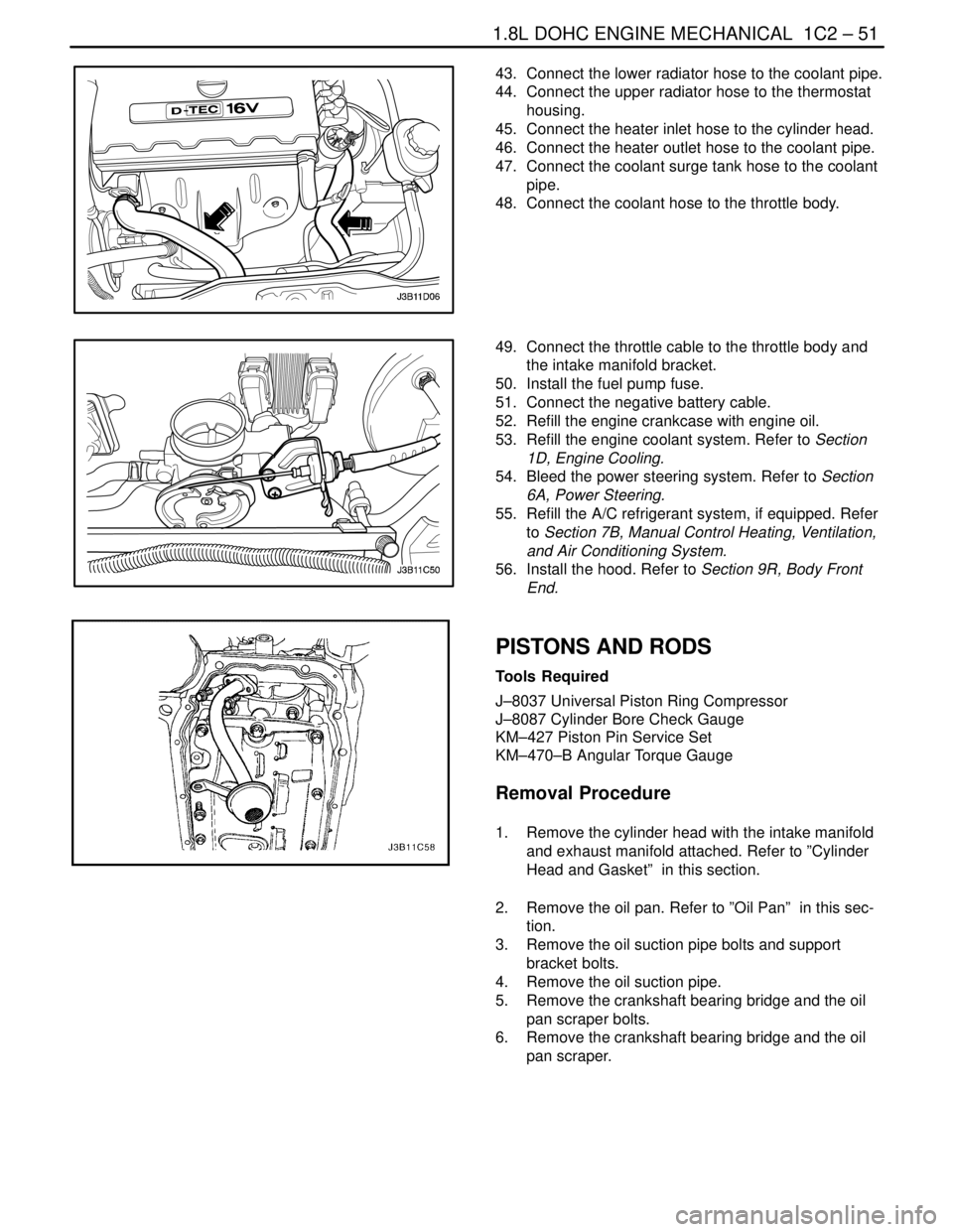
3. Remove the oil suction pipe bolts and support
bracket bolts.
4. Remove the oil suction pipe.
5. Remove the crankshaft bearing bridge and the oil
pan scraper bolts.
6. Remove the crankshaft bearing bridge and the oil
pan scraper.
Page 172 of 2643
1C2 – 52I1.8L DOHC ENGINE MECHANICAL
DAEWOO V–121 BL4
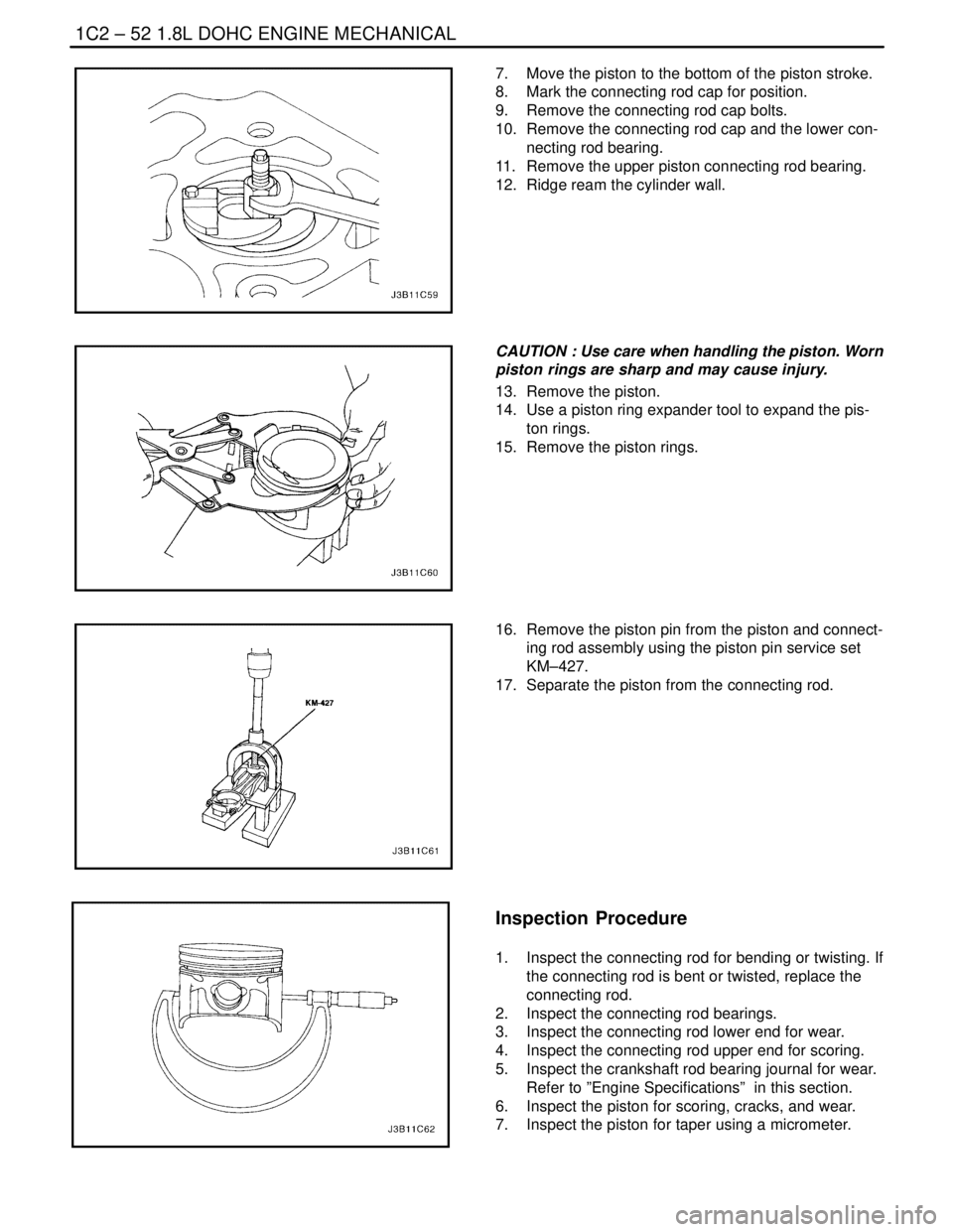
7. Move the piston to the bottom of the piston stroke.
8. Mark the connecting rod cap for position.
9. Remove the connecting rod cap bolts.
10. Remove the connecting rod cap and the lower con-
necting rod bearing.
11. Remove the upper piston connecting rod bearing.
12. Ridge ream the cylinder wall.
CAUTION : Use care when handling the piston. Worn
piston rings are sharp and may cause injury.
13. Remove the piston.
14. Use a piston ring expander tool to expand the pis-
ton rings.
15. Remove the piston rings.
16. Remove the piston pin from the piston and connect-
ing rod assembly using the piston pin service set
KM–427.
17. Separate the piston from the connecting rod.
Inspection Procedure
1. Inspect the connecting rod for bending or twisting. If
the connecting rod is bent or twisted, replace the
connecting rod.
2. Inspect the connecting rod bearings.
3. Inspect the connecting rod lower end for wear.
4. Inspect the connecting rod upper end for scoring.
5. Inspect the crankshaft rod bearing journal for wear.
Refer to ”Engine Specifications” in this section.
6. Inspect the piston for scoring, cracks, and wear.
7. Inspect the piston for taper using a micrometer.
Page 173 of 2643
1.8L DOHC ENGINE MECHANICAL 1C2 – 53
DAEWOO V–121 BL4
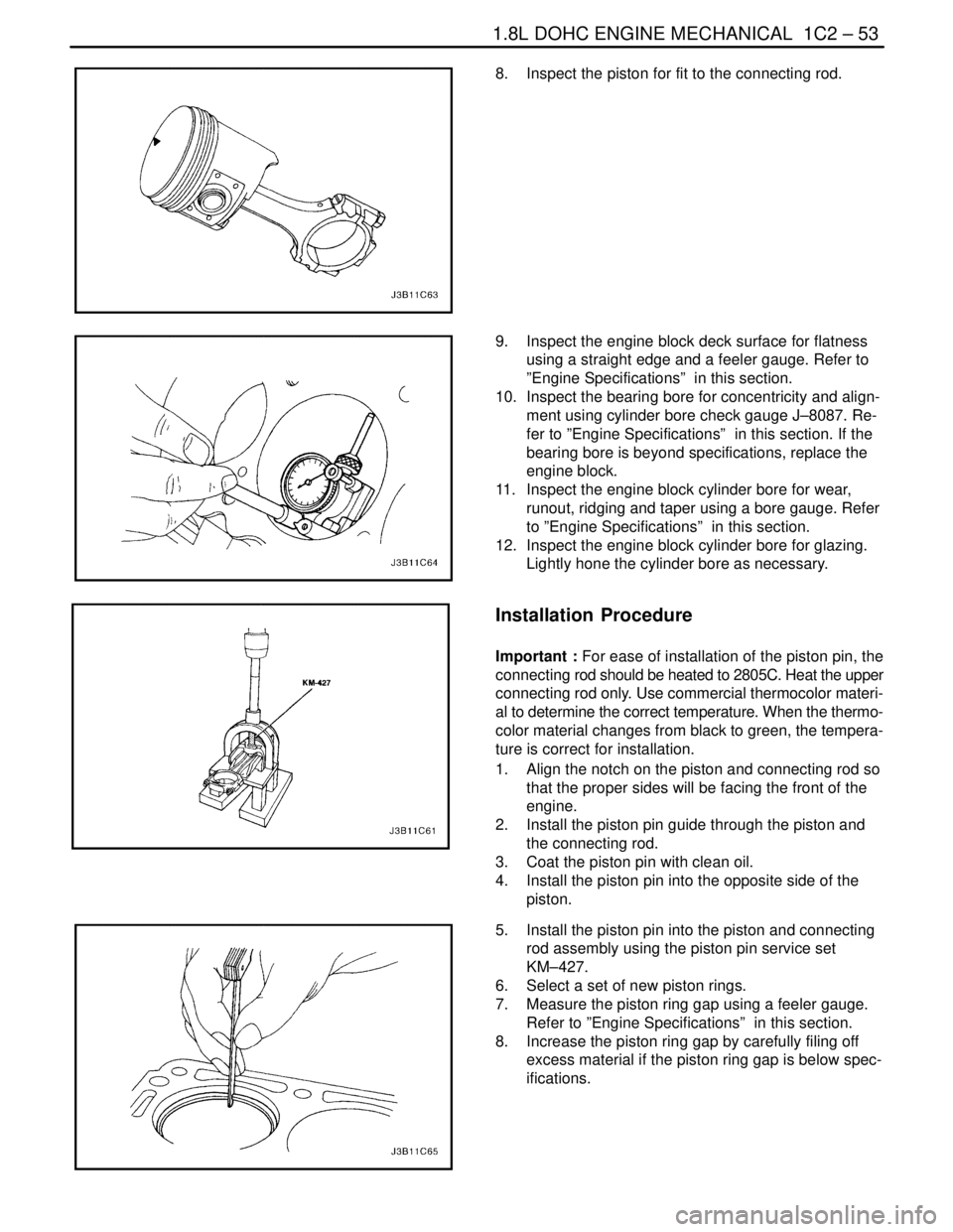
8. Inspect the piston for fit to the connecting rod.
9. Inspect the engine block deck surface for flatness
using a straight edge and a feeler gauge. Refer to
”Engine Specifications” in this section.
10. Inspect the bearing bore for concentricity and align-
ment using cylinder bore check gauge J–8087. Re-
fer to ”Engine Specifications” in this section. If the
bearing bore is beyond specifications, replace the
engine block.
11. Inspect the engine block cylinder bore for wear,
runout, ridging and taper using a bore gauge. Refer
to ”Engine Specifications” in this section.
12. Inspect the engine block cylinder bore for glazing.
Lightly hone the cylinder bore as necessary.
Installation Procedure
Important : For ease of installation of the piston pin, the
connecting rod should be heated to 2805C. Heat the upper
connecting rod only. Use commercial thermocolor materi-
al to determine the correct temperature. When the thermo-
color material changes from black to green, the tempera-
ture is correct for installation.
1. Align the notch on the piston and connecting rod so
that the proper sides will be facing the front of the
engine.
2. Install the piston pin guide through the piston and
the connecting rod.
3. Coat the piston pin with clean oil.
4. Install the piston pin into the opposite side of the
piston.
5. Install the piston pin into the piston and connecting
rod assembly using the piston pin service set
KM–427.
6. Select a set of new piston rings.
7. Measure the piston ring gap using a feeler gauge.
Refer to ”Engine Specifications” in this section.
8. Increase the piston ring gap by carefully filing off
excess material if the piston ring gap is below spec-
ifications.