speed DAEWOO LACETTI 2004 Service Owner's Manual
[x] Cancel search | Manufacturer: DAEWOO, Model Year: 2004, Model line: LACETTI, Model: DAEWOO LACETTI 2004Pages: 2643, PDF Size: 80.54 MB
Page 248 of 2643

1F – 2IENGINE CONTROLS
DAEWOO V–121 BL4
TROUBLE CODE DIAGNOSIS
(1.4L/1.6L DOHC) 1F–111. . . . . . . . . . . . . . . . . . . . . . . .
Clearing Trouble Codes 1F–111. . . . . . . . . . . . . . . . . . . .
Diagnostic Trouble Codes (1.4L/1.6L DOHC) 1F–111.
DTC P0107 Manifold Absolute Pressure Sensor
Low Voltage 1F–114. . . . . . . . . . . . . . . . . . . . . . . . . . .
DTC P0108 Manifold Absolute Pressure Sensor
High Voltage 1F–117. . . . . . . . . . . . . . . . . . . . . . . . . .
DTC P0112 Intake Air Temperature Sensor Low
Voltage 1F–120. . . . . . . . . . . . . . . . . . . . . . . . . . . . . . .
DTC P0113 Intake Air Temperature Sensor High
Voltage 1F–122. . . . . . . . . . . . . . . . . . . . . . . . . . . . . . .
DTC P0117 Engine Coolant Temperature
Sensor Low Voltage 1F–125. . . . . . . . . . . . . . . . . . . .
DTC P0118 Engine Coolant Temperature
Sensor High Voltage 1F–128. . . . . . . . . . . . . . . . . . . .
DTC P0122 Throttle Position Sensor Low
Voltage 1F–131. . . . . . . . . . . . . . . . . . . . . . . . . . . . . . .
DTC P0123 Throttle Position Sensor High
Voltage 1F–134. . . . . . . . . . . . . . . . . . . . . . . . . . . . . . .
DTC P0131 Front Heated Oxygen Sensor Low
Voltage 1F–137. . . . . . . . . . . . . . . . . . . . . . . . . . . . . . .
DTC P0132 Front Heated Oxygen Sensor High
Voltage 1F–140. . . . . . . . . . . . . . . . . . . . . . . . . . . . . . .
DTC P0133 Front Heated Oxygen Sensor No
Activity 1F–142. . . . . . . . . . . . . . . . . . . . . . . . . . . . . . .
DTC P0135 Front Heated Oxygen Sensor Heater
Circuit Not Functioning 1F–145. . . . . . . . . . . . . . . . . .
DTC P0137 Rear Heated Oxygen Sensor Low
Voltage 1F–148. . . . . . . . . . . . . . . . . . . . . . . . . . . . . . .
DTC P0138 Rear Heated Oxygen Sensor High
Voltage 1F–151. . . . . . . . . . . . . . . . . . . . . . . . . . . . . . .
DTC P0140 Rear Heated Oxygen Sensor No
Activity 1F–153. . . . . . . . . . . . . . . . . . . . . . . . . . . . . . .
DTC P0141 Rear Heated Oxygen Sensor Heater
Malfunction 1F–156. . . . . . . . . . . . . . . . . . . . . . . . . . .
DTC P0171 Fuel Trim System Too Lean 1F–158. . . .
DTC P0172 Fuel Trim System Too Rich 1F–162. . . . .
DTC P0222 Main Throttle Idle Actuator (MTIA)
Low Voltage 1F–165. . . . . . . . . . . . . . . . . . . . . . . . . . .
DTC P0223 Main Throttle Idle Actuator (MTIA)
High Voltage 1F–168. . . . . . . . . . . . . . . . . . . . . . . . . .
DTC P0261 Injector 1 Low Voltage 1F–171. . . . . . . . .
DTC P0262 Injector 1 High Voltage 1F–173. . . . . . . .
DTC P0264 Injector 2 Low Voltage 1F–175. . . . . . . . .
DTC P0265 Injector 2 High Voltage 1F–177. . . . . . . .
DTC P0267 Injector 3 Low Voltage 1F–179. . . . . . . . .
DTC P0268 Injector 3 High Voltage 1F–181. . . . . . . .
DTC P0270 Injector 4 Low Voltage 1F–183. . . . . . . . .
DTC P0271 Injector 4 High Voltage 1F–185. . . . . . . . DTC P0300 Multiple Cylinder Misfire(Catalyst
Damage) 1F–188. . . . . . . . . . . . . . . . . . . . . . . . . . . . .
DTC P0300 Multiple Cylinder Misfire(Increase
Emission) 1F–192. . . . . . . . . . . . . . . . . . . . . . . . . . . . .
DTC P0327 Knock Sensor Circuit Fault
(1.4L DOHC) 1F–195. . . . . . . . . . . . . . . . . . . . . . . . . .
DTC P0327 Knock Sensor Circuit Fault
(1.6L DOHC) 1F–198. . . . . . . . . . . . . . . . . . . . . . . . . .
DTC P0335 Magnetic Crankshaft Position
Sensor Electrical Error 1F–201. . . . . . . . . . . . . . . . . .
DTC P0336 58X Crankshaft Position Sensor
No Plausible Signal 1F–204. . . . . . . . . . . . . . . . . . . .
DTC P0337 58X Crankshaft Position Sensor
No Signal 1F–207. . . . . . . . . . . . . . . . . . . . . . . . . . . . .
DTC P0341 Camshaft Position Sensor
Rationality 1F–210. . . . . . . . . . . . . . . . . . . . . . . . . . . .
DTC P0342 Camshaft Position Sensor Signal 1F–212
DTC P0351 Ignition Signal Coil A Fault 1F–214. . . . .
DTC P0352 Ignition Signal Coil B Fault 1F–216. . . . .
DTC P0400 Exhaust Gas Recirculation Out
Of Limit 1F–218. . . . . . . . . . . . . . . . . . . . . . . . . . . . . . .
DTC P0404 Exhaust Gas Recirculation
Opened 1F–221. . . . . . . . . . . . . . . . . . . . . . . . . . . . . . .
DTC P0405 EGR Pintle Position Sensor Low
Voltage 1F–224. . . . . . . . . . . . . . . . . . . . . . . . . . . . . . .
DTC P0406 EGR Pintle Position Sensor High
Voltage 1F–227. . . . . . . . . . . . . . . . . . . . . . . . . . . . . . .
DTC P0420 Catalyst Low Efficiency 1F–230. . . . . . . .
DTC P0444 EVAP Purge Control Circuit No
Signal 1F–232. . . . . . . . . . . . . . . . . . . . . . . . . . . . . . . .
DTC P0445 EVAP Purge Control Circuit Fault 1F–235
DTC P0462 Fuel Level Sensor Low Voltage
(1.6L DOHC Only) 1F–238. . . . . . . . . . . . . . . . . . . . .
DTC P0463 Fuel Level Sensor High Voltage
(1.6L DOHC Only) 1F–241. . . . . . . . . . . . . . . . . . . . .
DTC P0480 Low Speed Cooling Fan Relay
Circuit Fault (1.4L DOHC) 1F–245. . . . . . . . . . . . . . .
DTC P0480 Low Speed Cooling Fan Relay
Circuit Fault (1.6L DOHC) 1F–248. . . . . . . . . . . . . . .
DTC P0481 High Speed Cooling Fan Relay
Circuit Fault (1.4L DOHC) 1F–251. . . . . . . . . . . . . . .
DTC P0481 High Speed Cooling Fan Relay
Circuit Fault (1.6L DOHC) 1F–254. . . . . . . . . . . . . . .
DTC P0501 Vehicle Speed No Signal
(M/T Only) 1F–257. . . . . . . . . . . . . . . . . . . . . . . . . . . .
DTC P0510 Throttle Position Switch Circuit Fault
(1.4L DOHC) 1F–260. . . . . . . . . . . . . . . . . . . . . . . . . .
DTC P0510 Throttle Position Switch Circuit
Fault (1.6L DOHC) 1F–262. . . . . . . . . . . . . . . . . . . . .
DTC P0532 A/C Pressure Sensor Low Voltage 1F–264
DTC P0533 A/C Pressure Sensor High
Voltage 1F–267. . . . . . . . . . . . . . . . . . . . . . . . . . . . . . .
Page 250 of 2643

1F – 4IENGINE CONTROLS
DAEWOO V–121 BL4
DTC P0203 Injector 3 Circuit Fault 1F–414. . . . . . . . .
DTC P0204 Injector 4 Circuit Fault 1F–417. . . . . . . . .
DTC P0300 Multiple Cylinder Misfire Detected 1F–421
DTC P0301 Cylinder 1 Misfire 1F–426. . . . . . . . . . . . .
DTC P0302 Cylinder 2 Misfire 1F–431. . . . . . . . . . . . .
DTC P0303 Cylinder 3 Misfire 1F–436. . . . . . . . . . . . .
DTC P0304 Cylinder 4 Misfire 1F–441. . . . . . . . . . . . .
DTC P0317 Rough Road Sensor Source Not
Detected 1F–445. . . . . . . . . . . . . . . . . . . . . . . . . . . . . .
DTC P0325 Knock Sensor Internal
Malfunction 1F–447. . . . . . . . . . . . . . . . . . . . . . . . . . .
DTC P0327 Knock Sensor Circuit Fault 1F–449. . . . .
DTC P0336 58X Crank Position Extra/Missing
Pulses 1F–452. . . . . . . . . . . . . . . . . . . . . . . . . . . . . . . .
DTC P0337 58X Crank Position Sensor No
Signal 1F–455. . . . . . . . . . . . . . . . . . . . . . . . . . . . . . . .
DTC P0341 Camshaft Position Sensor
Rationality 1F–458. . . . . . . . . . . . . . . . . . . . . . . . . . . .
DTC P0342 Camshaft Position Sensor No
Signal 1F–461. . . . . . . . . . . . . . . . . . . . . . . . . . . . . . . .
DTC P0351 Ignition Control Circuit A Fault
(Cylinder 1 and 4) 1F–464. . . . . . . . . . . . . . . . . . . . . .
DTC P0352 Ignition Control Circuit B Fault
(Cylinder 2 and 3) 1F–466. . . . . . . . . . . . . . . . . . . . . .
DTC P0401 Exhaust Gas Recirculation Insufficient
Flow 1F–468. . . . . . . . . . . . . . . . . . . . . . . . . . . . . . . . .
DTC P0402 Exhaust Gas Recirculation Excessive
Flow 1F–470. . . . . . . . . . . . . . . . . . . . . . . . . . . . . . . . .
DTC P0404 Exhaust Gas Recirculation Open
Valve Position Error 1F–474. . . . . . . . . . . . . . . . . . . .
DTC P0405 Exhaust Gas Recirculation Pintle
Position Low Voltage 1F–478. . . . . . . . . . . . . . . . . . .
DTC P0406 Exhaust Gas Recirculation Pintle
Position High Voltage 1F–481. . . . . . . . . . . . . . . . . . .
DTC P0420 Catalyst Oxygen Sensor Low
Efficiency 1F–484. . . . . . . . . . . . . . . . . . . . . . . . . . . . .
DTC P0443 Evaporative Emission System Purge
Solenoid Control Circuit 1F–486. . . . . . . . . . . . . . . . .
DTC P0461 Fuel Level Struck 1F–489. . . . . . . . . . . . .
DTC P0462 Fuel Level Low Voltage 1F–492. . . . . . . .
DTC P0463 Fuel Level High Voltage 1F–495. . . . . . .
DTC P0502 Vehicle Speed Sensor No Signal
(Engine Side) 1F–498. . . . . . . . . . . . . . . . . . . . . . . . . .
DTC P0506 Idle Speed RPM Lower Than Desired
Idle Speed 1F–501. . . . . . . . . . . . . . . . . . . . . . . . . . . .
DTC P0507 Idle Speed RPM Higher Than Desired
Idle Speed 1F–504. . . . . . . . . . . . . . . . . . . . . . . . . . . .
DTC P0532 A/C Pressure Sensor Low Voltage 1F–507
DTC P0533 A/C Pressure Sensor High
Voltage 1F–510. . . . . . . . . . . . . . . . . . . . . . . . . . . . . . . DTC P0562 System Voltage Too Low
(Engine Side) 1F–513. . . . . . . . . . . . . . . . . . . . . . . . . .
DTC P0563 System Voltage Too High
(Engine Side) 1F–515. . . . . . . . . . . . . . . . . . . . . . . . . .
DTC P0601 ECM Checksum Fault
(Engine Side) 1F–517. . . . . . . . . . . . . . . . . . . . . . . . . .
DTC P0602 ECM Reprogrom Error 1F–518. . . . . . . .
DTC P0607 Lower Power Counter Error 1F–519. . . .
DTC P0700 Transaxle Control Module
Malfunction 1F–520. . . . . . . . . . . . . . . . . . . . . . . . . . .
DTC P1106 Manifold Abosolute Pressure
Intermittent High Voltage 1F–522. . . . . . . . . . . . . . . .
DTC P1107 Manifold Abosolute Pressure
Intermittent Low Voltage 1F–524. . . . . . . . . . . . . . . .
DTC P1111 Intake Air Temperature Intermittent
High Voltage 1F–526. . . . . . . . . . . . . . . . . . . . . . . . . .
DTC P1112 Intake Air Temperature Intermittent
Low Voltage 1F–529. . . . . . . . . . . . . . . . . . . . . . . . . . .
DTC P1114 Engine Coolant Temperature
Intermittent Low Voltage 1F–531. . . . . . . . . . . . . . . .
DTC P1115 Engine Coolant Temperature
Intermittent High Voltage 1F–533. . . . . . . . . . . . . . . .
DTC P1121 Throttle Position Sensor Intermittent
High Voltage 1F–535. . . . . . . . . . . . . . . . . . . . . . . . . .
DTC P1122 Throttle Position Sensor Intermittent
Low Voltage 1F–537. . . . . . . . . . . . . . . . . . . . . . . . . . .
DTC P1133 Front Heated Oxyzen Sensor
(HO2S1) Too Few Transitions 1F–539. . . . . . . . . . .
DTC P1134 Front Heated Oxyzen Sensor
(HO2S1) Transitions Ratio 1F–543. . . . . . . . . . . . . .
DTC P1167 Front Heated Oxyzen Sensor
(HO2S1) Rich in Decel Fuel Cutoff (DFCO) 1F–546
DTC P1171 Fuel Trim System Lean During Power
Enrichment 1F–548. . . . . . . . . . . . . . . . . . . . . . . . . . . .
DTC P1336 58X Crank Position Tooth Error Not
Learned 1F–550. . . . . . . . . . . . . . . . . . . . . . . . . . . . . .
DTC P1391 G Sensor Rough Road Rationality 1F–552
DTC P1392 G Sensor Rough Low Voltage 1F–555. .
DTC P1393 G Sensor Rough High Voltage 1F–558. .
DTC P1396 ABS WSS Signal Variation 1F–561. . . . .
DTC P1397 ABS WSS No Signal 1F–563. . . . . . . . . .
DTC P1404 Exhaust Gas Recirculation Closed
Valve Pintle Error 1F–565. . . . . . . . . . . . . . . . . . . . . .
DTC P1601 SPI Communications Between
ECM and TCM 1F–568. . . . . . . . . . . . . . . . . . . . . . . .
DTC P1607 Lower Power Counter Reset 1F–569. . .
DTC P1626 Immobilizer No Response 1F–570. . . . . .
DTC P1631 Immobilizer Invalid Response 1F–571. .
DTC P1650 SPI Communications Between Error
with SIDM Chip 1F–572. . . . . . . . . . . . . . . . . . . . . . . .
DTC P1655 SPI Communications Between Error
with PSVI Chip 1F–573. . . . . . . . . . . . . . . . . . . . . . . .
Page 252 of 2643

1F – 6IENGINE CONTROLS
DAEWOO V–121 BL4
SPECIFICATIONS
ENGINE DATA DISPLAY TABLES
Engine Data Display
Parameter
ScalingValue
Desired Idle SpeedRPMECM idle command (varies with temperature)
Engine RPMRPM± 50 RPM from desired RPM in drive (A/T) ± 50 RPM
from desired RPM in neutral (M/T)
MAPkPa29 – 55 (varies with manifold and barometric pressure)
Throttle Position VoltV0 v
Start–up IAT°Cvaries
Intake Air Temperature°C10 – 90 °C
Coolant Temperature (Start–up)°Cvaries
Engine Coolant Temperature°C85 – 105 °C
IAC Motor Position–1 – 50
O2 Sensor (B1–S1)mV1–1000 mV (varies continuously)
O2 Sensor (B1–S2)mV1–1000 mV (varies continuously)
Fuel System StatusClosed Loop/Open
Loop”Closed Loop” (may enter ”Open Loop” at extended idle)
Rich/Lean (B1–S1)Rich/Leanvaries
Lean to Rich AveragemS10 –211 ms or 0 ms
Rich to Lean AveragemS10 –211 ms or 0 ms
Engine Load Value%0 – 100 % (varies)
Short Term Fuel Trim%–30 – 30%
Long Term Fuel Trim%–30 – 30%
Linear EGR FeedbackVvaries
EGR Duty Cycle%0 %
EGR EWMA Result–< = 0
Spark Advance°varies
MIL OdometerKm0 Km
MIL On TimeMin0 Min
Base Injection PWMmS1.0 – 5.0 ms
Barometric PressurekPavaries with altitude
Ignition VoltageV13.5 – 14.8 V
Air/Fuel RatioRatio14.6 (Closed Loop Enable)
Calculated Air FlowG/Svaries
Total Misfire (Current)–0
Misfire History Cyl. 1–0
Misfire History Cyl. 2–0
Misfire History Cyl. 3–0
Misfire History Cyl. 4–0
Vehicle SpeedKm/H0 Km/H
A/C PressureVvaries
Page 253 of 2643

ENGINE CONTROLS 1F – 7
DAEWOO V–121 BL4
Parameter ValueScaling
A/C RequestYes/NoNo
A/C ClutchOn/OffOff
Fuel Pump CommandOn/OffOn
Closed LoopYes/NoYe s
Throttle At IdleYes/NoNo
O2 Ready (B1–S1)Yes/NoYe s
Knock PresentYes/NoNo
Fan LowOn/OffOn/Off
Fan HighOn/OffOn/Off
TCC Engaged (Only AT)Yes/NoYe s
Park/Neutral (Only AT)P/N and R/N/DP/N
Fuel Level InputVvaries
Fuel Level Output%varies
Fuel Trim Cell–18
G–SensorV1.1 – 3.7 V (Non–ABS Only)
Engine RuntimeHH:MM:SSHours:Minutes:Seconds
* Condition: Warmed up, idle, park or neutral, A/C off
ENGINE DATA DISPLAY TABLE
DEFINITIONS
ECM Data Description
The following information will assist in diagnosing emis-
sion or driveability problems. A first technician can view
the displays while the vehicle is being driven by second
technician. Refer to Powertrain On–Board Diagnostic
(EOBD) System Check for addition information.
A/C Clutch
The A/C Relay represents the commanded state of the
A/C clutch control relay. The A/C clutch should be en-
gaged when the scan tool displays ON.
A/C Pressure
The A/C High Side displays the pressure value of the A/C
refrigerant pressure sensor. The A/C High Side helps to
diagnose the diagnostic trouble code (DTC) P0533.
A/C Request
The A/C Request represents whether the air conditioning
is being requested from the HVAC selector. The input is re-
ceived by the instrument panel cluster and then sent serial
data to the ECM and finally to the scan tool over KWP 2000
serial data.
Air Fuel Ratio
The Air Fuel Ration indicates the air to fuel ratio based on
the Front Heated Oxygen Sensor (HO2S1) inputs. The
ECM uses the fuel trims to adjust fueling in order to at-
tempt to maintain an air fuel ratio of 14.7:1.BARO
The Barometric Pressure (BARO) sensor measures the
change in the intake manifold pressure which results from
altitude changes. This value is updated at ignition ON and
also at Wide Open Throttle (WOT).
Base Injection PWM
Indicates the base Pulse Width Modulation (PWM) or ON
time of the indicated cylinder injector in milliseconds.
When the engine load is increased, the injector pulse width
will increase.
Calculated Air Flow
The calculated air flow is a calculation based on manifold
absolute pressure. The calculation is used in several diag-
nostics to determine when to run the diagnostics.
Desired Idle Speed
The ECM commands the idle speed. The ECM compen-
sates for various engine loads in order to maintain the de-
sired idle speed. The actual engine speed should remain
close to the desired idle under the various engine loads
with the engine idling.
Engine Coolant Temperature
The Engine Coolant Temperature (ECT) sensor sends en-
gine temperature information to the ECM. The ECM sup-
plies 5 volts to the engine coolant temperature sensor cir-
cuit. The sensor is a thermistor which changes internal
resistance as temperature changes. When the sensor is
cold (internal resistance high), the ECM monitors a high
voltage which it interprets as a cold engine. As the sensor
warms (internal resistance decreases), the voltage signal
will decrease and the ECM will interpret the lower voltage
as a warm engine.
Page 254 of 2643

1F – 8IENGINE CONTROLS
DAEWOO V–121 BL4
EGR Desired Position
The desired exhaust gas recirculation (EGR) position is
the commanded EGR position. The ECM calculates the
desired EGR position. The higher the percentage, the lon-
ger the ECM is commanding the EGR valve ON.
Engine Load
Indicates engine load based on manifold absolute pres-
sure. The higher the percentage, the more load the engine
is under.
Engine Run Time
The engine run time is a measure of how long the engine
has been running. When the engine stops running, the tim-
er resets to zero.
Engine Speed
Engine Speed is computed by the ECM from the fuel con-
trol reference input. It should remain close to desired idle
under the various engine loads with the engine idling.
Fan
The Fan Control (FC) Relay is commanded by the ECM.
The FC Relay displays the command as ON or OFF.
Fuel Level Sensor
The Fuel Level Sensor monitors the fuel level in the tank.
The Fuel Level Sensor monitors the rate of change of the
air pressure in the EVAP system. Several of the Enhanced
EVAP System diagnostics are dependent upon the correct
fuel level.
Fuel System Status
The Closed Loop is displayed indicating that the ECM is
controlling the fuel delivery according to the Front Heated
Oxygen Sensor (HO2S1) voltage as close to an air/fuel ra-
tio of 14.7 to 1 as possible.
IAC Position
The scan tool displays the ECM command for the Idle Air
Control (IAC) pintle position in counts. The higher the
number of counts, the greater the commanded idle speed
reads. The Idle Air Control responds to changes in the en-
gine load in order to maintain the desired idle rpm.
Ignition 1 (Voltage)
The ignition volts represent the system voltage measured
by the ECM at the ignition feed circuit.
Intake Air Temperature
The ECM converts the resistance of the Intake Air Tem-
perature (IAT) sensor to degrees in the same manner as
the engine coolant temperature (ECT) sensor. In take air
temperature is used by the ECM to adjust fuel delivery and
spark timing according to incoming air density.Knock Present
The KS Noise Channel indicates when the ECM detects
the KS signal. The ECM should display NO at idle.
Long Term FT
The Long Term Fuel Trim (FT) is derived from the short
term fuel trim value. The Long Term FT is used for the long
term correction of the fuel delivery. A value of 128 counts
(0%) indicates that the fuel delivery requires no com-
pensation in order to maintain a 14.7:1 air to fuel ratio. A
value below 128 counts means that the fuel system is too
rich and the fuel delivery is being reduced. The ECM is de-
creasing the injector pulse width. A value above 128
counts indicates that a lean condition exists for which the
ECM is compensating.
MAP
The Manifold Absolute Pressure (MAP) sensor measures
the change in the intake manifold pressure which results
from engine load and speed changes. As the intake man-
ifold pressure increases, the air density in the intake also
increases and the additional fuel is required.
Misfire History #1–4
Indicates the number of misfires that have occurred after
195 current misfires have been counted. The current mis-
fire counter will add its misfires to the history misfire count-
er after 195 total misfires have taken place. If 1 cylinder is
misfiring, the misfiring current counter will have 195 mis-
fires counted before adding to its history counter. If 2 cylin-
ders are misfiring, the misfiring current counter will add to
their history counters after 97 misfires. The counter incre-
ments only after a misfire diagnostic trouble code (DTC)
has been set.
Front Heated Oxygen Sensor
The pre–converter Front Heated Oxygen Sensor
(HO2S1) reading represents the exhaust oxygen sensor
output voltage. This voltage will fluctuate constantly be-
tween 100 mv (lean exhaust) and 900 mv (rich exhaust)
when the system is operating in a Closed Loop.
Rear Heated Oxygen Sensor
The post–converter Rear Heated Oxygen Sensor
(HO2S2) represents the exhaust oxygen output voltage
past the catalytic converter. This voltage remains inactive,
or the voltage will appear lazy within a range of 100 mv
(lean exhaust) and 900 mv (rich exhaust) when operating
in a Closed Loop.
Short Term FT
The Short Term FT represents a short term correction to
fuel delivery by the ECM in response to the amount of time
the oxygen sensor voltage spends above or below the 450
mv threshold. If the oxygen sensor has mainly been below
450 mv, indicating a lean air/fuel mixture, short term fuel
trim will increase to tell the ECM to add fuel. If the oxygen
sensor voltage stays mainly above the threshold, the ECM
will reduce fuel delivery to compensate for the indicated
rich condition.
Page 255 of 2643

ENGINE CONTROLS 1F – 9
DAEWOO V–121 BL4
Spark Advance
This is a display of the spark advance Ignition Coil (IC) cal-
culation which the ECM is programming in the ignition sys-
tem. It computes the desired spark advance using data
such as engine temperature, rpm, engine load, vehicle
speed and operating mode.
TCC Engaged
When the brake pedal is applied, the Torque Converter
Clutch (TCC) brake switch sends a signal to the ECM to
disengage the TCC and disable the cruise control.
Total Misfire Current Counter
Indicates the total number of misfires that have been de-tected in all the cylinders after 100 engine cycles. One
cycle equals one complete 4 stroke cycle. The total misfire
only increments during the steady state cruise conditions.
TP Sensor
The ECM uses the TP Sensor in order to determine the
amount of the throttle demanded by the vehicle’s operator.
The TP Sensor reads between 0.36–0.96 volts at idle to
above 4 volts at WOT.
Vehicle Speed
The vehicle speed sensor signal is converted into mph or
km/h for display. The vehicle speed output from the ECM
is 4000 pulses per mile. The scan tool uses the KWP 2000
serial data from the ECM to obtain vehicle speed, while the
Instrument Panel Cluster (IPC), cruise control module and
the chime alarm module use the 4000 ppm output.
Page 274 of 2643
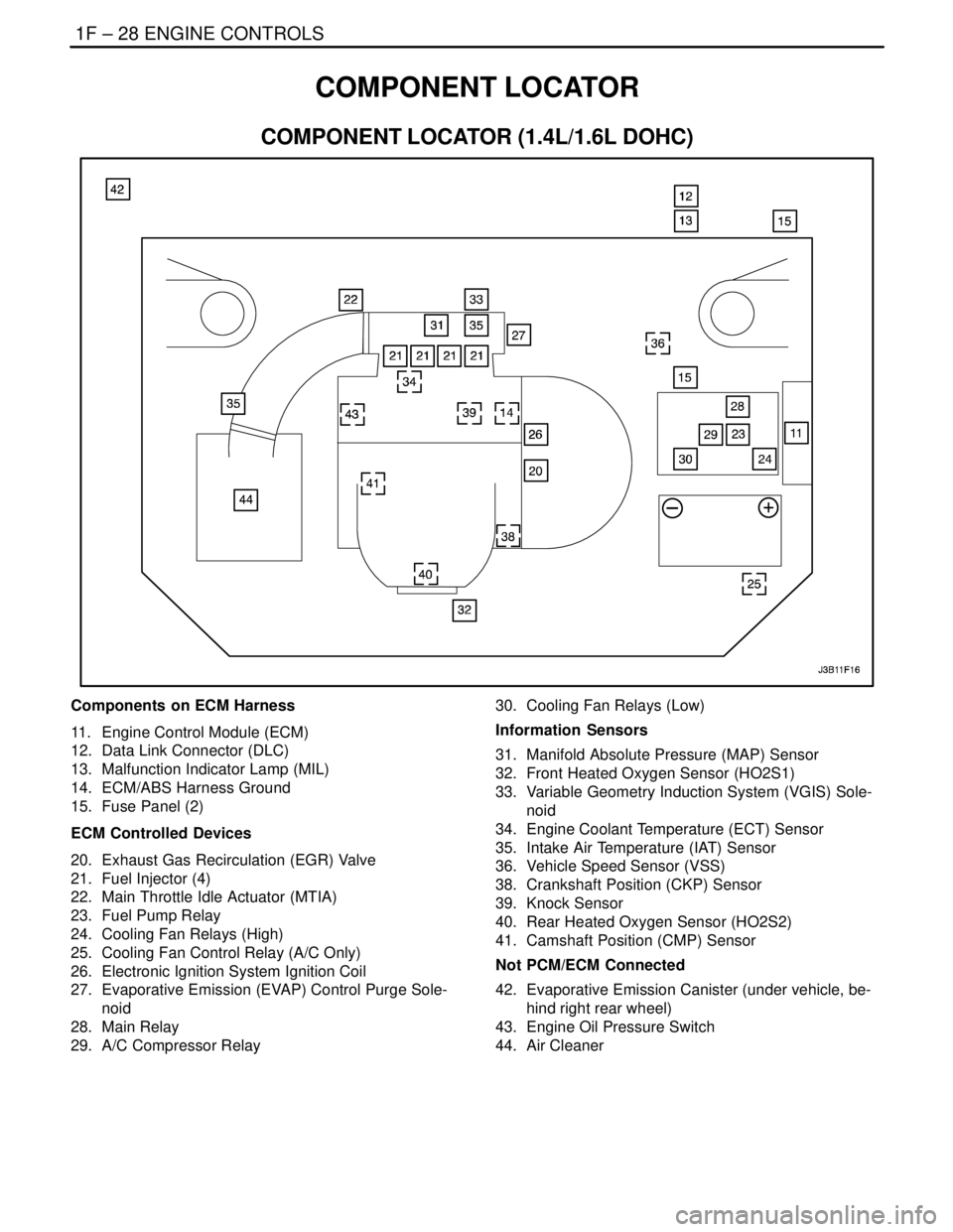
1F – 28IENGINE CONTROLS
DAEWOO V–121 BL4
COMPONENT LOCATOR
COMPONENT LOCATOR (1.4L/1.6L DOHC)
Components on ECM Harness
11. Engine Control Module (ECM)
12. Data Link Connector (DLC)
13. Malfunction Indicator Lamp (MIL)
14. ECM/ABS Harness Ground
15. Fuse Panel (2)
ECM Controlled Devices
20. Exhaust Gas Recirculation (EGR) Valve
21. Fuel Injector (4)
22. Main Throttle Idle Actuator (MTIA)
23. Fuel Pump Relay
24. Cooling Fan Relays (High)
25. Cooling Fan Control Relay (A/C Only)
26. Electronic Ignition System Ignition Coil
27. Evaporative Emission (EVAP) Control Purge Sole-
noid
28. Main Relay
29. A/C Compressor Relay30. Cooling Fan Relays (Low)
Information Sensors
31. Manifold Absolute Pressure (MAP) Sensor
32. Front Heated Oxygen Sensor (HO2S1)
33. Variable Geometry Induction System (VGIS) Sole-
noid
34. Engine Coolant Temperature (ECT) Sensor
35. Intake Air Temperature (IAT) Sensor
36. Vehicle Speed Sensor (VSS)
38. Crankshaft Position (CKP) Sensor
39. Knock Sensor
40. Rear Heated Oxygen Sensor (HO2S2)
41. Camshaft Position (CMP) Sensor
Not PCM/ECM Connected
42. Evaporative Emission Canister (under vehicle, be-
hind right rear wheel)
43. Engine Oil Pressure Switch
44. Air Cleaner
Page 275 of 2643
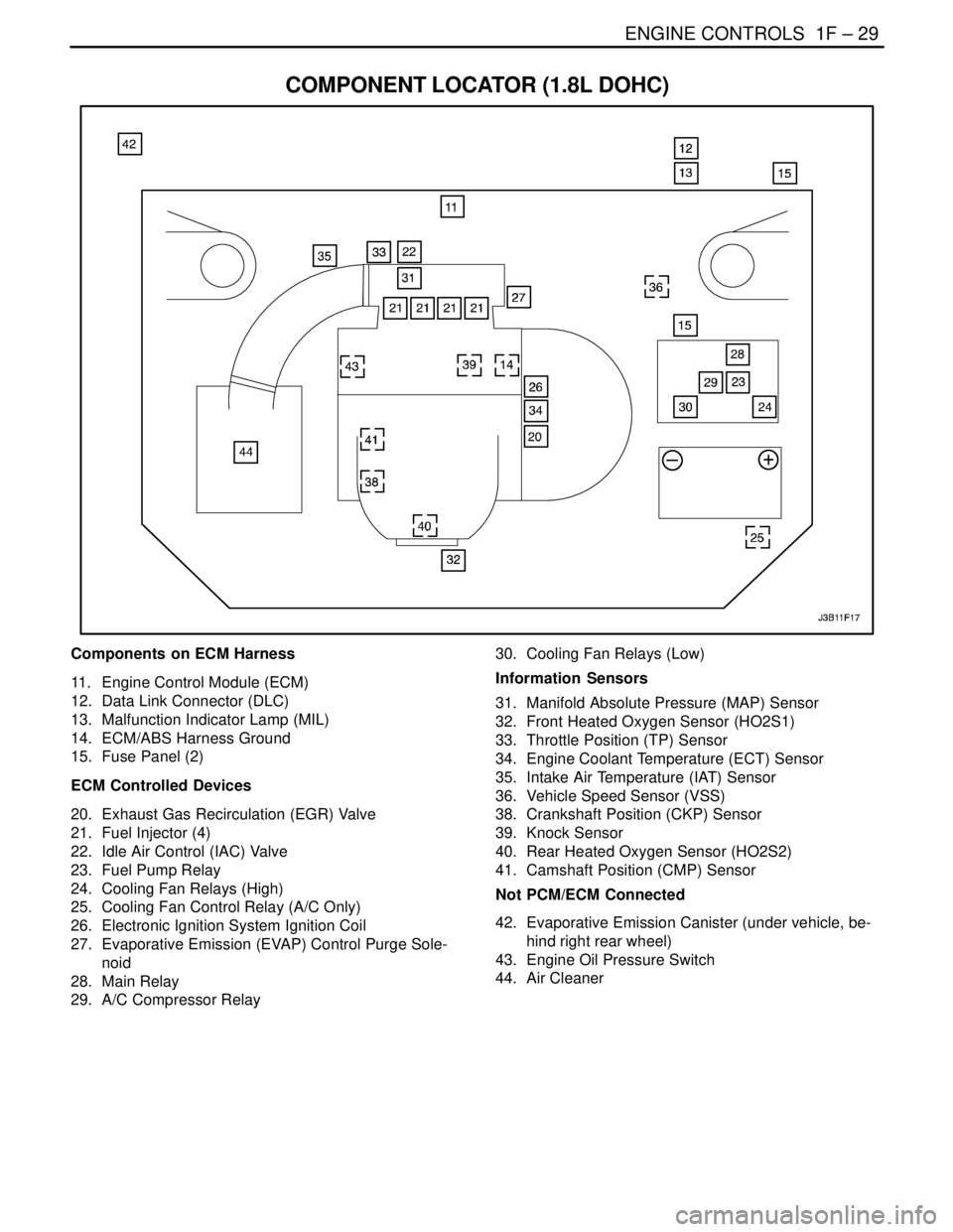
ENGINE CONTROLS 1F – 29
DAEWOO V–121 BL4
COMPONENT LOCATOR (1.8L DOHC)
Components on ECM Harness
11. Engine Control Module (ECM)
12. Data Link Connector (DLC)
13. Malfunction Indicator Lamp (MIL)
14. ECM/ABS Harness Ground
15. Fuse Panel (2)
ECM Controlled Devices
20. Exhaust Gas Recirculation (EGR) Valve
21. Fuel Injector (4)
22. Idle Air Control (IAC) Valve
23. Fuel Pump Relay
24. Cooling Fan Relays (High)
25. Cooling Fan Control Relay (A/C Only)
26. Electronic Ignition System Ignition Coil
27. Evaporative Emission (EVAP) Control Purge Sole-
noid
28. Main Relay
29. A/C Compressor Relay30. Cooling Fan Relays (Low)
Information Sensors
31. Manifold Absolute Pressure (MAP) Sensor
32. Front Heated Oxygen Sensor (HO2S1)
33. Throttle Position (TP) Sensor
34. Engine Coolant Temperature (ECT) Sensor
35. Intake Air Temperature (IAT) Sensor
36. Vehicle Speed Sensor (VSS)
38. Crankshaft Position (CKP) Sensor
39. Knock Sensor
40. Rear Heated Oxygen Sensor (HO2S2)
41. Camshaft Position (CMP) Sensor
Not PCM/ECM Connected
42. Evaporative Emission Canister (under vehicle, be-
hind right rear wheel)
43. Engine Oil Pressure Switch
44. Air Cleaner
Page 325 of 2643

ENGINE CONTROLS 1F – 79
DAEWOO V–121 BL4
IDLE AIR CONTROL SYSTEM CHECK (1.4L/1.6L DOHC)
Circuit Description
The aim of the MTIA (Main Throttle Idle Actuator) is to con-
trol the idle speed with the throttle body itself. The throttle
is motorized for low opening angle (0°C, 19°C). The char-
acteristics of the airflow are not the same for low and high
opening angles. As a matter of fact, the gradient of the
mass air flow function of TPS is lower for small angles that
permits to be more precise during the idle speed control.
Out of idle speed the throttle is actuated mechanically by
a classical bowdencable.
The main throttle idle actuator (MTIA) provides a voltagesignal that changes in relation to the throttle plate angle.
The signal voltage will vary from about nearly 5.0 V at idles
to about 0.2V to 0.4 V at wide–open throttle. The TPS is
one of the most important inputs used by the ECM for fuel
control and other functions such as idle, wide open
throttle, deceleration enleanment, and acceleration en-
richment.
Diagnostic Aids
If the idle is too high, stop the engine. Fully extend the main
throttle idle actuator (MTIA) with a IAC driver. Start the en-
gine. If the idle speed is above 800 rpm, locate and repair
the vacuum leak. Also, check for a binding throttle plate or
throttle linkage or an incorrect base idle setting.
Page 328 of 2643

1F – 82IENGINE CONTROLS
DAEWOO V–121 BL4
IDLE AIR CONTROL SYSTEM CHECK (1.8L DOHC)
Circuit Description
The Engine Control Module (ECM) controls the engine idle
speed with the Idle Air Control (IAC) valve. To increase the
idle speed, the ECM pulls the IAC pintle away from its seat,
allowing more air to pass by the throttle body. To decrease
the idle speed, it extends the IAC valve pintle toward its
seat, reducing bypass air flow. A scan tool will read the
ECM commands to the IAC valve in counts. The higher
counts indicate more air bypass (higher idle). The lower
counts indicate less air is allowed to bypass (lower idle).
Diagnostic Aids
If the idle is too high, stop the engine. Fully extend the Idle
Air Control (IAC) valve with a IAC driver. Start the engine.
If the idle speed is above 800 rpm, locate and repair the
vacuum leak. Also, check for a binding throttle plate or
throttle linkage or an incorrect base idle setting.
Test Description
The number(s) below refer to step(s) on the diagnostic
table.
2. The IAC valve is extended and retracted by the IAC
driver. IAC valve movement is verified by an engine
speed change. If no change in engine speed oc-
curs, the valve can be removed from the throttle
body and tested. Connect the IAC driver to the re-
moved IAC valve and turn the ignition ON. Do not
start the engine.5. This step checks the quality of the IAC valve move-
ment in Step 2. Fully extending the IAC valve may
cause an engine stall. This may be normal.
6. Steps 2 and 5 verify proper IAC valve operation.
This step checks the IAC circuit for a wiring or ECM
fault.
Idle Air Control Valve Reset Procedure
Whenever the battery cable or the Engine Control Module
(ECM) connector or the ECM fuse Ef11 is disconnected or
replaced, the following idle learn procedure must be per-
formed:
1. Turn the ignition ON for 5 seconds.
2. Turn the ignition OFF for 10 seconds.
3. Turn the ignition ON for 5 seconds.
4. Start the engine in park/neutral.
5. Allow the engine to run until the engine coolant is
above 185°F (85°C).
6. Turn the A/C ON for 10 seconds, if equipped.
7. Turn the A/C OFF for 10 seconds, if equipped.
8. If the vehicle is equipped with an automatic trans-
axle, apply the parking brake. While pressing the
brake pedal, place the transaxle in D (drive).
9. Turn the A/C ON for 10 seconds, if equipped.
10. Turn the A/C OFF for 10 seconds, if equipped.
11. Turn the ignition OFF. The idle learn procedure is
complete.