speed DAEWOO LACETTI 2004 Service Manual PDF
[x] Cancel search | Manufacturer: DAEWOO, Model Year: 2004, Model line: LACETTI, Model: DAEWOO LACETTI 2004Pages: 2643, PDF Size: 80.54 MB
Page 464 of 2643
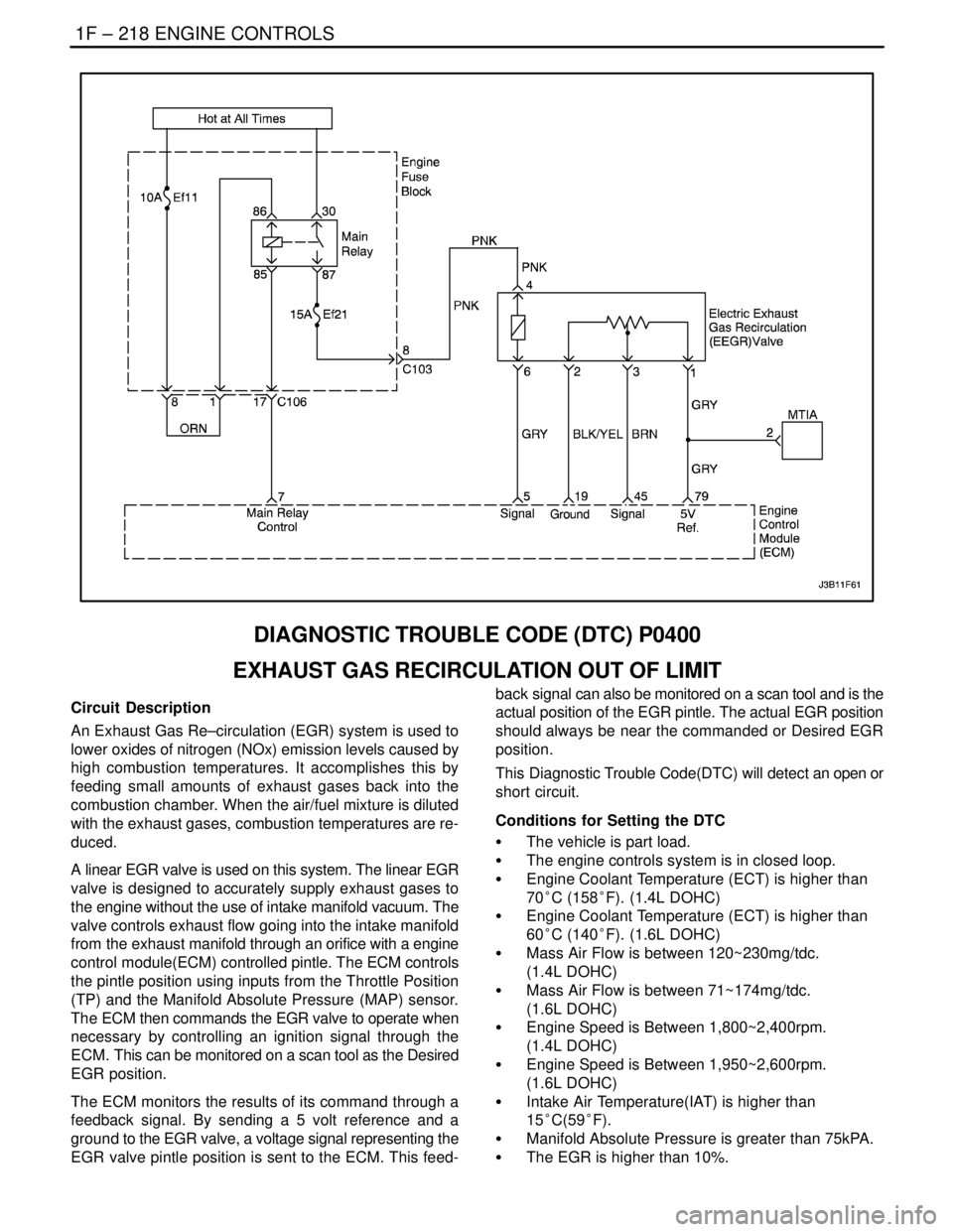
1F – 218IENGINE CONTROLS
DAEWOO V–121 BL4
DIAGNOSTIC TROUBLE CODE (DTC) P0400
EXHAUST GAS RECIRCULATION OUT OF LIMIT
Circuit Description
An Exhaust Gas Re–circulation (EGR) system is used to
lower oxides of nitrogen (NOx) emission levels caused by
high combustion temperatures. It accomplishes this by
feeding small amounts of exhaust gases back into the
combustion chamber. When the air/fuel mixture is diluted
with the exhaust gases, combustion temperatures are re-
duced.
A linear EGR valve is used on this system. The linear EGR
valve is designed to accurately supply exhaust gases to
the engine without the use of intake manifold vacuum. The
valve controls exhaust flow going into the intake manifold
from the exhaust manifold through an orifice with a engine
control module(ECM) controlled pintle. The ECM controls
the pintle position using inputs from the Throttle Position
(TP) and the Manifold Absolute Pressure (MAP) sensor.
The ECM then commands the EGR valve to operate when
necessary by controlling an ignition signal through the
ECM. This can be monitored on a scan tool as the Desired
EGR position.
The ECM monitors the results of its command through a
feedback signal. By sending a 5 volt reference and a
ground to the EGR valve, a voltage signal representing the
EGR valve pintle position is sent to the ECM. This feed-back signal can also be monitored on a scan tool and is the
actual position of the EGR pintle. The actual EGR position
should always be near the commanded or Desired EGR
position.
This Diagnostic Trouble Code(DTC) will detect an open or
short circuit.
Conditions for Setting the DTC
S The vehicle is part load.
S The engine controls system is in closed loop.
S Engine Coolant Temperature (ECT) is higher than
70°C (158°F). (1.4L DOHC)
S Engine Coolant Temperature (ECT) is higher than
60°C (140°F). (1.6L DOHC)
S Mass Air Flow is between 120~230mg/tdc.
(1.4L DOHC)
S Mass Air Flow is between 71~174mg/tdc.
(1.6L DOHC)
S Engine Speed is Between 1,800~2,400rpm.
(1.4L DOHC)
S Engine Speed is Between 1,950~2,600rpm.
(1.6L DOHC)
S Intake Air Temperature(IAT) is higher than
15°C(59°F).
S Manifold Absolute Pressure is greater than 75kPA.
S The EGR is higher than 10%.
Page 476 of 2643

1F – 230IENGINE CONTROLS
DAEWOO V–121 BL4
DIAGNOSTIC TROUBLE CODE (DTC) P0420
CATALYST LOW EFFICIENCY
Circuit Description
In order to control exhaust emissions of Hydrocarbons
(HC), Carbon Monoxide (CO) and Nitrogen Oxide (NOx),
a Three–Way Catalytic Converter (TWC) is used. The cat-
alyst within the converter promotes a chemical reaction
which oxidizes the HC and CO present in the exhaust gas,
converting them into harmless water vapor and carbon
dioxide, it also reduces NOx, converting it into nitrogen.
The catalytic converter also has the ability to store oxygen.
The Engine Control Module (ECM) has the capability to
monitor this process using a Heated Oxygen Sensor
(HO2S) located in the exhaust stream past the TWC. The
HO2S produces an output signal which indicates the oxy-
gen storage capacity of the catalyst; this in turn indicates
the catalyst’s ability to convert exhaust emissions effec-
tively. The ECM monitors the catalyst efficiency by first al-
lowing the catalyst to heat up, waiting for a stabilization pe-
riod while the engine is idling, and then adding and
removing fuel while monitoring the reaction of the HO2S.
When the catalyst is functioning properly, the HO2S re-
sponse to the extra fuel is slow compared to the Oxygen
Sensor (O2S). When the HO2S response is close to that
of the O2S, the Oxygen storage capability or efficiency of
the catalyst is considered to be bad, and the Malfunction
Indicator Lamp (MIL) will illuminate.
Conditions for Setting the DTC
S Closed loop stoichiometry.
S Engine Coolant Temperature (ECT) is more than
75°C (167°F) . (1.4L DOHC)
S Engine Coolant Temperature (ECT) is more than
70°C (158°F) . (1.6L DOHC)
S Engine speed between 1,766rpm and 2,368rpm.
(1.4L DOHC)
S Engine speed between 1,760rpm and 2,530rpm.
(1.6L DOHC)
S Vehicle speed is between 47km/h (29.2mph) and
80km/h (49.7mph). (1.4L DOHC)
S Vehicle speed is between 60km/h (37.3mph) and
76km/h (47.2mph). (1.6L DOHC)
S The manifold absolute pressure is greater than 70
kpa. (1.4L DOHC)S The manifold absolute pressure is greater than 76
kpa. (1.6L DOHC)
S Activity of the heated oxygen sensor excited by
lambda controller stimuli higher than a threshold.
S DTC(s) P0107, P0108, P0117, P0118, P0122,
P0123, P0131, P0132, P0133, P0137, P0138,
P0140, P0141, P0171, P0172, P0300, P0336,
P0337, P0341, P0342, P0351, P0352, P0404,
P0405, P0405 and P0562 are not sets.
Action Taken When the DTC Sets
S The Malfunction Indicator Lamp (MIL) will illuminate
after three consecutive trip with a fail.
S The ECM will record operating conditions at the
time the diagnostic fail. This information will be
stored in the Freeze Frame and Failure Records
buffers.
S A history DTC is stored.
Conditions for Clearing the MIL/DTC
S The MIL will turn off after four consecutive ignition
cycles in which the diagnostic runs without a fault.
S A history DTC will clear after 40 consecutive warm–
up cycles without a fault.
S DTC(s) can be cleared by using the scan tool.
S Disconnecting the ECM battery feed for more than
10 seconds.
Diagnostic Aids
The catalyst test may abort due to a change in the engine
load. Do not change the engine load (i.e. A/C, coolant fan,
heater motor) while a catalyst test is in progress.
An intermittent problem may be caused by a poor connec-
tion, rubbed–through wire insulation, or a wire that is bro-
ken inside the insulation.
Any circuitry, that is suspected as causing the intermittent
complaint, should be thoroughly checked for the following
conditions:
S Backed–out terminals
S Improper mating
S Broken locks
S Improperly formed
S Damaged terminals
S Poor terminal–to–wire connection.
Page 491 of 2643

ENGINE CONTROLS 1F – 245
DAEWOO V–121 BL4
DIAGNOSTIC TROUBLE CODE (DTC) P0480
LOW SPEED COOLING FAN RELAY CIRCUIT FAULT
(1.4L DOHC)
Circuit Description
Ignition voltage is supplied directly to the cooling fan relay
coil. The engine control module(ECM) controls the relay
by grounding the control circuit via an internal switch called
a driver. The primary function of the driver is supply the
ground for the component being controlled. Each driver
has a fault line which is monitored by the ECM. When the
ECM is commanding a component ON, the voltage of the
control circuit should be low (near 0volts). When the ECM
is commanding the control circuit to a component OFF, the
voltage potential of the circuit should be high(near battery
voltage). If the fault detection circuit senses a voltage oth-
er than what is expected, the fault line status will change
causing the DTC to set.
The relay is used to control the high current flow to the
cooling fan motors. This allows the ECM driver to only
have to handle the relatively low current used by the relay.
Conditions for Setting the DTC
S The low speed cooling fan control circuit is an open
or a short to battery to ground condition exist.
Action Taken When the DTC Sets
S The Malfunction Indicator Lamp (MIL) will not illumi-
nate after three consecutive trip with a fail.S The ECM will record operating conditions ant the
time the diagnostic fail. This information will be
stored in the Freeze Frame and Failure Records
buffers.
S A history DTC is stored.
Conditions for Clearing the MIL/DTC
S The MIL will turn off after four consecutive ignition
cycles in which the diagnostic runs without a fault.
S A history DTC will clear after 40 consecutive warm
up cycles without a fault.
S DTC(s) can be cleared by using the scan tool.
S Disconnecting the ECM battery feed for 10 sec-
onds.
Diagnostic Aids
Using Freeze Frame and/or failure records data may aid
in locating an intermittent condition. If the DTC cannot be
duplicated, the information included in the Freeze Frame
and/or failure records data can be useful in determining
how many miles since the DTC set. The fail counter and
Pass Counter can also be used to determine how many
ignition cycles the diagnostics reported a Freeze Frame
conditions (rpm, load, vehicle speed, temperature, etc.)
that .are noted. This will isolate when the DTC failed.
DTC P0480 – Low Speed Cooling Fan Relay Circuit Fault
(1.4L DOHC)
StepActionValue(s)YesNo
1Perform an Euro On–Board Diagnostic (EOBD)
System Check.
Is the system check complete?–Go to Step 2Go to
”On–Board
Diagnostic Sys-
tem Check”
21. Turn the ignition switch to ON with the engine
OFF.
2. Install a scan tool.
3. Command the relay ON and OFF.
Does the relay turn ON and OFF when command-
ed?–Go to Step 3Go to Step 5
31. Turn the ignition switch to LOCK.
2. Disconnect the engine control module (ECM)
connector.
3. Turn the ignition switch to ON.
4. Using a digital voltmeter(DVM), measure the
current in low speed relay control circuit, at ter-
minal 10 to ground for 2 minutes.
Does the amperage measure less than the specified
value?0.75 ampsGo to
”Diagnostic
Aids”Go to Step 6
Page 494 of 2643

1F – 248IENGINE CONTROLS
DAEWOO V–121 BL4
DIAGNOSTIC TROUBLE CODE (DTC) P0480
LOW SPEED COOLING FAN RELAY CIRCUIT FAULT
(1.6L DOHC)
Circuit Description
Ignition voltage is supplied directly to the cooling fan relay
coil. The engine control module(ECM) controls the relay
by grounding the control circuit via an internal switch called
a driver. The primary function of the driver is supply the
ground for the component being controlled. Each driver
has a fault line which is monitored by the ECM. When the
ECM is commanding a component ON, the voltage of the
control circuit should be low (near 0volts). When the ECM
is commanding the control circuit to a component OFF, the
voltage potential of the circuit should be high(near battery
voltage). If the fault detection circuit senses a voltage oth-
er than what is expected, the fault line status will change
causing the DTC to set.
The relay is used to control the high current flow to the
cooling fan motors. This allows the ECM driver to only
have to handle the relatively low current used by the relay.
Conditions for Setting the DTC
S The low speed cooling fan control circuit is an open
or a short to battery or a short to ground condition
exist.
Action Taken When the DTC SetsS The Malfunction Indicator Lamp (MIL) will not illumi-
nate.
S The ECM will store conditions which were present
when the DTC was set as Failure Records data
only.
S This information will not be stored in the Freeze
Frame data.
Conditions for Clearing the MIL/DTC
S A history DTC will clear after 40 consecutive warm–
up cycles without a fault.
S DTC(s) can be cleared by using the scan tool.
S Disconnecting the ECM battery feed for more than
10 seconds.
Diagnostic Aids
Using Freeze Frame and/or failure records data may aid
in locating an intermittent condition. If the DTC cannot be
duplicated, the information included in the Freeze Frame
and/or failure records data can be useful in determining
how many miles since the DTC set. The fail counter and
Pass Counter can also be used to determine how many
ignition cycles the diagnostics reported a Freeze Frame
conditions (rpm, load, vehicle speed, temperature, etc.)
that .are noted. This will isolate when the DTC failed.
DTC P0480 – Low Speed Cooling Fan Relay Circuit Fault
(1.6L DOHC)
StepActionValue(s)YesNo
1Perform an Euro On–Board Diagnostic (EOBD)
System Check.
Is the system check complete?–Go to Step 2Go to
”On–Board
Diagnostic Sys-
tem Check”
21. Turn the ignition switch to ON with the engine
OFF.
2. Install a scan tool.
3. Command the relay ON and OFF.
Does the relay turn ON and OFF when command-
ed?–Go to Step 3Go to Step 5
31. Turn the ignition switch to LOCK.
2. Disconnect the engine control module (ECM)
connector.
3. Turn the ignition switch to ON.
4. Using a digital voltmeter(DVM), measure the
current in low speed relay control circuit, at ter-
minal 10 to ground for 2 minutes.
Does the amperage measure less than the specified
value?0.75 ampsGo to
”Diagnostic
Aids”Go to Step 6
Page 497 of 2643

ENGINE CONTROLS 1F – 251
DAEWOO V–121 BL4
DIAGNOSTIC TROUBLE CODE (DTC) P0481
HIGH SPEED COOLING FAN RELAY CIRCUIT FAULT
(1.4L DOHC)
Circuit Description
Ignition voltage is supplied directly to the cooling fan relay
coil. The engine control module(ECM) controls the relay
by grounding the control circuit via an internal switch called
a driver. The primary function of the driver is supply the
ground for the component being controlled. Each driver
has a fault line which is monitored by the ECM. When the
ECM is commanding a component ON, the voltage of the
control circuit should be low (near 0volts). When the ECM
is commanding the control circuit to a component OFF, the
voltage potential of the circuit should be high(near battery
voltage). If the fault detection circuit senses a voltage oth-
er than what is expected, the fault line status will change
causing the DTC to set.
The relay is used to control the high current flow to the
cooling fan motors. This allows the ECM driver to only
have to handle the relatively low current used by the relay.
Conditions for Setting the DTC
S The high speed cooling fan control circuit is an
open or a short to battery or a short to ground con-
dition exist.
Action Taken When the DTC Sets
S The Malfunction Indicator Lamp (MIL) will not illumi-
nate after three consecutive trip with a fail.S The ECM will record operating conditions ant the
time the diagnostic fail. This information will be
stored in the Freeze Frame and Failure Records
buffers.
S A history DTC is stored.
Conditions for Clearing the MIL/DTC
S The MIL will turn off after four consecutive ignition
cycles in which the diagnostic runs without a fault.
S A history DTC will clear after 40 consecutive warm
up cycles without a fault.
S DTC(s) can be cleared by using the scan tool.
S Disconnecting the ECM battery feed for 10 sec-
onds.
Diagnostic Aids
Using Freeze Frame and/or failure records data may aid
in locating an intermittent condition. If the DTC cannot be
duplicated, the information included in the Freeze Frame
and/or failure records data can be useful in determining
how many miles since the DTC set. The fail counter and
Pass Counter can also be used to determine how many
ignition cycles the diagnostics reported a Freeze Frame
conditions (rpm, load, vehicle speed, temperature, etc.)
that .are noted. This will isolate when the DTC failed.
DTC P0481 – High Speed Cooling Fan Relay Circuit Fault
(1.4L DOHC)
StepActionValue(s)YesNo
1Perform an Euro On–Board Diagnostic (EOBD)
System Check.
Is the system check complete?–Go to Step 2Go to
”On–Board
Diagnostic Sys-
tem Check”
21. Turn the ignition switch to ON with the engine
OFF.
2. Install a scan tool.
3. Command the relay ON and OFF.
Does the relay turn ON and OFF when command-
ed?–Go to Step 3Go to Step 5
31. Turn the ignition switch to LOCK.
2. Disconnect the engine control module (ECM)
connector.
3. Turn the ignition switch to ON.
4. Using a digital voltmeter(DVM), measure the
current in high speed relay control circuit, at
terminal 9 to ground for 2 minutes.
Does the amperage measure less than the specified
value?0.75 ampsGo to
”Diagnostic
Aids”Go to Step 6
Page 500 of 2643

1F – 254IENGINE CONTROLS
DAEWOO V–121 BL4
DIAGNOSTIC TROUBLE CODE (DTC) P0481
HIGH SPEED COOLING FAN RELAY CIRCUIT FAULT
(1.6L DOHC)
Circuit Description
Ignition voltage is supplied directly to the cooling fan relay
coil. The engine control module(ECM) controls the relay
by grounding the control circuit via an internal switch called
a driver. The primary function of the driver is supply the
ground for the component being controlled. Each driver
has a fault line which is monitored by the ECM. When the
ECM is commanding a component ON, the voltage of the
control circuit should be low (near 0volts). When the ECM
is commanding the control circuit to a component OFF, the
voltage potential of the circuit should be high(near battery
voltage). If the fault detection circuit senses a voltage oth-
er than what is expected, the fault line status will change
causing the DTC to set.
The relay is used to control the high current flow to the
cooling fan motors. This allows the ECM driver to only
have to handle the relatively low current used by the relay.
Conditions for Setting the DTC
S The high speed cooling fan control circuit is an
open or a short to battery or a short to ground con-
dition exist.
Action Taken When the DTC SetsS The Malfunction Indicator Lamp (MIL) will not illumi-
nate.
S The ECM will store conditions which were present
when the DTC was set as Failure Records data
only.
S This information will not be stored in the Freeze
Frame data.
Conditions for Clearing the MIL/DTC
S A history DTC will clear after 40 consecutive warm–
up cycles without a fault.
S DTC(s) can be cleared by using the scan tool.
S Disconnecting the ECM battery feed for more than
10 seconds.
Diagnostic Aids
Using Freeze Frame and/or failure records data may aid
in locating an intermittent condition. If the DTC cannot be
duplicated, the information included in the Freeze Frame
and/or failure records data can be useful in determining
how many miles since the DTC set. The fail counter and
Pass Counter can also be used to determine how many
ignition cycles the diagnostics reported a Freeze Frame
conditions (rpm, load, vehicle speed, temperature, etc.)
that .are noted. This will isolate when the DTC failed.
DTC P0481 – High Speed Cooling Fan Relay Circuit Fault
(1.6L DOHC)
StepActionValue(s)YesNo
1Perform an Euro On–Board Diagnostic (EOBD)
System Check.
Is the system check complete?–Go to Step 2Go to
”On–Board
Diagnostic Sys-
tem Check”
21. Turn the ignition switch to ON with the engine
OFF.
2. Install a scan tool.
3. Command the relay ON and OFF.
Does the relay turn ON and OFF when command-
ed?–Go to Step 3Go to Step 5
31. Turn the ignition switch to LOCK.
2. Disconnect the engine control module (ECM)
connector.
3. Turn the ignition switch to ON.
4. Using a digital voltmeter(DVM), measure the
current in high speed relay control circuit, at
terminal 9 to ground for 2 minutes.
Does the amperage measure less than the specified
value?0.75 ampsGo to
”Diagnostic
Aids”Go to Step 6
Page 501 of 2643

ENGINE CONTROLS 1F – 255
DAEWOO V–121 BL4
StepNo Yes Value(s) Action
41. Turn the ignition switch to LOCK.
2. Disconnect the relay.
3. Using a DVM, measure the resistance between
terminals 85 and 9 in the high speed cooling
fan relay control circuit in the ECM harness
connector to ground.
Does the DVM display infinite resistance?–Go to Step 12Go to Step 10
51. Turn the ignition switch to LOCK.
2. Disconnect the relay.
3. Connect a test light between the relay coil ter-
minals 86 and 85 in the relay harness connec-
tor.
4. Turn the Turn the ignition switch to ON.
5. Using the scan tool, command the relay ON
and OFF.
Does the test light turn ON and OFF with each com-
manded?–Go to Step 8Go to Step 6
6With the test light connected to ground, probe the
ignition feed circuit in the relay harness connector.
Does the test light illuminate?–Go to Step 7Go to Step 11
71. Turn the ignition switch to LOCK.
2. Reconnect the relay.
3. Disconnect the ECM connector containing the
relay control circuit.
4. Turn the Turn the ignition switch to ON.
5. With a fused jumper wire connected to ground,
probe the relay control circuit at terminal 9 in
the ECM harness connector.
Does the relay operate?–Go to Step 9Go to Step 10
8Check the connections at the relay.
Is a problem found and corrected?–Go to Step 14Go to Step 12
9Check the connection at the ECM.
Is a problem found and corrected?–Go to Step 11Go to Step 13
10Repair the faulty relay control circuit.
Is the repair complete?–Go to Step 14–
11Repair the faulty relay ignition feed circuit.
Is the repair complete?–Go to Step 14–
12Replace the relay.
Is the replacement complete?–Go to Step 14–
13Replace the ECM.
Is the replacement complete?–Go to Step 14–
Page 503 of 2643
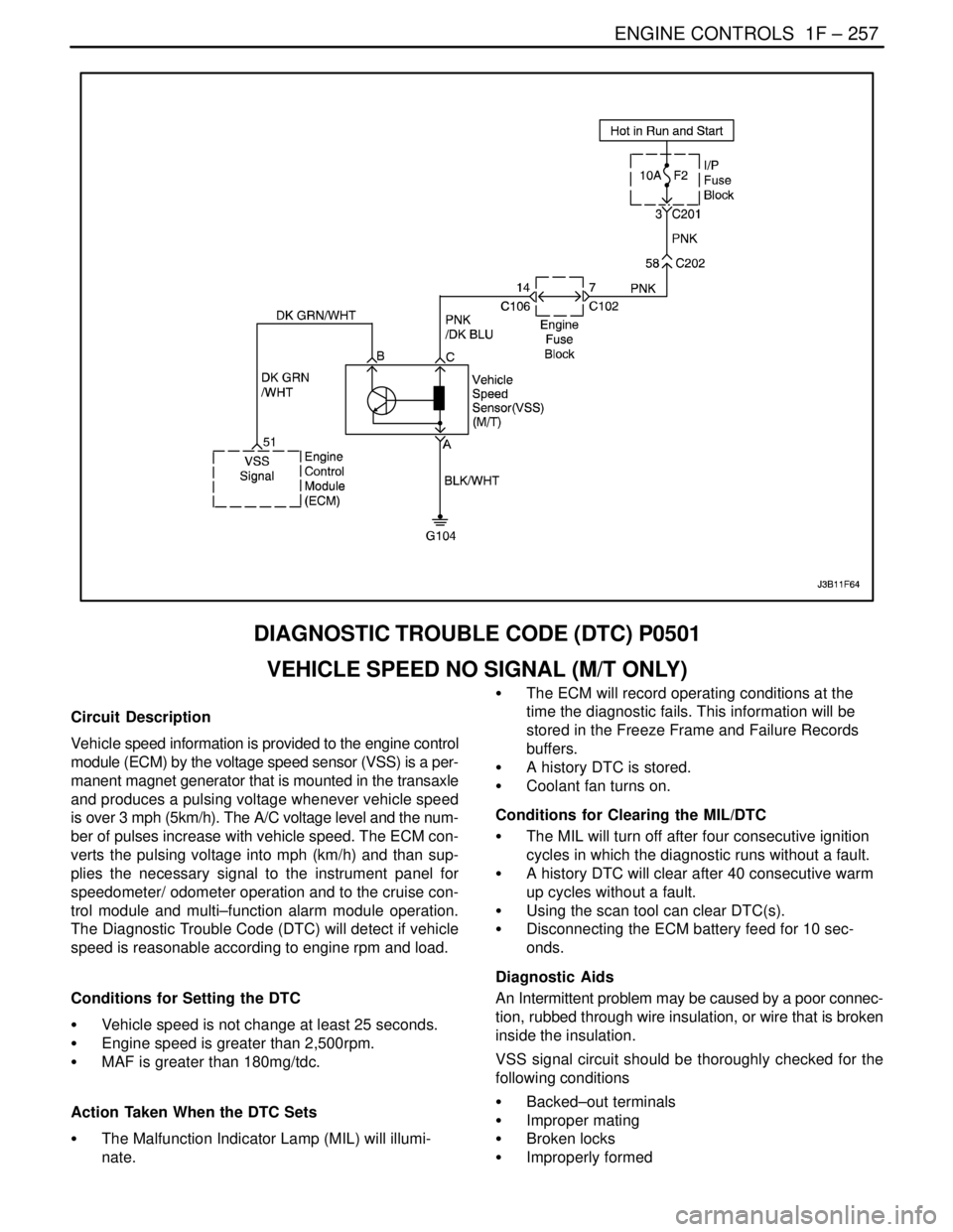
ENGINE CONTROLS 1F – 257
DAEWOO V–121 BL4
DIAGNOSTIC TROUBLE CODE (DTC) P0501
VEHICLE SPEED NO SIGNAL (M/T ONLY)
Circuit Description
Vehicle speed information is provided to the engine control
module (ECM) by the voltage speed sensor (VSS) is a per-
manent magnet generator that is mounted in the transaxle
and produces a pulsing voltage whenever vehicle speed
is over 3 mph (5km/h). The A/C voltage level and the num-
ber of pulses increase with vehicle speed. The ECM con-
verts the pulsing voltage into mph (km/h) and than sup-
plies the necessary signal to the instrument panel for
speedometer/ odometer operation and to the cruise con-
trol module and multi–function alarm module operation.
The Diagnostic Trouble Code (DTC) will detect if vehicle
speed is reasonable according to engine rpm and load.
Conditions for Setting the DTC
S Vehicle speed is not change at least 25 seconds.
S Engine speed is greater than 2,500rpm.
S MAF is greater than 180mg/tdc.
Action Taken When the DTC Sets
S The Malfunction Indicator Lamp (MIL) will illumi-
nate.S The ECM will record operating conditions at the
time the diagnostic fails. This information will be
stored in the Freeze Frame and Failure Records
buffers.
S A history DTC is stored.
S Coolant fan turns on.
Conditions for Clearing the MIL/DTC
S The MIL will turn off after four consecutive ignition
cycles in which the diagnostic runs without a fault.
S A history DTC will clear after 40 consecutive warm
up cycles without a fault.
S Using the scan tool can clear DTC(s).
S Disconnecting the ECM battery feed for 10 sec-
onds.
Diagnostic Aids
An Intermittent problem may be caused by a poor connec-
tion, rubbed through wire insulation, or wire that is broken
inside the insulation.
VSS signal circuit should be thoroughly checked for the
following conditions
S Backed–out terminals
S Improper mating
S Broken locks
S Improperly formed
Page 504 of 2643

1F – 258IENGINE CONTROLS
DAEWOO V–121 BL4
S Damaged terminals
S Poor terminal to wire connection
S Physical damage to the wiring harness
Ensure the VSS is correctly torqued to the trnasaxle hous-ing.
Refer to ”Intermittents” in this section.
DTC P0501 – Vehicle Speed No Signal (M/T Only)
StepActionValue(s)YesNo
1Perform an Euro On–Board Diagnostic (EOBD)
System Check.
Is the system check complete?–Go to Step 2Go to
”On–Board
Diagnostic Sys-
tem Check”
2Notice : Running the vehicle in gear with the wheels
hanging down at full travel will damage the drive
axles.
1. Turn the ignition ON, with the engine OFF.
2. Install a scan tool.
3. Raise the drive wheels.
4. Support the lower control arms so that the
drive axles are in a horizontal (straight) posi-
tion.
5. Allow the engine to idle in gear.
Does the scan tool display vehicle speed above the
specified value?0 mphGo to Step 3Go to Step 4
31. Turn the ignition ON, with the engine OFF.
2. Review the Freeze Frame data and note the
parameters.
3. Operate the vehicle within the Freeze Frame
conditions and Conditions for Setting this DTC.
Does the scan tool display the vehicle speed above
the specified value?0 mphGo to Step 12Go to Step 4
41. Turn the ignition OFF.
2. Disconnect the engine control module(ECM)
connector 51.
3. Using a digital voltmeter(DVM) connected to
ground, measure the voltage in the Vehicle
Speed Sensor (VSS) signal circuit, at terminal
C while rotating the wheels.
Is the voltage greater than or eqaul to specified val-
ue?0.5VGo to Step 12Go to Step 5
5Measure the resistant in the VSS signal circuit while
rotating the wheels.
Is the resistance greater than the specified value?1950WGo to Step 6Go to Step 7
6Check the VSS signal circuit for an open and repair
as necessary.
Is the repair complete?–Go to Step 12Go to Step 9
7Is the resistance value within or equal to the speci-
fied value?1300–1950WGo to Step 8Go to Step 9
8Check the VSS signal circuit for a short to ground or
for being shorted together and repair as necessary.
Is a repair necessary?–Go to Step 12Go to Step 12
91. Remove the VSS.
2. Measure the resistance between terminals A
and C.
Is the resistance value within the specified value?1300–1950WGo to Step 11Go to Step 10
Page 506 of 2643

1F – 260IENGINE CONTROLS
DAEWOO V–121 BL4
DIAGNOSTIC TROUBLE CODE (DTC) P0510
THROTTLE POSITION SWITCH CIRCUIT FAULT
(1.4L DOHC)
Circuit Description
The aim of the MTIA(Main Throttle Idle Actuator) is to con-
trol the idle speed with the throttle body itself. The throttle
is motorized for low opening angle (05, 195). The charac-
teristics of the air flow are not the same for low and high
opening angles. As a matter of fact, the gradient of the
mass air flow function of TP sensor is lower for small
angles that permits to be more precise during the idle
speed control. Out of idle speed the throttle is actuated
mechanically by a classical bowdencable.
This switch indicates throttle plate in idle position when
contact closed. This switch is fixed at the DC–motor drive
and the throttle plate closes the contact in dependence to
the actual motor drive position.
Conditions for Setting the DTC
S The engine stopped and ignition switch turned ON.
S DTCs P0122, P0123, P0222 and P0223 are not
set.
S MTIA output signal is highter than throttle position +
2.5° and throttle position is open at least 0.2 sec-
onds.
Or
S DTCs P0122, P0123, P0222, and P0223 are not
set.
S The throttle position output signal is greater than
30° and throttle position is closed at least 2 sec-
onds.
Action Taken When the DTC SetsS The Malfunction Indicator Lamp (MIL) will not illumi-
nate.
S The ECM will store conditions which were present
when the DTC was set as Failure Records data
only.
S This information will not be stored in the Freeze
Frame data.
Conditions for Clearing the MIL/DTC
S A history DTC will clear after 40 consecutive warm
up cycles without a fault.
S DTC(s) can be cleared by using the scan tool.
S Disconnecting the ECM battery feed for more than
10 seconds.
Diagnostic Aids
An Intermittent problem may be caused by a poor connec-
tion, rubbed through wire insulation, or wire that is broken
inside the insulation.
VSS signal circuit should be thoroughly checked for the
following conditions
S Backed–out terminals
S Improper mating
S Broken locks
S Improperly formed
S Damaged terminals
S Poor terminal to wire connection
S Physical damage to the wiring harness
Ensure the VSS is correctly torqued to the trnasaxle hous-
ing.
Refer to ”Intermittents” in this section.