Section 5 DAEWOO LACETTI 2004 Service Repair Manual
[x] Cancel search | Manufacturer: DAEWOO, Model Year: 2004, Model line: LACETTI, Model: DAEWOO LACETTI 2004Pages: 2643, PDF Size: 80.54 MB
Page 1072 of 2643
REAR DRUM BRAKES 4E2 – 3
DAEWOO V–121 BL4
MAINTENANCE AND REPAIR
ON–VEHICLE SERVICE
BRAKE ADJUSTMENT
Removal Procedure
1. Release the parking brake.
2. Operate the brake at least 10 times until the jump-
ing of the adjustment spring on the adjustment nut
can no longer be heard on either brake drum.
3. Raise and suitably support the vehicle.
4. Remove the rear wheels. Refer to Section 2E, Tires
and Wheels.
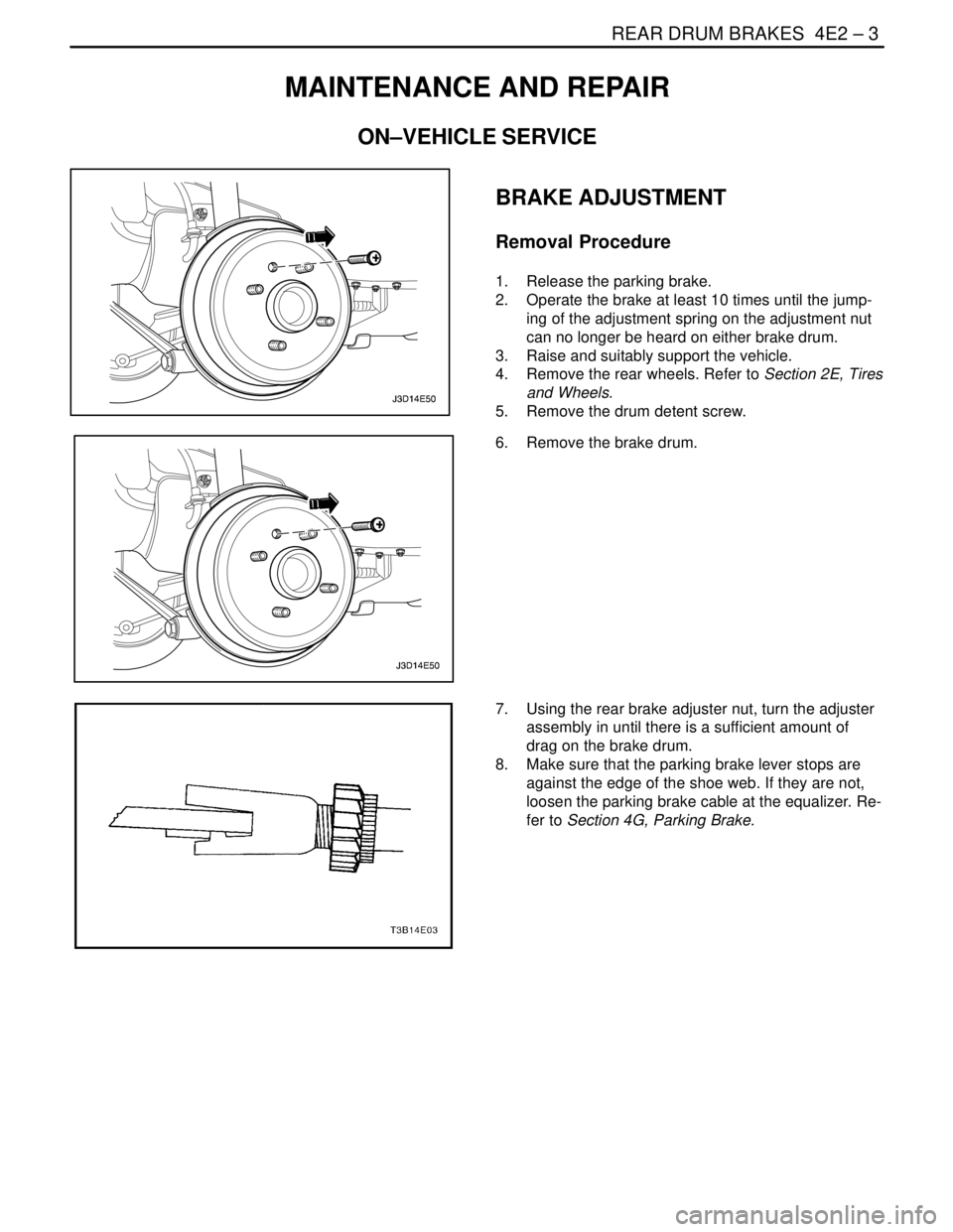
5. Remove the drum detent screw.
6. Remove the brake drum.
7. Using the rear brake adjuster nut, turn the adjuster
assembly in until there is a sufficient amount of
drag on the brake drum.
8. Make sure that the parking brake lever stops are
against the edge of the shoe web. If they are not,
loosen the parking brake cable at the equalizer. Re-
fer to Section 4G, Parking Brake.
Page 1073 of 2643
4E2 – 4IREAR DRUM BRAKES
DAEWOO V–121 BL4
Installation Procedure
1. Position the rear brake drum. Fasten the drum det-
ent screw.
Tighten
Tighten the drum detent screw to 4 NSm (35 lb–in).
2. Install the rear wheels. Refer to Section 2E, Tires
and Wheels.
Important : The brake pedal must be operated more than
10 times. When the clicking can no longer be heard, the
clearance between the brake shoe and drum is adjusted.
3. Apply the foot brake several times until the clicking
of the adjustment actuator can no longer be heard.
4. Adjust the parking brake. Refer to Section 4G,
Parking Brake.
SHOE AND LINING
Removal Procedure
1. Raise and suitably support the vehicle.
2. Remove the rear wheels. Refer to Section 2E, Tires
and Wheels.
3. Loosen the parking brake cable. Refer to Section
4G, Parking Brake.
4. Remove the brake drum.
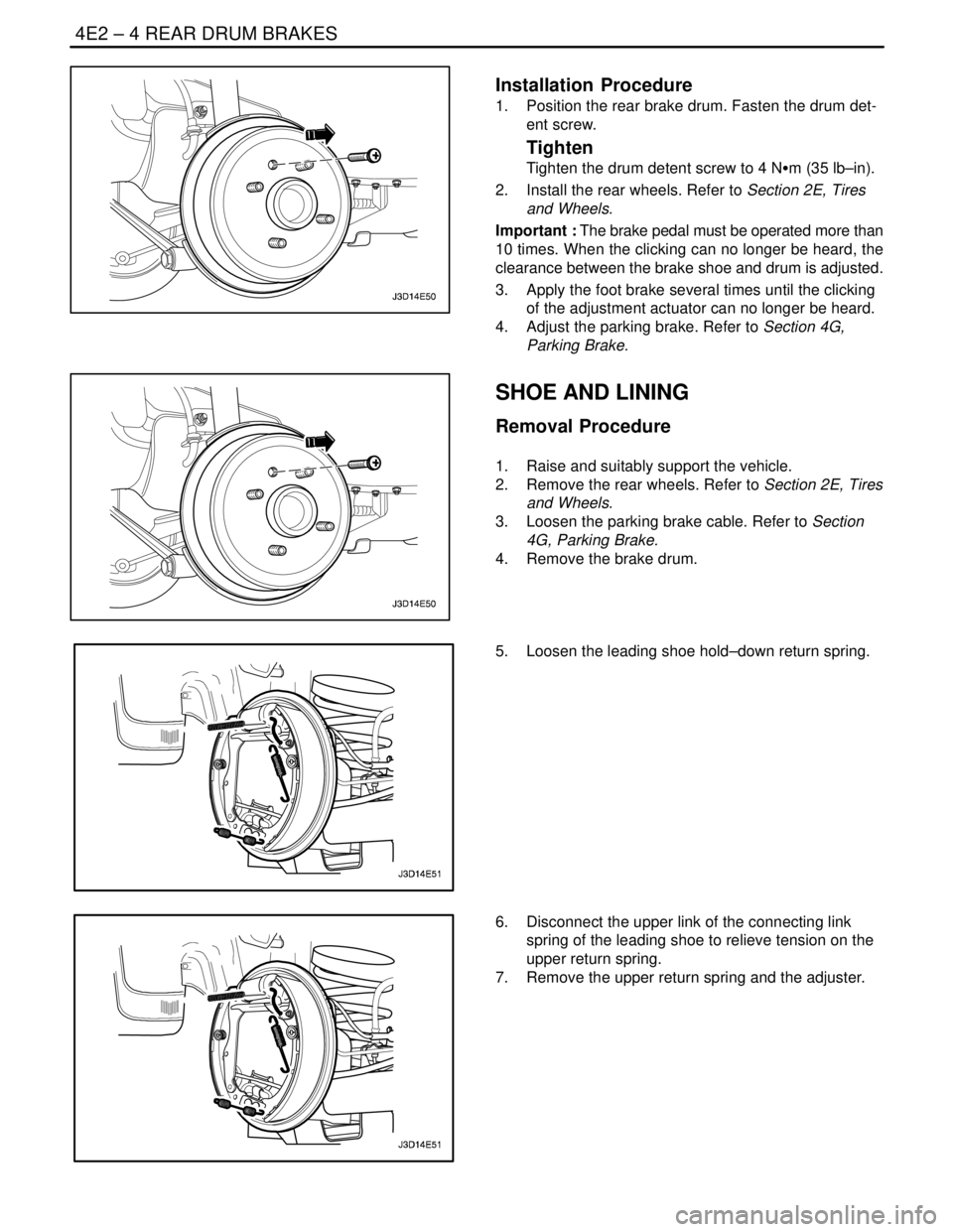
5. Loosen the leading shoe hold–down return spring.
6. Disconnect the upper link of the connecting link
spring of the leading shoe to relieve tension on the
upper return spring.
7. Remove the upper return spring and the adjuster.
Page 1074 of 2643
REAR DRUM BRAKES 4E2 – 5
DAEWOO V–121 BL4
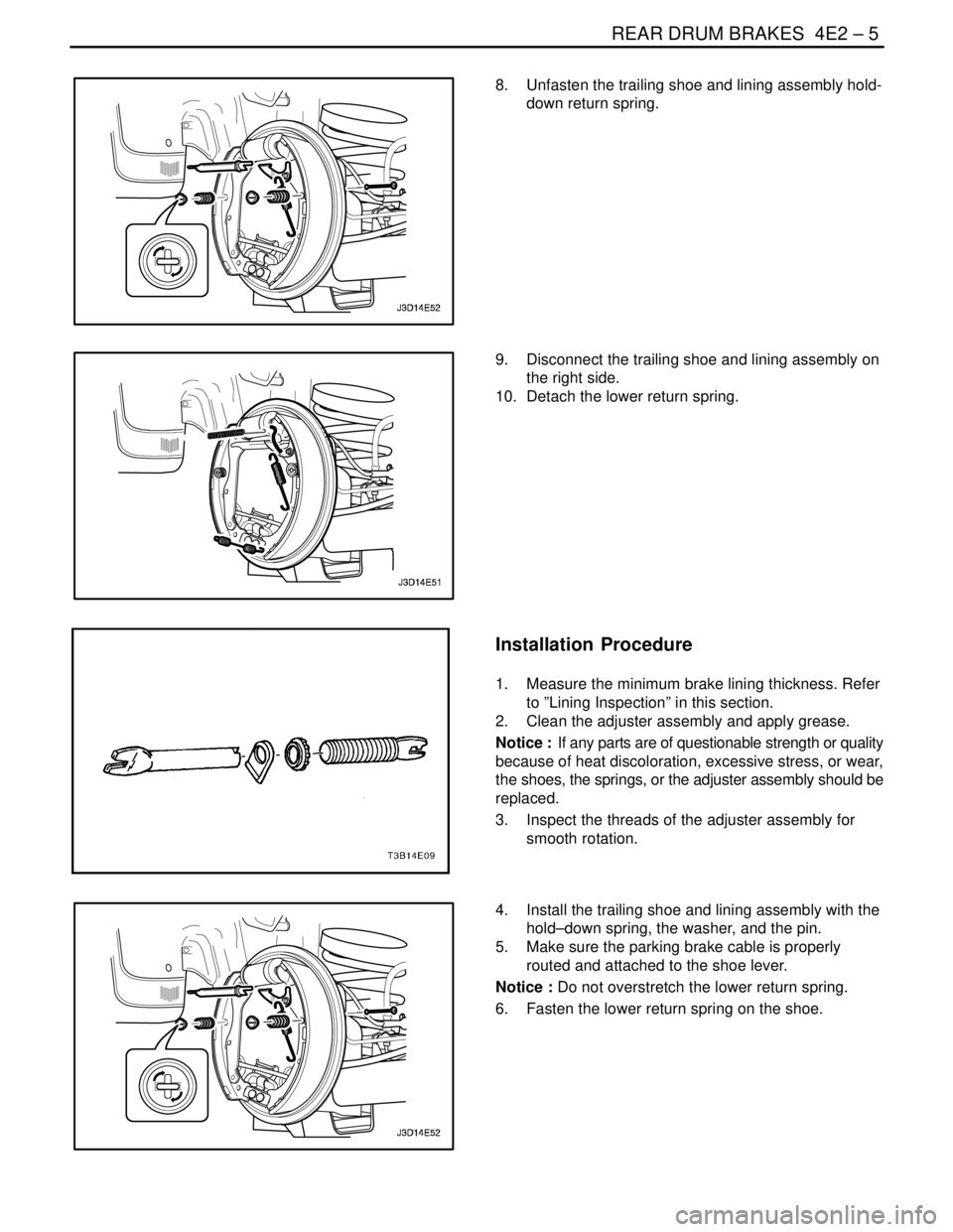
8. Unfasten the trailing shoe and lining assembly hold-
down return spring.
9. Disconnect the trailing shoe and lining assembly on
the right side.
10. Detach the lower return spring.
Installation Procedure
1. Measure the minimum brake lining thickness. Refer
to ”Lining Inspection” in this section.
2. Clean the adjuster assembly and apply grease.
Notice : If any parts are of questionable strength or quality
because of heat discoloration, excessive stress, or wear,
the shoes, the springs, or the adjuster assembly should be
replaced.
3. Inspect the threads of the adjuster assembly for
smooth rotation.
4. Install the trailing shoe and lining assembly with the
hold–down spring, the washer, and the pin.
5. Make sure the parking brake cable is properly
routed and attached to the shoe lever.
Notice : Do not overstretch the lower return spring.
6. Fasten the lower return spring on the shoe.
Page 1076 of 2643
REAR DRUM BRAKES 4E2 – 7
DAEWOO V–121 BL4
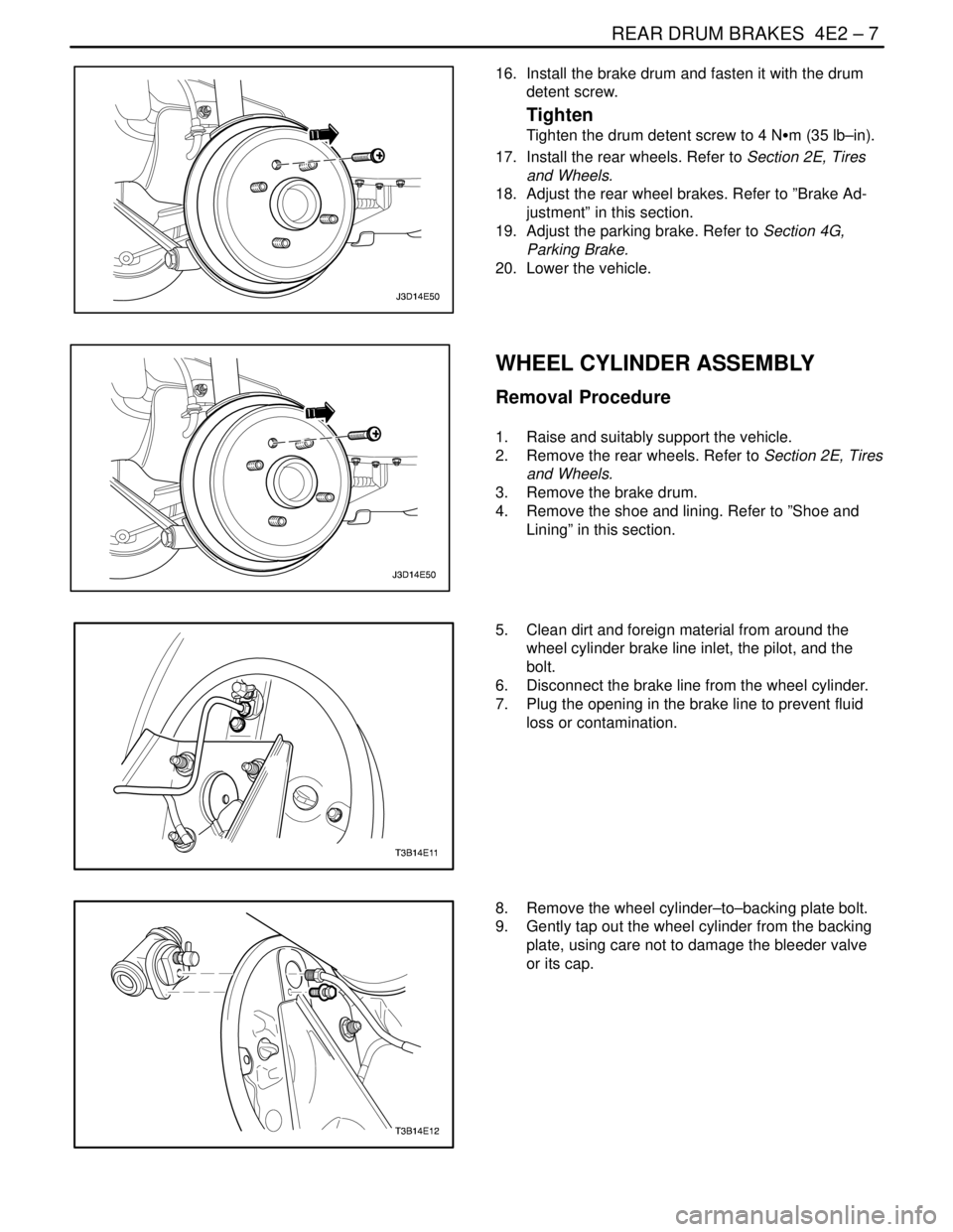
16. Install the brake drum and fasten it with the drum
detent screw.
Tighten
Tighten the drum detent screw to 4 NSm (35 lb–in).
17. Install the rear wheels. Refer to Section 2E, Tires
and Wheels.
18. Adjust the rear wheel brakes. Refer to ”Brake Ad-
justment” in this section.
19. Adjust the parking brake. Refer to Section 4G,
Parking Brake.
20. Lower the vehicle.
WHEEL CYLINDER ASSEMBLY
Removal Procedure
1. Raise and suitably support the vehicle.
2. Remove the rear wheels. Refer to Section 2E, Tires
and Wheels.
3. Remove the brake drum.
4. Remove the shoe and lining. Refer to ”Shoe and
Lining” in this section.
5. Clean dirt and foreign material from around the
wheel cylinder brake line inlet, the pilot, and the
bolt.
6. Disconnect the brake line from the wheel cylinder.
7. Plug the opening in the brake line to prevent fluid
loss or contamination.
8. Remove the wheel cylinder–to–backing plate bolt.
9. Gently tap out the wheel cylinder from the backing
plate, using care not to damage the bleeder valve
or its cap.
Page 1077 of 2643
4E2 – 8IREAR DRUM BRAKES
DAEWOO V–121 BL4
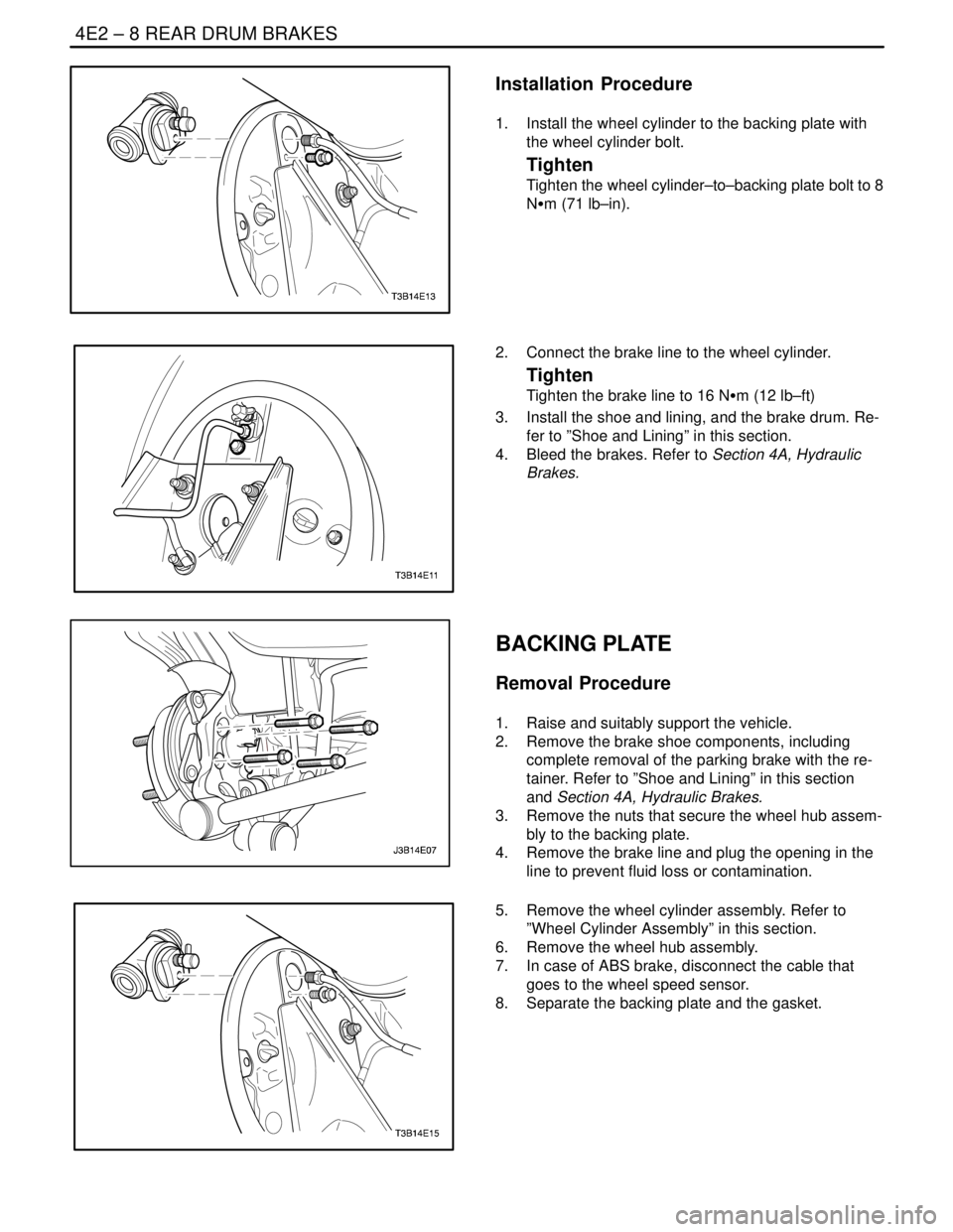
Installation Procedure
1. Install the wheel cylinder to the backing plate with
the wheel cylinder bolt.
Tighten
Tighten the wheel cylinder–to–backing plate bolt to 8
NSm (71 lb–in).
2. Connect the brake line to the wheel cylinder.
Tighten
Tighten the brake line to 16 NSm (12 lb–ft)
3. Install the shoe and lining, and the brake drum. Re-
fer to ”Shoe and Lining” in this section.
4. Bleed the brakes. Refer to Section 4A, Hydraulic
Brakes.
BACKING PLATE
Removal Procedure
1. Raise and suitably support the vehicle.
2. Remove the brake shoe components, including
complete removal of the parking brake with the re-
tainer. Refer to ”Shoe and Lining” in this section
and Section 4A, Hydraulic Brakes.
3. Remove the nuts that secure the wheel hub assem-
bly to the backing plate.
4. Remove the brake line and plug the opening in the
line to prevent fluid loss or contamination.
5. Remove the wheel cylinder assembly. Refer to
”Wheel Cylinder Assembly” in this section.
6. Remove the wheel hub assembly.
7. In case of ABS brake, disconnect the cable that
goes to the wheel speed sensor.
8. Separate the backing plate and the gasket.
Page 1078 of 2643
REAR DRUM BRAKES 4E2 – 9
DAEWOO V–121 BL4
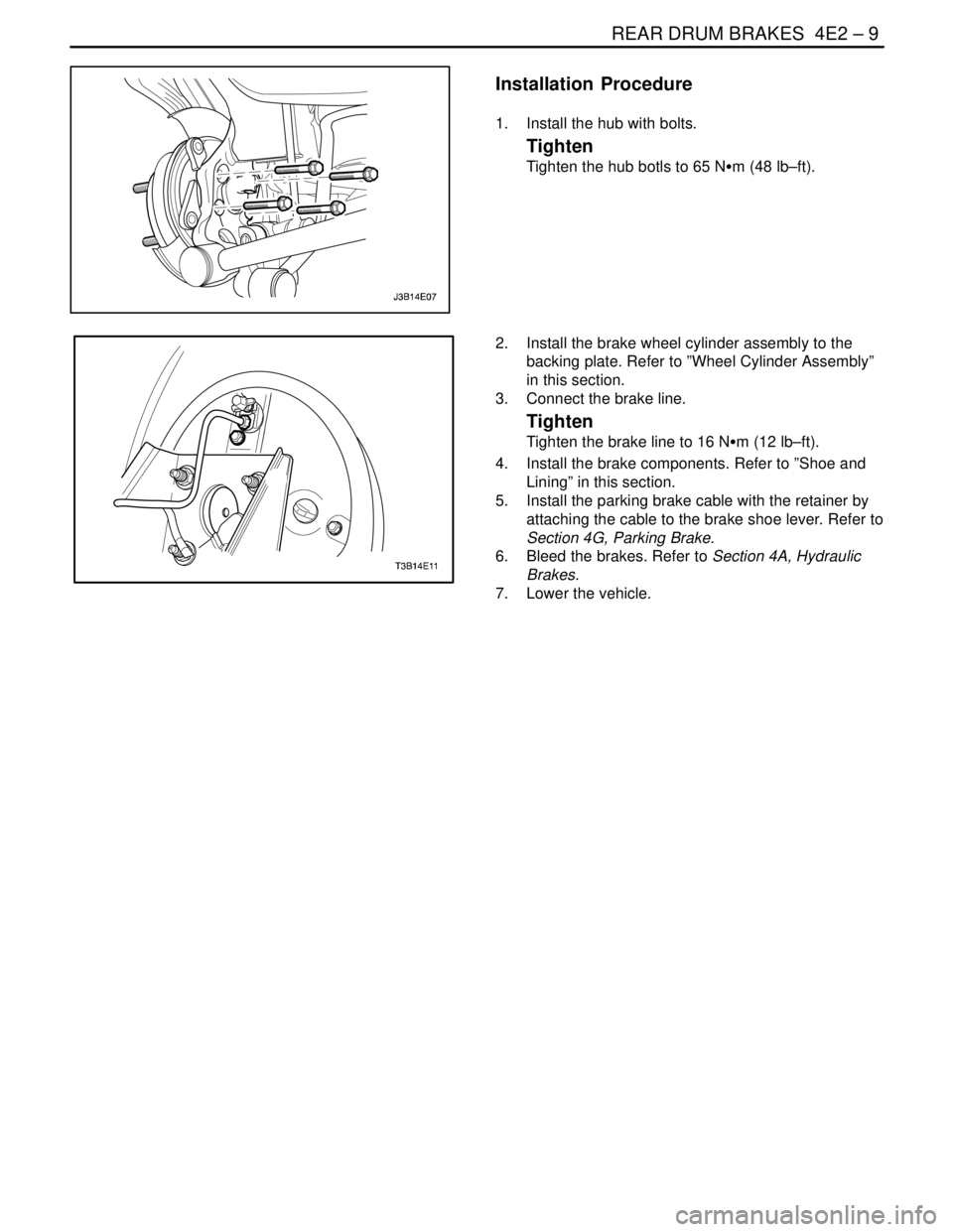
Installation Procedure
1. Install the hub with bolts.
Tighten
Tighten the hub botls to 65 NSm (48 lb–ft).
2. Install the brake wheel cylinder assembly to the
backing plate. Refer to ”Wheel Cylinder Assembly”
in this section.
3. Connect the brake line.
Tighten
Tighten the brake line to 16 NSm (12 lb–ft).
4. Install the brake components. Refer to ”Shoe and
Lining” in this section.
5. Install the parking brake cable with the retainer by
attaching the cable to the brake shoe lever. Refer to
Section 4G, Parking Brake.
6. Bleed the brakes. Refer to Section 4A, Hydraulic
Brakes.
7. Lower the vehicle.
Page 1079 of 2643
4E2 – 10IREAR DRUM BRAKES
DAEWOO V–121 BL4
UNIT REPAIR
WHEEL CYLINDER
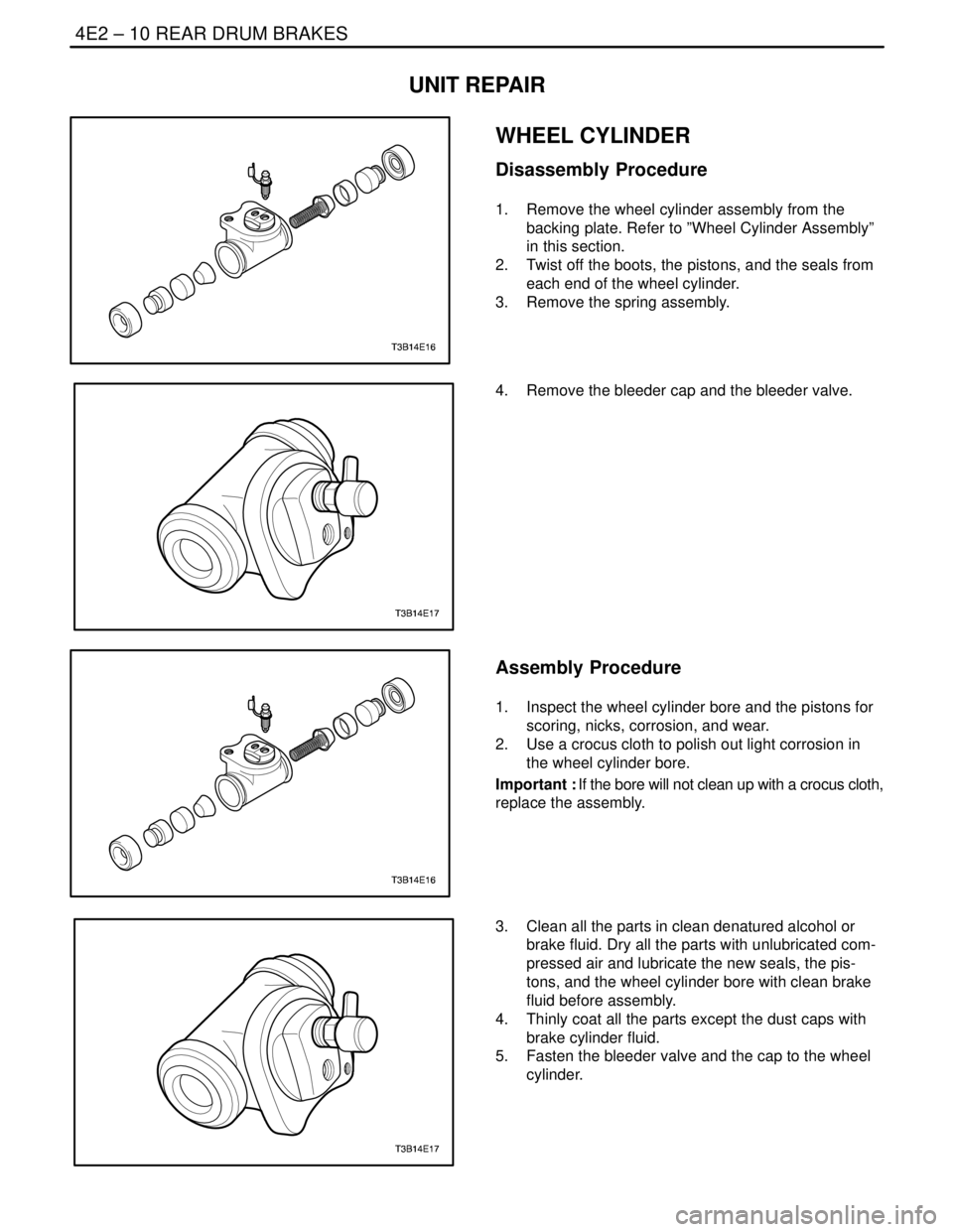
Disassembly Procedure
1. Remove the wheel cylinder assembly from the
backing plate. Refer to ”Wheel Cylinder Assembly”
in this section.
2. Twist off the boots, the pistons, and the seals from
each end of the wheel cylinder.
3. Remove the spring assembly.
4. Remove the bleeder cap and the bleeder valve.
Assembly Procedure
1. Inspect the wheel cylinder bore and the pistons for
scoring, nicks, corrosion, and wear.
2. Use a crocus cloth to polish out light corrosion in
the wheel cylinder bore.
Important : If the bore will not clean up with a crocus cloth,
replace the assembly.
3. Clean all the parts in clean denatured alcohol or
brake fluid. Dry all the parts with unlubricated com-
pressed air and lubricate the new seals, the pis-
tons, and the wheel cylinder bore with clean brake
fluid before assembly.
4. Thinly coat all the parts except the dust caps with
brake cylinder fluid.
5. Fasten the bleeder valve and the cap to the wheel
cylinder.
Page 1080 of 2643

REAR DRUM BRAKES 4E2 – 11
DAEWOO V–121 BL4
6. Attach to the wheel cylinder the spring assembly,
followed by the pistons, the seals, and the boots.
7. Inspect the pistons for free movement.
8. Install the wheel cylinder assembly. Refer to ”Wheel
Cylinder Assembly” in this section.
Page 1082 of 2643

SECTION : 4F
ANTILOCK BRAKE SYSTEM
CAUTION : Disconnect the negative battery cable before removing or installing any electrical unit or when a tool
or equipment could easily come in contact with exposed electrical terminals. Disconnecting this cable will help
prevent personal injury and damage to the vehicle. The ignition must also be in LOCK unless otherwise noted.
TABLE OF CONTENTS
SPECIFICATIONS4F–2 . . . . . . . . . . . . . . . . . . . . . . . . . .
Fastener Tightening Specifications 4F–2. . . . . . . . . .
SPECIAL TOOLS4F–2 . . . . . . . . . . . . . . . . . . . . . . . . . . .
Special Tools Table 4F–2. . . . . . . . . . . . . . . . . . . . . . . .
SCHEMATIC AND ROUTING DIAGRAMS4F–3 . . . . .
Abs System Circuit (I) 4F–3. . . . . . . . . . . . . . . . . . . . . .
Abs System Circuit (II) 4F–4. . . . . . . . . . . . . . . . . . . . .
Ebcm Connector Face View 4F–5. . . . . . . . . . . . . . . . .
COMPONENT LOCATOR4F–6 . . . . . . . . . . . . . . . . . . . .
ABS/EBD System Drive 4F–6. . . . . . . . . . . . . . . . . . . .
DIAGNOSIS4F–7 . . . . . . . . . . . . . . . . . . . . . . . . . . . . . . . .
Diagnostic Circuit Check 4F–7. . . . . . . . . . . . . . . . . . .
ABS Indicator Lamp Inoperative 4F–9. . . . . . . . . . . . .
Power Supply to Control Module,
No DTCs Stored 4F–12. . . . . . . . . . . . . . . . . . . . . . . .
ABS Indicator Lamp Illuminated Continuously,
No DTCs Stored 4F–16. . . . . . . . . . . . . . . . . . . . . . . .
Electronic Brake–Force Distribution (EBD)
System Indicator Lamp Inoperative 4F–18. . . . . . . .
SELF–DIAGNOSTICS 4F–22. . . . . . . . . . . . . . . . . . . .
DISPLAYING DTCs 4F–22. . . . . . . . . . . . . . . . . . . . . . .
CLEARING DTCs 4F–22. . . . . . . . . . . . . . . . . . . . . . . .
INTERMITTENTS AND POOR
CONNECTIONS 4F–22. . . . . . . . . . . . . . . . . . . . . . . .
DTC C0035 Left Front Wheel Speed Sensor
Circuit Malfunction 4F–23. . . . . . . . . . . . . . . . . . . . . .
DTC C0040 Right Front Wheel Speed Sensor
Circuit Malfunction 4F–26. . . . . . . . . . . . . . . . . . . . . .
DTC C0045 Left Rear Wheel Speed Sensor
Circuit Malfunction 4F–29. . . . . . . . . . . . . . . . . . . . . .
DTC C0050 Right Rear Wheel Speed Sensor
Circuit Malfunction 4F–32. . . . . . . . . . . . . . . . . . . . . .
DTC C0060/C0065 Left Front Inlet and
Outlet Valve Solenoid Fault 4F–35. . . . . . . . . . . . . . .
DTC C0070/C0075 Right Front Inlet and
Outlet Valve Solenoid Fault 4F–37. . . . . . . . . . . . . . . DTC C0080/C0085 Left Rear Inlet and
Outlet Valve Solenoid Fault 4F–39. . . . . . . . . . . . . . .
DTC C0090/C0095 Right Rear Inlet and
Outlet Valve Solenoid Fault 4F–41. . . . . . . . . . . . . . .
DTC C0110 Pump Motor Circuit Malfunction 4F–43. .
DTC C0121 Valve Relay Circuit Malfunction 4F–45. .
DTC C0161 ABS Brake Switch Circuit
Malfunction 4F–47. . . . . . . . . . . . . . . . . . . . . . . . . . . .
DTC C0245 Wheel Speed Sensor Frequency
Error 4F–50. . . . . . . . . . . . . . . . . . . . . . . . . . . . . . . . . .
DTC C0550 ABS Control Module Internal
Fault 4F–54. . . . . . . . . . . . . . . . . . . . . . . . . . . . . . . . . .
DTC C0800 Low Voltage Fault 4F–56. . . . . . . . . . . . .
DTC C0931 Overheated 4F–59. . . . . . . . . . . . . . . . . . .
MAINTENANCE AND REPAIR4F–60 . . . . . . . . . . . . . .
ON–VEHICLE SERVICE 4F–60. . . . . . . . . . . . . . . . . . . .
Service Precautions 4F–60. . . . . . . . . . . . . . . . . . . . . . .
Bleeding System 4F–61. . . . . . . . . . . . . . . . . . . . . . . . .
ABS 5.3 Assembly 4F–61. . . . . . . . . . . . . . . . . . . . . . . .
Front Wheel Speed Sensor 4F–62. . . . . . . . . . . . . . . .
Front Wheel Speed Sensor Jumper Harness 4F–63.
Rear Wheel Speed Sensor 4F–64. . . . . . . . . . . . . . . . .
GENERAL DESCRIPTION AND SYSTEM
OPERATION4F–65 . . . . . . . . . . . . . . . . . . . . . . . . . . . . .
Basic Knowledge Required 4F–65. . . . . . . . . . . . . . . . .
ABS System Components 4F–65. . . . . . . . . . . . . . . . .
Base Braking Mode 4F–65. . . . . . . . . . . . . . . . . . . . . . .
Antilock Braking Mode 4F–66. . . . . . . . . . . . . . . . . . . . .
EBD System 4F–69. . . . . . . . . . . . . . . . . . . . . . . . . . . . .
Electronic Brake–Force Distribution (EBD) Failure
Matrix 4F–70. . . . . . . . . . . . . . . . . . . . . . . . . . . . . . . . .
Tires and ABS/EBD 4F–71. . . . . . . . . . . . . . . . . . . . . . .
Electronic Brake Control Module (EBCM) 4F–71. . . .
Front Wheel Speed Sensors 4F–71. . . . . . . . . . . . . . .
Front Wheel Speed Sensor Rings 4F–71. . . . . . . . . . .
Rear Wheel Speed Sensors and Rings 4F–71. . . . . .
Valve Relay and Pump Motor Relay 4F–71. . . . . . . . .
Page 1104 of 2643

ANTILOCK BRAKE SYSTEM 4F – 23
DAEWOO V–121 BL4
J3B14F05
Left Front
Wheel Speed
Sensor
EBCM
LH BLU BRN1
2
76
DIAGNOSTIC TROUBLE CODE (DTC) C0035
LEFT FRONT WHEEL SPEED SENSOR CIRCUIT
MALFUNCTION
Circuit Description
The toothed wheel generates a voltage pulse as it moves
past the sensor. Each tooth–gap–tooth series on the
wheel generates the pulses. The electronic brake control
module (EBCM) uses the frequency of these pulses to de-
termine the wheel speed. The voltage generated depends
on the air gap between the sensor and the toothed wheel,
and on the wheel speed.
Diagnosis
This procedure checks for a malfunctioning wheel speed
sensor, a short to ground or to voltage in the wiring, or a
contact problem in a connector.
Cause(s)
S The wheel speed sensor is defective or discon-
nected.
S There is a problem in the wiring.
S There is a problem with a connector.
S There is a problem in the toothed ring.
S Wrong installed WSS.
S Wrong sensor signal.
S Signal noise via WSS.
Fail Action
ABS action is disabled, and the ABS warning lamp is ON.
EBD is enabled. (Refer to the EBD failure matrix in this
section).
Test Description
The number(s) below refer to step(s) on the diagnostic
table.1. This step begins an examination for a defective
wheel speed sensor.
6. This step tests the wiring for a short to voltage.
8. This step tests the wiring for a short to ground.
10. This step tests for an open or a high resistance in
the wiring.
Diagnostic Aids
Be sure that the speed sensor wiring is properly routed and
retained. This will help to prevent false signals due to the
pickup of electrical noise.
It is very important to perform a thorough inspection of the
wiring and the connectors. Failure to inspect the wiring
and the connectors carefully and completely may result in
misdiagnosis, causing part replacement with the reap-
pearance of the malfunction.
You can use the scan tool to monitor wheel speeds during
a road test. Watch the wheel speeds being displayed on
the scan tool to see if any of the readings is unusual, such
as one sensor varying in speed from the other three, a sig-
nal going intermittently high or low, etc. If this does not
identify the intermittent, wet the speed sensor harness on
the underside of the vehicle and perform a road test, moni-
toring the wheel speeds with the scan tool.
Important : If the WSS signal fault input to the EBCM, the
ABS warning lamp turns on. As if a sensor signal fault can
be removed by the scan tool, the ABS warning lamp
doesn’t turn off. In order to turn ABS warning lamp off, you
should driver a car up to 12 km/h.