Section 5 DAEWOO LACETTI 2004 Service Repair Manual
[x] Cancel search | Manufacturer: DAEWOO, Model Year: 2004, Model line: LACETTI, Model: DAEWOO LACETTI 2004Pages: 2643, PDF Size: 80.54 MB
Page 2091 of 2643
7D – 36IAUTOMATIC TEMPERATURE CONTROL HEATING, VENTILATION, AND AIR CONDITIONING SYSTEM
DAEWOO V–121 BL4
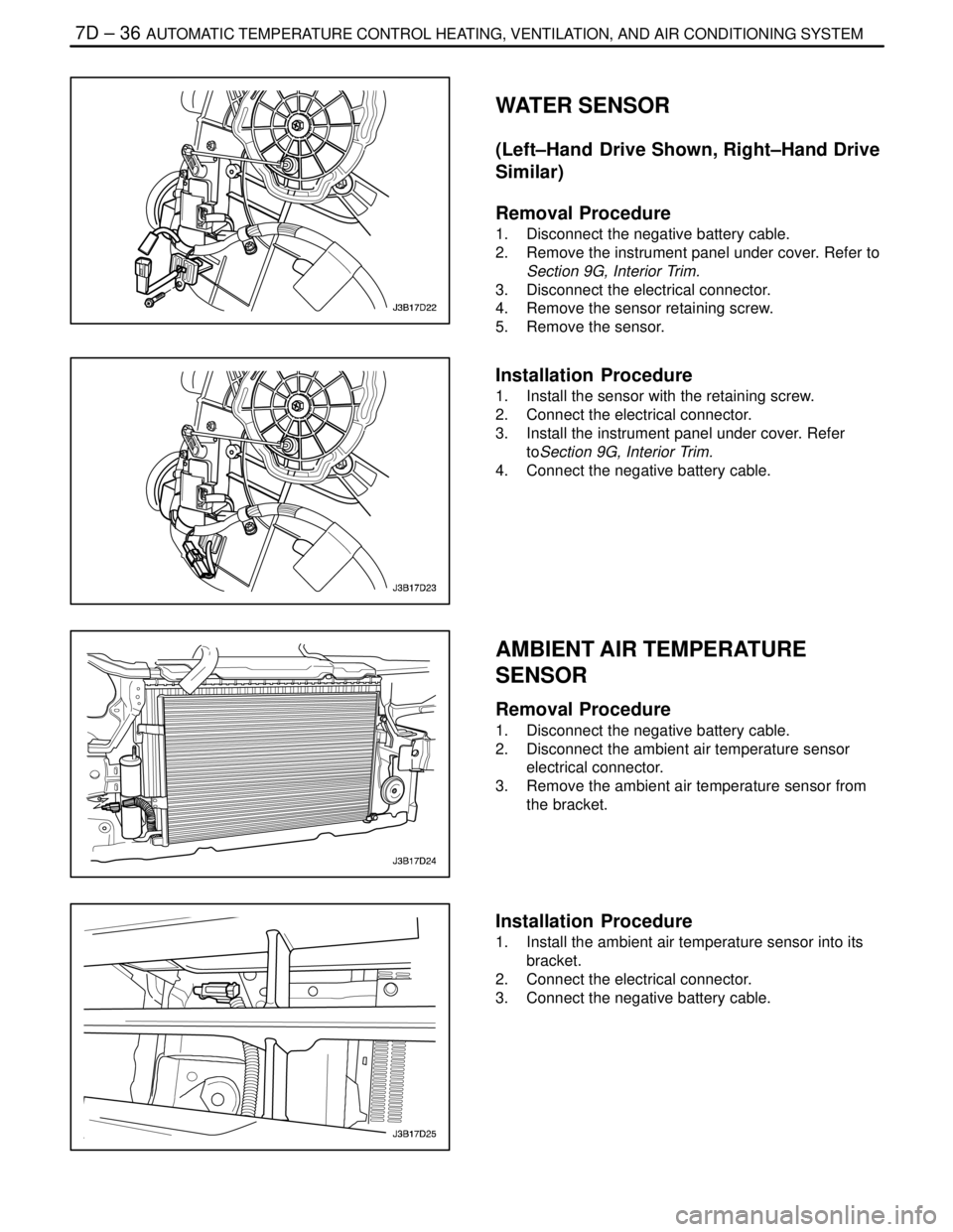
WATER SENSOR
(Left–Hand Drive Shown, Right–Hand Drive
Similar)
Removal Procedure
1. Disconnect the negative battery cable.
2. Remove the instrument panel under cover. Refer to
Section 9G, Interior Trim.
3. Disconnect the electrical connector.
4. Remove the sensor retaining screw.
5. Remove the sensor.
Installation Procedure
1. Install the sensor with the retaining screw.
2. Connect the electrical connector.
3. Install the instrument panel under cover. Refer
toSection 9G, Interior Trim.
4. Connect the negative battery cable.
AMBIENT AIR TEMPERATURE
SENSOR
Removal Procedure
1. Disconnect the negative battery cable.
2. Disconnect the ambient air temperature sensor
electrical connector.
3. Remove the ambient air temperature sensor from
the bracket.
Installation Procedure
1. Install the ambient air temperature sensor into its
bracket.
2. Connect the electrical connector.
3. Connect the negative battery cable.
Page 2092 of 2643
IAUTOMATIC TEMPERATURE CONTROL HEATING, VENTILATION, AND AIR CONDITIONING SYSTEM 7D – 37
DAEWOO V–121 BL4
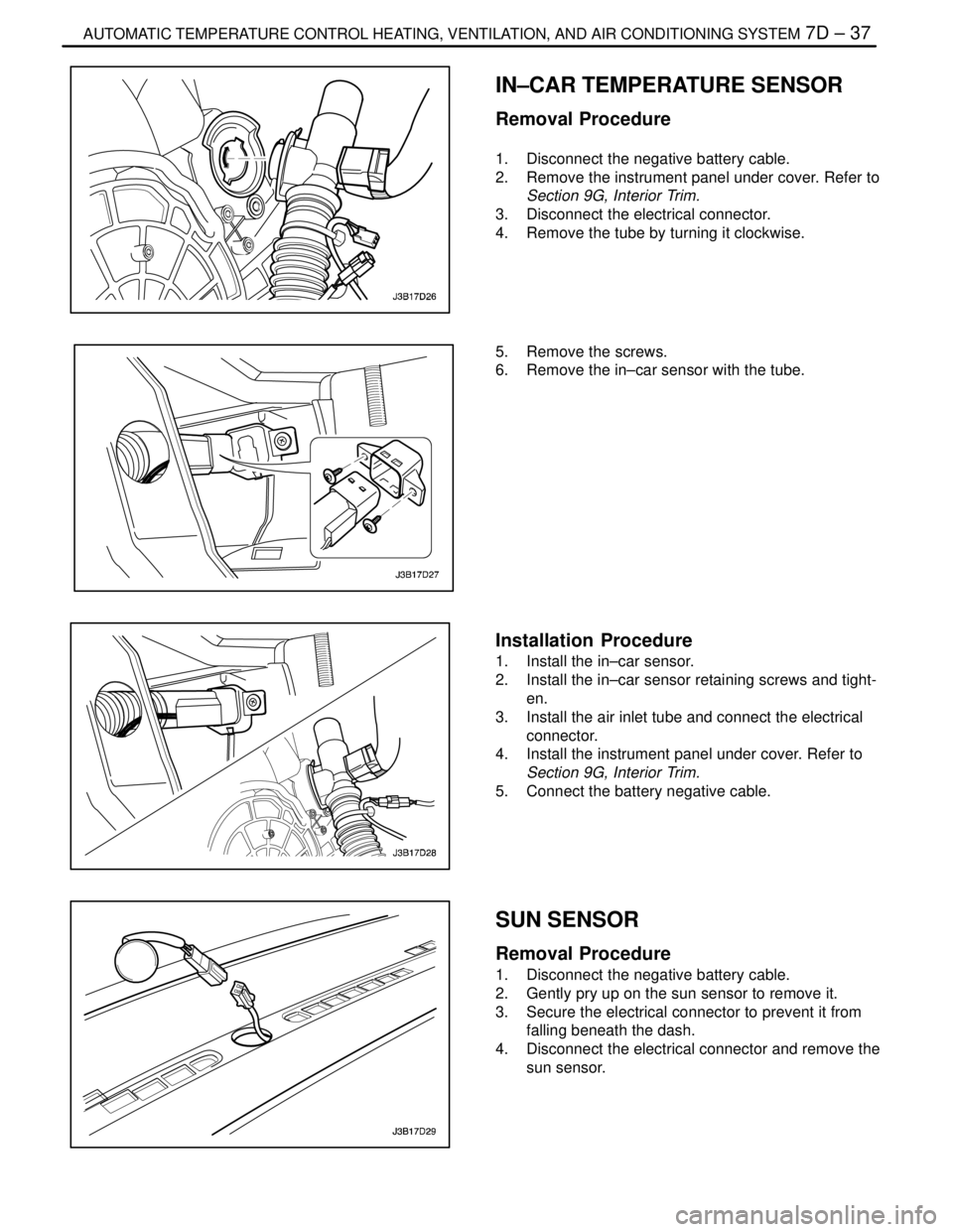
IN–CAR TEMPERATURE SENSOR
Removal Procedure
1. Disconnect the negative battery cable.
2. Remove the instrument panel under cover. Refer to
Section 9G, Interior Trim.
3. Disconnect the electrical connector.
4. Remove the tube by turning it clockwise.
5. Remove the screws.
6. Remove the in–car sensor with the tube.
Installation Procedure
1. Install the in–car sensor.
2. Install the in–car sensor retaining screws and tight-
en.
3. Install the air inlet tube and connect the electrical
connector.
4. Install the instrument panel under cover. Refer to
Section 9G, Interior Trim.
5. Connect the battery negative cable.
SUN SENSOR
Removal Procedure
1. Disconnect the negative battery cable.
2. Gently pry up on the sun sensor to remove it.
3. Secure the electrical connector to prevent it from
falling beneath the dash.
4. Disconnect the electrical connector and remove the
sun sensor.
Page 2094 of 2643

IAUTOMATIC TEMPERATURE CONTROL HEATING, VENTILATION, AND AIR CONDITIONING SYSTEM 7D – 39
DAEWOO V–121 BL4
UNIT REPAIR
V5 AIR CONDITIONING COMPRESSOR OVERHAUL
COMPRESSOR OVERHAUL
Refer to Section 7B, Manual Control Heating, Ventilation,
and Air Conditioning System for details of the following
procedures:
S Clutch Coil.
S Clutch Plate and Hub Assembly.
S Clutch Rotor and Bearing.
S Component Locator V5 Compressor.
S Control Valve Assembly.
S Cylinder to Front Head O–Ring.
S Leak Testing (External).
S Pressure Relief Valve.
S Rear Head, Gasket, Valve Plate, Reed Plate, and
O–Ring.
S Shaft Seal Replacement.
Page 2095 of 2643

7D – 40IAUTOMATIC TEMPERATURE CONTROL HEATING, VENTILATION, AND AIR CONDITIONING SYSTEM
DAEWOO V–121 BL4
GENERAL DESCRIPTION
AND SYSTEM OPERATION
GENERAL INFORMATION
THE V5 SYSTEM
Refer to Section 7B, Manual Control Heating, Ventilation,
and Air Conditioning System,for general information de-
tails for the following:
S System Components – Functional.
S The V5 A/C System.
S V5 Compressor – Description of Operation.
S V5 Compressor – General Description.
SYSTEM COMPONENTS–CONTROL
Controller
The operation of the A/C system is controlled by the
switches on the control head. This console–mounted
heating and ventilation system contains the following
knobs and display:
Temperature Control Push Knobs
1. Raise the temperature of the air entering the ve-
hicle by pressing the top switch, with the red arrow
pointing upward.
2. Lower the temperature by pressing the bottom
switch, with the blue arrow pointing downward.
3. Actuate the air mix door by an electric motor.
4. Vary the mix of the air passing through the heater
core with the air bypassing the core.
Each press of a switch changes the set temperature by in-
crements of 0.5°C (1°F). This is shown in the temperature
window on the function display.
The Function Display
This is an LCD display indicating the status of the control
settings selected. Starting from the left end of the display,
the sections are as follows:
1. Temperature setting – Indicates the temperature set
with the temperature control knob.
2. Auto status – Indicates whether the system is oper-
ating in the full auto mode or the manual mode.
3. Defroster icon – Indicates manual selection of full
defrost mode.
4. Mode – Indicated by icon, the mode chosen by the
system in auto (or by the operator in manual) is
shown by an illumination arrow indicating the air
path.
5. A/C – A snowflake icon indicating whether the A/C
is ON or OFF.
6. Fan speed – Indicates the fan speed by illuminating
a bar based on the segment at the front, for low
speed, and adding additional segments in order up
to the fifth, for high speed.Eight Additional Push Knobs
1. Full defrost – Causes the mode motors to direct all
air to the windshield and aide window outlets for
maximum defrosting.
2. Air intake – Switches between fresh air intake, the
default, and recirculating air. Airflow arrows on the
display indicate the mode in effect.
3. Full Auto Switch – Maintains the set temperature
automatically. In this mode, the fully automatic tem-
perature control (FATC) system controls the follow-
ing:
S The air mix door motor.
S The mode door motor.
S The blower motor speed.
S The inlet air door motor.
S A/C ON/OFF.
4. OFF Switch – Turns the automatic air conditioning
and fan control off.
5. Mode Switch – Allows manual selection of the air-
flow direction.
S Selection is shown on the function display.
S Each time the mode switch is pressed, the next
function is displayed.
6. A/C Switch – Allows manual selection and control
of the air conditioning function.
7. Fan Control Switch – Allows manual selection
among five fan speeds.
8. Defogger Switch – Turns on the electric defogging
heater in the rear window and the outside rearview
mirrors, if the vehicle is equipped with heated mir-
rors.
Pressure Transducer
Pressure transducer switching incorporates the functions
of the high–pressure and the low–pressure cutout
switches along with the fan cycling switch. The pressure
transducer is located in the high–side liquid refrigerant line
behind the right strut tower, between the right strut tower
and the fire wall. The output from this pressure transducer
goes to the electronic control module (ECM), which con-
trols the compressor function based on the pressure sig-
nal.
Wide–Open Throttle (WOT) Compressor
Cutoff
During full–throttle acceleration, the throttle position sen-
sor (TPS) sends a signal to the ECM, which then controls
the compressor clutch.
High RPM Cutoff
As engine rpm approaches the maximum limit, the ECM
will disengage the compressor clutch until the engine
slows to a lower rpm.
Page 2096 of 2643

SECTION : 8A
SEAT BELTS
CAUTION : Disconnect the negative battery cable before removing or installing any electrical unit or when a tool
or equipment could easily come in contact with exposed electrical terminals. Disconnecting this cable will help
prevent personal injury and damage to the vehicle. The ignition must also be in LOCK unless otherwise noted.
TABLE OF CONTENTS
SPECIFICATIONS8A–1 . . . . . . . . . . . . . . . . . . . . . . . . . .
Fastener Tightening Specifications 8A–1. . . . . . . . . . .
SCHEMATIC AND ROUTING DIAGRAMS8A–2 . . . . .
Driver Seat Belt Warning 8A–2. . . . . . . . . . . . . . . . . . . .
DIAGNOSIS8A–3 . . . . . . . . . . . . . . . . . . . . . . . . . . . . . . . .
Driver Seat Belt Warning 8A–3. . . . . . . . . . . . . . . . . . . .
MAINTENANCE AND REPAIR8A–4 . . . . . . . . . . . . . . .
ON–VEHICLE SERVICE 8A–4. . . . . . . . . . . . . . . . . . . . .
Pretensioner Front Seat Belt 8A–4. . . . . . . . . . . . . . . .
Front Seat Belt Height Adjuster 8A–5. . . . . . . . . . . . . . Three–Point Rear Seat Belt (LH,CENTER, RH) 8A–6
Front Seat Belt Buckle 8A–7. . . . . . . . . . . . . . . . . . . . .
GENERAL DESCRIPTION AND SYSTEM
OPERATION 8A–9 . . . . . . . . . . . . . . . . . . . . . . . . . . . . .
Driver Seat Belt Warning 8A–9. . . . . . . . . . . . . . . . . . . .
Three–Point ELR Front Seat Belt With
Pretensioner 8A–9. . . . . . . . . . . . . . . . . . . . . . . . . . . .
Three–Point CLR (ELR) Rear Outboard Seat
Belt 8A–9. . . . . . . . . . . . . . . . . . . . . . . . . . . . . . . . . . . .
Operational and Functional Checks 8A–9. . . . . . . . . .
Child Seat Tether Anchor 8A–9. . . . . . . . . . . . . . . . . . .
SPECIFICATIONS
FASTENER TIGHTENING SPECIFICATIONS
ApplicationNSmLb–FtLb–In
Child Seat Tether Anchor Bolt2518–
Front Seat Belt Height Adjuster Bolts2317–
Seat Belt Anchor Bolt3828–
Seat Belt Retractor Bracket Screws3–27
Seat Belt Retractor Bolt3828–
Page 2100 of 2643
SEAT BELTS 8A – 5
DAEWOO V–121 BL4
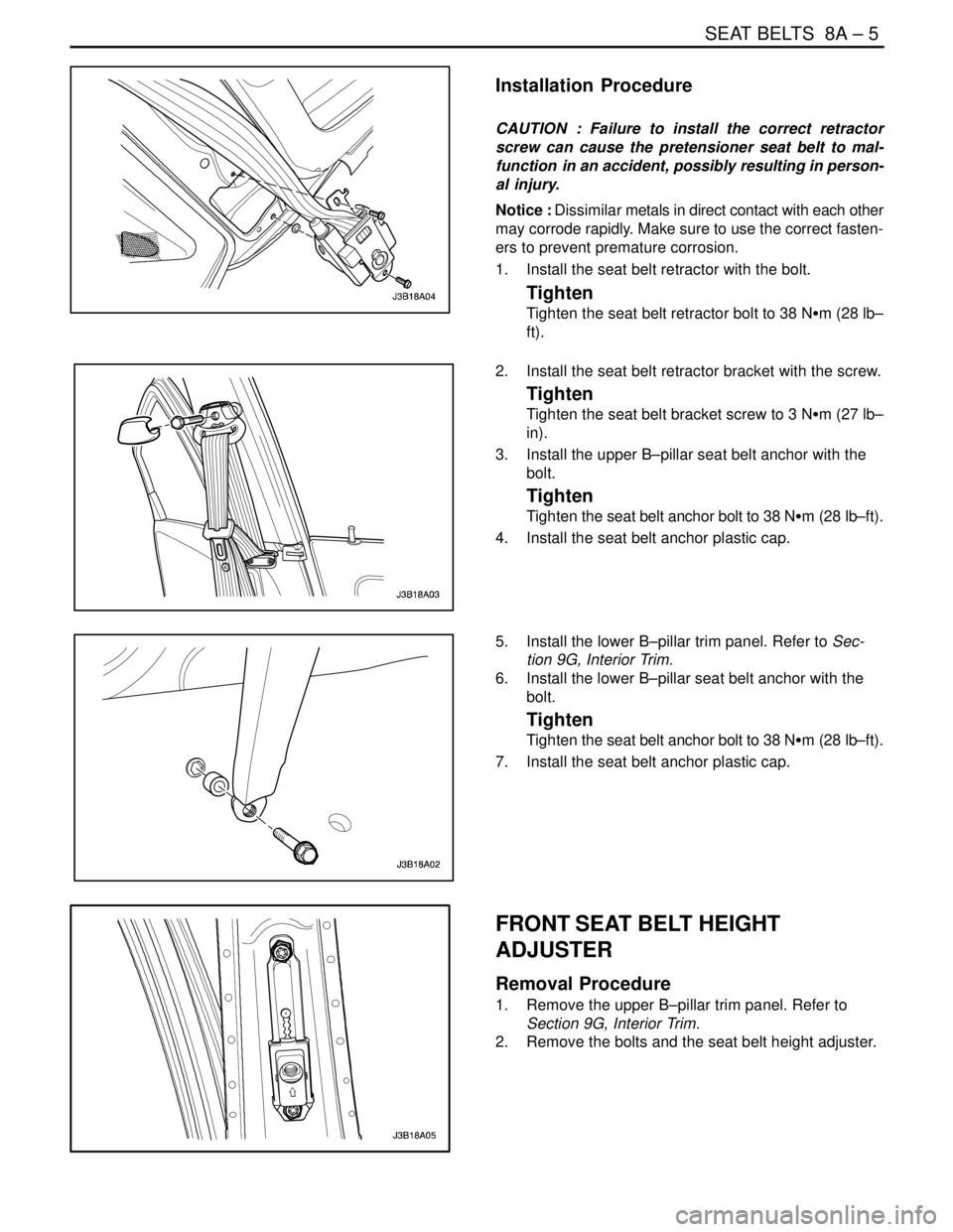
Installation Procedure
CAUTION : Failure to install the correct retractor
screw can cause the pretensioner seat belt to mal-
function in an accident, possibly resulting in person-
al injury.
Notice : Dissimilar metals in direct contact with each other
may corrode rapidly. Make sure to use the correct fasten-
ers to prevent premature corrosion.
1. Install the seat belt retractor with the bolt.
Tighten
Tighten the seat belt retractor bolt to 38 NSm (28 lb–
ft).
2. Install the seat belt retractor bracket with the screw.
Tighten
Tighten the seat belt bracket screw to 3 NSm (27 lb–
in).
3. Install the upper B–pillar seat belt anchor with the
bolt.
Tighten
Tighten the seat belt anchor bolt to 38 NSm (28 lb–ft).
4. Install the seat belt anchor plastic cap.
5. Install the lower B–pillar trim panel. Refer to Sec-
tion 9G, Interior Trim.
6. Install the lower B–pillar seat belt anchor with the
bolt.
Tighten
Tighten the seat belt anchor bolt to 38 NSm (28 lb–ft).
7. Install the seat belt anchor plastic cap.
FRONT SEAT BELT HEIGHT
ADJUSTER
Removal Procedure
1. Remove the upper B–pillar trim panel. Refer to
Section 9G, Interior Trim.
2. Remove the bolts and the seat belt height adjuster.
Page 2101 of 2643
8A – 6ISEAT BELTS
DAEWOO V–121 BL4
Installation Procedure
Notice : Dissimilar metals in direct contact with each other
may corrode rapidly. Make sure to use the correct fasten-
ers to prevent premature corrosion.
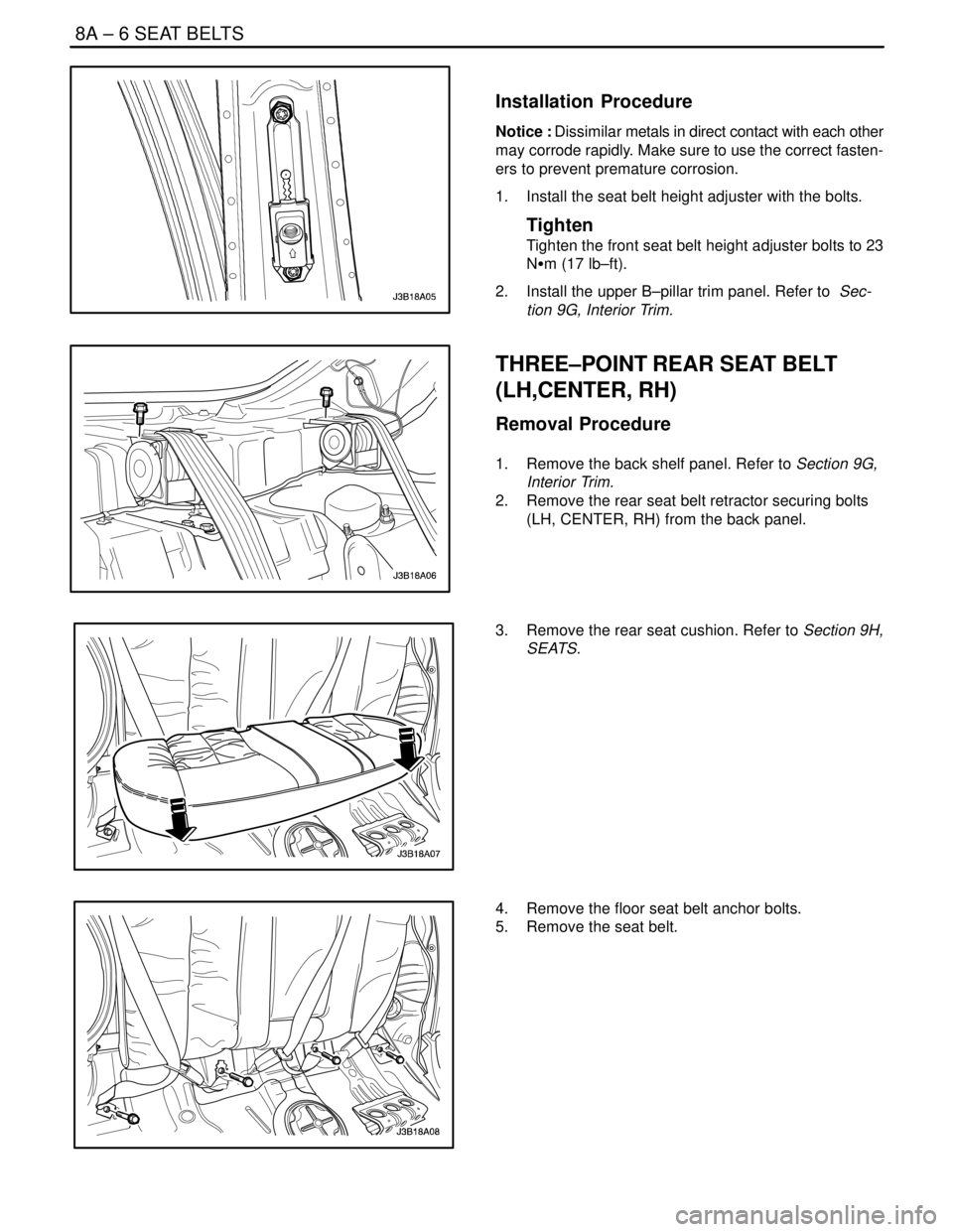
1. Install the seat belt height adjuster with the bolts.
Tighten
Tighten the front seat belt height adjuster bolts to 23
NSm (17 lb–ft).
2. Install the upper B–pillar trim panel. Refer to Sec-
tion 9G, Interior Trim.
THREE–POINT REAR SEAT BELT
(LH,CENTER, RH)
Removal Procedure
1. Remove the back shelf panel. Refer to Section 9G,
Interior Trim.
2. Remove the rear seat belt retractor securing bolts
(LH, CENTER, RH) from the back panel.
3. Remove the rear seat cushion. Refer to Section 9H,
SEATS.
4. Remove the floor seat belt anchor bolts.
5. Remove the seat belt.
Page 2102 of 2643
SEAT BELTS 8A – 7
DAEWOO V–121 BL4
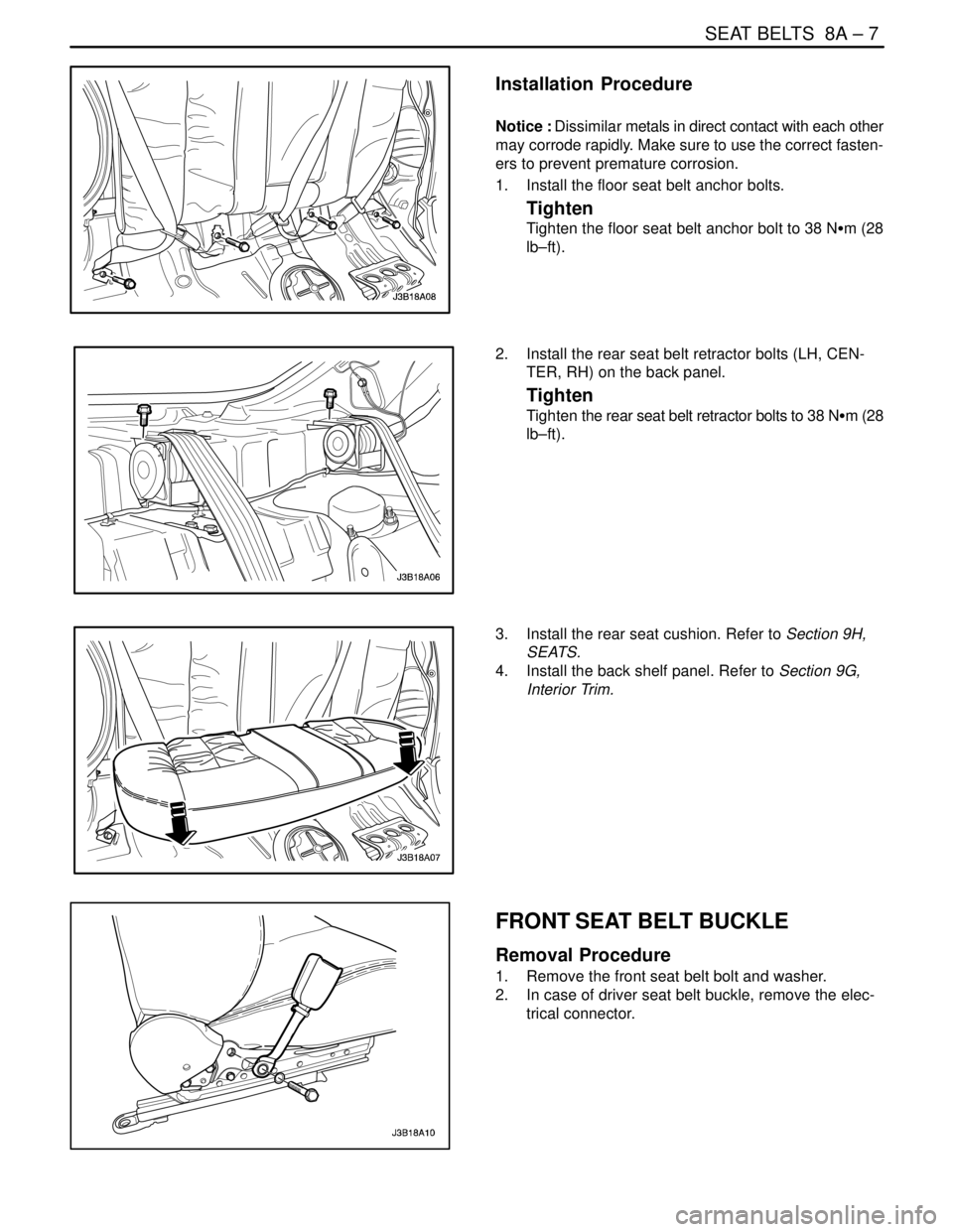
Installation Procedure
Notice : Dissimilar metals in direct contact with each other
may corrode rapidly. Make sure to use the correct fasten-
ers to prevent premature corrosion.
1. Install the floor seat belt anchor bolts.
Tighten
Tighten the floor seat belt anchor bolt to 38 NSm (28
lb–ft).
2. Install the rear seat belt retractor bolts (LH, CEN-
TER, RH) on the back panel.
Tighten
Tighten the rear seat belt retractor bolts to 38 NSm (28
lb–ft).
3. Install the rear seat cushion. Refer to Section 9H,
SEATS.
4. Install the back shelf panel. Refer to Section 9G,
Interior Trim.
FRONT SEAT BELT BUCKLE
Removal Procedure
1. Remove the front seat belt bolt and washer.
2. In case of driver seat belt buckle, remove the elec-
trical connector.
Page 2105 of 2643

SECTION : 8B
SUPPLEMENTAL INFLATABLE RESTRAINTS (SIR)
CAUTION : Disconnect the negative battery cable before removing or installing any electrical unit or when a tool
or equipment could easily come in contact with exposed electrical terminals. Disconnecting this cable will help
prevent personal injury and damage to the vehicle. The ignition mujst be also be in LOCK unless otherwise noted
TABLE OF CONTENTS
SPECIFICATIONS8B–3 . . . . . . . . . . . . . . . . . . . . . . . . . .
General Specifications 8B–3. . . . . . . . . . . . . . . . . . . . .
Fastener Tightening Specifications 8B–3. . . . . . . . . . .
SPECIAL TOOLS8B–3 . . . . . . . . . . . . . . . . . . . . . . . . . . .
SPECIAL TOOLS TABLE 8B–3. . . . . . . . . . . . . . . . . . .
SCHEMATIC AND ROUTING DIAGRAMS8B–4 . . . . .
Supplemental Inflatable Restraints(SIR)
Electronical Schematic 8B–4. . . . . . . . . . . . . . . . . . . .
SIR Component Locator 8B–5. . . . . . . . . . . . . . . . . . . .
DIAGNOSIS8B–6 . . . . . . . . . . . . . . . . . . . . . . . . . . . . . . . .
Diagnostic Trouble Code (DTC) 8B–6. . . . . . . . . . . . . .
Scan Tool Diagnostics 8B–7. . . . . . . . . . . . . . . . . . . . . .
SIR Diagnostic System Check 8B–8. . . . . . . . . . . . . . .
Sensing and Diagnostic Module (SDM) Integrity
check 8B–10. . . . . . . . . . . . . . . . . . . . . . . . . . . . . . . . .
DTC 1 Driver Airbag Deployment Loop Resistance
Is High 8B–12. . . . . . . . . . . . . . . . . . . . . . . . . . . . . . . .
DTC 2 Driver Airbag Deployment Loop Resistance
Is Low 8B–14. . . . . . . . . . . . . . . . . . . . . . . . . . . . . . . . .
DTC 3 Driver Airbag Deployment Loop Is Shorted
To Ground 8B–16. . . . . . . . . . . . . . . . . . . . . . . . . . . . .
DTC 4 Driver Airbag Deployment Loop Is Shorted
To Power 8B–18. . . . . . . . . . . . . . . . . . . . . . . . . . . . . .
DTC 5 Passenger Airbag Deployment Loop
Resistance Is High 8B–20. . . . . . . . . . . . . . . . . . . . . .
DTC 6 Passenger Airbag Deployment Loop
Resistance Is Low 8B–22. . . . . . . . . . . . . . . . . . . . . .
DTC 7 Passenger Airbag Deployment Loop Is
Shorted To Ground 8B–24. . . . . . . . . . . . . . . . . . . . . .
DTC 8 Passenger Airbag Deployment Loop Is
Shorted To Power 8B–26. . . . . . . . . . . . . . . . . . . . . . .
DTC 9 Driver Belt Pretensioner Deployment
Loop Resistance Is High 8B–28. . . . . . . . . . . . . . . . .
DTC 10 Driver Belt Pretensioner Deployment
Loop Resistance Is Low 8B–30. . . . . . . . . . . . . . . . . .
DTC 11 Driver Belt Pretensioner Deployment
Loop Is Shorted To Ground 8B–32. . . . . . . . . . . . . . . DTC 12 Driver Belt Pretensioner Deployment
Loop Is Shorted To Power 8B–34. . . . . . . . . . . . . . . .
DTC 13 Passenger Belt Pretensioner Deployment
Loop Resistance Is High 8B–36. . . . . . . . . . . . . . . . .
DTC 14 Passenger Belt Pretensioner Deployment
Loop Resistance Is Low 8B–38. . . . . . . . . . . . . . . . . .
DTC 15 Passenger Belt Pretensioner Deployment
Loop Is Shorted To Ground 8B–40. . . . . . . . . . . . . . .
DTC 16 Passenger Belt Pretensioner Deployment
Loop Is Shorted To Power 8B–42. . . . . . . . . . . . . . . .
DTC 23 Battery Voltage high 8B–44. . . . . . . . . . . . . . .
DTC 24 Battery Voltage Low 8B–46. . . . . . . . . . . . . . .
DTC 25 Airbag Warning Lamp Failure 8B–48. . . . . . .
DTC 31 Internal Sensing Diagnostic Module
(SDM) Failure 8B–50. . . . . . . . . . . . . . . . . . . . . . . . . .
DTC 32 Airbag Inflation Record By Frontal
Collision 8B–51. . . . . . . . . . . . . . . . . . . . . . . . . . . . . . .
DTC 33 Driver Side Airbag Inflation Record By
Side Impact 8B–52. . . . . . . . . . . . . . . . . . . . . . . . . . . .
DTC 34 Passenger Side Airbag Inflation Record
By Side Impact 8B–53. . . . . . . . . . . . . . . . . . . . . . . . .
DTC 35 Belt Pretensioner Explosion Record 8B–54. .
DTC 38 Side Airbag And Belt Pretensioner
Explosion Count Over 5 8B–55. . . . . . . . . . . . . . . . . .
DTC 52 Driver Side Airbag Deployment Loop
Resistance Is High 8B–56. . . . . . . . . . . . . . . . . . . . . .
DTC 53 Driver Side Airbag Deployment Loop
Resistance Is Low 8B–58. . . . . . . . . . . . . . . . . . . . . .
DTC 54 Driver Side Airbag Deployment Loop Is
Shorted To Ground 8B–60. . . . . . . . . . . . . . . . . . . . . .
DTC 55 Driver Side Airbag Deployment Loop Is
Shorted To Power 8B–62. . . . . . . . . . . . . . . . . . . . . . .
DTC 56 Passenger Side Airbag Deployment Loop
Resistance Is High 8B–64. . . . . . . . . . . . . . . . . . . . . .
DTC 57 Passenger Side Airbag Deployment Loop
Resistance Is Low 8B–66. . . . . . . . . . . . . . . . . . . . . .
DTC 58 Passenger Side Airbag Deployment Loop
Is Shorted To Ground 8B–68. . . . . . . . . . . . . . . . . . . .
DTC 59 Passenger Side Airbag Deployment Loop
Is Shorted To Power 8B–70. . . . . . . . . . . . . . . . . . . . .
Page 2112 of 2643

8B – 8ISUPPLEMENTAL INFLATABLE RESTRAINTS (SIR)
DAEWOO V–121 BL4
SIR DIAGNOSTIC SYSTEM CHECK
Notice : If the vehicle interior has been exposed to exten-
sive water intrusion such as water leaks, driving through
high water, flooding, or other causes, the sensing and
diagnostic module(SDM) and SDM connector may need
to be replaced. With ignition OFF, inspect the area around
the SDM, including the carpet. If any significant soaking or
evidence of previous soaking is detected, the water must
be removed, water damage repaired, and the SDM and
the SDM connector must be replaced. Before attempting
any of these repairs, the supplemental inflatable re-
straints(SIR) must be disabled. Refer to ”Disabling the
SIR” and ”Sensing and Diagnostic Module(SDM)” in this
section for instructions on how to disable the SIR and re-
place the SDM.
The SIR Diagnostic System Check must always be the
starting point for any SIR diagnosis. The Diagnostic Sys-
tem Check reveals diagnostic trouble codes(DTCs)
through the use of scan tool. The diagnostic procedures
used in this section are designed to find any repair SIR
conditions. To get the best results, it is important to use the
diagnostic charts and follow the sequence listed below.
1. Perform the SIR Diagnostic System Check, which
reveal diagnostic trouble codes(DTCs) through theuse of scan tool.. It also checks for proper airbag
indicator operation.
2. Refer to the proper diagnostic chart as directed by
SIR Diagnostic System Check. Bypassing these
procedures may result in extended diagnostic time,
incorrect diagnosis, and incorrect parts replace-
ment.
3. Repeat the SIR Diagnostic System Check after any
repair or diagnostic procedures have been per-
formed to ensure that the repair has been made
correctly and that no other malfunction exists.
Circiut Description
When the ignition switch is first turned to ON, ignition volt-
age is supplied from airbag fuse to find the SDM at input
terminal A1. The SDM responds by flashing the airbag in-
dicator seven times and then turning it off while the SDM
performs tests on the SIR.
Diagnostic Aids
The order in which DTCs are diagnosed is very important.
Failure to diagnose the DTCs in the order specified may
result in extended diagnostic time, incorrect diagnosis,
and incorrect parts replacement.
SIR Diagnostic System Check
CAUTION : The sensing and the diagnosis module
(SDM) can maintain surfficient voltage to deploy the
airbags and pretensioners for 1 minute after the igni-
tion is OFF and the fuse has been removed. If the air-
bags and pretensioners are not disconnected, do not
begin service until one minute has been passed after
disconnecting power to the SDM. Otherwise, injury
could result.
CAUTION : During service procedure, be very careful
when handling the SDM. Never strike or jar the SDM.Never power the supplemental inflatable re-
straints(SIR) when the SDM is not rigidly attached to
the vehicle. All SDM mounting bolts must be carefully
tightened , and the arrow on the SDM must be point
toward the front of the vehicle to ensure proper op-
eration of the SIR. The SDM could be activated if it is
powered when it is not rigidly attached to the vehicle,
resulting in unexpected deployment and possible in-
jury.
Step
ActionValue(s)YesNo
11. Turn the ignition switch ON.
2. Observe the airbag indicator as the ignition is
being turned ON. Does the indicator flash
seven times?–System OKGo to Step 2
21. Turn the ignition to LOCK and remove the key.
2. Connect the scan tool to the data link connec-
tor(DLC). Follow the directions given in the
scan tool manual.
3. Are any DTCs displayed on the scan tool?–Go to the
DTC check
procedureGo to Step 3
3Check the fuse F1 in the interior fuse box.
Is the fuse F1 blown?–Go to Step 4Go to Step 5
4Replace the fuse F1.–––
51. Disconnect the connector C207.
2. Check the wiring shortage between the fuse F1
and the terminal 1 of the connector C207.
3. Is the wiring shorted? Then, repair the wiring.––Go to Step 6