lock DAEWOO LACETTI 2004 Service Manual PDF
[x] Cancel search | Manufacturer: DAEWOO, Model Year: 2004, Model line: LACETTI, Model: DAEWOO LACETTI 2004Pages: 2643, PDF Size: 80.54 MB
Page 213 of 2643

1D – 18IENGINE COOLING
DAEWOO V–121 BL4
GENERAL DESCRIPTION
AND SYSTEM OPERATION
GENERAL DESCRIPTION
The cooling system maintains the engine temperature at
an efficient level during all engine operating conditions.
When the engine is cold, the cooling system cools the en-
gine slowly or not at all. This slow cooling of the engine al-
lows the engine to warm up quickly.
The cooling system includes a radiator and recovery sub-
system, cooling fans, a thermostat and housing, a coolant
pump, and a coolant pump drive belt. The timing belt
drives the coolant pump.
All components must function properly in order for the
cooling system to operate. The coolant pump draws the
coolant from the radiator. The coolant then circulates
through water jackets in the engine block, the intake man-
ifold, and the cylinder head. When the coolant reaches the
operating temperature of the thermostat, the thermostat
opens. The coolant then goes back to the radiator where
it cools.
This system directs some coolant through the hoses to the
heater core. This provides for heating and defrosting. The
surge tank is connected to the radiator to recover the cool-
ant displaced by expansion from the high temperatures.
The surge tank maintains the correct coolant level.
The cooling system for this vehicle has no radiator cap or
filler neck. The coolant is added to the cooling system
through the surge tank.
RADIATOR
This vehicle has a lightweight tube–and–fin aluminum ra-
diator. Plastic tanks are mounted on the right and the left
sides of the radiator core.
On vehicles equipped with automatic transaxles, the
transaxle fluid cooler lines run through the left radiator
tank. A radiator drain cock is on this radiator.
To drain the cooling system, open the drain cock.
SURGE TANK
The surge tank is a transparent plastic reservoir, similar to
the windshield washer reservoir.
The surge tank is connected to the radiator by a hose and
to the engine cooling system by another hose. As the ve-
hicle is driven, the engine coolant heats and expands. The
portion of the engine coolant displaced by this expansion
flows from the radiator and the engine into the surge tank.
The air trapped in the radiator and the engine is degassed
into the surge tank.When the engine stops, the engine coolant cools and con-
tracts. The displaced engine coolant is then drawn back
into the radiator and the engine. This keeps the radiator
filled with the coolant to the desired level at all times and
increases the cooling efficiency.
Maintain the coolant level between the MIN and the MAX
marks on the surge tank when the system is cold.
WATER PUMP
The belt–driven centrifugal water pump consists of an im-
peller, a drive shaft, and a belt pulley. The water pump is
mounted on the front of the transverse–mounted engine,
and is driven by the timing belt.
The impeller is supported by a completely sealed bearing.
The water pump is serviced as an assembly and, there-
fore, cannot be disassembled.
THERMOSTAT
A wax pellet–type thermostat controls the flow of the en-
gine coolant through the engine cooling system. The ther-
mostat is mounted in the thermostat housing to the front
of the cylinder head.
The thermostat stops the flow of the engine coolant from
the engine to the radiator in order to provide faster warm–
up, and to regulate the coolant temperature. The thermo-
stat remains closed while the engine coolant is cold, pre-
venting circulation of the engine coolant through the
radiator. At this point, the engine coolant is allowed to cir-
culate only throughout the heater core to warm it quickly
and evenly.
As the engine warms, the thermostat opens. This allows
the engine coolant to flow through the radiator, where the
heat is dissipated through the radiator. This opening and
closing of the thermostat permits enough engine coolant
to enter the radiator to keep the engine within proper en-
gine temperature operating limits.
The wax pellet in the thermostat is hermetically sealed in
a metal case. The wax element of the thermostat expands
when it is heated and contracts when it is cooled.
As the vehicle is driven and the engine warms, the engine
coolant temperature increases. When the engine coolant
reaches a specified temperature, the wax pellet element
in the thermostat expands and exerts pressure against the
metal case, forcing the valve open. This allows the engine
coolant to flow through the engine cooling system and cool
the engine.
As the wax pellet cools, the contraction allows a spring to
close the valve.
The thermostat begins to open at 87°C (189°F) and is fully
open at 102°C (216°F). The thermostat closes at 86°C
(187°F).
Page 214 of 2643

ENGINE COOLING 1D – 19
DAEWOO V–121 BL4
ELECTRIC COOLING FAN
CAUTION : Keep hands, tools, and clothing away
from the engine cooling fans to help prevent personal
injury. This fan is electric and can turn ON whether or
not the engine is running.
CAUTION : If a fan blade is bent or damaged in any
way, no attempt should be made to repair or reuse the
damaged part. A bent or damaged fan assembly
should always be replaced with a new one. Failure to
do so can result in personal injury.
The cooling fans are mounted behind the radiator in the
engine compartment. The electric cooling fans increase
the flow of air across the radiator fins and across the con-
denser on air condition (A/C)–equipped vehicles. This
helps to speed cooling when the vehicle is at idle or moving
at low speeds.
1.4L DOHC engine fan size is 340mm (13.4 in.) and
1.6L/1.8L DOHC engine main fan size is 300 mm (11.8
inches) in diameter with five blades to aid the air flow
through the radiator and the condenser. An electric motor
attached to the radiator support drives the fan.
A/C models have two fans – the main fan and the auxiliary
fan. The auxiliary fan is 300 mm (11.8 inches) in diameter.
Non–A/C models have only the main fan.
A/C OFF or Non–A/C Model (1.4L/1.6L)
S The cooling fans are actuated by the electronic
control module (ECM) using a low–speed cooling
fan relay and a high–speed cooling fan relay. On
A/C–equipped vehicles, a series/parallel cooling fan
relay is also used.
S The ECM will turn the cooling fans on at low speed
when the coolant temperature reaches 97.5°C
(207.5°F) and the cooling fans off at 95.25°C
(203.4°F).
A/C OFF or Non–A/C Model (1.8L)
S The cooling fans are actuated by the electronic
control module (ECM) using a low–speed cooling
fan relay and a high–speed cooling fan relay. On
A/C–equipped vehicles, a series/parallel cooling fan
relay is also used.
S The ECM will turn the cooling fans on at low speed
when the coolant temperature reaches 93°C
(199°F) and the cooling fans off at 90°C (194°F).
A/C ON (1.4L/1.6L)
S The ECM will turn the cooling fans on at low speed
when the A/C system is on. The ECM will change
to high speed when the coolant temperature reach-
es 101.25°C (214°F) or the high side A/C pressure
reaches 1859 kPa (270 psi).
S The cooling fans will return to low speed when the
coolant temperature reaches 99°C (210°F) and the
high side A/C pressure reaches 1449 kPa (210 psi).
A/C ON (1.8L)
S The ECM will turn the cooling fans on at low speed
when the A/C system is on. The ECM will change
to high speed when the coolant temperature reach-
es 97°C (207°F) or the high side A/C pressure
reaches 1859 kPa (270 psi).
S The cooling fans will return to low speed when the
coolant temperature reaches 94°C (201°F) and the
high side A/C pressure reaches 1449 kPa (210 psi).
ENGINE BLOCK HEATER
The vehicle is designed to accept an engine block heater
that helps to warm the engine and to improve starting in
cold weather. It also can help to reduce fuel consumption
while a cold engine warms up.
The engine block heater is located under the intake man-
ifold and uses an existing expansion plug for installation.
Page 215 of 2643

SECTION : 1E
ENGINE ELECTRICAL
CAUTION : Disconnect the negative battery cable before removing or installing any electrical unit or when a tool
or equipment could easily come in contact with exposed electrical terminals. Disconnecting this cable will help
prevent personal injury and damage to the vehicle. The ignition must also be in LOCK unless otherwise noted.
TABLE OF CONTENTS
SPECIFICATIONS1E–2 . . . . . . . . . . . . . . . . . . . . . . . . . .
Starter Specifications 1E–2. . . . . . . . . . . . . . . . . . . . . .
Battery Specifications 1E–2. . . . . . . . . . . . . . . . . . . . . .
Fastener Tightening Specifications 1E–3. . . . . . . . . .
SCHEMATIC AND ROUTING DIAGRAMS1E–4 . . . . .
Startimg System 1E–4. . . . . . . . . . . . . . . . . . . . . . . . . .
Charging System 1E–5. . . . . . . . . . . . . . . . . . . . . . . . . .
DIAGNOSIS1E–6 . . . . . . . . . . . . . . . . . . . . . . . . . . . . . . . .
No Crank 1E–6. . . . . . . . . . . . . . . . . . . . . . . . . . . . . . . .
Starter Motor Noise 1E–9. . . . . . . . . . . . . . . . . . . . . . .
Battery Load Test 1E–9. . . . . . . . . . . . . . . . . . . . . . . . .
Genrator Output Test 1E–10. . . . . . . . . . . . . . . . . . . . .
Generator System Check 1E–10. . . . . . . . . . . . . . . . .
MAINTENANCE AND REPAIR1E–11 . . . . . . . . . . . . . .
ON–VEHICLE SERVICE 1E–11. . . . . . . . . . . . . . . . . . . .
Generator 1E–11. . . . . . . . . . . . . . . . . . . . . . . . . . . . . . .
Starter 1E–14. . . . . . . . . . . . . . . . . . . . . . . . . . . . . . . . . .
Battery and Battery Tray 1E–15. . . . . . . . . . . . . . . . . . . UNIT REPAIR 1E–17. . . . . . . . . . . . . . . . . . . . . . . . . . . . .
Starter Motor 1E–17. . . . . . . . . . . . . . . . . . . . . . . . . . . . .
Generator 1E–25. . . . . . . . . . . . . . . . . . . . . . . . . . . . . . .
GENERAL DESCRIPTION AND SYSTEM
OPERATION1E–30 . . . . . . . . . . . . . . . . . . . . . . . . . . . . .
Battery 1E–30. . . . . . . . . . . . . . . . . . . . . . . . . . . . . . . . . .
Ratings 1E–30. . . . . . . . . . . . . . . . . . . . . . . . . . . . . . . . . .
Reserve Capacity 1E–30. . . . . . . . . . . . . . . . . . . . . . . . .
Cold Cranking Amperage 1E–30. . . . . . . . . . . . . . . . . .
Built–In Hydrometer 1E–30. . . . . . . . . . . . . . . . . . . . . . .
Charging Procedure 1E–30. . . . . . . . . . . . . . . . . . . . . . .
Charging Time Required 1E–31. . . . . . . . . . . . . . . . . . .
Charging a Completely Discharged Battery
(OFF the Vehicle) 1E–31. . . . . . . . . . . . . . . . . . . . . . .
Jump Starting Procedure 1E–31. . . . . . . . . . . . . . . . . .
Generator 1E–32. . . . . . . . . . . . . . . . . . . . . . . . . . . . . . .
Charging System 1E–32. . . . . . . . . . . . . . . . . . . . . . . . .
Starter 1E–32. . . . . . . . . . . . . . . . . . . . . . . . . . . . . . . . . .
Starting System 1E–32. . . . . . . . . . . . . . . . . . . . . . . . . .
Page 217 of 2643

ENGINE ELECTRICAL 1E – 3
DAEWOO V–121 BL4
FASTENER TIGHTENING SPECIFICATIONS
ApplicationNSmLb–FtLb–In
Battery Cable Nuts5–44
Battery Carrier Tray Lower, Side and Upper Bolts2015–
Battery Retainer Clamp–to–Battery Rod Nuts5–44
Generator Drive End Bearing Nut8160–
Generator Lower Bracket–to–Engine Block Bolts (1.8L Engine)3727–
Generator Lower Bracket–to–Generator Nut (1.4L/1.6L Engine)2518–
Generator Through–Bolts10–89
Generator–to–Intake Manifold and Cylinder Head Support
Bracket Bolts (1.8L Engine)3727–
Generator–to–Intake Manifold Strap Bracket Bolt (1.8L Engine)2216–
Generator Upper Support Bracket Bolt (1.4L/1.6L Engine)2015–
Intake Manifold–to–Cylinder Body Strap Bracket Bolts (Over
Starter)2216–
Starter Field Connector Nut12–106
Starter Lower Mounting Stud Ground Wire Nut12–106
Starter Mounting Studs/Nuts (1.4L/1.6L Engine)2518–
Starter Solenoid Assembly Screws8–71
Starter Solenoid Terminal–to–Battery Cable Terminal Nut5.5–49
Starter Solenoid Terminal–to–Ignition Solenoid Terminal Nut5.5–49
Starter Through–Bolts6–53
Starter–to–Engine Block Mounting Bolt (1.8L Engine)4533–
Starter–to–Engine Transaxle Mounting Bolt (1.8L Engine)5037–
Page 220 of 2643

1E – 6IENGINE ELECTRICAL
DAEWOO V–121 BL4
DIAGNOSIS
NO CRANK
StepActionValue(s)YesNo
11. Turn the headlamps ON.
2. Turn the dome lamps ON.
3. Turn the ignition to START.
Did the lights dim or go out?–Go to Step 2Go to Step 8
2Check the battery state of charge.
Is the green eye showing from the built–in hydrome-
ter?–Go to Step 3Go to
”Charging Pro-
cedure”
31. Connect the voltmeter positive lead to the posi-
tive battery terminal.
2. Connect the voltmeter negative lead to the
negative battery terminal.
3. Turn the ignition to START.
Does the voltmeter indicate the value specified?< 9.6 vGo to
”Charging Pro-
cedure”Go to Step 4
41. Connect the voltmeter negative lead to the
negative battery terminal.
2. Connect the positive voltmeter lead to the en-
gine block.
Does the voltmeter indicate the value specified?> 0.5 vGo to Step 5Go to Step 6
5Clean, tighten, or replace the negative battery cable.
Is the repair complete?–System OK–
61. Connect the voltmeter positive lead to the start-
er ”B+” terminal.
2. Connect the voltmeter negative lead to the
negative battery terminal.
Does the voltmeter indicate the value specified?< 9 vGo to Step 7Go to Step 13
7Clean, tighten, or replace the positive battery cable.
Is the repair complete?–System OK–
8Inspect the engine fuse block fuse Ef5.
Is the fuse OK?–Go to Step 10Go to Step 9
9Inspect the engine fuse block fuse Ef4.
Is the fuse OK?–System OK–
10Check the connection at the starter ”ST” terminal.
Is the connection OK?–Go to Step 12Go to Step 11
11Clean or tighten the connection as needed.
Is the repair complete?–System OK–
121. Connect the voltmeter positive lead to the start-
er ”ST” terminal.
2. Connect the voltmeter negative lead to the
negative battery terminal.
3. Turn the ignition to START.
Does the voltmeter indicate the value specified?< 7 vGo to Step 13Go to Step 14
13Repair or replace the starter as needed.
Is the repair complete?–System OK–
14Determine the type of transaxle on the vehicle.
Is the vehicle equipped with an automatic transaxle?–Go to Step 15Go to Step 32
Page 221 of 2643

ENGINE ELECTRICAL 1E – 7
DAEWOO V–121 BL4
StepNo Yes Value(s) Action
151. Disconnect the neutral safety back–up (PNP)
switch.
2. Connect the negative voltmeter lead to the
PNP switch connector terminal E.
3. Connect the positive voltmeter lead to battery
positive.
Does the voltmeter indicate the value specified?11–14 vGo to Step 16Go to Step 19
161. Jumper the PNP switch connector terminals 9
and 10.
2. Connect the negative voltmeter lead to the igni-
tion switch.
3. Connect the positive voltmeter lead to battery
positive.
Does the voltmeter indicate the value specified?11–14 vGo to Step 17Go to Step 18
17Replace the neutral safety backup switch.
Is the repair complete?–System OK–
18Repair the wire as needed.
Is the repair complete?–System OK–
19Repair the open wire between the PNP switch con-
nector terminal E and ground.
Is the repair complete?–System OK–
201. Connect the voltmeter positive lead to the igni-
tion switch connector terminal 3 by backprob-
ing the connector.
2. Connect the voltmeter negative lead to ground.
Does the voltmeter indicate the value specified?11–14 vGo to Step 22Go to Step 21
21Repair the open in the wiring between the engine
block fuse Ef5 and the ignition switch connector ter-
minal 2.
Is the repair complete?–System OK–
221. Connect the voltmeter positive lead to the igni-
tion switch connector terminal 3 by backprob-
ing the connector.
2. Connect the voltmeter negative lead to ground.
3. Turn the ignition to START.
Does the voltmeter indicate the value specified?11–14 vGo to Step 23Go to Step 27
231. Connect the voltmeter positive lead to the igni-
tion switch connector terminal 3 by backprob-
ing the connector.
2. Connect the voltmeter negative lead to ground.
Does the voltmeter indicate the value specified?11–14 vGo to Step 25Go to Step 24
24Repair the open in the wiring between the engine
block fuse Ef5 and the ignition switch connector ter-
minal 3.
Is the repair complete?–System OK–
251. Connect the voltmeter positive lead to the igni-
tion switch connector terminal 3 by backprob-
ing the connector.
2. Connect the voltmeter negative lead to ground.
3. Turn the ignition to START.
Does the voltmeter indicate the value specified?11–14 vGo to Step 26Go to Step 27
Page 225 of 2643
ENGINE ELECTRICAL 1E – 11
DAEWOO V–121 BL4
MAINTENANCE AND REPAIR
ON–VEHICLE SERVICE
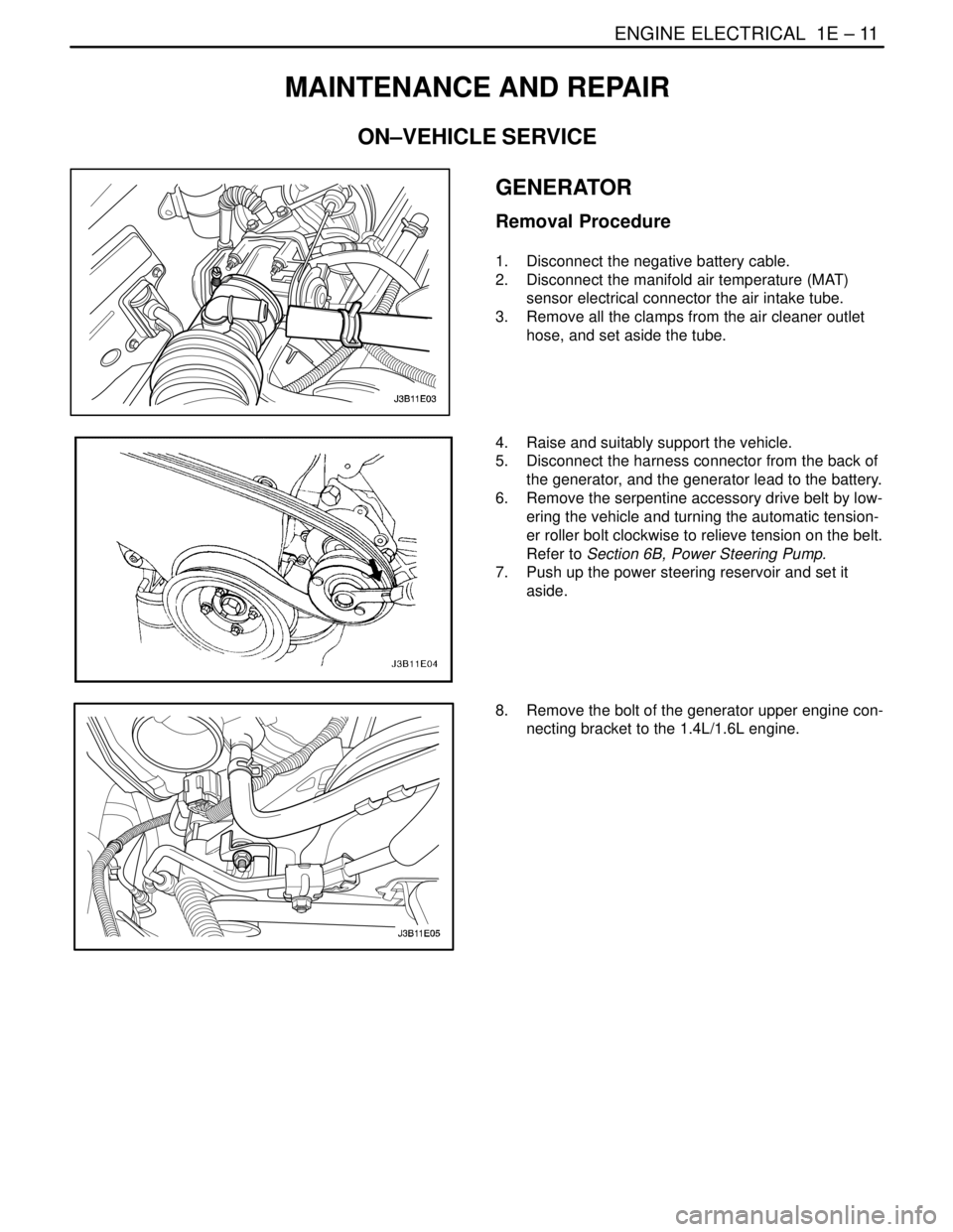
GENERATOR
Removal Procedure
1. Disconnect the negative battery cable.
2. Disconnect the manifold air temperature (MAT)
sensor electrical connector the air intake tube.
3. Remove all the clamps from the air cleaner outlet
hose, and set aside the tube.
4. Raise and suitably support the vehicle.
5. Disconnect the harness connector from the back of
the generator, and the generator lead to the battery.
6. Remove the serpentine accessory drive belt by low-
ering the vehicle and turning the automatic tension-
er roller bolt clockwise to relieve tension on the belt.
Refer to Section 6B, Power Steering Pump.
7. Push up the power steering reservoir and set it
aside.
8. Remove the bolt of the generator upper engine con-
necting bracket to the 1.4L/1.6L engine.
Page 227 of 2643
ENGINE ELECTRICAL 1E – 13
DAEWOO V–121 BL4
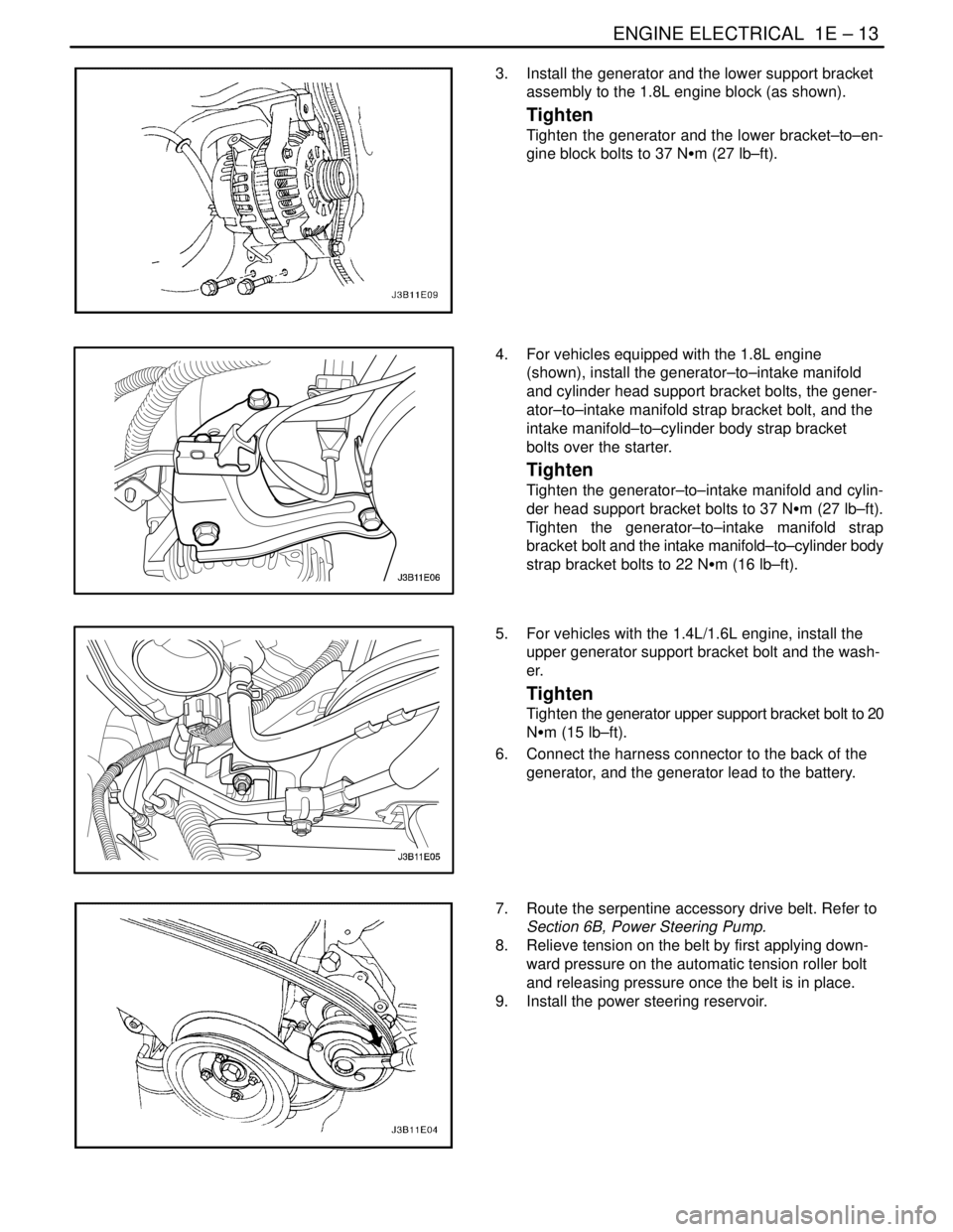
3. Install the generator and the lower support bracket
assembly to the 1.8L engine block (as shown).
Tighten
Tighten the generator and the lower bracket–to–en-
gine block bolts to 37 NSm (27 lb–ft).
4. For vehicles equipped with the 1.8L engine
(shown), install the generator–to–intake manifold
and cylinder head support bracket bolts, the gener-
ator–to–intake manifold strap bracket bolt, and the
intake manifold–to–cylinder body strap bracket
bolts over the starter.
Tighten
Tighten the generator–to–intake manifold and cylin-
der head support bracket bolts to 37 NSm (27 lb–ft).
Tighten the generator–to–intake manifold strap
bracket bolt and the intake manifold–to–cylinder body
strap bracket bolts to 22 NSm (16 lb–ft).
5. For vehicles with the 1.4L/1.6L engine, install the
upper generator support bracket bolt and the wash-
er.
Tighten
Tighten the generator upper support bracket bolt to 20
NSm (15 lb–ft).
6. Connect the harness connector to the back of the
generator, and the generator lead to the battery.
7. Route the serpentine accessory drive belt. Refer to
Section 6B, Power Steering Pump.
8. Relieve tension on the belt by first applying down-
ward pressure on the automatic tension roller bolt
and releasing pressure once the belt is in place.
9. Install the power steering reservoir.
Page 228 of 2643
1E – 14IENGINE ELECTRICAL
DAEWOO V–121 BL4
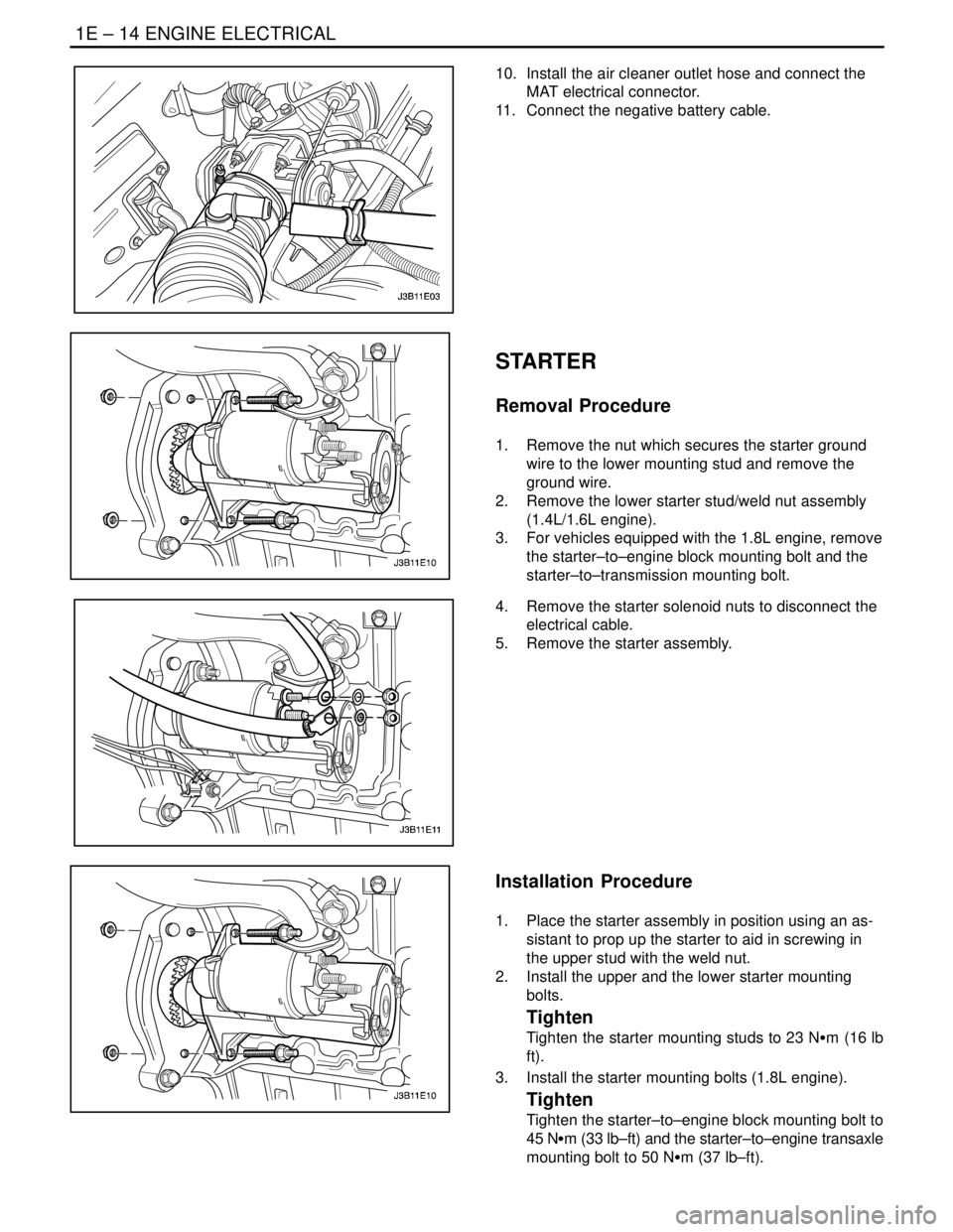
10. Install the air cleaner outlet hose and connect the
MAT electrical connector.
11. Connect the negative battery cable.
STARTER
Removal Procedure
1. Remove the nut which secures the starter ground
wire to the lower mounting stud and remove the
ground wire.
2. Remove the lower starter stud/weld nut assembly
(1.4L/1.6L engine).
3. For vehicles equipped with the 1.8L engine, remove
the starter–to–engine block mounting bolt and the
starter–to–transmission mounting bolt.
4. Remove the starter solenoid nuts to disconnect the
electrical cable.
5. Remove the starter assembly.
Installation Procedure
1. Place the starter assembly in position using an as-
sistant to prop up the starter to aid in screwing in
the upper stud with the weld nut.
2. Install the upper and the lower starter mounting
bolts.
Tighten
Tighten the starter mounting studs to 23 NSm (16 lb
ft).
3. Install the starter mounting bolts (1.8L engine).
Tighten
Tighten the starter–to–engine block mounting bolt to
45 NSm (33 lb–ft) and the starter–to–engine transaxle
mounting bolt to 50 NSm (37 lb–ft).
Page 235 of 2643
ENGINE ELECTRICAL 1E – 21
DAEWOO V–121 BL4
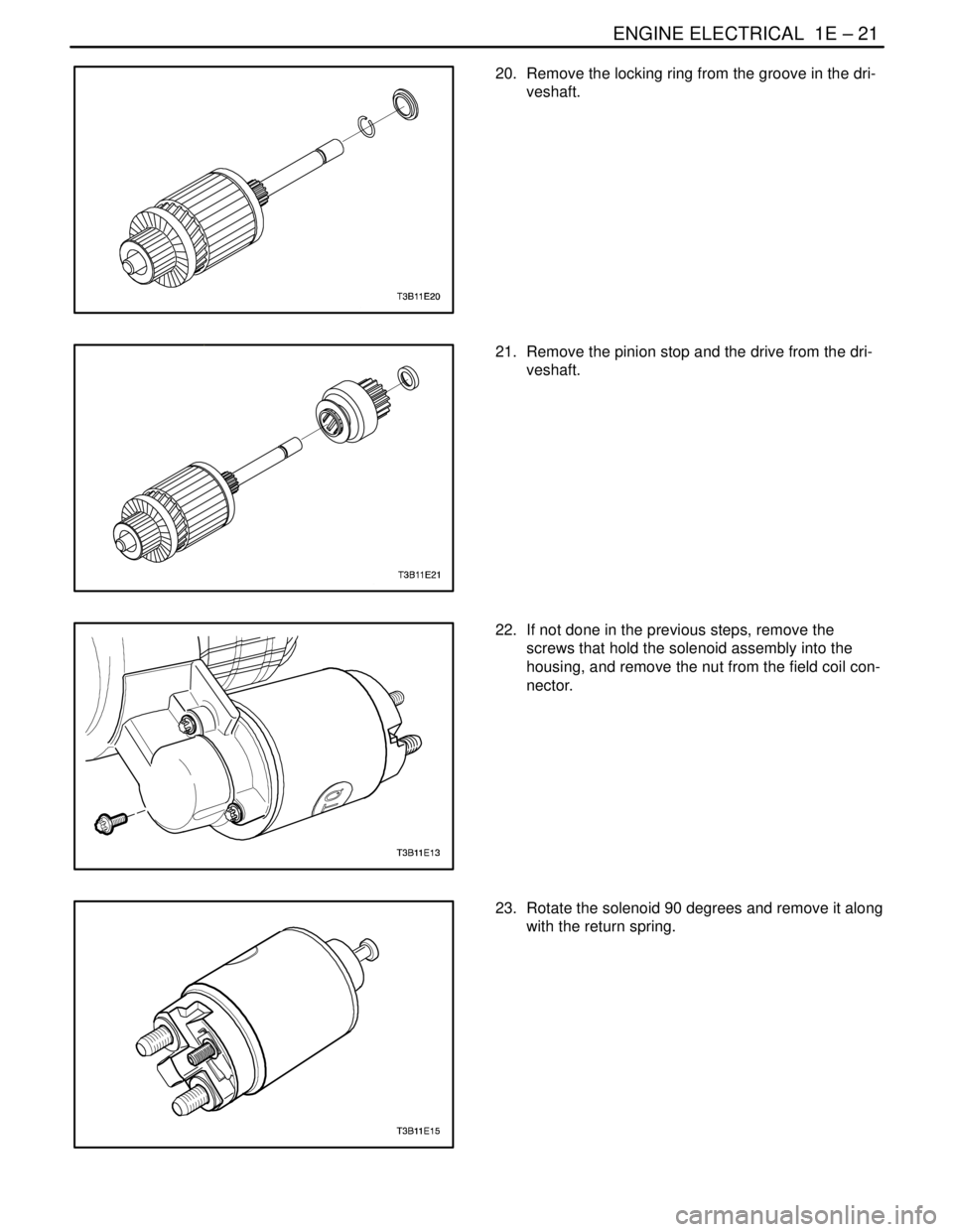
20. Remove the locking ring from the groove in the dri-
veshaft.
21. Remove the pinion stop and the drive from the dri-
veshaft.
22. If not done in the previous steps, remove the
screws that hold the solenoid assembly into the
housing, and remove the nut from the field coil con-
nector.
23. Rotate the solenoid 90 degrees and remove it along
with the return spring.