lock DAEWOO LACETTI 2004 Service Repair Manual
[x] Cancel search | Manufacturer: DAEWOO, Model Year: 2004, Model line: LACETTI, Model: DAEWOO LACETTI 2004Pages: 2643, PDF Size: 80.54 MB
Page 1919 of 2643
6C – 2IPOWER STEERING GEAR
DAEWOO V–121 BL4
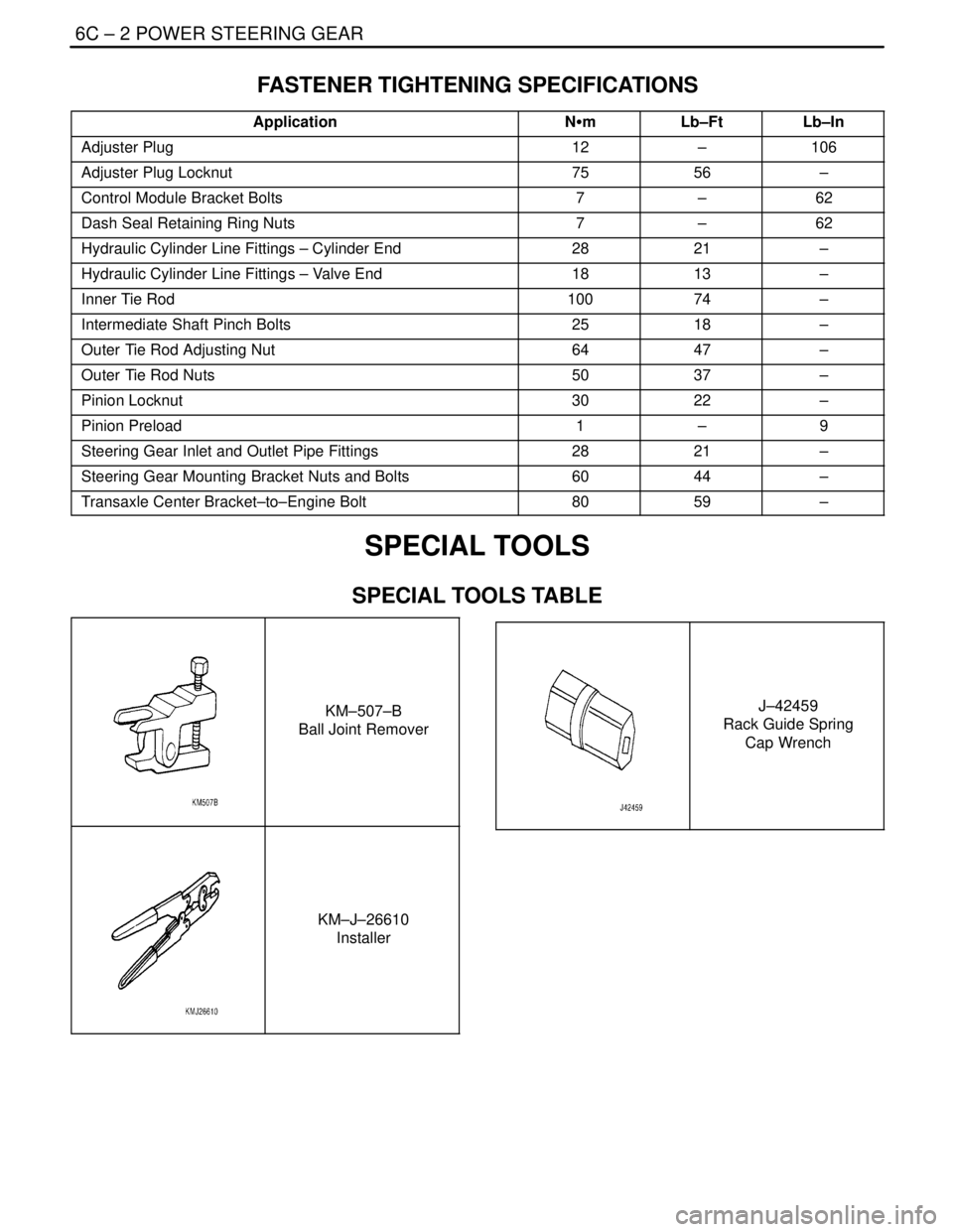
FASTENER TIGHTENING SPECIFICATIONS
ApplicationNSmLb–FtLb–In
Adjuster Plug12–106
Adjuster Plug Locknut7556–
Control Module Bracket Bolts7–62
Dash Seal Retaining Ring Nuts7–62
Hydraulic Cylinder Line Fittings – Cylinder End2821–
Hydraulic Cylinder Line Fittings – Valve End1813–
Inner Tie Rod10074–
Intermediate Shaft Pinch Bolts2518–
Outer Tie Rod Adjusting Nut6447–
Outer Tie Rod Nuts5037–
Pinion Locknut3022–
Pinion Preload1–9
Steering Gear Inlet and Outlet Pipe Fittings2821–
Steering Gear Mounting Bracket Nuts and Bolts6044–
Transaxle Center Bracket–to–Engine Bolt8059–
SPECIAL TOOLS
SPECIAL TOOLS TABLE
KM–507–B
Ball Joint Remover
KM–J–26610
Installer
J–42459
Rack Guide Spring
Cap Wrench
Page 1924 of 2643

POWER STEERING GEAR 6C – 7
DAEWOO V–121 BL4
SPEED SENSITIVE POWER STEERING SYSTEM
OPERATING WITH FULL ASSIST AT ALL TIMES
StepActionValue(s)YesNo
1Perform an initial inspection of the power steering
system.
Is the system operational?–Go to Step 2Go to
Section 6A,
Power Steering
System
2Check the speedometer.
Is the speedometer inoperative?–Go to
Section5,
TransaxleGo to Step 3
3Check the diagnostic trouble codes at the engine
control module (ECM).
Is the ECM code 24 set?–Go to
Section1F,
Engine
ControlsGo to Step 4
41. Turn the ignition ON.
2. Disconnect the electronic variable orifice (EVO)
solenoid actuator electrical connector at the
power steering pump.
3. Probe terminal 1 of the EVO actuator connec-
tor with a voltmeter.
Does the voltmeter display the specified value?–Go to Step 6Go to Step 5
5Repair the open or short in the circuit between termi-
nal 1 of the EVO solenoid actuator electrical connec-
tor and terminal 2 on the speed sensitive power
steering (SSPS) control module connector.
Is the repair complete?–System OK–
61. Remove the EVO solenoid actuator from the
power steering pump.
2. Turn the actuator upside down to position the
pintle.
3. Stimulate the actuator by connecting it to the
battery.
Does the actuator click?–Go to Step 8Go to Step 7
7Replace the EVO solenoid actuator.
Is the repair complete?–System OK–
81. Turn the ignition OFF.
2. Remove the SSPS control module from the
control module bracket.
3. Disconnect the SSPS control module connec-
tor.
4. Connect a test light from terminal 8 on the
SSPS control module connector to the ground.
5. Turn the ignition ON.
Is the test light on?–Go to Step 14Go to Step 9
9Check the ignition fuse.
Is the ignition fuse open?–Go to Step 10Go to Step 11
10Replace the ignition fuse.
Is the repair complete?–System OK–
11Check for an open or short in the circuit between ter-
minal 8 of the control module connector and the I/P
fuse block.
Is the connection faulty?–Go to Step 12Go to Step 13
Page 1925 of 2643

6C – 8IPOWER STEERING GEAR
DAEWOO V–121 BL4
StepNo Yes Value(s) Action
12Repair the open or short in the circuit between termi-
nal 8 of the SSPS control module connector and the
I/P fuse block.
Is the repair complete?–System OK–
13Repair the power feed to the ignition fuse F2.
Is the repair complete?–System OK–
141. Turn the ignition OFF.
2. Connect a test light from terminal 10 of the
SSPS control module connector to B+.
Is the test light on?–Go to Step 16Go to Step 15
15Repair the open in the ground circuit between termi-
nal 10 of the SSPS control module connector and
G203.
Is the repair complete?–System OK–
16Check for a short to B+ or an open in the circuit be-
tween terminal 1 of the SSPS control module con-
nector and terminal B of the EVO solenoid actuator
connector.
Is the connection faulty?–Go to Step 17Go to Step 18
17Repair the short to B+ or an open in the circuit be-
tween terminal 1 of the SSPS control module con-
nector and terminal 2 of the EVO solenoid actuator
connector.
Is the repair complete?–System OK–
181. Disconnect the steering wheel rotation sensor.
2. Turn the ignition ON.
3. Check for an open, short to ground, short to
B+, or poor terminal contact between terminal
5 of the SSPS control module connector and
terminal 1 of the steering wheel rotation sensor
connector.
Is the connection faulty?–Go to Step 19Go to Step 20
19Repair the open, short to ground, short to B+, or poor
terminal contact between terminal 5 of the SSPS
control module connector and terminal 1 of the
steering wheel rotation sensor connector.
Is the repair complete?–System OK–
20Check for an open between terminal 3 of the SSPS
control module connector and terminal 3 of the
steering wheel rotation sensor connector.
Is the connection faulty?–Go to Step 21Go to Step 22
21Repair the open between terminal 3 of the SSPS
control module connector and terminal 3 of the
steering wheel rotation sensor connector.
Is the repair complete?–System OK–
22Check for an open, short to ground, short to B+, or
poor terminal contact between terminal 14 of the
SSPS control module connector and terminal 2 of
the steering wheel rotation sensor connector.
Is the connection faulty?–Go to Step 23Go to Step 24
Page 1943 of 2643
6C – 26IPOWER STEERING GEAR
DAEWOO V–121 BL4
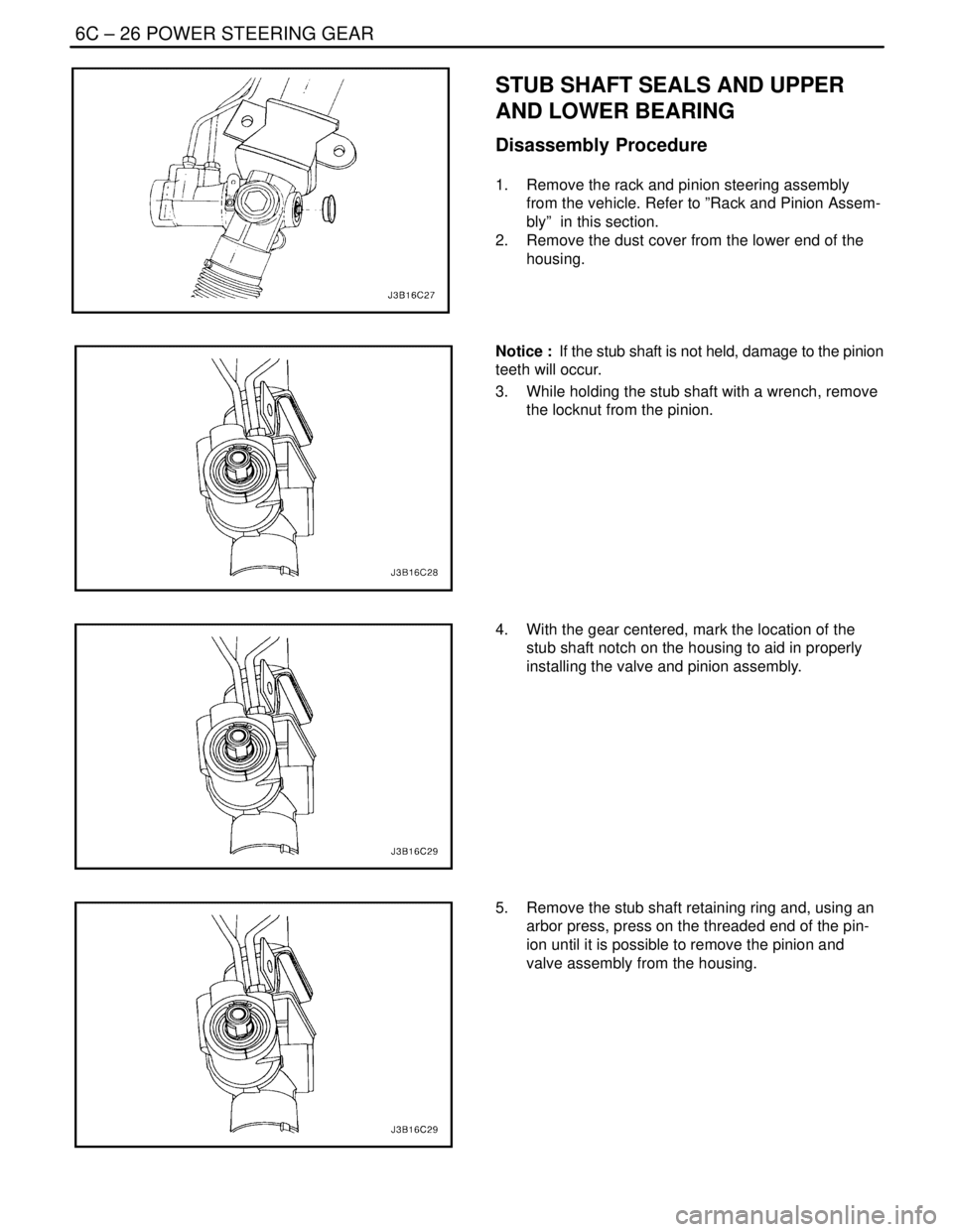
STUB SHAFT SEALS AND UPPER
AND LOWER BEARING
Disassembly Procedure
1. Remove the rack and pinion steering assembly
from the vehicle. Refer to ”Rack and Pinion Assem-
bly” in this section.
2. Remove the dust cover from the lower end of the
housing.
Notice : If the stub shaft is not held, damage to the pinion
teeth will occur.
3. While holding the stub shaft with a wrench, remove
the locknut from the pinion.
4. With the gear centered, mark the location of the
stub shaft notch on the housing to aid in properly
installing the valve and pinion assembly.
5. Remove the stub shaft retaining ring and, using an
arbor press, press on the threaded end of the pin-
ion until it is possible to remove the pinion and
valve assembly from the housing.
Page 1945 of 2643
6C – 28IPOWER STEERING GEAR
DAEWOO V–121 BL4
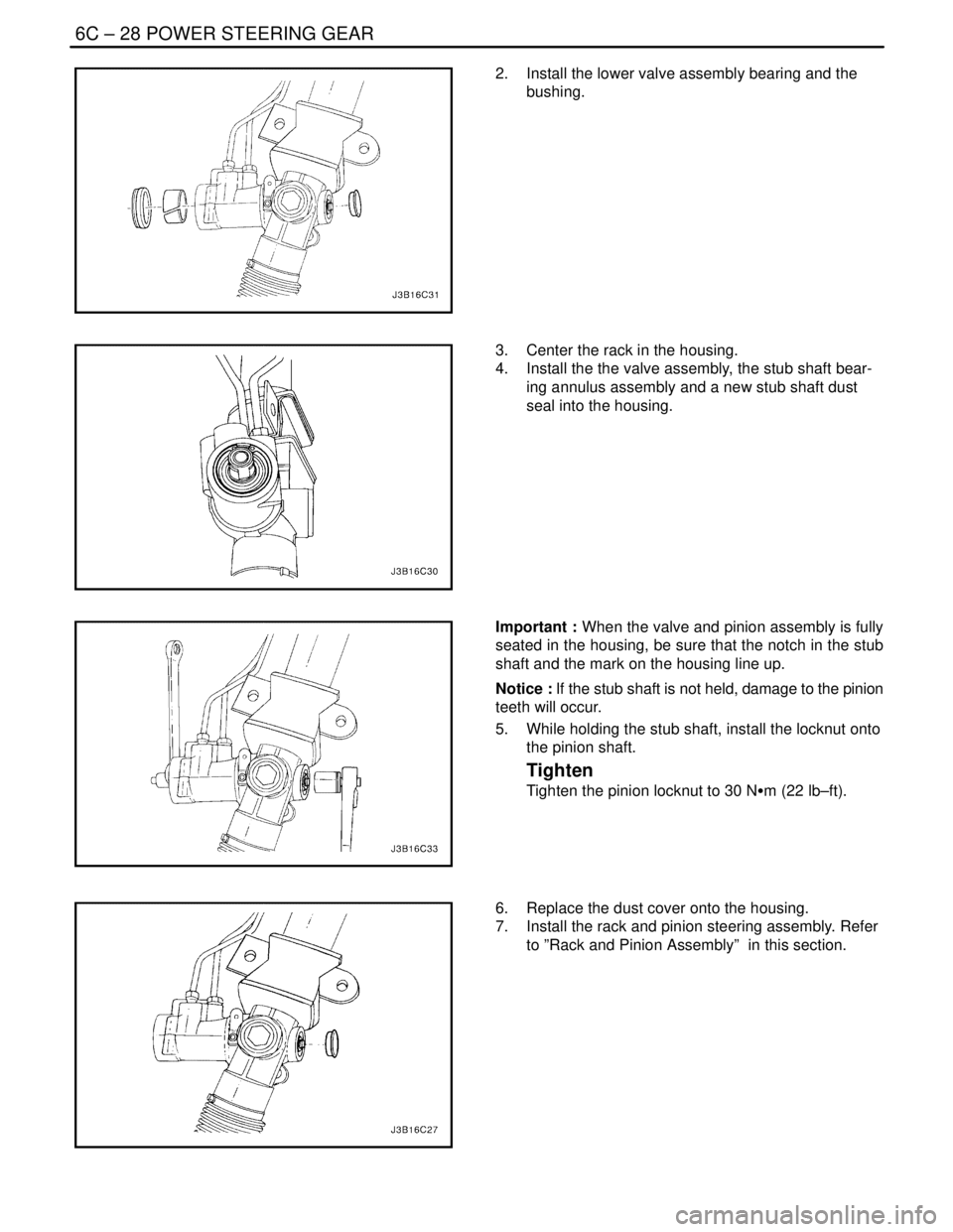
2. Install the lower valve assembly bearing and the
bushing.
3. Center the rack in the housing.
4. Install the the valve assembly, the stub shaft bear-
ing annulus assembly and a new stub shaft dust
seal into the housing.
Important : When the valve and pinion assembly is fully
seated in the housing, be sure that the notch in the stub
shaft and the mark on the housing line up.
Notice : If the stub shaft is not held, damage to the pinion
teeth will occur.
5. While holding the stub shaft, install the locknut onto
the pinion shaft.
Tighten
Tighten the pinion locknut to 30 NSm (22 lb–ft).
6. Replace the dust cover onto the housing.
7. Install the rack and pinion steering assembly. Refer
to ”Rack and Pinion Assembly” in this section.
Page 1946 of 2643
POWER STEERING GEAR 6C – 29
DAEWOO V–121 BL4
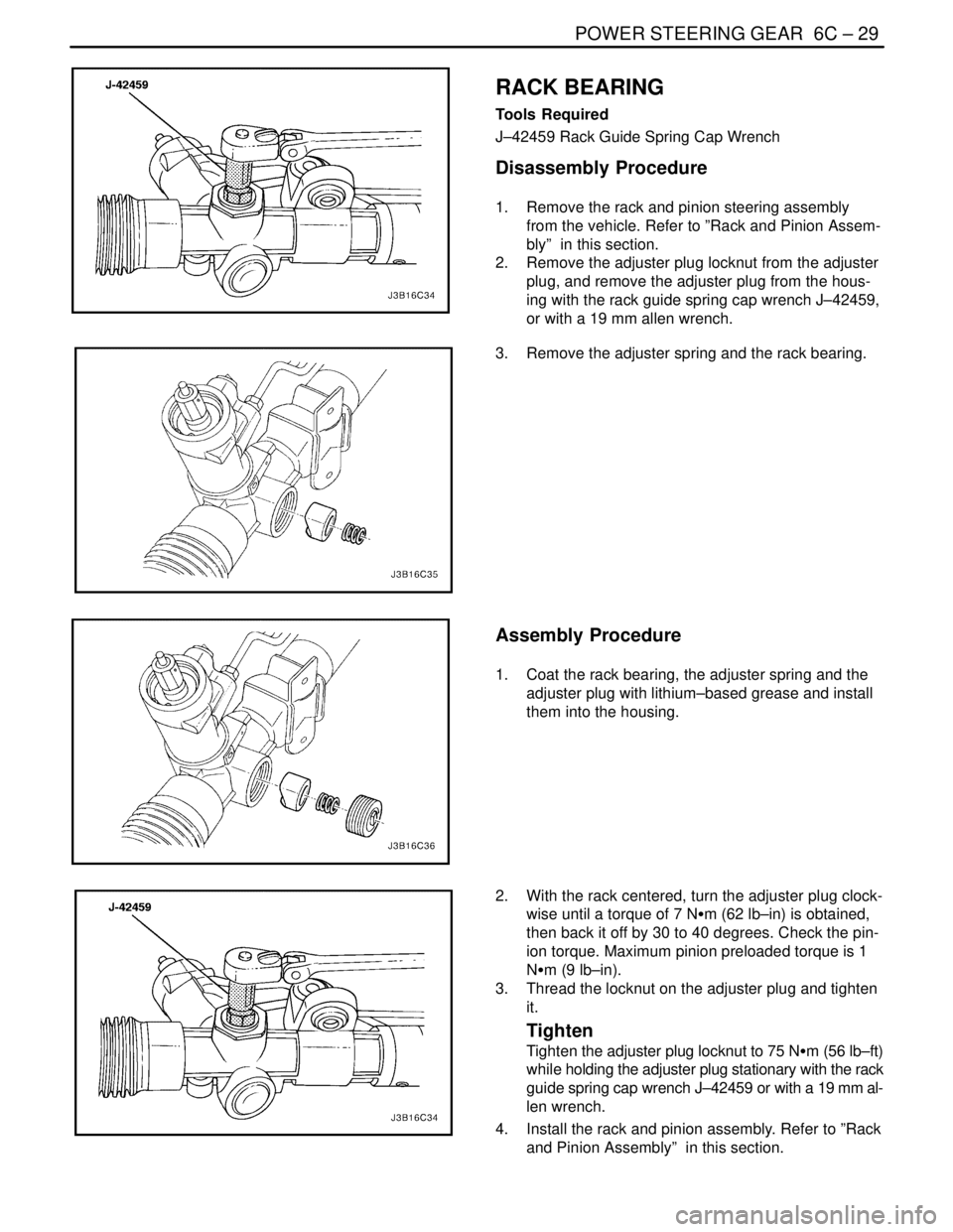
RACK BEARING
Tools Required
J–42459 Rack Guide Spring Cap Wrench
Disassembly Procedure
1. Remove the rack and pinion steering assembly
from the vehicle. Refer to ”Rack and Pinion Assem-
bly” in this section.
2. Remove the adjuster plug locknut from the adjuster
plug, and remove the adjuster plug from the hous-
ing with the rack guide spring cap wrench J–42459,
or with a 19 mm allen wrench.
3. Remove the adjuster spring and the rack bearing.
Assembly Procedure
1. Coat the rack bearing, the adjuster spring and the
adjuster plug with lithium–based grease and install
them into the housing.
2. With the rack centered, turn the adjuster plug clock-
wise until a torque of 7 NSm (62 lb–in) is obtained,
then back it off by 30 to 40 degrees. Check the pin-
ion torque. Maximum pinion preloaded torque is 1
NSm (9 lb–in).
3. Thread the locknut on the adjuster plug and tighten
it.
Tighten
Tighten the adjuster plug locknut to 75 NSm (56 lb–ft)
while holding the adjuster plug stationary with the rack
guide spring cap wrench J–42459 or with a 19 mm al-
len wrench.
4. Install the rack and pinion assembly. Refer to ”Rack
and Pinion Assembly” in this section.
Page 1947 of 2643
6C – 30IPOWER STEERING GEAR
DAEWOO V–121 BL4
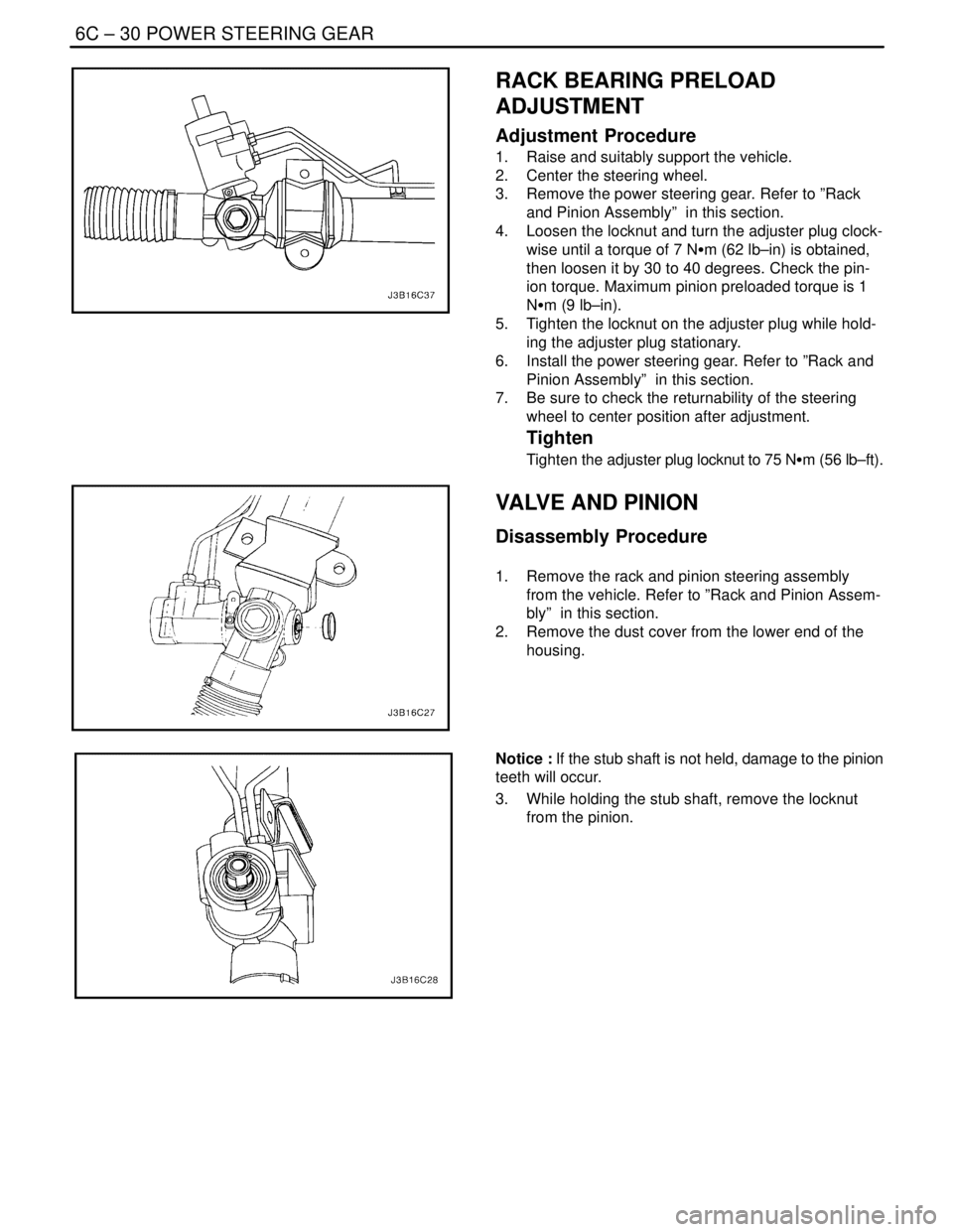
RACK BEARING PRELOAD
ADJUSTMENT
Adjustment Procedure
1. Raise and suitably support the vehicle.
2. Center the steering wheel.
3. Remove the power steering gear. Refer to ”Rack
and Pinion Assembly” in this section.
4. Loosen the locknut and turn the adjuster plug clock-
wise until a torque of 7 NSm (62 lb–in) is obtained,
then loosen it by 30 to 40 degrees. Check the pin-
ion torque. Maximum pinion preloaded torque is 1
NSm (9 lb–in).
5. Tighten the locknut on the adjuster plug while hold-
ing the adjuster plug stationary.
6. Install the power steering gear. Refer to ”Rack and
Pinion Assembly” in this section.
7. Be sure to check the returnability of the steering
wheel to center position after adjustment.
Tighten
Tighten the adjuster plug locknut to 75 NSm (56 lb–ft).
VALVE AND PINION
Disassembly Procedure
1. Remove the rack and pinion steering assembly
from the vehicle. Refer to ”Rack and Pinion Assem-
bly” in this section.
2. Remove the dust cover from the lower end of the
housing.
Notice : If the stub shaft is not held, damage to the pinion
teeth will occur.
3. While holding the stub shaft, remove the locknut
from the pinion.
Page 1949 of 2643
6C – 32IPOWER STEERING GEAR
DAEWOO V–121 BL4
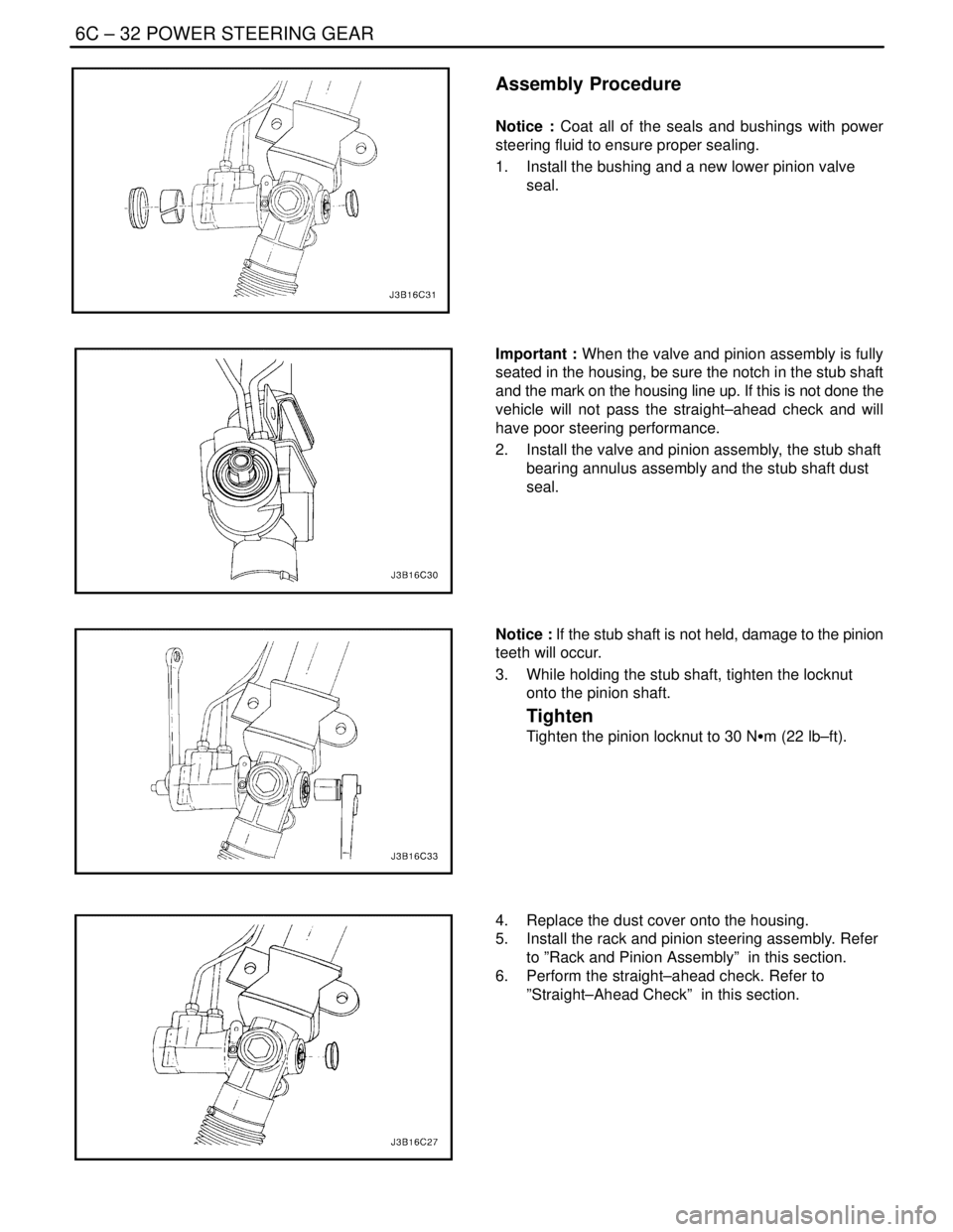
Assembly Procedure
Notice : Coat all of the seals and bushings with power
steering fluid to ensure proper sealing.
1. Install the bushing and a new lower pinion valve
seal.
Important : When the valve and pinion assembly is fully
seated in the housing, be sure the notch in the stub shaft
and the mark on the housing line up. If this is not done the
vehicle will not pass the straight–ahead check and will
have poor steering performance.
2. Install the valve and pinion assembly, the stub shaft
bearing annulus assembly and the stub shaft dust
seal.
Notice : If the stub shaft is not held, damage to the pinion
teeth will occur.
3. While holding the stub shaft, tighten the locknut
onto the pinion shaft.
Tighten
Tighten the pinion locknut to 30 NSm (22 lb–ft).
4. Replace the dust cover onto the housing.
5. Install the rack and pinion steering assembly. Refer
to ”Rack and Pinion Assembly” in this section.
6. Perform the straight–ahead check. Refer to
”Straight–Ahead Check” in this section.
Page 1950 of 2643

POWER STEERING GEAR 6C – 33
DAEWOO V–121 BL4
GENERAL DESCRIPTION
AND SYSTEM OPERATION
POWER RACK AND PINION
The power rack and pinion steering system has a rotary
control valve that directs hydraulic fluid coming from the
hydraulic pump to one side or the other side of the rack pis-
ton. The integral rack piston is attached to the rack. The
rack piston converts hydraulic pressure to a linear force
that moves the rack left or right. That force is then trans-
mitted through the tie rods to the steering knuckles, which
turn the wheels.
If power rack and pinion steering is not available, manual
rack and pinion control is used; however, with this system,
more steering effort is required. The movement of the
steering wheel is transferred to the pinion. The rotary
movement of the pinion is then transferred through the pin-
ion threads, which mesh with teeth on the rack, thereby
causing the rack to move in a linear direction.
A vane–type of hydraulic pump provides hydraulic pres-
sure for both steering systems.
SPEED SENSITIVE POWER
STEERING SYSTEM
The speed sensitive power steering (SSPS) system varies
the driver effort required to steer as the vehicle speed
changes. At low speeds, the system provides maximum
power assist for easy turning and parking maneuvers. At
higher speeds, the steering power is reduced to provide
the driver with firmer steering and directional stability. The
SSPS system accomplishes this by reducing the amount
of power steering fluid flow from the power steering pump
to the power steering gear as the vehicle speed increases.
When the vehicle is stationary, the SSPS system provides
maximum fluid flow to the steering gear. As the vehicle
speed increases, the fluid flow to the steering gear is de-
creased.
Control Module
The SSPS control module processes the vehicle speed in-
formation from the engine control module (ECM) and uses
the steering wheel rotation sensor to provide a control sig-
nal to the electronic variable orifice (EVO) actuator located
on the power steering pump.
Electronic Variable Orifice (EVO) Actuator
The electronic variable orifice (EVO) actuator is located on
the power steering pump and contains a solenoid– oper-
ated pintle valve. Fluid leaving the pump passes through
an orifice in the actuator tip. When the EVO actuator is
powered by the SSPS control module, the pintle moves
into the orifice and reduces the power steering fluid flow.As the vehicle speed increases, current from the SSPS
control module increases, and the pintle blocks more and
more of the orifice.
Steering Wheel Rotation Sensor
The steering wheel rotation sensor is located at the end of
the steering column housing and is used to send a signal
to the controller when abrupt or evasive steering maneu-
vers are needed.
Power Steering Pressure Hose
SSPS vehicles have a specific pressure hose assembly
which includes an in–line check valve in the rack and pin-
ion assembly. This reduces the amount of steering wheel
”kick” when driving over irregular road surfaces while oper-
ating at speeds with reduced flow rate and pressure.
Power Rack and Pinion
Except for differences in valve machining, the design of
the SSPS power rack and pinion assembly is the same as
for the a non–SSPS system. The steering wheel move-
ment is transferred to the pinion via the intermediate shaft.
The pinion moves the rack left or right through meshing the
pinion and the rack teeth. The force is then transmitted
through the tie rods and steering knuckle to steer the
wheels.
The power rack and pinion steering system has a rotary
control valve which directs the hydraulic fluid from the
power steering pump to one side or the other side of the
rack piston. The piston is attached to the rack and uses hy-
draulic pressure to move the rack left or right. The rotary
control valve regulates the degree of assist by responding
to the driver’s torque input.
If hydraulic assist is not available, manual control is main-
tained. However, under this condition, more steering effort
is required.
Power Steering Pump
The standard vane–type pump, which provides hydraulic
pressure for the system, incorporates a special discharge
fitting to hold the EVO actuator.
System Operation
System operation originates with input from the vehicle
speed sensor via the engine control module to the SSPS
control module. The SSPS control module sends a signal
to the SSPS actuator to vary the rate of fluid flow output
by the power steering pump.
Circuit Operation
The SSPS system uses inputs from the speed sensor and
steering wheel rotation sensor to the SSPS controller to
determine the desired amount of power steering assist.
The SSPS control module constantly compares the
amount of current flowing through the EVO actuator to the
desired current it has calculated. The EVO actuator has a
pintle that moves in and out of an orifice, regulating power
Page 1955 of 2643

SECTION : 6E
STEERING WHEEL AND COLUMN
CAUTION : Disconnect the negative battery cable before removing or installing any electrical unit or when a tool
or equipment could easily come in contact with exposed electrical terminals. Disconnecting this cable will help
prevent personal injury and damage to the vehicle. The ignition must also be in LOCK unless otherwise noted.
TABLE OF CONTENTS
SPECIFICATIONS6E–1 . . . . . . . . . . . . . . . . . . . . . . . . . .
Fastener Tightening Specifications 6E–1. . . . . . . . . . .
SPECIAL TOOLS6E–2 . . . . . . . . . . . . . . . . . . . . . . . . . . .
Special Tools Table 6E–2. . . . . . . . . . . . . . . . . . . . . . . .
DIAGNOSIS6E–2 . . . . . . . . . . . . . . . . . . . . . . . . . . . . . . . .
Steering Column Diagnosis 6E–2. . . . . . . . . . . . . . . . .
MAINTENANCE AND REPAIR6E–8 . . . . . . . . . . . . . . .
ON–VEHICLE SERVICE 6E–8. . . . . . . . . . . . . . . . . . . . .
Headlamp/Turn Signal Switch and Lever 6E–8. . . . . .
Wiper Switch and Lever 6E–9. . . . . . . . . . . . . . . . . . . . Steering Wheel Rotation Sensor 6E–10. . . . . . . . . . . .
Steering Wheel Without SIR 6E–11. . . . . . . . . . . . . . . .
Steering Wheel With SIR 6E–13. . . . . . . . . . . . . . . . . .
Ignition Lock Cylinder and Switch 6E–13. . . . . . . . . . .
Steering Column 6E–15. . . . . . . . . . . . . . . . . . . . . . . . . .
UNIT REPAIR 6E–19. . . . . . . . . . . . . . . . . . . . . . . . . . . . .
Tilt Steering Column 6E–19. . . . . . . . . . . . . . . . . . . . . .
GENERAL DESCRIPTION AND SYSTEM
OPERATION6E–20 . . . . . . . . . . . . . . . . . . . . . . . . . . . . .
Steering Wheel and Column 6E–20. . . . . . . . . . . . . . . .
Ignition Key Reminder 6E–20. . . . . . . . . . . . . . . . . . . . .
SPECIFICATIONS
FASTENER TIGHTENING SPECIFICATIONS
ApplicationNSmLb–FtLb–In
Ignition Switch Housing Shear Bolts11–97
Ignition Switch Retaining Screw2.5–22
Steering Column Jacket Assembly Front Bracket Bolts2216–
Steering Column Jacket Assembly Rear Bracket Nuts2216–
Steering Shaft Universal Joint Pinch Bolt2518–
Steering Wheel Horn Cap Screws4.5–40
Steering Wheel Nut3828–
Steering Wheel Rotation Sensor Retaining Screw2–18
Support Housing Screws1612–
Turn Signal Switch Housing Screws3–27
Upper and Lower Steering Column Cover Panel Screws2.5–22