engine DAEWOO NUBIRA 2004 Service Repair Manual
[x] Cancel search | Manufacturer: DAEWOO, Model Year: 2004, Model line: NUBIRA, Model: DAEWOO NUBIRA 2004Pages: 2643, PDF Size: 80.54 MB
Page 1354 of 2643

ZF 4 HP 16 AUTOMATIC TRANSAXLE 5A1 – 5
DAEWOO V–121 BL4
SPECIFICATIONS
GENERAL SPECIFICATIONS
Definition
Transaxle Type4–speed with four–wheel drive and transverse engine
Input Torque240 NSm (177 lb–ft)
Transaxle Weight76kg (168 lb)
Torque Converter Capacity9.72kg (21.4 lb)
Transaxle Fluid Type (manufacture company)ESSO LT 71141 or TOTAL ATF H50235
Transaxle Fluid Capacity7.3qt (6.9L)
TRANSAXLE GEAR RATIO
GearRatio
First2.719
Second1.487
Third1.000
Fourth0.717
Reverse 2.529
Final3.945:1
FLUID CAPACITY
LitresQuarts
Bottom Pan Removal44.2
Complete Overhaul6.97.3
Torque Converter Removal22.1
(Measurements are approximate)
FASTENER TIGHTENING SPECIFICATIONS
ApplicationNSmLb–FtLb–In
Bearing Plate Bolts23.517.5–
Slotted Nut220162–
Rear Cover Attachment Bolts23.517.5–
Baffle Plate Attachment Bolts10–89
Park/Neutral Position Switch10–89
Fluid Pump Connecting Bolts10–89
Fluid Filter Housing Cover Attachment Bolts10–89
Input Speed sensor Attachment Bolts8–71
Output Speed Sensor Attachment Bolts8–71
Valve Body Bolts8–71
Valve Body Upper & Lower Fixing Bolts6–53
Fluid Pan Connecting Bolts6–53
Fluid Pan Drain Plug4533–
Page 1355 of 2643

5A1 – 6IZF 4 HP 16 AUTOMATIC TRANSAXLE
DAEWOO V–121 BL4
Application Lb–InLb–Ft NSm
Fluid Level Plug4533–
Line Pleasure Plugs2015–
Valve Housing 1 Cover Attachment Bolts6–53
Solenoid Valve Attachment Bolts6–53
Pressure Control Regulator(EDS) Attachment Bolts6–53
Oil Cooler Inlet Pipe Bolts3526–
Oil Cooler Outlet Pipe Bolts3526–
Shift Control Cable Adjuster Pinch Nut8–71
Shift Control Cable Attachment Nut8–71
Upper Transaxle–to–Engine Bolts7555–
Selector Lever(On Transaxle Case)1511–
Torque Converter Attachment Bolts4533–
Shift Control Assembly Mounting Bolt, Nut8–71
Lower Engine–to–Transaxle Bolts(a)7555–
Lower Engine–to–Transaxle Bolt(b)2115–
Lower Engine–to–Transaxle Bolts(c)3123–
Rear Transaxle Mounting Bracket Bolts6245–
Damping Block Connection Bolt and Nut6850–
Left Transaxle Mount Bracket Cage Bolt(a)11 081–
Left Transaxle Mount Bracket Cage Bolt(b)6548–
Left Transaxle Mount Bracket Cage Nut(c)6548–
Left Transaxle Mounting Bolts4835–
Page 1358 of 2643
ZF 4 HP 16 AUTOMATIC TRANSAXLE 5A1 – 9
DAEWOO V–121 BL4
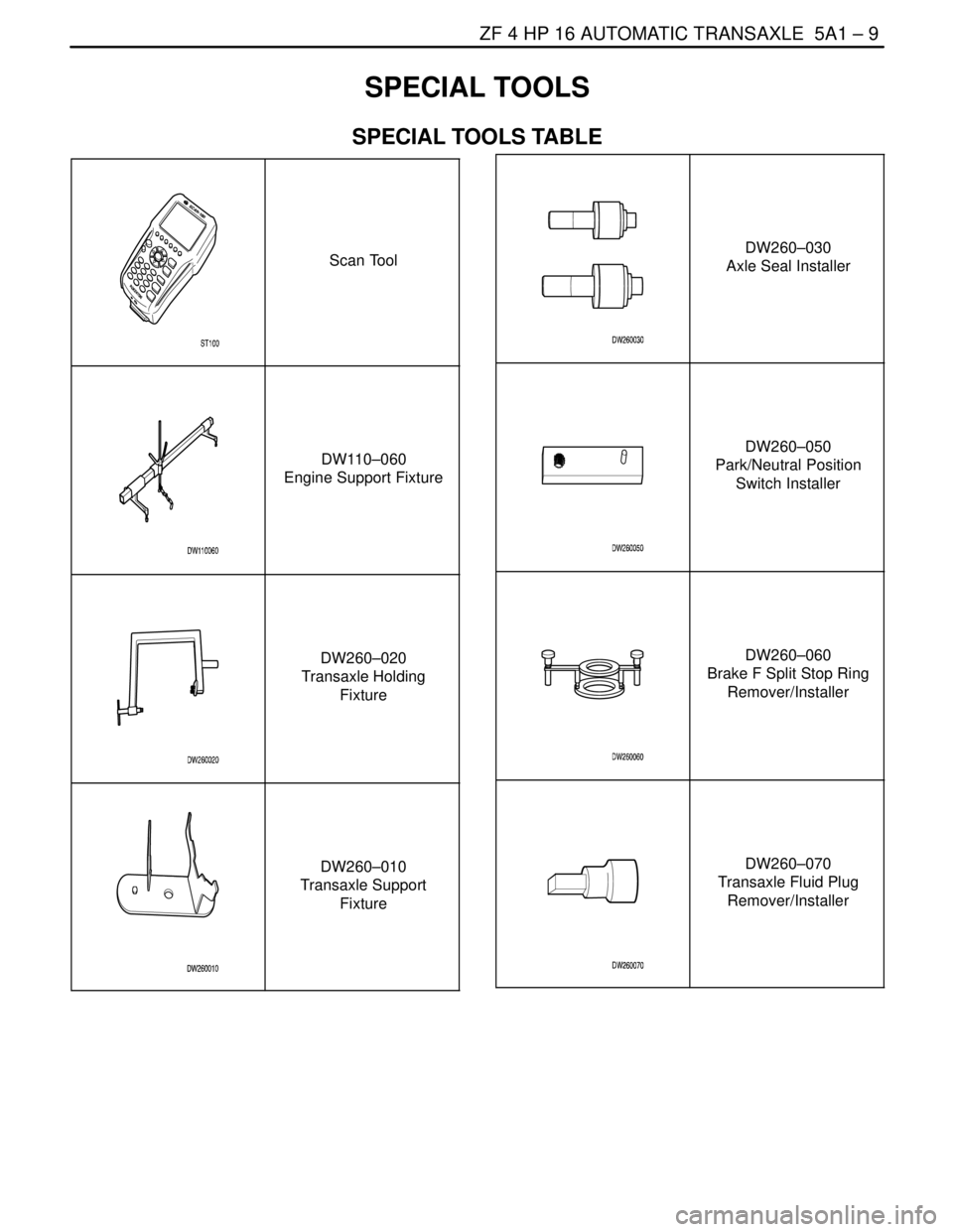
SPECIAL TOOLS
SPECIAL TOOLS TABLE
Scan Tool
DW110–060
Engine Support Fixture
DW260–020
Transaxle Holding
Fixture
DW260–010
Transaxle Support
Fixture
DW260–030
Axle Seal Installer
DW260–050
Park/Neutral Position
Switch Installer
DW260–060
Brake F Split Stop Ring
Remover/Installer
DW260–070
Transaxle Fluid Plug
Remover/Installer
Page 1367 of 2643

5A1 – 18IZF 4 HP 16 AUTOMATIC TRANSAXLE
DAEWOO V–121 BL4
Park/Neutral
In Park or Neutral with the engine running there is no drive
to the planetary gear set. Line pressure (from the oil pump)
is supplied to the valve body. Only clutch B is supplied and
the torque converter is released.
Control
Line Pressure Control Valve
The line pressure control valve sets the general pressure
level in the valve body. When gearshifts are not taking
place, the line pressure varies between two levels, de-
pending on the turbine torque. Line pressure increase lin-
early by time. But it has a limit point. When pressure reach-
es that point, excess oil pressure drains back into the oil
sump.
Reduction Valve
The reduction valve reduces the line pressure with which
the downstream solenoid valves and pressure control so-
lenoid valves (EDS) are supplied. This makes it possible
to use smaller solenoid valves.
The line pressure comes from the oil pump and flows to the
reduction valve. The inlet port to the reduction valve will be
blocked and line pressure will be maintained at the ap-
propriate level.
Solenoid Valve 1, 2
Solenoid Valve 1 controls the line pressure (high and low)
to the clutch valves. Solenoid Valve 1 is either ON or OFF.
When the solenoid is turned ON the line pressure will be
low [87~116psi (6~8bar)].When the solenoid is turned
OFF the line pressure will be high [232~261psi
(16~18bar)].
Solenoid 2 controls the fluid flow to clutch valve E or the
TCC clutch valve. When solenoid 2 is ON fluid is directed
to the TCC pressure valve and if the solenoid is switched
OFF fluid will flow to the inlet at clutch valve E.The TCM monitors numerous inputs to determine the ap-
propriate solenoid state combination and transaxle gear
for the vehicle operating conditions.
In Park and Neutral solenoid valve 1 is ON. So line pres-
sure flows to the safety valve and the line pressure control
valve via the solenoid valve.
Clutch B Engaged
In Park and Neutral solenoid valves 1 and 2 are both ON.
Pressure control solenoids (EDS) 4 and 6 are also turned
ON.
When EDS 6 is ON, the fluid supplied from the reduction
valve flows to the safety valve, clutch valve B and holding
valve B. The oil that is supplied to the inlet port of the clutch
valve presses on the valve spool. Line pressure then flows
to the holding valve and check ball, engaging clutch B.
Lock–up Clutch (TCC)
Solenoid 2 is turned ON and the line pressure control
valves spool will be depressed. Fluid will now flow through
the torque converter pressure valve.
As a result, the oil pressure behind the converter lock–up
clutch piston and in the turbine zone is equal. The direction
of flow is through the turbine shaft and through the space
behind the piston, to the turbine chamber.
Lubrication/Cooling.
The lubricating valve ensures that the converter is sup-
plied with cooling oil first if the pump rate is low. The lubri-
cating pressure valve in addition guarantees that the nec-
essary amount of cooling and lubricating oil is available via
the bypass duct.
The fluid, which is supplied from the torque converter,
flows to the cooler via the lubrication valve.
Page 1392 of 2643

ZF 4 HP 16 AUTOMATIC TRANSAXLE 5A1 – 43
DAEWOO V–121 BL4
DIAGNOSTIC INFORMATION AND
PROCEDURES DIAGNOSIS
BASIC KNOWLEDGE REQUIRED
You must be familiar with some basic electronics to use
this section of the Service Manual. They will help you to
follow diagnostic procedures.
Notice : Lack of the basic knowledge of this transaxle
when performing diagnostic procedures could result in in-
correct diagnostic performance or damage to transaxle
components.
Do not, under any circumstances, attempt to diagnose a
transaxle problem without this basic knowledge.
Notice : If a wire is probed with a sharp instrument and not
properly sealed afterward, the wire will corrode and an
open circuit will result.
Diagnostic test probes are now available that allow you to
probe individual wires without leaving the wire open to the
environment. These probe devices are inexpensive and
easy to install, and they permanently seal the wire from
corrosion.
Special Tools
You should be able to use a Digital Volt Meter (DVM), a cir-
cuit tester, jumper wires or leads and a line pressure gauge
set.
The functional check procedure is designed to verify the
correct operation of electronic components in the trans-
axle.
This will eliminate the unnecessary removal of transaxle
components.
FUNCTIONAL CHECK PROCEDURE
Begin with the Functional Check Procedure which pro-
vides a general outline of how to diagnose automatic
transaxle. The following functional check procedure will in-
dicate the proper path of diagnosing the transaxle by de-
scribing the basic checks and then referencing the loca-
tions of the specific checks.
S Check the fluid level according to the Fluid Level
Service Procedure.
S Check the transaxle for fluid leaks.
S Check if the transaxle fluid is not burnt by color and
smell.
S Ensure that the transaxle is not in Limp Home
Mode(LHM).
S Check the battery terminals and the ground con-
nections for corrosion or looseness.
S Check that the cooler flow is not restricted.S Check all electrical connections for tightness.
S Use on–board diagnostic tool or a scan tool to see
if any transaxle trouble codes have been set. Refer
to the appropriate ”Diagnostic Trouble Code (DTC)”
information and repair the vehicle as directed. After
repairing the vehicle, perform the road test and
verify that the code has not set again.
S Perform the Electrical/Garage Shift Tests.
S Perform the Road Test Procedure in this section.
S Inspect the oil and check for metal or other contam-
inants in the oil pan.
LINE PRESSURE CHECK
PROCEDURE
The 4HP 16 A/T uses a trochoid type oil pump to produce
hydraulic pressure, and a pressure control solenoid (sole-
noid 1) to control that pressure at the pressure regulator
valve, after it leaves the pump. The transaxle pressure
control solenoid is controlled by an electrical signal that
ranges from 0 to 12 volts corresponds to minimum line
pressure (approx. 89.9 to 124.7 psi (6.2 to 8.6 bar)) and
0 volt corresponds to a maximum line pressure (approx.
221.9 to 252.4 psi (15.3 to 17.4 bar)) in all range.
Line pressures are calculated for two sets of gear ranges
– Drive–Park–Neutral and Reverse. This allow the trans-
axle line pressure to be appropriate for different pressure
needs in different gear ranges:
Gear
Range
Solenoid
1RPMPressure
Drive,
ReverseOff2,500221.9~252.4psi
(15.3~17.4 bar)
On2,50017.4~269.8psi
(1.2~18.6 bar)
Neutral,
ParkOff2,500221.9~252.4psi
(15.3~17.4 bar)
On2,50089.9~269.8 psi
(6.2~18.6 bar)
Before performing a line pressure check, verify that the
pressure control solenoid is receiving the correct electrical
signal from the TCM:
1. Install a scan tool.
2. Start the engine and set parking brake.
3. Check for a stored pressure control solenoid diag-
nostic trouble code, and other diagnostic trouble
codes.
Page 1393 of 2643
5A1 – 44IZF 4 HP 16 AUTOMATIC TRANSAXLE
DAEWOO V–121 BL4
4. Repair vehicle, if necessary.
Inspect:
S Fluid level.
S Manual linkage.
Install or Connect:
S Scan tool (scanner)
S Oil pressure gauge at line pressure port (clutch B or
E ports on transaxle case)
5. Put gear selector in Park and set the parking brake.6. Start engine and allow it to warm up at idle.
7. Access the ”Solenoid 1 Control Mode” on the scan-
ner.
8. Switching solenoid 1 ON/OFF, accelerating the en-
gine to 2,500rpm, and then read the line pressure
at the each gear.
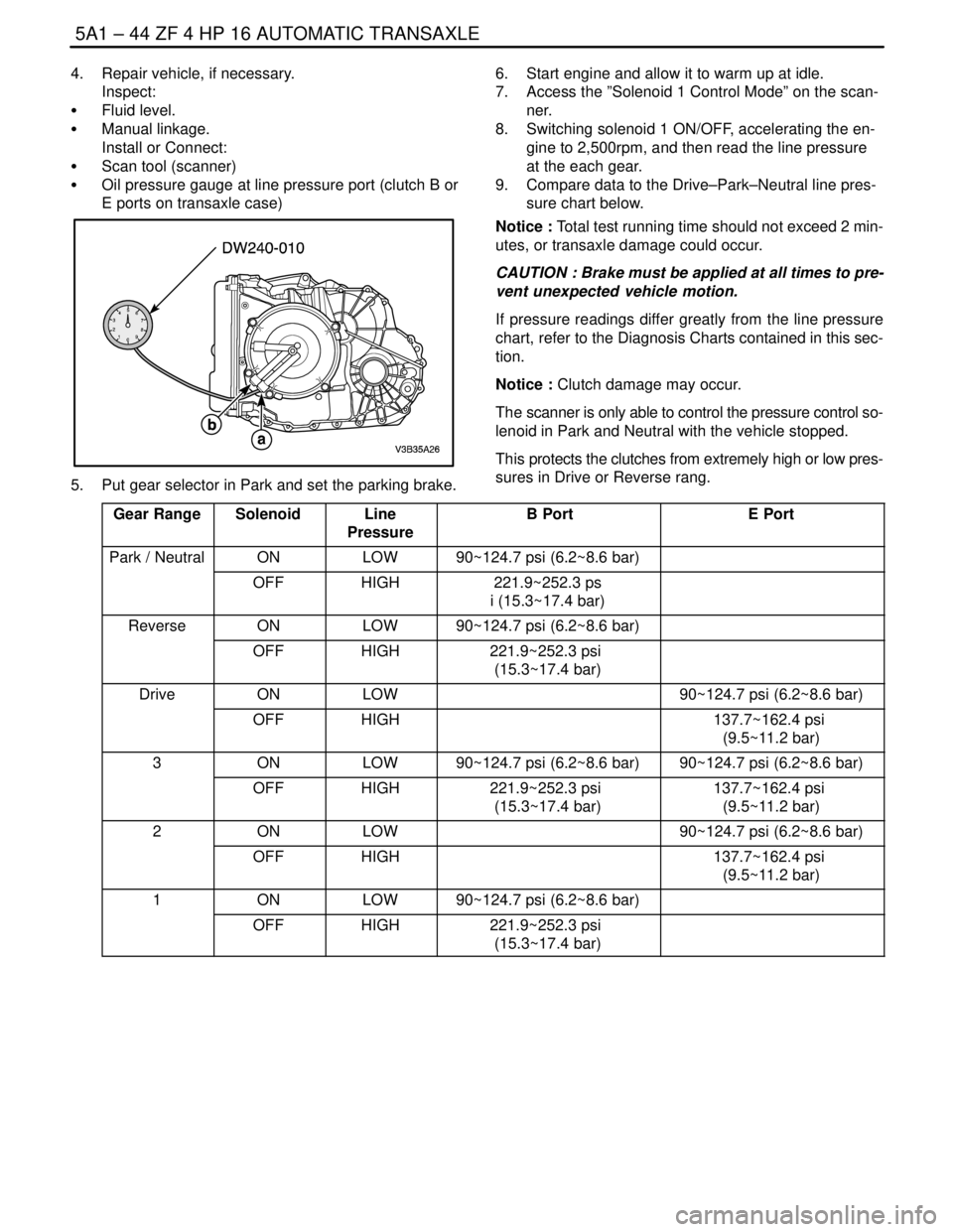
9. Compare data to the Drive–Park–Neutral line pres-
sure chart below.
Notice : Total test running time should not exceed 2 min-
utes, or transaxle damage could occur.
CAUTION : Brake must be applied at all times to pre-
vent unexpected vehicle motion.
If pressure readings differ greatly from the line pressure
chart, refer to the Diagnosis Charts contained in this sec-
tion.
Notice : Clutch damage may occur.
The scanner is only able to control the pressure control so-
lenoid in Park and Neutral with the vehicle stopped.
This protects the clutches from extremely high or low pres-
sures in Drive or Reverse rang.
Gear Range
SolenoidLine
Pressure B PortE Port
Park / NeutralONLOW90~124.7 psi (6.2~8.6 bar)
OFFHIGH221.9~252.3 ps
i (15.3~17.4 bar)
ReverseONLOW90~124.7 psi (6.2~8.6 bar)
OFFHIGH221.9~252.3 psi
(15.3~17.4 bar)
DriveONLOW90~124.7 psi (6.2~8.6 bar)
OFFHIGH137.7~162.4 psi
(9.5~11.2 bar)
3ONLOW90~124.7 psi (6.2~8.6 bar)90~124.7 psi (6.2~8.6 bar)
OFFHIGH221.9~252.3 psi
(15.3~17.4 bar)137.7~162.4 psi
(9.5~11.2 bar)
2ONLOW90~124.7 psi (6.2~8.6 bar)
OFFHIGH137.7~162.4 psi
(9.5~11.2 bar)
1ONLOW90~124.7 psi (6.2~8.6 bar)
OFFHIGH221.9~252.3 psi
(15.3~17.4 bar)
Page 1394 of 2643

ZF 4 HP 16 AUTOMATIC TRANSAXLE 5A1 – 45
DAEWOO V–121 BL4
CLUTCH PLATE DIAGNOSIS
Composition Plates
Dry the plate and inspect the plates for the following condi-
tions :
S Pitting
S Flaking
S Wear
S Glazing
S Cracking
S Charring
Chips or metal particles embedded in the lining
Replace a composition plate which shows any of these
conditions.
Steel Plates
Wipe the plates dry and check the plates for heat discolor-
ation. If the surfaces are smooth, even if colorsmear is in-
dicated, you can reuse the plate. If the plate is discolored
with hot spots or if the surface is scuffed, replace the plate.
Important : If the clutch shows evidence or extreme heat
or burning, replace the springs.
Causes of Burned Clutch Plates
The following conditions can result in a burned clutch
plate:
S Incorrect usage of clutch plates.
S Engine coolant in the transaxle fluid.
S A cracked clutch piston.
S Damaged or missing seals.
S Low line pressure.
S Valve problems.
– The valve body face is not flat
– Porosity between channels
– The valve bushing clips are improperly installed.
– The check balls are misplaced.
S The seal rings are worn or damaged
Engine Coolant in Transaxle
Notice : Antifreeze will deteriorate the O–ring seals and
the glue used to bond the clutch material to the pressure
plate. Both conditions may cause transaxle damage.
Perform the following steps if the transaxle oil cooler has
developed a leak, allowing engine coolant to enter the
transaxle:
1. Because the coolant will attach to the seal material
causing leakage, disassemble the transaxle and
replace all rubber type seals.
2. Because the facing material may become sepa-
rated from the steel center portion, replace the
composition faced clutch plate assemblies.
3. Replace all nylon parts including washers.
4. Replace the torque converter.
5. Thoroughly clean and rebuild the transaxle, using
new gaskets and oil filter.6. Flush the cooler lines after you have properly re-
paired or replaced the transaxle.
COOLER FLUSHING AND FLOW
TEST
Notice : You must flush the cooler whenever you receive
a transaxle for service. Cooler flushing is essential for
SRTA installation, major overhaul, whenever you replace
a pump or torque converter, or whenever you suspect that
the fluid has been contaminated.
After filling the transaxle with fluid, start the engine and run
for 30 seconds. This will remove any residual moisture
from the oil cooler. Disconnect the return line at the trans-
axle and observe the flow with the engine running. If the
fluid flow is insufficient, check the fluid flow by disconnect-
ing the feed line at the cooler. Observe the flow with the
engine running.
S If the flow from the cooler return line at the trans-
axle is insufficient, check the flow rate from the feed
line to the cooler. BLockage exists in the transaxle
or the cooler.
S If the flow from the transaxle feed line to the cooler
is insufficient, the transaxle is the cause of the fluid
flow problem.
S If the flow the transaxle feed line to the cooler is
insufficient, but flow from the cooler return line to
the transaxle is insufficient, inspect the cooler pipes
and fittings. Then repeat the cooler flushing proce-
dure. If the flow is still insufficient, replace the cool-
er.
TRANSAXLE FLUID LEVEL SERVICE
PROCEDURE
This procedure is to be used when checking a concern
with the fluid level in a vehicle. A low fluid level will result
in slipping and loss of drive/ reverse or delay on engage-
ment of drive/ reverse when the vehicle is cold.
The vehicle is first checked for transaxle diagnostic mes-
sages on the scan tool. If the oil level is low, it is possible
to register a vehicle speed signal fault.
The vehicle is to be test driven to determine if there is an
abnormal delay when selecting drive or reverse, or loss of
drive. One symptom of low fluid level is a momentary loss
of drive when driving the vehicle around a corner. Also
when the transaxle fluid level is low, a loss of drive may oc-
cur when the transaxle fluid temperature is low.
When adding or changing transaxle fluid use only ESSO
LT 71141 automatic transaxle fluid or other approved
fluids. The use of incorrect fluid will cause the performance
and durability of the transaxle to be severely degraded.
Fluid Level Diagnosis Procedure
1. If the vehicle is at operating temperature allow the
vehicle to cool down for two hours, but no greater
than four hours. Or if the vehicle is at cool status,
start the engine and allow the engine to idle for
approximately 5 minutes (825~875 rpm), if pos-
Page 1395 of 2643

5A1 – 46IZF 4 HP 16 AUTOMATIC TRANSAXLE
DAEWOO V–121 BL4
sible, drive the vehicle for a few kilometers (N–D,
N–R, shift until two gear). This will allow the trans-
axle to be within the correct temperature range.
Transaxle fluid level should be checked at tempera-
ture 20 to 45°C (68 to 113°F).
CAUTION : Removal of the fluid filler plug when the
transaxle fluid is hot may cause injury if fluid drains
from the filler hole.
2. Switch off accessories, especially air conditioner,
heater.
3. With the brake pedal pressed, move the gear shift
control lever through the gear ranges, pausing a
few seconds in each range. Return the gearshift
lever to P(Park). Turn the engine OFF.
4. Park the vehicle on a hoist, inspection pit or similar
raised level surface. The vehicle must be level to
obtain a correct fluid level measurement.
5. Place a fluid container below the fluid filler plug.
6. Clean all dirt from around the fluid filler plug.
Remove the fluid filler plug. Clean the filler plug and
check that there is no damage to the ”O” ring.
S If fluid drains through the filler hole the transaxle
may have been overfilled. When the fluid stops
draining the fluid level is correct. Install the fluid
filler plug and tighten it to 45NSm(34 lb–ft).
S If fluid does not drain through the filler hole, the
transaxle fluid level may be low. Lower the ve-
hicle, and start the vehicle in P(Park) with the
parking brake and the brake applied. With the
engine idling, move the gear shift lever through
the gear ranges, pausing a few seconds in each
range and adding the fluid until gear application
is felt. Return the gear shift lever to P(Park).
Turn the engine OFF and raise the vehicle.
Check if the fluid level is aligned with the bottom
of the filler hole. If not, add a small quantity of
fluid to the correct level. Install the fluid filler
plug and tighten it to 45NSm(34 lb–ft).
7. When the fluid level checking procedure is com-
pleted, wipe any fluid around the filler plug with a
rag or shop towel.
Fluid Level Set After Service
1. Depending on the service procedure performed,
add the following amounts of fluid through the filler
plug hole prior to adjusting the fluid level:
Oil pan removal – 4 liters (4.23 quarts)
Converter removal – 2 liters ( 2.11 quarts)
Overhaul – 6.9liters (7.3 quarts)
Oil drain plug removal – 4 liters (4.23 quarts)
2. Follow steps 1 through 4 of the Fluid Level Diagno-
sis Procedure.
3. Clean all dirt from around the fluid filler plug.
Remove the fluid filler plug. Clean the filler plug and
check that there is no damage to the ”O” ring.
4. Lower the vehicle with the filler plug still removed
and start the vehicle in P(Park) with the parking
brake and the brake applied. With the engine idling,move the gear shift lever through the gear ranges,
pausing a few seconds in each range and adding
the fluid until gear application is felt. Then add an
additional 0.5 liters of fluid. Return the gear shift
lever to P(Park). Turn the engine OFF and raise the
vehicle. Install the fluid filler plug and tighten it to
45NSm (34 lb–ft).
5. Drive the vehicle at 2.2 miles(3.5km) to 2.8
miles(4.5 km) with light throttle so that the engine
does not exceed 2500 rpm. This should result in
the transaxle temperature being in the range 20 to
45°C (68 to 11°F). With the brake applied, move
the shift lever through the gear ranges, pausing a
few seconds in each range at the engine idling.
6. Return the gear shift lever to P(Park). Turn the en-
gine OFF and raise the vehicle on the hoist, if appli-
cable, ensuring the vehicle is level. When the three
minutes passed after the engine stopped, remove
the filler plug. Check if the fluid level is aligned with
the bottom of the filler hole. If not, add a small
quantity of fluid to the correct level. Install the fluid
filler plug and tighten it to 45NSm (34 lb–ft).
7. Wipe any fluid around the filler plug with a rag or
shop towel.
Fluid Leak Diagnosis and Repair
The cause of most external leaks can generally be Lo-
cated and repaired with the transaxle in the vehicle.
Methods for Locating Leaks
General Method
1. Verify that the leak is transaxle fluid.
2. Thoroughly clean the suspected leak area.
3. Drive the vehicle for approximately 25 km (15
miles) or until the transaxle reaches normal operat-
ing temperature (88°C, 190°F).
4. Park the vehicle over clean paper or cardboard.
5. Turn the engine OFF and look for fluid spots on the
paper.
6. Make the necessary repairs to correct the leak.
Powder Method
1. Thoroughly clean the suspected leak area.
2. Apply an aerosol type powder (foot powder) to the
suspected leak area.
3. Drive the vehicle for approximately 25 km (15
miles) or until the transaxle reaches normal operat-
ing temperature (88°C, 190°F).
4. Turn the engine OFF.
5. Inspect the suspected leak area and trace the leak
path through the powder to find the source of the
leak.
6. Make the necessary repairs.
Dye and Black Light Method
1. Add dye to the transaxle though the transaxle fluid
filler plug. Follow the manufacturer’s recommenda-
tion for the amount of dye to be used.
2. Use the black light to find the fluid leak.
3. Make the necessary repairs.
Page 1396 of 2643

ZF 4 HP 16 AUTOMATIC TRANSAXLE 5A1 – 47
DAEWOO V–121 BL4
Repairing the Fluid Leak
Once the leak point is found the source of the leak must
be determined. The following list describes the potential
causes for the leak:
S Fasteners are not torqued to specification.
S Fastener threads and fastener holes are dirty or
corroded.
S Gaskets, seals or sleeves are misarranged, dam-
aged or worn.
S Damaged, warped or scratched seal bore or gasket
surface.
S Loose or worn bearing causing excess seal or
sleeve wears.
S Case or component porosity.
S Fluid level is too high.
S Plugged vent or damaged vent tube.
S Water or coolant in fluid.
S Fluid drain back holes plugged.
ELECTRICAL/GARAGE SHIFT TEST
This preliminary test should be performed before a hoist
or road test to make sure electronic control inputs is con-
nected and operating. If the inputs are not checked before
operating the transaxle, a simple electrical condition could
be misdiagnosed as a major transaxle condition.
A scan tool provides valuable information and must be
used on the automatic transaxle for accurate diagnosis.
1. Move gear selector to P (Park) and set the parking
brake.
2. Connect scan tool to Data Link Connector (DLC)
terminal.
3. Start engine.
4. Turn the scan tool ON.
5. Verify that the appropriate signals are present.
These signals may include:
S ENGINE SPEED
S VEHICLE SPEED
S THROTTLE POSITION
S TRANSAXLE GEAR STATE
S GEAR SHIFT LEVER POSITION
S TRANSAXLE FLUID TEMPERATURE
S CLOSED THROTTLE POSITION LEARN
S OPEN THROTTLE POSITION LEARNT
S CLOSED ACCEL. PEDAL POSITION LEARNT
S OPEN ACCEL. PEDAL POSITION LEARNT
S A/C COMPRESSOR STATUS
S MODE SWITCH
S THROTTLE POSITION VOLTAGE
S GEAR SHIFT LEVER POSITION VOLTAGE
S TRANS. FLUID TEMPERATURE VOLTAGE
S A/C SWITCH
S MODE SWITCH VOLTAGE
S BATTERY VOLTAGE
6. Monitor the A/C COMPRESSOR STATUS signal
while pushing the A/C switch.S The A/C COMPRESSOR STATUS should come
ON when the A/C switch is pressed, and turns
OFF when the A/C switch is repushed.
7. Monitor the GEAR SHIFT LEVER POSITION signal
and move the gear shift control lever through all the
ranges.
S Verify that the GEAR SHIFT LEVER POSITION
value matches the gear range indicated on the
instrument panel or console.
S Gear selections should be immediate and not
harsh.
8. Move gear shift control lever to neutral and monitor
the THROTTLE POSITION signal while increasing
and decreasing engine speed with the accelerator
pedal.
S THROTTLE POSITION should increase with
engine speed.
ROAD TEST PROCEDURE
S Perform the road test using a scan tool.
S This test should be performed when traffic and road
conditions permit.
S Observe all traffic regulations.
The TCM calculates upshift points based primarily on two
inputs : throttle angle and vehicle speed. When the TCM
wants a shift to occur, an electrical signal is sent to the shift
solenoids which in turn moves the valves to perform the
upshift.
The shift speed charts reference throttle angle instead of
”min throttle” or ”wot” to make shift speed measurement
more uniform and accurate. A scan tool should be used to
monitor throttle angle. Some scan tools have been pro-
grammed to record shift point information. Check the
introduction manual to see if this test is available.
Upshift Procedure
With gear selector in drive(D)
1. Look at the shift speed chart contained in this sec-
tion and choose a percent throttle angle of 10 or
25%.
2. Set up the scan tool to monitor throttle angle and
vehicle speed.
3. Accelerate to the chosen throttle angle and hold the
throttle steady.
4. As the transaxle upshifts, note the shift speed and
commanded gear changes for :
S Second gear.
S Third gear.
S Fourth gear.
Important : Shift speeds may vary due to slight hydraulic
delays responding to electronic controls. A change from
the original equipment tire size affects shift speeds.
Note when TCC applies. This should occur in fourth gear.
If the apply is not noticed by an rpm drop, refer to the
”Lock–up Clutch Diagnosis” information contained in this
section.
Page 1397 of 2643

5A1 – 48IZF 4 HP 16 AUTOMATIC TRANSAXLE
DAEWOO V–121 BL4
The Lock up clutch should not apply unless the transaxle
has reached a minimum operating temperature of 8°C
(46°F) TRANS TEMP AND engine coolant temp of 50°C
(122°F).
5. Repeat steps 1–4 using several different throttle
angles.
Part Throttle Detent Downshift
At vehicle steeds of 55 to 65km/h (34 to 40mph) in Fourth
gear, quickly increase throttle angle to greater than 50%.
Verify that :
S TCC apply.
S Transaxle downshift to 3rd gear.
S Solenoid 1 turns ON to OFF.
S Solenoid 2 turns OFF.
Full Throttle Detent Downshift
At vehicle speeds of 55 to 65km/h (34 to 40mph)in Fourth
gear, quickly increase throttle angle to its maximum posi-
tion (100%)
Verify that :
S TCC release.
S Transaxle downshift to Second gear immediately.
S Solenoid 1 turns ON to OFF
S Solenoid 2 turns OFF.
Manual Downshifts
1. At vehicle speeds of 60km/h (40mph)in Fourth
gear, release accelerator pedal while moving gear
selector to Manual Third (3). Observe that :
S Transaxle downshift to Third gear immediately.
S Engine slows vehicle down.
2. Move gear selector back to overdrive(D) and accel-
erate to 31mph (50km/h). Release the accelerator
pedal and move the gear selector to Manual
First(1) and observe that :
S Transaxle downshift to second gear immediate-
ly.
S Engine slows vehicle down
Notice : A Manual First––Third Gear Ratio will occur at
high speeds as an upshift safety feature. Do not attempt
to perform this shift.
Coasting Downshifts
1. With the gear selector in Overdrive(D), accelerate
to Fourth gear with TCC applied.
2. Release the accelerator pedal and lightly apply the
brakes, and observe that :
S TCC release.
S Down shifts occur at speeds shown ON the shift
speed chart.
Manual Gear Range Selection
Upshifts in the manual gear ranges are controlled by the
shift solenoids. Perform the following tests by accelerating
at 25 percent TP sensor increments.
Manual Third (3)
S With vehicle stopped, move the gear selector to
Manual third(3) and accelerate to observe :
– 1–2 shift.
– 2–3 shift.
Manual Second (2)
S With vehicle stopped, move the gear selector to
Manual second(2) and accelerate to observe :
– 1–2 shift.
S Accelerate to 40km/h(25mph) and observe :
– 2–3 shift does not occur
– TCC does not apply
Manual First (1)
S With vehicle stopped, move gear selector to Manu-
al First(1). Accelerate to 30km/h(19mph) and ob-
serve :
– No upshifts occur
Reverse (R)
S With vehicle stopped, move gear selector to R(Re-
verse) and observe :
– Solenoid 1 is OFF
– Solenoid 2 is OFF
Use a scan tool to see if any transaxle trouble codes have
been set. Refer to ”Diagnostic Trouble Codes”in this sec-
tion and repair the vehicle as directed. After repairing the
vehicle, perform the hoist test and verify that the code has
not set again.
If the transaxle is not performing well and no trouble codes
have been set, there may be an intermittent condition.
Check all electrical connections for damage or a loose fit.
You also have to perform a snapshot test which can help
catch an intermittent condition that dose not occur long
enough to set a code.
You may want to read ”Electronic Component Diagnosis”
in this section to become familiar with transaxle conditions
caused by transaxle electrical malfunction.
If no trouble codes have been set and the condition is sus-
pected to be hydraulic, take the vehicle on a road test.
TORQUE CONVERTER LOCK–UP
CLUTCH(TCC) DIAGNOSIS
To properly diagnosis the lock–up clutch(TCC) system,
perform all electrical testing first and then the hydraulic
testing.
The TCC is applied by fluid pressure which is controlled by
a solenoid Located inside the valve body. The solenoid is
energized by completing an electrical circuit through a
combination of switches and sensors.