engine DAEWOO NUBIRA 2004 Service Repair Manual
[x] Cancel search | Manufacturer: DAEWOO, Model Year: 2004, Model line: NUBIRA, Model: DAEWOO NUBIRA 2004Pages: 2643, PDF Size: 80.54 MB
Page 1839 of 2643
FIVE–SPEED MANUAL TRANSAXLE 5B – 15
DAEWOO V–121 BL4
MAINTENANCE AND REPAIR
ON–VEHICLE SERVICE
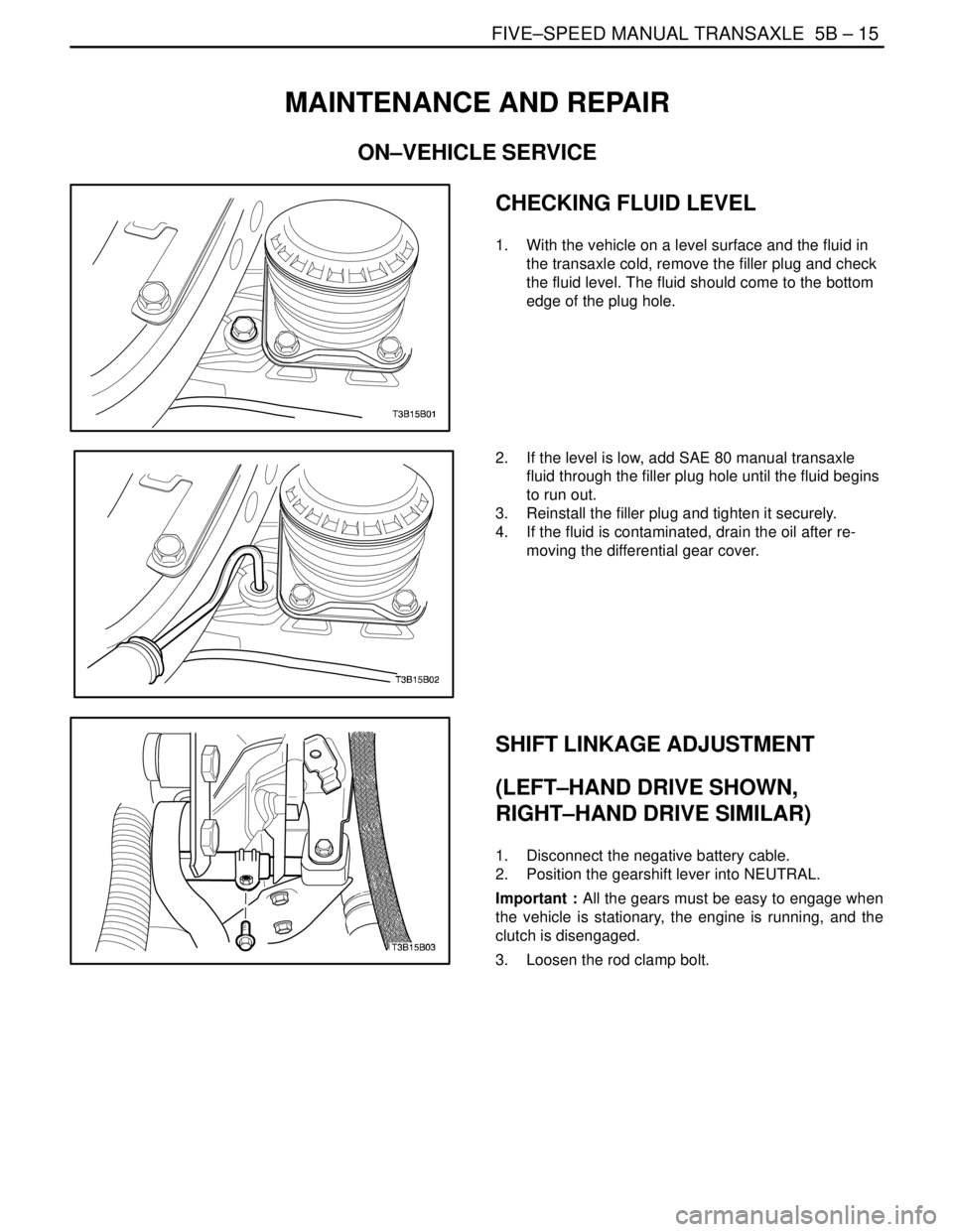
CHECKING FLUID LEVEL
1. With the vehicle on a level surface and the fluid in
the transaxle cold, remove the filler plug and check
the fluid level. The fluid should come to the bottom
edge of the plug hole.
2. If the level is low, add SAE 80 manual transaxle
fluid through the filler plug hole until the fluid begins
to run out.
3. Reinstall the filler plug and tighten it securely.
4. If the fluid is contaminated, drain the oil after re-
moving the differential gear cover.
SHIFT LINKAGE ADJUSTMENT
(LEFT–HAND DRIVE SHOWN,
RIGHT–HAND DRIVE SIMILAR)
1. Disconnect the negative battery cable.
2. Position the gearshift lever into NEUTRAL.
Important : All the gears must be easy to engage when
the vehicle is stationary, the engine is running, and the
clutch is disengaged.
3. Loosen the rod clamp bolt.
Page 1845 of 2643
FIVE–SPEED MANUAL TRANSAXLE 5B – 21
DAEWOO V–121 BL4
TRANSAXLE ASSEMBLY
Tools Required
J–28467–B Engine Support Fixture
Removal Procedure
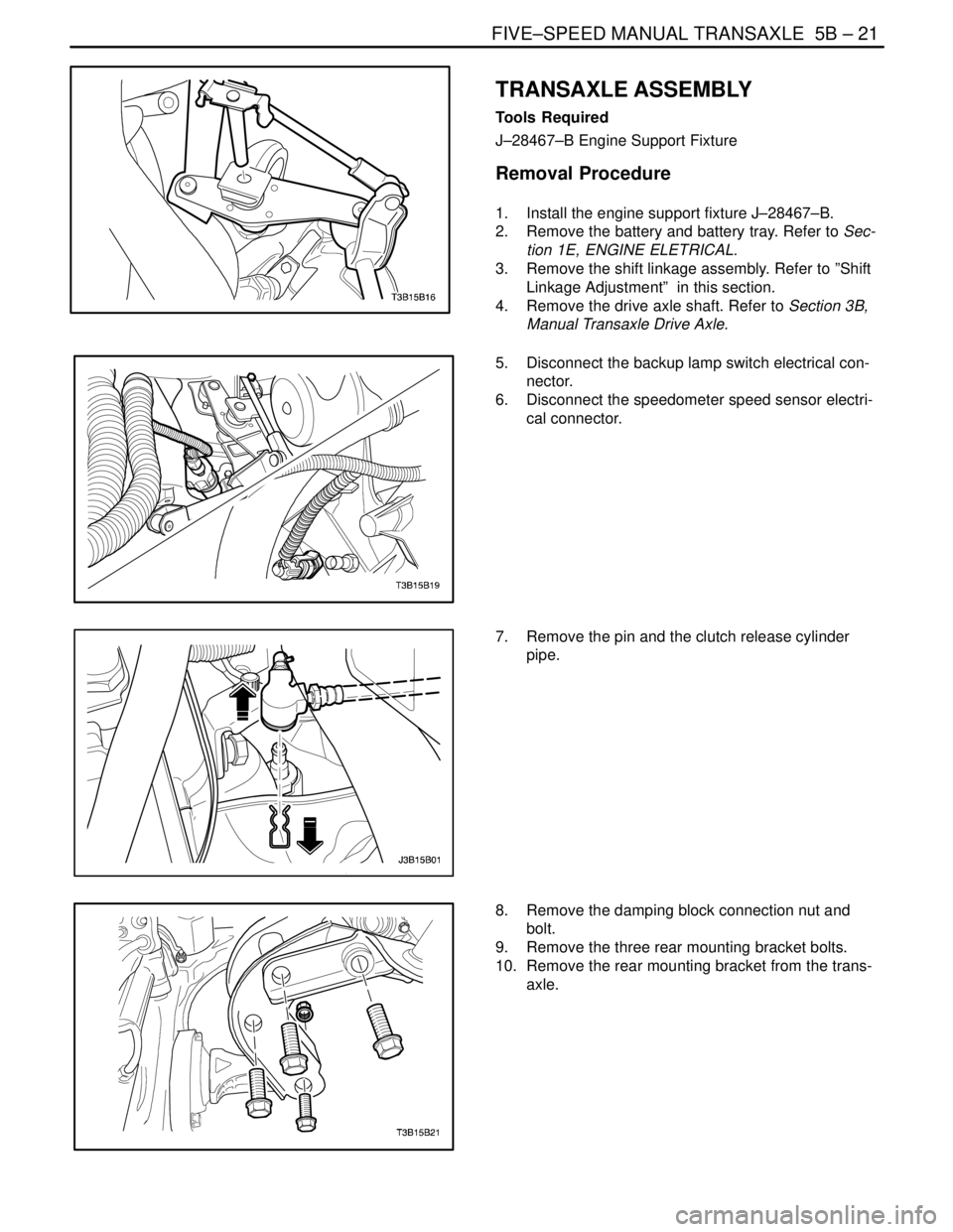
1. Install the engine support fixture J–28467–B.
2. Remove the battery and battery tray. Refer to Sec-
tion 1E, ENGINE ELETRICAL.
3. Remove the shift linkage assembly. Refer to ”Shift
Linkage Adjustment” in this section.
4. Remove the drive axle shaft. Refer to Section 3B,
Manual Transaxle Drive Axle.
5. Disconnect the backup lamp switch electrical con-
nector.
6. Disconnect the speedometer speed sensor electri-
cal connector.
7. Remove the pin and the clutch release cylinder
pipe.
8. Remove the damping block connection nut and
bolt.
9. Remove the three rear mounting bracket bolts.
10. Remove the rear mounting bracket from the trans-
axle.
Page 1847 of 2643
FIVE–SPEED MANUAL TRANSAXLE 5B – 23
DAEWOO V–121 BL4
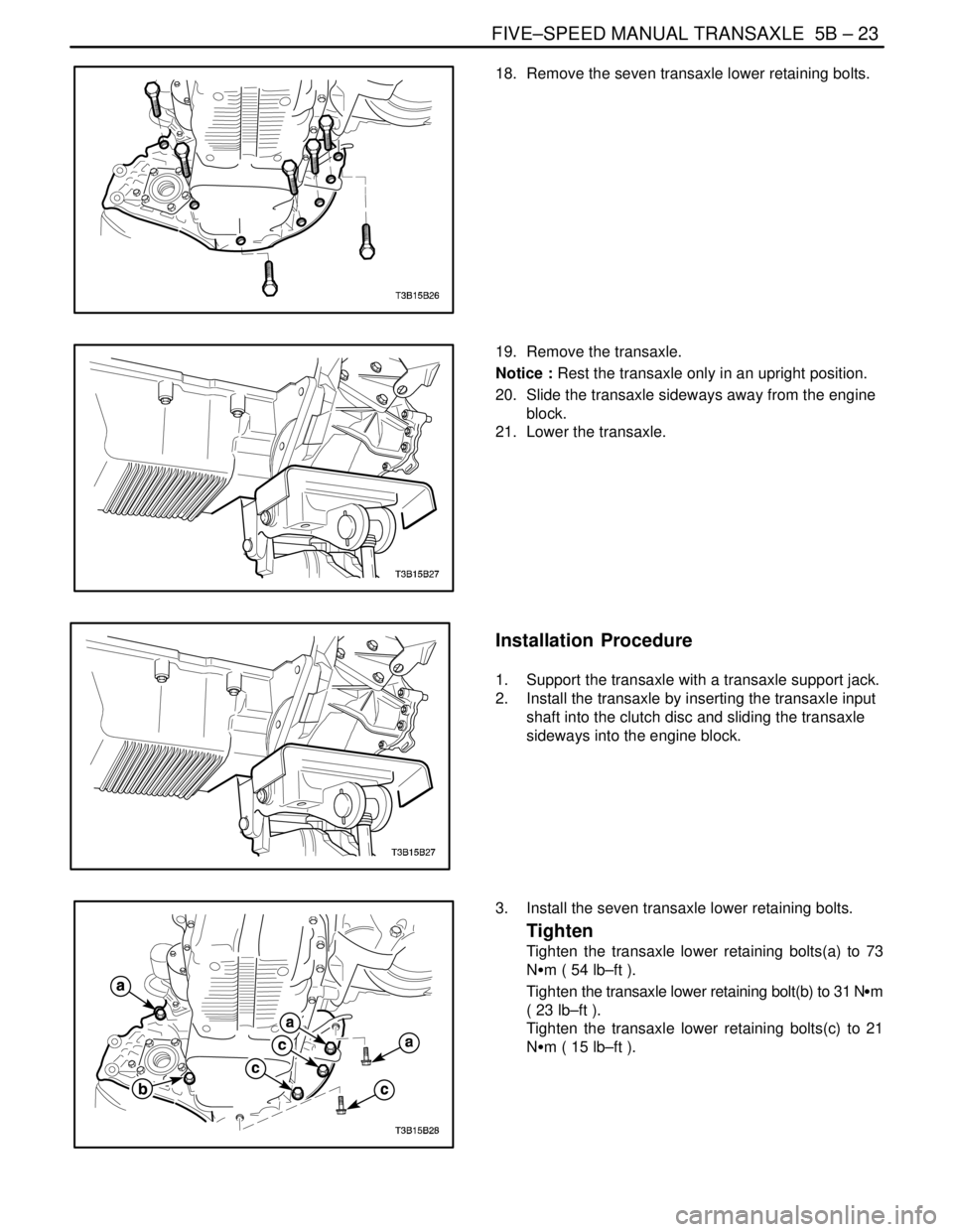
18. Remove the seven transaxle lower retaining bolts.
19. Remove the transaxle.
Notice : Rest the transaxle only in an upright position.
20. Slide the transaxle sideways away from the engine
block.
21. Lower the transaxle.
Installation Procedure
1. Support the transaxle with a transaxle support jack.
2. Install the transaxle by inserting the transaxle input
shaft into the clutch disc and sliding the transaxle
sideways into the engine block.
3. Install the seven transaxle lower retaining bolts.
Tighten
Tighten the transaxle lower retaining bolts(a) to 73
NSm ( 54 lb–ft ).
Tighten the transaxle lower retaining bolt(b) to 31 NSm
( 23 lb–ft ).
Tighten the transaxle lower retaining bolts(c) to 21
NSm ( 15 lb–ft ).
Page 1849 of 2643
FIVE–SPEED MANUAL TRANSAXLE 5B – 25
DAEWOO V–121 BL4
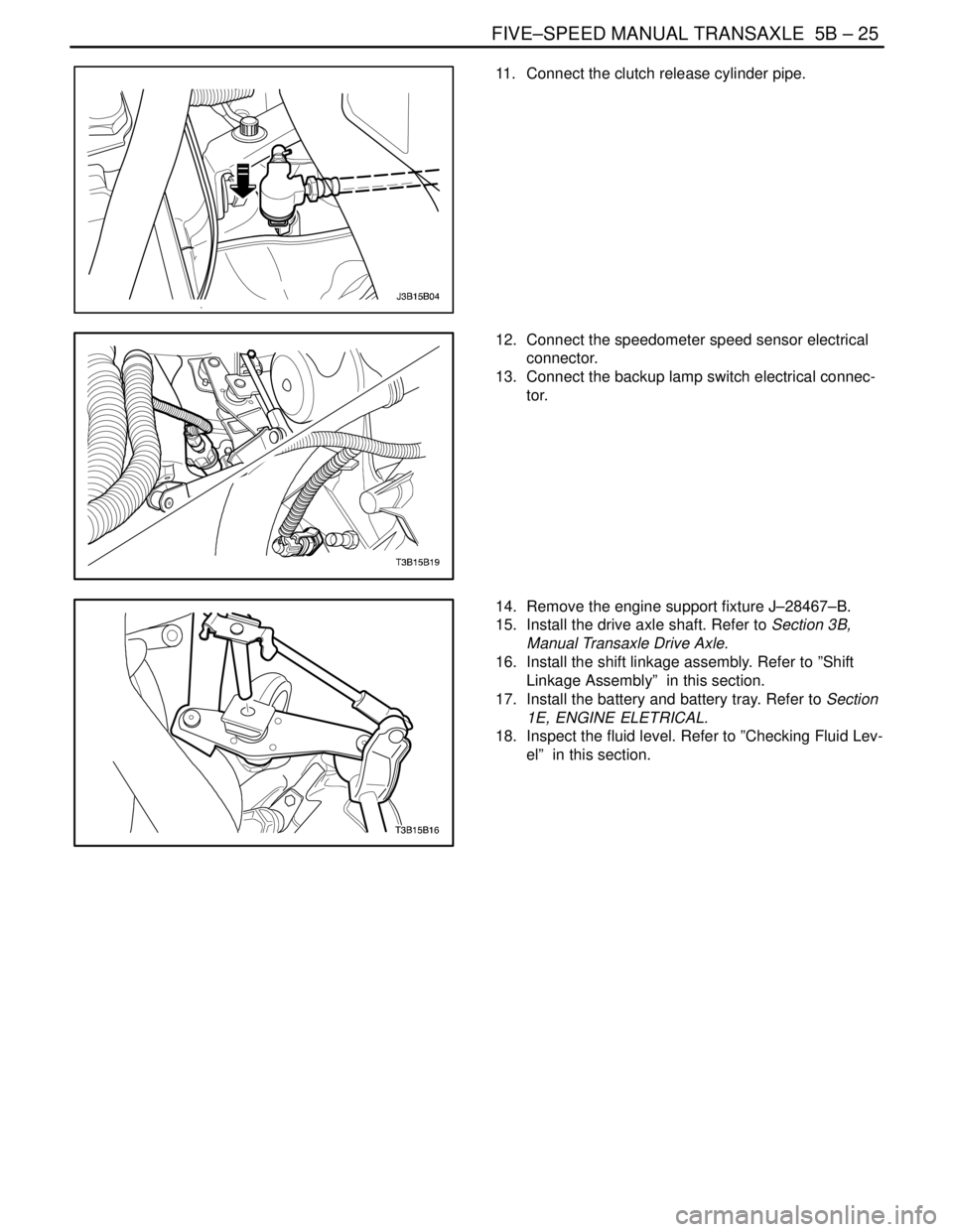
11. Connect the clutch release cylinder pipe.
12. Connect the speedometer speed sensor electrical
connector.
13. Connect the backup lamp switch electrical connec-
tor.
14. Remove the engine support fixture J–28467–B.
15. Install the drive axle shaft. Refer to Section 3B,
Manual Transaxle Drive Axle.
16. Install the shift linkage assembly. Refer to ”Shift
Linkage Assembly” in this section.
17. Install the battery and battery tray. Refer to Section
1E, ENGINE ELETRICAL.
18. Inspect the fluid level. Refer to ”Checking Fluid Lev-
el” in this section.
Page 1895 of 2643
5C – 8ICLUTCH
DAEWOO V–121 BL4
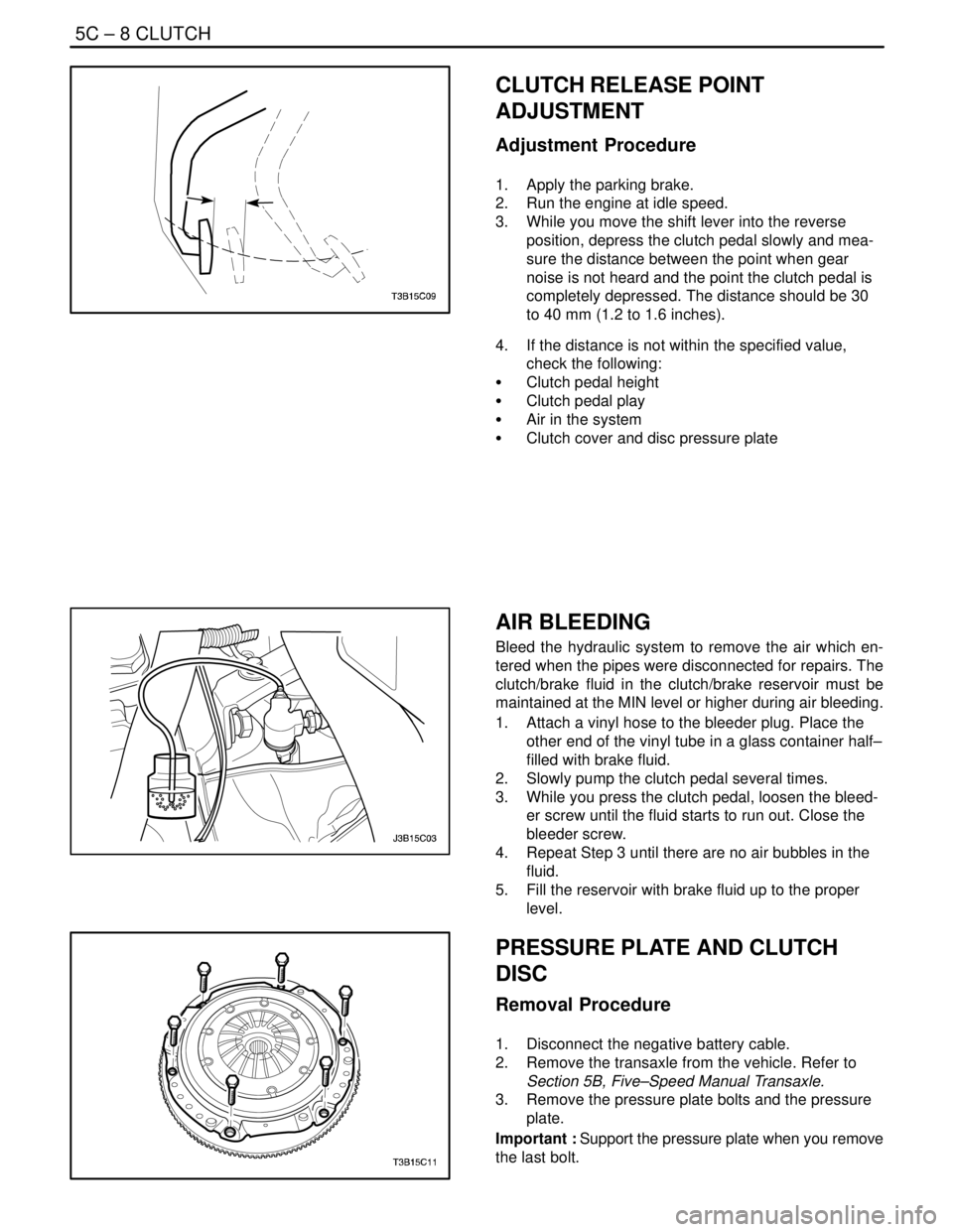
CLUTCH RELEASE POINT
ADJUSTMENT
Adjustment Procedure
1. Apply the parking brake.
2. Run the engine at idle speed.
3. While you move the shift lever into the reverse
position, depress the clutch pedal slowly and mea-
sure the distance between the point when gear
noise is not heard and the point the clutch pedal is
completely depressed. The distance should be 30
to 40 mm (1.2 to 1.6 inches).
4. If the distance is not within the specified value,
check the following:
S Clutch pedal height
S Clutch pedal play
S Air in the system
S Clutch cover and disc pressure plate
AIR BLEEDING
Bleed the hydraulic system to remove the air which en-
tered when the pipes were disconnected for repairs. The
clutch/brake fluid in the clutch/brake reservoir must be
maintained at the MIN level or higher during air bleeding.
1. Attach a vinyl hose to the bleeder plug. Place the
other end of the vinyl tube in a glass container half–
filled with brake fluid.
2. Slowly pump the clutch pedal several times.
3. While you press the clutch pedal, loosen the bleed-
er screw until the fluid starts to run out. Close the
bleeder screw.
4. Repeat Step 3 until there are no air bubbles in the
fluid.
5. Fill the reservoir with brake fluid up to the proper
level.
PRESSURE PLATE AND CLUTCH
DISC
Removal Procedure
1. Disconnect the negative battery cable.
2. Remove the transaxle from the vehicle. Refer to
Section 5B, Five–Speed Manual Transaxle.
3. Remove the pressure plate bolts and the pressure
plate.
Important : Support the pressure plate when you remove
the last bolt.
Page 1901 of 2643

5C – 14ICLUTCH
DAEWOO V–121 BL4
GENERAL DESCRIPTION
AND SYSTEM OPERATION
DRIVING MEMBERS
The driving members consist of two flat surfaces ma-
chined to a smooth finish. One of these is the rear face of
the engine flywheel and the other is the pressure plate.
The pressure plate is fitted into a steel cover which is
bolted the flywheel.
DRIVEN MEMBERS
The driven member is the clutch disc with a splined hub.The splined hub is free to slide lengthwise along the
splines of the input shaft and drives the input shaft through
these same splines.
The driving and driven members are held in contact by
spring pressure. This pressure is exerted by a diaphragm
spring in the pressure plate assembly.
OPERATING MEMBERS
The clutch release system consists of the clutch pedal, the
clutch master cylinder, and concentric slave cylinder.
Unlike the former system to release the clutch by the re-
lease lever and release fork, the concentric slave cylinder
type makes the concentric slave cylinder directly perform
the clutch release by the generated pressure through the
clutch pedal operation.
Page 1903 of 2643

6A – 2IPOWER STEERING SYSTEM
DAEWOO V–121 BL4
DIAGNOSIS
POWER STEERING SYSTEM
PRESSURE TEST
Tools Required
KM–354–B Pressure Test Gauge Kit
Check the fluid pressure as follows to determine whether
the trouble is in the pump or the gear unit.
Test Procedure
1. Check the power steering fluid level and the power
steering pump belt tension. Refer to ”Checking and
Adding Fluid” in this section and Section 6B, Power
Steering Pump.
2. Disconnect the high pressure line at the pump. Use
a small container to catch any fluid.
3. Connect the hose of the pressure test gauge kit
KM–354–B to the power steering pressure hose
from the power steering pump.
4. Place the gear selector lever in PARK (automatic
transaxle–equipped vehicles) or NEUTRAL (manual
transaxle–equipped vehicles). Set the parking
brake.
5. Open the gauge valve fully.
6. Start the engine and let it idle.
7. Turn the steering wheel from lock to lock several
times to warm the fluid to operating temperature.
8. Increase the engine speed to 1,500 rpm.
Notice : The power steering pump could be damaged if
the valve is fully closed for more than 5 seconds.
9. Close the gauge valve fully, and read the pressure.
The pump pressure with the valve closed should be
between 8,330 kPa to 8,820 kPa (1,208 psi to
1,279 psi). With electronic variable orifice, the pres-
sure should be between 8,500 kPa to 8,960 kPa
(1,233 psi to 1,299 psi).
10. Immediately open the gauge valve fully.
11. Turn the steering wheel all the way to the left and
the right. If the pressure is within the specified lim-
its, the problem is not in the pump. Check the pow-
er steering gear for leaks.
POWER STEERING SYSTEM LEAK
TEST
General Procedure
Inspect the following:
S The fluid reservoir for overfill.
S Fluid for aeration and overflow.
S The hoses for loose connections.
S The torsion bar, stub shaft and adjuster seals for
leaks.
S The component sealing surfaces for damage.
Important : Verify the exact point of the leak. The point
from which the fluid is dripping is not necessarily the point
at which the system is leaking. When service is required,
clean the leak area upon disassembly, replace the leaking
seal, check the component sealing surfaces for damage
and reset the torque bolt to specifications, where required.
External Leak Check
The purpose of this procedure is to pinpoint the location of
the leak. In some cases, the leak can be easily located, but
seepage–type leaks may be harder to find. To locate seep-
age leaks, use the following method:
1. With the engine off, wipe dry the complete power
steering system.
2. Check the power steering fluid level in the pump’s
reservoir. Adjust the fluid level as necessary. Refer
to ”Checking and Adding Fluid” in this section.
Notice : Do not hold the steering wheel at a stop for any
length of time as this can damage the power steering
pump.
3. Start the engine. Turn the steering wheel counter-
clockwise and clockwise from stop to stop several
times.
4. Find the exact area of the leak and repair it.
Page 1904 of 2643

POWER STEERING SYSTEM 6A – 3
DAEWOO V–121 BL4
MAINTENANCE AND REPAIR
ON–VEHICLE SERVICE
BLEEDING THE POWER STEERING
SYSTEM
If the power steering hydraulic system has been serviced,
an accurate fluid level reading cannot be obtained until the
air is bled from the system. Follow these steps to bleed the
air from the system.
1. Turn the wheels all the way to the left and add the
power steering fluid to the MIN mark on the fluid
level indicator.
Notice : When adding fluid or making a complete fluid
change, always use DEXRON®–II or III power steering
fluid. Failure to use the proper fluid will cause hose and
seal damage and fluid leaks.
2. Start the engine. With the engine running at fast
idle, recheck the fluid level. If necessary, add fluid
to bring the level up to the MIN mark.
3. Bleed the system by turning the wheels from side to
side without reaching the stop at either end. Keep
the fluid level at the MIN mark. The air must be
eliminated from the fluid before normal steering ac-
tion can be obtained.
4. Return the wheels to the center position. Continue
running the engine for 2 to 3 minutes.
5. Road test the car to be sure the steering functions
normally and is free from noise.
6. Recheck the fluid level as described in steps 1 and
2. Make sure the fluid level is at the MAX mark af-
ter the system has stabilized at its normal operating
temperature. Add fluid as needed.
CHECKING AND ADDING FLUID
Notice : When adding fluid or making a complete fluid
change, always use DEXRON®–II or III power steering
fluid. Failure to use the proper fluid will cause hose and
seal damage and fluid leaks.
1. The power steering fluid level is indicated either by
marks on a see–through fluid reservoir or by marks
on a fluid level indicator on the fluid reservoir cap.
2. If the fluid is warmed up to 66°C (150°F), the fluid
level should be between the MAX and MIN marks.
Add fluid as needed.
3. If the fluid is cool, 21°C (70°F), the fluid level
should be at the MIN mark. Add fluid as needed.
Page 1917 of 2643

6B – 8IPOWER STEERING PUMP
DAEWOO V–121 BL4
GENERAL DESCRIPTION
AND SYSTEM OPERATION
POWER STEERING PUMP
The power steering pump is a multivaned hydraulic pump.
The serpentine accessory drive belt on the engine drives
the power steering pump.The power steering pump provides the hydraulic pressure
to the power steering gear.
The power steering gear uses the hydraulic pressure to
assist in steering the vehicle.
The power steering system uses a remote reservoir in or-
der to make available more space in the engine compart-
ment.
Page 1919 of 2643
6C – 2IPOWER STEERING GEAR
DAEWOO V–121 BL4
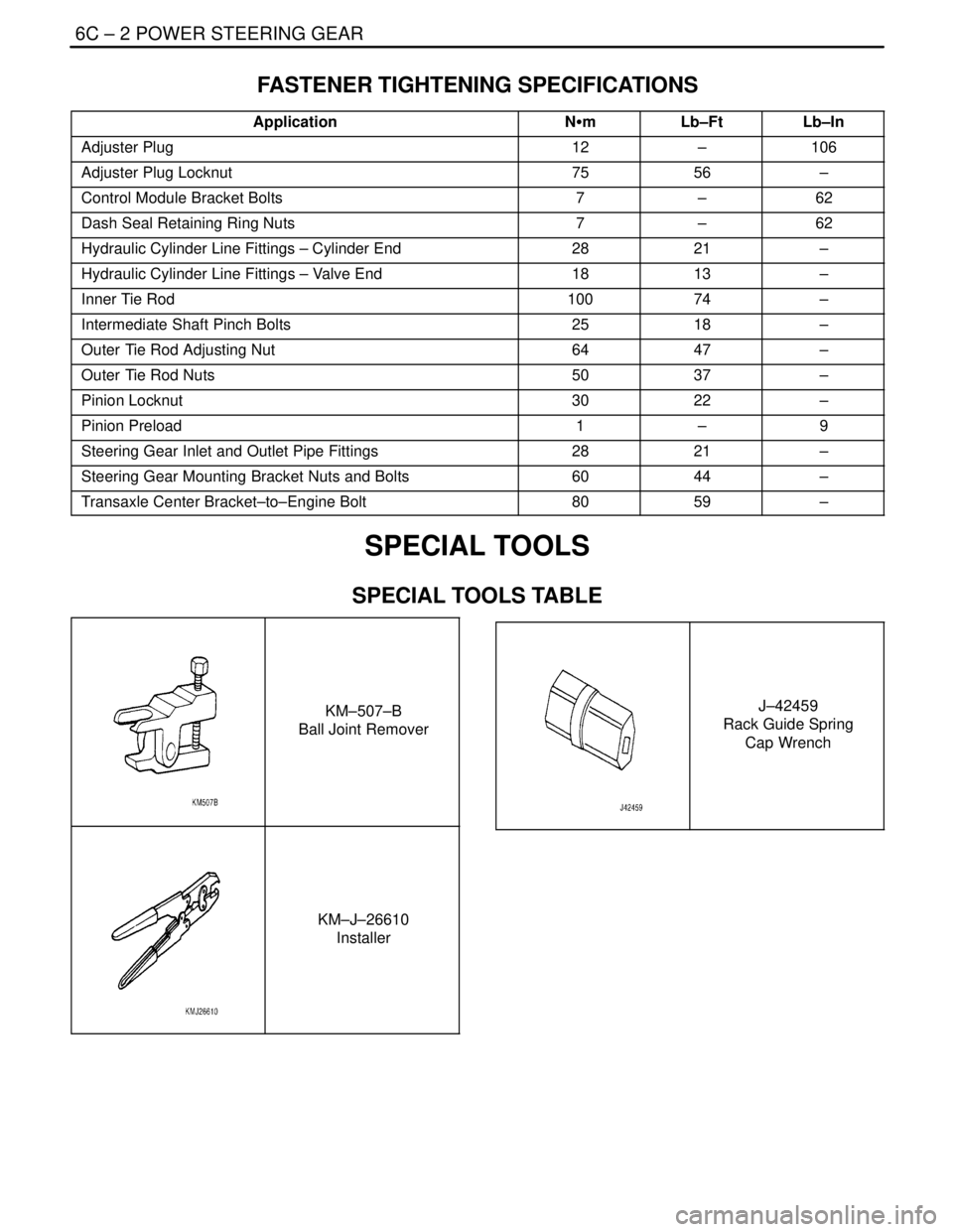
FASTENER TIGHTENING SPECIFICATIONS
ApplicationNSmLb–FtLb–In
Adjuster Plug12–106
Adjuster Plug Locknut7556–
Control Module Bracket Bolts7–62
Dash Seal Retaining Ring Nuts7–62
Hydraulic Cylinder Line Fittings – Cylinder End2821–
Hydraulic Cylinder Line Fittings – Valve End1813–
Inner Tie Rod10074–
Intermediate Shaft Pinch Bolts2518–
Outer Tie Rod Adjusting Nut6447–
Outer Tie Rod Nuts5037–
Pinion Locknut3022–
Pinion Preload1–9
Steering Gear Inlet and Outlet Pipe Fittings2821–
Steering Gear Mounting Bracket Nuts and Bolts6044–
Transaxle Center Bracket–to–Engine Bolt8059–
SPECIAL TOOLS
SPECIAL TOOLS TABLE
KM–507–B
Ball Joint Remover
KM–J–26610
Installer
J–42459
Rack Guide Spring
Cap Wrench