check engine DAEWOO NUBIRA 2004 Service User Guide
[x] Cancel search | Manufacturer: DAEWOO, Model Year: 2004, Model line: NUBIRA, Model: DAEWOO NUBIRA 2004Pages: 2643, PDF Size: 80.54 MB
Page 39 of 2643

GENERAL ENGINE INFORMATION 1A – 7
DAEWOO V–121 BL4
Knocks at Idle Hot
StepActionValue(s)YesNo
1Does the engine knock at idle when hot?–Go to Step 2System OK
2Inspect the drive belts.
Are the belts loose or worn?–Go to Step 3Go to Step 4
3Tension or replace the belts, as necessary.
Is the repair complete?–Go to Step 1–
4Inspect the A/C compressor and the generator.
Is either the compressor or the generator faulty?–Go to Step 5Go to Step 6
5Replace the faulty A/C compressor or the generator.
Is the repair complete?–Go to Step 1–
6Inspect the valve train.
Are valve train components faulty?–Go to Step 7Go to Step 8
7Replace the faulty valve train components.
Is the repair complete?–Go to Step 1–
8Check the engine oil.
Is the proper viscosity oil used in the crankcase?–Go to Step 10Go to Step 9
9Install oil of the proper viscosity for the expected
seasonal temperatures.
Is the repair complete?–Go to Step 1–
10Inspect the piston pin clearance.
Is the clearance more than the specified value?0.020 mm
(0.0008 in.)Go to Step 11Go to Step 12
11Replace the piston and the pin.
Is the repair complete?–Go to Step 1–
12Check the connecting rod alignment.
Is the alignment faulty?–Go to Step 13Go to Step 14
13Check and replace rods, as necessary.
Is the repair complete?–Go to Step 1–
14Inspect the piston–to–bore clearance.
Is the clearance within the specified value?0.030 mm
(0.0012 in.)Go to Step 16Go to Step 15
15Hone the bore and fit a new piston.
Is the repair complete?Go to Step 1–
16Inspect the crankshaft balancer.
Is the balancer loose?–Go to Step 17Go to Step 18
17Torque or replace worn parts.
Is the repair complete?–Go to Step 1–
18Check the piston pin offset.
Is the offset at the specified value?0.5 ± 0.1 mm
(0.020 ~ 0.003
in.)
Toward Thrust
SideGo to Step 19System OK
19Install the correct piston.
Is the repair complete?–Go to Step 1–
Page 40 of 2643

1A – 8IGENERAL ENGINE INFORMATION
DAEWOO V–121 BL4
NOISE DIAGNOSIS
Main Bearing Noise
StepActionValue(s)YesNo
1Are dull thuds or knocks heard with every engine
revolution?–Go to Step 2System OK
2Check the oil pump pressure.
Is the oil pump pressure low?–Go to Oil Pres-
sure TestGo to Step 3
3Inspect the crankshaft end play.
Does the crankshaft end play exceed the specified
value?0.1 mm
(0.0039 in.)Go to Crank-
shaft Replace-
ment Proce-
dureGo to Step 4
4Inspect the crankshaft journals.
Are the crankshaft journals out–of–round?0.004 mm
(0.0002 in.)
max.Go to Crank-
shaft Replace-
ment Proce-
dureGo to Step 5
5Inspect the belt tension.
Does the belt tension exceed the specified value?–Go to Timing
Belt Replace-
ment Proce-
dureGo to Step 6
6Inspect the crankshaft pulley.
Is the crankshaft pulley loose?–Go to Crank-
shaft Replace-
ment Proce-
dureSystem OK
Connecting Rod Bearing Noise Symptom
StepActionValue(s)YesNo
1Is a knock noise heard under all engine speeds?–Go to Step 2System OK
2Inspect the crankshaft connecting rod journal.
Is the crankshaft connecting rod journal worn?–Go to Crank-
shaft Replace-
ment Proce-
dureGo to Step 3
3Check the oil pump pressure.
Is the oil pump pressure low?–Go to Oil Pres-
sure TestGo to Step 4
4Inspect the crankshaft connecting rod journals.
Are the journals out–of–round?–Go to Crank-
shaft Replace-
ment Proce-
dureGo to Step 5
5Inspect the connecting rods.
Is there a misaligned connecting rod?–Go to Pistons
and Rods Re-
placement Pro-
cedureGo to Step 6
6Inspect the connecting rod bolts.
Are the connecting rod bolts torqued properly?–System OKGo to Pistons
and Rods Re-
placement Pro-
cedure
Page 42 of 2643

1A – 10IGENERAL ENGINE INFORMATION
DAEWOO V–121 BL4
Valve Mechanism or Valve Train Noises
StepActionValue(s)YesNo
1Is a light tapping sound heard from the engine?–Go to Step 2System OK
2Inspect the valve springs.
Are the springs weak or broken?–Go to Cylinder
Head and
Valve Train
Components
Replacement
ProcedureGo to Step 3
3Inspect the valves.
Are the valves sticking or warped?–Go to Cylinder
Head and
Valve Train
Components
Replacement
ProcedureGo to Step 4
4Inspect the valve lifters.
Are the valve lifters dirty, stuck or worn?–Go to Cylinder
Head and
Valve Train
Components
Replacement
ProcedureGo to Step 5
5Inspect the camshaft lobes.
Are the camshaft lobes damaged or improperly ma-
chined?–Go to Cam-
shaft Replace-
ment Proce-
dureGo to Step 6
6Check the oil supply to the valve train.
Is the oil supply insufficient or poor?–Go to Cylinder
Head and
Valve Train
Components
Replacement
ProcedureGo to Step 7
7Inspect the valve guides.
Are the valve guides worn?–Go to Cylinder
Head and
Valve Train
Components
Replacement
ProcedureGo to Step 8
8Inspect the valve spring seat.
Is the valve spring seat incorrect?–Go to Cylinder
Head and
Valve Train
Components
Replacement
ProcedureSystem OK
Page 44 of 2643

SECTION : 1C1
1.4L/1.6L DOHC ENGINE MECHANICAL
CAUTION : Disconnect the negative battery cable before removing or installing any electrical unit or when a tool
or equipment could easily come in contact with exposed electrical terminals. Disconnecting this cable will help
prevent personal injury and damage to the vehicle. The ignition must also be in LOCK unless otherwise noted.
TABLE OF CONTENTS
SPECIFICATIONS1C1–2 . . . . . . . . . . . . . . . . . . . . . . . . .
Engine Specifications 1C1–2. . . . . . . . . . . . . . . . . . . . .
Fastener Tightening Specifcations 1C1–5. . . . . . . . . .
SPECIAL TOOLS1C1–7 . . . . . . . . . . . . . . . . . . . . . . . . . .
Special Tools Table 1C1–7. . . . . . . . . . . . . . . . . . . . . . .
COMPONENT LOCATOR1C1–9 . . . . . . . . . . . . . . . . . . .
Cylinder Head 1C1–9. . . . . . . . . . . . . . . . . . . . . . . . . . . .
Cylinder Block 1C1–10. . . . . . . . . . . . . . . . . . . . . . . . . . .
Intake & Exhaust Manifold 1C1–12. . . . . . . . . . . . . . . .
Timing Belt 1C1–13. . . . . . . . . . . . . . . . . . . . . . . . . . . . .
Engine Mounting 1C1–14. . . . . . . . . . . . . . . . . . . . . . . .
MAINTENANCE AND REPAIR1C1–15 . . . . . . . . . . . . .
ON–VEHICLE SERVICE 1C1–15. . . . . . . . . . . . . . . . . . .
Engine Cover 1C1–15. . . . . . . . . . . . . . . . . . . . . . . . . . .
Camshaft Cover 1C1–15. . . . . . . . . . . . . . . . . . . . . . . . .
Intake Manifold 1C1–16. . . . . . . . . . . . . . . . . . . . . . . . . .
Exhaust Manifold 1C1–20. . . . . . . . . . . . . . . . . . . . . . . .
Cylinder Head and Gasket 1C1–21. . . . . . . . . . . . . . . .
Camshaft 1C1–29. . . . . . . . . . . . . . . . . . . . . . . . . . . . . . .
Timing Belt Check and Adjust 1C1–30. . . . . . . . . . . . .
Timing Belt 1C1–34. . . . . . . . . . . . . . . . . . . . . . . . . . . . . Oil Pan 1C1–38. . . . . . . . . . . . . . . . . . . . . . . . . . . . . . . . .
Oil Pump 1C1–40. . . . . . . . . . . . . . . . . . . . . . . . . . . . . . .
Engine Mount 1C1–43. . . . . . . . . . . . . . . . . . . . . . . . . . .
Camshaft Gears 1C1–45. . . . . . . . . . . . . . . . . . . . . . . . .
Rear Timing Belt Cover 1C1–46. . . . . . . . . . . . . . . . . . .
Engine 1C1–48. . . . . . . . . . . . . . . . . . . . . . . . . . . . . . . . .
Pistons and Rods 1C1–53. . . . . . . . . . . . . . . . . . . . . . . .
UNIT REPAIR 1C1–58. . . . . . . . . . . . . . . . . . . . . . . . . . . .
Cylinder Head and Valve Train Components 1C1–58.
Crankshaft 1C1–65. . . . . . . . . . . . . . . . . . . . . . . . . . . . . .
Crankshaft Bearing and Connecting Rod
Beadings – Gauging Plastics 1C1–74. . . . . . . . . . . .
GENERAL DESCRIPTION AND SYSTEM
OPERATION1C1–77 . . . . . . . . . . . . . . . . . . . . . . . . . . . .
Cylinder Head and Gasket 1C1–77. . . . . . . . . . . . . . . .
Crankshaft 1C1–77. . . . . . . . . . . . . . . . . . . . . . . . . . . . . .
Timing Belt 1C1–77. . . . . . . . . . . . . . . . . . . . . . . . . . . . .
Oil Pump 1C1–77. . . . . . . . . . . . . . . . . . . . . . . . . . . . . . .
Oil Pan 1C1–77. . . . . . . . . . . . . . . . . . . . . . . . . . . . . . . . .
Exhaust Manifold 1C1–77. . . . . . . . . . . . . . . . . . . . . . . .
Intake Manifold 1C1–77. . . . . . . . . . . . . . . . . . . . . . . . . .
Camshaft 1C1–77. . . . . . . . . . . . . . . . . . . . . . . . . . . . . . .
Page 71 of 2643
1C1 – 28I1.4L/1.6L DOHC ENGINE MECHANICAL
DAEWOO V–121 BL4
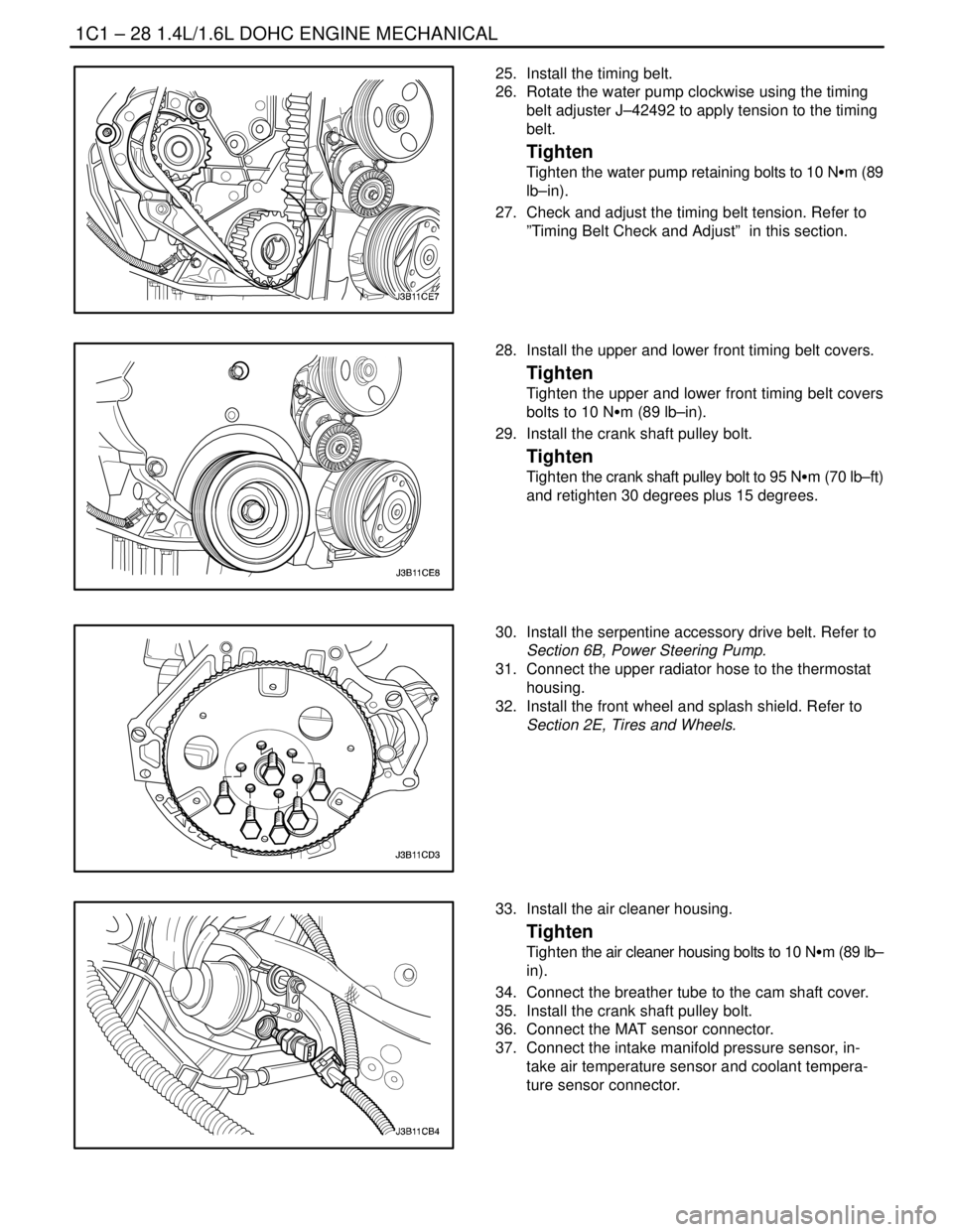
25. Install the timing belt.
26. Rotate the water pump clockwise using the timing
belt adjuster J–42492 to apply tension to the timing
belt.
Tighten
Tighten the water pump retaining bolts to 10 NSm (89
lb–in).
27. Check and adjust the timing belt tension. Refer to
”Timing Belt Check and Adjust” in this section.
28. Install the upper and lower front timing belt covers.
Tighten
Tighten the upper and lower front timing belt covers
bolts to 10 NSm (89 lb–in).
29. Install the crank shaft pulley bolt.
Tighten
Tighten the crank shaft pulley bolt to 95 NSm (70 lb–ft)
and retighten 30 degrees plus 15 degrees.
30. Install the serpentine accessory drive belt. Refer to
Section 6B, Power Steering Pump.
31. Connect the upper radiator hose to the thermostat
housing.
32. Install the front wheel and splash shield. Refer to
Section 2E, Tires and Wheels.
33. Install the air cleaner housing.
Tighten
Tighten the air cleaner housing bolts to 10 NSm (89 lb–
in).
34. Connect the breather tube to the cam shaft cover.
35. Install the crank shaft pulley bolt.
36. Connect the MAT sensor connector.
37. Connect the intake manifold pressure sensor, in-
take air temperature sensor and coolant tempera-
ture sensor connector.
Page 74 of 2643
1.4L/1.6L DOHC ENGINE MECHANICAL 1C1 – 31
DAEWOO V–121 BL4
TIMING BELT CHECK AND ADJUST
Tools Required
J–42492 Timing Belt Adjuster
KM–470–B Angular Torque Gauge
Adjustment Procedure
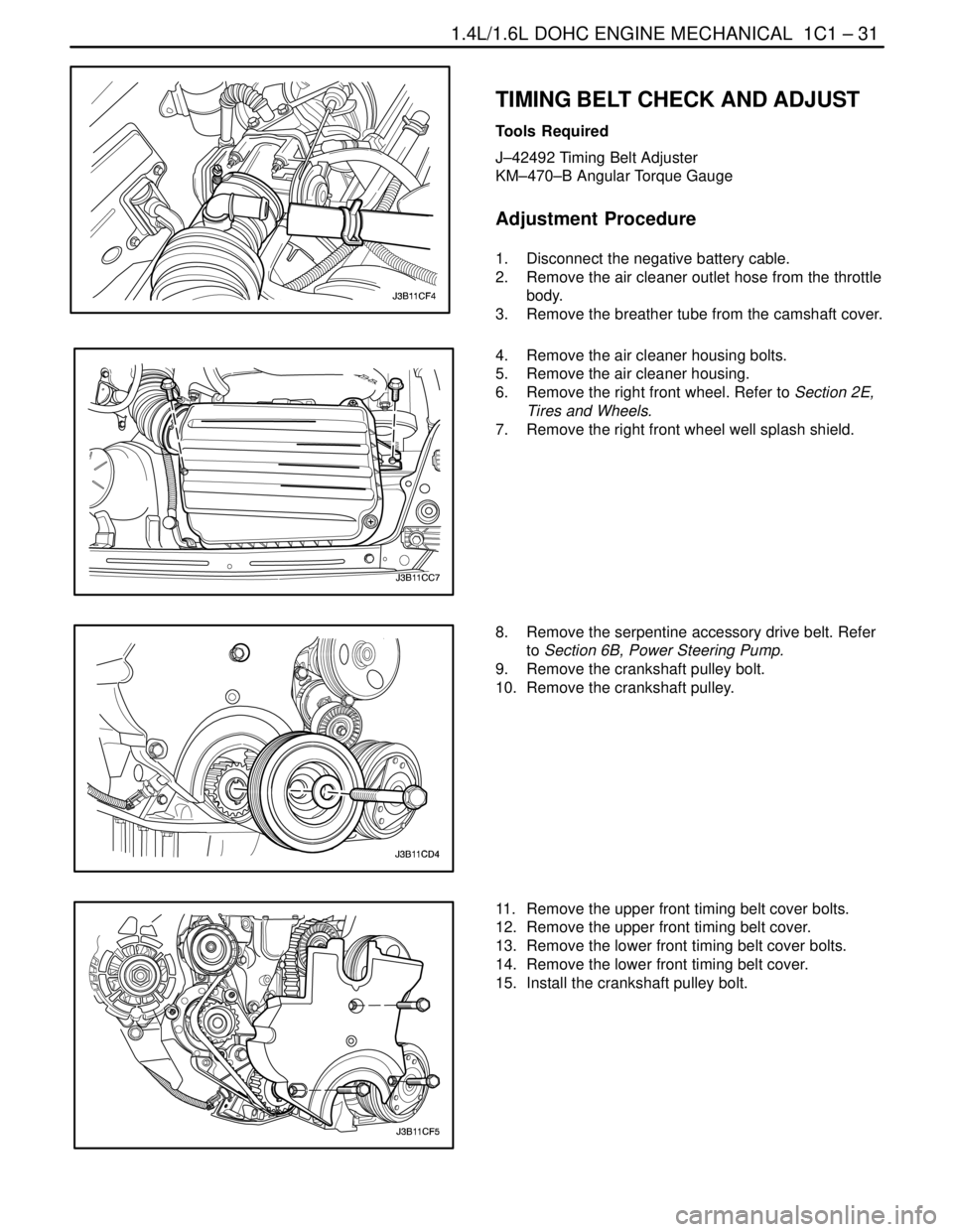
1. Disconnect the negative battery cable.
2. Remove the air cleaner outlet hose from the throttle
body.
3. Remove the breather tube from the camshaft cover.
4. Remove the air cleaner housing bolts.
5. Remove the air cleaner housing.
6. Remove the right front wheel. Refer to Section 2E,
Tires and Wheels.
7. Remove the right front wheel well splash shield.
8. Remove the serpentine accessory drive belt. Refer
to Section 6B, Power Steering Pump.
9. Remove the crankshaft pulley bolt.
10. Remove the crankshaft pulley.
11. Remove the upper front timing belt cover bolts.
12. Remove the upper front timing belt cover.
13. Remove the lower front timing belt cover bolts.
14. Remove the lower front timing belt cover.
15. Install the crankshaft pulley bolt.
Page 83 of 2643
1C1 – 40I1.4L/1.6L DOHC ENGINE MECHANICAL
DAEWOO V–121 BL4
OIL PUMP
Tools Required
KM–498–B Pressure Gauge
KM–135 Adapter
Engine Oil Pressure Inspection Procedure
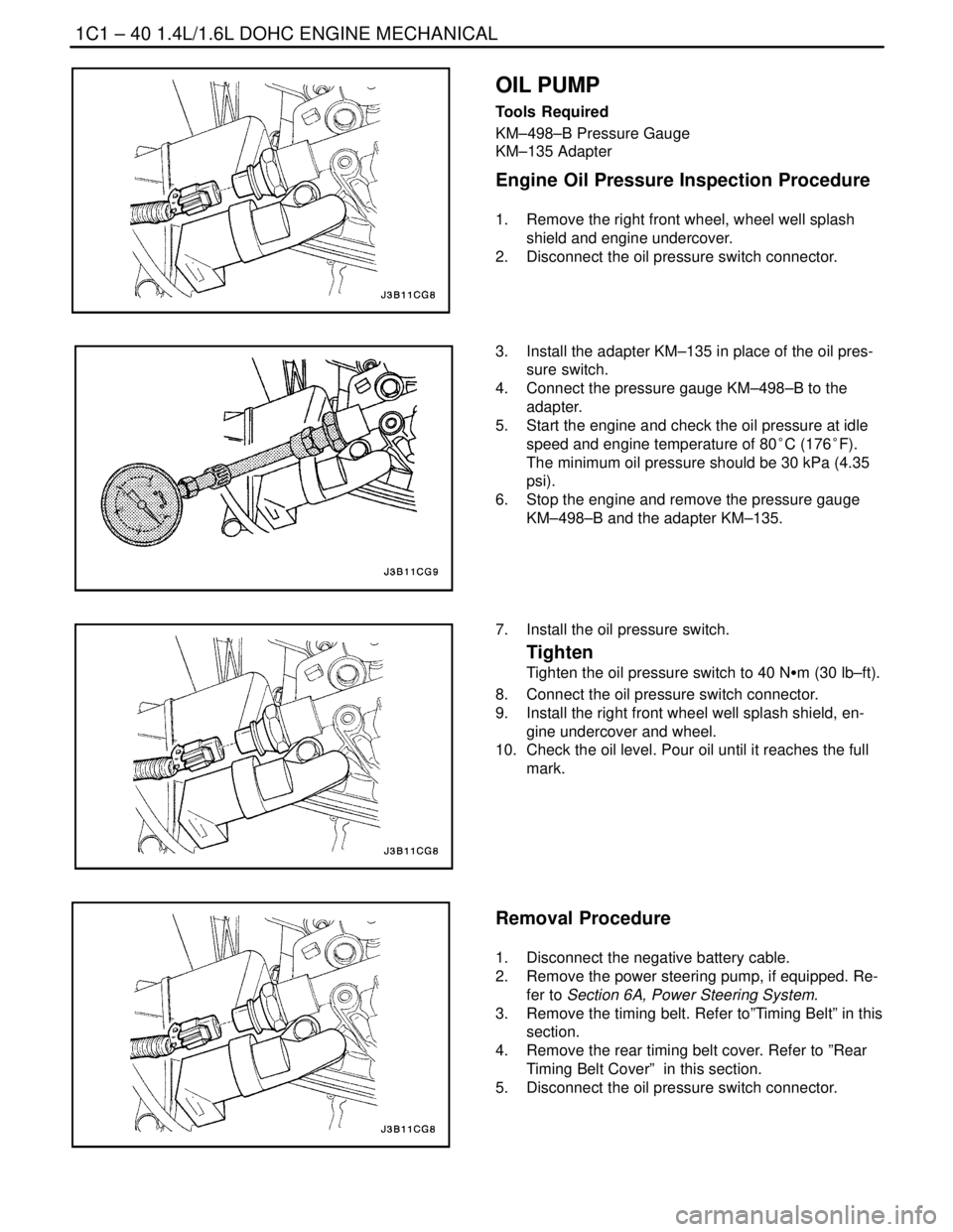
1. Remove the right front wheel, wheel well splash
shield and engine undercover.
2. Disconnect the oil pressure switch connector.
3. Install the adapter KM–135 in place of the oil pres-
sure switch.
4. Connect the pressure gauge KM–498–B to the
adapter.
5. Start the engine and check the oil pressure at idle
speed and engine temperature of 80°C (176°F).
The minimum oil pressure should be 30 kPa (4.35
psi).
6. Stop the engine and remove the pressure gauge
KM–498–B and the adapter KM–135.
7. Install the oil pressure switch.
Tighten
Tighten the oil pressure switch to 40 NSm (30 lb–ft).
8. Connect the oil pressure switch connector.
9. Install the right front wheel well splash shield, en-
gine undercover and wheel.
10. Check the oil level. Pour oil until it reaches the full
mark.
Removal Procedure
1. Disconnect the negative battery cable.
2. Remove the power steering pump, if equipped. Re-
fer to Section 6A, Power Steering System.
3. Remove the timing belt. Refer to”Timing Belt” in this
section.
4. Remove the rear timing belt cover. Refer to ”Rear
Timing Belt Cover” in this section.
5. Disconnect the oil pressure switch connector.
Page 103 of 2643
1C1 – 60I1.4L/1.6L DOHC ENGINE MECHANICAL
DAEWOO V–121 BL4
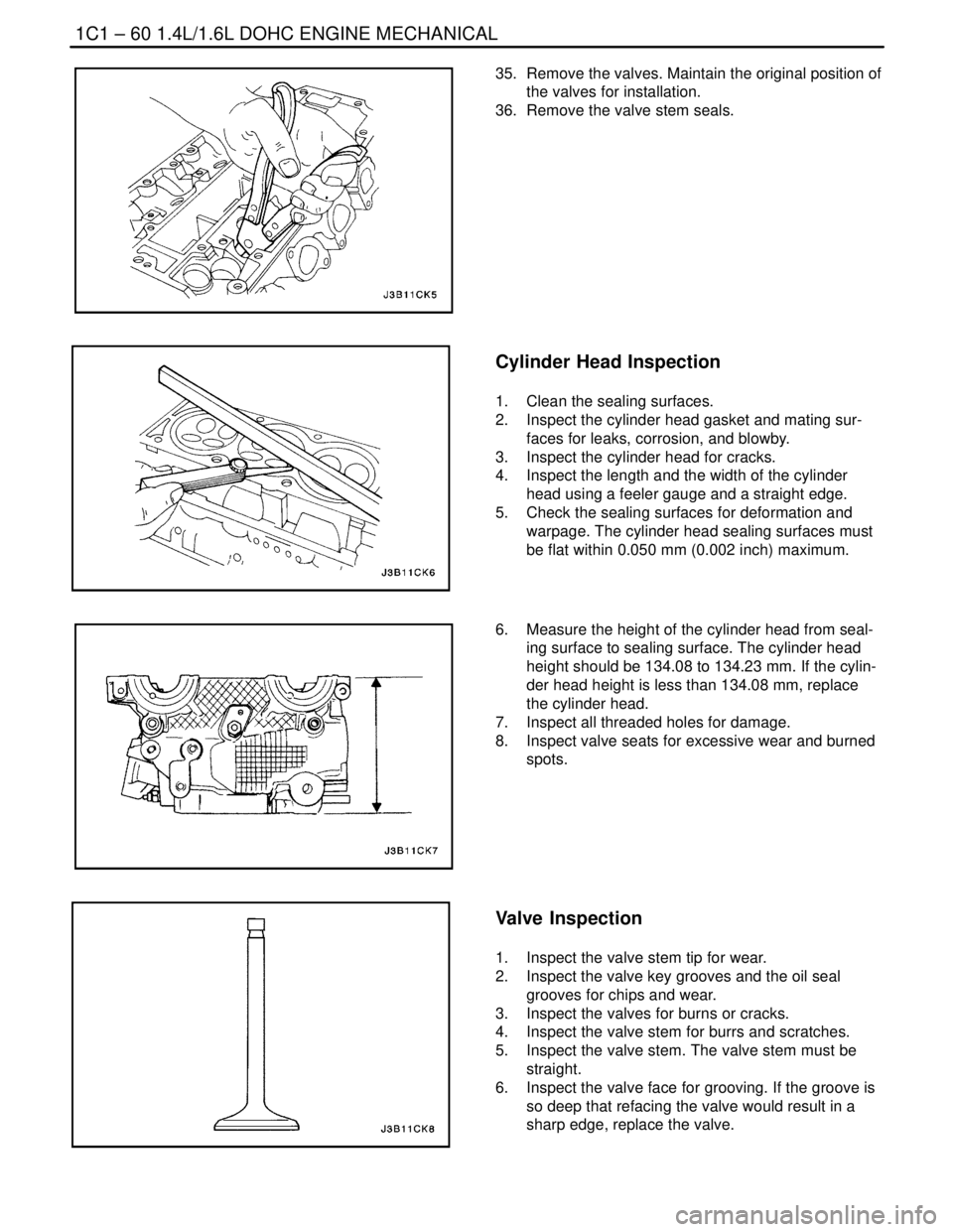
35. Remove the valves. Maintain the original position of
the valves for installation.
36. Remove the valve stem seals.
Cylinder Head Inspection
1. Clean the sealing surfaces.
2. Inspect the cylinder head gasket and mating sur-
faces for leaks, corrosion, and blowby.
3. Inspect the cylinder head for cracks.
4. Inspect the length and the width of the cylinder
head using a feeler gauge and a straight edge.
5. Check the sealing surfaces for deformation and
warpage. The cylinder head sealing surfaces must
be flat within 0.050 mm (0.002 inch) maximum.
6. Measure the height of the cylinder head from seal-
ing surface to sealing surface. The cylinder head
height should be 134.08 to 134.23 mm. If the cylin-
der head height is less than 134.08 mm, replace
the cylinder head.
7. Inspect all threaded holes for damage.
8. Inspect valve seats for excessive wear and burned
spots.
Valve Inspection
1. Inspect the valve stem tip for wear.
2. Inspect the valve key grooves and the oil seal
grooves for chips and wear.
3. Inspect the valves for burns or cracks.
4. Inspect the valve stem for burrs and scratches.
5. Inspect the valve stem. The valve stem must be
straight.
6. Inspect the valve face for grooving. If the groove is
so deep that refacing the valve would result in a
sharp edge, replace the valve.
Page 104 of 2643
1.4L/1.6L DOHC ENGINE MECHANICAL 1C1 – 61
DAEWOO V–121 BL4
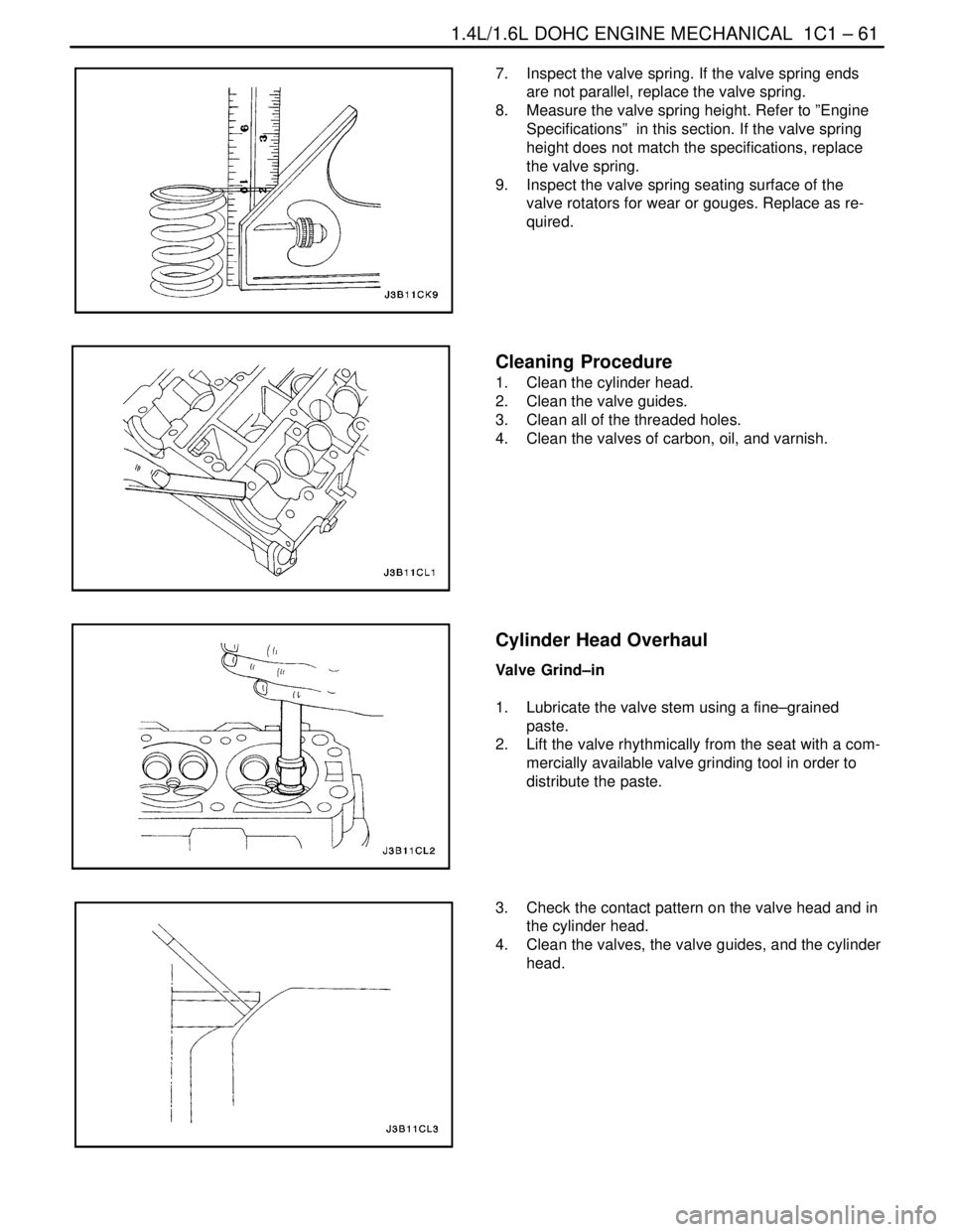
7. Inspect the valve spring. If the valve spring ends
are not parallel, replace the valve spring.
8. Measure the valve spring height. Refer to ”Engine
Specifications” in this section. If the valve spring
height does not match the specifications, replace
the valve spring.
9. Inspect the valve spring seating surface of the
valve rotators for wear or gouges. Replace as re-
quired.
Cleaning Procedure
1. Clean the cylinder head.
2. Clean the valve guides.
3. Clean all of the threaded holes.
4. Clean the valves of carbon, oil, and varnish.
Cylinder Head Overhaul
Valve Grind–in
1. Lubricate the valve stem using a fine–grained
paste.
2. Lift the valve rhythmically from the seat with a com-
mercially available valve grinding tool in order to
distribute the paste.
3. Check the contact pattern on the valve head and in
the cylinder head.
4. Clean the valves, the valve guides, and the cylinder
head.
Page 112 of 2643
1.4L/1.6L DOHC ENGINE MECHANICAL 1C1 – 69
DAEWOO V–121 BL4
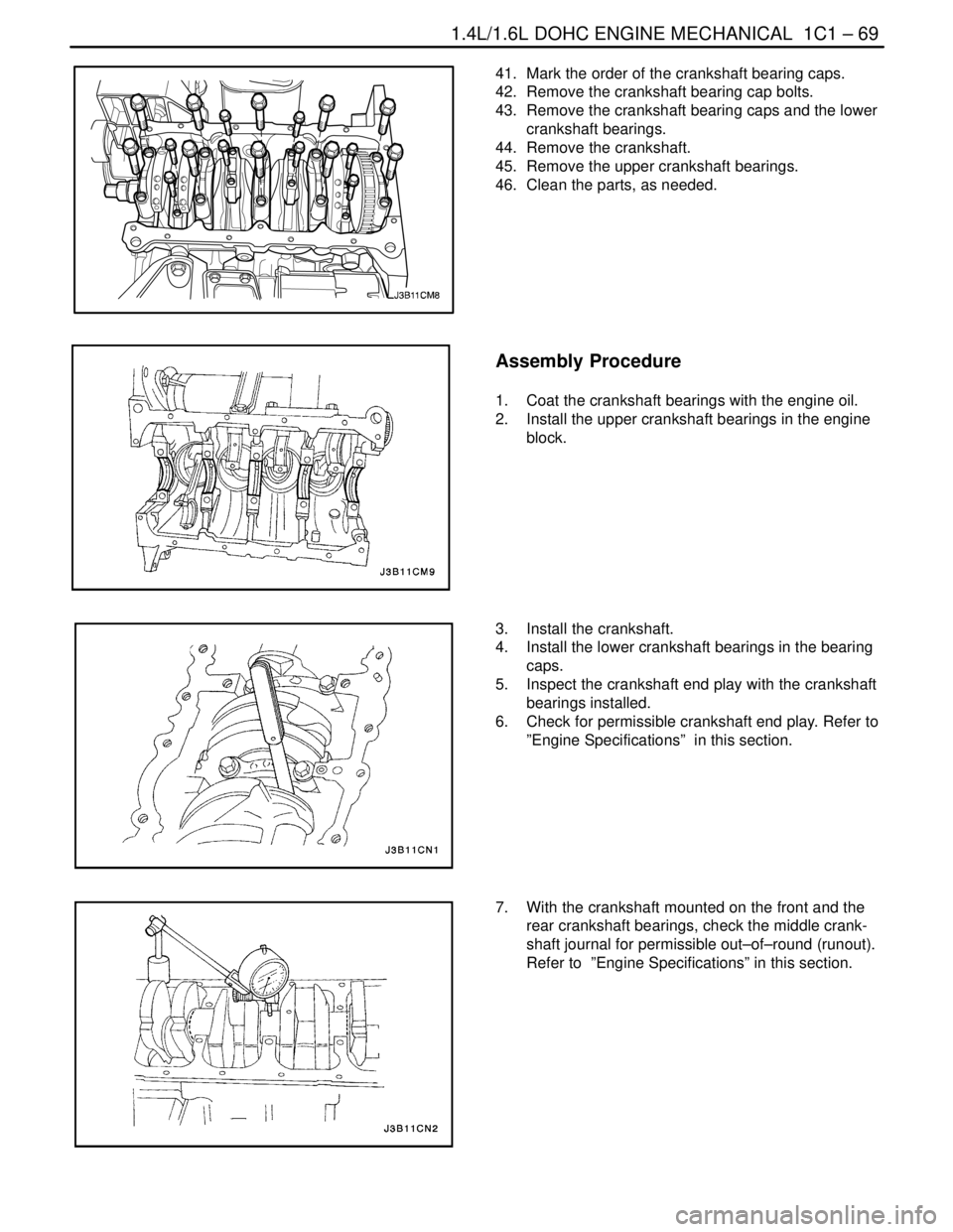
41. Mark the order of the crankshaft bearing caps.
42. Remove the crankshaft bearing cap bolts.
43. Remove the crankshaft bearing caps and the lower
crankshaft bearings.
44. Remove the crankshaft.
45. Remove the upper crankshaft bearings.
46. Clean the parts, as needed.
Assembly Procedure
1. Coat the crankshaft bearings with the engine oil.
2. Install the upper crankshaft bearings in the engine
block.
3. Install the crankshaft.
4. Install the lower crankshaft bearings in the bearing
caps.
5. Inspect the crankshaft end play with the crankshaft
bearings installed.
6. Check for permissible crankshaft end play. Refer to
”Engine Specifications” in this section.
7. With the crankshaft mounted on the front and the
rear crankshaft bearings, check the middle crank-
shaft journal for permissible out–of–round (runout).
Refer to ”Engine Specifications” in this section.