fuse DAEWOO NUBIRA 2004 Service User Guide
[x] Cancel search | Manufacturer: DAEWOO, Model Year: 2004, Model line: NUBIRA, Model: DAEWOO NUBIRA 2004Pages: 2643, PDF Size: 80.54 MB
Page 158 of 2643
1C2 – 38I1.8L DOHC ENGINE MECHANICAL
DAEWOO V–121 BL4
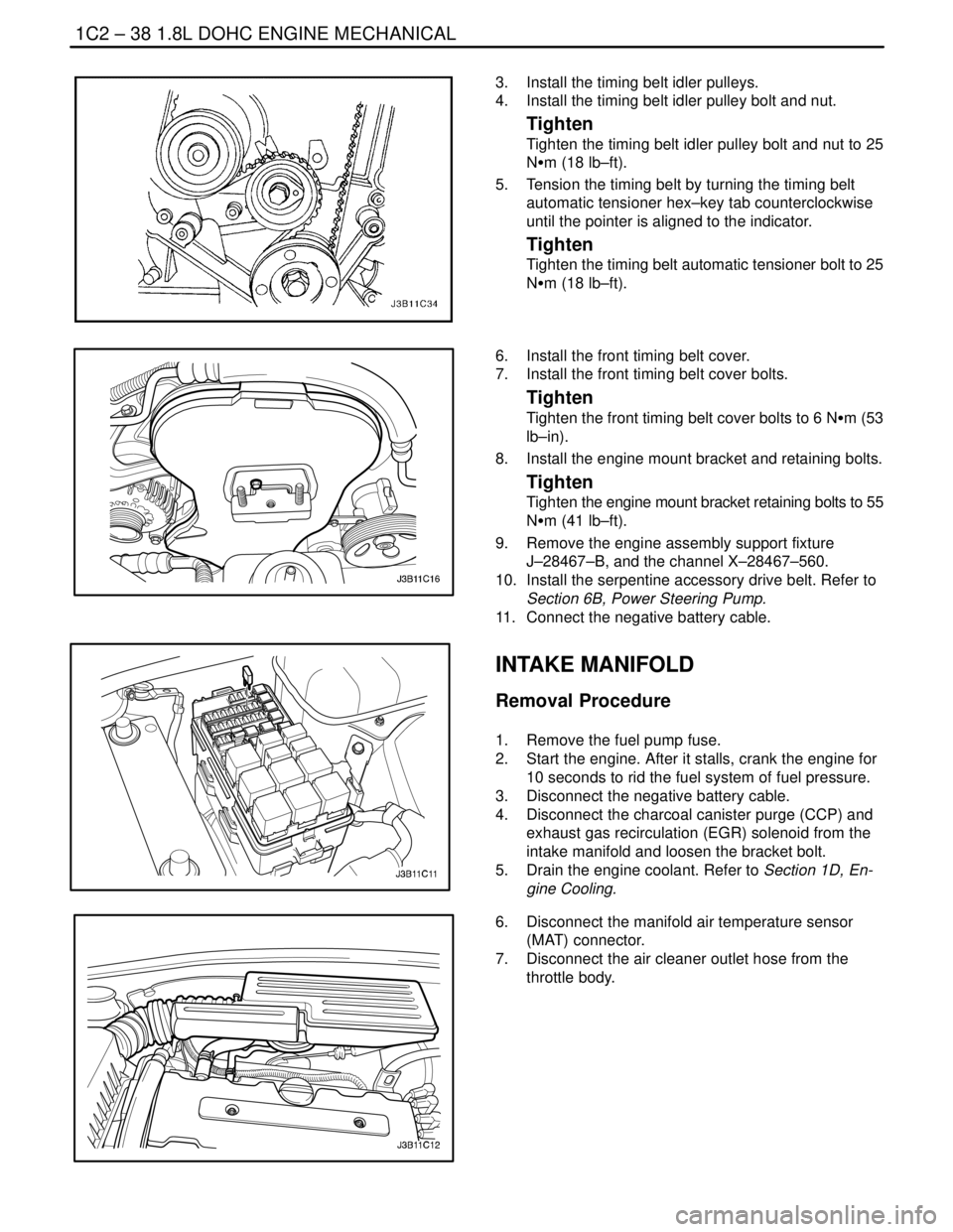
3. Install the timing belt idler pulleys.
4. Install the timing belt idler pulley bolt and nut.
Tighten
Tighten the timing belt idler pulley bolt and nut to 25
NSm (18 lb–ft).
5. Tension the timing belt by turning the timing belt
automatic tensioner hex–key tab counterclockwise
until the pointer is aligned to the indicator.
Tighten
Tighten the timing belt automatic tensioner bolt to 25
NSm (18 lb–ft).
6. Install the front timing belt cover.
7. Install the front timing belt cover bolts.
Tighten
Tighten the front timing belt cover bolts to 6 NSm (53
lb–in).
8. Install the engine mount bracket and retaining bolts.
Tighten
Tighten the engine mount bracket retaining bolts to 55
NSm (41 lb–ft).
9. Remove the engine assembly support fixture
J–28467–B, and the channel X–28467–560.
10. Install the serpentine accessory drive belt. Refer to
Section 6B, Power Steering Pump.
11. Connect the negative battery cable.
INTAKE MANIFOLD
Removal Procedure
1. Remove the fuel pump fuse.
2. Start the engine. After it stalls, crank the engine for
10 seconds to rid the fuel system of fuel pressure.
3. Disconnect the negative battery cable.
4. Disconnect the charcoal canister purge (CCP) and
exhaust gas recirculation (EGR) solenoid from the
intake manifold and loosen the bracket bolt.
5. Drain the engine coolant. Refer to Section 1D, En-
gine Cooling.
6. Disconnect the manifold air temperature sensor
(MAT) connector.
7. Disconnect the air cleaner outlet hose from the
throttle body.
Page 161 of 2643
1.8L DOHC ENGINE MECHANICAL 1C2 – 41
DAEWOO V–121 BL4
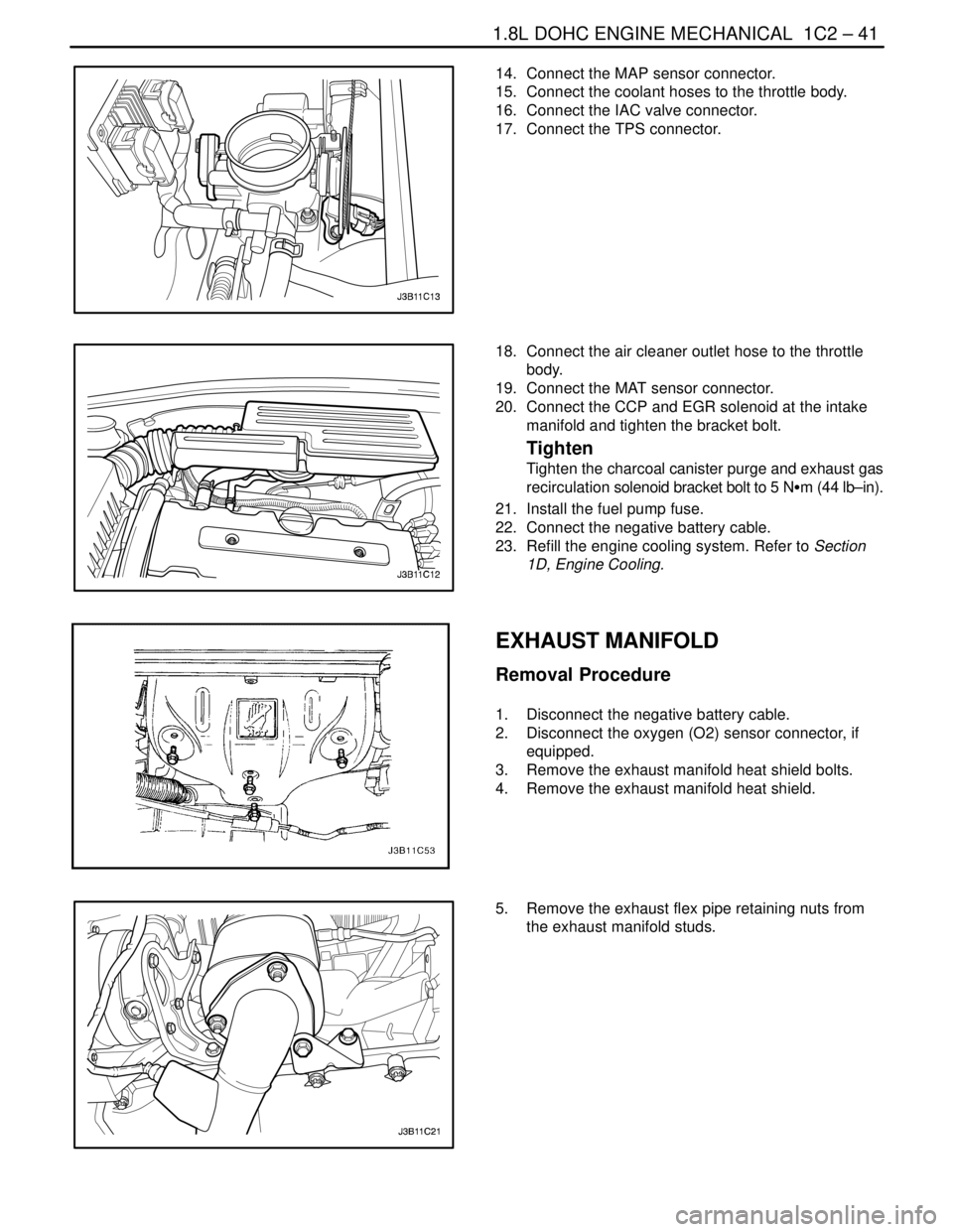
14. Connect the MAP sensor connector.
15. Connect the coolant hoses to the throttle body.
16. Connect the IAC valve connector.
17. Connect the TPS connector.
18. Connect the air cleaner outlet hose to the throttle
body.
19. Connect the MAT sensor connector.
20. Connect the CCP and EGR solenoid at the intake
manifold and tighten the bracket bolt.
Tighten
Tighten the charcoal canister purge and exhaust gas
recirculation solenoid bracket bolt to 5 NSm (44 lb–in).
21. Install the fuel pump fuse.
22. Connect the negative battery cable.
23. Refill the engine cooling system. Refer to Section
1D, Engine Cooling.
EXHAUST MANIFOLD
Removal Procedure
1. Disconnect the negative battery cable.
2. Disconnect the oxygen (O2) sensor connector, if
equipped.
3. Remove the exhaust manifold heat shield bolts.
4. Remove the exhaust manifold heat shield.
5. Remove the exhaust flex pipe retaining nuts from
the exhaust manifold studs.
Page 166 of 2643
1C2 – 46I1.8L DOHC ENGINE MECHANICAL
DAEWOO V–121 BL4
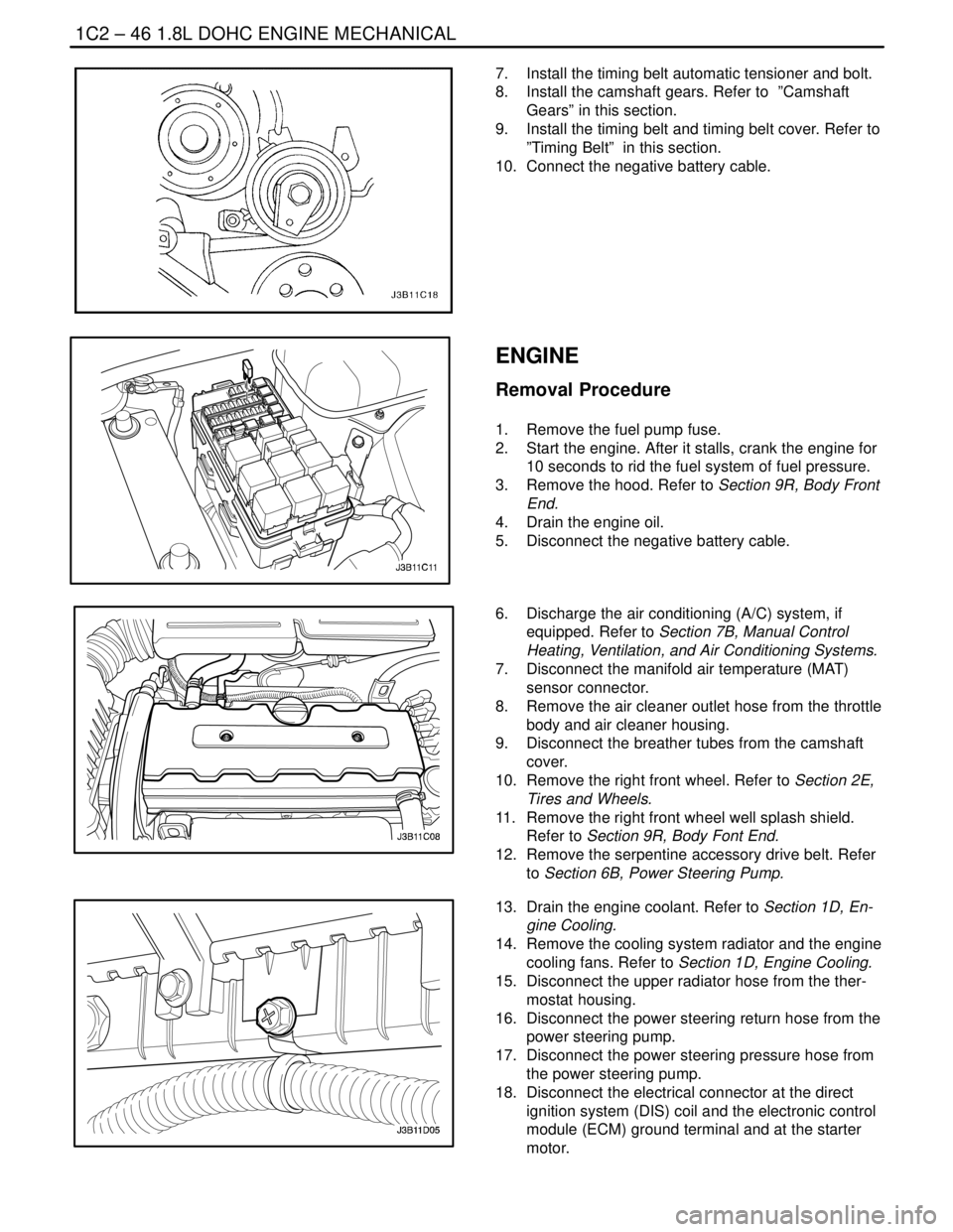
7. Install the timing belt automatic tensioner and bolt.
8. Install the camshaft gears. Refer to ”Camshaft
Gears” in this section.
9. Install the timing belt and timing belt cover. Refer to
”Timing Belt” in this section.
10. Connect the negative battery cable.
ENGINE
Removal Procedure
1. Remove the fuel pump fuse.
2. Start the engine. After it stalls, crank the engine for
10 seconds to rid the fuel system of fuel pressure.
3. Remove the hood. Refer to Section 9R, Body Front
End.
4. Drain the engine oil.
5. Disconnect the negative battery cable.
6. Discharge the air conditioning (A/C) system, if
equipped. Refer to Section 7B, Manual Control
Heating, Ventilation, and Air Conditioning Systems.
7. Disconnect the manifold air temperature (MAT)
sensor connector.
8. Remove the air cleaner outlet hose from the throttle
body and air cleaner housing.
9. Disconnect the breather tubes from the camshaft
cover.
10. Remove the right front wheel. Refer to Section 2E,
Tires and Wheels.
11. Remove the right front wheel well splash shield.
Refer to Section 9R, Body Font End.
12. Remove the serpentine accessory drive belt. Refer
to Section 6B, Power Steering Pump.
13. Drain the engine coolant. Refer to Section 1D, En-
gine Cooling.
14. Remove the cooling system radiator and the engine
cooling fans. Refer to Section 1D, Engine Cooling.
15. Disconnect the upper radiator hose from the ther-
mostat housing.
16. Disconnect the power steering return hose from the
power steering pump.
17. Disconnect the power steering pressure hose from
the power steering pump.
18. Disconnect the electrical connector at the direct
ignition system (DIS) coil and the electronic control
module (ECM) ground terminal and at the starter
motor.
Page 171 of 2643
1.8L DOHC ENGINE MECHANICAL 1C2 – 51
DAEWOO V–121 BL4
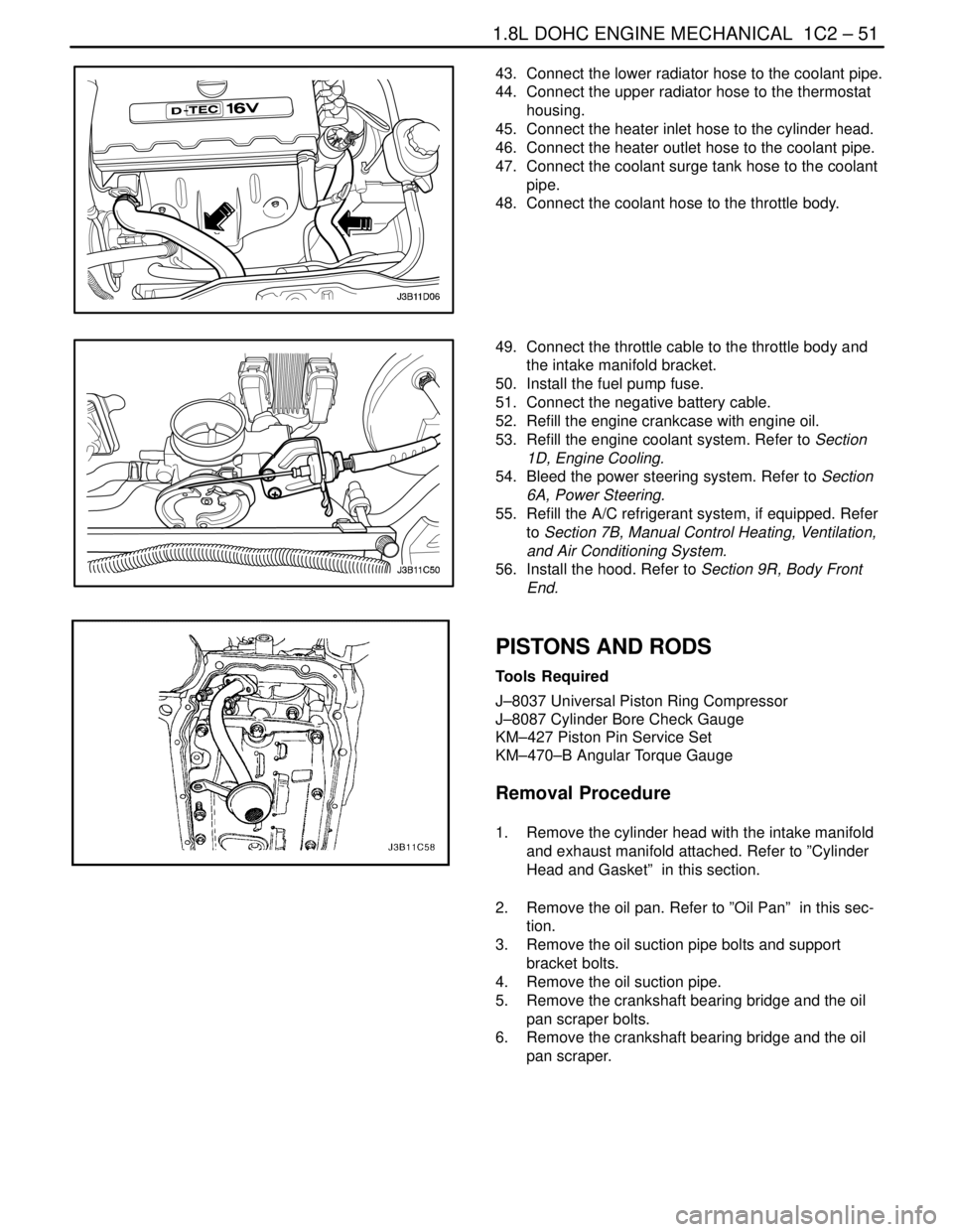
43. Connect the lower radiator hose to the coolant pipe.
44. Connect the upper radiator hose to the thermostat
housing.
45. Connect the heater inlet hose to the cylinder head.
46. Connect the heater outlet hose to the coolant pipe.
47. Connect the coolant surge tank hose to the coolant
pipe.
48. Connect the coolant hose to the throttle body.
49. Connect the throttle cable to the throttle body and
the intake manifold bracket.
50. Install the fuel pump fuse.
51. Connect the negative battery cable.
52. Refill the engine crankcase with engine oil.
53. Refill the engine coolant system. Refer to Section
1D, Engine Cooling.
54. Bleed the power steering system. Refer to Section
6A, Power Steering.
55. Refill the A/C refrigerant system, if equipped. Refer
to Section 7B, Manual Control Heating, Ventilation,
and Air Conditioning System.
56. Install the hood. Refer to Section 9R, Body Front
End.
PISTONS AND RODS
Tools Required
J–8037 Universal Piston Ring Compressor
J–8087 Cylinder Bore Check Gauge
KM–427 Piston Pin Service Set
KM–470–B Angular Torque Gauge
Removal Procedure
1. Remove the cylinder head with the intake manifold
and exhaust manifold attached. Refer to ”Cylinder
Head and Gasket” in this section.
2. Remove the oil pan. Refer to ”Oil Pan” in this sec-
tion.
3. Remove the oil suction pipe bolts and support
bracket bolts.
4. Remove the oil suction pipe.
5. Remove the crankshaft bearing bridge and the oil
pan scraper bolts.
6. Remove the crankshaft bearing bridge and the oil
pan scraper.
Page 220 of 2643

1E – 6IENGINE ELECTRICAL
DAEWOO V–121 BL4
DIAGNOSIS
NO CRANK
StepActionValue(s)YesNo
11. Turn the headlamps ON.
2. Turn the dome lamps ON.
3. Turn the ignition to START.
Did the lights dim or go out?–Go to Step 2Go to Step 8
2Check the battery state of charge.
Is the green eye showing from the built–in hydrome-
ter?–Go to Step 3Go to
”Charging Pro-
cedure”
31. Connect the voltmeter positive lead to the posi-
tive battery terminal.
2. Connect the voltmeter negative lead to the
negative battery terminal.
3. Turn the ignition to START.
Does the voltmeter indicate the value specified?< 9.6 vGo to
”Charging Pro-
cedure”Go to Step 4
41. Connect the voltmeter negative lead to the
negative battery terminal.
2. Connect the positive voltmeter lead to the en-
gine block.
Does the voltmeter indicate the value specified?> 0.5 vGo to Step 5Go to Step 6
5Clean, tighten, or replace the negative battery cable.
Is the repair complete?–System OK–
61. Connect the voltmeter positive lead to the start-
er ”B+” terminal.
2. Connect the voltmeter negative lead to the
negative battery terminal.
Does the voltmeter indicate the value specified?< 9 vGo to Step 7Go to Step 13
7Clean, tighten, or replace the positive battery cable.
Is the repair complete?–System OK–
8Inspect the engine fuse block fuse Ef5.
Is the fuse OK?–Go to Step 10Go to Step 9
9Inspect the engine fuse block fuse Ef4.
Is the fuse OK?–System OK–
10Check the connection at the starter ”ST” terminal.
Is the connection OK?–Go to Step 12Go to Step 11
11Clean or tighten the connection as needed.
Is the repair complete?–System OK–
121. Connect the voltmeter positive lead to the start-
er ”ST” terminal.
2. Connect the voltmeter negative lead to the
negative battery terminal.
3. Turn the ignition to START.
Does the voltmeter indicate the value specified?< 7 vGo to Step 13Go to Step 14
13Repair or replace the starter as needed.
Is the repair complete?–System OK–
14Determine the type of transaxle on the vehicle.
Is the vehicle equipped with an automatic transaxle?–Go to Step 15Go to Step 32
Page 221 of 2643

ENGINE ELECTRICAL 1E – 7
DAEWOO V–121 BL4
StepNo Yes Value(s) Action
151. Disconnect the neutral safety back–up (PNP)
switch.
2. Connect the negative voltmeter lead to the
PNP switch connector terminal E.
3. Connect the positive voltmeter lead to battery
positive.
Does the voltmeter indicate the value specified?11–14 vGo to Step 16Go to Step 19
161. Jumper the PNP switch connector terminals 9
and 10.
2. Connect the negative voltmeter lead to the igni-
tion switch.
3. Connect the positive voltmeter lead to battery
positive.
Does the voltmeter indicate the value specified?11–14 vGo to Step 17Go to Step 18
17Replace the neutral safety backup switch.
Is the repair complete?–System OK–
18Repair the wire as needed.
Is the repair complete?–System OK–
19Repair the open wire between the PNP switch con-
nector terminal E and ground.
Is the repair complete?–System OK–
201. Connect the voltmeter positive lead to the igni-
tion switch connector terminal 3 by backprob-
ing the connector.
2. Connect the voltmeter negative lead to ground.
Does the voltmeter indicate the value specified?11–14 vGo to Step 22Go to Step 21
21Repair the open in the wiring between the engine
block fuse Ef5 and the ignition switch connector ter-
minal 2.
Is the repair complete?–System OK–
221. Connect the voltmeter positive lead to the igni-
tion switch connector terminal 3 by backprob-
ing the connector.
2. Connect the voltmeter negative lead to ground.
3. Turn the ignition to START.
Does the voltmeter indicate the value specified?11–14 vGo to Step 23Go to Step 27
231. Connect the voltmeter positive lead to the igni-
tion switch connector terminal 3 by backprob-
ing the connector.
2. Connect the voltmeter negative lead to ground.
Does the voltmeter indicate the value specified?11–14 vGo to Step 25Go to Step 24
24Repair the open in the wiring between the engine
block fuse Ef5 and the ignition switch connector ter-
minal 3.
Is the repair complete?–System OK–
251. Connect the voltmeter positive lead to the igni-
tion switch connector terminal 3 by backprob-
ing the connector.
2. Connect the voltmeter negative lead to ground.
3. Turn the ignition to START.
Does the voltmeter indicate the value specified?11–14 vGo to Step 26Go to Step 27
Page 274 of 2643
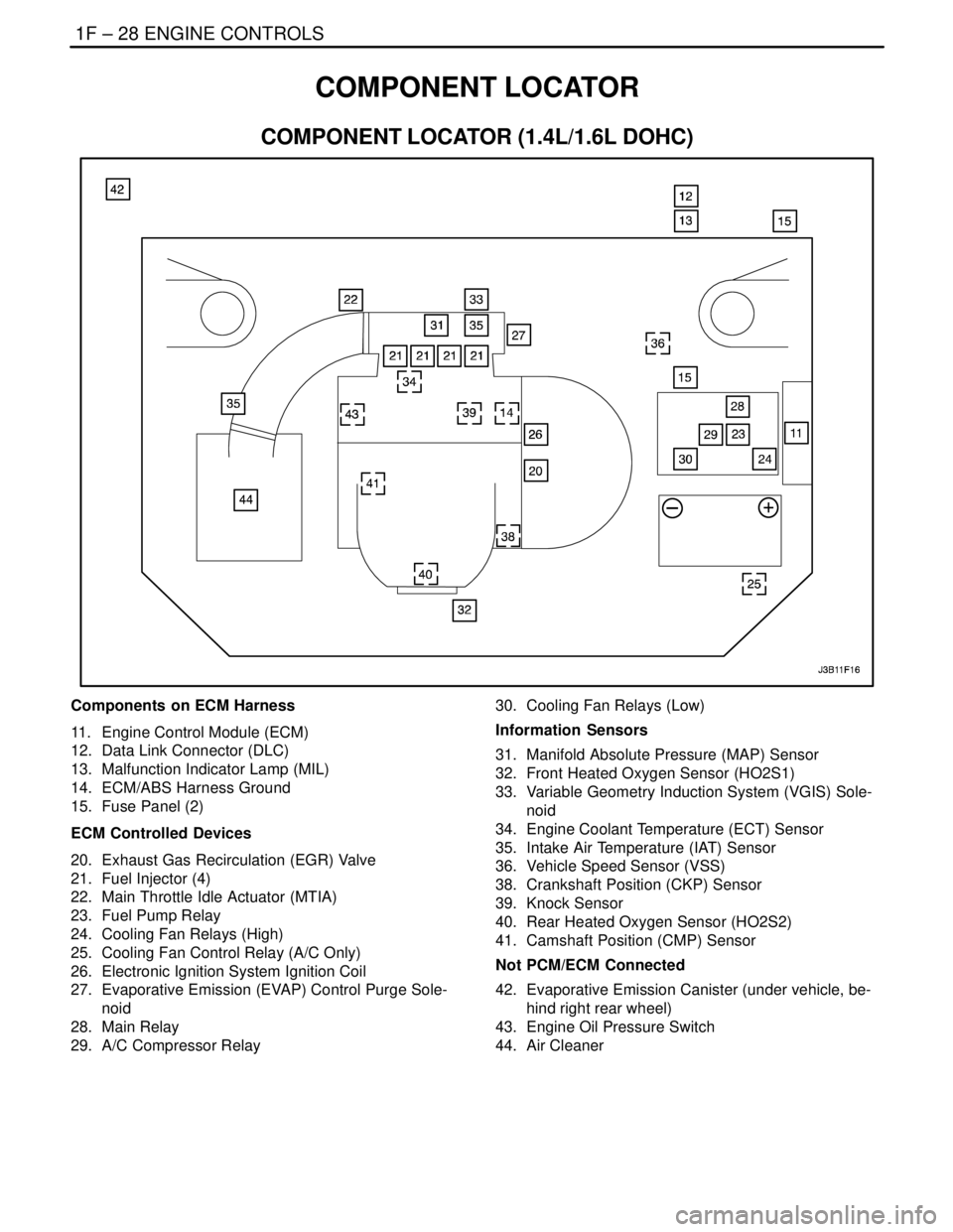
1F – 28IENGINE CONTROLS
DAEWOO V–121 BL4
COMPONENT LOCATOR
COMPONENT LOCATOR (1.4L/1.6L DOHC)
Components on ECM Harness
11. Engine Control Module (ECM)
12. Data Link Connector (DLC)
13. Malfunction Indicator Lamp (MIL)
14. ECM/ABS Harness Ground
15. Fuse Panel (2)
ECM Controlled Devices
20. Exhaust Gas Recirculation (EGR) Valve
21. Fuel Injector (4)
22. Main Throttle Idle Actuator (MTIA)
23. Fuel Pump Relay
24. Cooling Fan Relays (High)
25. Cooling Fan Control Relay (A/C Only)
26. Electronic Ignition System Ignition Coil
27. Evaporative Emission (EVAP) Control Purge Sole-
noid
28. Main Relay
29. A/C Compressor Relay30. Cooling Fan Relays (Low)
Information Sensors
31. Manifold Absolute Pressure (MAP) Sensor
32. Front Heated Oxygen Sensor (HO2S1)
33. Variable Geometry Induction System (VGIS) Sole-
noid
34. Engine Coolant Temperature (ECT) Sensor
35. Intake Air Temperature (IAT) Sensor
36. Vehicle Speed Sensor (VSS)
38. Crankshaft Position (CKP) Sensor
39. Knock Sensor
40. Rear Heated Oxygen Sensor (HO2S2)
41. Camshaft Position (CMP) Sensor
Not PCM/ECM Connected
42. Evaporative Emission Canister (under vehicle, be-
hind right rear wheel)
43. Engine Oil Pressure Switch
44. Air Cleaner
Page 275 of 2643
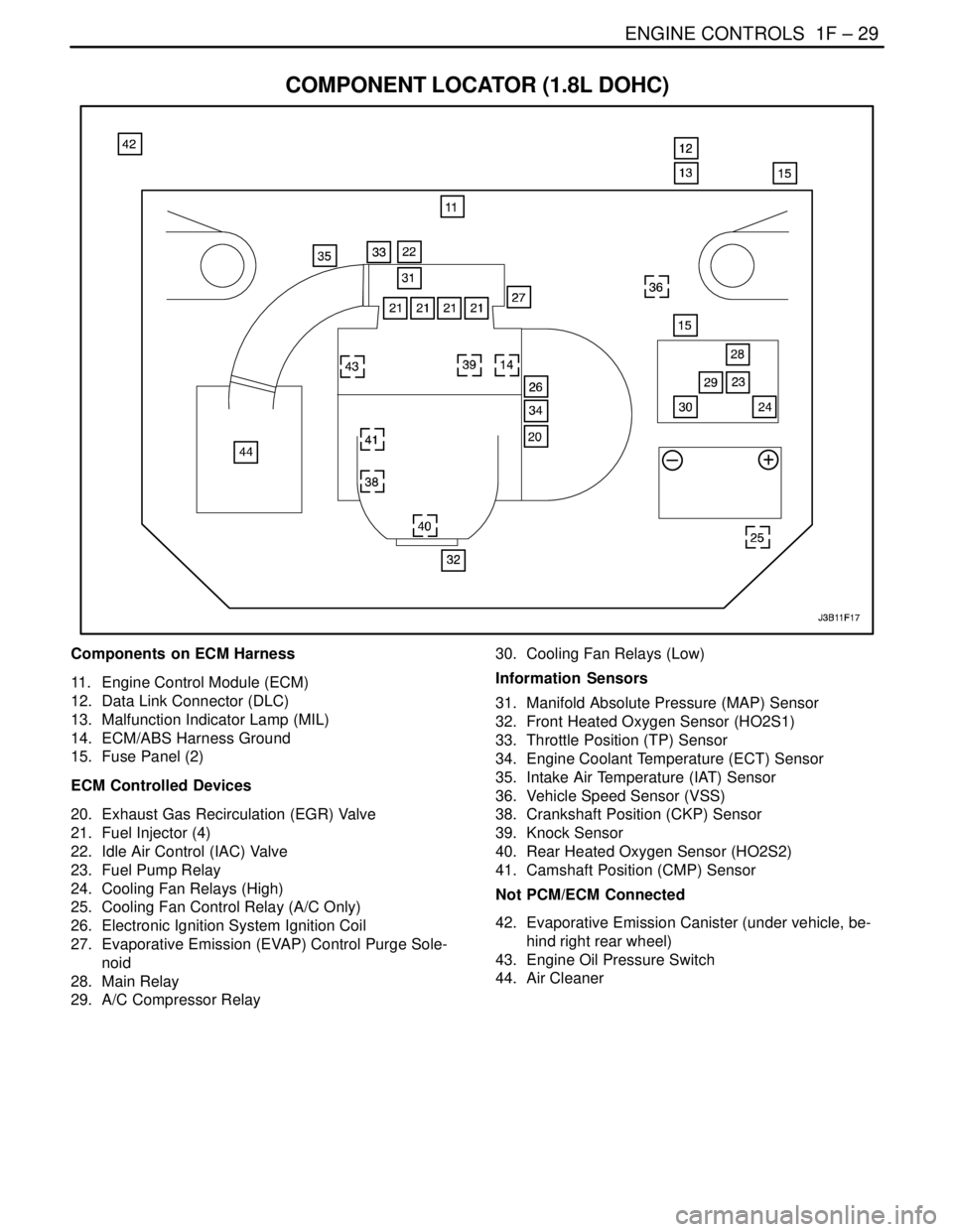
ENGINE CONTROLS 1F – 29
DAEWOO V–121 BL4
COMPONENT LOCATOR (1.8L DOHC)
Components on ECM Harness
11. Engine Control Module (ECM)
12. Data Link Connector (DLC)
13. Malfunction Indicator Lamp (MIL)
14. ECM/ABS Harness Ground
15. Fuse Panel (2)
ECM Controlled Devices
20. Exhaust Gas Recirculation (EGR) Valve
21. Fuel Injector (4)
22. Idle Air Control (IAC) Valve
23. Fuel Pump Relay
24. Cooling Fan Relays (High)
25. Cooling Fan Control Relay (A/C Only)
26. Electronic Ignition System Ignition Coil
27. Evaporative Emission (EVAP) Control Purge Sole-
noid
28. Main Relay
29. A/C Compressor Relay30. Cooling Fan Relays (Low)
Information Sensors
31. Manifold Absolute Pressure (MAP) Sensor
32. Front Heated Oxygen Sensor (HO2S1)
33. Throttle Position (TP) Sensor
34. Engine Coolant Temperature (ECT) Sensor
35. Intake Air Temperature (IAT) Sensor
36. Vehicle Speed Sensor (VSS)
38. Crankshaft Position (CKP) Sensor
39. Knock Sensor
40. Rear Heated Oxygen Sensor (HO2S2)
41. Camshaft Position (CMP) Sensor
Not PCM/ECM Connected
42. Evaporative Emission Canister (under vehicle, be-
hind right rear wheel)
43. Engine Oil Pressure Switch
44. Air Cleaner
Page 276 of 2643

1F – 30IENGINE CONTROLS
DAEWOO V–121 BL4
DIAGNOSIS
SYSTEM DIAGNOSIS
DIAGNOSTIC AIDS
If an intermittent problem is evident, follow the guidelines
below.
Preliminary Checks
Before using this section you should have already per-
formed the ”On–Board Diagnostic System Check.”
Perform a thorough visual inspection. This inspection can
often lead to correcting a problem without further checks
and can save valuable time. Inspect for the following con-
ditions:
S Engine control module (ECM) grounds for being
clean, tight, and in their proper location.
S Vacuum hoses for splits, kinks, collapsing and prop-
er connections as shown on the Vehicle Emission
Control Information label. Inspect thoroughly for
any type of leak or restriction.
S Air leaks at the throttle body mounting area and the
intake manifold sealing surfaces.
S Ignition wires for cracks, hardness, proper routing,
and carbon tracking.
S Wiring for proper connections.
S Wiring for pinches or cuts.
Diagnostic Trouble Code Tables
Do not use the Diagnostic Trouble Code (DTC) tables to
try to correct an intermittent fault. The fault must be pres-
ent to locate the problem.
Incorrect use of the DTC tables may result in the unneces-
sary replacement of parts.
Faulty Electrical Connections or Wiring
Most intermittent problems are caused by faulty electrical
connections or wiring. Perform a careful inspection of sus-
pect circuits for the following:
S Poor mating of the connector halves.
S Terminals not fully seated in the connector body.
S Improperly formed or damaged terminals. All con-
nector terminals in a problem circuit should be care-
fully inspected, reformed, or replaced to insure con-
tact tension.S Poor terminal–to–wire connection. This requires
removing the terminal from the connector body.
Road Test
If a visual inspection does not find the cause of the prob-
lem, the vehicle can be driven with a voltmeter or a scan
tool connected to a suspected circuit. An abnormal voltage
or scan tool reading will indicate that the problem is in that
circuit.
If there are no wiring or connector problems found and a
DTC was stored for a circuit having a sensor, except for
DTC P0171 and DTC P0172, replace the sensor.
Fuel System
Some intermittent driveability problems can be attributed
to poor fuel quality. If a vehicle is occasionally running
rough, stalling, or otherwise performing badly, ask the cus-
tomer about the following fuel buying habits:
S Do they always buy from the same source? If so,
fuel quality problems can usually be discounted.
S Do they buy their fuel from whichever fuel station
that is advertising the lowest price? If so, check the
fuel tank for signs of debris, water, or other contam-
ination.
IDLE LEARN PROCEDURE
Whenever the battery cables, the engine control module
(ECM), or the ECM fuse is disconnected or replaced, the
following idle learn procedure must be performed:
1. Turn the ignition ON for 5 seconds.
2. Turn the ignition OFF for 5 seconds.
3. Turn the ignition ON for 5 seconds.
4. Start the engine in park/neutral.
5. Allow the engine to run until the engine coolant is
above 185° F (85°C ).
6. Turn the A/C ON for 10 seconds, if equipped.
7. Turn the A/C OFF for 10 seconds, if equipped.
8. If the vehicle is equipped with an automatic trans-
axle, apply the parking brake. While pressing the
brake pedal, place the transaxle in D (drive).
9. Turn the A/C ON for 10 seconds, if equipped.
10. Turn the A/C OFF for 10 seconds, if equipped.
11. Turn the ignition OFF. The idle learn procedure is
complete.
Page 286 of 2643

1F – 40IENGINE CONTROLS
DAEWOO V–121 BL4
ENGINE CRANKS BUT WILL NOT RUN (1.4L/1.6L DOHC)
Test Description
The number(s) below refer to step(s) on the diagnostic
table.
1. The On–Board Diagnostic (EOBD) System Check
prompts the technician to complete some basic
checks and store the freeze frame and failure re-
cords data on the scan tool if applicable. This
creates an electronic copy of the data taken when
the occurred. The information is then stored on the
scan tool for later reference.
2. By performing a compression test, it can be deter-
mined if the engine has the mechanical ability to
run.
3. It is important to check for the presence of sparkfrom all of the ignition wires. If spark is present from
one to three of the ignition coil terminals, the Crank-
shaft Position (CKP) sensor is OK.
19. In checking the engine control module (ECM) out-
puts for the electronic spark timing signal, it recom-
mended to use an oscilloscope to view the varying
voltage signals. In measuring these outputs with a
voltmeter, intermittent errors may occur that cannot
be seen by a voltmeter.
35. This step checks for proper operation of the ECM’s
control of the fuel pump circuit.
59. This step checks for a ground signal being supplied
by the ECM to operate the fuel injectors. If there is
no ground present during the cranking of the en-
gine, and the fuel injector wiring is OK, the ECM is
at fault.
Engine Cranks But Will Not Run (1.4L/1.6L DOHC)
CAUTION : Use only electrically insulated pliers when
handling ignition wires with the engine running to
prevent an electrical shock.
CAUTION : Do not pinch or restrict nylon fuel lines.Damage to the lines could cause a fuel leak, resulting
in possible fire or personal injury.
Step
ActionValue(s)YesNo
1Perform an Euro On–Board Diagnostic (EOBD)
System Check.
Is the check complete.–Go to Step 2Go to
”Euro On–
Board Diagnos-
tic System
Check”
2Crank the engine.
Does the engine start and continue to run?–System OKGo to Step 3
3Perform a cylinder compression test.
Is the cylinder compression for all of the cylinders at
or above the value specified?689 kPa
(100 psi)Go to Step 7Go to Step 4
4Inspect the timing belt alignment.
Is the timing belt in alignment?–Go to Step 6Go to Step 5
5Align or replace the timing belt as needed.
Is the repair complete?–Go to Step 2–
6Repair internal engine damage as needed.
Is the repair complete?–Go to Step 2–
7Inspect the fuel pump fuse.
Is the problem found?–Go to Step 8Go to Step 9
8Replace the fuse.
Is the repair complete?–Go to Step 2–
9Check for the presence of spark from all of the igni-
tion wires while cranking the engine.
Is spark present from all of the ignition wires?–Go to Step 23Go to Step 10
101. Measure the resistance of the ignition wires.
2. Replace any of the ignition wire(s) with a resist-
ance above the value specified.
3. Check for the presence of spark from all of the
ignition wire.
Is spark present from all of the ignition wires?30000 WGo to Step 2Go to Step 11