fuse DAEWOO NUBIRA 2004 Service Owner's Manual
[x] Cancel search | Manufacturer: DAEWOO, Model Year: 2004, Model line: NUBIRA, Model: DAEWOO NUBIRA 2004Pages: 2643, PDF Size: 80.54 MB
Page 290 of 2643

1F – 44IENGINE CONTROLS
DAEWOO V–121 BL4
StepNo Yes Value(s) Action
39Repair the open or short circuit the following termi-
nals.
S Terminal 6 of ECM and terminal 86 of fuel
pump relay.
S Terminal 87 of fuel pump relay and terminal
3 of fuel pump.
Is the repair complete?–Go to Step 2–
40Replace the fuel pump relay.
Is the repair complete?–Go to Step 2–
411. Turn the ignition OFF.
2. Disconnect the fuel inject harness connectors
from all of the fuel injectors.
3. Turn the ignition ON.
4. Connect test light between fuel injector harness
connector 2 and ground.
5. Repeat step 4 for each of the remaining fuel
injectors.
Does the test light on at all of the fuel injectors?–Go to Step 42Go to Step 45
421. Turn the ignition OFF.
2. Connect test light between fuel injector harness
connector 1 and battery positive.
3. Crank the engine.
4. Repeat step 2 and 3 for each of the remaining
fuel injectors.
Does the test light flash for all of the fuel injectors?–Go to Step 43Go to Step 46
43Measure the resistance of each fuel injectors.
Is the resistance within the value specified.
Notice : the resistance will increase slightly at higher
temperature.11.6–12.4WSystem OKGo to Step 44
44Replace any of the fuel injectors with a resistance
out of specification.
Is the repair complete?–Go to Step 2–
451. Inspect the fuse EF22 in engine fuse block.
2. Check for an open between the circuit from
terminal 2 of the four fuel injectors and terminal
87 of main relay.
Is the problem found?–Go to Step 48Go to
”Main Relay
Circuit Check”
46Measure the resistance between following termi-
nals.
S Terminal 2 of injector 1 connector and terminal
59 of ECM connector.
S Terminal 2 of injector 2 connector and terminal
90 of ECM connector.
S Terminal 2 of injector 3 connector and terminal
60 of ECM connector.
S Terminal 2 of injector 4 connector and terminal
89 of ECM connector.
Does the resistance within the specified value?0 WGo to Step 49Go to Step 47
47Repair the open fuel injector harness wire(s).
Is the repair complete?–Go to Step 2–
Page 291 of 2643

ENGINE CONTROLS 1F – 45
DAEWOO V–121 BL4
StepNo Yes Value(s) Action
48Replace the fuse or repair the wiring as needed.
Is the repair complete?–Go to Step 2–
49Replace the ECM.
Is the repair complete?–Go to Step 2–
Page 293 of 2643

ENGINE CONTROLS 1F – 47
DAEWOO V–121 BL4
ENGINE CRANKS BUT WILL NOT RUN (1.8L DOHC)
Test Description
The number(s) below refer to step(s) on the diagnostic
table.
1. The On–Board Diagnostic (EOBD) System Check
prompts the technician to complete some basic
checks and store the freeze frame and failure re-
cords data on the scan tool if applicable. This
creates an electronic copy of the data taken when
the occurred. The information is then stored on the
scan tool for later reference.
2. By performing a compression test, it can be deter-
mined if the engine has the mechanical ability to
run.
3. It is important to check for the presence of sparkfrom all of the ignition wires. If spark is present from
one to three of the ignition coil terminals, the Crank-
shaft Position (CKP) sensor is OK.
19. In checking the engine control module (ECM) out-
puts for the electronic spark timing signal, it recom-
mended to use an oscilloscope to view the varying
voltage signals. In measuring these outputs with a
voltmeter, intermittent errors may occur that cannot
be seen by a voltmeter.
35. This step checks for proper operation of the ECM’s
control of the fuel pump circuit.
59. This step checks for a ground signal being supplied
by the ECM to operate the fuel injectors. If there is
no ground present during the cranking of the en-
gine, and the fuel injector wiring is OK, the ECM is
at fault.
Engine Cranks But Will Not Run (1.8L DOHC)
CAUTION : Use only electrically insulated pliers when
handling ignition wires with the engine running to
prevent an electrical shock.
CAUTION : Do not pinch or restrict nylon fuel lines.Damage to the lines could cause a fuel leak, resulting
in possible fire or personal injury.
Step
ActionValue(s)YesNo
1Perform an On–Board Diagnostic (EOBD) System
Check.
Was the check performed?–Go to Step 2Go to
”On–Board
Diagnostic
(EOBD) Sys-
tem Check”
2Check for set Diagnostic Trouble Code (DTC)
P0601.
Is the DTC set?–Go to applica-
ble DTC tableGo to Step 4
3Crank the engine.
Does the engine start and continue to run?–System OKGo to Step 5
4Perform a cylinder compression test.
Is the cylinder compression for all of the cylinders at
or above the value specified?689 kPa
(100 psi)Go to Step 8Go to Step 5
5Inspect the timing belt alignment.
Is the timing belt in alignment?–Go to Step 7Go to Step 6
6Align or replace the timing belt as needed.
Is the repair complete?–Go to Step 3–
7Repair the internal engine damage as needed.
Is the repair complete?–Go to Step 3–
8Inspect the fuel pump fuse.
Is the problem found?–Go to Step 9Go to Step 10
9Replace the fuse.
Is the repair complete?–Go to Step 3–
101. Install a scan tool.
2. Turn the ignition ON, the engine OFF and close
the throttle.
Does the Throttle Position (TP) sensor read less
than the specified value.1.0 vGo to Step 11Go to ”DTC
P0123 Throttle
Position Sensor
High Voltage”
Page 298 of 2643

1F – 52IENGINE CONTROLS
DAEWOO V–121 BL4
StepNo Yes Value(s) Action
571. Turn the ignition OFF.
2. Connect a test light between the fuel pump
relay connector terminal 30 and ground.
Is the test light on?–Go to Step 58Go toStep 63
581. Turn the ignition OFF.
2. Check the wire between the fuel pump relay
connector terminal 87 and the fuel pump con-
nector terminal 3 for an open or short to
ground.
Is the repair complete?–Go to Step 2–
59Replace the fuel pump relay.
Is the repair complete?–Go to Step 3–
601. Check for an open in the wiring between the
fuel pump relay connector terminal 86 and
ground.
Is the problem found?–Go to Step 71–
61Check the wire between the fuel pump relay connec-
tor terminal 85 to the ECM connector terminal K54
for an open.
Is the problem found?–Go to Step 62Go to Step 40
62Repair the wire between the fuel pump relay connec-
tor terminal 85 to the ECM connector terminal K54.
Is the repair complete?–Go to Step 3–
63Repair the wire between the fuel pump relay connec-
tor terminal 30 and the fuse Ef18.
Is the repair complete?–Go to Step 3–
641. Turn the ignition OFF.
2. Disconnect the fuel injector harness connectors
from all of the fuel injectors.
3. Turn the ignition ON.
4. Connect a test light between the fuel injector
harness connector 2 and ground.
5. Repeat step 4 for each of the remaining fuel
injectors.
Is the test light on at all of the fuel injectors?–Go to Step 65Go to Step 68
651. Turn the ignition OFF.
2. Connect a test light between the fuel injector
harness connector terminal 1 and battery posi-
tive.
3. Crank the engine.
4. Repeat steps two and three for each of the re-
maining fuel injectors.
Does the test light flash for all of the fuel injectors?–Go to Step 66Go to Step 69
66Measure the resistance of each fuel injector.
Is the resistance within the value specified (the re-
sistance will increase slightly at higher tempera-
tures)?11.6–12.4 WSystem OKGo to Step 67
67Replace any of the fuel injectors with a resistance
out of specification.
Is the repair complete?–Go to Step 3–
Page 299 of 2643

ENGINE CONTROLS 1F – 53
DAEWOO V–121 BL4
StepNo Yes Value(s) Action
68Repair the open wire(s) between the fuel injector
harness connector(s) terminal 2 and the engine har-
ness C103 terminal 10.
Is the repair complete?–Go to Step 3–
691. Check for an open between the #1 fuel injector
harness connector terminal 1 and the connec-
tor terminal M25.
2. Check for an open between the #2 fuel injector
harness connector terminal 1 and the connec-
tor terminal M22.
3. Check for an open between the #3 fuel injector
harness connector terminal 1 and the connec-
tor terminal M24.
4. Check for an open between the #4 fuel injector
harness connector terminal 1 and the connec-
tor terminal M11.
Is the problem found?–Go to Step 70Go to Step 72
70Repair the open fuel injector harness wire(s).
Is the repair complete?–Go to Step 3–
71Replace the fuse or repair the wiring as needed.
Is the repair complete?–Go to Step 3–
721. Inspect the I/P fuse F2.
2. Check for an open between the circuits from
terminal 2 for each of the four fuel injectors and
the ignition switch.
Is the problem found?–Go to Step 71–
Page 300 of 2643
1F – 54IENGINE CONTROLS
DAEWOO V–121 BL4
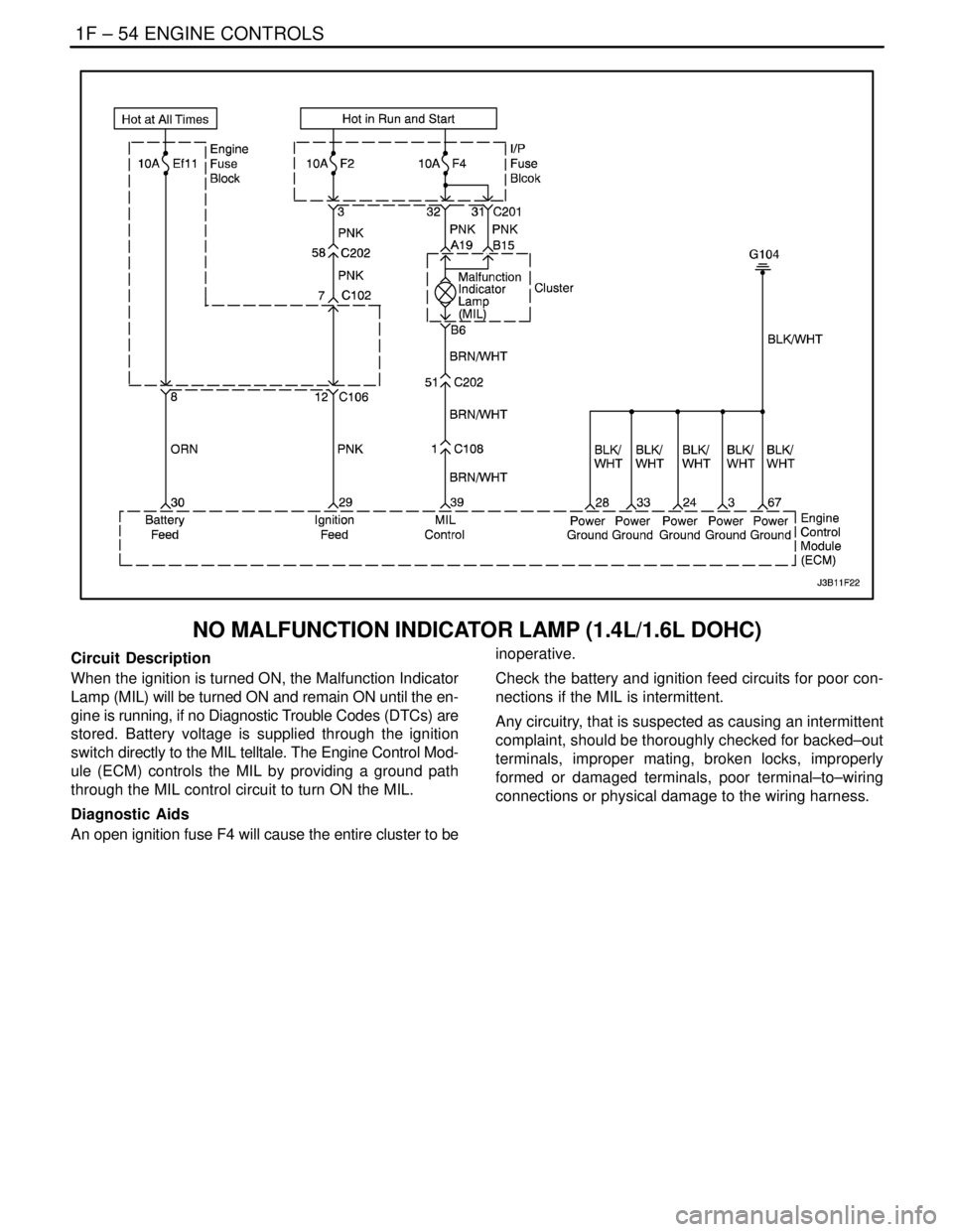
NO MALFUNCTION INDICATOR LAMP (1.4L/1.6L DOHC)
Circuit Description
When the ignition is turned ON, the Malfunction Indicator
Lamp (MIL) will be turned ON and remain ON until the en-
gine is running, if no Diagnostic Trouble Codes (DTCs) are
stored. Battery voltage is supplied through the ignition
switch directly to the MIL telltale. The Engine Control Mod-
ule (ECM) controls the MIL by providing a ground path
through the MIL control circuit to turn ON the MIL.
Diagnostic Aids
An open ignition fuse F4 will cause the entire cluster to beinoperative.
Check the battery and ignition feed circuits for poor con-
nections if the MIL is intermittent.
Any circuitry, that is suspected as causing an intermittent
complaint, should be thoroughly checked for backed–out
terminals, improper mating, broken locks, improperly
formed or damaged terminals, poor terminal–to–wiring
connections or physical damage to the wiring harness.
Page 301 of 2643

ENGINE CONTROLS 1F – 55
DAEWOO V–121 BL4
No Malfunction Indicator Lamp (1.4L/1.6L DOHC)
StepActionValue(s)YesNo
1Attempt to start the engine.
Does the engine start?–Go to Step 2Go to
”Engine Cranks
But Will Not
Run”
21. Turn the ignition switch to LOCK.
2. Disconnect the Engine Control Module (ECM)
connector.
3. Turn the ignition switch to ON.
4. Connect a test light between the ECM connec-
tor terminal 39 and ground.
Is the test light illuminate?–Go to Step 3Go to Step 6
3Check terminals for damage or poor connection.
Does any problem found?–Go to Step 5Go to Step 4
4Replace the ECM.
Is the replacement complete?–Go to
”On–Board
Diagnostic Sys-
tem Check”–
5Repair any damaged terminals or poor connection.
Is the repair complete?–Go to
”On–Board
Diagnostic Sys-
tem Check”–
6Check the fuse F4.
Is the fuse open?Go to Step 7Go to Step 8
71. Check for a short to ground in the circuit and
repair as needed.
2. Replace the fuse F4.
Is the repair or replacement complete?–Go to
”On–Board
Diagnostic Sys-
tem Check”–
81. Check for an open circuit between fuse F4 and
the ECM connector terminal 39 and repair as
needed.
2. Check the MIL bulb and replace if open.
Is the repair or replacement complete?–Go to
”On–Board
Diagnostic Sys-
tem Check”–
Page 302 of 2643
1F – 56IENGINE CONTROLS
DAEWOO V–121 BL4
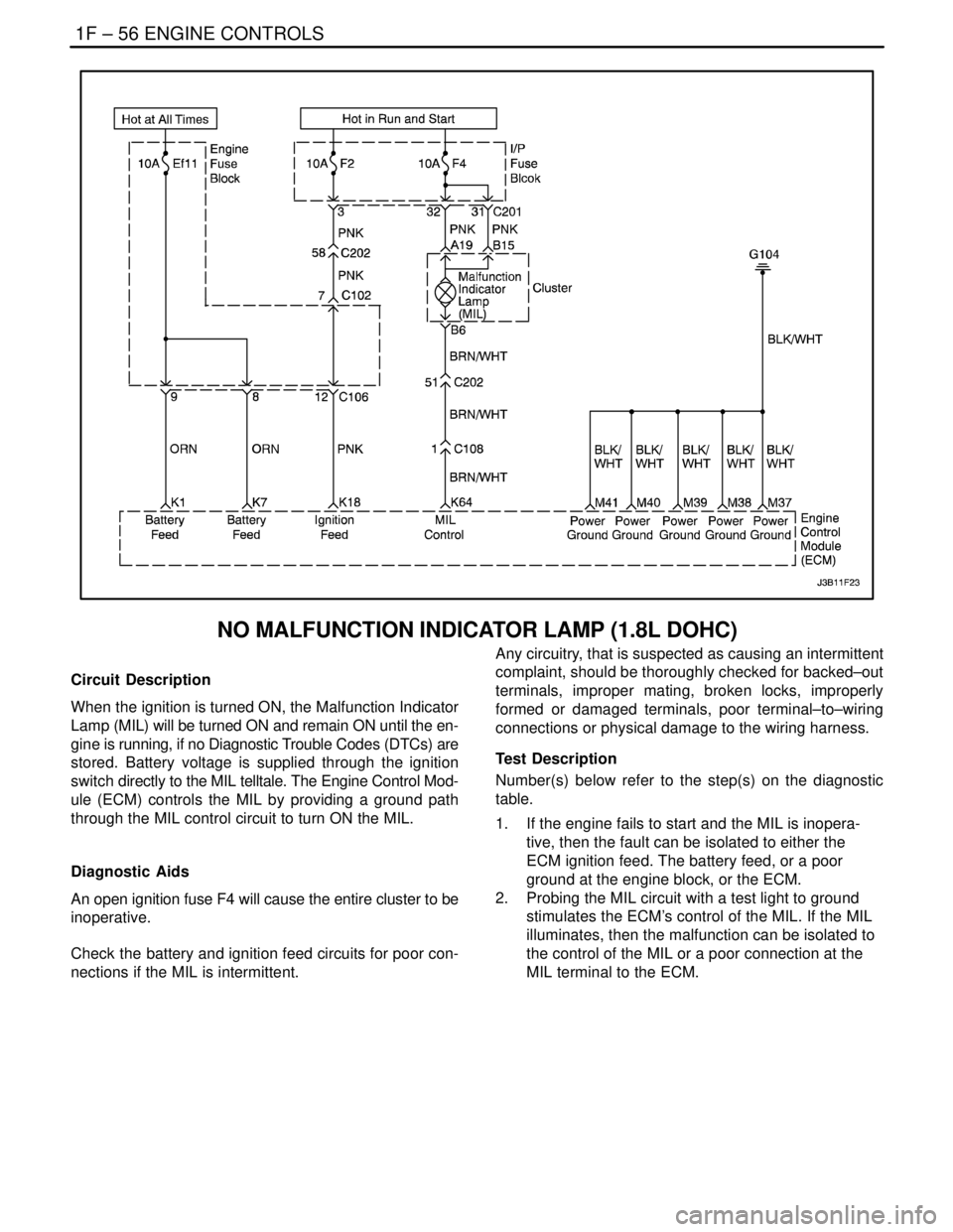
NO MALFUNCTION INDICATOR LAMP (1.8L DOHC)
Circuit Description
When the ignition is turned ON, the Malfunction Indicator
Lamp (MIL) will be turned ON and remain ON until the en-
gine is running, if no Diagnostic Trouble Codes (DTCs) are
stored. Battery voltage is supplied through the ignition
switch directly to the MIL telltale. The Engine Control Mod-
ule (ECM) controls the MIL by providing a ground path
through the MIL control circuit to turn ON the MIL.
Diagnostic Aids
An open ignition fuse F4 will cause the entire cluster to be
inoperative.
Check the battery and ignition feed circuits for poor con-
nections if the MIL is intermittent.Any circuitry, that is suspected as causing an intermittent
complaint, should be thoroughly checked for backed–out
terminals, improper mating, broken locks, improperly
formed or damaged terminals, poor terminal–to–wiring
connections or physical damage to the wiring harness.
Test Description
Number(s) below refer to the step(s) on the diagnostic
table.
1. If the engine fails to start and the MIL is inopera-
tive, then the fault can be isolated to either the
ECM ignition feed. The battery feed, or a poor
ground at the engine block, or the ECM.
2. Probing the MIL circuit with a test light to ground
stimulates the ECM’s control of the MIL. If the MIL
illuminates, then the malfunction can be isolated to
the control of the MIL or a poor connection at the
MIL terminal to the ECM.
Page 303 of 2643

ENGINE CONTROLS 1F – 57
DAEWOO V–121 BL4
No Malfunction Indicator Lamp (1.8L DOHC)
StepActionValue(s)YesNo
1Attempt to start the engine.
Does the engine start?–Go to Step 2Go to
”Engine Cranks
But Will Not
Run”
21. Turn the ignition switch to LOCK.
2. Disconnect the Engine Control Module (ECM)
connector.
3. Turn the ignition switch to ON.
4. Connect a test light between the ECM connec-
tor terminal K64 and ground.
Is the test light illuminate?–Go to Step 3Go to Step 6
3Check terminals for damage or poor connection.
Does any problem found?–Go to Step 5Go to Step 4
4Replace the ECM.
Is the replacement complete?–Go to
”On Board
Diagnostic Sys-
tem Check”–
5Repair any damaged terminals or poor connection.
Is the repair complete?–Go to
”On Board
Diagnostic Sys-
tem Check”–
6Check the fuse F4.
Is the fuse open?Go to Step 7Go to Step 8
71. Check for a short to ground in the circuit and
repair as needed.
2. Replace the fuse F4.
Is the repair or replacement complete?–Go to
”On Board
Diagnostic Sys-
tem Check”
81. Check for an open circuit between fuse F4 and
the ECM connector terminal K64 and repair as
needed.
2. Check the MIL bulb and replace if open.
Is the repair or replacement complete?–Go to
”On Board
Diagnostic Sys-
tem Check”–
Page 308 of 2643

1F – 62IENGINE CONTROLS
DAEWOO V–121 BL4
FUEL SYSTEM DIAGNOSIS
Circuit Description
The fuel pump is an in–tank type mounted to a fuel sender
assembly. The fuel pump will remain on as long as the en-
gine is cranking or running and the Engine Control Module
(ECM) is receiving reference pulses from the crankshaft
position (CKP) sensor. If there are no reference pulses,
the ECM will turn off the fuel pump two seconds after the
ignition switch is turned ON or two seconds after the en-
gine stops running. The fuel pump delivers fuel to the fuel
rail and the fuel injectors, where the fuel system pressure
is controlled from 284 to 325 kPa (41 to 47 psi) by the fuel
pressure regulator. The excess fuel is returned to the fuel
tank.
Test Description
The number(s) below refer to step(s) on the diagnostic
table.
2. When the engine is idling, the intake manifold vacu-
um is high. This vacuum is applied to the fuel pres-
sure regulator diaphragm, offsetting the spring
pressure inside the fuel pressure regulator and low-
ering the fuel pressure.10. If there is fuel bleeding back through the fuel return
outlet, this is due to a faulty fuel pressure regulator.
14. Another symptom often present when the fuel injec-
tors are leaking is hard starting. Leaking fuel injec-
tors can cause a flooding condition.
23. Fuel leaking from the fuel pump inlet is due to a
faulty one–way check valve in the fuel pump.
CAUTION : The fuel system is under pressure. To
avoid fuel spillage and the risk of personal injury or
fire, it is necessary to relieve the fuel system pressure
before disconnecting the fuel lines.
CAUTION : Do not pinch or restrict nylon fuel lines to
avoid damage that could cause a fuel leak, resulting
in possible fire or personal injury.
Fuel Pressure Relief Procedure
1. Remove the fuel cap.
2. Remove the fuel pump fuse EF18 from the engine
fuse box.
3. Start the engine and allow the engine to stall.
4. Crank the engine for an additional 10 seconds.
Fuel System Diagnosis
StepActionValue(s)YesNo
11. Relieve the fuel system pressure.
2. Install a fuel pressure gauge.
3. Turn the ignition ON.
Is the fuel pressure within the values specified and
holding steady?284~325 kPa
(41~47psi)Go to Step 2Go to Step 4
21. Allow the engine to idle.
2. Disconnect the vacuum hose from the fuel
pressure regulator.
3. Connect a vacuum pump with a gauge to the
fuel pressure regulator vacuum port.
4. Apply 41~47 kPa (12~14 in. Hg) of vacuum to
the fuel pressure regulator.
Does the fuel pressure decrease?–Go to Step 3Go to Step 15
31. Locate and correct the cause of the vacuum
restriction to the fuel pressure regulator.
2. Confirm the operation of the fuel pressure reg-
ulator.
Is the repair complete?–System OK–
41. Relieve the fuel system pressure.
2. Install a fuel pressure gauge.
3. Turn the ignition ON.
Is the fuel pressure within the values specified but
not holding steady?284~325 kPa
(41~47psi)Go to Step 5Go to Step 16
5Inspect the fuel lines for a leak.
Is the problem found?–Go to Step 6Go to Step 7