nut DAEWOO NUBIRA 2004 Service Repair Manual
[x] Cancel search | Manufacturer: DAEWOO, Model Year: 2004, Model line: NUBIRA, Model: DAEWOO NUBIRA 2004Pages: 2643, PDF Size: 80.54 MB
Page 2200 of 2643

8B – 96ISUPPLEMENTAL INFLATABLE RESTRAINTS (SIR)
DAEWOO V–121 BL4
Deployment Procedure
CAUTION : The sensing and diagnostic mod-
ule(SDM) can maintain sufficient voltage to
deploy the airbags and pretensioners for 1 min-
ute after the ignition is OFF and the fuse has been
removed. If the airbags and pretensioners are not
disconnected, do not begin service until one
minute has passed after disconnecting power to
SDM. If the airbags are disconnected, service can
be executed immediately without waiting for
one–minute time period to expire. Failure to tem-
porarily disable the SIR during service can result
in unexpected deployment, personal injury and
unnecessary SIR repairs.
1. Disconnect both battery cables and place the bat-
tery at least 10 meters (33 feet) from the vehicle.
2. Remove the driver side knee bolster or instrument
panel lower cover from the steering column. Refer
to Section 9G, Interior Trim.
3. At the lower steering column, cut the two wires
leading from the supplemental inflatable re-
straints(SIR) harness to the clock spring.
4. Strip 13mm(0.5 inch) of the insulation from the end
of the wires leading to the clock spring.
5. Use two additional wires, each at least 10 me-
ters(33 feet) long, to reach from the deployment
battery to the inflator module.
6. Strip 13mm(0.5 inch) of the insulation from the end
of these two additional wires.
7. Twist the two wires together at one end.
8. Place the twisted ends of the two wires near the
deployment battery. Do not connect the wires to the
battery at this time.
9. Using the free ends of the 10 meters(33 feet) wires
leading to the clock spring, make two splices, one
at each wires from the airbag modules.
10. Wrap the wires with insulation tape.
11. Now that the free ends of the 10 meters(33 feet)
wires are spliced to the airbag module wires, and
the ends that are twisted together are near the de-
ployment battery. Clear the area.
12. Untwist the wires that near the deployment battery.
13. Touch one wire to the positive battery terminal and
touch the other wire to the negative battery termi-
nal. The airbag will deploy.
14. Repeat this procedure for the passenger airbag,
side airbags and pretensioners.
15. Using proper precautions, dispose of the deployed
airbags/pretensioners. Refer to ”Deployed Airbag
Module Disposal Procedure” in this section.
Page 2201 of 2643

SUPPLEMENTAL INFLATABLE RESTRAINTS (SIR) 8B – 97
DAEWOO V–121 BL4
AIRBAG MODULE DEPLOYMENT
(OUTSIDE OF VEHICLE)
If the vehicle is within the warranty period, contact the
Daewoo regional service manager for approval or
special instructions before deploying the airbag mod-
ules.
Deploy airbag modules in following situations :
S If the vehicle is to be strapped. Refer to”Airbag
Module Deployment(Inside of Vehicle” in this sec-
tion.
S If an airbag module is damaged during transit, stor-
age or service.
CAUTION : To avoid injury while deploying an air-
bag or a pretensioner outside the vehicle, ob-
serve the following precaution :
S Deploy the airbags only in an evacuated area. Ser-
vice personnel who must be present during the de-
ployment should be at least 10 meters(33 feet) in
front of the vehicle.
S Do not connect the voltage source until after having
completed all other preparations for the deployment
of airbags.
S Allow a deployed airbag module or pretensioner
cool for 30 minutes before handling.
S Wear gloves and eye protection during the disposal
procedure.
S If the deployment fails, disconnect the voltage
source and wait 5 minutes before approaching the
vehicle.
1. Position the airbag module face up, on flat ground
outdoors, at least 10 meters(33 feet) from the any
obstacles or people.
2. Place a vehicle battery at least 10 meters(33 feet)
away from the airbag module.
3. Deploy the airbag module.
4. Please follow detailed Airbag Module deployment
procedure as below.
5. Cut the yellow wires to the airbag module/preten-
sioner.
6. Strip 13mm(0.5 inch) of the insulation from the end
of the wires leading to the airbag module/preten-
sioner.
7. Use two additional wires, each at least 10 me-
ters(33 feet) long, to reach from the deployment
battery to the airbag module/pretensioner.
8. Strip 13mm(0.5 inch) of the insulation from the
ends of these two additional wires.
9. Twist the two wires together at one end.
10. Place the twisted ends of the two wires near the
deployment battery. Do not connect the wires to the
battery at this time.
Page 2205 of 2643
SUPPLEMENTAL INFLATABLE RESTRAINTS (SIR) 8B – 101
DAEWOO V–121 BL4
FRONT SEAT BELT
PRETENSIONERS
CAUTION : Tempering with seat belt pretensioner
creates the risk of an injury from unexpected deploy-
ment. Therefore, the driver airbag module should
never be disassembled.
The seat belt pretensioners(with load limiter for some ve-
hicles) are assembled with each front seat belt retractors
to retract the seat belt webbing when accounted frontal
collision. The seat belt pretensioners are controlled by
sensing and diagnostic module(SDM). The seat belt pre-
tensioner contains an igniter charge and a gas generator
to pull the seat belt webbing. The seat belt pretensioner
must be replaced after an accident that causes its activa-
tion.
The seat belt pretensioner also contains a shorting bar to
prevent current from travelling through the seat belt pre-
tensioner during servicing. The shorting bar is disengaged
when the connector is connected.
SENSING AND DIAGNOSTIC
MODULE (SDM)
CAUTION : During the service procedures, be careful
when handling the SDM. Never shake or jar the SDM.
Never apply power to SIR when the SDM is not rigidly
attached to the vehicle. All SDM mounting bolts and
grounding nuts must be fully tightened. Failure to fol-
low these precautions could cause deployment and
result in personal injury.
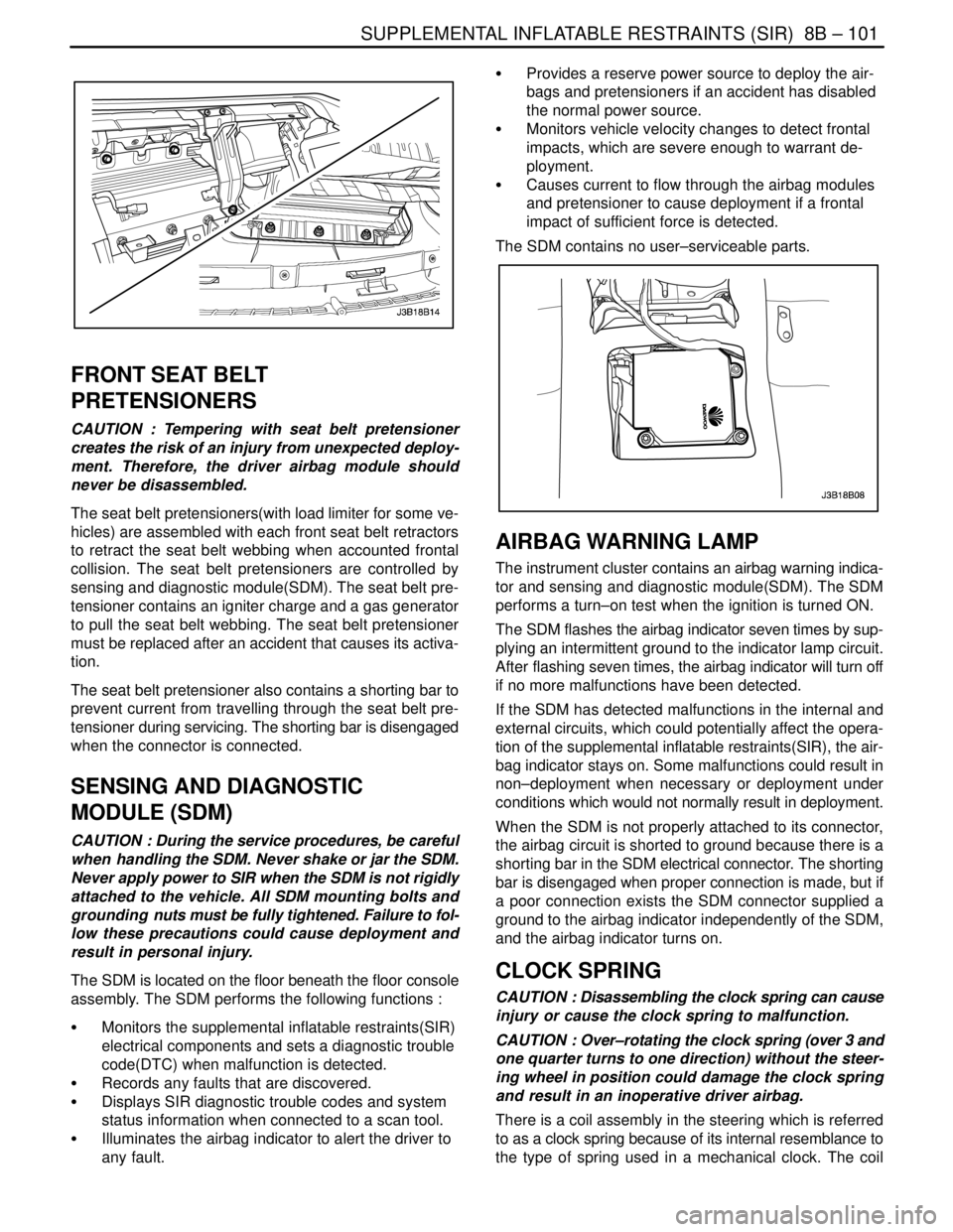
The SDM is located on the floor beneath the floor console
assembly. The SDM performs the following functions :
S Monitors the supplemental inflatable restraints(SIR)
electrical components and sets a diagnostic trouble
code(DTC) when malfunction is detected.
S Records any faults that are discovered.
S Displays SIR diagnostic trouble codes and system
status information when connected to a scan tool.
S Illuminates the airbag indicator to alert the driver to
any fault.S Provides a reserve power source to deploy the air-
bags and pretensioners if an accident has disabled
the normal power source.
S Monitors vehicle velocity changes to detect frontal
impacts, which are severe enough to warrant de-
ployment.
S Causes current to flow through the airbag modules
and pretensioner to cause deployment if a frontal
impact of sufficient force is detected.
The SDM contains no user–serviceable parts.
AIRBAG WARNING LAMP
The instrument cluster contains an airbag warning indica-
tor and sensing and diagnostic module(SDM). The SDM
performs a turn–on test when the ignition is turned ON.
The SDM flashes the airbag indicator seven times by sup-
plying an intermittent ground to the indicator lamp circuit.
After flashing seven times, the airbag indicator will turn off
if no more malfunctions have been detected.
If the SDM has detected malfunctions in the internal and
external circuits, which could potentially affect the opera-
tion of the supplemental inflatable restraints(SIR), the air-
bag indicator stays on. Some malfunctions could result in
non–deployment when necessary or deployment under
conditions which would not normally result in deployment.
When the SDM is not properly attached to its connector,
the airbag circuit is shorted to ground because there is a
shorting bar in the SDM electrical connector. The shorting
bar is disengaged when proper connection is made, but if
a poor connection exists the SDM connector supplied a
ground to the airbag indicator independently of the SDM,
and the airbag indicator turns on.
CLOCK SPRING
CAUTION : Disassembling the clock spring can cause
injury or cause the clock spring to malfunction.
CAUTION : Over–rotating the clock spring (over 3 and
one quarter turns to one direction) without the steer-
ing wheel in position could damage the clock spring
and result in an inoperative driver airbag.
There is a coil assembly in the steering which is referred
to as a clock spring because of its internal resemblance to
the type of spring used in a mechanical clock. The coil
Page 2228 of 2643

9B – 2ILIGHTING SYSTEMS
DAEWOO V–121 BL4
SPECIFICATIONS
BULB USAGE CHART
BulbReplacement Bulb Number
Backup Lamp21W
Center High–Mounted Stoplamp5W
Front Fog Lamp27W
Headlamp55W
Interior Courtesy Lamp10W
License Plate Lamp5W
Luggage Compartment Lamp10W
Park and Front Turn Signal LampDouble 21/5W
Rear Fog Lamp21W
Rear Turn Signal Lamp21W
Side Turn Signal Lamp5W
Taillamp and StoplampDouble 21/5W
FASTENER TIGHTENING SPECIFICATIONS
ApplicationNSmLb–FtLb–In
CHMSL Mounting Nuts4–35
Door Jamb Switch Screw4–35
Front Fog Lamp Nuts4–35
Headlamp Assembly Bolts and Nuts4–35
License Plate Lamp Screws4–35
Map Lamp Screws1.5–13
Rear Combination Lamp Assembly Screws4–35
Hatchback Extension Lamp3–27
Page 2262 of 2643
9B – 36ILITHING SYSTEMS
DAEWOO V–121 BL4
MAINTENANCE AND REPAIR
ON–VEHICLE SERVICE
HEADLAMPS/FRONT TURN SIGNAL
LAMPS
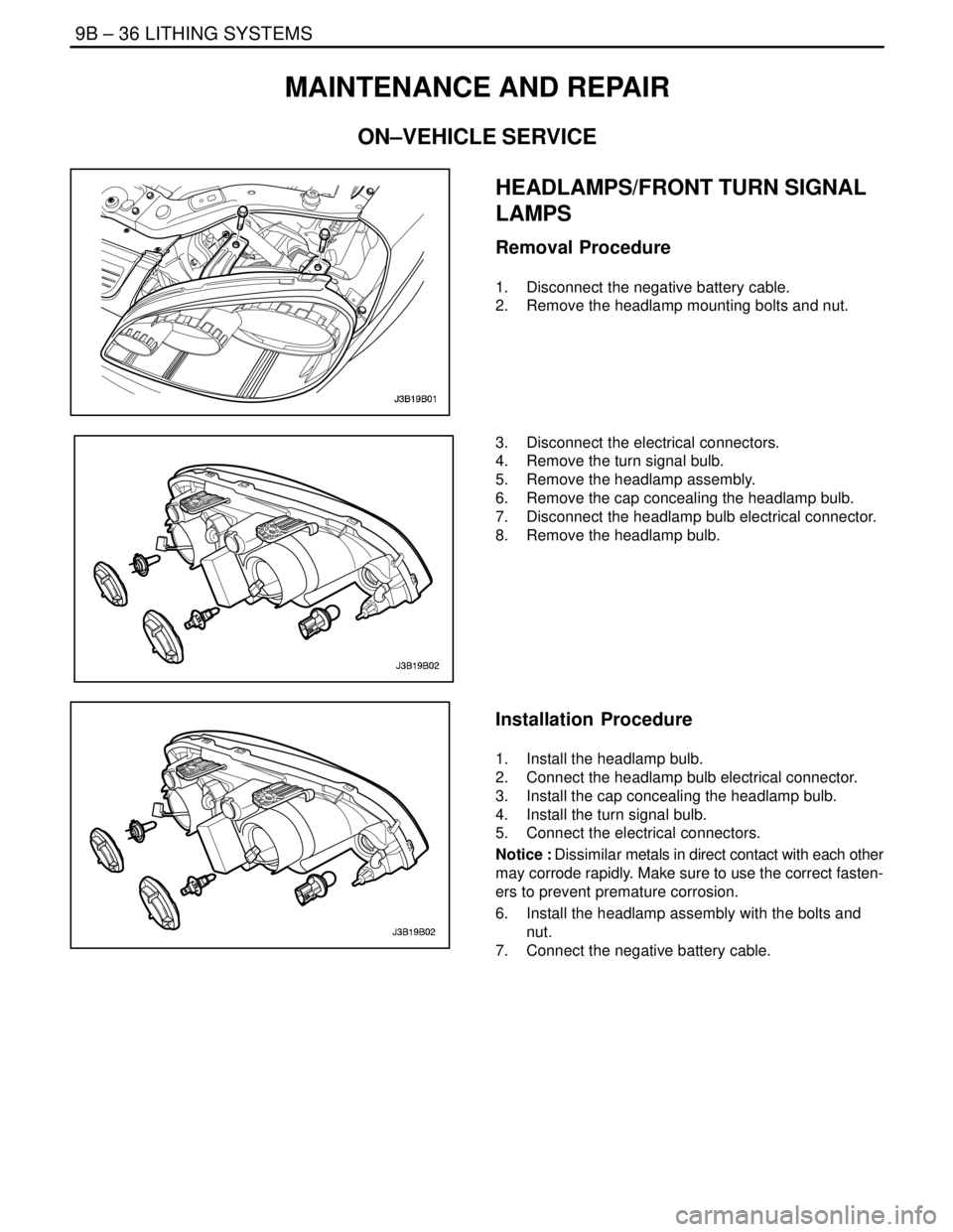
Removal Procedure
1. Disconnect the negative battery cable.
2. Remove the headlamp mounting bolts and nut.
3. Disconnect the electrical connectors.
4. Remove the turn signal bulb.
5. Remove the headlamp assembly.
6. Remove the cap concealing the headlamp bulb.
7. Disconnect the headlamp bulb electrical connector.
8. Remove the headlamp bulb.
Installation Procedure
1. Install the headlamp bulb.
2. Connect the headlamp bulb electrical connector.
3. Install the cap concealing the headlamp bulb.
4. Install the turn signal bulb.
5. Connect the electrical connectors.
Notice : Dissimilar metals in direct contact with each other
may corrode rapidly. Make sure to use the correct fasten-
ers to prevent premature corrosion.
6. Install the headlamp assembly with the bolts and
nut.
7. Connect the negative battery cable.
Page 2263 of 2643
LITHING SYSTEMS 9B – 37
DAEWOO V–121 BL4
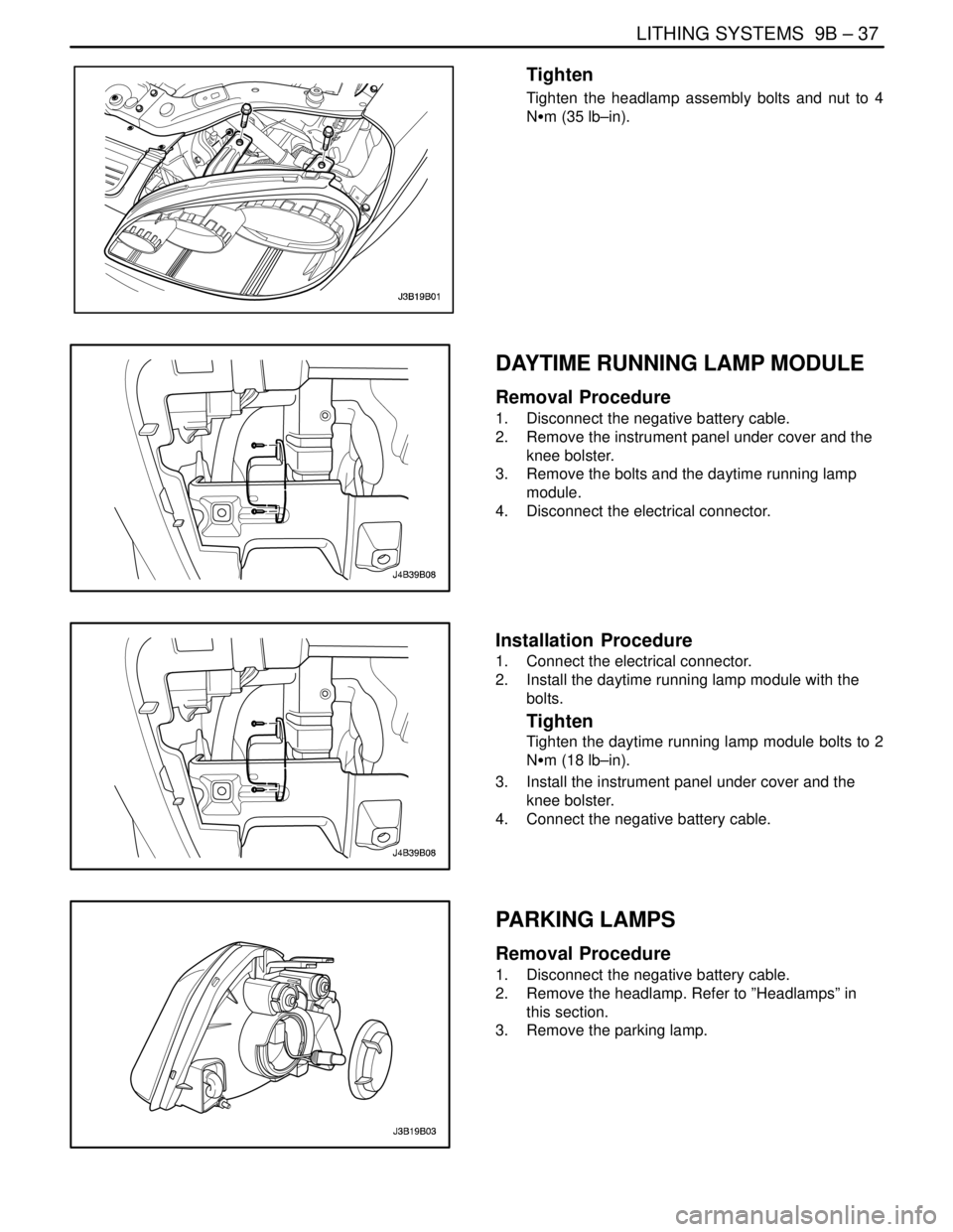
Tighten
Tighten the headlamp assembly bolts and nut to 4
NSm (35 lb–in).
DAYTIME RUNNING LAMP MODULE
Removal Procedure
1. Disconnect the negative battery cable.
2. Remove the instrument panel under cover and the
knee bolster.
3. Remove the bolts and the daytime running lamp
module.
4. Disconnect the electrical connector.
Installation Procedure
1. Connect the electrical connector.
2. Install the daytime running lamp module with the
bolts.
Tighten
Tighten the daytime running lamp module bolts to 2
NSm (18 lb–in).
3. Install the instrument panel under cover and the
knee bolster.
4. Connect the negative battery cable.
PARKING LAMPS
Removal Procedure
1. Disconnect the negative battery cable.
2. Remove the headlamp. Refer to ”Headlamps” in
this section.
3. Remove the parking lamp.
Page 2265 of 2643
LITHING SYSTEMS 9B – 39
DAEWOO V–121 BL4
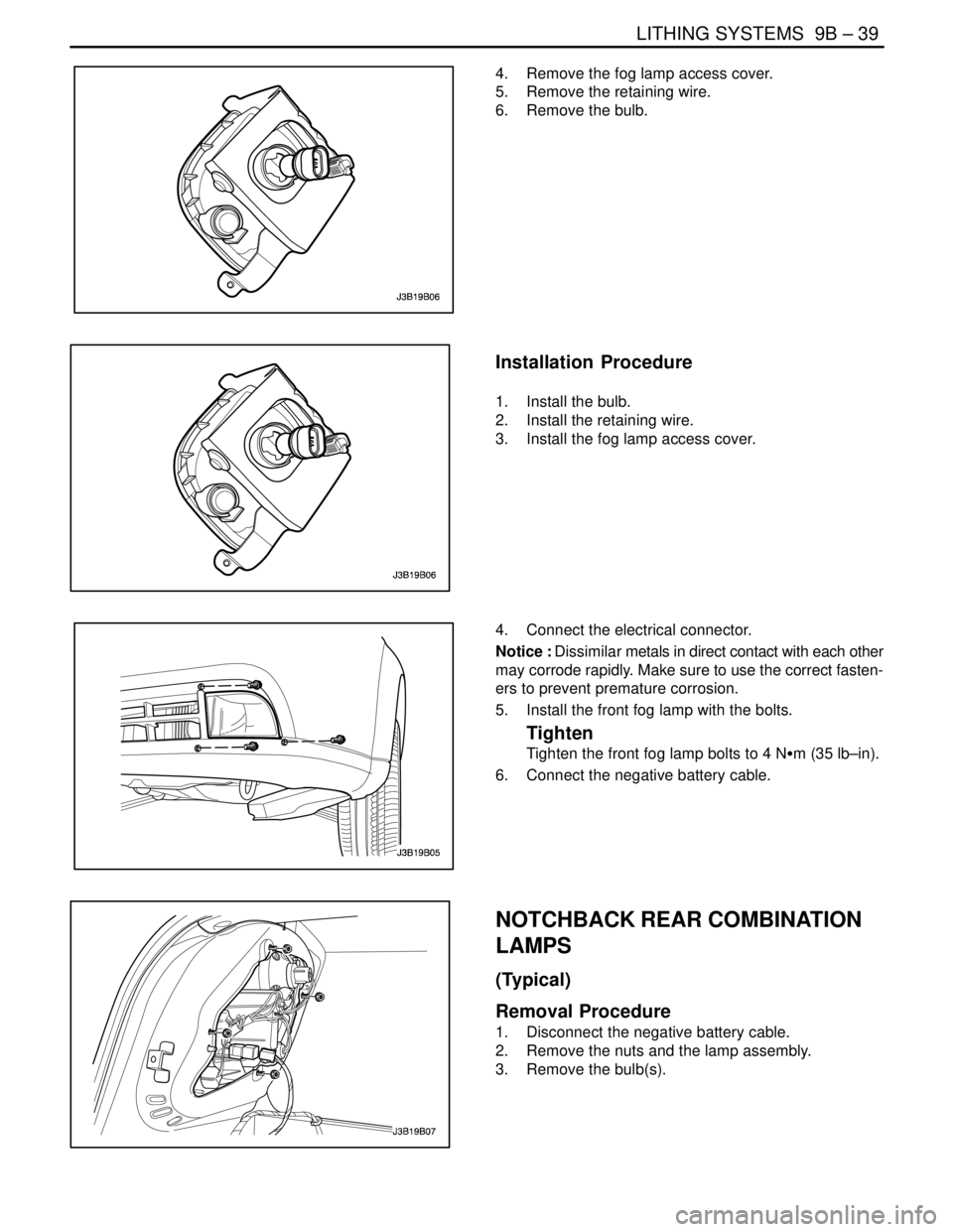
4. Remove the fog lamp access cover.
5. Remove the retaining wire.
6. Remove the bulb.
Installation Procedure
1. Install the bulb.
2. Install the retaining wire.
3. Install the fog lamp access cover.
4. Connect the electrical connector.
Notice : Dissimilar metals in direct contact with each other
may corrode rapidly. Make sure to use the correct fasten-
ers to prevent premature corrosion.
5. Install the front fog lamp with the bolts.
Tighten
Tighten the front fog lamp bolts to 4 NSm (35 lb–in).
6. Connect the negative battery cable.
NOTCHBACK REAR COMBINATION
LAMPS
(Typical)
Removal Procedure
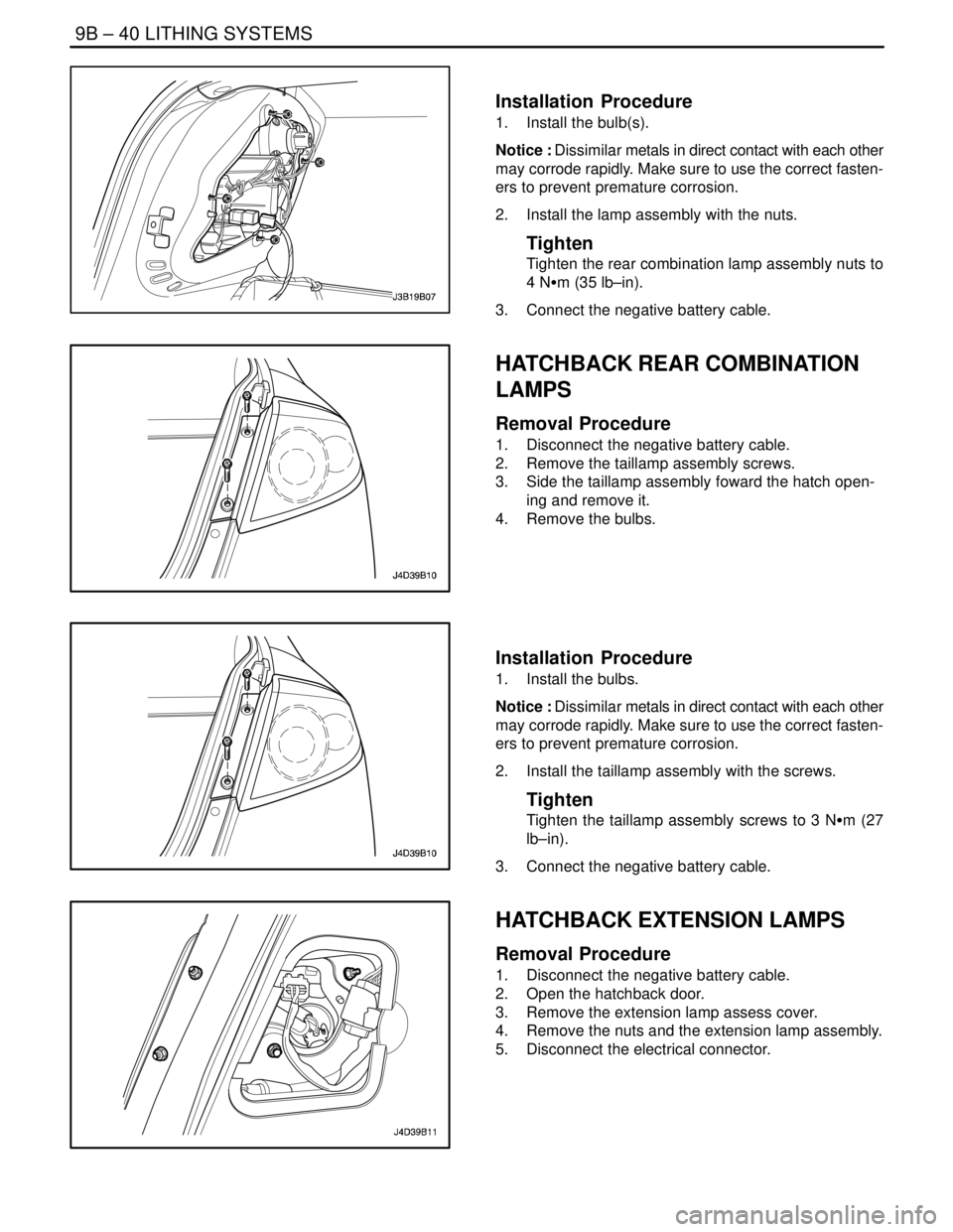
1. Disconnect the negative battery cable.
2. Remove the nuts and the lamp assembly.
3. Remove the bulb(s).
Page 2266 of 2643
9B – 40ILITHING SYSTEMS
DAEWOO V–121 BL4
Installation Procedure
1. Install the bulb(s).
Notice : Dissimilar metals in direct contact with each other
may corrode rapidly. Make sure to use the correct fasten-
ers to prevent premature corrosion.
2. Install the lamp assembly with the nuts.
Tighten
Tighten the rear combination lamp assembly nuts to
4 NSm (35 lb–in).
3. Connect the negative battery cable.
HATCHBACK REAR COMBINATION
LAMPS
Removal Procedure
1. Disconnect the negative battery cable.
2. Remove the taillamp assembly screws.
3. Side the taillamp assembly foward the hatch open-
ing and remove it.
4. Remove the bulbs.
Installation Procedure
1. Install the bulbs.
Notice : Dissimilar metals in direct contact with each other
may corrode rapidly. Make sure to use the correct fasten-
ers to prevent premature corrosion.
2. Install the taillamp assembly with the screws.
Tighten
Tighten the taillamp assembly screws to 3 NSm (27
lb–in).
3. Connect the negative battery cable.
HATCHBACK EXTENSION LAMPS
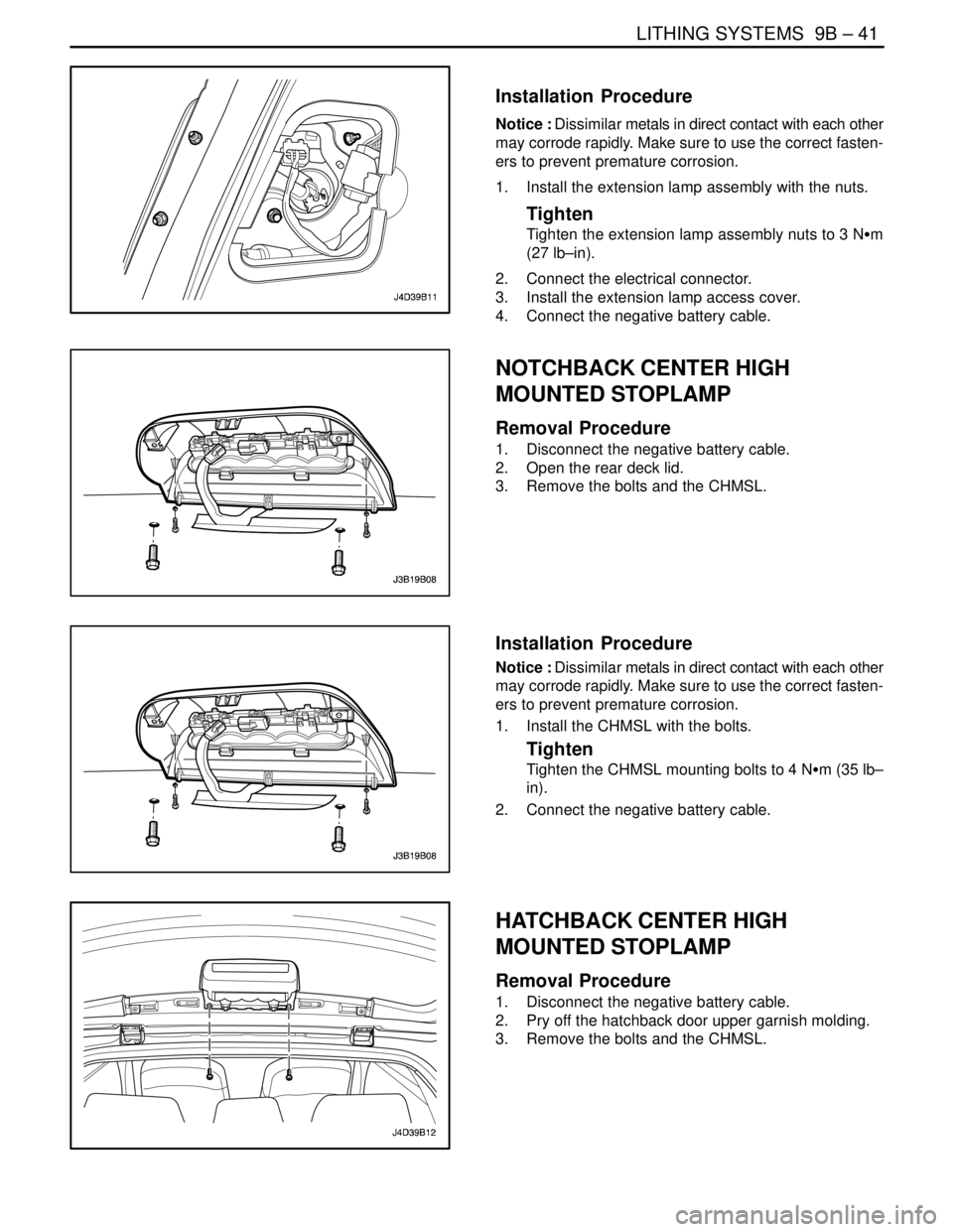
Removal Procedure
1. Disconnect the negative battery cable.
2. Open the hatchback door.
3. Remove the extension lamp assess cover.
4. Remove the nuts and the extension lamp assembly.
5. Disconnect the electrical connector.
Page 2267 of 2643
LITHING SYSTEMS 9B – 41
DAEWOO V–121 BL4
Installation Procedure
Notice : Dissimilar metals in direct contact with each other
may corrode rapidly. Make sure to use the correct fasten-
ers to prevent premature corrosion.
1. Install the extension lamp assembly with the nuts.
Tighten
Tighten the extension lamp assembly nuts to 3 NSm
(27 lb–in).
2. Connect the electrical connector.
3. Install the extension lamp access cover.
4. Connect the negative battery cable.
NOTCHBACK CENTER HIGH
MOUNTED STOPLAMP
Removal Procedure
1. Disconnect the negative battery cable.
2. Open the rear deck lid.
3. Remove the bolts and the CHMSL.
Installation Procedure
Notice : Dissimilar metals in direct contact with each other
may corrode rapidly. Make sure to use the correct fasten-
ers to prevent premature corrosion.
1. Install the CHMSL with the bolts.
Tighten
Tighten the CHMSL mounting bolts to 4 NSm (35 lb–
in).
2. Connect the negative battery cable.
HATCHBACK CENTER HIGH
MOUNTED STOPLAMP
Removal Procedure
1. Disconnect the negative battery cable.
2. Pry off the hatchback door upper garnish molding.
3. Remove the bolts and the CHMSL.
Page 2278 of 2643

SECTION : 9D
WIPERS/WASHER SYSTEMS
CAUTION : Disconnect the negative battery cable before removing or installing any electrical unit or when a tool
or equipment could easily come in contact with exposed electrical terminals. Disconnecting this cable will help
prevent personal injury and damage to the vehicle. The ignition must also be in LOCK unless otherwise noted.
TABLE OF CONTENTS
SPECIFICATIONS9D–1 . . . . . . . . . . . . . . . . . . . . . . . . . .
Fastener Tightening Specifications 9D–1. . . . . . . . . . .
SCHEMATIC AND ROUTING DIAGRAMS9D–2 . . . . .
Wipers and Washer System 9D–2. . . . . . . . . . . . . . . . .
Wipers and Washer System 9D–3. . . . . . . . . . . . . . . . .
Wipers and Washer System (HatchBack) 9D–4. . . . .
Wipers and Washer System (HatchBack) 9D–5. . . . .
DIAGNOSIS9D–6 . . . . . . . . . . . . . . . . . . . . . . . . . . . . . . . .
Windshield Wipers 9D–6. . . . . . . . . . . . . . . . . . . . . . . . .
Windshield Washer System 9D–10. . . . . . . . . . . . . . . .
Rear Window Wiper (Hatchback) 9D–11. . . . . . . . . . .
Rear Window Washer System (Hatchback) 9D–13. . .
MAINTENANCE AND REPAIR9D–14 . . . . . . . . . . . . . .
ON–VEHICLE SERVICE 9D–14. . . . . . . . . . . . . . . . . . . .
Windshield Wiper Arm 9D–14. . . . . . . . . . . . . . . . . . . . . Windshield Wiper Motor 9D–14. . . . . . . . . . . . . . . . . . .
Windshield Wiper Blade 9D–15. . . . . . . . . . . . . . . . . . .
Windshield Wiper Blade Insert 9D–16. . . . . . . . . . . . . .
Windshield Washer Reservoir 9D–16. . . . . . . . . . . . . .
Windshield Washer Pump(s) 9D–17. . . . . . . . . . . . . . .
Windshield Washer Nozzles 9D–18. . . . . . . . . . . . . . . .
Windshield Washer Hoses 9D–18. . . . . . . . . . . . . . . . .
Rear Window Wiper Arm (HATCHBACK) 9D–19. . . .
Rear Window Wiper Motor (HATCHBACK) 9D–20. . .
Rear Window Washer Nozzle (HATCHBACK) 9D–20
GENERAL DESCRIPTION AND SYSTEM
OPERATION9D–22 . . . . . . . . . . . . . . . . . . . . . . . . . . . . .
Windshield Wiper System 9D–22. . . . . . . . . . . . . . . . . .
Windshield Washer System 9D–22. . . . . . . . . . . . . . . .
Rear Window Wiper/Washer System 9D–22. . . . . . . .
SPECIFICATIONS
FASTENER TIGHTENING SPECIFICATIONS
ApplicationNSmLb–FtLb–In
Front Wheel Well Splash Shield Bolts1.5–13
Washer Fluid Reservoir Bolts8–71
Wiper Arm Linkage Nut5–44
Wiper Arm Nut2216–
Wiper Motor Bolts8–71
Rear Wiper Arm Nut11–97