nut DAEWOO NUBIRA 2004 Service Repair Manual
[x] Cancel search | Manufacturer: DAEWOO, Model Year: 2004, Model line: NUBIRA, Model: DAEWOO NUBIRA 2004Pages: 2643, PDF Size: 80.54 MB
Page 2365 of 2643
SEATS 9H – 9
DAEWOO V–121 BL4
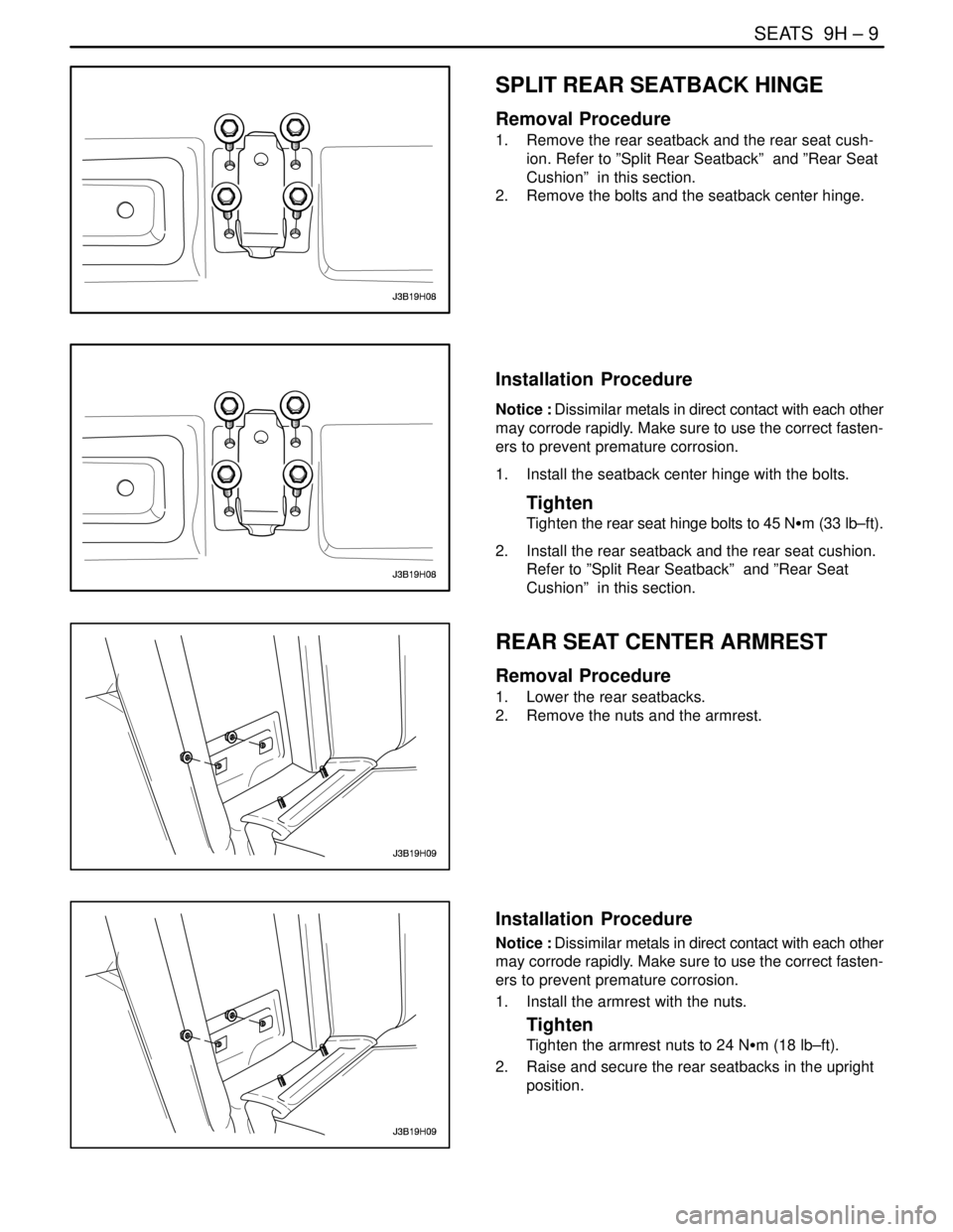
SPLIT REAR SEATBACK HINGE
Removal Procedure
1. Remove the rear seatback and the rear seat cush-
ion. Refer to ”Split Rear Seatback” and ”Rear Seat
Cushion” in this section.
2. Remove the bolts and the seatback center hinge.
Installation Procedure
Notice : Dissimilar metals in direct contact with each other
may corrode rapidly. Make sure to use the correct fasten-
ers to prevent premature corrosion.
1. Install the seatback center hinge with the bolts.
Tighten
Tighten the rear seat hinge bolts to 45 NSm (33 lb–ft).
2. Install the rear seatback and the rear seat cushion.
Refer to ”Split Rear Seatback” and ”Rear Seat
Cushion” in this section.
REAR SEAT CENTER ARMREST
Removal Procedure
1. Lower the rear seatbacks.
2. Remove the nuts and the armrest.
Installation Procedure
Notice : Dissimilar metals in direct contact with each other
may corrode rapidly. Make sure to use the correct fasten-
ers to prevent premature corrosion.
1. Install the armrest with the nuts.
Tighten
Tighten the armrest nuts to 24 NSm (18 lb–ft).
2. Raise and secure the rear seatbacks in the upright
position.
Page 2369 of 2643

SECTION : 9I
WATERLEAKS
TABLE OF CONTENTS
SPECIFICATIONS9I–1 . . . . . . . . . . . . . . . . . . . . . . . . . . .
Recommended Materials for Waterleak Repairs 9I–1.
Watertest Stand Specifications 9I–1. . . . . . . . . . . . . . .
DIAGNOSIS9I–2 . . . . . . . . . . . . . . . . . . . . . . . . . . . . . . . . . Waterleak Diagnosis 9I–2. . . . . . . . . . . . . . . . . . . . . . . .
MAINTENANCE AND REPAIR9I–5 . . . . . . . . . . . . . . . .
ON–VEHICLE SERVICE 9I–5. . . . . . . . . . . . . . . . . . . . . .
Waterleak Repair 9I–5. . . . . . . . . . . . . . . . . . . . . . . . . . .
SPECIFICATIONS
RECOMMENDED MATERIALS FOR WATERLEAK
REPAIRS
Leak Areas Repair Materials
Windshield, back windowUrethane adhesive, caulking kit, or the equivalent
Metal jointsBrushable seam sealer which can be painted
Ventilation ducts3Mnv Auto Bedding and Glazing Compound or the equiva-
lent
Small cracks and pin holes3Mnv Drip–Check Sealer or the equivalent
Large holes3Mnv Automotive Joint and Seam Sealer
Weatherstrips3Mnv 08011 Weatherstrip Adhesive or the equivalent
Bolts, studs, and screwsStrip caulk
WATERTEST STAND SPECIFICATIONS
ApplicationDescription
Nozzle TypeFull jet spray nozzle #1/2 GG–25 or equivalent with a 60°
included angle
Nozzle HeightApproximately 1 600 mm (63.0 in.) from the floor
Volume of Flow14L (3.7 gal) per minute
Pressure155 kPa (22.5 psi) measured at the nozzle
Windshield and A–Pillar Test Stand PositionApproximately 30° down, 45° toward the rear, and aimed
at the corner of the windshield
B–Pillar Test Stand PositionApproximately 30° down, 45° toward the rear, and aimed
at the center of the rear door
Back Window and Rear Deck Lid Test Stand PositionApproximately 30° down, 30° toward the front and aimed
approximately 610 mm (24.0 in.) from the corner of the
back window
Page 2374 of 2643
9I – 6IWATERLEAKS
DAEWOO V–121 BL4
8. Allow the primer to dry for 5 minutes.
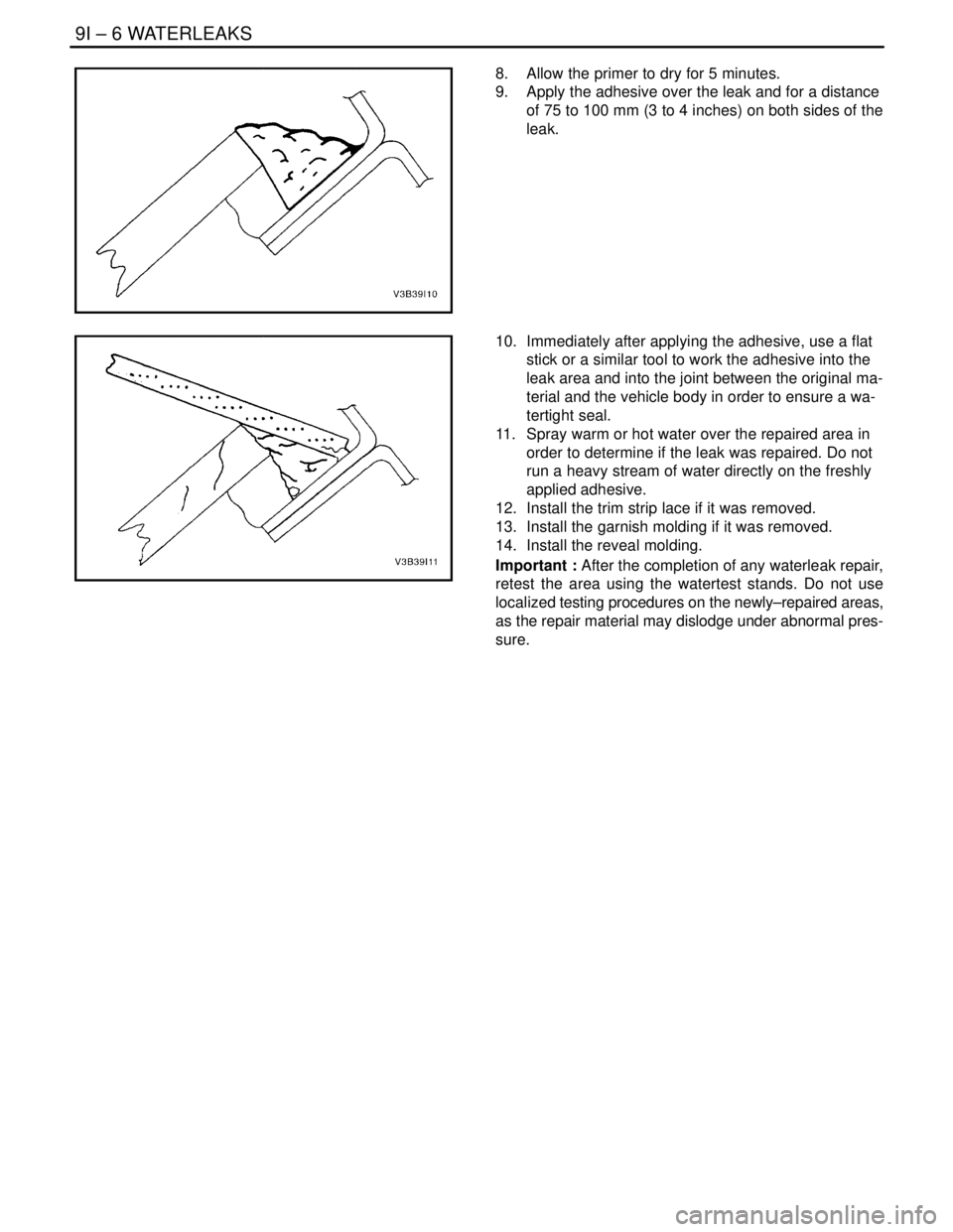
9. Apply the adhesive over the leak and for a distance
of 75 to 100 mm (3 to 4 inches) on both sides of the
leak.
10. Immediately after applying the adhesive, use a flat
stick or a similar tool to work the adhesive into the
leak area and into the joint between the original ma-
terial and the vehicle body in order to ensure a wa-
tertight seal.
11. Spray warm or hot water over the repaired area in
order to determine if the leak was repaired. Do not
run a heavy stream of water directly on the freshly
applied adhesive.
12. Install the trim strip lace if it was removed.
13. Install the garnish molding if it was removed.
14. Install the reveal molding.
Important : After the completion of any waterleak repair,
retest the area using the watertest stands. Do not use
localized testing procedures on the newly–repaired areas,
as the repair material may dislodge under abnormal pres-
sure.
Page 2378 of 2643

9K – 2ISQUEAKS AND RATTLES
DAEWOO V–121 BL4
Glass Knock Coming From the Rear of the Vehicle When Driving
Over Bumps
ChecksAction
Check for an out–of–adjustment hatchback latch.S Test drive the vehicle in order to verify this condition.
S Loosen the latch nuts and adjust the latch downward.
Rattle Coming From Door
Checks Action
Check the door lock solenoid.S Remove the door trim panel and check if the sole-
noid is loose.
S Tighten the solenoid bolts.
Check for rattling electrical connectors inside the door trim
panel.S Tap on the trim panel and listen for a rattle.
S Remove the trim panel and wrap foam padding
around the connectors as required.
Squeak When Operating Doors
ChecksAction
Check for a lack of lubrication of the door hinge pins.S Operate the doors and listen for squeaks.
S Lubricate the door hinge pins with light oil and coat
with lithium grease.
Squeak Coming From Console When Shifting Manual Transaxle
(Condition Occurs In Cold Weather with a Cold Engine)
Checks Action
Check the manual transaxle control lever lower boot.S Move the control lever between gears and listen for
squeaks.
S Remove the floor console and replace the lower shift
boot or apply talcum powder to the lower shift boot.
Buzz From the Left Side of Instrument Panel
ChecksAction
Check for vibration of the fuse box cover against the instru-
ment panel side trim.S Tap on the cover with a finger and listen for a buzz.
S Apply 6.35 mm (0.250 inch) by 25.4 mm (1.00 inch)
felt pads to the side trim where the cover makes con-
tact.
Squeak Coming From Instrument Cluster Trim Plate
Checks Action
Check for rubbing of the cluster trim plate on the instru-
ment panel.S Test drive the vehicle in order to verify this condition.
S Remove the instrument cluster trim plate and install
felt tape to the edges.
Page 2393 of 2643
9L – 14IGLASS AND MIRRORS
DAEWOO V–121 BL4
5. Buff the grid lines that are to be repaired with steel
wool. Wipe the lines clean using a cloth dampened
with alcohol. Buff and clean about 6 mm (0.25 inch)
beyond each side of the break in the grid line.
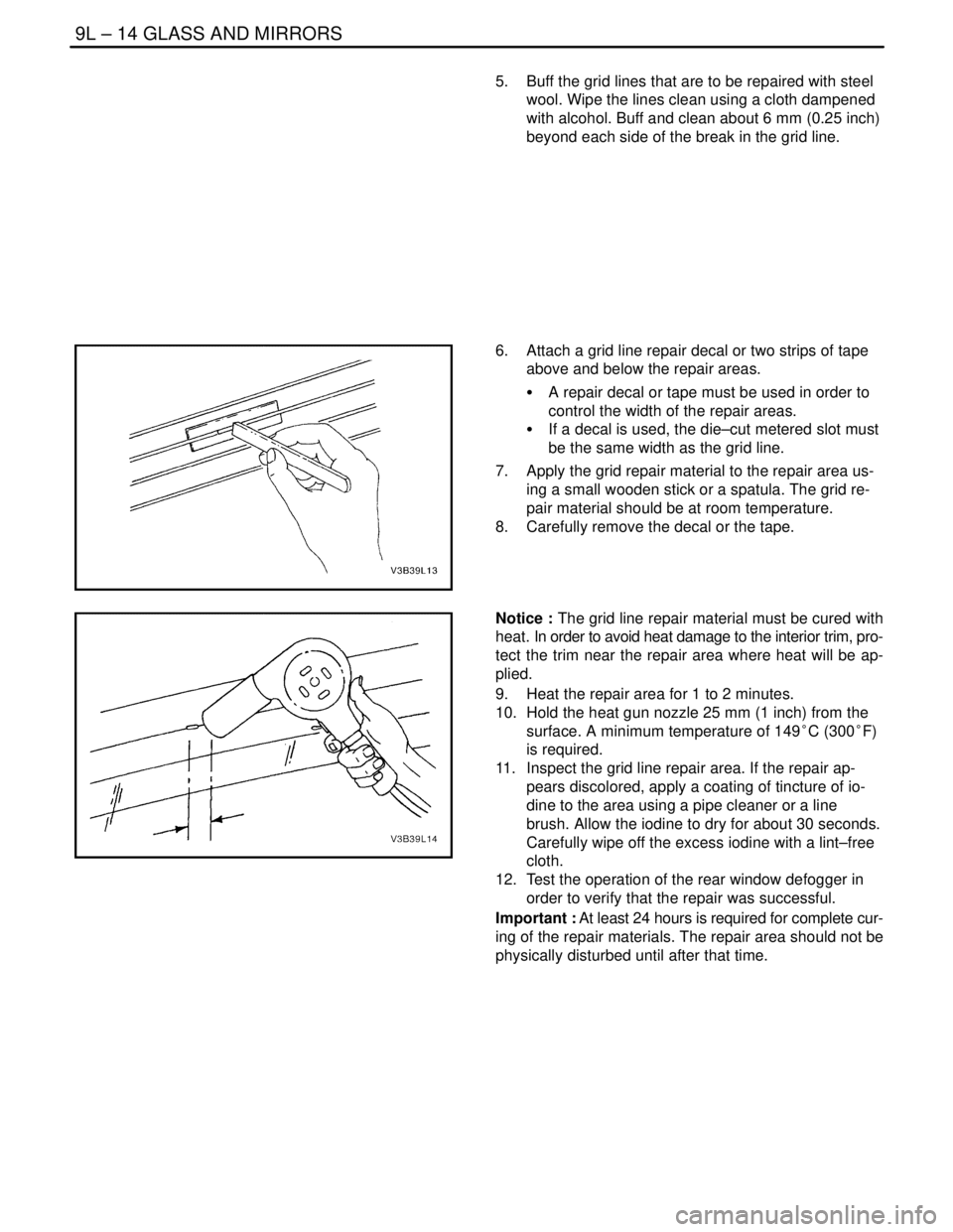
6. Attach a grid line repair decal or two strips of tape
above and below the repair areas.
S A repair decal or tape must be used in order to
control the width of the repair areas.
S If a decal is used, the die–cut metered slot must
be the same width as the grid line.
7. Apply the grid repair material to the repair area us-
ing a small wooden stick or a spatula. The grid re-
pair material should be at room temperature.
8. Carefully remove the decal or the tape.
Notice : The grid line repair material must be cured with
heat. In order to avoid heat damage to the interior trim, pro-
tect the trim near the repair area where heat will be ap-
plied.
9. Heat the repair area for 1 to 2 minutes.
10. Hold the heat gun nozzle 25 mm (1 inch) from the
surface. A minimum temperature of 149°C (300°F)
is required.
11. Inspect the grid line repair area. If the repair ap-
pears discolored, apply a coating of tincture of io-
dine to the area using a pipe cleaner or a line
brush. Allow the iodine to dry for about 30 seconds.
Carefully wipe off the excess iodine with a lint–free
cloth.
12. Test the operation of the rear window defogger in
order to verify that the repair was successful.
Important : At least 24 hours is required for complete cur-
ing of the repair materials. The repair area should not be
physically disturbed until after that time.
Page 2395 of 2643
9L – 16IGLASS AND MIRRORS
DAEWOO V–121 BL4
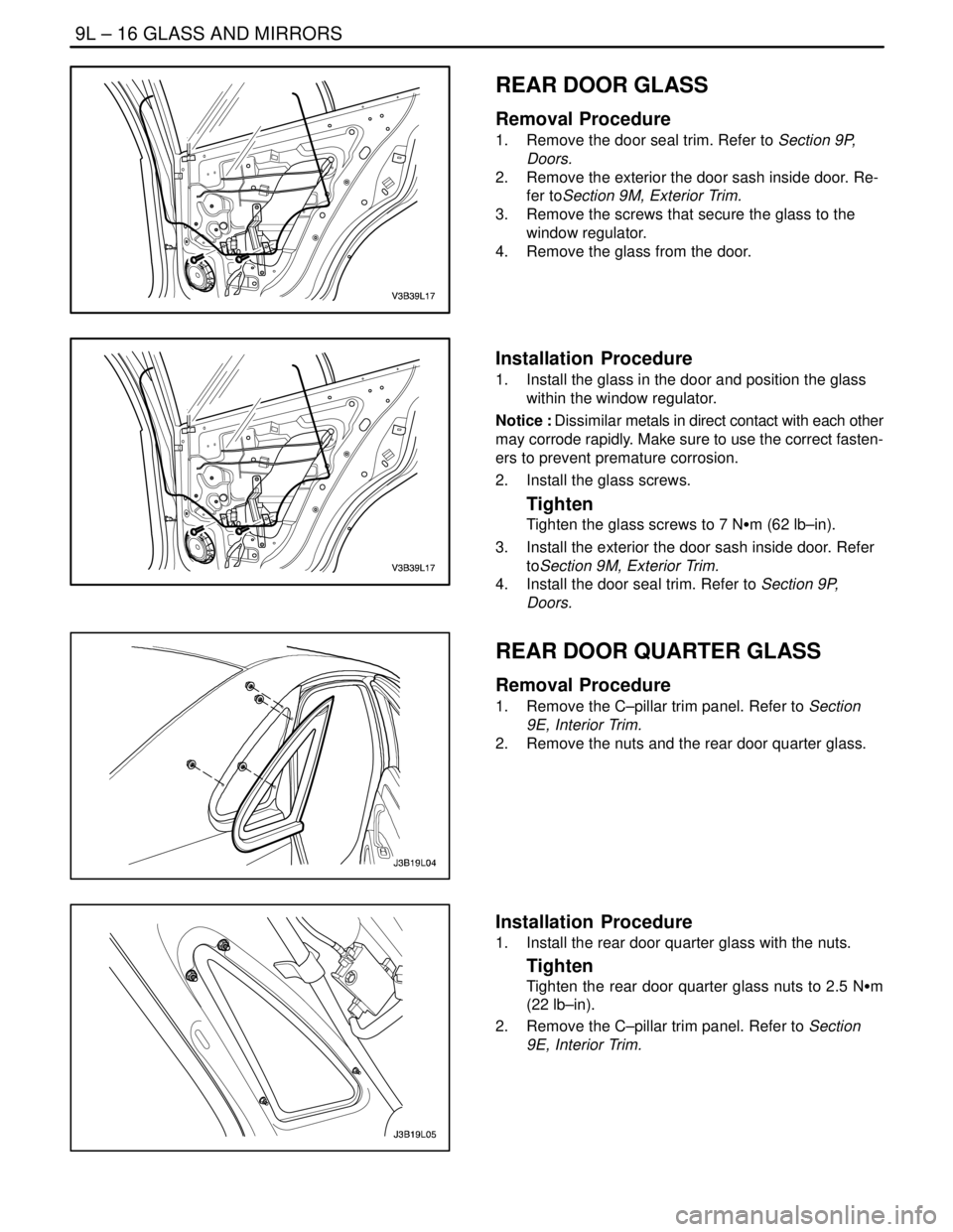
REAR DOOR GLASS
Removal Procedure
1. Remove the door seal trim. Refer to Section 9P,
Doors.
2. Remove the exterior the door sash inside door. Re-
fer toSection 9M, Exterior Trim.
3. Remove the screws that secure the glass to the
window regulator.
4. Remove the glass from the door.
Installation Procedure
1. Install the glass in the door and position the glass
within the window regulator.
Notice : Dissimilar metals in direct contact with each other
may corrode rapidly. Make sure to use the correct fasten-
ers to prevent premature corrosion.
2. Install the glass screws.
Tighten
Tighten the glass screws to 7 NSm (62 lb–in).
3. Install the exterior the door sash inside door. Refer
toSection 9M, Exterior Trim.
4. Install the door seal trim. Refer to Section 9P,
Doors.
REAR DOOR QUARTER GLASS
Removal Procedure
1. Remove the C–pillar trim panel. Refer to Section
9E, Interior Trim.
2. Remove the nuts and the rear door quarter glass.
Installation Procedure
1. Install the rear door quarter glass with the nuts.
Tighten
Tighten the rear door quarter glass nuts to 2.5 NSm
(22 lb–in).
2. Remove the C–pillar trim panel. Refer to Section
9E, Interior Trim.
Page 2396 of 2643
GLASS AND MIRRORS 9L – 17
DAEWOO V–121 BL4
INSIDE REARVIEW MIRROR
The inside rearview mirror is attached to a support which
is secured to the windshield glass. The support is installed
by the glass supplier using a plastic–polyvinyl butyl adhe-
sive.
Service replacement windshield glass has the mirror sup-
port bonded to the glass assembly. In order to install a de-
tached mirror support or to install a new part, the following
items will be needed:
S Loctite® Minute–Bond Adhesive.
S Original or replacement mirror support.
S Wax marking pencil or crayon.
S Rubbing alcohol.
S Clean paper towel.
S Fine grit sandpaper (grit #320 or #360).
S 2 mm allen wrench.
Installation Procedure
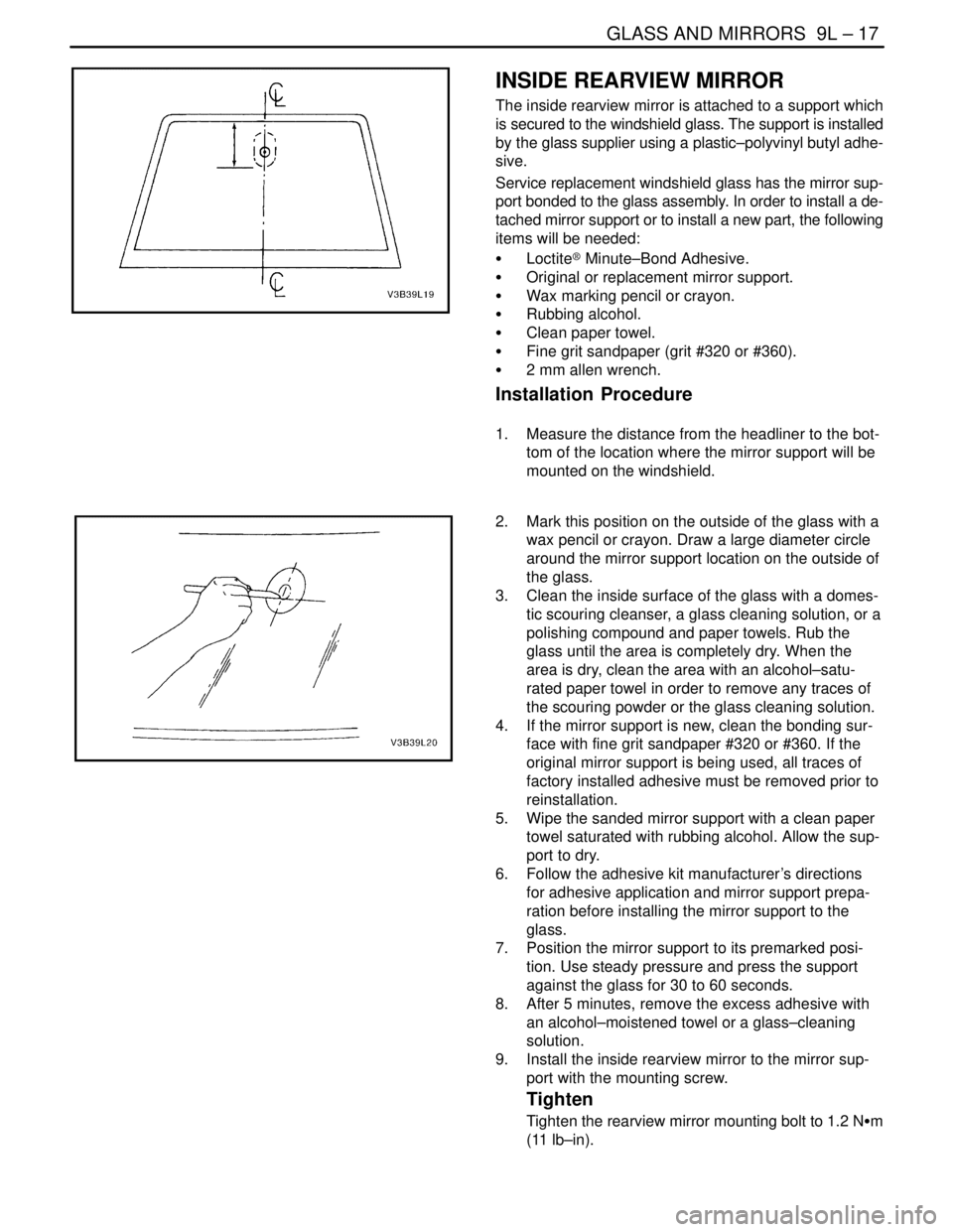
1. Measure the distance from the headliner to the bot-
tom of the location where the mirror support will be
mounted on the windshield.
2. Mark this position on the outside of the glass with a
wax pencil or crayon. Draw a large diameter circle
around the mirror support location on the outside of
the glass.
3. Clean the inside surface of the glass with a domes-
tic scouring cleanser, a glass cleaning solution, or a
polishing compound and paper towels. Rub the
glass until the area is completely dry. When the
area is dry, clean the area with an alcohol–satu-
rated paper towel in order to remove any traces of
the scouring powder or the glass cleaning solution.
4. If the mirror support is new, clean the bonding sur-
face with fine grit sandpaper #320 or #360. If the
original mirror support is being used, all traces of
factory installed adhesive must be removed prior to
reinstallation.
5. Wipe the sanded mirror support with a clean paper
towel saturated with rubbing alcohol. Allow the sup-
port to dry.
6. Follow the adhesive kit manufacturer’s directions
for adhesive application and mirror support prepa-
ration before installing the mirror support to the
glass.
7. Position the mirror support to its premarked posi-
tion. Use steady pressure and press the support
against the glass for 30 to 60 seconds.
8. After 5 minutes, remove the excess adhesive with
an alcohol–moistened towel or a glass–cleaning
solution.
9. Install the inside rearview mirror to the mirror sup-
port with the mounting screw.
Tighten
Tighten the rearview mirror mounting bolt to 1.2 NSm
(11 lb–in).
Page 2402 of 2643
9M – 4IEXTERIOR TRIM
DAEWOO V–121 BL4
J4D39M01
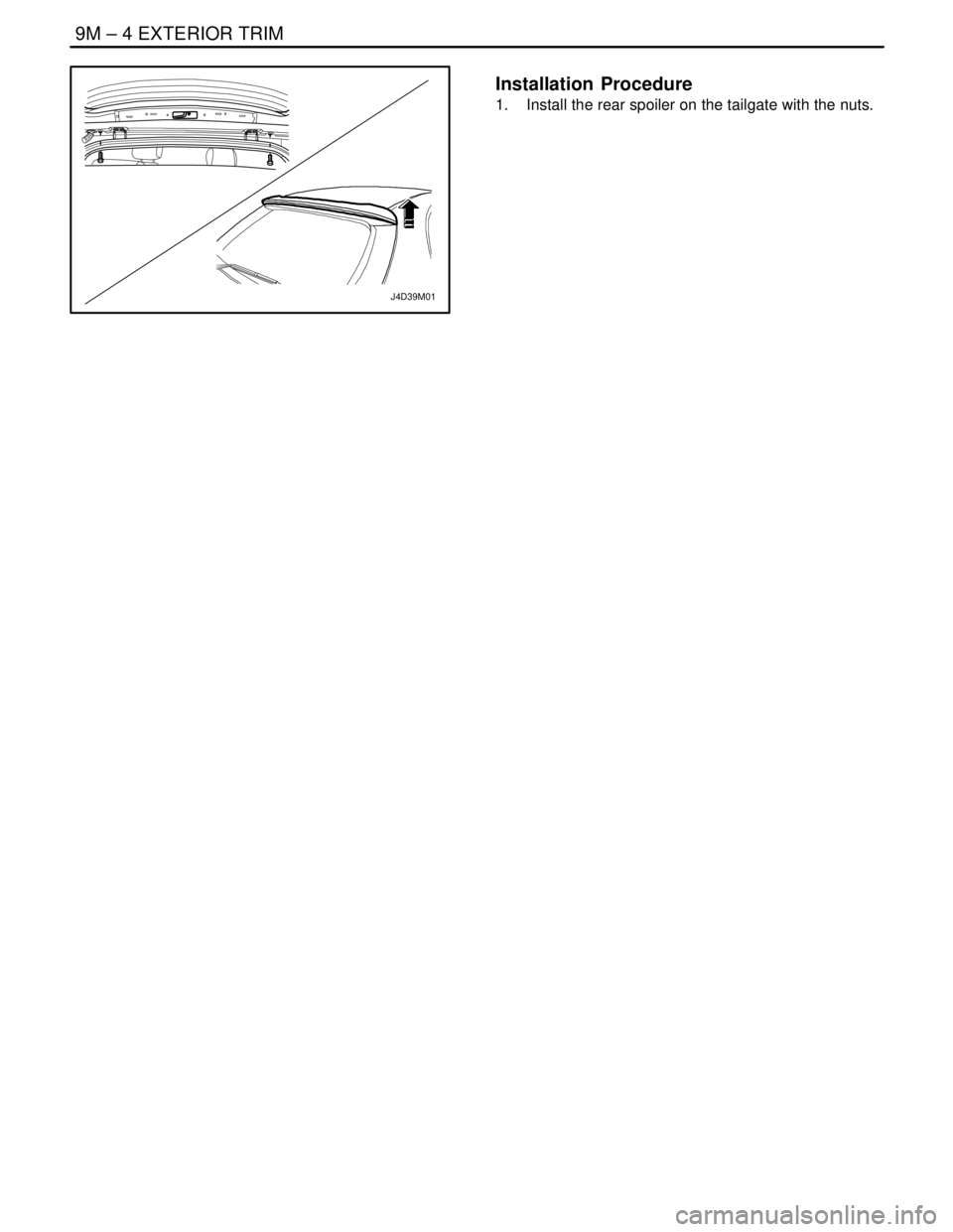
Installation Procedure
1. Install the rear spoiler on the tailgate with the nuts.
Page 2416 of 2643
BUMPERS AND FASCIAS 9O – 5
DAEWOO V–121 BL4
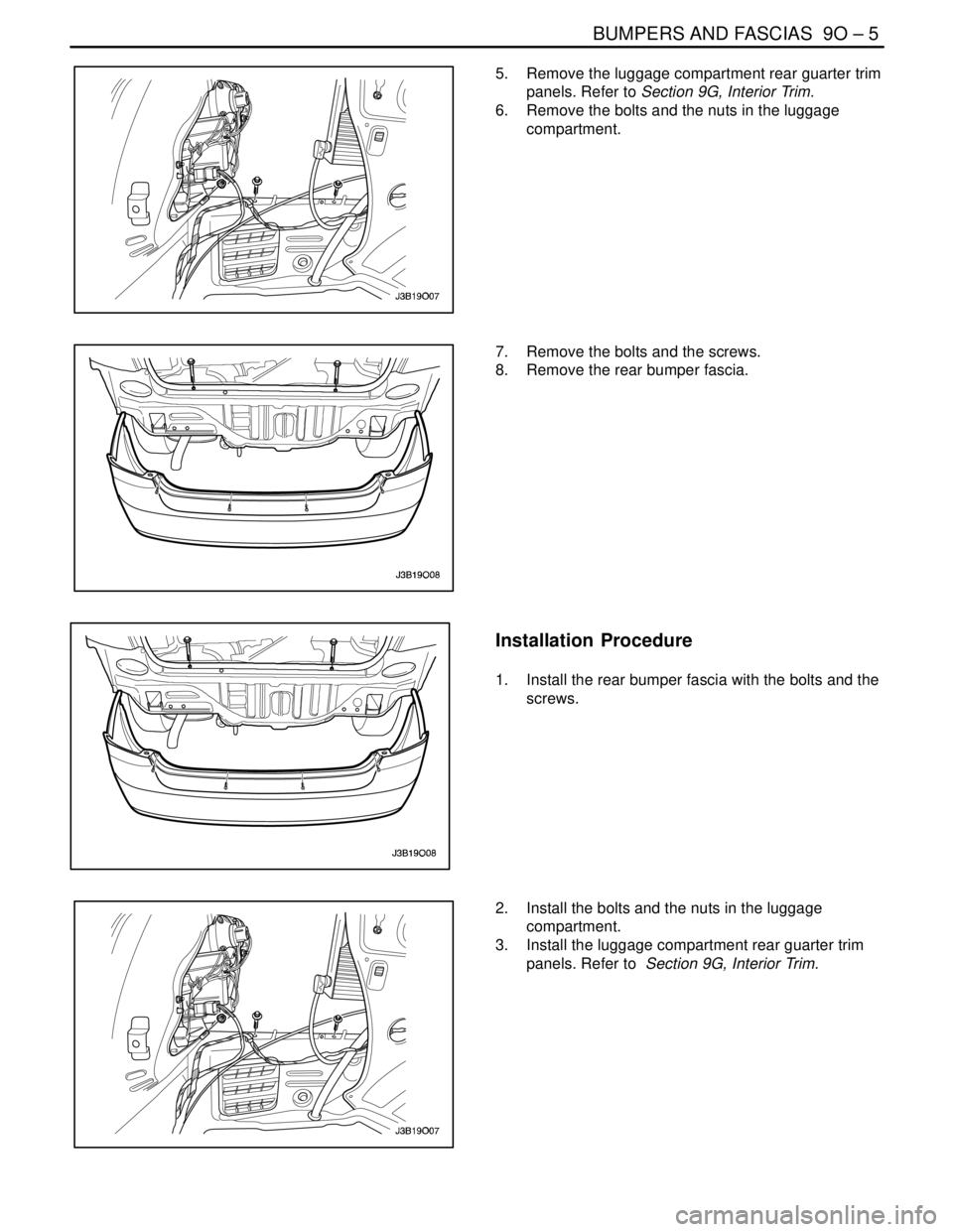
5. Remove the luggage compartment rear guarter trim
panels. Refer to Section 9G, Interior Trim.
6. Remove the bolts and the nuts in the luggage
compartment.
7. Remove the bolts and the screws.
8. Remove the rear bumper fascia.
Installation Procedure
1. Install the rear bumper fascia with the bolts and the
screws.
2. Install the bolts and the nuts in the luggage
compartment.
3. Install the luggage compartment rear guarter trim
panels. Refer to Section 9G, Interior Trim.
Page 2417 of 2643
9O – 6IBUMPERS AND FASCIAS
DAEWOO V–121 BL4
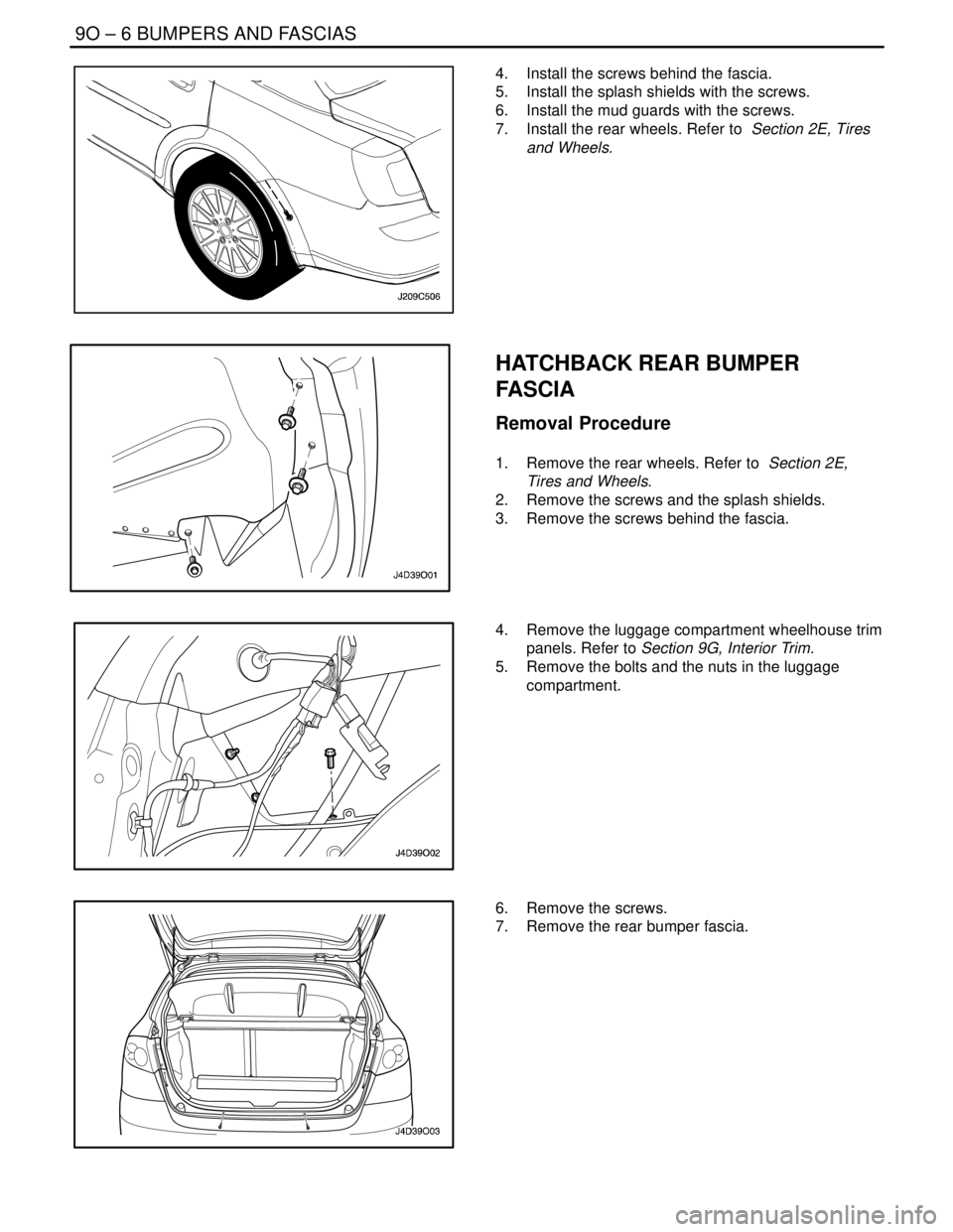
4. Install the screws behind the fascia.
5. Install the splash shields with the screws.
6. Install the mud guards with the screws.
7. Install the rear wheels. Refer to Section 2E, Tires
and Wheels.
HATCHBACK REAR BUMPER
FASCIA
Removal Procedure
1. Remove the rear wheels. Refer to Section 2E,
Tires and Wheels.
2. Remove the screws and the splash shields.
3. Remove the screws behind the fascia.
4. Remove the luggage compartment wheelhouse trim
panels. Refer to Section 9G, Interior Trim.
5. Remove the bolts and the nuts in the luggage
compartment.
6. Remove the screws.
7. Remove the rear bumper fascia.