ECU DAEWOO NUBIRA 2004 Service Repair Manual
[x] Cancel search | Manufacturer: DAEWOO, Model Year: 2004, Model line: NUBIRA, Model: DAEWOO NUBIRA 2004Pages: 2643, PDF Size: 80.54 MB
Page 2476 of 2643
BODY REAR END 9S – 5
DAEWOO V–121 BL4
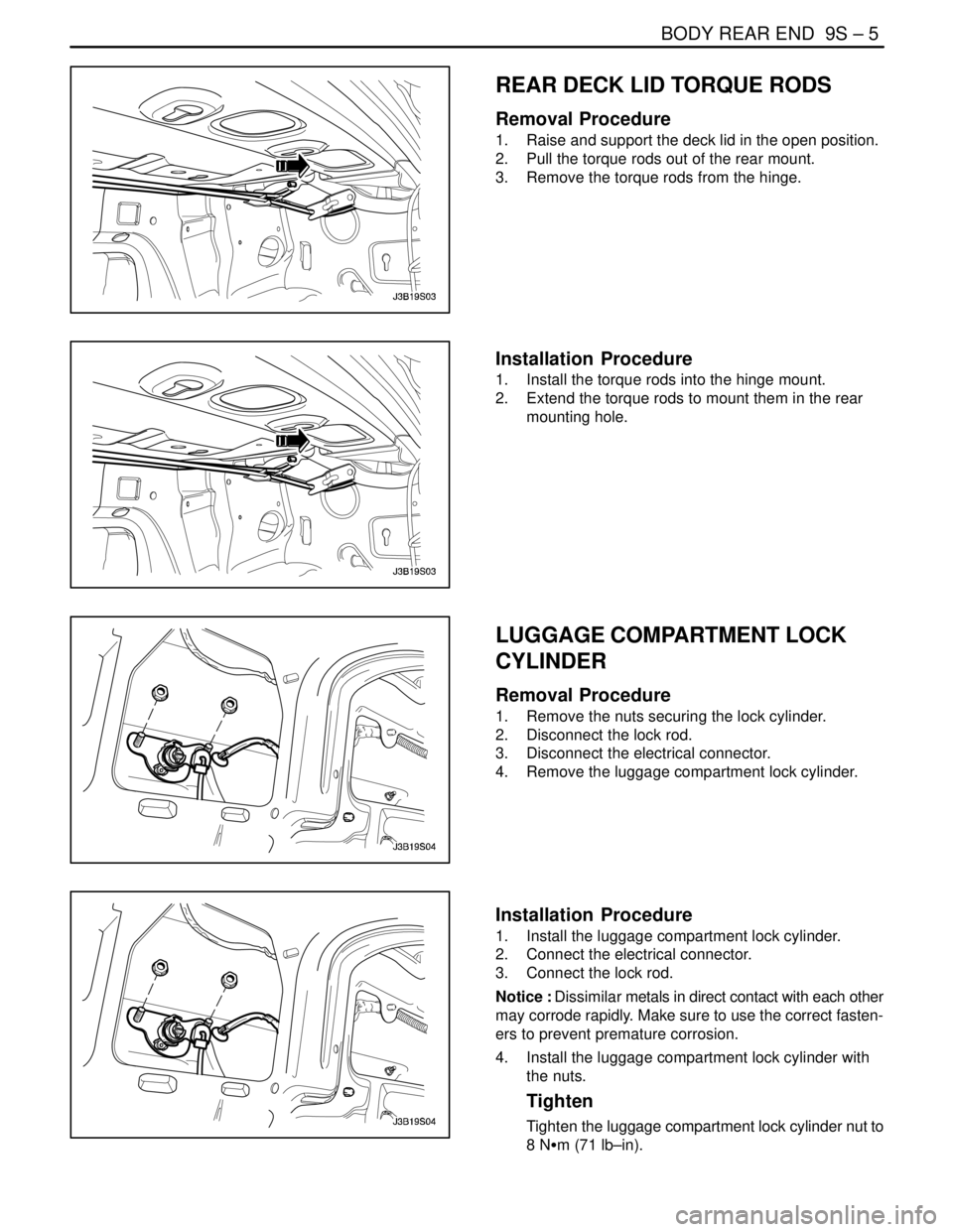
REAR DECK LID TORQUE RODS
Removal Procedure
1. Raise and support the deck lid in the open position.
2. Pull the torque rods out of the rear mount.
3. Remove the torque rods from the hinge.
Installation Procedure
1. Install the torque rods into the hinge mount.
2. Extend the torque rods to mount them in the rear
mounting hole.
LUGGAGE COMPARTMENT LOCK
CYLINDER
Removal Procedure
1. Remove the nuts securing the lock cylinder.
2. Disconnect the lock rod.
3. Disconnect the electrical connector.
4. Remove the luggage compartment lock cylinder.
Installation Procedure
1. Install the luggage compartment lock cylinder.
2. Connect the electrical connector.
3. Connect the lock rod.
Notice : Dissimilar metals in direct contact with each other
may corrode rapidly. Make sure to use the correct fasten-
ers to prevent premature corrosion.
4. Install the luggage compartment lock cylinder with
the nuts.
Tighten
Tighten the luggage compartment lock cylinder nut to
8 NSm (71 lb–in).
Page 2477 of 2643
9S – 6IBODY REAR END
DAEWOO V–121 BL4
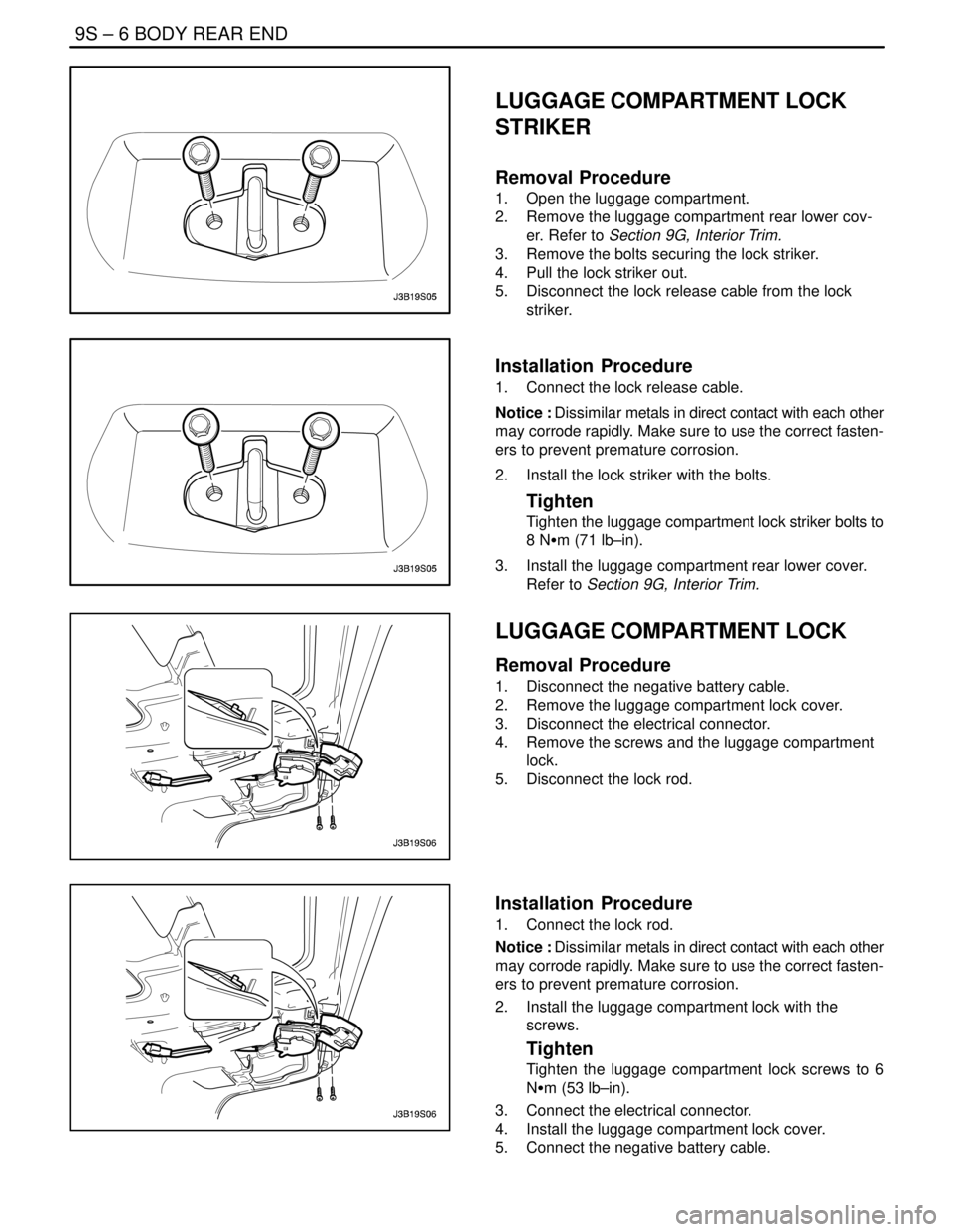
LUGGAGE COMPARTMENT LOCK
STRIKER
Removal Procedure
1. Open the luggage compartment.
2. Remove the luggage compartment rear lower cov-
er. Refer to Section 9G, Interior Trim.
3. Remove the bolts securing the lock striker.
4. Pull the lock striker out.
5. Disconnect the lock release cable from the lock
striker.
Installation Procedure
1. Connect the lock release cable.
Notice : Dissimilar metals in direct contact with each other
may corrode rapidly. Make sure to use the correct fasten-
ers to prevent premature corrosion.
2. Install the lock striker with the bolts.
Tighten
Tighten the luggage compartment lock striker bolts to
8 NSm (71 lb–in).
3. Install the luggage compartment rear lower cover.
Refer to Section 9G, Interior Trim.
LUGGAGE COMPARTMENT LOCK
Removal Procedure
1. Disconnect the negative battery cable.
2. Remove the luggage compartment lock cover.
3. Disconnect the electrical connector.
4. Remove the screws and the luggage compartment
lock.
5. Disconnect the lock rod.
Installation Procedure
1. Connect the lock rod.
Notice : Dissimilar metals in direct contact with each other
may corrode rapidly. Make sure to use the correct fasten-
ers to prevent premature corrosion.
2. Install the luggage compartment lock with the
screws.
Tighten
Tighten the luggage compartment lock screws to 6
NSm (53 lb–in).
3. Connect the electrical connector.
4. Install the luggage compartment lock cover.
5. Connect the negative battery cable.
Page 2480 of 2643
BODY REAR END 9S – 9
DAEWOO V–121 BL4
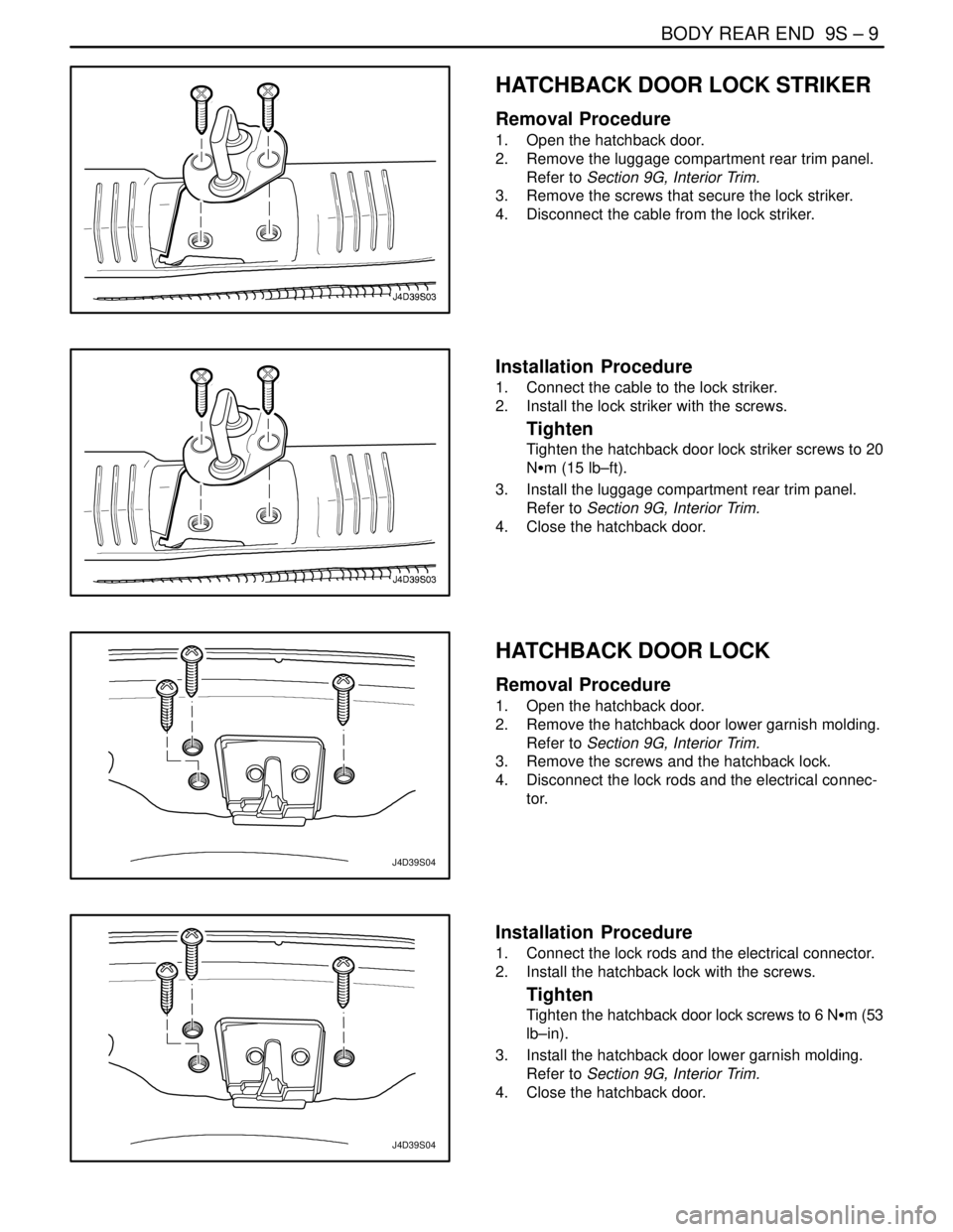
HATCHBACK DOOR LOCK STRIKER
Removal Procedure
1. Open the hatchback door.
2. Remove the luggage compartment rear trim panel.
Refer to Section 9G, Interior Trim.
3. Remove the screws that secure the lock striker.
4. Disconnect the cable from the lock striker.
Installation Procedure
1. Connect the cable to the lock striker.
2. Install the lock striker with the screws.
Tighten
Tighten the hatchback door lock striker screws to 20
NSm (15 lb–ft).
3. Install the luggage compartment rear trim panel.
Refer to Section 9G, Interior Trim.
4. Close the hatchback door.
J4D39S04
HATCHBACK DOOR LOCK
Removal Procedure
1. Open the hatchback door.
2. Remove the hatchback door lower garnish molding.
Refer to Section 9G, Interior Trim.
3. Remove the screws and the hatchback lock.
4. Disconnect the lock rods and the electrical connec-
tor.
J4D39S04
Installation Procedure
1. Connect the lock rods and the electrical connector.
2. Install the hatchback lock with the screws.
Tighten
Tighten the hatchback door lock screws to 6 NSm (53
lb–in).
3. Install the hatchback door lower garnish molding.
Refer to Section 9G, Interior Trim.
4. Close the hatchback door.
Page 2482 of 2643

SECTION : 9T1
REMOTE KEYLESS ENTRY AND ANTI–THEFT
SYSTEM
CAUTION : Disconnect the negative battery cable before removing or installing any electrical unit or when a tool
or equipment could easily come in contact with exposed electrical terminals. Disconnecting this cable will help
prevent personal injury and damage to the vehicle. The ignition must also be in LOCK unless otherwise noted.
TABLE OF CONTENTS
SPECIFICATIONS 9T1–1 . . . . . . . . . . . . . . . . . . . . . . . . .
Fastener Tightening Specifications 9T1–1. . . . . . . . . .
SCHEMATIC AND ROUTING DIAGRAMS9T1–2 . . . .
Notchback Remote Keyless Entry and Anti–Theft
System 9T1–2. . . . . . . . . . . . . . . . . . . . . . . . . . . . . . . .
Hatchback Remote Keyless Entry and Anti–Theft
System 9T1–3. . . . . . . . . . . . . . . . . . . . . . . . . . . . . . . .
Control Module/Receiver Connector 9T1–4. . . . . . . . .
MAINTENANCE AND REPAIR9T1–5 . . . . . . . . . . . . . .
ON–VEHICLE SERVICE 9T1–5. . . . . . . . . . . . . . . . . . . .
Control Module/Receiver 9T1–5. . . . . . . . . . . . . . . . . . .
Siren (General Only) 9T1–5. . . . . . . . . . . . . . . . . . . . . . Remote Keyless Entry Transmitter
Programming 9T1–7. . . . . . . . . . . . . . . . . . . . . . . . . . .
GENERAL DESCRIPTION AND SYSTEM
OPERATION9T1–8 . . . . . . . . . . . . . . . . . . . . . . . . . . . . .
Remote Keyless Entry and Anti–Theft System 9T1–8
Remote Locking and Unlocking 9T1–8. . . . . . . . . . . . .
Security Indicator 9T1–8. . . . . . . . . . . . . . . . . . . . . . . . .
Intrusion Sensing 9T1–8. . . . . . . . . . . . . . . . . . . . . . . . .
Siren (General Only) 9T1–8. . . . . . . . . . . . . . . . . . . . . .
Vehicle Locator 9T1–8. . . . . . . . . . . . . . . . . . . . . . . . . . .
Autolocking (Safety Lock) 9T1–9. . . . . . . . . . . . . . . . . .
Control Module/Receiver 9T1–9. . . . . . . . . . . . . . . . . . .
Fault or Alarm Indication 9T1–9. . . . . . . . . . . . . . . . . . .
SPECIFICATIONS
FASTENER TIGHTENING SPECIFICATIONS
ApplicationNSmLb–FtLb–In
Siren Braket Mounting Bolts.8–71
Page 2485 of 2643

9T1 – 4IREMOTE KEYLESS ENTRY AND ANTI–THEFT SYSTEM
DAEWOO V–121 BL4
CONTROL MODULE/RECEIVER CONNECTOR
TerminalColorDescription
1YELSiren
2BLKGround
3––
4LT BLUDoor and Trunk Tamper Switch
5PNK/BLKTrunk Open Switch
6––
7PNK/DKBLUHood Open Switch
8PPLDoor contact Switch
9LT BLU/BLKUnlock
10LT GRN/WHTLock
11YELUnlock
12LT GRNAnti–Theft Door Locking Switch
13DK BLURight Turn Signal Bulb
14––
15PNKIgnition+
16––
17LT GRNDiagnostic Communication
18LT GRN/REDKey Reminder Switch
19YEL/DK GRNSecurity Indicator
20PPLAnti–Theft Door Locking Switch
21––
22––
23––
24BRNTrunk Open Switch
25ORNBattery+
26LT BLULeft Turn Signal Bulb
Page 2489 of 2643

9T1 – 8IREMOTE KEYLESS ENTRY AND ANTI–THEFT SYSTEM
DAEWOO V–121 BL4
GENERAL DESCRIPTION
AND SYSTEM OPERATION
REMOTE KEYLESS ENTRY AND
ANTI–THEFT SYSTEM
The remote keyless entry and anti–theft system can per-
form the following functions:
S Remotely lock and unlock the vehicle doors by
means of a hand–held, high–frequency transmitter.
S Sense intrusion into the vehicle.
S Activate a warning in the event of an intrusion.
S Help the driver find the vehicle in a parking area.
S Automatically re–lock the doors if the door or the
trunk is not opened within 30 seconds after the ve-
hicle has been unlocked by the remote keyless
entry.
S Communicate serial data to a scan tool to help
diagnose system faults.
The remote keyless entry and anti–theft system consists
of the following components:
S Keyless entry and anti–theft control module/receiv-
er.
S Security indicator.
S Trunk open switch (NOTCHBACK).
S Trunk tamper switch (NOTCHBACK).
S Front door tamper switches.
S Door contact switches.
S Central door lock relay.
S Turn signal bulbs.
S Siren.
S Hood open switch.
REMOTE LOCKING AND UNLOCKING
The hand–held transmitter locks and unlocks the vehicle
doors by sending radio waves to the control module/re-
ceiver in the vehicle. The effective range of the transmitter
varies between 5 and 10 meters, (approximately 16 to 32
feet), depending on whether or not objects, such as other
vehicles are blocking the path of the radio waves.
The transmitter has a LOCK button and an UNLOCK but-
ton which only function when the ignition is OFF. Pressing
the UNLOCK button has the following effects:
S The doors are unlocked.
S The turn signal bulbs flash twice.
S The control module is disarmed.
Pressing the LOCK button has the following effects:
S The doors are locked.
S The turn signal bulbs flash once.
S The control module is armed.
The transmitter has a replaceable battery. The battery is
designed to last at least two years before replacement is
necessary.
SECURITY INDICATOR
There is a security indicator on the instrument panel. After
the LOCK button of the transmitter is pressed, the module
is placed in the armed mode, and the security indicator
flashes. The security indicator turns ON for 0.1 second
and OFF for 0.7 second. It then flashes at that frequency
until the control module/receiver is disarmed.
INTRUSION SENSING
The anti–theft function is armed if the transmitter sends
the LOCK message to the control module/receiver when
the ignition is OFF. When the hood, door, or trunk is
opened, the hood open, door contact, or trunk open switch
sends a ”ground” signal to the control module/receiver.
Unless the control module/receiver is disarmed, the siren
will be activated when the ”ground” signal is received from
the trunk open, hood open, or door contact switches.
The following actions disarm the anti–theft system:
S An UNLOCK message is received from the trans-
mitter.
S Key operation is detected by the tamper switches.
(The tamper switches are operated by the lock cyl-
inders in the front doors and trunk.)
The alarm will also be activated if the control module/re-
ceiver detects voltage from the ignition before either of the
following conditions occur:
S An UNLOCK message is received from the trans-
mitter.
S Key operation is indicated by the tamper switches.
SIREN (GENERAL ONLY)
The remote keyless entry system is armed when the
LOCK message is received from the transmitter when the
ignition is OFF. When the system is armed, it will activate
the siren and flash the turn signals for 28 seconds if any
of the following conditions occur:
S Close all the windows.
S Turn the ignition key to LOCK and remove the key.
S Have all passengers get out of the vehicle.
S Close all doors, the hood and the turnk lid.
S The control module/receiver detects ignition voltage
while the system is armed.
The siren will not operate if any of the following conditions
occur after the system has been armed:
S The door is opened with the key.
S The trunk is opened with the key.
S The UNLOCK or LOCK button on the remote trans-
mitter is pressed within 2 seconds after the siren is
activated.
VEHICLE LOCATOR
The remote keyless entry system assists the driver in lo-
cating the vehicle. When the vehicle is unlocked with the
remote control, the turn signals flash twice to indicate the
location of the vehicle. The duration of the flashes and the
Page 2501 of 2643

IMMOBILIZER ANTI–THEFT SYSTEM 9T2 – 11
DAEWOO V–121 BL4
GENERAL DESCRIPTION
AND SYSTEM OPERATION
IMMOBILIZER SYSTEM
The purpose of the Immobilizer system is to provide addi-
tional theft deterrence to the vehicle in which it is installed
and to prevent it from being stolen or driven by unautho-
rized users.
The verification of the user authorization is done by an igni-
tion key with integrated transponder.
The external LED displays the Immobilizer status and has
an additional theft deterrence function.
To secure the communication, the status is exchanged be-
tween the Immobilizer and the ECM in a 5 byte of encoded
data.
These 5 bytes are composed by a mixture of random data
and two types of fixed code
S a vehicle model identification number : MIN
S a vehicle specific identification : VIN
The MIN is known from the first supply of the system.
The VIN is realized by ICU on the special order from the
key coding (reading of transponder code and storing it as
valid key code in Immobilizer EEPROM).
A different random data is computed at each key transi-
tion.
All the immobilization communication between the ECM
and ICU is made on K–line (K line : Serial data line ’7’).
Due to the learning of the Vehicle specific identification
Number, both ICU and ECM can stay in 3 stable modes
S Virgin mode (VIN not learnt)
S Learnt mode (VIN learnt)
S Neutral mode (for a new VIN learning)
In case of using valid key, the release message commu-
nication with the ECM take place and the LED displays the
Immobilizer status valid key In case of using invalid key,
the ECM disables the fuel injector circuit with coded inter-
vention and sets DTC(Diagnostic Trouble Code)
The above conditions are maintained until the ignition is
switched off.
An ECM without an immobilizer control unit cannot be in-
terchanged for an ECM that is used with an immobilizer
control unit system. The Immobilizer control unit and ECM
must have a matching ID code. ID coding and key coding
are accomplished by using Scanner–100
The Immobilizer system consists of
S a maximum or 5 ignition keys with integrated trans-
ponder
S the toroidal coil (Detection coil) for energizing and
reading the transponder mounted at the ignition
lock.S the Immobilizer control unit(ICU) with :
– power supply
– ignition input circuit
– transponder modulation and demodulation unit
– EEPROM
– driver electronic for the external status LED
– serial data link hardware
S the external status LED for displaying the Immobi-
lizer status
S the serial data link between Immobilizer and ECM
ELECTRONICALLY CODED KEYS
Each valid ignition key has an internal transponder which
is a read /write transponder.
The transponder contains an implementation of a crypto–
algorithm with 96 bits of user configurable s cret–key con-
tained in EEPROM and transmits data to the ICU by mod-
ulating the amplitude of the ele tromagnetic field, and
receives data and commands in a similar way.
DETECTION COIL
The toroidal coil is mounted at the ignition lock in front of
the key barrel.
It is connected to the ICU with a four terminal connector
fixed at the body of the coil.
The length of the connection between coil and Immobilizer
is restricted to 50cm. The correct placement on the ignition
lock and the exact electrical data is very important for the
reading distance of transponder.
he toroidal coil and receiving coil inside the transponder
built a transformer. During the readingprocess the coil in-
duces energy into the transponder. The transponder
charges the field and generates an amplitude modulated
signal with the manchester coded data. This charge of the
field is demodulated inside the Immobilizer.
The Immobilizer contains the coil driver hardware for di-
rect connection of the toroidal coil.
IMMOBILIZER CONTROL UNIT
The function of the Immobilizer System is shared between
the ICU and the ECM.
The task of the Immobilizer Electronic Control unit (ICU)
are:
S Reading of the input information ”ignition ON/OFF”
S Controlling the states LED
S Controlling the transponder read/write process
(modulation, demodulation, decoding, comparison
of the read code with the code of the valid keys).
S Communication with the ECM after ignition ON (re-
ceiving of the ECM–request and transmission of
release message).
S Special functions for calculation and handling of the
VIN–code.
The VIN code is calculated by the Immobilizer using a ran-
dom generator.
Page 2502 of 2643

9T2 – 12IIMMOBILIZER ANTI–THEFT SYSTEM
DAEWOO V–121 BL4
The VIN code is transmitted from the Immobilizer in the re-
lease message communication only incase of using an au-
thorized key. Without an authorized key it is not possible
to getthe system VIN code.In case of ECM internal state
is in Virgin mode or neutral mode the ECM learns the sys-
tem VIN code automatically after receiving the first release
response message.
To get a synchronized Immobilizer system (same VIN–
code in Immobilizer and ECM,authorized key) the DLC
test equipment has to be used for authorization of the
keys(first key coding). The usage of this test equipment is
restricted to authorized persons.
S Communication with the DLC–test equipment. Main
functions are the key coding procedure, the VIN–
code handling and the support for system test func-
tions.
S Handling of the software watchdog
Operation
In the active mode of immobilizer (engine OFF, IG key
OFF) the status LED isblinking as mode A. When ignition
is turned ON, the system wakes up and tries to read out
the transponder.
In case of the detection of a valid key , The release mes-
sage communication with the ECM takes place. The sta-
tus LED displays the Immobilizer state ”valid key”.
After turning off the ignition(ignition OFF detection similar
to the ECM ignition OFF detection), the Immobilizer
changes to the active mode. The status LED is blinking as
Mode A.
Data Link Connector (DLC) Mode
When the ignition is on, a scan tool can switch the immobi-
lizer control unit to the DLC mode for diagnostics, key cod-
ing and ID coding.
S The status LED is turned off during DLC–mode
S The Immobilizer will answer all correct messages,
which are defined as Immobilizer messages.
ID Code Handling
One of 65,535 VIN codes is stored in the immobilizer EE-
PROM.
The VIN code can be erased by using ”Reset VIN code”
command of the scan tool.
When the immobilizer control unit calculates a new VIN
code, ECM VIN code should be reset to get identical with
the immobilizer control unit’s.
During diagnostic procedures, the VIN code can be read
for comparison with the ECM VIN code by using the scan
tool’s ”Read immobilizer control unit VIN code” command.
SERIAL DATA LINK
Serial data can be exchanged between a scan tool and the
ECM and the Immobilizer control unit.
ELECTRONIC CONTROL MOUDLE
(ECM)
S ECM in Virgin mode
In this mode, the ECM knows only the model
vehicle identifier code.
The engine can be locked/unlocked.
ECM requests to ICU the VIN number. As soon
as the ECM receives two correct consecutive
communication frames with the same VIN code
the ECM learns it.
The VIN code will be stored in non–volatile
memory at the end of power latch phase. ECM
enters in Learnt mode.
S ECM in Learnt mode
In such a state, ECM checks on every commu-
nication, the correct encoding of the ICU.
If the code received is not correct, then the vehicle is im-
mobilized.
The coded 5 bytes of data emitted by ECM are
a mixture of MIN code and random.
The coded 5 bytes of data emitted by ICU are a
mixture of VIN code and random.
S ECM in Neutral mode
This mode is a special intermediate mode, used
for ICU replacement or immobilizer option instal-
lation.
ECM request to ICU the VIN number. As soon
as the ECM receives two correct consecutive
communication frames with the same VIN code
the ECM learns it. The VIN code will be stored
in non–volatile memory at the end of power latch
phase. ECM enters in Learnt mode.
S After turning on the ignition the ECM will control the
engine in a normal way for starting and running
while waiting for a valid release response message
from the Immobilizer.
Page 2537 of 2643
NUBIRA/LACETTIFRONT 4–3
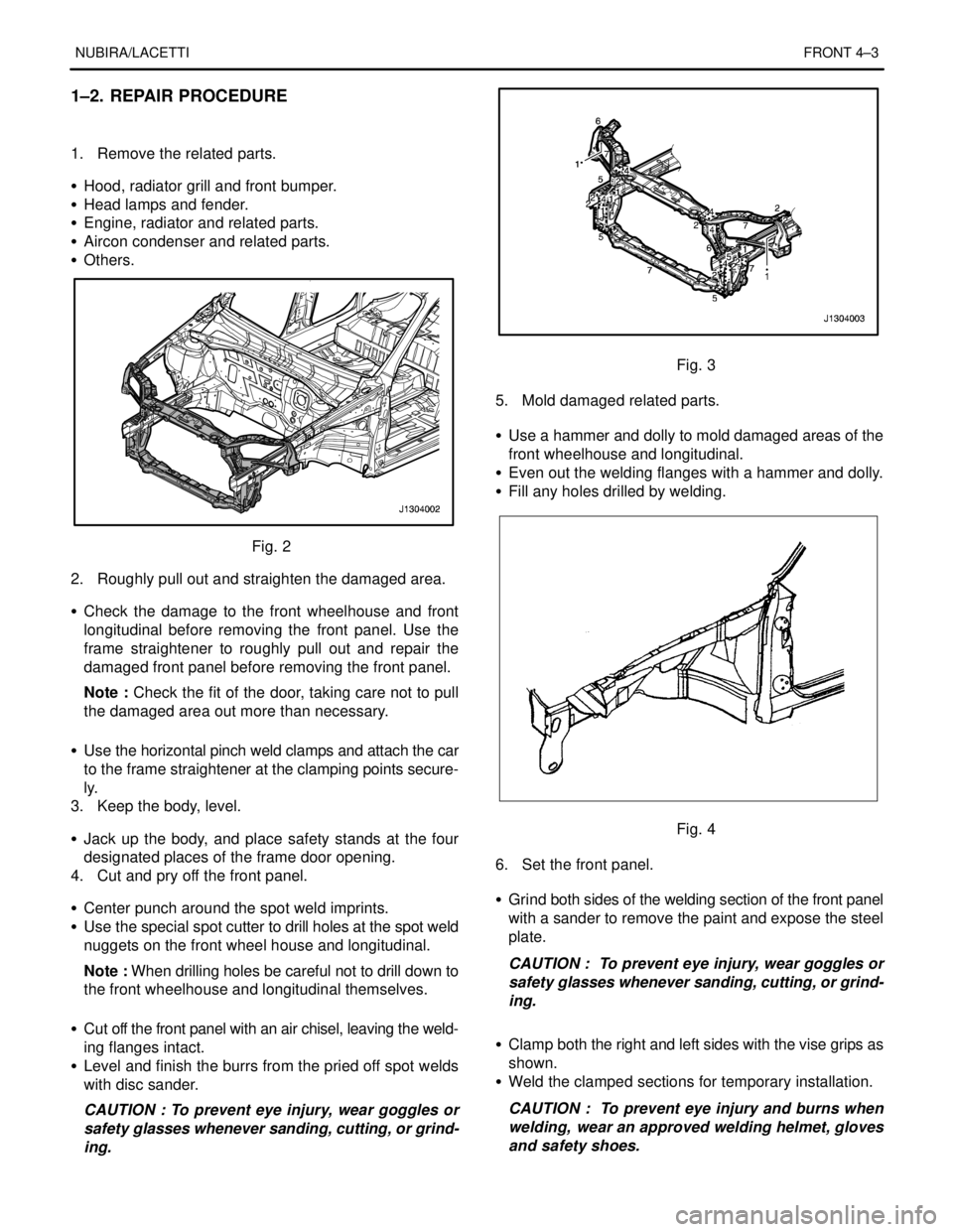
1–2. REPAIR PROCEDURE
1. Remove the related parts.
S Hood, radiator grill and front bumper.
S Head lamps and fender.
S Engine, radiator and related parts.
S Aircon condenser and related parts.
S Others.
Fig. 2
2. Roughly pull out and straighten the damaged area.
S Check the damage to the front wheelhouse and front
longitudinal before removing the front panel. Use the
frame straightener to roughly pull out and repair the
damaged front panel before removing the front panel.
Note : Check the fit of the door, taking care not to pull
the damaged area out more than necessary.
S Use the horizontal pinch weld clamps and attach the car
to the frame straightener at the clamping points secure-
ly.
3. Keep the body, level.
S Jack up the body, and place safety stands at the four
designated places of the frame door opening.
4. Cut and pry off the front panel.
S Center punch around the spot weld imprints.
S Use the special spot cutter to drill holes at the spot weld
nuggets on the front wheel house and longitudinal.
Note : When drilling holes be careful not to drill down to
the front wheelhouse and longitudinal themselves.
S Cut off the front panel with an air chisel, leaving the weld-
ing flanges intact.
S Level and finish the burrs from the pried off spot welds
with disc sander.
CAUTION : To prevent eye injury, wear goggles or
safety glasses whenever sanding, cutting, or grind-
ing.
Fig. 3
5. Mold damaged related parts.
S Use a hammer and dolly to mold damaged areas of the
front wheelhouse and longitudinal.
S Even out the welding flanges with a hammer and dolly.
S Fill any holes drilled by welding.
Fig. 4
6. Set the front panel.
S Grind both sides of the welding section of the front panel
with a sander to remove the paint and expose the steel
plate.
CAUTION : To prevent eye injury, wear goggles or
safety glasses whenever sanding, cutting, or grind-
ing.
S Clamp both the right and left sides with the vise grips as
shown.
S Weld the clamped sections for temporary installation.
CAUTION : To prevent eye injury and burns when
welding, wear an approved welding helmet, gloves
and safety shoes.
Page 2561 of 2643
NUBIRA/LACETTI ROOF, BACK PANEL AND REAR FLOOR PANEL 5–9
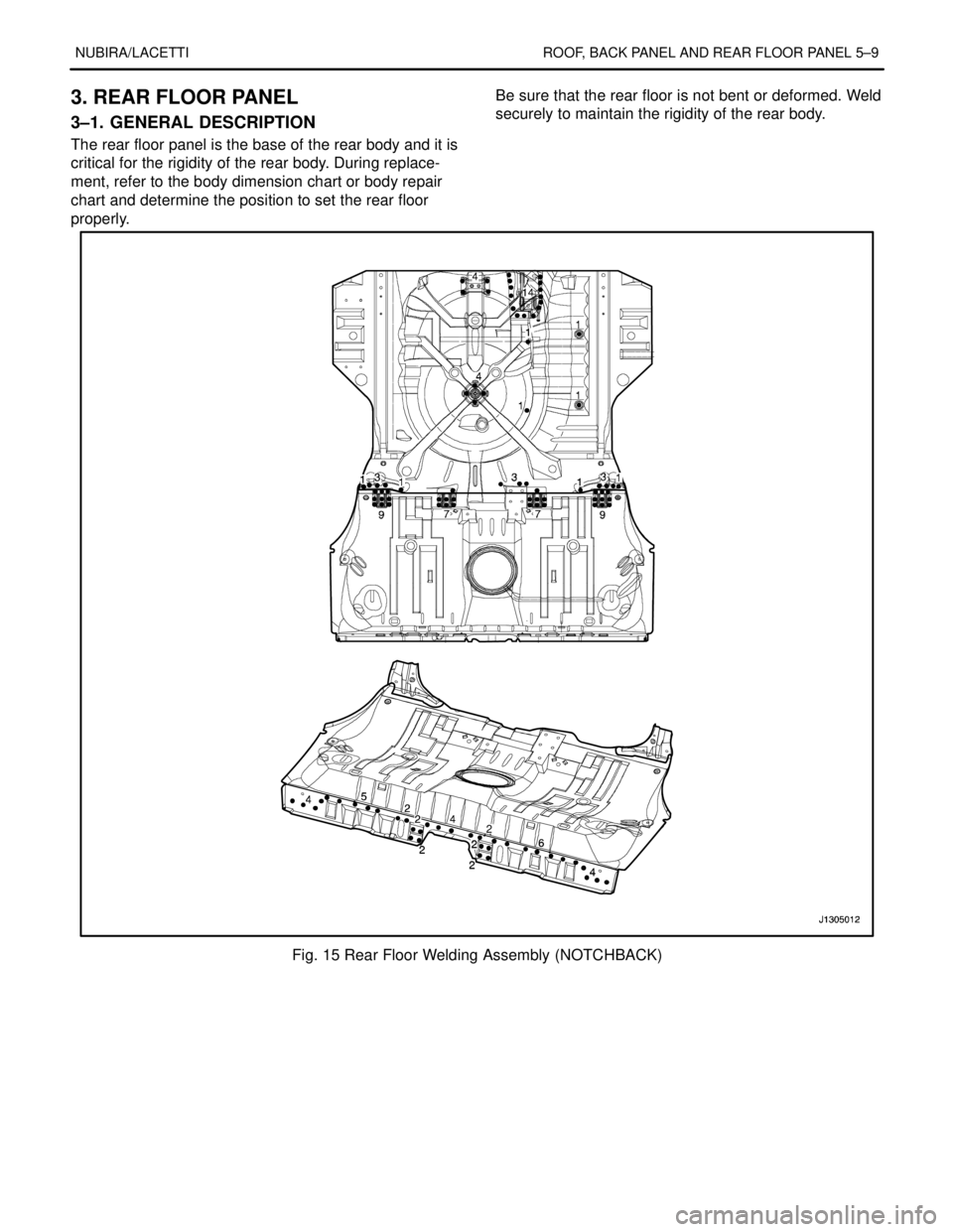
3. REAR FLOOR PANEL
3–1. GENERAL DESCRIPTION
The rear floor panel is the base of the rear body and it is
critical for the rigidity of the rear body. During replace-
ment, refer to the body dimension chart or body repair
chart and determine the position to set the rear floor
properly.Be sure that the rear floor is not bent or deformed. Weld
securely to maintain the rigidity of the rear body.
2
Fig. 15 Rear Floor Welding Assembly (NOTCHBACK)