nut DAEWOO NUBIRA 2004 Service Workshop Manual
[x] Cancel search | Manufacturer: DAEWOO, Model Year: 2004, Model line: NUBIRA, Model: DAEWOO NUBIRA 2004Pages: 2643, PDF Size: 80.54 MB
Page 197 of 2643
1D – 2IENGINE COOLING
DAEWOO V–121 BL4
SPECIFICATIONS
CAPACITY
ApplicationDescription
Coolant in the Cooling System
(1.4L/1.6L DOHC MPFI System)7.0L (1.85 gal) for automatic transaxle
7.0L (1.85 gal) for manual transaxle
Coolant in the Cooling System
(1.8L DOHC MPFI System)7.1L (1.88 gal) for automatic transaxle
7.1L (1.88 gal) for manual transaxle
FASTENER TIGHTENING SPECIFICATIONS
ApplicationNSmLb–FtLb–In
Water Pump Mounting Bolts (1.4L/1.6L DOHC)10–89
Water Pump Mounting Bolts (1.8L DOHC)2518–
Fan Assembly Mounting Bolts4–35
Fan Motor Nut3.2–28
Fan Motor Retaining Screws4–35
Radiator Retaining Bolts, Upper Left and Upper Right8–71
Surge Tank Attaching Bolt5–44
Thermostat Housing Mounting Bolts (1.6L DOHC)2015–
Thermostat Housing Mounting Bolts (1.8L DOHC)1511–
SPECIAL TOOLS
SPECIAL TOOLS TABLE
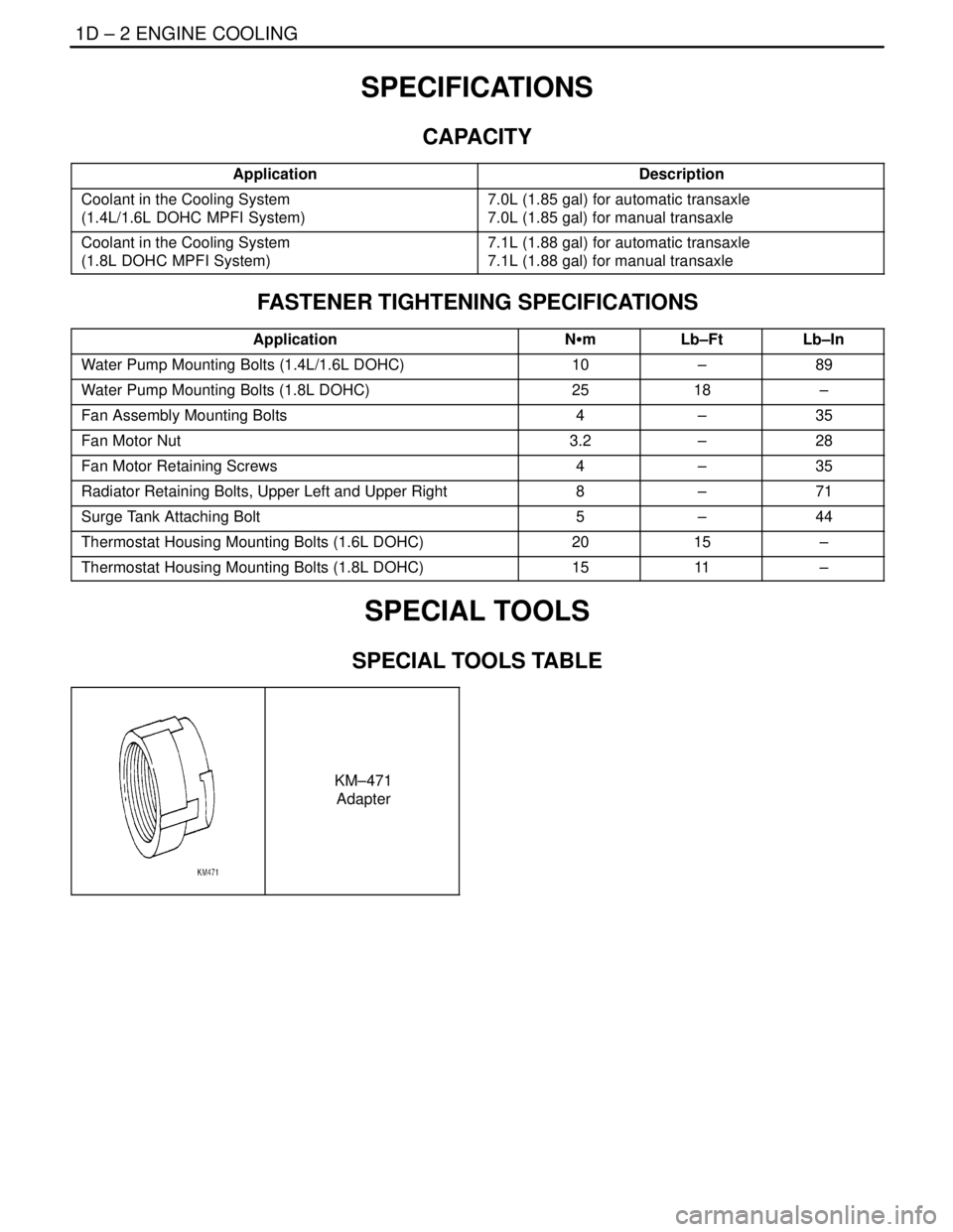
KM–471
Adapter
Page 208 of 2643
ENGINE COOLING 1D – 13
DAEWOO V–121 BL4
ELECTRIC COOLING FAN – MAIN OR
AUXILIARY
Removal Procedure
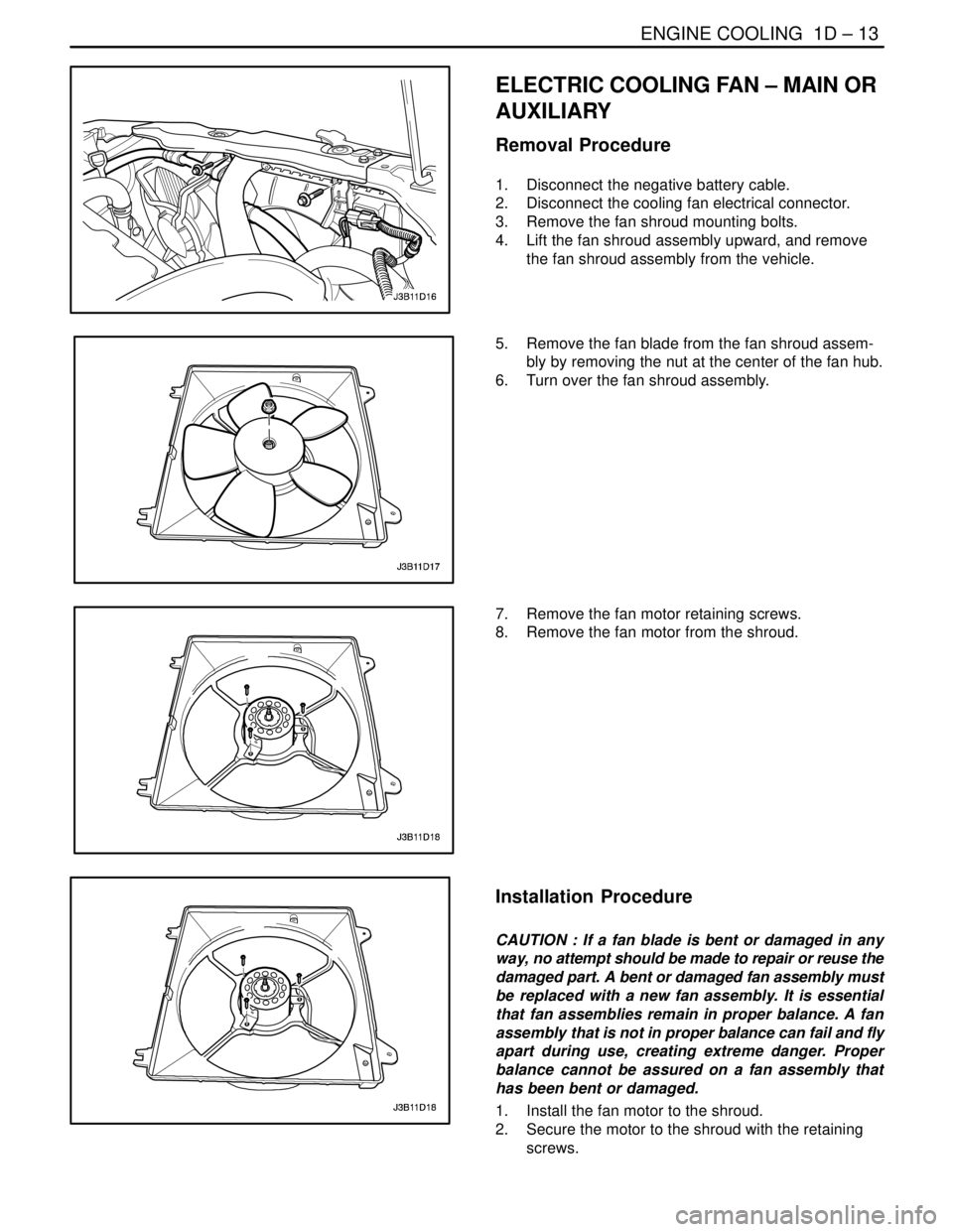
1. Disconnect the negative battery cable.
2. Disconnect the cooling fan electrical connector.
3. Remove the fan shroud mounting bolts.
4. Lift the fan shroud assembly upward, and remove
the fan shroud assembly from the vehicle.
5. Remove the fan blade from the fan shroud assem-
bly by removing the nut at the center of the fan hub.
6. Turn over the fan shroud assembly.
7. Remove the fan motor retaining screws.
8. Remove the fan motor from the shroud.
Installation Procedure
CAUTION : If a fan blade is bent or damaged in any
way, no attempt should be made to repair or reuse the
damaged part. A bent or damaged fan assembly must
be replaced with a new fan assembly. It is essential
that fan assemblies remain in proper balance. A fan
assembly that is not in proper balance can fail and fly
apart during use, creating extreme danger. Proper
balance cannot be assured on a fan assembly that
has been bent or damaged.
1. Install the fan motor to the shroud.
2. Secure the motor to the shroud with the retaining
screws.
Page 209 of 2643
1D – 14IENGINE COOLING
DAEWOO V–121 BL4
Tighten
Tighten the fan motor retaining screws to 4 NSm (35
lb–in).
3. Turn over the fan shroud assembly.
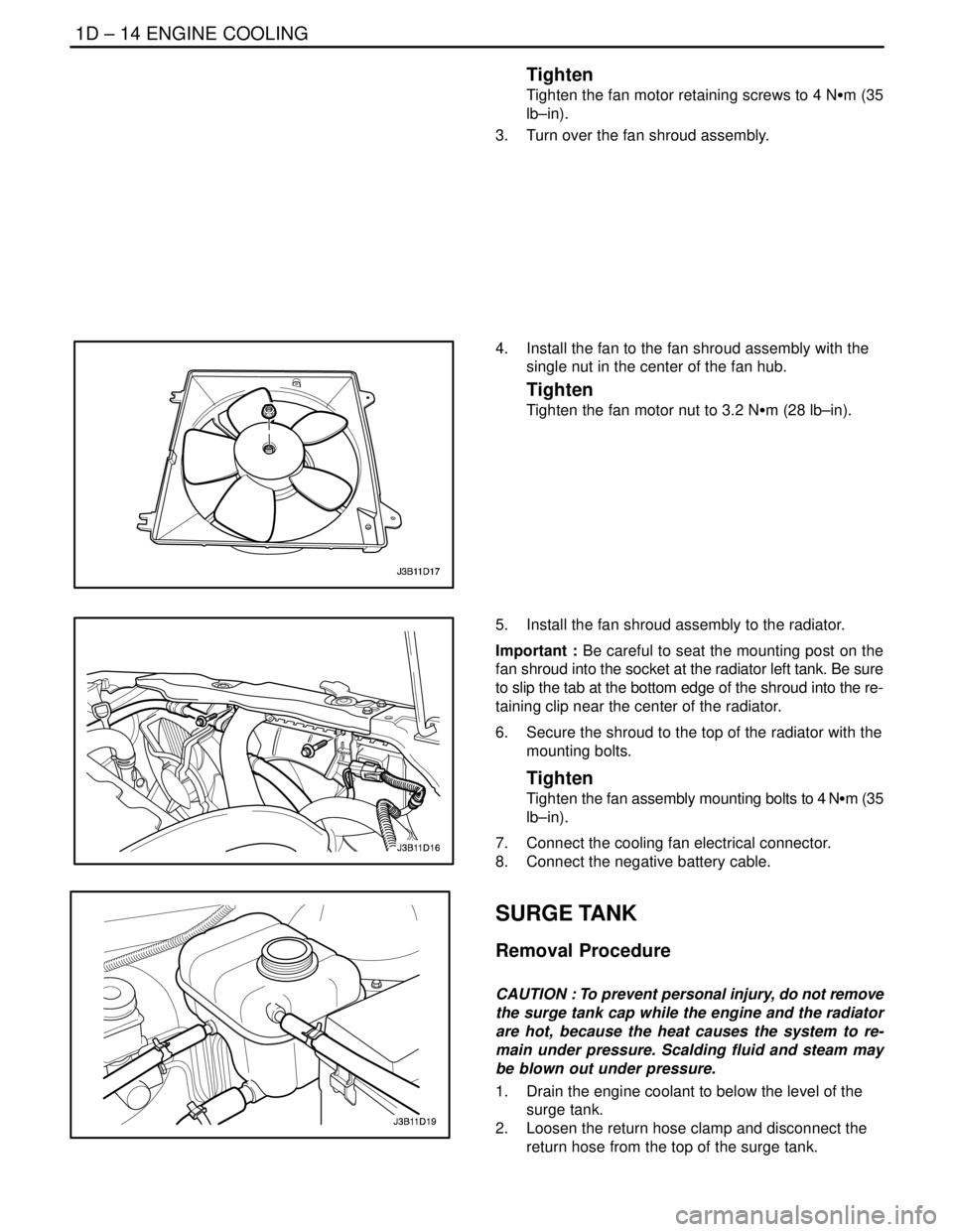
4. Install the fan to the fan shroud assembly with the
single nut in the center of the fan hub.
Tighten
Tighten the fan motor nut to 3.2 NSm (28 lb–in).
5. Install the fan shroud assembly to the radiator.
Important : Be careful to seat the mounting post on the
fan shroud into the socket at the radiator left tank. Be sure
to slip the tab at the bottom edge of the shroud into the re-
taining clip near the center of the radiator.
6. Secure the shroud to the top of the radiator with the
mounting bolts.
Tighten
Tighten the fan assembly mounting bolts to 4 NSm (35
lb–in).
7. Connect the cooling fan electrical connector.
8. Connect the negative battery cable.
SURGE TANK
Removal Procedure
CAUTION : To prevent personal injury, do not remove
the surge tank cap while the engine and the radiator
are hot, because the heat causes the system to re-
main under pressure. Scalding fluid and steam may
be blown out under pressure.
1. Drain the engine coolant to below the level of the
surge tank.
2. Loosen the return hose clamp and disconnect the
return hose from the top of the surge tank.
Page 216 of 2643

1E – 2IENGINE ELECTRICAL
DAEWOO V–121 BL4
SPECIFICATIONS
STARTER SPECIFICATIONS
ApplicationDescription
Starter (1.6L DOHC)1.2 Kw
No Load Test @ 12.0 volts90 amps Max
Drive Pinion Speed at:Min 2,600 rpm
Starter (1.8L DOHC)1.4 Kw
No Load Test @ 12.0 volts85 amps Max
Drive Pinion Speed at:Min 2,550 rpm
Solenoid
Hold–in Windings @ 12.0 volts12–20 amps
Pull–in Windings @ 12.0 volts60 – 90 amps
BATTERY SPECIFICATIONS
ApplicationDescription
Cold Cranking Amps610 amps
Cold Cranking Amps (Extremely Cold Area)610 amps
Reserve Capacity Minimum90 minutes
Load Test270 amps
Minimum Voltage:
9.6
9.4
9.1
8.8
8.5
8.0Estimated Temperature:
21°C (69.8°F)
20°C (68°F)
0°C (32°F)
–10°C (14°F)
–18°C (0°F)
Below –18°C (Below 0°F)
Page 217 of 2643

ENGINE ELECTRICAL 1E – 3
DAEWOO V–121 BL4
FASTENER TIGHTENING SPECIFICATIONS
ApplicationNSmLb–FtLb–In
Battery Cable Nuts5–44
Battery Carrier Tray Lower, Side and Upper Bolts2015–
Battery Retainer Clamp–to–Battery Rod Nuts5–44
Generator Drive End Bearing Nut8160–
Generator Lower Bracket–to–Engine Block Bolts (1.8L Engine)3727–
Generator Lower Bracket–to–Generator Nut (1.4L/1.6L Engine)2518–
Generator Through–Bolts10–89
Generator–to–Intake Manifold and Cylinder Head Support
Bracket Bolts (1.8L Engine)3727–
Generator–to–Intake Manifold Strap Bracket Bolt (1.8L Engine)2216–
Generator Upper Support Bracket Bolt (1.4L/1.6L Engine)2015–
Intake Manifold–to–Cylinder Body Strap Bracket Bolts (Over
Starter)2216–
Starter Field Connector Nut12–106
Starter Lower Mounting Stud Ground Wire Nut12–106
Starter Mounting Studs/Nuts (1.4L/1.6L Engine)2518–
Starter Solenoid Assembly Screws8–71
Starter Solenoid Terminal–to–Battery Cable Terminal Nut5.5–49
Starter Solenoid Terminal–to–Ignition Solenoid Terminal Nut5.5–49
Starter Through–Bolts6–53
Starter–to–Engine Block Mounting Bolt (1.8L Engine)4533–
Starter–to–Engine Transaxle Mounting Bolt (1.8L Engine)5037–
Page 226 of 2643
1E – 12IENGINE ELECTRICAL
DAEWOO V–121 BL4
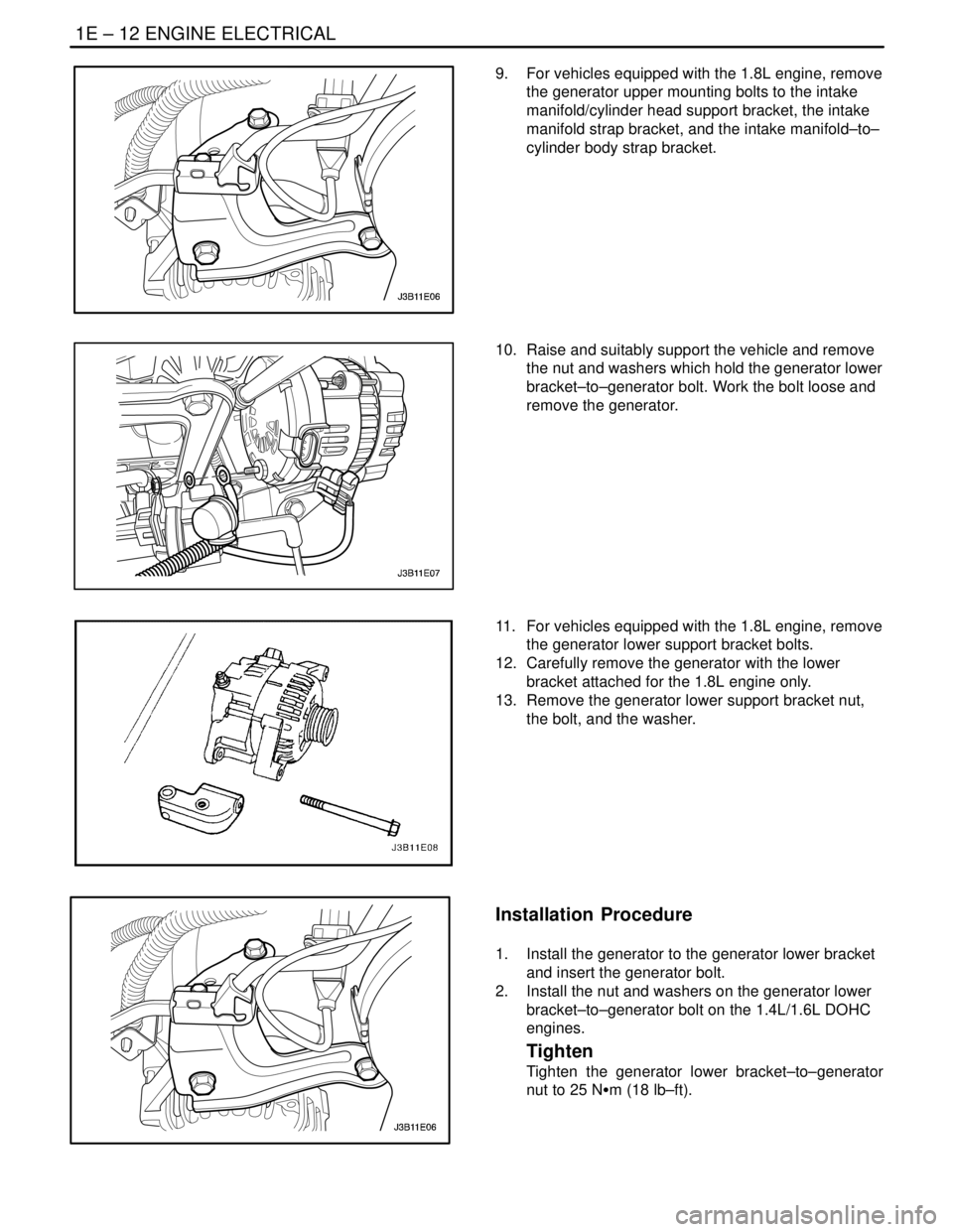
9. For vehicles equipped with the 1.8L engine, remove
the generator upper mounting bolts to the intake
manifold/cylinder head support bracket, the intake
manifold strap bracket, and the intake manifold–to–
cylinder body strap bracket.
10. Raise and suitably support the vehicle and remove
the nut and washers which hold the generator lower
bracket–to–generator bolt. Work the bolt loose and
remove the generator.
11. For vehicles equipped with the 1.8L engine, remove
the generator lower support bracket bolts.
12. Carefully remove the generator with the lower
bracket attached for the 1.8L engine only.
13. Remove the generator lower support bracket nut,
the bolt, and the washer.
Installation Procedure
1. Install the generator to the generator lower bracket
and insert the generator bolt.
2. Install the nut and washers on the generator lower
bracket–to–generator bolt on the 1.4L/1.6L DOHC
engines.
Tighten
Tighten the generator lower bracket–to–generator
nut to 25 NSm (18 lb–ft).
Page 228 of 2643
1E – 14IENGINE ELECTRICAL
DAEWOO V–121 BL4
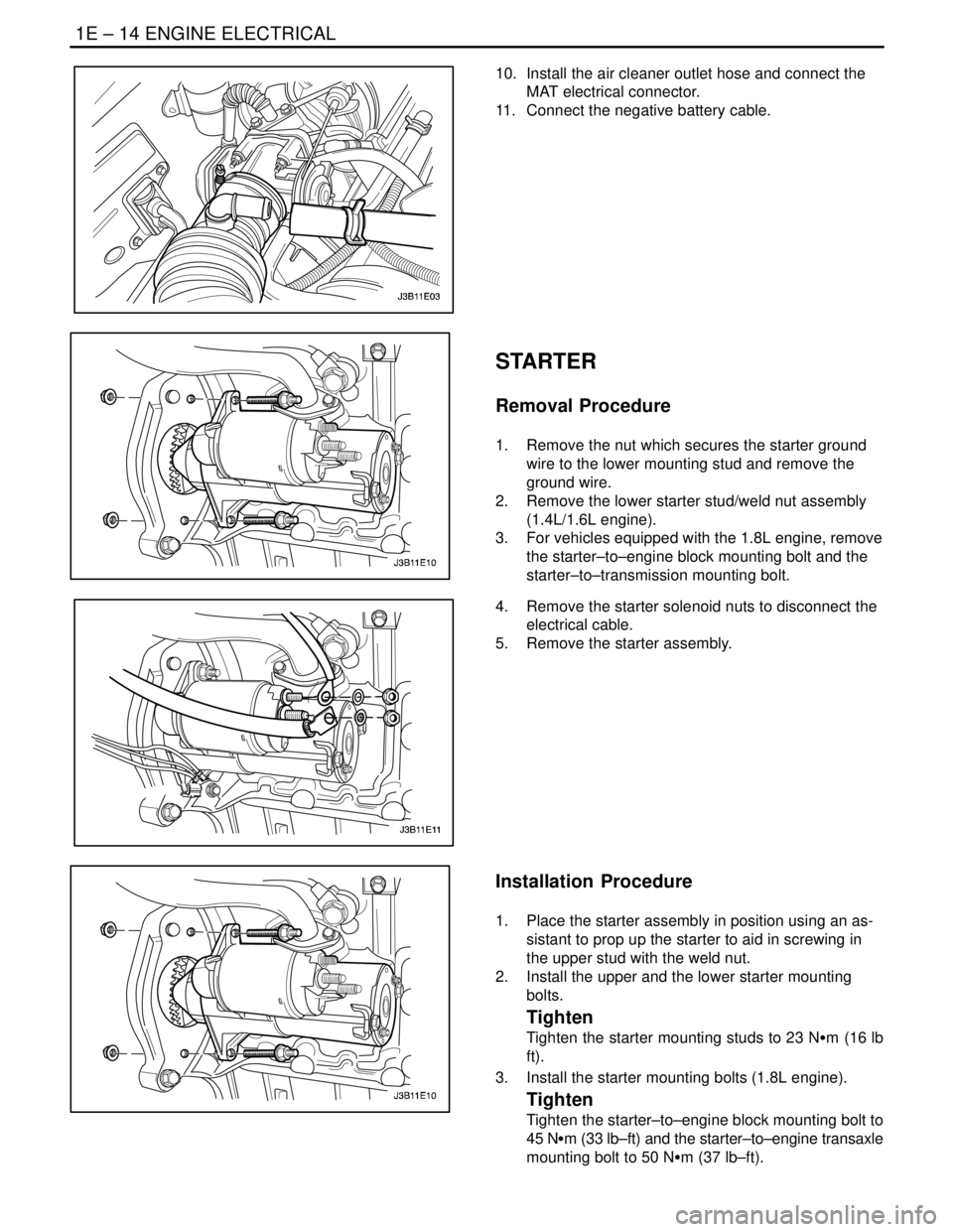
10. Install the air cleaner outlet hose and connect the
MAT electrical connector.
11. Connect the negative battery cable.
STARTER
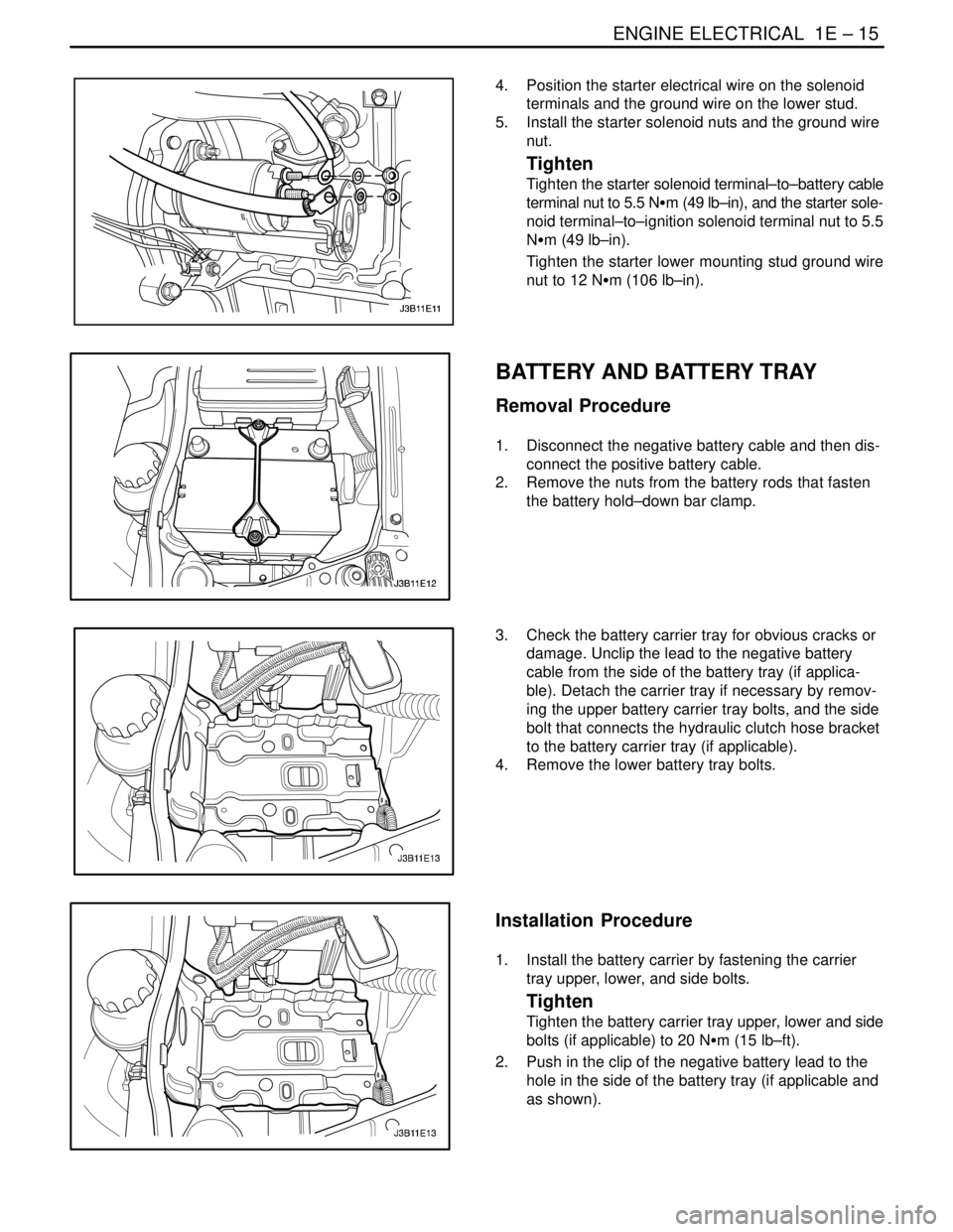
Removal Procedure
1. Remove the nut which secures the starter ground
wire to the lower mounting stud and remove the
ground wire.
2. Remove the lower starter stud/weld nut assembly
(1.4L/1.6L engine).
3. For vehicles equipped with the 1.8L engine, remove
the starter–to–engine block mounting bolt and the
starter–to–transmission mounting bolt.
4. Remove the starter solenoid nuts to disconnect the
electrical cable.
5. Remove the starter assembly.
Installation Procedure
1. Place the starter assembly in position using an as-
sistant to prop up the starter to aid in screwing in
the upper stud with the weld nut.
2. Install the upper and the lower starter mounting
bolts.
Tighten
Tighten the starter mounting studs to 23 NSm (16 lb
ft).
3. Install the starter mounting bolts (1.8L engine).
Tighten
Tighten the starter–to–engine block mounting bolt to
45 NSm (33 lb–ft) and the starter–to–engine transaxle
mounting bolt to 50 NSm (37 lb–ft).
Page 229 of 2643
ENGINE ELECTRICAL 1E – 15
DAEWOO V–121 BL4
4. Position the starter electrical wire on the solenoid
terminals and the ground wire on the lower stud.
5. Install the starter solenoid nuts and the ground wire
nut.
Tighten
Tighten the starter solenoid terminal–to–battery cable
terminal nut to 5.5 NSm (49 lb–in), and the starter sole-
noid terminal–to–ignition solenoid terminal nut to 5.5
NSm (49 lb–in).
Tighten the starter lower mounting stud ground wire
nut to 12 NSm (106 lb–in).
BATTERY AND BATTERY TRAY
Removal Procedure
1. Disconnect the negative battery cable and then dis-
connect the positive battery cable.
2. Remove the nuts from the battery rods that fasten
the battery hold–down bar clamp.
3. Check the battery carrier tray for obvious cracks or
damage. Unclip the lead to the negative battery
cable from the side of the battery tray (if applica-
ble). Detach the carrier tray if necessary by remov-
ing the upper battery carrier tray bolts, and the side
bolt that connects the hydraulic clutch hose bracket
to the battery carrier tray (if applicable).
4. Remove the lower battery tray bolts.
Installation Procedure
1. Install the battery carrier by fastening the carrier
tray upper, lower, and side bolts.
Tighten
Tighten the battery carrier tray upper, lower and side
bolts (if applicable) to 20 NSm (15 lb–ft).
2. Push in the clip of the negative battery lead to the
hole in the side of the battery tray (if applicable and
as shown).
Page 230 of 2643
1E – 16IENGINE ELECTRICAL
DAEWOO V–121 BL4
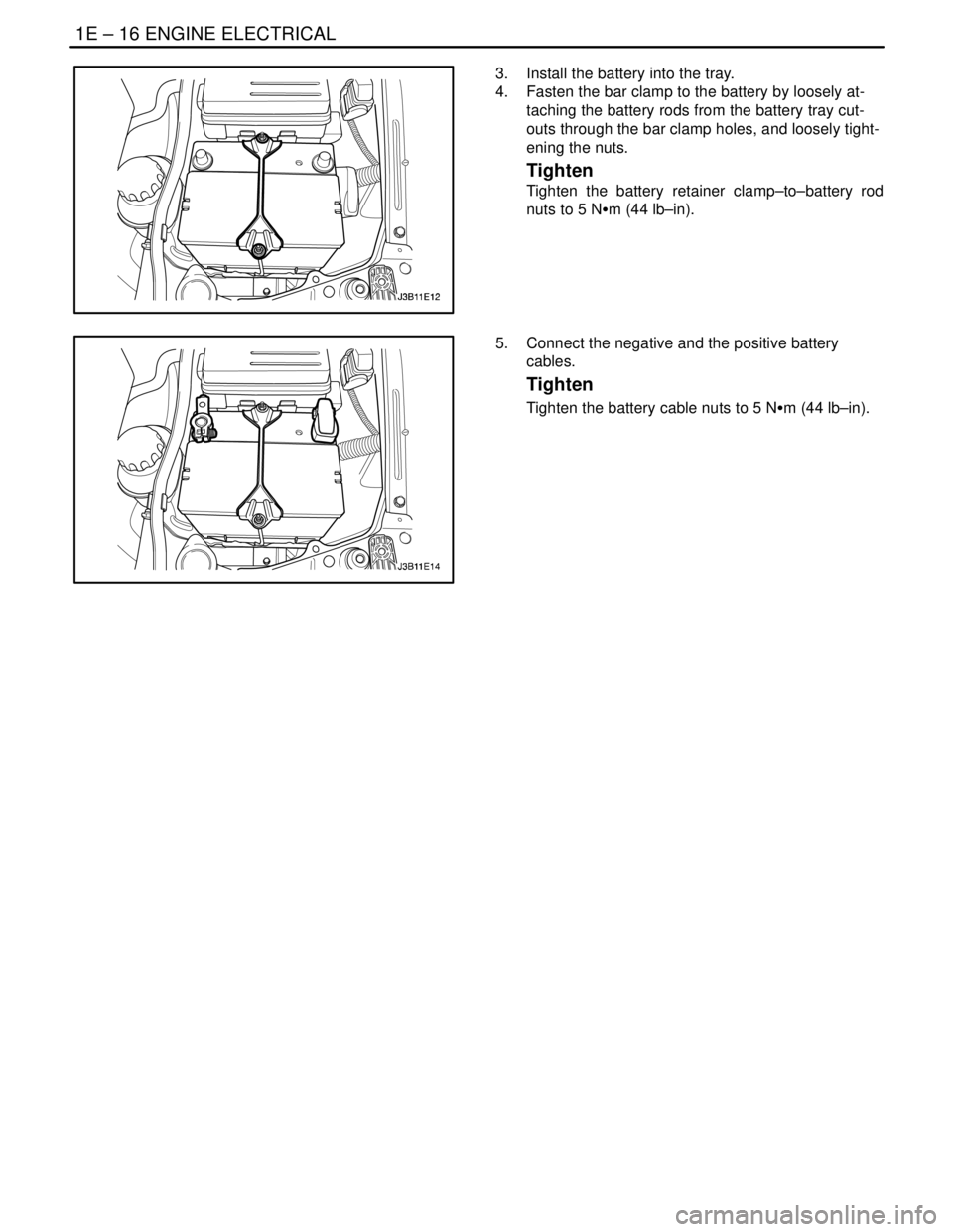
3. Install the battery into the tray.
4. Fasten the bar clamp to the battery by loosely at-
taching the battery rods from the battery tray cut-
outs through the bar clamp holes, and loosely tight-
ening the nuts.
Tighten
Tighten the battery retainer clamp–to–battery rod
nuts to 5 NSm (44 lb–in).
5. Connect the negative and the positive battery
cables.
Tighten
Tighten the battery cable nuts to 5 NSm (44 lb–in).
Page 232 of 2643
1E – 18IENGINE ELECTRICAL
DAEWOO V–121 BL4
1) Rated current draw and no–load speed indicate
a normal condition for the starter motor.
2) Low rpm combined with high current draw is an
indication of excessive friction caused by tight,
dirty, or worn bearings; a bent armature shaft;
a shorted armature; or a shorted field coils.
3) Failure to operate with high current draw indi-
cates a direct ground in the terminal or fields,
or ”frozen” bearings.
4) Failure to operate with no current draw indi-
cates an open field circuit, open armature coils,
broken brush springs, worn brushes, high in-
sulation between the commutator bars, or oth-
er causes which would prevent good contact
between the brushes and the commutator.
5) Low, no–load speed and low current indicate
high internal resistance and high current draw,
which usually mean shorted fields.
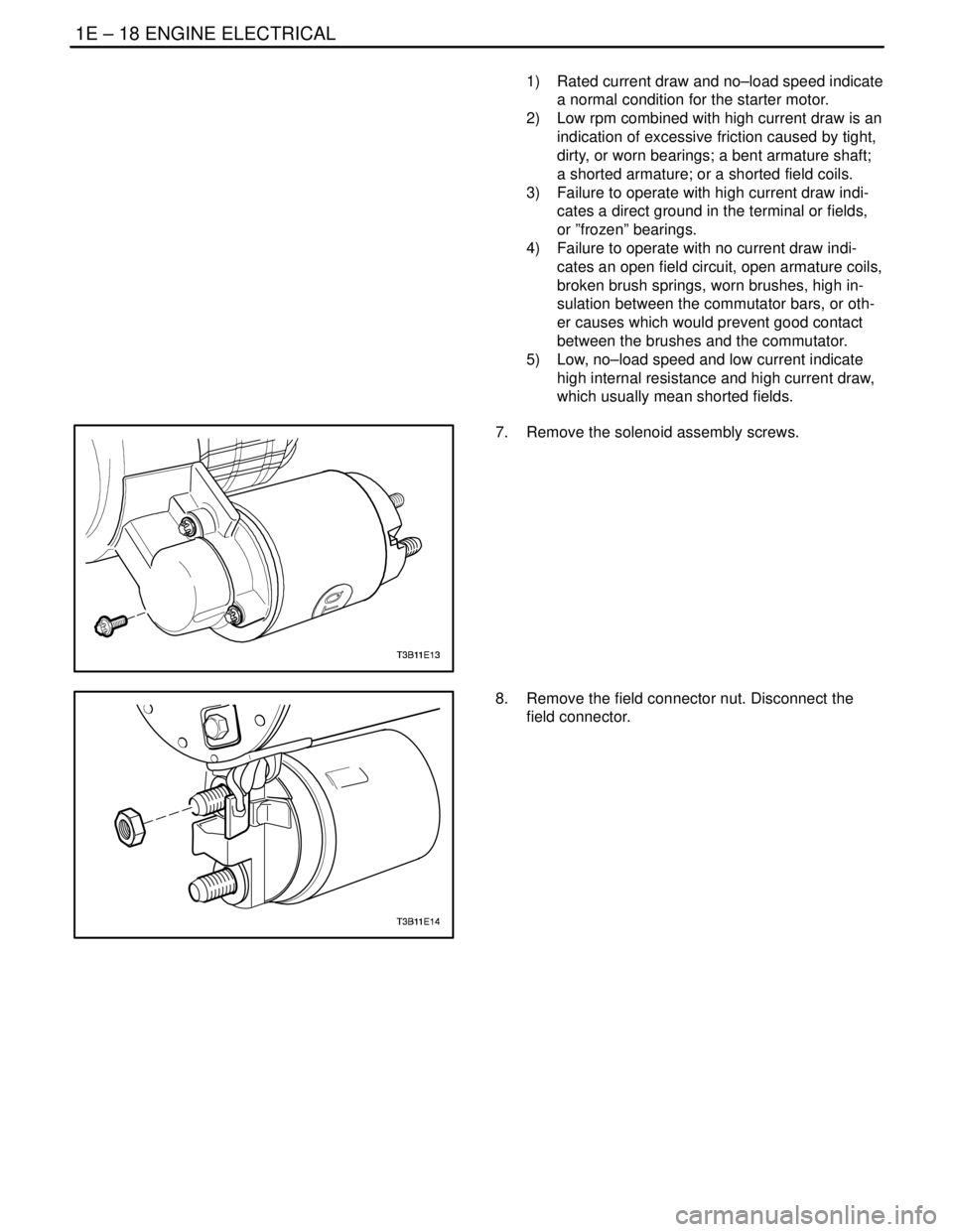
7. Remove the solenoid assembly screws.
8. Remove the field connector nut. Disconnect the
field connector.