nut DAEWOO NUBIRA 2004 Service Manual PDF
[x] Cancel search | Manufacturer: DAEWOO, Model Year: 2004, Model line: NUBIRA, Model: DAEWOO NUBIRA 2004Pages: 2643, PDF Size: 80.54 MB
Page 235 of 2643

ENGINE ELECTRICAL 1E – 21
DAEWOO V–121 BL4
20. Remove the locking ring from the groove in the dri-
veshaft.
21. Remove the pinion stop and the drive from the dri-
veshaft.
22. If not done in the previous steps, remove the
screws that hold the solenoid assembly into the
housing, and remove the nut from the field coil con-
nector.
23. Rotate the solenoid 90 degrees and remove it along
with the return spring.
Page 238 of 2643
1E – 24IENGINE ELECTRICAL
DAEWOO V–121 BL4
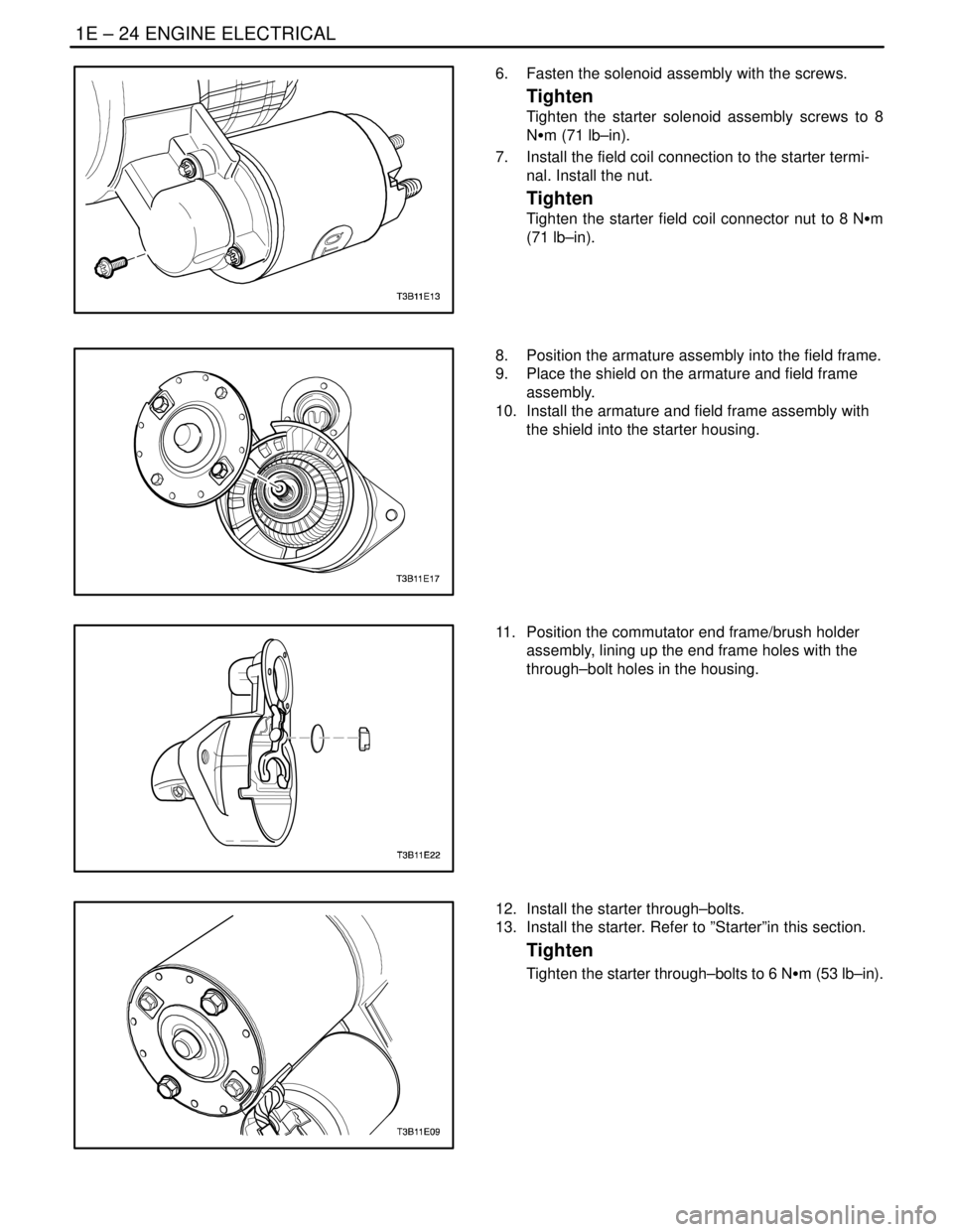
6. Fasten the solenoid assembly with the screws.
Tighten
Tighten the starter solenoid assembly screws to 8
NSm (71 lb–in).
7. Install the field coil connection to the starter termi-
nal. Install the nut.
Tighten
Tighten the starter field coil connector nut to 8 NSm
(71 lb–in).
8. Position the armature assembly into the field frame.
9. Place the shield on the armature and field frame
assembly.
10. Install the armature and field frame assembly with
the shield into the starter housing.
11. Position the commutator end frame/brush holder
assembly, lining up the end frame holes with the
through–bolt holes in the housing.
12. Install the starter through–bolts.
13. Install the starter. Refer to ”Starter”in this section.
Tighten
Tighten the starter through–bolts to 6 NSm (53 lb–in).
Page 240 of 2643

1E – 26IENGINE ELECTRICAL
DAEWOO V–121 BL4
9. Retest by connecting the ohmmeter terminals in
reverse.
10. Replace the rectifier bridge, if each reading is the
same.
11. Test the remaining two diodes after the above pro-
cedure.
Notice : Some kinds of digital ohmmeters are not suited
for the test of the bridge diode. In this case, consult the
manufacturer regarding the test capacity.
12. Test the diodes by connecting the ohmmeter termi-
nals to the bridge terminal and the base plate. If the
reading is the same, the rectifier bridge should be
replaced.
13. Remove the generator through – bolts.
Important : The fastening torque of this nut is 81 NSm (60
lb–ft) and may not normally be unfastened using hand
strength.
14. Move to the drive end of the generator and remove
the drive end bearing nut.
15. Remove the pulley and the collars.
Page 243 of 2643
ENGINE ELECTRICAL 1E – 29
DAEWOO V–121 BL4
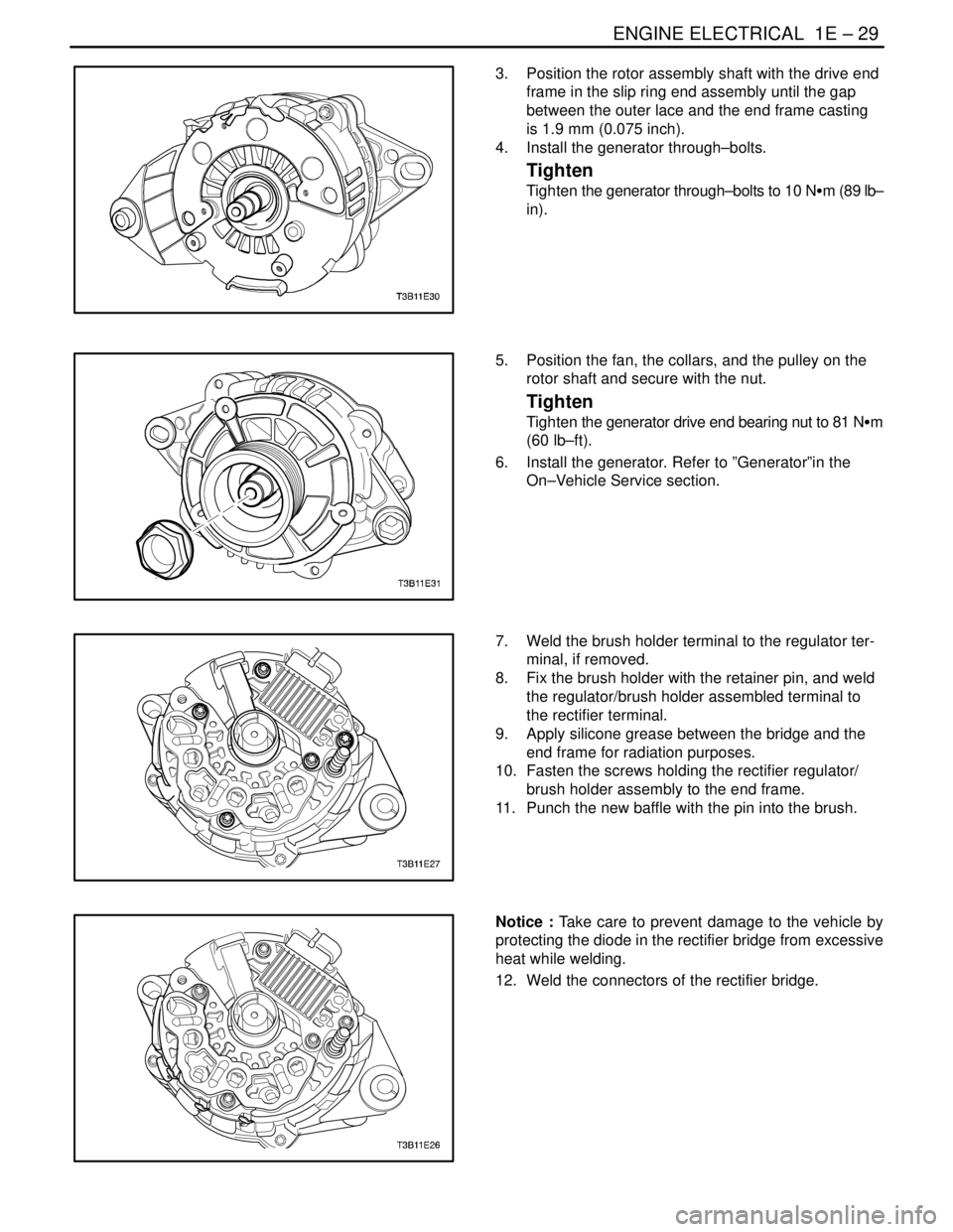
3. Position the rotor assembly shaft with the drive end
frame in the slip ring end assembly until the gap
between the outer lace and the end frame casting
is 1.9 mm (0.075 inch).
4. Install the generator through–bolts.
Tighten
Tighten the generator through–bolts to 10 NSm (89 lb–
in).
5. Position the fan, the collars, and the pulley on the
rotor shaft and secure with the nut.
Tighten
Tighten the generator drive end bearing nut to 81 NSm
(60 lb–ft).
6. Install the generator. Refer to ”Generator”in the
On–Vehicle Service section.
7. Weld the brush holder terminal to the regulator ter-
minal, if removed.
8. Fix the brush holder with the retainer pin, and weld
the regulator/brush holder assembled terminal to
the rectifier terminal.
9. Apply silicone grease between the bridge and the
end frame for radiation purposes.
10. Fasten the screws holding the rectifier regulator/
brush holder assembly to the end frame.
11. Punch the new baffle with the pin into the brush.
Notice : Take care to prevent damage to the vehicle by
protecting the diode in the rectifier bridge from excessive
heat while welding.
12. Weld the connectors of the rectifier bridge.
Page 244 of 2643

1E – 30IENGINE ELECTRICAL
DAEWOO V–121 BL4
GENERAL DESCRIPTION
AND SYSTEM OPERATION
BATTERY
The sealed battery is standard on all cars. There are no
vent plugs in the cover. The battery is completely sealed,
except for two small vent holes in the sides. These vent
holes allow the small amount of gas produced in the bat-
tery to escape. The battery has the following advantages
over conventional batteries:
S No water addition for the life of the battery.
S Overcharge protection. If too much voltage is ap-
plied to the battery, it will not accept as much cur-
rent as a conventional battery. In a conventional
battery, the excess voltage will still try to charge the
battery, leading to gassing, which causes liquid
loss.
S Not as liable to self–discharge as compared to a
conventional battery. This is particularly important
when a battery is left standing for long periods of
time.
S More power available in a lighter and smaller case.
The battery has three major functions in the electrical sys-
tem. First, the battery provides a source of energy for
cranking the engine. Second, the battery acts as a voltage
stabilizer for the electrical system. Finally, the battery can,
for a limited time, provide energy when the electrical de-
mand exceeds the output of the generator.
RATINGS
A battery has two ratings: (1) a reserve capacity rating
designated at 27°C (80°F), which is the time a fully
charged battery will provide 25 amperes current flow at or
above 10.5 volts; (2) a cold cranking amp rating deter-
mined under testing at –18°C (0°F), which indicates the
cranking load capacity.
RESERVE CAPACITY
The reserve capacity is the maximum length of time it is
possible to travel at night with the minimum electrical load
and no generator output. Expressed in minutes, Reserve
Capacity (or RC rating) is the time required for a fully
charged battery, at a temperature of 27°C (80°F) and be-
ing discharged at a current of 25 amperes, to reach a ter-
minal voltage of 10.5 volts.
COLD CRANKING AMPERAGE
The cold cranking amperage test is expressed at a battery
temperature of –18°C (0°F). The current rating is the mini-
mum amperage, which must be maintained by the battery
for 30 seconds at the specified temperature, while meeting
a minimum voltage requirement of 7.2 volts. This rating is
a measure of cold cranking capacity.The battery is not designed to last indefinitely. However,
with proper care, the battery will provide many years of
service.
If the battery tests well, but fails to perform satisfactorily
in service for no apparent reason, the following factors
may point to the cause of the trouble:
S Vehicle accessories are left on overnight.
S Slow average driving speeds are used for short pe-
riods.
S The vehicle’s electrical load is more than the gener-
ator output, particularly with the addition of after-
market equipment.
S Defects in the charging system, such as electrical
shorts, a slipping generator belt, a faulty generator,
or a faulty voltage regulator.
S Battery abuse, including failure to keep the battery
cable terminals clean and tight, or a loose battery
hold–down clamp.
S Mechanical problems in the electrical system, such
as shorted or pinched wires.
BUILT – IN HYDROMETER
The sealed battery has a built–in, temperature–compen-
sated hydrometer in the top of the battery. This hydrome-
ter is to be used with the following diagnostic procedure:
1. When observing the hydrometer, make sure that
the battery has a clean top.
2. Under normal operation, two indications can be ob-
served:
S GREEN DOT VISIBLE – Any green appearance
is interpreted as a ”green dot,” meaning the bat-
tery is ready for testing.
S DARK GREEN DOT IS NOT VISIBLE – If there
is a cranking complaint, the battery should be
tested. The charging and electrical systems
should also be checked at this time.
3. Occasionally, a third condition may appear:
S CLEAR OR BRIGHT YELLOW – This means
the fluid level is below the bottom of the hydrom-
eter. This may have been caused by excessive
or prolonged charging, a broken case, excessive
tipping, or normal battery wear. Finding a battery
in this condition may indicate high charging by a
faulty charging system. Therefore, the charging
and the electrical systems may need to be
checked if a cranking complaint exists. If the
cranking complaint is caused by the battery, re-
place the battery.
CHARGING PROCEDURE
1. Batteries with the green dot showing do not require
charging unless they have just been discharged
(such as in cranking a vehicle).
2. When charging sealed–terminal batteries out of the
vehicle, install the adapter kit. Make sure all the
charger connections are clean and tight. For best
results, batteries should be charged while the elec-
Page 246 of 2643

1E – 32IENGINE ELECTRICAL
DAEWOO V–121 BL4
the same cable to the positive terminal on the other
battery. Never connect the other end to the nega-
tive terminal of the discharged battery.
CAUTION : To avoid injury do not attach the cable di-
rectly to the negative terminal of the discharged bat-
tery. Doing so could cause sparks and a possible bat-
tery explosion.
6. Clamp one end of the second cable to the negative
terminal of the booster battery. Make the final con-
nection to a solid engine ground (such as the en-
gine lift bracket) at least 450 millimeters (18 inches)
from the discharged battery.
7. Start the engine of the vehicle with the good bat-
tery. Run the engine at a moderate speed for sever-
al minutes. Then start the engine of the vehicle
which has the discharged battery.
8. Remove the jumper cables by reversing the above
sequence exactly. Remove the negative cable from
the vehicle with the discharged battery first. While
removing each clamp, take care that it does not
touch any other metal while the other end remains
attached.
GENERATOR
The Delco–Remy CS charging system has several mod-
els available, including the CS. The number denotes the
outer diameter in millimeters of the stator lamination.
CS generators are equipped with internal regulators. A
Delta stator, a rectifier bridge, and a rotor with slip rings
and brushes are electrically similar to earlier generators.
A conventional pulley and fan are used. There is no test
hole.
Unlike three–wire generators, the CS may be used with
only two connections: battery positive and an ”L’’ terminal
to the charge indicator lamp.
As with other charging systems, the charge indicator lamp
lights when the ignition switch is turned to RUN, and goes
out when the engine is running. If the charge indicator is
on with the engine running, a charging system defect is in-
dicated. This indicator light will glow at full brilliance for
several kinds of defects as well as when the system volt-
age is too high or too low.The regulator voltage setting varies with temperature and
limits the system voltage by controlling rotor field current.
At high speeds, the on–time may be 10 percent and the
off–time 90 percent. At low speeds, with high electrical
loads, on–time may be 90 percent and the off–time 10 per-
cent.
CHARGING SYSTEM
CS generators use a new type of regulator that incorpo-
rates a diode trio. A Delta stator, a rectifier bridge, and a
rotor with slip rings and brushes are electrically similar to
earlier generators. A conventional pulley and fan are used.
There is no test hole.
STARTER
Wound field starter motors have pole pieces, arranged
around the armature, which are energized by wound field
coils.
Enclosed shift lever cranking motors have the shift lever
mechanism and the solenoid plunger enclosed in the drive
housing, protecting them from exposure to dirt, icy condi-
tions, and splashes.
In the basic circuit, solenoid windings are energized when
the switch is closed. The resulting plunger and shift lever
movement causes the pinion to engage the engine fly-
wheel ring gear. The solenoid main contacts close. Crank-
ing then takes place.
When the engine starts, pinion overrun protects the arma-
ture from excessive speed until the switch is opened, at
which time the return spring causes the pinion to disen-
gage. To prevent excessive overrun, the switch should be
released immediately after the engine starts.
STARTING SYSTEM
The engine electrical system includes the battery, the igni-
tion, the starter, the generator, and all the related wiring.
Diagnostic tables will aid in troubleshooting system faults.
When a fault is traced to a particular component, refer to
that component section of the service manual.
The starting system circuit consists of the battery, the
starter motor, the ignition switch, and all the related electri-
cal wiring. All of these components are connected electri-
cally.
Page 253 of 2643

ENGINE CONTROLS 1F – 7
DAEWOO V–121 BL4
Parameter ValueScaling
A/C RequestYes/NoNo
A/C ClutchOn/OffOff
Fuel Pump CommandOn/OffOn
Closed LoopYes/NoYe s
Throttle At IdleYes/NoNo
O2 Ready (B1–S1)Yes/NoYe s
Knock PresentYes/NoNo
Fan LowOn/OffOn/Off
Fan HighOn/OffOn/Off
TCC Engaged (Only AT)Yes/NoYe s
Park/Neutral (Only AT)P/N and R/N/DP/N
Fuel Level InputVvaries
Fuel Level Output%varies
Fuel Trim Cell–18
G–SensorV1.1 – 3.7 V (Non–ABS Only)
Engine RuntimeHH:MM:SSHours:Minutes:Seconds
* Condition: Warmed up, idle, park or neutral, A/C off
ENGINE DATA DISPLAY TABLE
DEFINITIONS
ECM Data Description
The following information will assist in diagnosing emis-
sion or driveability problems. A first technician can view
the displays while the vehicle is being driven by second
technician. Refer to Powertrain On–Board Diagnostic
(EOBD) System Check for addition information.
A/C Clutch
The A/C Relay represents the commanded state of the
A/C clutch control relay. The A/C clutch should be en-
gaged when the scan tool displays ON.
A/C Pressure
The A/C High Side displays the pressure value of the A/C
refrigerant pressure sensor. The A/C High Side helps to
diagnose the diagnostic trouble code (DTC) P0533.
A/C Request
The A/C Request represents whether the air conditioning
is being requested from the HVAC selector. The input is re-
ceived by the instrument panel cluster and then sent serial
data to the ECM and finally to the scan tool over KWP 2000
serial data.
Air Fuel Ratio
The Air Fuel Ration indicates the air to fuel ratio based on
the Front Heated Oxygen Sensor (HO2S1) inputs. The
ECM uses the fuel trims to adjust fueling in order to at-
tempt to maintain an air fuel ratio of 14.7:1.BARO
The Barometric Pressure (BARO) sensor measures the
change in the intake manifold pressure which results from
altitude changes. This value is updated at ignition ON and
also at Wide Open Throttle (WOT).
Base Injection PWM
Indicates the base Pulse Width Modulation (PWM) or ON
time of the indicated cylinder injector in milliseconds.
When the engine load is increased, the injector pulse width
will increase.
Calculated Air Flow
The calculated air flow is a calculation based on manifold
absolute pressure. The calculation is used in several diag-
nostics to determine when to run the diagnostics.
Desired Idle Speed
The ECM commands the idle speed. The ECM compen-
sates for various engine loads in order to maintain the de-
sired idle speed. The actual engine speed should remain
close to the desired idle under the various engine loads
with the engine idling.
Engine Coolant Temperature
The Engine Coolant Temperature (ECT) sensor sends en-
gine temperature information to the ECM. The ECM sup-
plies 5 volts to the engine coolant temperature sensor cir-
cuit. The sensor is a thermistor which changes internal
resistance as temperature changes. When the sensor is
cold (internal resistance high), the ECM monitors a high
voltage which it interprets as a cold engine. As the sensor
warms (internal resistance decreases), the voltage signal
will decrease and the ECM will interpret the lower voltage
as a warm engine.
Page 256 of 2643

1F – 10IENGINE CONTROLS
DAEWOO V–121 BL4
FASTENER TIGHTENING SPECIFICATIONS
ApplicationNSmLb–FtLb–In
Camshaft Position Sensor Bolts (1.4L/1.6L DOHC)7–62
Camshaft Position Sensor Bolts (1.8 DOHC)8–71
Crankshaft Position Sensor Retaining Bolt (1.4L/1.6L DOHC)6.5–58
Crankshaft Position Sensor Retaining Bolt (1.8 DOHC)8–71
Electronic Ignition System Ignition Coil Retaining Bolts10–89
Exhaust Gas Recirculation Valve Retaining Bolts3022–
Engine Control Module Bolts12–106
Engine Coolant Temperature Sensor Bolt (1.4L/1.6L DOHC)17.513–
Engine Coolant Temperature Sensor Bolt (1.8 DOHC)2015–
Evaporative Emission Canister Flange Bolt4–35
Evaporative Emission Canister Purge Solenoid Bracket Bolt5–44
Fuel Filter Mounting Bracket Assembly Bolt4–35
Fuel Tank Retaining Bolts2015–
Fuel Rail Retaining Bolts2518–
Idle Air Control Valve Retaining Bolts (1.8 DOHC)3–27
Intake Air Temperature Sensor2216–
Knock Sensor Bolt2015–
Manifold Absolute Pressure Sensor Bolts (1.4L/1.6L DOHC)8–71
Manifold Absolute Pressure Sensor Bolts (1.8 DOHC)4–35
Oxygen Sensor Bolt4231–
Throttle Body Retaining Nuts (1.4L/1.6L DOHC)1511–
Throttle Body Retaining Nuts (1.8 DOHC)10–89
Throttle Position Sensor Retaining Bolts (1.8 DOHC)2–18
Page 356 of 2643

1F – 110IENGINE CONTROLS
DAEWOO V–121 BL4
FUEL INJECTOR BALANCE TEST
A fuel injector tester is used to energize the injector for a
precise amount of time, thus spraying a measured amount
of fuel into the intake manifold. This causes a drop in the
fuel rail pressure that can be recorded and used tocompare each of the fuel injectors. All of the fuel injectors
should have the same pressure drop.
Fuel Injector Balance Test Example
Cylinder1234
First Reading296 kPa (43 psi)296 kPa (43 psi)296 kPa (43 psi)296 kPa (43 psi)
Second Reading131 kPa (19 psi)117 kPa (17 psi)124 kPa (18 psi)145 kPa (21 psi)
Amount Of Drop165 kPa (24 psi)179 kPa (26 psi)172 kPa (25 psi)151 kPa (22 psi)
Average Range:
156~176 kPa
(22.5~25.5 psi)Injector OKFaulty Injector – Too
Much Pressure DropInjector OKFaulty Injector – Too
Little Pressure Drop
CAUTION : The fuel system is under pressure. To
avoid fuel spillage and the risk of personal injury or
fire, it is necessary to relieve the fuel system pressure
before disconnecting the fuel lines.
CAUTION : Do not pinch or restrict nylon fuel lines.
Damage to the lines could cause a fuel leak, resulting
in possible fire or personal injury.
Notice : In order to prevent flooding of the engine, do not
perform the Injector Balance Test more than once (includ-
ing any retest on faulty fuel injectors) without running the
engine.
Test
1. Turn the ignition switch to ON in order to get the
fuel pressure to its maximum level.
2. Allow the fuel pressure to stabilize and then record
this initial pressure reading. Wait until there is no
movement of the needle on the fuel pressure
gauge.
3. Follow the manufacturer’s instructions for the use
of the adapter harness. Energize the fuel injector
tester once and note the fuel pressure drop at its
lowest point. Record this second reading. Subtract
it from the first reading to determine the amount of
the fuel pressure drop.
4. Disconnect the fuel injector tester from the fuel in-
jector.
5. After turning the ignition switch to ON, in order toobtain maximum pressure once again, make a con-
nection at the next fuel injector. Energize the fuel
injector tester and record the fuel pressure reading.
Repeat this procedure for all the injectors.
6. Retest any of the fuel injectors that the pressure
drop exceeds the 10 kPa (1.5 psi) of the average
pressure drop value.
7. Replace any of the fuel injectors that fail the retest.
8. If the pressure drop of all of the fuel injectors is
within 10 kPa (1.5 psi) of the average pressure
drop value, then the fuel injectors are flowing nor-
mally and no replacement should be necessary.
9. Reconnect the fuel injector harness and review the
symptom diagnostic tables.
10. An engine cool down period of 10 minutes is neces-
sary in order to avoid irregular readings due to hot
soak fuel boiling.
11. Connect the fuel pressure gauge carefully to avoid
any fuel spillage.
12. The fuel pump should run about 2 seconds after the
ignition is turned to the ON position.
13. Insert a clear tube attached to the vent valve of the
fuel pressure gauge into a suitable container.
14. Bleed the air from the fuel pressure gauge and
hose until all of the air is bled from the fuel pressure
gauge.
15. The ignition switch must be in the OFF position at
least 10 seconds in order to complete the Engine
Control Module (ECM) shutdown cycle.
Page 392 of 2643

1F – 146IENGINE CONTROLS
DAEWOO V–121 BL4
S Damaged harness
Test Description
Number(s) below refer to the step number(s) on the Diag-
nostic Table.
1. The On–Board Diagnostic (EOBD) System Check
prompts the technician to complete some basic
checks and store the freeze frame and failure re-
cords data on the scan tool if applicable. This
creates an electronic copy of the data taken when
the malfunction occurred. The information is then
stored on the scan tool for later reference.
2. This step determines if DTC P0135 is the result of
a hard failure or an intermittent condition. With the
ignition ON, engine OFF, the HO2S1 voltage dis-played on the scan tool should change within sever-
al minutes toward 0 or 1 volt, indicating that the
heater is working properly.
3. Probing terminal 4 of the HO2S1 connector verifies
if voltage is available to the HO2S1 heater.
4. If voltage is available at the connector, than it be-
comes a good voltage source to check for a ground
at terminal 3.
5. Determines if voltage is not available at the HO2S1
due to an open in the HO2S1 fuse or open ignition
feed circuit. If the fuse is open, determine if it was
due to a short in the ignition feed circuit before re-
placing the fuse.
DTC P0135 – Front Heated Oxygen Sensor Heater Circuit Not
Functioning
StepActionValue(s)YesNo
1Perform an On–Board Diagnostic (EOBD) System
Check.
Is the check complete?–Go to Step 2Go to
”On–Board
Diagnostic Sys-
tem Check”
2Notice : If the engine has just been operating, allow
the engine to cool for about one–half hour before
proceeding.
1. Turn the ignition switch ON, with the engine
OFF.
2. Install a scan tool.
Does the Front Heated Oxygen Sensor (HO2S1)
voltage gradually change toward the specified volt-
age?0 v or 1 vGo to Step 13Go to Step 3
31. Disconnect the HO2S1 electrical connector.
2. With a test light connected to ground, probe
the ignition feed circuit, terminal 2 of the con-
nector.
Does the test light illuminate?–Go to Step 4Go to Step 5
4Connect a test light between the ignition feed and
ground circuits, terminal 2 and 3 of the connector.
Does the test light illuminate?–Go to Step 6Go to Step 7
5Inspect the fuse in the engine fuse block.
Is the fuse open?–Go to Step 8Go to Step 9
6Check the connections terminal 2 and 1 at the
HO2S2 connector and repair as necessary.
Is a repair necessary?–Go to Step 13Go to Step 10
7Check the connections terminal 4 at the HO2S1 con-
nector and repair as necessary.
Is a repair necessary?–Go to Step 13Go to Step 11
81. Check for a short to ground in the HO2S1 igni-
tion feed circuit and repair as necessary?
2. Replace open fuse.
Is the action complete?–Go to Step 13–