ECU DAEWOO NUBIRA 2004 Service Manual Online
[x] Cancel search | Manufacturer: DAEWOO, Model Year: 2004, Model line: NUBIRA, Model: DAEWOO NUBIRA 2004Pages: 2643, PDF Size: 80.54 MB
Page 535 of 2643

ENGINE CONTROLS 1F – 289
DAEWOO V–121 BL4
DIAGNOSTIC TROUBLE CODE (DTC) P1231
FUEL PUMP RELAY HIGH VOLTAGE (1.4L DOHC)
Circuit Description
When the ignition switch is turned ON, the ECM will acti-
vate the fuel pump relay and run the in–tank fuel pump.
The fuel pump will operate as long as the engine is crank-
ing or running and the ECM is receiving ignition reference
pulses.
Conditions for Setting the DTC
S This DTC can be stored in ”key–on” status.
S A high voltage condition exists.
Action Taken When the DTC Sets
S The Malfunction Indicator Lamp (MIL) will not illumi-
nate.
S The ECM will store conditions which were present
when the DTC was set as Failure Records data
only.
S This information will not be stored in the Freeze
Frame data.Conditions for Clearing the MIL/DTC
S A history DTC will clear after 40 consecutive warm
up cycles without a fault.
S DTC(s) can be cleared by using the scan tool.
S Disconnecting the ECM battery feed for more than
10 seconds.
Diagnostic Aids
An Intermittent problem may be caused by a poor connec-
tion, rubbed through wire insulation, or wire that is broken
inside the insulation.
Any circuitry, that is suspected as causing the complaint,
should be thoroughly checked for the following conditions.
S Backed–out terminals
S Improper mating
S Broken locks
S Improperly formed
S Damaged terminals
S Poor terminals to wire connection
S Physical damage to the wiring harness
Page 538 of 2643

1F – 292IENGINE CONTROLS
DAEWOO V–121 BL4
DIAGNOSTIC TROUBLE CODE (DTC) P1231
FUEL PUMP RELAY HIGH VOLTAGE (1.6L DOHC)
Circuit Description
When the ignition switch is turned ON, the ECM will acti-
vate the fuel pump relay and run the in–tank fuel pump.
The fuel pump will operate as long as the engine is crank-
ing or running and the ECM is receiving ignition reference
pulses.
Conditions for Setting the DTC
S This DTC can be stored in ”key–on” status.
S A high voltage condition exists.
Action Taken When the DTC Sets
S The Malfunction Indicator Lamp (MIL) will illumi-
nate.
S The ECM will record operating conditions at the
time the diagnostic fails. This information will be
stored in the Freeze Frame and Records buffers.
S A history DTC is stored.
S Coolant fan turns ON.
Conditions for Clearing the MIL/DTCS The MIL will turn off after consecutive ignition
cycles in which the diagnostic runs without a fault.
S A history DTC will clear after 40 consecutive warm
up cycles without a fault.
S DTC(s) can be cleared by using the scan tool.
S Disconnecting the ECM battery feed for 10 sec-
onds.
Diagnostic Aids
An Intermittent problem may be caused by a poor connec-
tion, rubbed through wire insulation, or wire that is broken
inside the insulation.
Any circuitry, that is suspected as causing the complaint,
should be thoroughly checked for the following conditions.
S Backed–out terminals
S Improper mating
S Broken locks
S Improperly formed
S Damaged terminals
S Poor terminals to wire connection
S Physical damage to the wiring harness
Page 541 of 2643

ENGINE CONTROLS 1F – 295
DAEWOO V–121 BL4
DIAGNOSTIC TROUBLE CODE (DTC) P1320
CRANKSHAFT SEGMENT PERIOD SEGMENT
ADAPTATION AT LIMIT
Circuit Description
The 58X reference signal is produced by the Crankshaft
Position (CKP) sensor. During one crankshaft revolution,
58 crankshaft pulses will be produced. The Engine Control
Module (ECM) uses the 58X reference signal to calculate
engine rpm and CKP. The ECM constantly monitors the
number of pulses on the 58X reference circuit and
compares them to the number of Camshaft Position
(CMP) signal pulses being received. If the ECM receives
and incorrect number of pulses on the 58X reference cir-
cuit, Diagnostic Trouble Code (DTC) P1320 will set.
Conditions for Setting the DTC
S Segment adaptation valve at the limit.
Action Taken When the DTC Sets
S The Malfunction Indicator Lamp (MIL) will illuminate
after three consecutive trip with a fail.
S The ECM will record operating conditions at the
time the diagnostic fail. This information will be
stored in the Freeze Frame and Failure Records
buffers.
S A history DTC is stored.
Conditions for Clearing the MIL/DTC
S The MIL will turn off after four consecutive ignition
cycles in which the diagnostic runs without a fault.S A history DTC will clear after 40 consecutive warm–
up cycles without a fault.
S DTC(s) can be cleared by using the scan tool.
S Disconnecting the ECM battery feed for more than
10 seconds.
Diagnostic Aids
An intermittent may be caused by a poor connection,
rubbed–through wire insulation or a wire broken inside the
insulation. Check for:
S Poor connection – Inspect the ECM harness and
connectors for improper mating, broken locks, im-
properly formed or damaged terminals, and poor
terminal–to–wire connections.
S Damaged harness – Inspect the wiring harness for
damage. If the harness appears to be OK, discon-
nect the ECM, turn the ignition ON and observe a
voltmeter connected to the 58X reference circuit at
the ECM harness connector while moving the con-
nectors and the wiring harnesses related to the
ECM. A change in voltage will indicate the location
of the fault.
S Reviewing the Failure Records vehicle mileage
since the diagnostic test last failed may help deter-
mine how often the condition that caused the DTC
to be set occurs. This may assist in diagnosing the
condition.
DTC P1320 – Crankshaft Segment Period Segment Adaptation at
Limit
StepActionValue(s)YesNo
1Perform an Euro On–Board Diagnostic (EOBD)
System Check.
Was the check performed?–Go to Step 2Go to
”On–Board
Diagnostic Sys-
tem Check”
2Attempt to start the engine.
Does the engine start?–Go to Step 3Refer to
”Engine Cranks
But Will Not
Run”
31. Turn the ignition OFF.
2. Install a scan tool to the Data Link Connector
(DLC).
3. Turn the ignition ON, with the engine OFF.
4. Review and record Failure Records informa-
tion.
5. Clear the Diagnostic Trouble Codes (DTCs).
6. Start the engine and idle for 1 minute.
Is DTC P1320 set?–Go to Step 4Go to
”Diagnostic
Aids”
Page 543 of 2643

ENGINE CONTROLS 1F – 297
DAEWOO V–121 BL4
DIAGNOSTIC TROUBLE CODE (DTC) P1321
CRANKSHAFT SEGMENT PERIOD TOOTH ERROR
Circuit Description
The 58X reference signal is produced by the Crankshaft
Position (CKP) sensor. During one crankshaft revolution,
58 crankshaft pulses will be produced. The Engine Control
Module (ECM) uses the 58X reference signal to calculate
engine rpm and CKP. The ECM constantly monitors the
number of pulses on the 58X reference circuit and
compares them to the number of Camshaft Position
(CMP) signal pulses being received. If the ECM receives
and incorrect number of pulses on the 58X reference cir-
cuit, Diagnostic Trouble Code (DTC) P1321 will set.
Conditions for Setting the DTC
S Missing or additional teeth detected.
Action Taken When the DTC Sets
S The Malfunction Indicator Lamp (MIL) will illuminate
after three consecutive trip with a fail.
S The ECM will record operating conditions at the
time the diagnostic fail. This information will be
stored in the Freeze Frame and Failure Records
buffers.
S A history DTC is stored.
Conditions for Clearing the MIL/DTC
S The MIL will turn off after four consecutive ignition
cycles in which the diagnostic runs without a fault.S A history DTC will clear after 40 consecutive warm–
up cycles without a fault.
S DTC(s) can be cleared by using the scan tool.
S Disconnecting the ECM battery feed for more than
10 seconds.
Diagnostic Aids
An intermittent may be caused by a poor connection,
rubbed–through wire insulation or a wire broken inside the
insulation. Check for:
S Poor connection – Inspect the ECM harness and
connectors for improper mating, broken locks, im-
properly formed or damaged terminals, and poor
terminal–to–wire connections.
S Damaged harness – Inspect the wiring harness for
damage. If the harness appears to be OK, discon-
nect the ECM, turn the ignition ON and observe a
voltmeter connected to the 58X reference circuit at
the ECM harness connector while moving the con-
nectors and the wiring harnesses related to the
ECM. A change in voltage will indicate the location
of the fault.
S Reviewing the Failure Records vehicle mileage
since the diagnostic test last failed may help deter-
mine how often the condition that caused the DTC
to be set occurs. This may assist in diagnosing the
condition.
DTC P1321 – Crankshaft Segment Period Tooth Error
StepActionValue(s)YesNo
1Perform an Euro On–Board Diagnostic (EOBD)
System Check.
Was the check performed?–Go to Step 2Go to
”On–Board
Diagnostic Sys-
tem Check”
2Attempt to start the engine.
Does the engine start?–Go to Step 3Refer to
”Engine Cranks
But Will Not
Run”
31. Turn the ignition OFF.
2. Install a scan tool to the Data Link Connector
(DLC).
3. Turn the ignition ON, with the engine OFF.
4. Review and record Failure Records informa-
tion.
5. Clear the Diagnostic Trouble Codes (DTCs).
6. Start the engine and idle for 1 minute.
Is DTC P1321 set?–Go to Step 4Go to
”Diagnostic
Aids”
41. Remove the crankshaft.
2. Check for a problem with the crahkshaft’s visu-
al defection and tooth.
Is a problem found?–Go to Step 5Go to Step 6
Page 545 of 2643

ENGINE CONTROLS 1F – 299
DAEWOO V–121 BL4
DIAGNOSTIC TROUBLE CODE (DTC) P1382
ROUGH ROAD DATA INVALID (NON ABS)
Circuit Description
The VR sensor is used to detecting the road situation.
By sensing difference of wheel rotation duration caused by
bumps or potholes in the road, the Engine Control Module
(ECM) can determine if the changes in crankshaft speed
are due to engine misfire or are driveline induced. If the VR
sensor detects a rough road condition, the ECM misfire
detection diagnostic will be de–activated.
Conditions for Setting the DTC
S Vehicle speed is higher than 5km/h(3.1mph).
S No Vehicle Speed Sensor error not set.
S VR sensor output signal is higher than 0.26.
S VR sensor output signal is not change for 30sec-
onds.Action Taken When the DTC Sets
S The Malfunction Indicator Lamp (MIL) will not illumi-
nate.
S The ECM will store conditions which were present
when the DTC was set as Failure Records data
only.
S This information will not be stored in the Freeze
Frame data.
Conditions for Clearing the MIL/DTC
S A history DTC will clear after 40 consecutive warm–
up cycles without a fault.
S DTC(s) can be cleared by using the scan tool.
S Disconnecting the ECM battery feed for more than
10 seconds.
Page 548 of 2643

1F – 302IENGINE CONTROLS
DAEWOO V–121 BL4
DIAGNOSTIC TROUBLE CODE (DTC) P1382
ROUGH ROAD DATA INVALID (ABS)
Circuit Description
The wheel speed sensor is used to detecting the road situ-
ation.
As the wheel is rotated, the wheel speed sensor produces
an AC voltage that increase with wheel speed. The EBCM
uses the frequency of the AC signal to calculate wheel
speed. The wheel speed sensor is connected to EBCM by
a ”twisted pair” of wires. Twisting reduces noise suscepti-
bility than may cause a DTC to set. If the wheel speed sen-
sor detects a rough road condition, the ECM misfire detec-
tion diagnostic will be de–activated.
Conditions for Setting the DTC
S Vehicle speed is higher than 5km/h(3.1mph).
S No Vehicle Speed Sensor error not set.
S VR sensor output signal is higher than 0.26.S VR sensor output signal is not change for 30sec-
onds.
Action Taken When the DTC Sets
S The Malfunction Indicator Lamp (MIL) will not illumi-
nate.
S The ECM will store conditions which were present
when the DTC was set as Failure Records data
only.
S This information will not be stored in the Freeze
Frame data.
Conditions for Clearing the MIL/DTC
S A history DTC will clear after 40 consecutive warm–
up cycles without a fault.
S DTC(s) can be cleared by using the scan tool.
S Disconnecting the ECM battery feed for more than
10 seconds.
Page 551 of 2643

ENGINE CONTROLS 1F – 305
DAEWOO V–121 BL4
DIAGNOSTIC TROUBLE CODE (DTC) P1385
ROUGH ROAD SENSOR CIRCUIT FAULT (NON ABS)
Circuit Description
The VR sensor is used to detecting the road situation.
By sensing difference of wheel rotation duration caused by
bumps or potholes in the road, the Engine Control Module
(ECM) can determine if the changes in crankshaft speed
are due to engine misfire or are driveline induced. If the VR
sensor detects a rough road condition, the ECM misfire
detection diagnostic will be de–activated.
Conditions for Setting the DTC
S The VR sensor is greater than 0.06V.
Or
S The minimum value of the VR sensor is less than
1.5V.
OrS The maximum value of the VR sensor is greater
than 2.2V.
Action Taken When the DTC Sets
S The Malfunction Indicator Lamp (MIL) will not illumi-
nate.
S The ECM will store conditions which were present
when the DTC was set as Failure Records data
only.
S This information will not be stored in the Freeze
Frame data.
Conditions for Clearing the MIL/DTC
S A history DTC will clear after 40 consecutive warm–
up cycles without a fault.
S DTC(s) can be cleared by using the scan tool.
S Disconnecting the ECM battery feed for more than
10 seconds.
Page 554 of 2643
1F – 308IENGINE CONTROLS
DAEWOO V–121 BL4
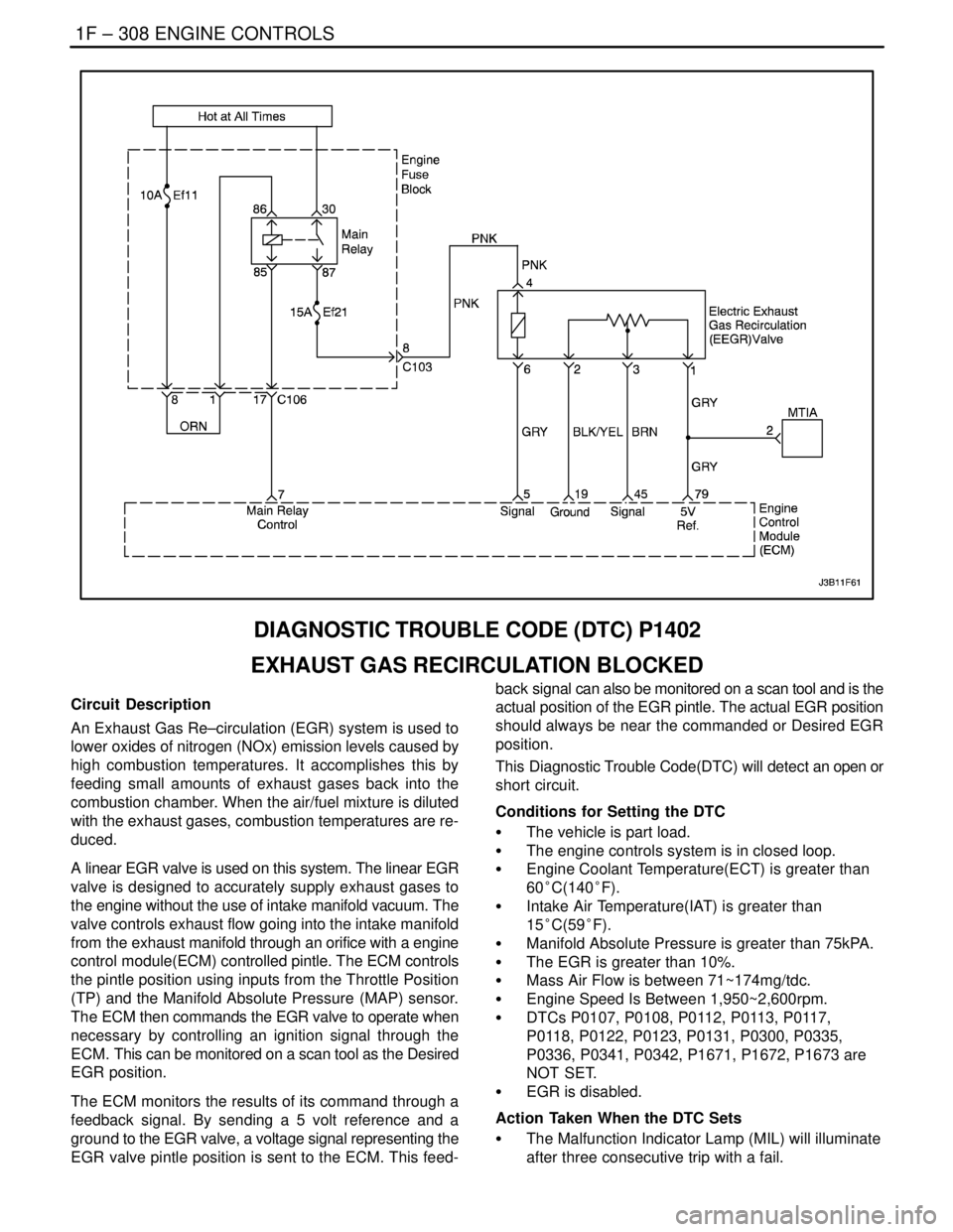
DIAGNOSTIC TROUBLE CODE (DTC) P1402
EXHAUST GAS RECIRCULATION BLOCKED
Circuit Description
An Exhaust Gas Re–circulation (EGR) system is used to
lower oxides of nitrogen (NOx) emission levels caused by
high combustion temperatures. It accomplishes this by
feeding small amounts of exhaust gases back into the
combustion chamber. When the air/fuel mixture is diluted
with the exhaust gases, combustion temperatures are re-
duced.
A linear EGR valve is used on this system. The linear EGR
valve is designed to accurately supply exhaust gases to
the engine without the use of intake manifold vacuum. The
valve controls exhaust flow going into the intake manifold
from the exhaust manifold through an orifice with a engine
control module(ECM) controlled pintle. The ECM controls
the pintle position using inputs from the Throttle Position
(TP) and the Manifold Absolute Pressure (MAP) sensor.
The ECM then commands the EGR valve to operate when
necessary by controlling an ignition signal through the
ECM. This can be monitored on a scan tool as the Desired
EGR position.
The ECM monitors the results of its command through a
feedback signal. By sending a 5 volt reference and a
ground to the EGR valve, a voltage signal representing the
EGR valve pintle position is sent to the ECM. This feed-back signal can also be monitored on a scan tool and is the
actual position of the EGR pintle. The actual EGR position
should always be near the commanded or Desired EGR
position.
This Diagnostic Trouble Code(DTC) will detect an open or
short circuit.
Conditions for Setting the DTC
S The vehicle is part load.
S The engine controls system is in closed loop.
S Engine Coolant Temperature(ECT) is greater than
60°C(140°F).
S Intake Air Temperature(IAT) is greater than
15°C(59°F).
S Manifold Absolute Pressure is greater than 75kPA.
S The EGR is greater than 10%.
S Mass Air Flow is between 71~174mg/tdc.
S Engine Speed Is Between 1,950~2,600rpm.
S DTCs P0107, P0108, P0112, P0113, P0117,
P0118, P0122, P0123, P0131, P0300, P0335,
P0336, P0341, P0342, P1671, P1672, P1673 are
NOT SET.
S EGR is disabled.
Action Taken When the DTC Sets
S The Malfunction Indicator Lamp (MIL) will illuminate
after three consecutive trip with a fail.
Page 555 of 2643

ENGINE CONTROLS 1F – 309
DAEWOO V–121 BL4
S The ECM will record operating conditions at the
time the diagnostic fail. This information will be
stored in the Freeze Frame and Failure Records
buffers.
S A history DTC is stored.
Conditions for Clearing the MIL/DTC
S The MIL will turn off after four consecutive ignition
cycles in which the diagnostic runs without a fault.
S A history DTC will clear after 40 consecutive warm–
up cycles without a fault.
S DTC(s) can be cleared by using the scan tool.S Disconnecting the ECM battery feed for more than
10 seconds.
Diagnostic Aids
Due to moisture associated with exhaust systems, the
EGR valve may freeze and stick in cold weather at times.
After the vehicle is brought into a warm shop for repairs,
the valve warms and the problem disappears.
By watching the Actual EGR and desired EGR positions
on a cold vehicle with a scan tool, the fault can be easily
verified. Check the Freeze Frame data to determine if the
DTC set when the vehicle was cold by viewing the Engine
Coolant Temperature (ECT).
DTC P1402 – Exhaust Gas Recirculation Blocked
StepActionValue(s)YesNo
1Perform an Euro On–Board Diagnostic (EOBD)
System Check.
Is the system check complete?–Go to Step 2Go to
”On–Board
Diagnostic Sys-
tem Check”
21. Start the engine and allow the engine to idle.
2. Install the scan tool.
3. Command the exhaust gas recirculation (EGR)
valve to the specified values.
Does the engine stall or attempt to stall?50%Go to Step 5Go to Step 3
31. Turn the ignition switch to LOCK.
2. Remove the EGR valve assembly.
3. Inspect the EGR valve, passages and pipe for
a restriction or damage and repair as neces-
sary.
Is a repair necessary?–Go to Step 5Go to Step 4
4Replace the EGR valve.
Is the replacement complete?–Go to Step 5–
51. Start the engine.
2. Disconnect the battery for the specified time.
3. Drive the vehicle to the specified value.
4. Release the throttle and allow the vehicle to
decelerate to the specified value.
Is the EGR Decel Filter Values less than the speci-
fied value?10 secnds
60mph
(27km/h)
20mph
(32km/h)
0mphGo to Step 3Go to Step 6
61. Using the scan tool, clear the Diagnostic
Trouble Codes (DTCs).
2. Start the engine and idle at normal operating
temperature.
3. Operate the vehicle within the conditions for
setting the DTC as specifiec in the supporting
text.
Does the scan tool indicate that this diagnostic ran
and passed?–Go to Step 7Go to Step 2
Page 557 of 2643

ENGINE CONTROLS 1F – 311
DAEWOO V–121 BL4
Action Taken When the DTC Sets
S The Malfunction Indicator Lamp (MIL) will illuminate
after three consecutive trip with a fail.
S The ECM will record operating conditions at the
time the diagnostic fail. This information will be
stored in the Freeze Frame and Failure Records
buffers.
S A history DTC is stored.
Conditions for Clearing the MIL/DTC
S The MIL will turn off after four consecutive ignition
cycles in which the diagnostic runs without a fault.
S A history DTC will clear after 40 consecutive warm–
up cycles without a fault.S DTC(s) can be cleared by using the scan tool.
S Disconnecting the ECM battery feed for more than
10 seconds.
Diagnostic Aids
Due to moisture associated with exhaust systems, the
EGR valve may freeze and stick in cold weather at times.
After the vehicle is brought into a warm shop for repairs,
the valve warms and the problem disappears.
By watching the Actual EGR and desired EGR positions
on a cold vehicle with a scan tool, the fault can be easily
verified. Check the Freeze Frame data to determine if the
DTC set when the vehicle was cold by viewing the Engine
Coolant Temperature (ECT).
DTC P1403 – Exhaust Gas Recirculation Valve Failure
StepActionValue(s)YesNo
1Perform an Euro On–Board Diagnostic (EOBD)
System Check.
Is the system check complete?–Go to Step 2Go to
”On–Board
Diagnostic Sys-
tem Check”
21. Turn the ignition switch to with the engine OFF.
2. Install the scan tool.
3. Command the exhaust gas recirculation (EGR)
valve to the specified values.
Does the Actual EGR Position follow the desired
EGR position?25%, 50%
75%, 100%Go to Step 19Go to Step 3
31. Turn the ignition switch to ON.
2. Disconnect the EGR valve electrical connector.
3. With a test light connected to B+, probe the
ground circuit to the EGR valve.
Does the test light illuminate?–Go to Step 4Go to Step 5
41. Connect the test light to ground.
2. Probe the EGR control circuit at terminal 3 to
the EGR valve.
3. Command the EGR valve to the specified val-
ues using a scan tool.
After the command is raised, does the test light glow
brighter, flash or maintain a steady glow?25%, 50%
75%, 100%Go to Step 6Go to Step 7
5Repair the open or poor connection in the EGR
ground circuit.
Is the repair complete?–Go to Step 19–
6With a test light still connected to ground, probe the
signal circuit at terminal 3.
Does the test light illuminate?–Go to Step 8Go to Step 9
7With a test light still connected to ground, again
probe the signal circuit without commanding the
EGR valve with the scan tool.
Does the test light illuminate?–Go to Step 10Go to Step 11
8Check the signal circuit for a short to voltage and re-
pair as necessary.
Is a repair necessary?–Go to Step 19Go to Step 12