open hood DATSUN 210 1979 User Guide
[x] Cancel search | Manufacturer: DATSUN, Model Year: 1979, Model line: 210, Model: DATSUN 210 1979Pages: 548, PDF Size: 28.66 MB
Page 432 of 548
Body
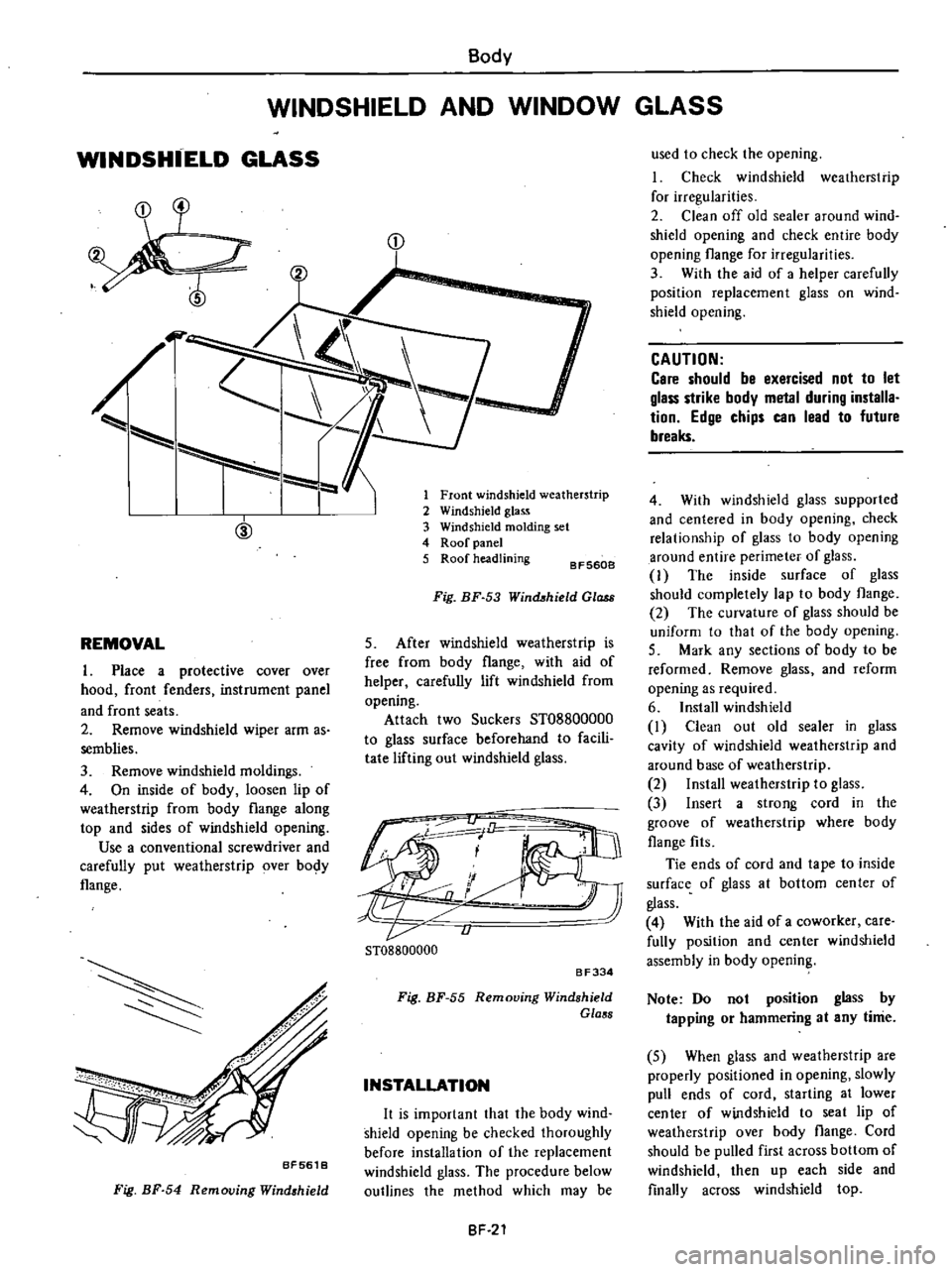
WINDSHIELD
AND
WINDOW
GLASS
WINDSHIELD
GLASS
00
REMOVAL
I
Place
a
protective
cover
over
hood
front
fenders
instrument
panel
and
front
seats
2
Remove
windshield
wiper
arm
as
semblies
3
Remove
windshield
moldings
4
On
inside
of
body
loosen
lip
of
weatherstrip
from
body
flange
along
top
and
sides
of
windshield
opening
Use
a
conventional
screwdriver
and
carefully
put
weatherstrip
over
body
flange
BF5618
Fig
BF
54
Removing
Wind
hield
D
1
Front
windshield
weatherstrip
2
Windshield
glass
3
Windshield
molding
set
4
Roof
panel
5
Roof
headlining
BF5608
Fig
BF
53
Winct
hield
Ol
5
After
windshield
weatherstrip
is
free
from
body
flange
with
aid
of
helper
carefully
lift
windshield
from
opening
Attach
two
Suckers
ST08800000
to
glass
surface
beforehand
to
facili
tate
lifting
out
windshield
glass
Li
ST08800000
BF334
Fig
BF
55
Removing
Windshield
Glass
INSTALLATION
It
is
important
that
the
body
wind
shield
opening
be
checked
thoroughly
before
installation
of
the
replacement
windshield
glass
The
procedure
below
outlines
the
method
which
may
be
BF
21
used
to
check
the
opening
I
Check
windshield
weatherstrip
for
irregularities
2
Clean
off
old
sealer
around
wind
shield
opening
and
check
entire
body
opening
flange
for
irregularities
3
With
the
aid
of
a
helper
carefully
position
replacement
glass
on
wind
shield
opening
CAUTION
Care
should
be
exercised
not
to
let
glass
strike
body
metal
during
installa
tion
Edge
chips
can
lead
to
future
breaks
4
With
windshield
glass
supported
and
centered
in
body
opening
check
relationship
of
glass
to
body
opening
around
entire
perimeter
of
glass
I
The
inside
surface
of
glass
should
completely
lap
to
body
flange
2
The
curvature
of
glass
should
be
uniform
to
that
of
the
body
opening
5
Mark
any
sections
of
body
to
be
reformed
Remove
glass
and
reform
opening
as
required
6
Install
windshield
I
Clean
out
old
sealer
in
glass
cavity
of
windshield
weatherstrip
and
around
base
of
weatherstrip
2
Install
weatherstrip
to
glass
3
Insert
a
strong
cord
in
the
groove
of
weatherstrip
where
body
flange
fits
Tie
ends
of
cord
and
tape
to
inside
surface
of
glass
at
bottom
center
of
glass
4
With
the
aid
of
a
coworker
care
fully
position
and
center
windshield
assembly
in
body
opening
Note
Do
not
position
glass
by
tapping
or
hammering
at
any
time
5
When
glass
and
weatherstrip
are
properly
positioned
in
opening
slowly
pull
ends
of
cord
starting
at
lower
center
of
windshield
to
seat
lip
of
weatherstrip
over
body
flange
Cord
should
be
pulled
first
across
bottom
of
windshield
then
up
each
side
and
finally
across
windshield
top
Page 518 of 548
COMPRESSOR
OIL
LEVEL
CHECK
The
oil
used
to
lubricate
compres
sor
circulates
into
system
from
the
oil
sump
while
compressor
is
operating
Therefore
to
correctly
measure
com
pressor
oil
the
amount
of
oil
flowing
to
system
must
be
considered
If
a
considerable
amount
of
leakage
of
refrigerant
gas
happens
the
leakage
of
compressor
oil
is
also
considered
There
will
be
no
compressor
oil
leak
age
from
a
completely
sealed
system
When
system
operates
under
satisfying
condition
the
compressor
oil
level
check
is
unnecessary
When
checking
the
level
of
com
pressor
oil
or
when
replacing
any
component
part
of
the
system
use
the
following
service
procedure
This
facio
litates
to
return
oil
to
compressor
1
Operate
compressor
at
engine
idling
speed
I
OOO
rpm
or
below
with
controls
set
for
maximum
cooling
and
high
blower
speed
for
10
to
15
minutes
in
order
to
return
com
pressor
oil
to
compressor
2
Stop
the
engine
and
discharge
refrigerant
of
system
and
then
remove
compressor
from
the
car
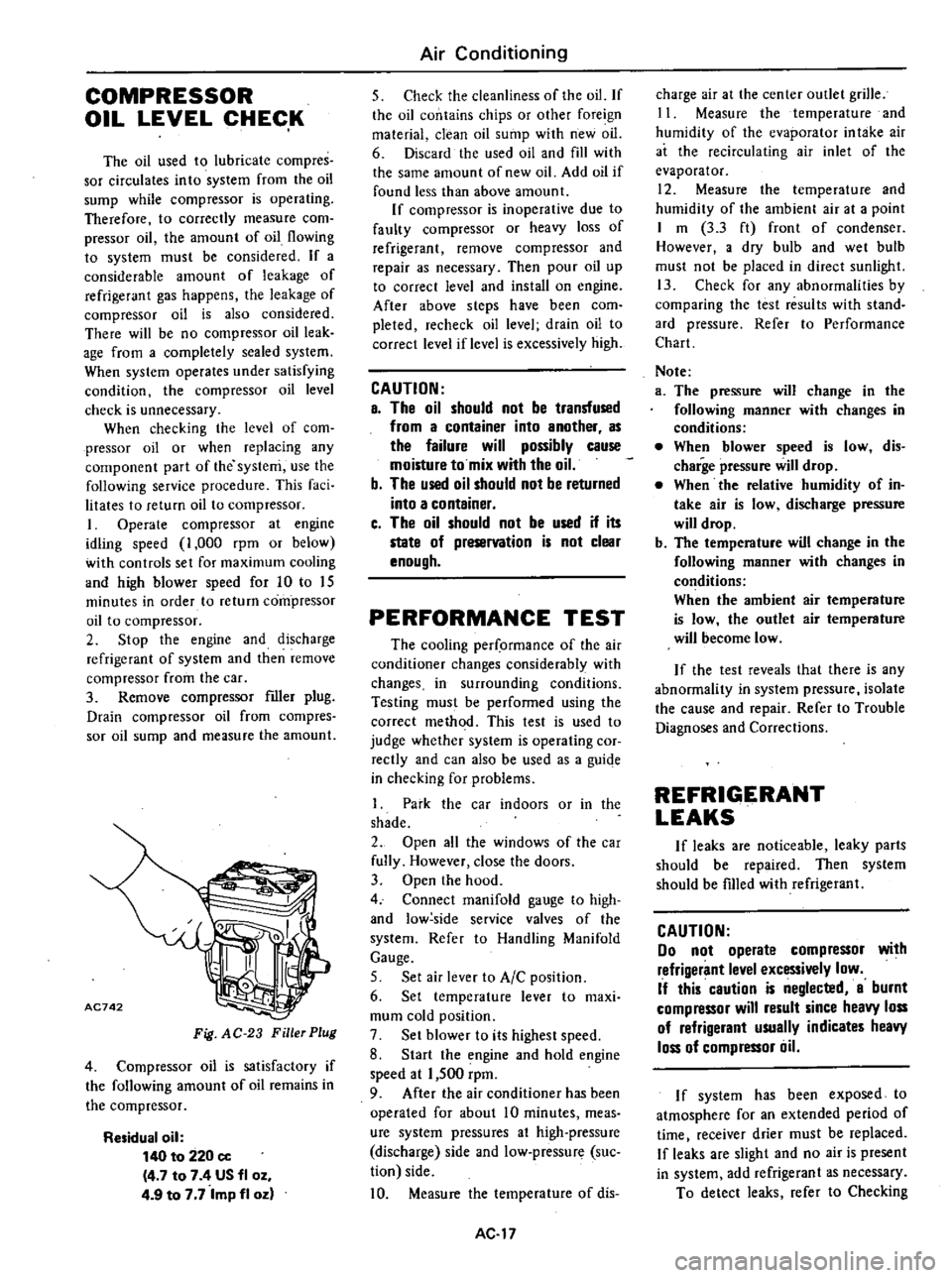
3
Remove
compressor
filler
plug
Drain
compressor
oil
from
compres
sor
oil
sump
and
measure
the
amount
AC742
Fig
AC
23
Filler
Plug
4
Compressor
oil
is
satisfactory
if
the
following
amount
of
oil
remains
in
the
compressor
Residual
oil
140
to
220
cc
4
7
to
7
4
US
fl
oz
4
9
to
7
7
Imp
fl
oz
Air
Conditioning
5
Check
the
cleanliness
of
the
oil
If
the
oil
contains
chips
or
other
foreign
material
clean
oil
sump
with
new
oil
6
Discard
the
used
oil
and
fill
with
the
same
amount
of
new
oil
Add
oil
if
found
less
than
above
amount
If
compressor
is
inoperative
due
to
faulty
compressor
or
heavy
loss
of
refrigerant
remove
compressor
and
repair
as
necessary
Then
pour
oil
up
to
correct
level
and
install
on
engine
After
above
steps
have
been
com
pleted
recheck
oil
level
drain
oil
to
correct
level
if
level
is
excessively
high
CAUTION
a
The
oil
should
not
be
transfused
from
a
container
into
another
as
the
failure
will
possibly
cause
moisture
to
mix
with
the
oil
b
The
used
oil
should
not
be
returned
into
a
container
c
The
oil
should
not
be
used
if
its
state
of
preservation
is
not
clear
enough
PERFORMANCE
TEST
The
cooling
per
ormance
of
the
air
conditioner
changes
considerably
with
changes
in
surrounding
conditions
Testing
must
be
performed
using
the
correct
method
This
test
is
used
to
judge
whether
system
is
operating
cor
rectly
and
can
also
be
used
as
a
guiqe
in
checking
for
problems
1
Park
the
car
indoors
or
in
the
shade
2
Open
all
the
windows
of
the
car
fully
However
close
the
doors
3
Open
the
hood
4
Connect
manifold
gauge
to
high
and
low
side
service
valves
of
the
system
Refer
to
Handling
Manifold
Gauge
5
Set
air
lever
to
AIC
position
6
Set
temperature
lever
to
maxi
mum
cold
position
7
Set
blower
to
its
highest
speed
8
Start
the
engine
and
hold
engine
speed
at
1
500
rpm
9
After
the
air
conditioner
has
been
operated
for
about
10
minutes
meas
ure
system
pressures
at
high
pressure
discharge
side
and
low
pressure
suc
tion
side
10
Measure
the
temperature
of
dis
AC
17
charge
air
at
the
center
outlet
grille
11
Measure
the
temperature
and
humidity
of
the
evaporator
in
take
air
at
the
recirculating
air
inlet
of
the
evaporator
12
Measure
the
temperature
and
humidity
of
the
ambient
air
at
a
point
I
m
3
3
ft
front
of
condenser
However
a
dry
bulb
and
wet
bulb
must
not
be
placed
in
direct
sunlight
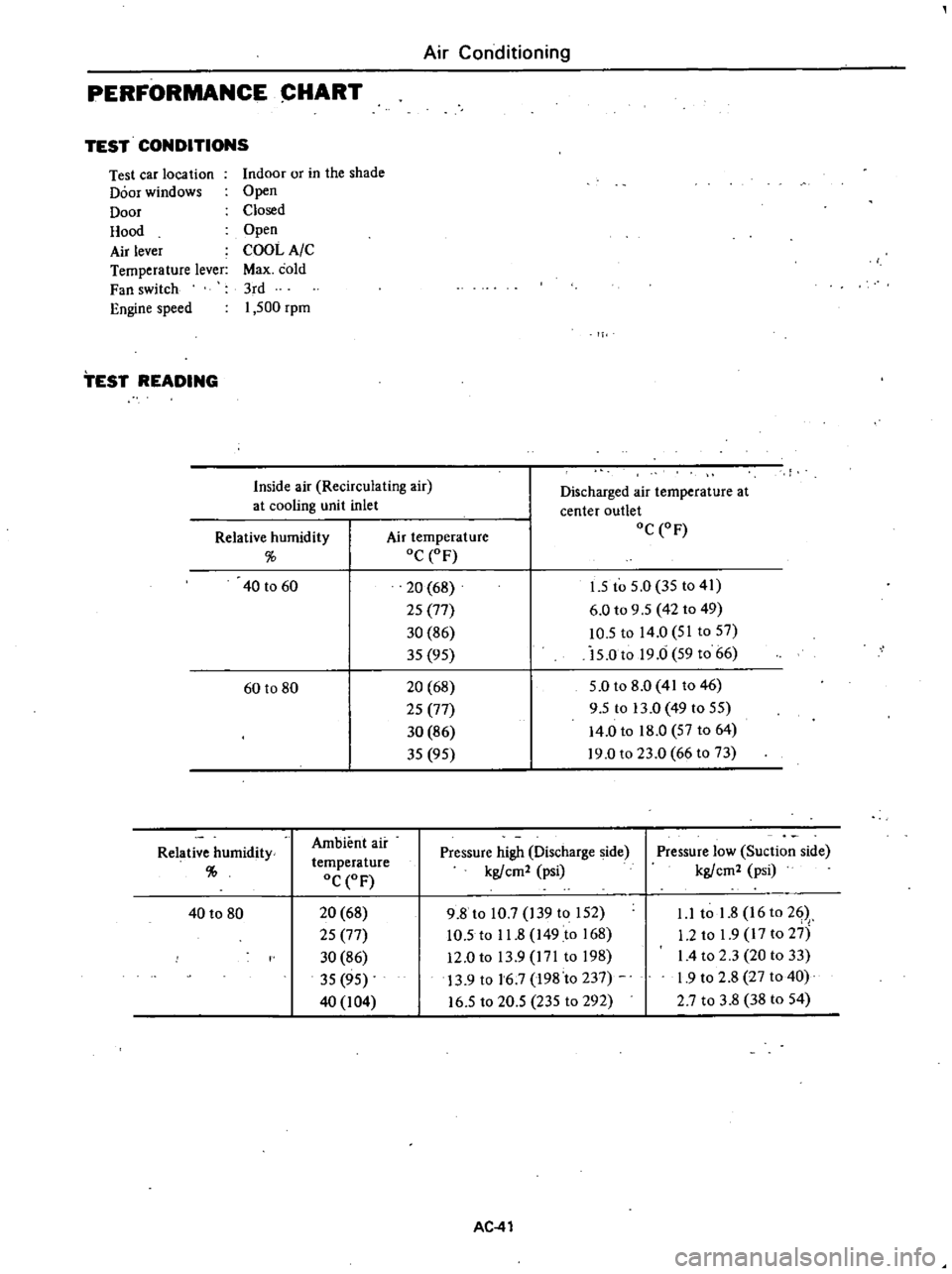
13
Check
for
any
abnormalities
by
comparing
the
test
results
with
stand
ard
pressure
Refer
to
Performance
Chart
Note
a
The
pressure
will
change
in
the
following
manner
with
changes
in
conditions
When
blower
speed
is
low
dis
charge
pressure
will
drop
When
the
relative
humidity
of
in
take
air
is
low
discharge
pressure
will
drop
b
The
temperature
will
change
in
the
following
manner
with
changes
in
conditions
When
the
ambient
air
temperature
is
low
the
outlet
air
temperature
will
become
low
If
the
test
reveals
that
there
is
any
abnormality
in
system
pressure
isolate
the
cause
and
repair
Refer
to
Trouble
Diagnoses
and
Corrections
REFRIGERANT
LEAKS
If
leaks
are
noticeable
leaky
parts
should
be
repaired
Then
system
should
be
fIlled
with
refrigerant
CAUTION
00
not
operate
compressor
with
refrigerant
level
excessively
low
If
this
caution
is
neglected
a
burnt
compressor
will
result
since
heavy
loss
of
refrigerant
usually
indicates
heavy
loss
of
compressor
liil
I
f
system
has
been
exposed
to
atmosphere
for
an
extended
period
of
time
I
receiver
drier
must
be
replaced
If
leaks
are
slight
and
no
air
is
present
in
system
add
refrigerant
as
necessary
To
detect
leaks
refer
to
Checking
Page 542 of 548
PERFORMANCE
CHART
TEST
CONDITIONS
Test
car
location
Door
windows
Door
Hood
Air
lever
Temperature
lever
Fan
switch
Engine
speed
Indoor
or
in
the
shade
Open
Closed
Open
COOL
Ale
Max
cold
3rd
1
500
rpm
TEST
READING
Air
Conditioning
Inside
air
Recirculating
air
at
cooling
unit
inlet
Relative
humidity
40
to
60
60
to
80
Relative
humidity
Ambient
air
temperature
oe
OF
40
to
80
20
68
25
77
30
86
35
95
40
104
Discharged
air
temperature
at
center
outlet
oe
OF
Air
temperature
oC
OF
20
68
25
77
30
86
35
95
20
68
25
77
30
86
35
95
1
5
to
5
0
35
to
41
6
0
to
9
5
42
to
49
10
5
to
14
0
51
to
57
i5
O
to
19
6
59
to
66
5
0
to
8
0
41
to
46
9
5
to
13
0
49
to
55
14
0
to
18
0
57
to
64
19
0
to
23
0
66
to
73
Pressure
high
Discharge
side
kg
cm2
psi
Pressure
low
Suction
side
kg
cm
2
psi
9
8
to
10
7
139
to
152
10
5
to
11
8
149
to
168
12
0
to
13
9
171
to
198
13
9
to
16
7
198
to
237
16
5
to
20
5
235
to
292
1
1
to
1
8
16
to
26
ii
1
2
to
1
9
17
to
27
14
to
2
3
20
to
33
1
9
to
2
8
27
to
40
2
7
to
3
8
38
to
54
AC
41