water pump DATSUN 210 1979 User Guide
[x] Cancel search | Manufacturer: DATSUN, Model Year: 1979, Model line: 210, Model: DATSUN 210 1979Pages: 548, PDF Size: 28.66 MB
Page 81 of 548
2
Loosen
belt
then
remove
fan
blade
from
torque
coupling
and
torque
coupling
and
pulley
from
hub
Air
conditioning
system
equipped
models
only
4
Remove
pump
assembly
and
gas
ket
from
front
cover
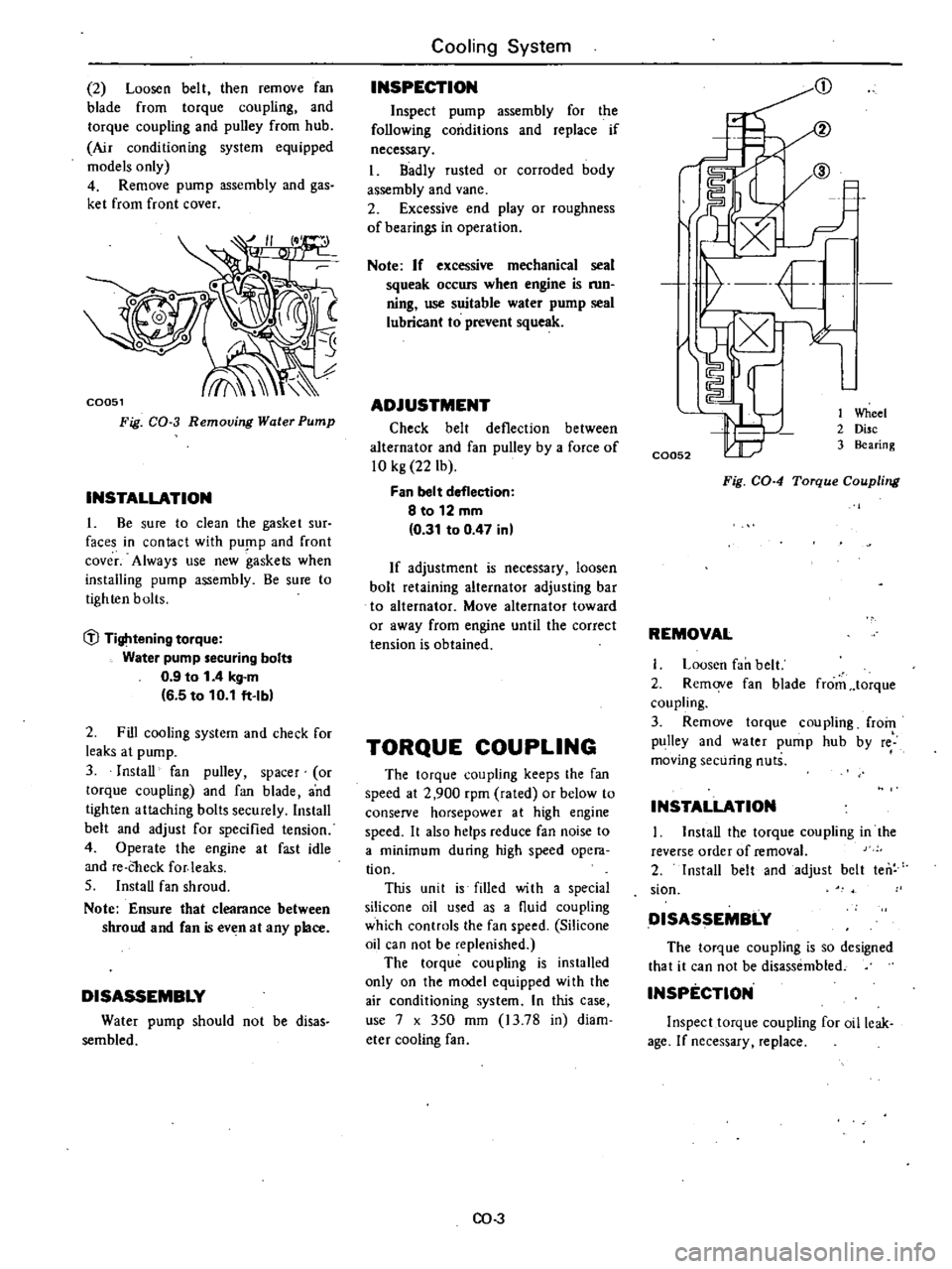
C0051
Fig
CO
3
Removing
Water
Pump
INSTALLATION
1
Be
sure
to
clean
the
gasket
sur
faces
in
contact
with
pU
flP
and
front
cover
Always
use
new
gaskets
when
installing
pump
assembly
Be
sure
to
tighten
bolts
i
l
Tightening
torque
Water
pump
securing
bolts
0
9
to
1
4
kg
m
6
5
to
10
1
ft
Ib
2
Fill
cooling
system
and
check
for
leaks
at
pump
3
InstaD
fan
pulley
spacer
or
torque
coupling
and
fan
blade
and
tighten
attaching
bolts
securely
Install
belt
and
adjust
for
specified
tension
4
Operate
the
engine
at
fast
idle
and
re
Check
for
leaks
S
Install
fan
shroud
Note
Ensure
that
clearance
between
shroud
and
fan
even
at
any
place
DISASSEMBLY
Water
pump
should
not
be
disas
sembled
Cooling
System
INSPECTION
Inspect
pump
assembly
for
the
following
conditions
and
replace
if
necessary
I
Badly
rusted
or
corroded
body
assembly
and
vane
2
Excessive
end
play
or
roughness
of
bearings
in
operation
Note
If
excessive
mechanical
seal
squeak
occurs
when
engine
is
mn
ning
use
suitable
water
pump
seal
lubricant
to
prevent
squeak
ADJUSTMENT
Check
belt
deflection
between
alternator
and
fan
pulley
by
a
force
of
10
kg
22
Ib
Fan
belt
deflection
8
to
12
mm
0
31
to
0
47
in
If
adjustment
is
necessary
loosen
bolt
retaining
alternator
adjusting
bar
to
alternator
Move
alternator
toward
or
away
from
engine
until
the
correct
tension
is
obtained
TORQUE
COUPLING
The
torque
coupling
keeps
the
fan
speed
at
2
900
rpm
rated
or
below
to
conserve
horsepower
at
high
engine
speed
It
also
helps
reduce
fan
noise
to
a
minimum
during
high
speed
opera
tion
This
unit
is
filled
with
a
special
silicone
oil
used
as
a
fluid
coupling
which
controls
the
fan
speed
Silicone
oil
can
not
be
replenished
The
torque
coupling
is
installed
only
on
the
model
equipped
with
the
air
conditioning
system
In
this
case
use
7
x
350
mm
13
78
in
diam
eter
cooling
fan
CO
3
C0052
t
Wheel
2
Disc
3
Bearing
Fig
CO
4
Torque
Coupling
REMOVAL
Lousen
fan
belt
2
Remove
fan
blade
from
torque
coupling
3
Remove
torque
coupling
from
pulley
and
water
pump
hub
by
re
moving
securing
nuts
INSTALLATION
I
InstaD
the
torque
coupling
in
the
reverse
order
of
removal
2
Install
belt
and
adjust
belt
ten
sian
DISASSEMBLY
The
torque
coupling
is
so
designed
that
it
can
not
be
disassembled
INSPECTION
Inspect
torque
coupling
for
oil
leak
age
If
necessary
replace
Page 82 of 548
Cooling
System
TEM
COUPLlNG
Non
Califomia
model
equipped
with
air
conditioning
Tem
coupling
is
a
type
of
fan
coupling
which
is
provided
with
a
temperature
control
system
The
conventional
coupling
always
slips
the
fan
at
a
high
speed
under
a
constant
ratio
regardless
of
the
engine
cooling
requirement
The
slipping
ratio
of
the
Tem
coupling
however
is
properly
changed
with
the
cooling
requirement
ON
denotes
that
cooling
is
required
and
the
fan
operates
up
to
about
2
900rpm
When
high
cooling
is
not
required
during
cold
season
with
the
engine
warmed
up
etc
the
oper
ation
is
placed
under
OFF
condition
and
the
fan
slips
at
about
2
050
rpm
The
coiled
bimetal
thermostat
installed
on
the
front
center
portion
of
the
Tem
coupling
detects
temperature
of
air
passing
through
the
radiator
The
air
temperature
is
directly
relative
to
the
engine
coolant
tempera
ture
and
the
inside
slide
valve
is
opened
or
closed
as
required
and
thus
the
ON
OFF
control
is
performed
When
the
air
temperature
rises
the
bimetal
is
expanded
and
the
valve
is
opened
silicone
oil
is
forwarded
to
the
groove
that
transmits
torque
and
the
system
is
placed
under
ON
con
dition
When
the
valve
closes
silicone
oil
is
not
supplied
to
the
groove
oil
in
the
groove
is
accumulated
on
the
Tem
coupling
periphery
due
to
the
centrifu
1
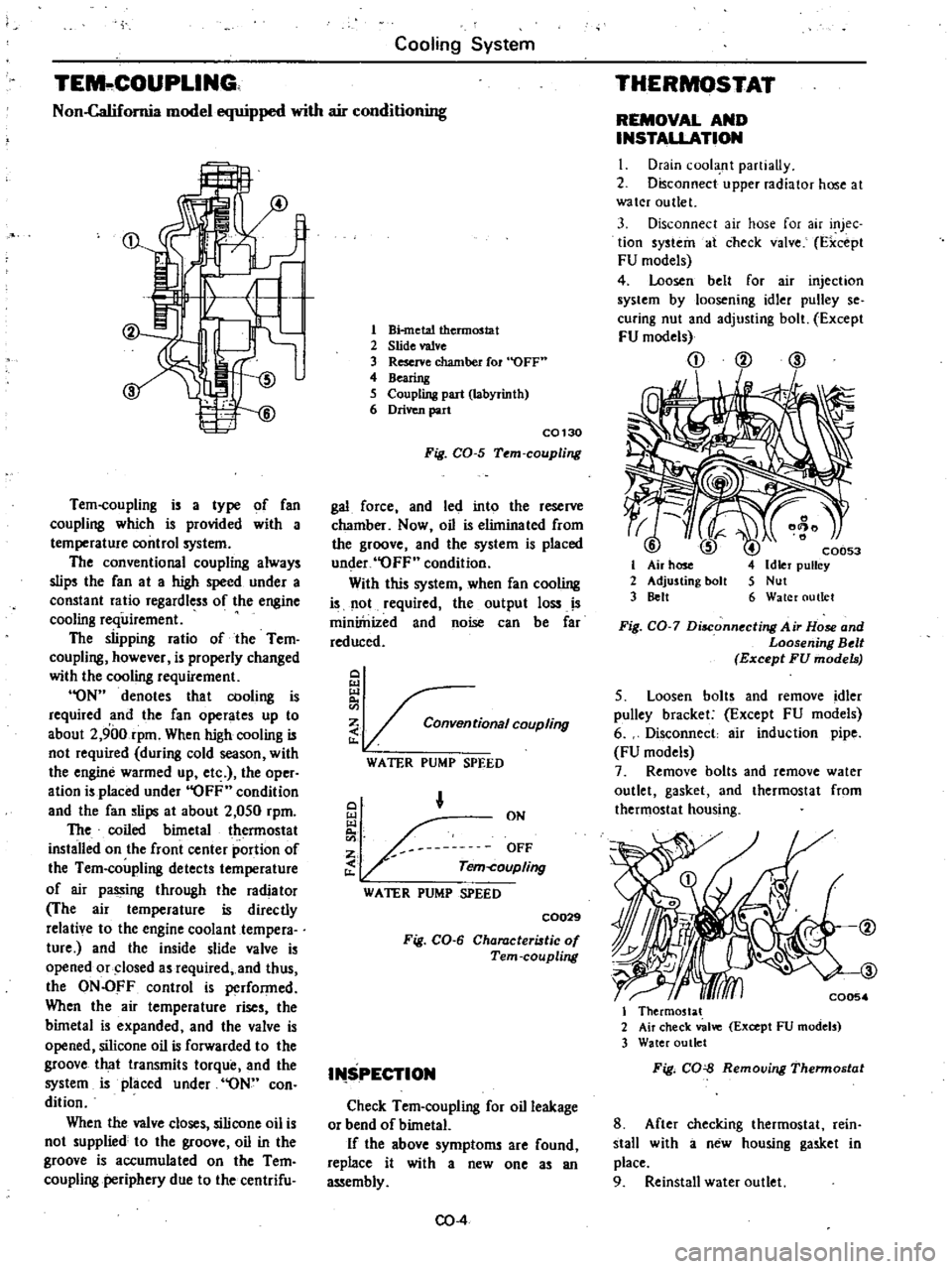
Bi
metal
thermostat
2
Slide
valve
3
Reserve
chamber
fOl
OFF
4
Bearing
5
Coupling
part
labyrinth
6
Driven
part
C0130
Fig
CO
5
Tem
coupling
gal
force
and
led
into
the
reserve
chamber
Now
oil
is
eliminated
from
the
groove
and
the
system
is
placed
under
OFF
condition
With
this
system
when
fan
cooling
is
not
required
the
output
loss
IS
miniinized
and
noise
can
be
far
reduced
Q
i
tionalCOUPling
WATER
PUMP
SPEED
Q
ON
OFF
Tem
coupling
WATER
PUMP
SPEED
C0029
Fig
CO
6
Characteristic
of
Tern
coupling
I
SPECTION
Check
Tem
coupling
for
oil
leakage
or
bend
of
bimetaL
If
the
above
symptoms
are
found
replace
it
with
a
new
one
as
an
assembly
CO
4
THERMOSTAT
REMOVAL
AND
INSTALLATION
I
Drain
cool
nt
partiaUy
2
Disconnect
upper
radiator
hose
at
water
outlet
3
Disconnect
air
hose
for
air
injec
tion
systein
at
check
valve
Fxcept
FU
models
4
Loosen
belt
for
air
injechon
system
by
loosening
idler
pulley
se
curing
nut
and
adjusting
bolt
Except
FU
models
CD
@
ID
I
2
3
C0053
Idler
pulley
Nut
Water
outlet
Fig
CO
7
Disconnecting
Air
Hose
and
Loosening
Belt
Except
FU
models
5
Loosen
bolts
and
remove
idler
pulley
bracket
Except
FU
models
6
Disconnect
air
induction
pipe
FU
models
7
Remove
bolts
and
remove
water
outlet
gasket
and
thermostat
from
thermostat
housing
I
Thermostat
2
Air
check
valve
Except
FU
models
3
Water
outlet
Fig
CO
Removing
Thennostat
8
After
checking
thermostat
rein
stall
with
a
new
housing
gasket
in
place
9
Reinstall
water
outlet
Page 85 of 548
Condition
Loss
of
water
Poor
circulation
Corrosion
Overheating
Over
cooling
Cooling
System
TROUBLE
DIAGNOSES
AND
CORRECTIONS
Probable
cause
Damaged
radiator
seams
Leaks
at
heater
connections
or
plugs
Leak
at
water
temperature
gauge
Loose
joints
Damaged
cylinder
head
gasket
Cracked
cylinder
block
Cracked
cylinder
head
Loose
cylinder
head
bolts
Restriction
in
system
Insufficient
coolant
Inoperative
water
pump
Loose
fan
belt
Inoperative
thermostat
Excessive
impurity
in
water
Infrequent
flushing
and
draining
of
system
Inoperative
thermostat
Radiator
fin
choked
with
mud
chaff
etc
Incorrect
ignition
and
valve
timing
Dirty
oil
and
sludge
in
engine
Inoperative
water
pump
Inoperative
torque
coupling
or
tem
coupling
Loose
fan
belt
Restricted
radiator
Inaccurate
temperature
gauge
Impurity
in
water
Inoperative
thermostat
Inaccurate
temperature
gauge
CO
7
Corrective
action
Repair
Repair
Tighten
Tighten
Replace
Check
engine
oil
for
contamination
and
reml
as
necessary
Replace
Check
engine
oil
in
crankcase
for
mixing
with
water
by
pulling
oil
level
gauge
Replace
Tighten
Check
hoses
for
crimps
and
clear
the
system
of
rust
and
sludge
by
flushing
radiator
Replenish
Replace
Adjust
Replace
Use
soft
clean
water
rain
water
is
satis
factory
Cooling
system
should
be
drained
and
flush
ed
thoroughly
at
least
twice
a
year
Permanent
antifreeze
Ethylene
glycol
base
can
be
used
throughout
the
seasons
of
the
year
and
change
periodically
at
intervals
recommended
Replace
Clean
out
air
passage
thoroughly
by
using
air
pressure
from
engine
side
of
radiator
Adjust
Refill
Replace
Replace
Adjust
Flush
radiator
Replace
Use
soft
dean
water
Replace
Replace
Page 114 of 548
CLEANING
AND
INSPECTION
Dirt
gum
water
or
carbon
con
tamination
in
or
on
exterior
moving
parts
of
a
carburetor
are
often
respon
sible
for
unsatisfactory
performance
For
this
reason
efficient
carhuretion
depends
upon
careful
cleaning
and
inspection
while
servicing
Blow
all
passages
and
castings
with
compressed
air
and
blow
off
all
parts
until
dry
Note
Do
not
pass
drills
or
wires
through
calibrated
jets
or
passages
as
this
may
enlarge
orifice
and
seriously
affect
carburetor
calibra
tion
2
Check
all
parts
for
wear
If
wear
is
noted
damaged
parts
must
be
re
placed
Note
especially
the
following
I
Check
float
needle
and
seat
for
wear
If
wear
is
noted
assembly
must
be
replaced
2
Check
throttle
and
choke
shaft
bores
in
throttle
chamber
and
choke
chamber
for
wear
or
out
of
roundness
3
Inspect
idle
adjusting
needle
for
hurrs
or
ridges
Such
a
condition
re
quires
replacement
Engine
Fuel
3
Inspect
gaskets
to
see
if
they
appear
hard
or
brittle
or
if
edges
are
torn
or
distorted
If
any
such
condi
tion
is
noted
they
must
be
replaced
4
Check
filter
screen
for
dirt
or
lint
Clean
and
if
screen
is
distorted
or
remains
plugged
replace
5
Check
linkage
for
operating
condition
6
Inspect
operation
of
accelerating
pump
Pour
fuel
into
float
chamber
and
make
throttle
lever
operate
Check
condition
of
fuel
injection
from
the
accelerating
nome
7
Push
connecting
rod
of
dia
phragm
chamber
and
block
passage
of
vacuum
with
finger
When
connecting
rod
becomes
free
check
for
leakage
of
air
or
damage
to
diaphragm
Jets
Carburetor
performance
depend
on
jets
and
air
bleeds
That
is
why
these
components
must
be
fabricated
with
utmost
care
To
clean
them
use
cleaning
solvent
and
blow
air
on
them
Larger
inner
nwnbers
stamped
on
the
EF
29
jets
indicate
larger
diameters
Ac
cordingIy
main
and
slow
jets
with
larger
numbers
provide
richer
mixture
the
smaller
numbers
the
leaner
mix
ture
Conversely
the
main
and
slow
air
bleeds
through
which
air
to
passes
make
the
fuel
leaner
if
they
bear
larger
numbers
the
smaller
numbers
the
richer
fuel
Assembly
To
assemble
reverse
the
disassem
bly
procedure
taking
care
to
the
following
I
Thoroughly
wash
all
the
parts
before
assembling
2
Inspect
gaskets
to
see
if
they
appear
hard
or
brittle
or
if
edges
are
torn
or
distorted
If
any
of
such
undesirable
condi
tions
is
noted
they
must
be
replaced
3
Install
jet
and
air
bleed
having
the
Same
size
number
as
that
of
original
one
4
After
reassembling
carburetor
check
each
rotating
portion
or
sliding
portion
for
smooth
operation
Page 152 of 548

e
In
o
L
1
Ignition
switch
2
Vacuum
switching
v3
lve
3
Top
detecting
switch
4
Function
check
connector
EC330A
i
Fig
EC
99
Checking
Top
Detecting
l
Switch
Vacuum
dela
valve
Remove
vacUum
delay
valve
2
Blow
air
from
th
port
of
the
distributor
side
The
vacuum
delay
valve
is
in
go
ij
condition
if
the
air
flows
through
the
valve
3
Try
again
from
the
opposit
side
of
the
valve
Th
valve
is
in
goo
condition
if
th
a
flow
resistance
is
greater
than
the
step
2
abov
Distributor
side
Carburetor
side
Distribu
tor
side
Carburetor
side
EC346
Fig
EC
100
Checking
Vocuum
Dewy
Valve
Emission
Control
Syst
m
4
If
the
condition
of
spark
delay
valve
is
questionable
dip
port
into
a
cup
filled
with
water
Blow
air
from
brown
face
side
Small
air
bubbles
should
appear
CAUTION
Be
c
areful
to
avoid
entry
of
oil
or
dirt
into
valve
7
E
C279
Fig
EC
101
Checking
Vacuum
D
lDy
Valve
CATALYTIC
CONVERTER
California
dels
DESCRIPTION
1
The
catalytic
converter
accelerates
the
chemical
reaction
of
hydrocarbons
CD
0
He
and
carbon
monoxide
O
in
the
exhaust
gas
and
changes
them
into
non
harmful
carbon
dioxide
C02
and
water
H20
This
chemical
reac
tiOD
process
requires
the
proper
a
mount
of
air
which
is
supplied
by
the
air
pump
Refer
to
the
item
AJ
S
This
air
is
called
secondary
air
The
Catalytic
converter
is
mounted
0
the
models
destinbd
for
California
OPERATION
Exhaust
gas
emitted
from
the
en
gine
contains
some
harmful
substances
due
to
incomplete
combustion
in
the
combustion
chamber
The
air
injection
stem
i
designed
to
reduce
the
con
tent
of
such
substances
in
the
exhaust
gas
In
this
system
the
secondary
air
is
led
from
the
ch
ck
valve
and
injected
in
o
the
exhaust
manifold
With
this
injection
of
the
secondary
air
hydro
carbons
He
and
carbon
monoxide
CO
in
the
exhaust
gas
are
gradually
oxidized
with
oxygen
02
in
the
secondary
air
and
converted
into
nOD
harmful
carbon
dioxide
C02
and
water
HP
The
catalytic
converter
further
cleans
engine
exhaust
gas
Through
catalytic
action
it
changes
residual
hydrocarbons
and
carbon
monoxide
contained
in
exhaust
gas
into
carbon
dioxide
and
water
before
exhaust
gas
is
discharged
to
the
atmosphere
0
Secondary
air
Carbon
monoxide
hydrocarbon
Carbon
dioxide
gas
Nater
EC
i
A
I
Front
tube
2
Catalytic
converter
3
Center
tube
4
Main
murner
EC
33
EC215
Fig
EC
I02
Function
of
Catalytic
Converter
Page 254 of 548

The
3N71
B
trammission
is
a
fully
automatic
unit
consisting
primarily
of
a
3
element
hydraulic
torque
converter
and
two
planetary
gear
sets
Two
multiple
disc
c1utclies
a
multiple
disc
brake
brake
band
and
one
way
clutch
provide
the
friction
elements
necessary
to
obtain
the
desired
function
of
the
two
planetary
gear
ets
A
hydraulic
control
system
is
used
to
operate
the
friction
elements
and
automatic
shift
controls
TORQUE
CONVERTER
The
torque
converter
is
attached
to
the
crankshaft
through
a
flexible
drive
plate
Heat
generat
in
the
t
rque
converter
is
dissipated
by
circulating
the
transmission
fluid
through
an
oil
to
water
type
cooler
in
the
radiator
lower
tank
The
welded
comtruction
of
the
torque
co
verter
prevents
di
3
ssembly
or
service
unless
highly
specialized
equipment
is
available
Qj
gJ
Autpmatic
Trimsmissi6n
DEScRIPTION
FLUID
RECOMMENDAnON
Use
DEXRON
type
automatic
transmission
fluid
only
IDENTIFICATION
NUMBER
Stamped
position
The
plate
is
attached
to
the
right
han
side
of
transmission
case
AT
M
Fig
AT
l
Identification
Number
Identification
of
number
arranaemanta
JAPAJllUTOIlATlC
TRAJISIIISSIO
C8
Ull
MODEL
X
0
12
3
NO
7
6
0
1
2
34
Number
designation
76
0
I
2
34
L
Serial
productioo
number
for
the
month
Month
of
production
1
Jan
2
Feb
X
Oct
Y
Nov
Z
Dec
Lut
IJgUre
denotins
the
year
A
D
IJ
III
J
W
f
r
lrr
G
1
Transmission
case
2
Oil
pump
3
Front
clutch
4
Band
brake
5
Rear
dutch
6
Front
planetary
geat
7
Rear
planetary
gear
8
One
way
clutch
9
Low
4
Reverse
brake
10
Oil
distributor
11
Governor
12
utput
shaft
13
Rear
extension
14
Oil
pan
IS
Control
valve
16
Input
shaft
17
Torque
converter
18
Converter
housi
19
Drive
pia
te
Tightening
torque
T
of
bolts
and
nuts
kg
m
ft
lb
@
T
4
to
5
29
to
36
@
T
14
to
16
101
to
116
@
T
4
5
to
5
5
33
to
40
@
T
0
6
to
0
8
4
3
to
5
8
@
T
0
5
to
0
7
3
6
to
5
1
T
2
0
to
2
5
14
to
18
@
T
1
3
to
1
8
9
to
13
@
T
0
55
ta
0
75
4
0
to
5
4
CD
T
0
25
to
0
35
1
8
to
2
5
AT312
Fig
AT
2
3N71B
Automatic
Trammiuion
AT
2
Page 291 of 548
Automatic
Transmission
TROUBLE
DIAGNOSIS
AND
ADJUSTMENT
Since
mo
automatic
transmission
troubles
can
be
repaired
by
simple
adjustment
do
not
disassemble
im
media
tely
Firstly
inspect
and
adjust
the
auto
D1
3tic
transmission
in
place
utilizing
the
Trouble
Shooting
Chart
If
the
trouble
can
not
be
solved
by
this
procedure
remove
and
disas
semble
the
automatic
tlllnsmission
It
is
advisable
to
check
overhaul
and
repair
each
part
in
the
order
listed
in
the
Trouble
Shooting
Chart
In
the
Trouble
Shooting
Chart
the
diagnosis
items
are
arranged
ac
cording
to
difficulty
from
easy
to
difficult
therefore
please
follow
these
items
The
tlllnsmission
should
riot
be
removed
unless
necessary
2
Tests
and
adjustments
should
be
inade
on
the
basil
of
standard
values
and
the
data
Should
be
recorded
INSPECTION
AND
ADJUSTMENT
BEFORE
TROUBLE
DIAGNOSIS
TESTING
INSTRUMENT
FOR
INSPECTION
I
Engine
t
chometer
2
Vacuum
gauge
3
Oil
pressure
gauge
It
is
convenieni
to
install
these
instruments
in
a
way
that
allows
meas
urements
to
be
made
from
the
driver
s
seat
CHECKING
OIL
LEVEL
In
checkIng
the
automatic
transmis
sion
the
oil
level
and
the
condition
of
oil
around
the
oil
level
gauge
should
be
examined
every
S
ooo
Ion
3
000
miles
This
is
an
easy
and
effective
trouble
shooting
procedure
since
some
changes
in
oil
condition
are
often
linked
with
developed
troubles
For
instance
Lack
of
oil
causes
defective
opera
tion
by
making
the
clutches
and
brakes
slip
resulting
in
severe
wear
This
is
because
the
oil
pump
sucks
air
causing
oil
foaming
thus
rapidly
deteriorating
the
oil
quality
and
pro
ducing
sludge
and
varnish
Excessive
oil
is
also
bad
because
of
oil
foaming
caused
by
the
gears
stirring
up
the
oil
During
high
speed
driving
excessive
oil
in
the
transmission
often
hlows
out
from
the
brealher
Me
urlns
011
level
To
check
the
nuid
leyel
sian
Ihe
engine
and
run
it
until
normal
operat
ing
temperatures
oil
temperature
SO
to
800C
122
to
1160F
Approxi
mately
ten
minute
of
operation
will
raise
the
temperature
to
this
range
and
engine
idling
conditions
are
stabi
lized
Then
apply
the
brakes
and
move
the
transmission
shift
lever
through
aU
drive
positions
and
place
it
in
park
P
position
In
his
inspec
tion
the
car
must
be
placc
d
on
a
level
surface
The
amount
of
the
oil
varies
with
the
temperature
As
a
rule
the
oil
level
must
be
measured
after
its
tempera
ture
becomes
sufficiently
high
I
Fill
the
oil
to
the
line
H
The
difference
of
capacities
between
both
H
and
L
is
approximately
0
4
liter
J
U
S
pt
Y
Imp
pt
and
therefore
do
not
fill
beyond
the
line
H
2
When
topping
up
and
changing
oil
care
should
be
taken
to
prevent
mixing
the
oil
with
dusl
and
water
In
pectlns
oU
condition
The
condition
of
oil
sticking
to
the
level
gauge
indicates
whether
to
OVOl
haul
and
repair
the
transmission
or
luok
for
Ihe
defective
part
If
the
oil
has
deteriorated
to
a
varnish
ike
quality
it
causes
the
con
trol
valve
to
stick
Blackened
oil
indi
cates
a
burned
clutch
brake
band
etc
AT
39
In
these
cases
the
transmission
must
be
repaired
CAUTION
I
In
checking
oil
IlVal
use
special
piper
Cloth
tohandla
the
18V81
llIugi
Ind
be
careful
not
to
let
the
scraps
of
paper
end
cloth
stick
to
the
IlIUp
b
U
lutomatic
transmission
fluid
having
OEXRON
ida
ons
only
in
the
3N71
B
eutomatic
trans
mission
c
Pay
IttBntion
blcau
the
oil
to
be
used
differs
from
that
used
in
the
Nissen
Full
Autometic
TllInsmis
sion
3N71A
N8V8r
mill
thl
oils
Note
Insert
the
gauge
fully
and
take
it
out
quickly
before
splesbing
oil
edheres
to
the
gauge
Then
observe
the
level
INSPECTION
AND
REPAIR
OF
OIL
LEAKAGE
When
oil
leakage
takes
place
the
portion
near
the
leakage
is
covered
with
oil
presenting
difficulty
in
detecting
the
spot
Therefore
the
places
where
oil
seals
and
gaskets
are
equipped
are
enumerated
below
Converter
housing
Rubber
ring
of
oil
pump
housing
Oil
seal
of
oil
pump
housing
Oil
seal
of
engine
crankshaft
Bolts
of
converter
housing
to
case
2
Transmission
and
rear
extension
Junction
of
transmission
and
rear
extension
Oil
cooler
tube
connectors
Oil
pan
Oil
pressure
inspection
holes
See
Fig
AT
81
Mounting
portion
of
vacuum
dia
phragm
and
downshift
solenoid
Breather
and
oil
charging
pipe
Speedometer
pinion
sleeve
Oil
seal
of
rear
extension
To
exactly
locate
Ihe
place
of
oil
leakage
proceed
as
follows
Page 333 of 548

FA731
Fig
FA
35
Removing
Wwer
Arm
8
Remove
suspension
ball
joint
from
lower
arm
9
Place
knuckle
arm
in
a
vise
Re
move
suspension
ball
joint
from
knuckle
arm
using
a
press
@
I
r
662
Fig
FA
36
Remouing
Suspension
Ball
Joint
10
Withdraw
lower
arm
bushing
from
transverse
link
using
Front
Lower
Arm
Bushing
Replacer
Set
ST36720000
and
a
press
Mrl
o
o
o
0
F
A669
Fig
FA
37
Removing
Wwer
Am
BuNUng
INSPECTION
Lower
arm
I
Repair
or
replace
lower
arm
if
deformed
cracked
or
damaged
Front
Axle
Front
Suspension
2
Replace
bushing
if
excessively
worn
or
cracked
3
Make
sure
mating
surface
of
bush
ing
is
clean
and
free
from
oil
or
grease
apply
soapy
water
to
bushing
to
facili
tate
installation
Lower
bell
Joint
I
Ball
joint
is
assembled
at
factory
and
cannot
be
disassembled
Check
ball
stud
turning
torque
with
nut
in
place
on
ball
stud
If
it
is
far
from
specifications
replace
liJ
Turning
torque
New
parts
40
to
100
kg
cm
35
to
87
in
Ibl
Used
parts
More
than
20
kg
cm
117
in
Ibl
lUJ
F
A333
Fig
FA
38
Lower
Ball
Joint
2
Check
condition
of
dust
cover
If
it
is
cracked
excessively
replace
ball
joint
3
Lubricate
ball
joint
with
recorn
mended
multi
purpose
grease
To
lubricate
remove
plug
and
in
stall
grease
nipple
Pump
grease
slowly
until
old
grease
is
completely
forced
out
After
greasing
reinstall
plug
Note
When
a
high
pressure
grease
gun
used
operate
it
carefully
so
that
grease
is
injected
slowly
and
new
grease
does
not
DOme
out
from
clamp
portion
INSTALLATION
Install
lower
arm
and
suspension
ball
joint
in
reverse
order
of
removal
FA
l
Lower
erm
buahln
I
Before
installing
bushing
rub
off
rust
or
paint
drops
from
insi
e
collar
on
lower
arm
with
emery
paper
2
Using
Replacer
Set
ST36720000
insert
bushing
with
a
press
until
end
face
of
bushing
is
aligned
with
collar
on
lower
arm
ST36720000
I
I
HA734
Fig
FA
39
Installiff
l
Wwer
Ami
Bu
hi1f
I
Lower
erm
end
atebIllzer
ber
To
install
lower
arm
and
stabilizer
bar
temporarily
tighten
securing
bolts
Then
tighten
bolts
to
specifications
at
curb
weight
with
tires
on
ground
liJ
Tightening
torque
Bell
joint
socket
to
lower
arm
5
1
to
6
1
kg
m
37
to
44
ft
Ibl
Bell
joint
socket
to
lowel
arm
with
tension
rod
5
1
to
6
1
kg
m
37
to
44
ft
Ibl
Bell
joint
to
knuck
le
arm
5
5
to
10
0
kg
m
140
to
72
ft
Ibl
Lower
IIrm
bolt
nut
3
9
to
5
0
kg
m
28
to
36
ft
Ibl
Side
lod
ball
joint
to
knuckle
arm
3
0
to
7
0
kg
m
122
to
51
ft
lbl
Steering
knuckle
erm
to
stlut
7
3
to
9
9
kg
m
53
to
72
ft
Ibl