catalytic converter DATSUN 210 1979 Service Manual
[x] Cancel search | Manufacturer: DATSUN, Model Year: 1979, Model line: 210, Model: DATSUN 210 1979Pages: 548, PDF Size: 28.66 MB
Page 9 of 548
Erigine
crankcase
EI
gine
cooling
system
Transmission
case
Final
drive
case
housing
Steering
gear
box
Fuel
tank
Air
conditioning
system
Refrigerant
Compressor
oil
f
tl
It
J
4
i
1
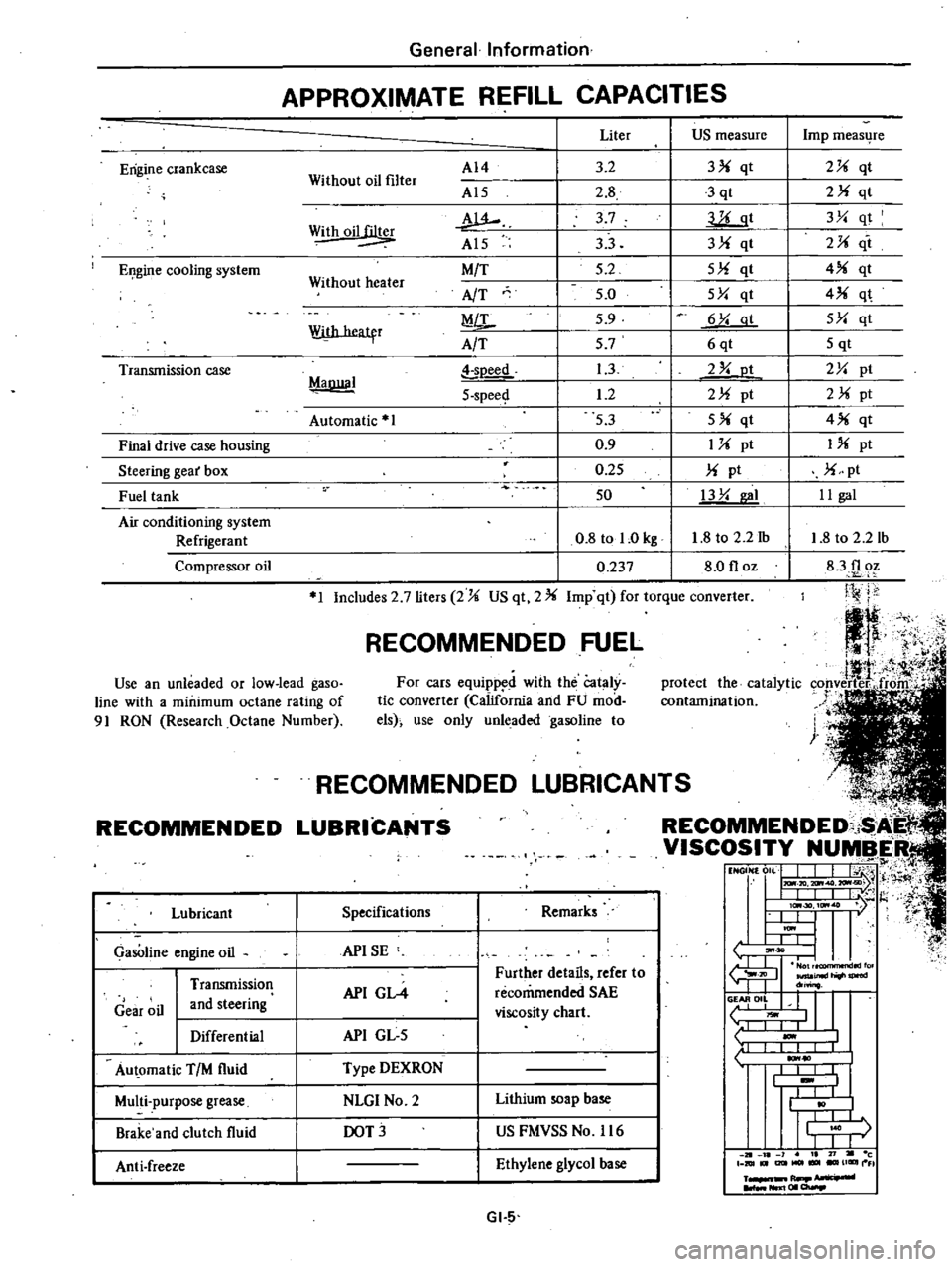
protect
the
catalytic
cop
verter
froitr
contamination
t
n
General
Information
APPROXIMATE
REFILL
CAPACITIES
Without
oil
filter
AI4
Al5
w
Al5
M
T
AfT
MiL
A
T
Liter
US
measure
3
2
3
qt
2
8
3
qt
3
7
llLgt
33
3
qt
5
2
5
qt
5
0
5Y
qt
5
9
6
Y
at
57
6qt
1
3
2
Y
ot
1
2
2
pt
53
5
qt
0
9
1
pt
0
25
pt
50
13
Y
I
0
8
tol
Okg
1
8
to
2
2
1b
0
237
8
0
floz
Withoil
Without
heater
With
heatfr
MaDllal
soeed
5
spee
Automatic
1
1
Includes
2
7
liters
2
US
qt
2
Imp
qt
for
torque
converter
RECOMMENDED
FUEL
Use
an
unleaded
or
low
lead
gaso
line
with
a
minimum
octane
rating
of
91
RON
Research
Octane
Number
For
cars
equipp
d
with
the
Cataly
tic
converter
California
and
FU
mod
els
use
only
unleaded
gasoline
to
RECOMMENDED
Lubricant
GasOline
engine
oil
Gear
oil
Transmission
and
steering
Differential
Au
omatic
TIM
fluid
Multi
purpose
grease
Brake
and
clutch
fluid
Anti
freeze
L
NDED
LUBRICAN
COMMENDED
i
I
VISCOSITY
NUMBER
t1
NGON
0
L
J
I
j
H
I
IlL
I
t
l
I
lc
30
ItM
7
l
t
U
I
ItM
I
L
L
tJ
30
I
I
fu
JIl
inld
do
o
II
L
liOwl
1
I
I
1
10
I
I
I
I
t
I
I
j
r
I
I
J
1
21
l
1
I
71
c
DIUt
I2lItMOl
UGIIII
FI
R
NIl
I
01
a
Specifications
Remarks
APISE
API
GL4
Further
details
refer
to
recommended
SAE
viscosity
chart
API
GL
5
Type
DEXRON
NLGI
No
2
Lithium
soap
base
DOT
US
FMVSS
No
116
Ethylene
glycol
base
GI
5
Imp
meas4re
2
qt
2
qt
3Y
qt
2
it
4
qt
4
q
5Y
qt
5
qt
2Y
pt
2
pt
4
qt
I
pt
pt
II
gal
1
8
to
2
2
lb
83f1
oz
Ji
j
j
Page 96 of 548
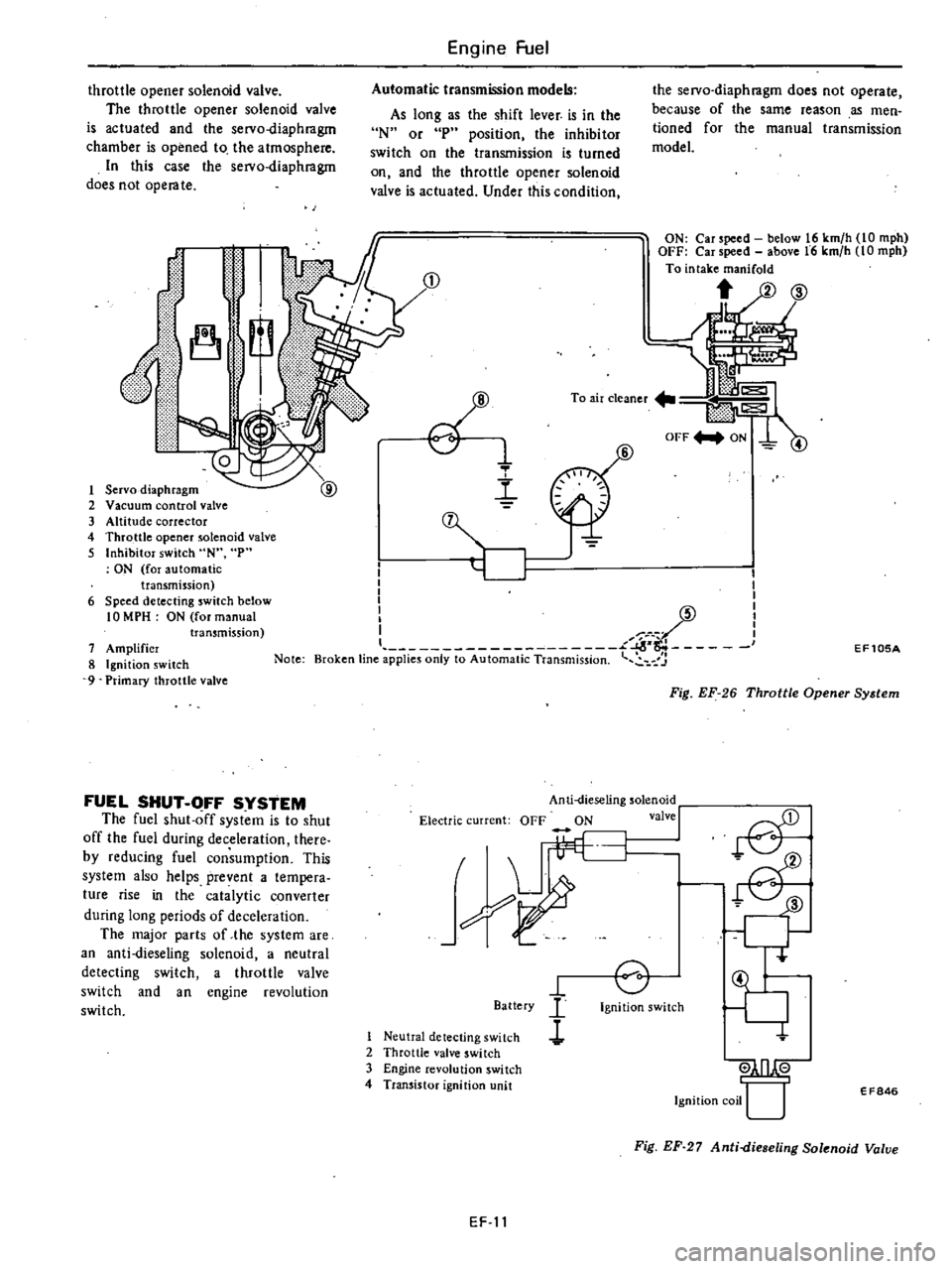
throttle
opener
solenoid
valve
The
throttle
opener
solenoid
valve
is
actuated
and
the
servo
diaphragm
chamber
is
opened
to
the
atmosphere
In
this
case
the
seIVo
diaphragm
does
not
opera
te
Engine
Fuel
Automatic
transmission
models
As
long
as
the
shift
lever
is
in
the
N
or
p
position
the
inhibitor
switch
on
the
transmission
is
turned
on
and
the
throttle
opener
solenoid
valve
is
actuated
Under
this
condition
the
seIVo
diaphragm
does
not
operate
because
of
the
same
reason
as
men
tioned
for
the
manual
transmission
model
ON
Car
peed
betow
t6
km
h
to
mph
OFF
Car
peed
above
16
km
h
to
mph
To
intake
manifold
j
lJl
11
1
ti
i
ljn
L
o
1
Servo
diaphragm
2
Vacuum
control
valve
3
Altitude
corrector
4
Throttle
opener
solenoid
valve
5
Inhibitor
switch
N
p
ON
for
automatic
transmission
6
Speed
detecting
switch
below
10
MPH
ON
for
manual
transmission
7
Amplifier
8
Ignition
switch
9
Primary
throttle
valve
Note
FUEL
SHUT
OFF
SYSTEM
The
fuel
shut
off
system
is
to
shut
off
the
fuel
during
deceleration
there
by
reducing
fuel
consumption
This
system
also
helps
prevent
a
tempera
ture
rise
in
the
catalytic
converter
during
long
periods
of
deceleration
The
major
parts
of
the
system
are
an
anti
dieseling
solenoid
a
neutral
detecting
switch
a
throttle
valve
switch
and
an
engine
revolution
switch
e
1
l
6
I
I
I
I
I
I
I
I
I
l
L
I
Broken
tine
applies
only
to
Automatic
Transmission
7
Anti
dieseling
solenoid
Electric
current
OFF
ON
valve
I
I
h
L
Battery
I
Neutral
detecting
switch
l
2
Throttle
valve
switch
3
Engine
revolution
switch
4
Transistor
ignition
unit
o
Ignition
switch
EF105A
Fig
EF
26
Throttle
Opener
System
ill
Ignition
coil
U
EF846
Fig
EF
27
Anti
dieseling
Solenoid
Valve
EF
11
Page 120 of 548

DATSUN
210
Model
8310
Series
SECTIONEC
EMISSION
CONTROL
SYSTEM
CONTENTS
GENERAL
DESCRIPTION
CRANKCASE
EMISSION
CONTROL
SYSTEM
DESCRIPTION
INSPECTION
EXHAUST
EMISSION
CONTROL
SYSTEM
DESCRIPTION
EARLY
FUEL
EVAPORATIVE
E
F
E
SYSTEM
AIR
INJECTION
SYSTEM
A
IS
AIR
INDUCTION
SYSTEM
A
I
S
EXHAUST
GAS
RECIRCULATION
E
G
R
1
CONTROL
SYSTEM
EC
2
EC
6
EC
6
EC
6
EC
7
EC
7
EC
8
EC
9
EC
18
EC
21
SPARK
T
MING
CONTROL
SYSTEM
CATALYTIC
CONVERTER
EVAPORATIVE
EMISSION
CONTROL
SYSTEM
DESCRIPTION
OPERATION
REMOVAL
AND
INSTALLATION
INSPECTION
SERVICE
DATA
AND
SPECIFICATIONS
INSPECTION
AND
ADJUSTMENT
TIGHTENING
TORQUE
SPECIAL
SERVICE
TOOLS
EC
26
EC
33
E
C
35
EC
35
EC
36
EC
36
EC
36
EC
38
EC
38
EC
38
EC
39
Page 126 of 548
Emission
Control
System
EXHAUST
EMISSION
CONTROL
SYSTEM
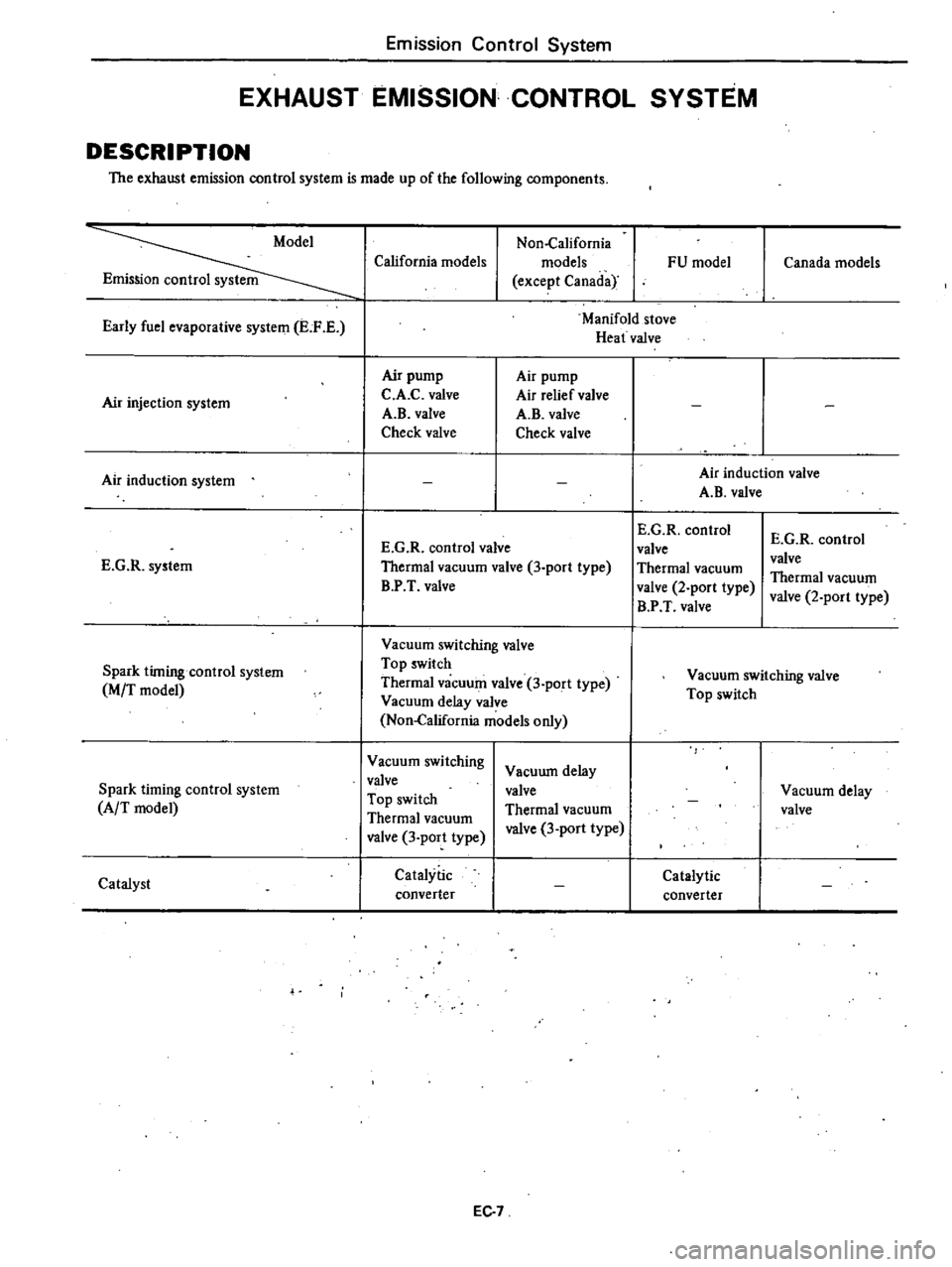
DESCRIPTION
The
exhaust
emission
control
system
is
made
up
of
the
following
components
Early
fuel
evaporative
system
E
F
E
Air
injection
system
Air
induction
system
E
G
R
system
Spark
tirningcontrol
system
M
T
model
Spark
timing
control
system
A
T
model
Catalyst
Non
California
California
models
models
except
CanadaY
FU
model
Manifold
stove
Heat
valve
Air
pump
C
A
C
valve
A
B
valve
Check
valve
Air
pump
Air
relief
valve
A
B
valve
Check
valve
E
G
R
control
valve
Thermal
vacuum
valve
3
port
type
B
P
T
valve
Vacuum
switching
valve
Top
switch
Thermal
vacuum
valve
3
port
type
Vacuum
delay
valve
Non
California
models
only
Vacuum
switching
valve
Top
switch
Thermal
vacuum
valve
3
port
type
Vacuum
delay
valve
Thermal
vacuum
valve
3
port
type
Catalytic
converter
EC
7
Canada
models
Air
induction
valve
A
B
valve
E
G
R
control
valve
Thermal
vacuum
valve
2
port
type
B
P
T
valve
E
G
R
control
valve
Thermal
vacuum
valve
2
port
type
Vacuum
switching
valve
Top
switch
Catalytic
converter
Vacuum
delay
valve
Page 131 of 548

following
functions
without
affecting
the
effectiveness
of
the
exhaust
emis
sion
control
system
Minimizes
exhaust
gas
tempera
ture
rise
2
Minimizes
horsepower
losses
reo
sulting
from
air
injection
into
the
exhaust
system
3
Protects
pump
from
excessive
back
pressure
To
carburetor
air
cleaner
Secondary
ir
Not
actuated
To
carburetor
air
cleaner
J
l
Secondary
sir
Actuated
EC294
Fig
EC
18
Air
Pump
Relief
Valve
c
A
C
valve
Californiamodels
The
C
A
C
valve
controls
the
quantity
of
secondary
air
fed
from
the
air
pump
according
to
the
load
condi
tion
and
it
discharges
the
secondary
air
into
the
atmosphere
to
prevent
overheating
of
the
catalytic
converter
This
valve
is
operated
by
intake
manifold
vacuum
and
air
pump
dis
charge
pressure
When
intake
manifold
vacuum
is
small
or
in
the
high
load
range
the
No
2
valve
opens
when
it
is
great
or
in
the
low
load
range
the
No
I
valve
opens
If
air
pump
discharge
pressure
is
large
or
the
engine
is
running
at
a
high
speed
the
No
3
valve
opens
admitting
the
air
pump
discharge
pressure
to
the
No
2
dia
phragm
chamber
of
the
C
A
C
valve
mission
Control
System
and
opening
ihe
No
i
valve
At
this
point
the
No
2
valve
serves
as
a
relief
valve
F
111
air
pump
No
3
valve
EC787
Fig
EC
19
C
A
C
Valve
I
Engine
in
low
speed
and
light
load
When
the
engine
is
operating
under
these
conditions
intake
vacuum
is
high
The
No
2
valve
unitized
with
the
No
I
diaphragm
is
lifted
by
the
intake
manifold
vacuum
pushing
up
the
No
I
valve
These
valves
will
then
stop
at
a
position
where
a
balanced
condition
exists
between
air
pump
discharge
pressure
an
d
spring
tension
acting
on
the
No
I
and
No
2
valves
The
No
2
jiaphragm
however
does
not
move
due
to
low
engine
speed
low
air
pump
discharge
pressure
and
spring
tension
acting
on
the
No
3
valve
For
this
reason
these
valves
are
brought
to
a
balanced
condition
To
intake
manifold
t
i
l
3
Spring
4
ValveNo
3
5
Di
phragm
No
I
I
@
6
Spring
7
Valve
No
1
8
Valve
No
2
EC683
Fig
EC
20
Operation
of
C
A
C
Valve
1
2
Engine
in
low
speed
and
heavy
load
EC12
Wheo
the
engine
is
operating
under
these
cooditions
intake
manifold
vacuum
is
low
and
all
valves
are
balanced
t
To
intake
manUol
U
E
ii
ji
j
Ii
5
LL
jj
Ii
JI
l
Jij
ulJC
1t
To
atmosphere
EC685
Fig
EC
21
Operation
of
C
A
C
Valve
2
3
Engine
in
high
speed
and
middle
load
When
the
engine
is
operating
under
these
conditions
intake
manifold
vacuum
lies
midway
between
1
and
2
above
The
No
3
valve
moves
to
the
left
because
of
high
air
pump
discharge
pressure
To
intake
manifold
t
L
J
f
E
bt
I
5
tfi
11
I
LJr
To
tmg
J
j
1
EC
4
Fig
EC
22
Operation
of
C
A
C
Volve
3
REMOVAL
AND
INSTALLATION
Air
pump
air
cleaner
Loosen
nuts
securing
air
pump
air
cleaner
to
bracket
then
detach
air
cleaner
from
bracket
Air
cleaner
filter
and
air
cleaner
lower
body
are
built
into
a
unit
construction
Replace
air
cleaner
filter
and
lower
body
as
an
assembly
Page 152 of 548

e
In
o
L
1
Ignition
switch
2
Vacuum
switching
v3
lve
3
Top
detecting
switch
4
Function
check
connector
EC330A
i
Fig
EC
99
Checking
Top
Detecting
l
Switch
Vacuum
dela
valve
Remove
vacUum
delay
valve
2
Blow
air
from
th
port
of
the
distributor
side
The
vacuum
delay
valve
is
in
go
ij
condition
if
the
air
flows
through
the
valve
3
Try
again
from
the
opposit
side
of
the
valve
Th
valve
is
in
goo
condition
if
th
a
flow
resistance
is
greater
than
the
step
2
abov
Distributor
side
Carburetor
side
Distribu
tor
side
Carburetor
side
EC346
Fig
EC
100
Checking
Vocuum
Dewy
Valve
Emission
Control
Syst
m
4
If
the
condition
of
spark
delay
valve
is
questionable
dip
port
into
a
cup
filled
with
water
Blow
air
from
brown
face
side
Small
air
bubbles
should
appear
CAUTION
Be
c
areful
to
avoid
entry
of
oil
or
dirt
into
valve
7
E
C279
Fig
EC
101
Checking
Vacuum
D
lDy
Valve
CATALYTIC
CONVERTER
California
dels
DESCRIPTION
1
The
catalytic
converter
accelerates
the
chemical
reaction
of
hydrocarbons
CD
0
He
and
carbon
monoxide
O
in
the
exhaust
gas
and
changes
them
into
non
harmful
carbon
dioxide
C02
and
water
H20
This
chemical
reac
tiOD
process
requires
the
proper
a
mount
of
air
which
is
supplied
by
the
air
pump
Refer
to
the
item
AJ
S
This
air
is
called
secondary
air
The
Catalytic
converter
is
mounted
0
the
models
destinbd
for
California
OPERATION
Exhaust
gas
emitted
from
the
en
gine
contains
some
harmful
substances
due
to
incomplete
combustion
in
the
combustion
chamber
The
air
injection
stem
i
designed
to
reduce
the
con
tent
of
such
substances
in
the
exhaust
gas
In
this
system
the
secondary
air
is
led
from
the
ch
ck
valve
and
injected
in
o
the
exhaust
manifold
With
this
injection
of
the
secondary
air
hydro
carbons
He
and
carbon
monoxide
CO
in
the
exhaust
gas
are
gradually
oxidized
with
oxygen
02
in
the
secondary
air
and
converted
into
nOD
harmful
carbon
dioxide
C02
and
water
HP
The
catalytic
converter
further
cleans
engine
exhaust
gas
Through
catalytic
action
it
changes
residual
hydrocarbons
and
carbon
monoxide
contained
in
exhaust
gas
into
carbon
dioxide
and
water
before
exhaust
gas
is
discharged
to
the
atmosphere
0
Secondary
air
Carbon
monoxide
hydrocarbon
Carbon
dioxide
gas
Nater
EC
i
A
I
Front
tube
2
Catalytic
converter
3
Center
tube
4
Main
murner
EC
33
EC215
Fig
EC
I02
Function
of
Catalytic
Converter
Page 153 of 548

REMOVAL
AND
INSTALLATION
I
Jack
up
the
car
Note
Apply
parking
brake
and
place
wheel
chocks
2
Remove
screws
securing
lower
shelter
of
catalytic
converter
Loosen
flange
bolt
connecting
catalytic
converter
to
front
and
rear
exhaust
tube
Catalytic
converter
assembly
can
then
be
taken
out
3
Installation
i
in
the
reverse
se
quence
of
removal
CAUTION
a
Be
careful
not
to
damage
catalytic
co
when
handliilg
b
Never
wet
catalyzer
with
water
oil
etc
t
J
Tightening
torque
Catalyti
converter
bolts
2
6
to
3
4
kg
m
19
to
25
ft
lb
Emission
Control
System
EC075A
EC076A
Fig
EC
103
Removing
Catalytic
Converter
INSPECTION
PrelimInary
In
pectlon
Vi
ually
check
condition
of
all
component
parts
including
hose
tubes
and
wires
replace
if
necessary
Refer
to
Air
Injection
System
for
inspection
EC
34
Catalytic
converter
Whether
catalytic
converter
is
nor
mal
or
not
can
e
checked
by
ob
serving
variation
in
CO
percentage
The
checking
procedure
is
as
follows
Apply
parking
brake
Shift
gears
into
Neutral
for
manual
transmis
sion
and
N
or
P
for
automatic
transmission
position
I
Adjust
engine
idling
speed
and
CO
percentage
Refer
to
Adjusting
Carburetor
Idle
RPM
and
Mixture
Ratio
for
adjustment
2
Race
engine
1
500
to
2
000
rpm
two
or
three
times
under
no
load
and
make
sure
that
specified
CO
percent
age
obtained
3
Remove
cap
and
connect
air
hose
to
air
check
valve
If
idling
speed
increases
readjust
it
to
specified
speed
with
throttle
adjusting
screw
4
Warm
up
engine
for
about
four
minutes
at
2
000
pm
under
no
load
S
Measure
Ci
percentage
at
idling
speed
After
stepAhas
been
complet
ed
wait
for
one
minute
before
making
CO
percentage
measurement
6
If
CO
percentage
measured
in
step
5
is
less
than
0
3
the
catalytic
converter
is
normaL
7
If
CO
percentage
measured
in
step
5
is
over
0
3
recheck
AJ
S
and
1
replace
air
check
valVe
The
perform
inspection
steps
4
and
S
8
If
CO
percentage
is
still
over
0
3
in
step
7
catalyt
iC
converter
i
mal
functioning
Replace
catalytic
con
verter
Page 157 of 548

Emission
Control
System
SERVICE
DATA
AND
SPECIRCATIONS
INSPECTION
AND
ADJUSTMENT
AIR
PUMP
Air
pressure
With
engine
speed
at
2
600
pm
mrriHg
inHg
More
than
100
3
94
E
G
R
SYSTEM
Thermal
vacuum
valve
opening
temperature
U
S
A
models
except
FU
model
FU
and
Canada
models
Oc
OF
oC
F
SO
to
63
122
to
145
40
to
63
104
to
145
T
C
S
SYSTEM
Thermal
vacuum
valve
Except
Canada
and
FU
models
Closing
temperature
oC
F
Opening
temperature
OC
F
Above
SO
to
63
122
to
145
Below
5
to
18
41
to
64
5
to
18
and
SO
to
63
41
to
64
and
122
to
145
TIGHTENING
TORQUE
Air
pump
Bea
ring
cover
securing
bolt
Rotor
ring
screw
End
cover
bolt
Pulley
securing
bolt
Thermal
vacuum
valVe
BP
T
valve
mounting
sere
Top
detecting
switch
Catalytic
converter
bolt
kg
m
ft4b
kg
m
ft
lb
kg
m
ft
Ib
kg
m
ft
b
kg
m
ft
lb
kg
m
ft
Ib
kg
m
ft
Ib
kg
m
ft
lb
0
1
to
0
2
0
7
to
1
4
0
5
to
0
7
3
6
to
5
1
0
7
to
0
9
5
1
to
6
5
0
75
to
0
90
5
4
to
6
5
Less
than
2
2
16
0
38
to
0
51
2
7
to
3
7
2
0
to
3
0
14
to
22
2
6
to
3
4
19
to
25
EC
38
Page 405 of 548

TI
m
3
S
3
a
3
c
1
3
2
m
N
i
ClI@
@
@
7Jr
iJ
@
Aut
omatic
transmission
equipped
models
@
r
I
5
6
1
Front
exhaust
tube
2
Catalytic
converter
3
Rear
exhaust
tube
4
Exhaust
mounting
insulator
S
Rear
exhaust
tube
shelter
6
Converter
lower
shelter
I
@
7
Converter
upper
shelter
8
Exhaust
mounting
bracket
9
V
bolt
clamp
10
U
bolt
housing
calmp
11
Gusset
12
Exhaust
tail
mounting
bracket
13
Muffler
clamp
ring
rubber
@@
@
@
@
l
@
Tightening
torque
kg
m
ft
lb
@
2
0
to
2
6
14
to
19
@
3
2
t04
3
23
to
31
@
1
6
to
2
t
12
to
15
@
0
8
to
1
2
5
8
to
8
7
@
0
3
to
0
5
2
2
to
3
6
e
a
8
O
6
l
c
a
8
l
m
X
c
en
4
en
en
4
m
s
m
co
i
CD
o
a
21
CD
l2
m
T
c
Ul
CD
3
Page 406 of 548
Engine
Control
fuel
Exhaust
Systems
Non
California
models
except
FU
model
Automatic
transmission
equipped
models
@
REMOVAL
CALIFORNIA
MODELS
AND
FU
MODEL
I
Remove
catalytic
converter
shel
ter
and
rear
exhaust
tube
shelter
2
Temporarily
loosen
bolts
securing
exhaust
mounting
insulator
to
body
and
remove
bolts
securing
muffler
lower
clamp
imd
muffler
to
muffler
upper
clamp
Note
Take
care
Dot
to
drop
muffler
heat
insulator
3
Remove
rear
exhaust
tube
from
catalytic
converter
and
remove
it
from
car
as
follows
I
Remove
bolts
securing
exhaust
mounting
insulator
to
body
and
put
rear
exhaust
tube
on
rear
axle
case
as
shown
in
Fig
FE
9
1
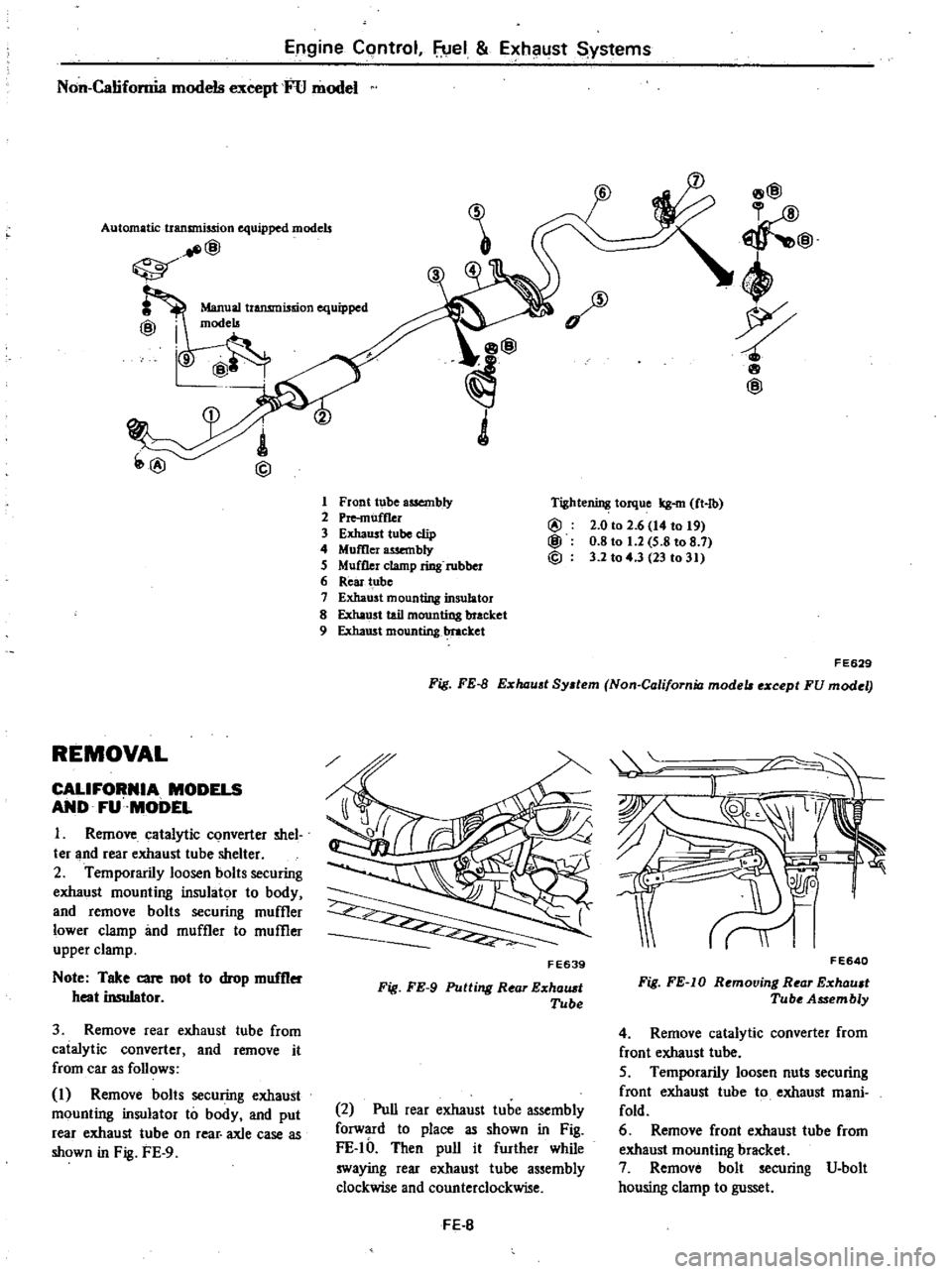
Front
tube
assembly
2
Pre
muff1er
3
Exhaust
tube
clip
4
Momer
wembly
5
Muffler
clamp
ring
rubber
6
Rear
tube
7
Exhaust
mounting
insulator
8
Exha
st
tail
mounting
bracket
9
Exhaust
mounting
1
ttacket
8@
@
4
wp
8
@
Tightening
torque
kg
m
ft
lb
@
2
0
to
2
6
14
to
t9
@
0
8
to
1
2
5
8
to
8
7
@
3
2
to
4
3
23
to
31
FE629
Fig
FE
B
E
haust
System
Non
California
mode
e
cept
FU
modet
FE639
Fig
FE
9
Putting
Rear
E
halUt
Tube
2
Pull
rear
exhaust
tube
assembly
forward
to
place
as
shown
in
Fig
FE
IO
Then
pull
it
further
while
swaying
rear
exhaust
tube
assembly
clockwise
and
counterclockwise
FE
B
II
F
E640
Fig
FE
IO
Removing
Rear
E
xhault
Tube
Assembly
4
Remove
catalytic
converter
from
front
exhaust
tube
5
Temporarily
loosen
nuts
securing
f
root
exhaust
tube
to
exhaust
mani
fold
6
Remove
front
exhaust
tube
from
exhaust
mounting
bracket
7
Remove
bolt
securing
V
bolt
housing
clamp
to
gusset