battery DATSUN B110 1973 Service User Guide
[x] Cancel search | Manufacturer: DATSUN, Model Year: 1973, Model line: B110, Model: DATSUN B110 1973Pages: 513, PDF Size: 28.74 MB
Page 306 of 513
EMISSION
CONTROL
AND
TUNE
UP
EMISSION
CONTROL
SYSTEM
AN
D
ENGINE
TUNE
UP
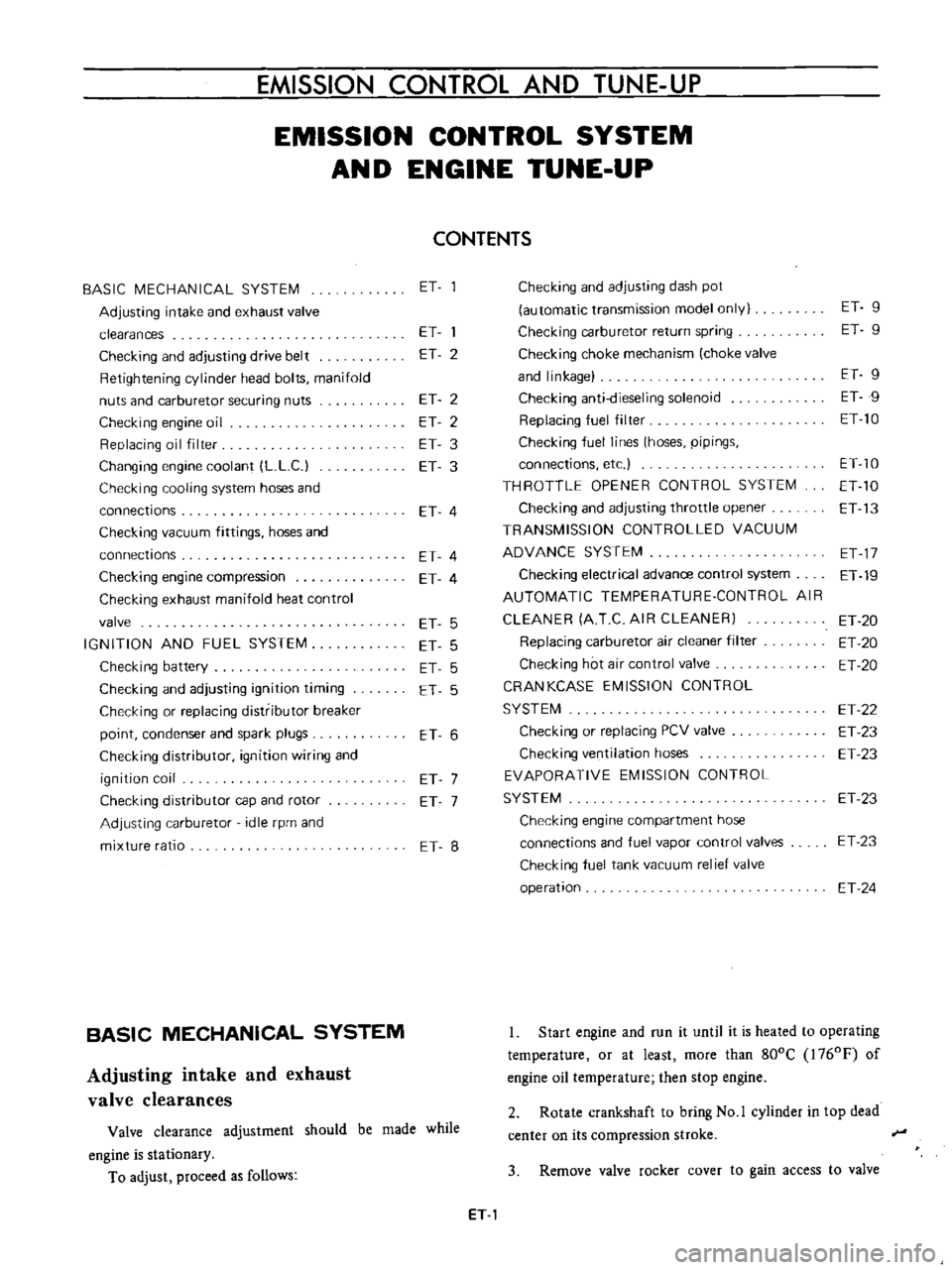
CONTENTS
BASIC
MECHANICAL
SYSTEM
ET
Checking
and
adjusting
dash
pot
Adjusting
intake
and
exhaust
valve
automatic
transmission
model
only
ET
9
clearances
ET
1
Checking
carburetor
return
spring
ET
9
Checking
and
adjustin9
drive
belt
ET
2
Checking
choke
mechanism
choke
valve
Retightening
cylinder
head
bolts
manifold
and
linkagel
ET
9
nuts
and
carburetor
securing
nuts
ET
2
Checking
anti
dieseling
solenoid
ET
9
Checking
engine
oil
ET
2
Replacing
fuel
filter
ET
10
Replacing
oil
filter
ET
3
Checking
fuel
lines
hoses
pipings
Changing
engine
coolant
L
L
C
ET
3
connections
etc
ET10
Checking
cooling
system
hoses
and
THROTTLE
OPENER
CONTROL
SYSTEM
ET
10
connections
ET
4
Checking
and
adjusting
throttle
opener
ET
13
Checking
vacuum
fittings
hoses
and
TRANSMISSION
CONTROLLED
VACUUM
connections
ET
4
ADVANCE
SYSTEM
ET
17
Checking
engine
compression
ET
4
Checking
electrical
advance
control
system
ET
19
Checking
exhaust
manifold
heat
control
AUTOMATIC
TEMPERATURE
CONTROL
AIR
valve
ET
5
CLEANER
A
T
C
AIR
CLEANER
ET
20
IGNITION
AND
FUEL
SYSTEM
ET
5
Replacing
carburetor
air
cleaner
filter
ET
20
Checking
battery
ET
5
Checking
hot
air
control
valve
ET
20
Checking
and
adjusting
ignition
timing
ET
5
CRANKCASE
EMISSION
CONTROL
Checking
or
replacing
distributor
breaker
SYSTEM
ET
22
point
condenser
and
spark
plugs
ET
6
Checking
or
replacing
PCV
valve
ET
23
Checking
distributor
ignition
wiring
and
Checking
ventilation
hoses
ET
23
ignition
coil
ET
7
EVAPORATIVE
EMISSION
CONTROL
Checking
distributor
cap
and
rotor
ET
7
SYSTEM
ET
23
Adjusting
carburetor
id
Ie
rpm
and
Checking
engine
compartment
hose
mixture
ratio
ET
8
connections
and
fuel
vapor
control
valves
ET
23
Checking
fuel
tank
vacuum
relief
valve
operation
ET
24
BASIC
MECHANICAL
SYSTEM
1
Start
engine
and
run
it
until
it
is
heated
to
operating
temperature
or
at
least
more
than
800C
I760F
of
engine
oil
temperature
then
stop
engine
Adjusting
intake
and
exhaust
valve
clearances
Valve
clearance
adjustment
should
be
made
while
engine
is
stationary
To
adjust
proceed
as
follows
2
Rotate
crankshaft
to
bring
No
1
cylinder
in
top
dead
center
on
its
compression
stroke
3
Remove
valve
rocker
cover
to
gain
access
to
valve
ET
1
Page 310 of 513
EMISSION
CONTROL
AND
TUNE
UP
reading
cylinders
through
spark
plug
hole
Repeat
compression
check
on
these
cylinders
1
If
compression
improves
considerably
piston
rings
are
defective
2
If
compression
does
not
improve
valves
are
sticking
or
seating
improperly
3
If
two
adjacent
cylinders
indicate
low
compression
and
injecting
oil
on
pistons
does
not
increase
compres
sion
the
cause
may
be
a
cylinder
head
gasket
leak
between
the
cylinders
Engine
oil
and
coolant
in
cylinder
could
result
from
this
problem
Compression
pressure
12
S
to
14
S
kg
cm2
178
to
206
psi
at
3S0
rpm
Checking
exhaust
manifold
heat
control
valve
Check
heat
control
valve
for
proper
operation
If
it
does
not
operate
properly
trouble
is
due
to
excess
carbon
on
shaft
or
damaged
shaft
Clean
if
necessary
The
bimetal
should
be
also
checked
for
proper
function
IGNITION
AND
FUEL
SYSTEM
Checking
battery
Check
electrolyte
level
in
each
battery
celL
L
Unscrew
each
filler
cap
and
inspect
fluid
leveL
If
fluid
level
is
low
add
distilled
water
to
bring
level
up
to
app
roximately
10
to
20
mm
0
3937
to
0
7874
in
above
plates
Do
not
overfilL
2
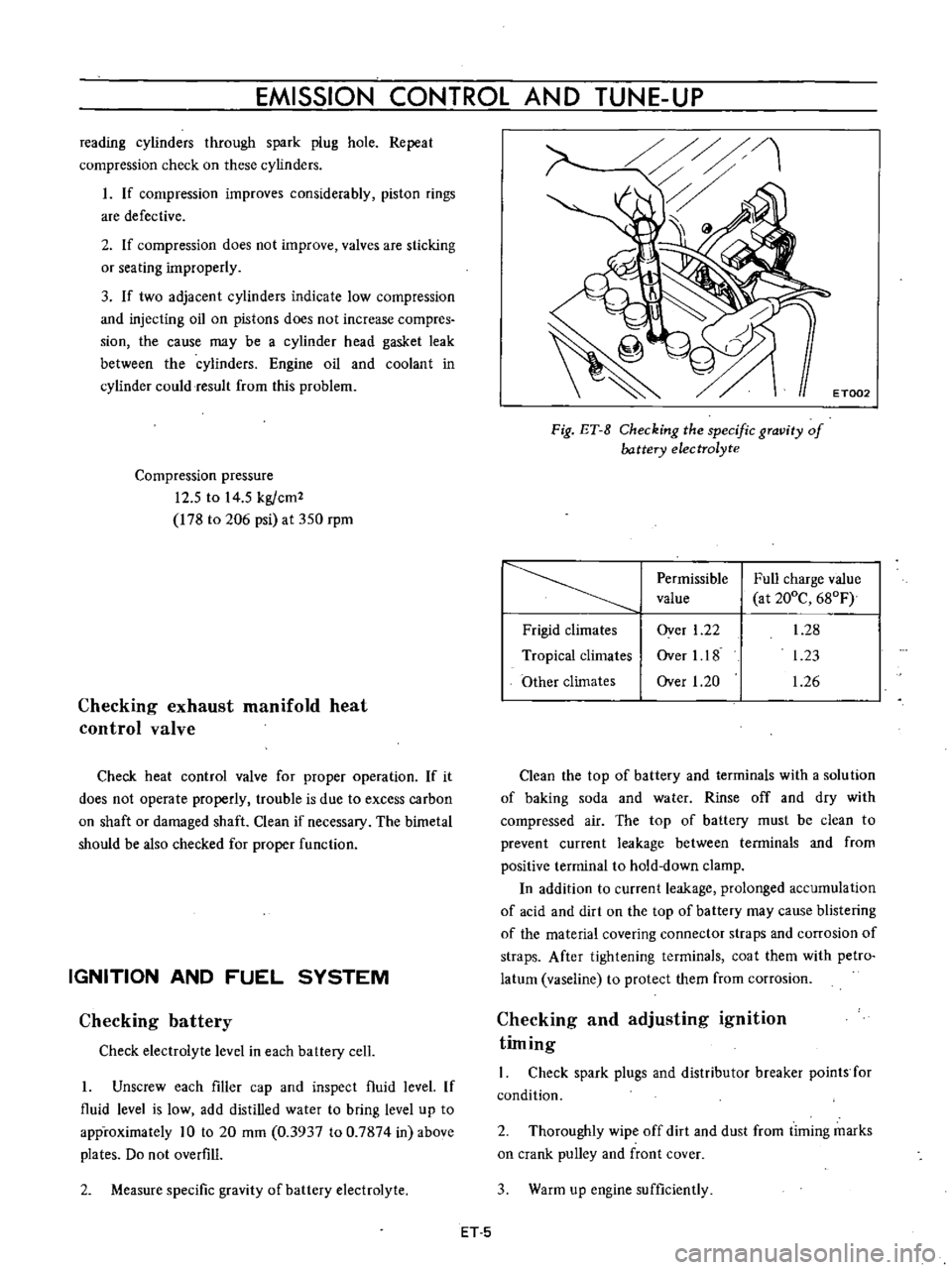
Measure
specific
gravity
of
battery
electrolyte
ET002
Fig
ET
B
Checking
the
specific
gravity
of
battery
electrolyte
Permissible
Full
charge
value
value
at
200C
68OF
Frigid
climates
Over
1
22
1
28
Tropical
climates
Over
1
18
1
23
Other
climates
Over
L
20
1
26
Clean
the
top
of
battery
and
terminals
with
a
solu
lion
of
baking
soda
and
water
Rinse
off
and
dry
with
compressed
air
The
top
of
battery
must
be
clean
to
prevent
current
leakage
between
terminals
and
from
positive
terminal
to
hold
down
clamp
In
addition
to
current
leakage
prolonged
accumulation
of
acid
and
dirt
on
the
top
of
battery
may
cause
blistering
of
the
material
covering
connector
straps
and
corrosion
of
straps
After
tightening
terminals
coat
them
with
petro
laturn
vaseline
to
protect
them
from
corrosion
Checking
and
adjusting
ignition
timing
I
Check
spark
plugs
and
distributor
breaker
points
for
condition
2
Thoroughly
wipe
off
dirt
and
dust
from
timing
marks
on
crank
pulley
and
front
cover
3
Warm
up
engine
sufficiently
ET
5
Page 316 of 513
EMISSION
CONTROL
AND
TUNE
UP
Ignition
switch
0
Speed
switch
Ignition
switch
6
Transmission
A12
Engine
with
Manual
Transmission
l
Battery
J
Below
10
mph
switch
ON
To
throttle
opener
Servo
diaphragm
Needle
valve
To
air
cleaner
To
intake
manifold
f
Vacuum
control
valve
p
Throttle
opener
noid
ON
Car
speed
below
16
km
h
10
MPH
OFF
Car
speed
above
16
km
h
10
MPH
A12
Engine
with
Automatic
Transmission
Inhibitor
switch
1
J
Battery
To
intake
manifold
t
ET
11
OFF
ON
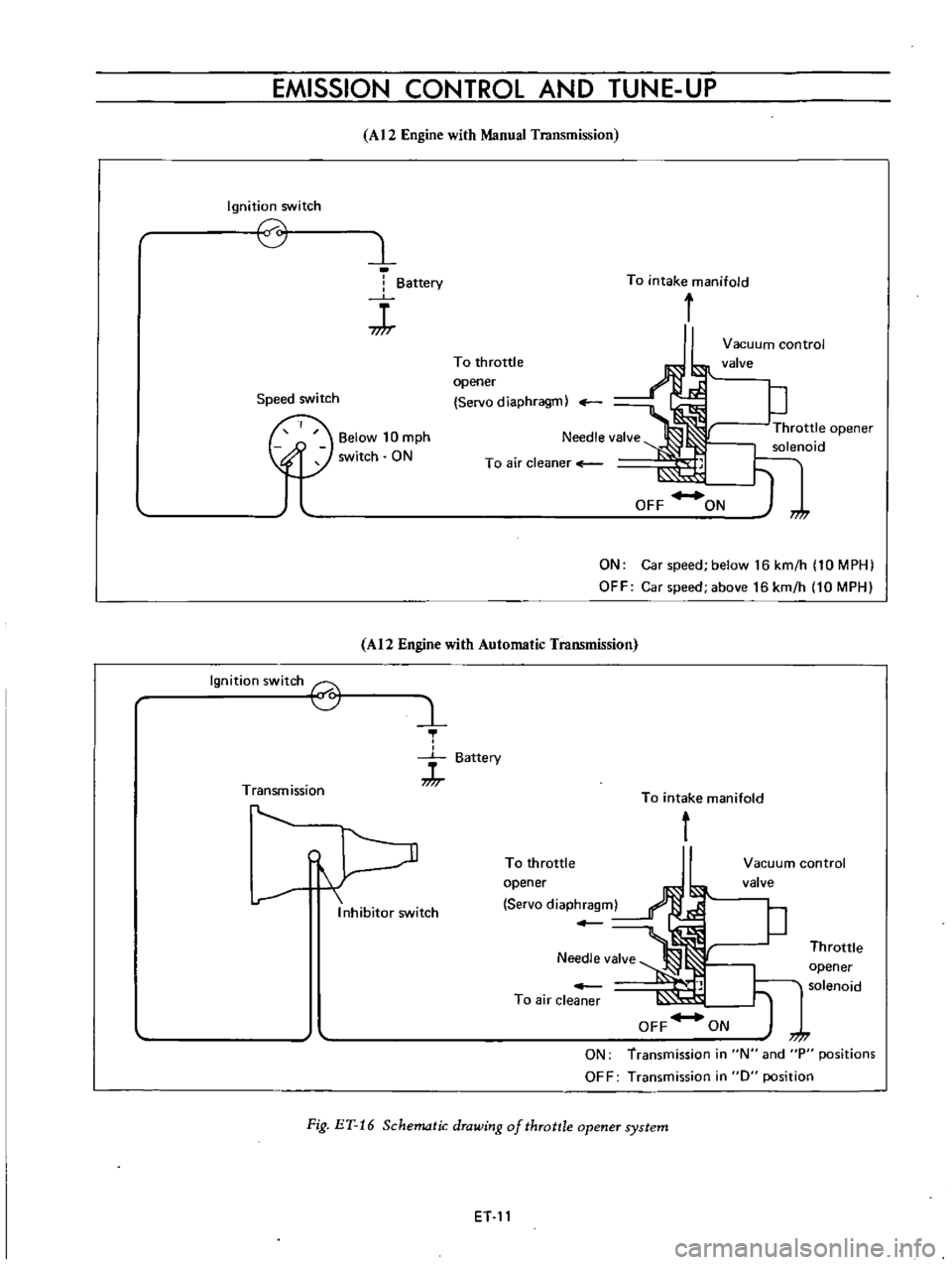
Fig
BY
16
Schematic
drawing
of
throttle
opener
system
To
throttle
opener
Servo
diaphragm
Vacuum
control
valve
P
Throttle
t
opener
solenoid
7
7
ON
transmission
in
N
and
P
positions
OFF
Transmission
in
0
position
Page 323 of 513
ENGINE
Gear
Vacuum
advance
Note
R
No
1st
No
2nd
No
3rd
No
4th
Yes
Immediately
after
starting
the
engine
in
cold
weather
vacuum
advance
is
available
for
all
gear
positions
A12
Engine
with
Manual
Transmission
Distributor
Ignition
switch
8
1
J
Battery
Thermo
switch
9
Transmission
L
r
l
r
Vacuum
advance
unit
To
carburetor
Needle
valve
OFF
l
To
air
cleaner
ON
Vacuum
cutting
valve
solenoid
Top
switch
Top
off
I
7
1
OFF
Vacuum
actuated
ON
Vacuum
eminated
into
atmosphere
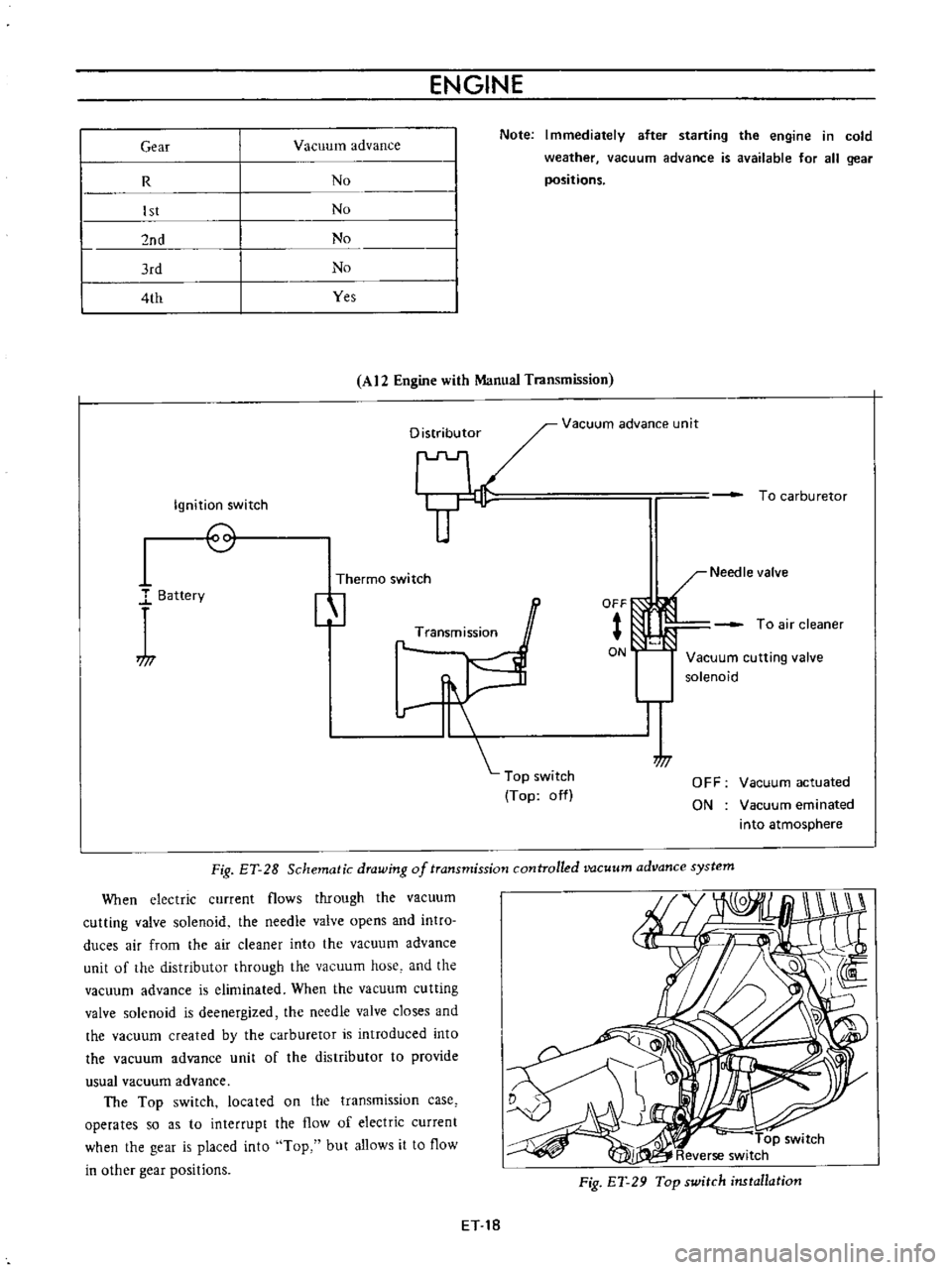
Fig
ET
28
Schematic
drawing
of
transmission
controlled
vacuum
advance
system
When
electric
current
flows
through
the
vacuum
cutting
valve
solenoid
the
needle
valve
opens
and
intro
duces
air
from
the
air
cleaner
into
the
vacuum
advance
unit
of
the
distributor
through
the
vacuum
hose
and
the
vacuum
advance
is
eliminated
When
the
vacuum
cutting
valve
solenoid
is
deenergized
the
needle
valve
closes
and
the
vacuum
created
by
the
carburetor
is
introduced
into
the
vacuum
advance
unit
of
the
distributor
to
provide
usual
vacuum
advance
The
Top
switch
located
on
the
transmission
case
operates
so
as
to
interrupt
the
flow
of
electric
current
when
the
gear
is
placed
into
Top
but
allows
it
to
flow
in
other
gear
positions
Fig
ET
29
Top
switch
installation
ET
18
Page 330 of 513
EMISSION
CONTROL
AND
TUNE
UP
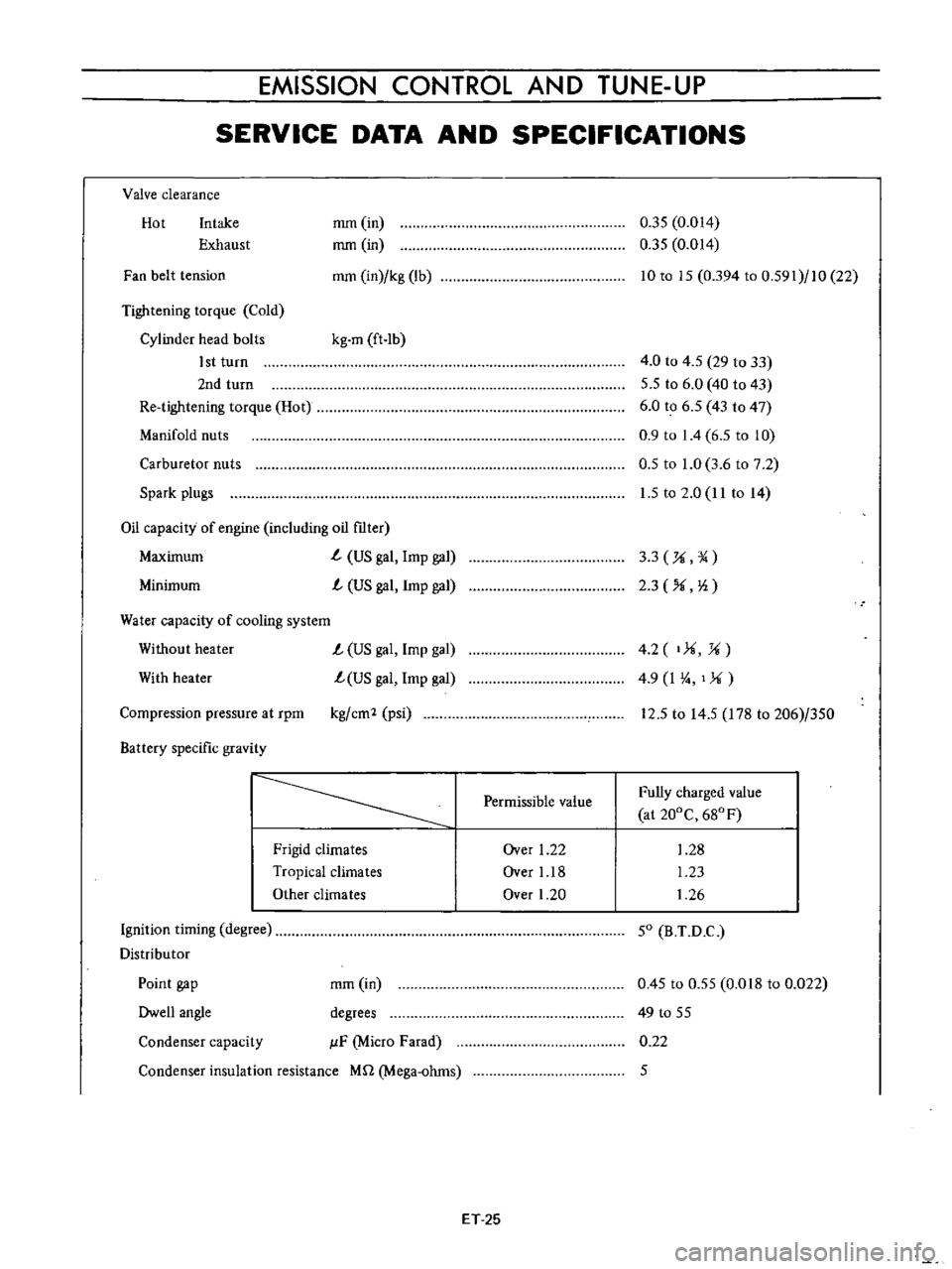
SERVICE
DATA
AND
SPECIFICATIONS
Valve
clearance
Hot
Intake
Exhaust
mm
in
rom
in
rom
in
kg
lb
0
35
0
014
0
35
0
014
10
to
15
0
394
to
0
591
10
22
Fan
belt
tension
Tightening
torque
Cold
Cylinder
head
bolts
kg
m
ft
lb
1st
turn
2nd
turn
Re
tightening
torque
Hot
Manifold
nuts
Carburetor
nuts
4
0
to
4
5
29
to
33
5
5
to
6
0
40
to
43
6
0
to
6
5
43
to
47
0
9
to
I
4
6
5
to
10
0
5
to
1
0
3
6
to
7
2
1
5
to
2
0
II
to
14
Spark
plugs
Oil
capacity
of
engine
including
oil
ftIter
Maximum
L
US
gal
Imp
gal
L
US
gal
Imp
gal
3
3
U
14
2
3
Ii
Minimum
Water
capacity
of
cooling
system
Without
heater
L
US
gal
Imp
gal
With
heater
L
US
gal
Imp
gal
4
2
1
U
4
9
I
4
11
12
5
to
14
5
I78
to
206
350
Compression
pressure
at
rpm
kg
em
psi
Battery
specific
gravity
Permissible
value
Fully
charged
value
at
200C
680F
Frigid
climates
Tropical
climates
Other
elima
tes
Over
1
22
Over
1
18
Over
1
20
1
28
1
23
1
26
Ignition
timing
degree
Distributor
50
B
T
D
C
Condenser
capacity
mm
in
degrees
IlF
Micro
Farad
0
45
to
0
55
0
018
to
0
022
49
to
55
0
22
5
Point
gap
Dwell
angle
Condenser
insulation
resistance
Mil
Mega
ohms
ET
25
Page 331 of 513
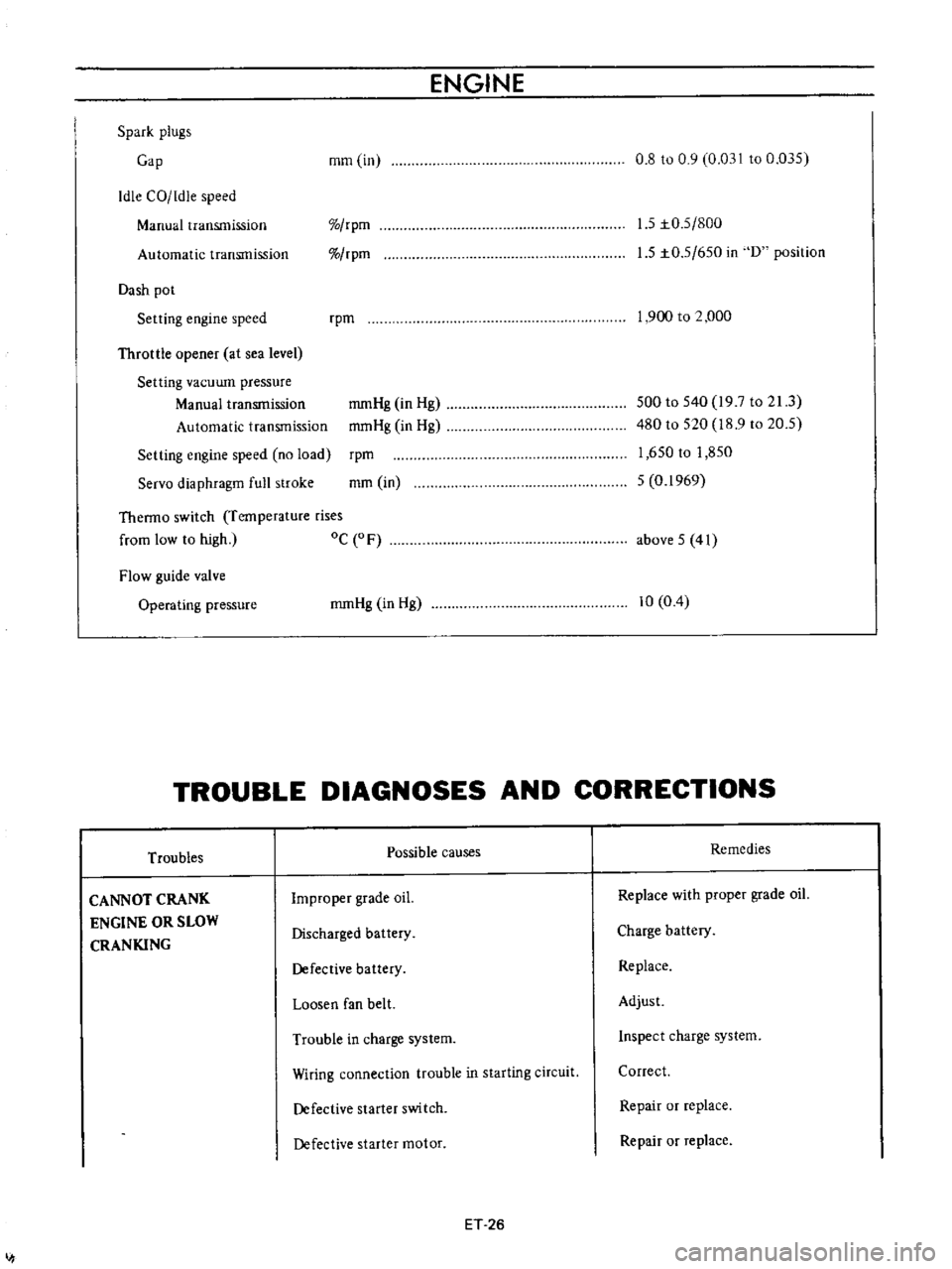
ENGINE
Spark
plugs
Cap
mm
in
0
8
to
0
9
0
03110
0
035
Idle
CO
ldie
speed
Manual
transmission
rpm
rpm
1
5
to
5
800
1
5
to
5
650
in
D
position
Automatic
transmission
Dash
pot
Setting
engine
speed
rpm
1
900
to
2
000
Throttle
opener
at
sea
level
Setting
vacuwn
pressure
Manual
transmission
Automatic
transmission
Setting
engine
speed
no
load
Servo
diaphragm
full
stroke
rpm
mm
in
500
to
540
19
7
to
21
3
480
to
520
18
9
to
20
5
1
650
to
1
850
5
0
1969
mmHg
in
Hg
mmHg
in
Hg
Theono
switch
Temperature
rises
from
low
to
high
oC
0
F
above
5
41
Flow
guide
valve
Opera
ting
pressure
mmHg
in
Hg
10
0
4
TROUBLE
DIAGNOSES
AND
CORRECTIONS
Troubles
Possible
causes
Remedies
CANNOT
CRANK
ENGINE
OR
SLOW
CRANKING
Improper
grade
oiL
Replace
with
proper
grade
oiL
Discharged
battery
Charge
battery
Defective
battery
Replace
Loosen
fan
belt
Adjust
Trouble
in
charge
system
Inspect
charge
system
Wiring
connection
trouble
in
starting
circuit
Correct
Defective
starter
switch
Repair
or
replace
Defective
starter
motor
Repair
or
replace
ET
26
I
Page 332 of 513
EMISSION
CONTROL
AND
TUNE
UP
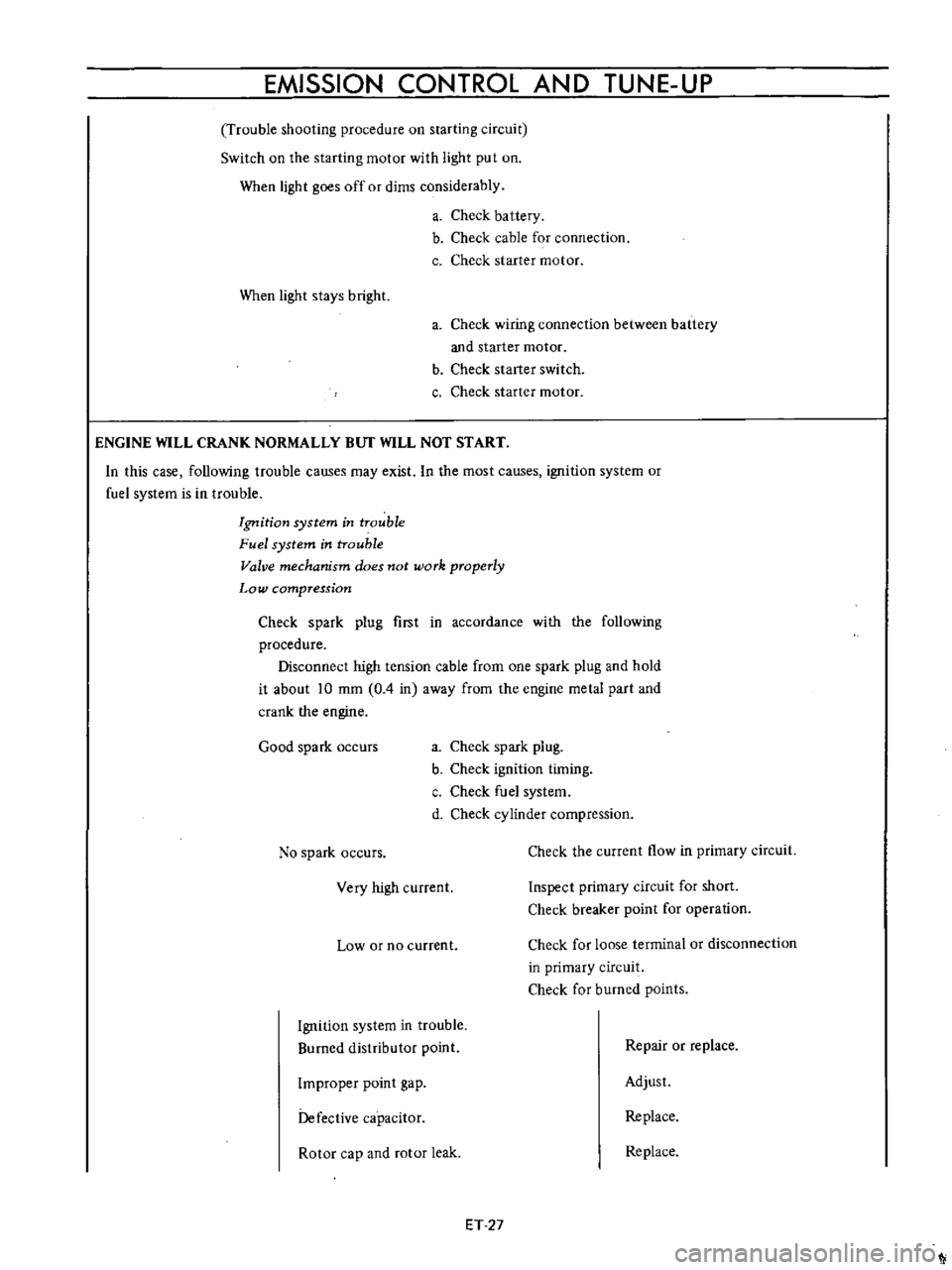
Trouble
shooting
procedure
on
starting
circuit
Switch
on
the
starting
motor
with
light
put
on
When
light
goes
off
or
dims
considerably
a
Check
battery
b
Check
cable
for
connection
c
Check
starter
motor
When
light
stays
bright
a
Check
wiring
connection
between
battery
and
starter
motor
b
Check
starter
switch
c
Check
starter
motor
ENGINE
WILL
CRANK
NORMALLY
BUT
WILL
NOT
START
In
this
case
following
trouble
causes
may
exist
In
the
most
causes
ignition
system
or
fuel
system
is
in
trouble
Ignition
system
in
trouble
Fuel
system
in
trouble
Valve
mechanism
does
not
work
properly
Low
compression
Check
spark
plug
first
in
accordance
with
the
following
procedure
Disconnect
high
tension
cable
from
one
spark
plug
and
hold
it
about
10
rom
0
4
in
away
from
the
engine
metal
part
and
crank
the
engine
Good
spark
occurs
a
Check
spark
plug
b
Check
ignition
timing
Check
fuel
system
d
Check
cylinder
compression
No
spark
occurs
Check
the
current
flow
in
primary
circuit
Very
high
current
Inspect
primary
circuit
for
short
Check
breaker
point
for
operation
Low
or
no
current
Check
for
loose
terminal
or
disconnection
in
primary
circuit
Check
for
burned
points
Ignition
system
in
trouble
Burned
distributor
point
Repair
or
replace
Improper
point
gap
Adjust
Defective
capacitor
Replace
Rotor
cap
and
rotor
leak
Replace
ET
27
ti
Page 420 of 513
DATSUN
1200
MODEL
B
11
0
SERIES
L
NISSAN
I
NISSAN
MOTOR
CO
LTD
TOKYO
JAPAN
SECTION
EE
ENGINE
ELECTRICAL
SYSTEM
BATTERY
STARTING
MOTOR
CHARGING
CIRCUIT
ALTERNATOR
REGULATOR
IGNITIO
N
CIRCUIT
DISTRIBUTOR
IGNITION
COIL
SPARK
PLUG
EEl
EE
3
EE
15
EE
16
EE
23
EE
29
EE
29
EE
36
EE
37
Page 421 of 513
ENGINE
ElECTRICAL
SYSTEM
BATTERY
CONTENTS
REMOVAL
CHECKING
ELECTROLYTE
LEVEL
CHECKING
SPECIFIC
GRAVITY
EE
1
EE
l
EE
1
REMOVAL
Disconnect
the
negative
terminal
first
and
then
the
positive
terminal
2
Remove
the
retainer
nuts
and
take
off
retainer
3
Release
retainer
bolts
and
remove
battery
CHECKING
ELECTROLYTE
LEVEL
Adjust
the
electrolyte
level
in
the
battery
when
the
battery
is
in
a
fully
charged
condition
The
electrolyte
hould
maintain
its
indicated
correct
level
in
the
battery
N
water
other
than
distilled
water
should
be
added
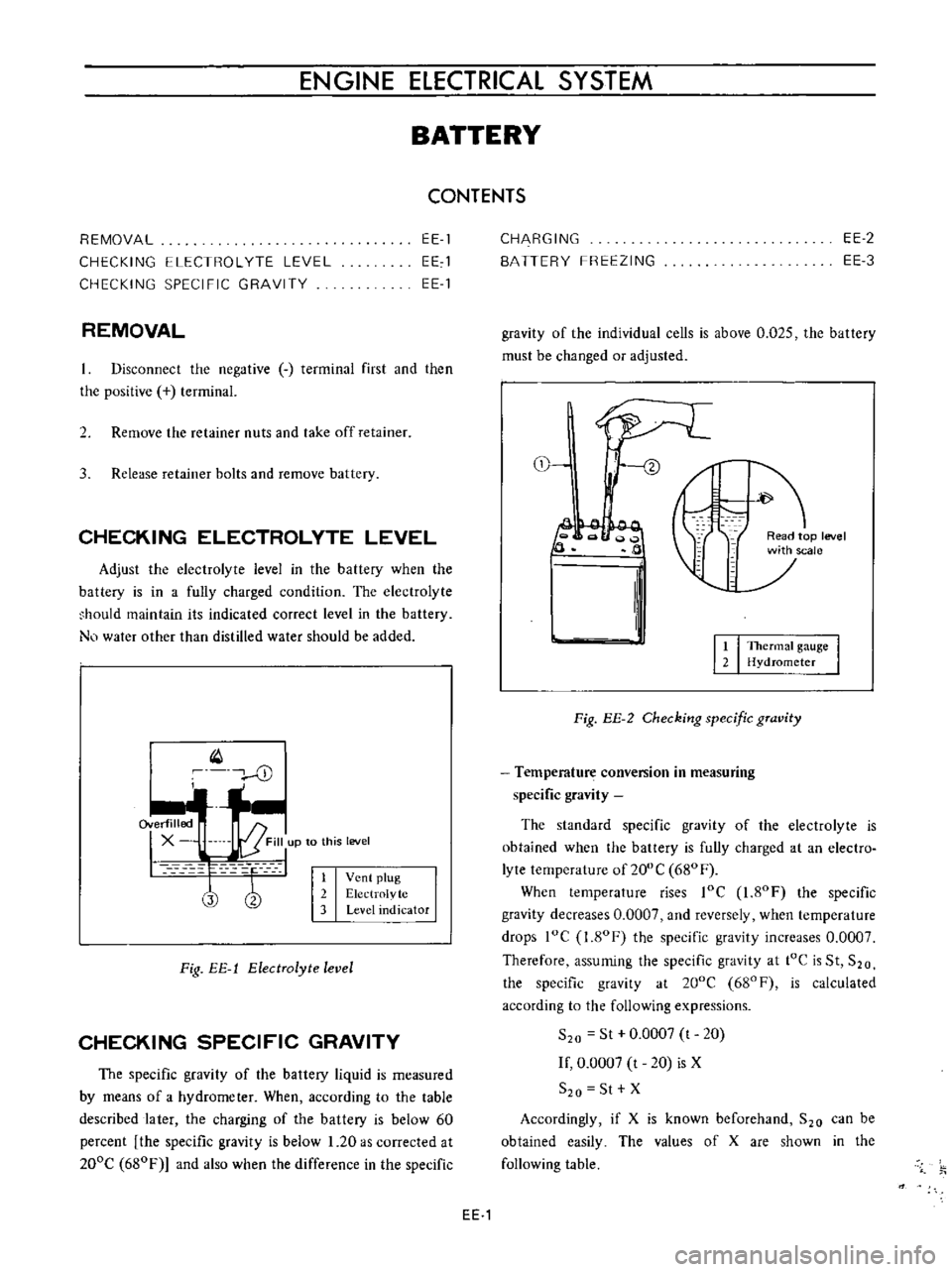
Q
cD
I
1
Vent
plug
2
Electrolvte
3
Level
indicator
Fig
EE
1
ElectTolyte
level
CHECKING
SPECIFIC
GRAVITY
The
specific
gravity
of
the
battery
liquid
is
measured
by
means
of
a
hydrometer
When
according
to
the
table
described
later
the
charging
of
the
battery
is
below
60
percent
the
specific
gravity
is
below
1
20
as
corrected
at
200e
680F
and
also
when
the
difference
in
the
specific
CHARGING
BATTERY
FREEZING
EE
2
EE
3
gravity
of
the
individual
cells
is
above
0
025
the
battery
must
be
changed
or
adjusted
tl
f
ead
p
level
jSCale
2
II
It
I
TheTmat
gauge
I
2
Hydrometer
Fig
EE
2
Checking
specific
gTavity
Temperature
conversion
in
measuring
specific
gravity
The
standard
specific
gravity
of
the
electrolyte
is
obtained
when
the
battery
is
fully
charged
at
an
electro
lyte
temperature
of
200
e
680
F
When
temperature
rises
loe
1
80F
the
specific
gravity
decreases
0
0007
and
reversely
when
temperature
drops
loe
I
ROF
the
specific
gravity
increases
0
0007
Therefore
assuming
the
specific
gravity
at
tOe
is
St
S20
the
specific
gravity
at
200e
680F
is
calculated
according
to
the
following
expressions
S
o
St
0
0007
t
20
If
0
0007
t
20
is
X
S
o
St
X
Accordingly
if
X
is
known
beforehand
S
o
can
be
obtained
easily
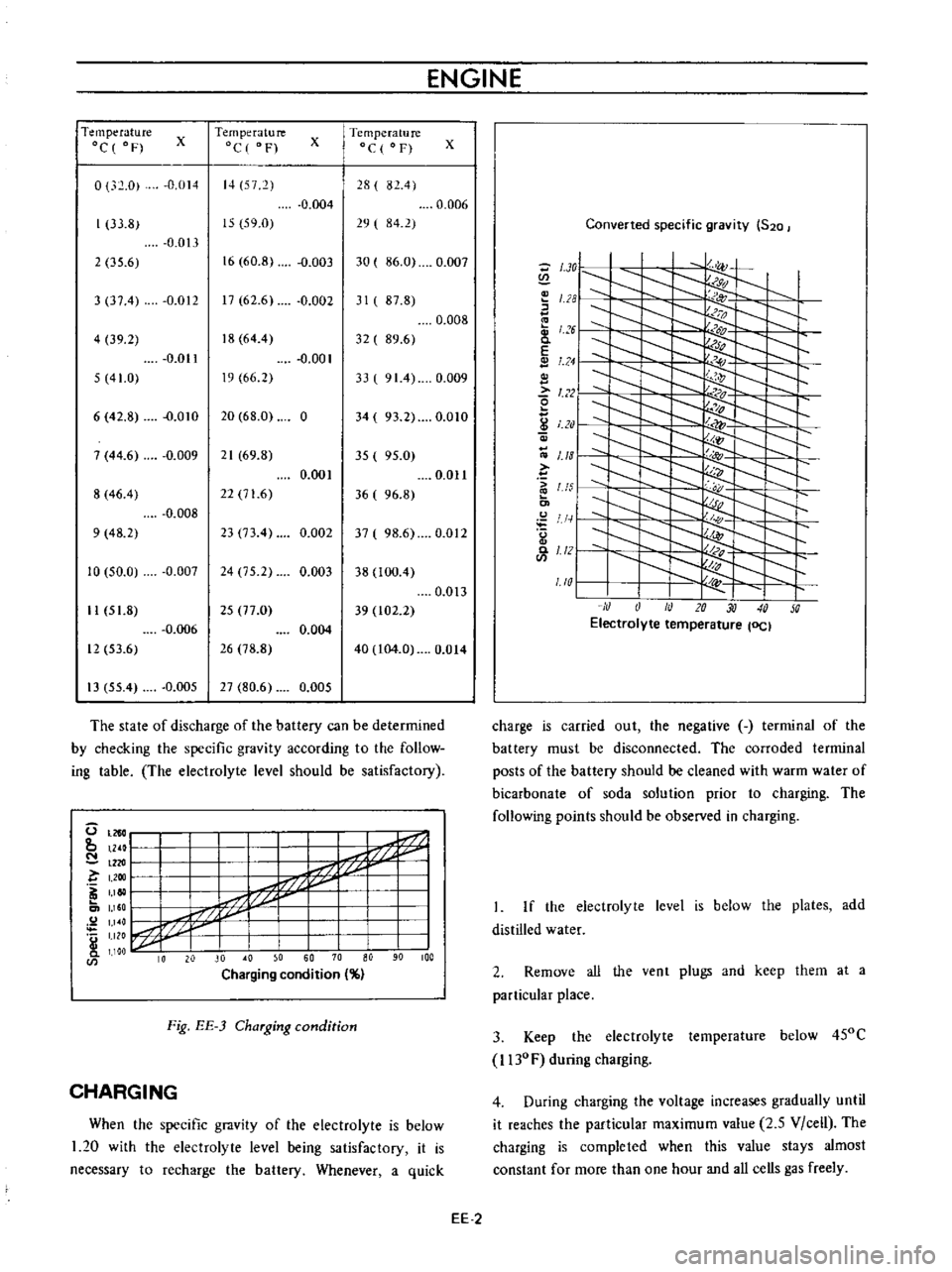
The
values
of
X
are
shown
in
the
following
table
EE
1
Page 422 of 513
ENGINE
Temperature
Oc
of
Temperature
C
F
x
Temperature
Oc
F
x
0
32
0
0
014
14
572
28
82
4
0
004
0
006
33
8
IS
59
0
19
I
84
2
0
013
2
35
6
16
60
8
0
003
30
86
0
0
007
3
37
4
0
012
17
61
6
0
001
31
87
8
0
008
4
39
2
18
64
4
32
89
6
0
011
0
001
5
41
0
19
66
2
33
91
4
0
009
6
42
8
0
010
20
68
0
0
34
93
2
0
010
7
44
6
0
009
21
69
8
35
95
0
0
001
0
01l
8
46
4
22
71
6
36
96
8
0
008
9
48
2
23
73
4
0
002
37
98
6
0
012
10
50
0
0
007
24
75
2
0
003
38
100
4
0
013
II
51
8
25
77
0
39
t02
2
0
006
0
004
12
53
6
16
78
8
40
104
0
0
Ot4
13
55
4
0
005
27
80
6
0
005
The
state
of
discharge
of
the
battery
can
be
determined
by
checking
the
specific
gravity
according
to
the
follow
ing
table
The
electrolyte
level
should
be
satisfactory
U
tn
l
k
1
I
P
I
IZf
I
r7
42
I
bt
7
J
I
I
11
0
I
M
I
L
J
I
10
20
30
0
50
60
70
aD
90
100
Charging
condition
Fig
EE
3
Charging
condition
CHARGING
When
the
specific
gravity
of
he
electrolyte
is
below
1
20
with
the
electrolyte
level
being
satisfactory
it
is
necessary
to
recharge
the
battery
Whenever
a
quick
x
Converted
specific
gravity
520
V
9d
f
o
1
28
u
1
6
c
E
1
24
l
22
o
0
U5
S
I
1
1
2
1
10
1
NON
M
i
Electrolyte
temperature
lOCI
charge
is
carried
out
the
negative
terminal
of
the
battery
must
be
disconnected
The
corroded
terminal
posts
of
the
battery
should
be
cleaned
with
warm
water
of
bicarbonate
of
soda
solution
prior
to
charging
The
following
points
should
be
observed
in
charging
If
the
electrolyte
level
is
below
the
plates
add
distilled
water
2
Remove
all
the
vent
plugs
and
keep
them
at
a
particular
place
3
Keep
the
electrolyte
temperature
below
450C
l130F
during
charging
4
During
charging
the
voltage
increases
gradually
until
it
reaches
the
particular
maximum
value
2
5
Vice
II
The
charging
is
completed
when
this
value
stays
almost
constant
for
more
than
one
hour
and
all
cells
gas
freely
EE
2