battery DATSUN B110 1973 Service Owner's Guide
[x] Cancel search | Manufacturer: DATSUN, Model Year: 1973, Model line: B110, Model: DATSUN B110 1973Pages: 513, PDF Size: 28.74 MB
Page 441 of 513
ENGINE
ElECTRICAL
SYSTEM
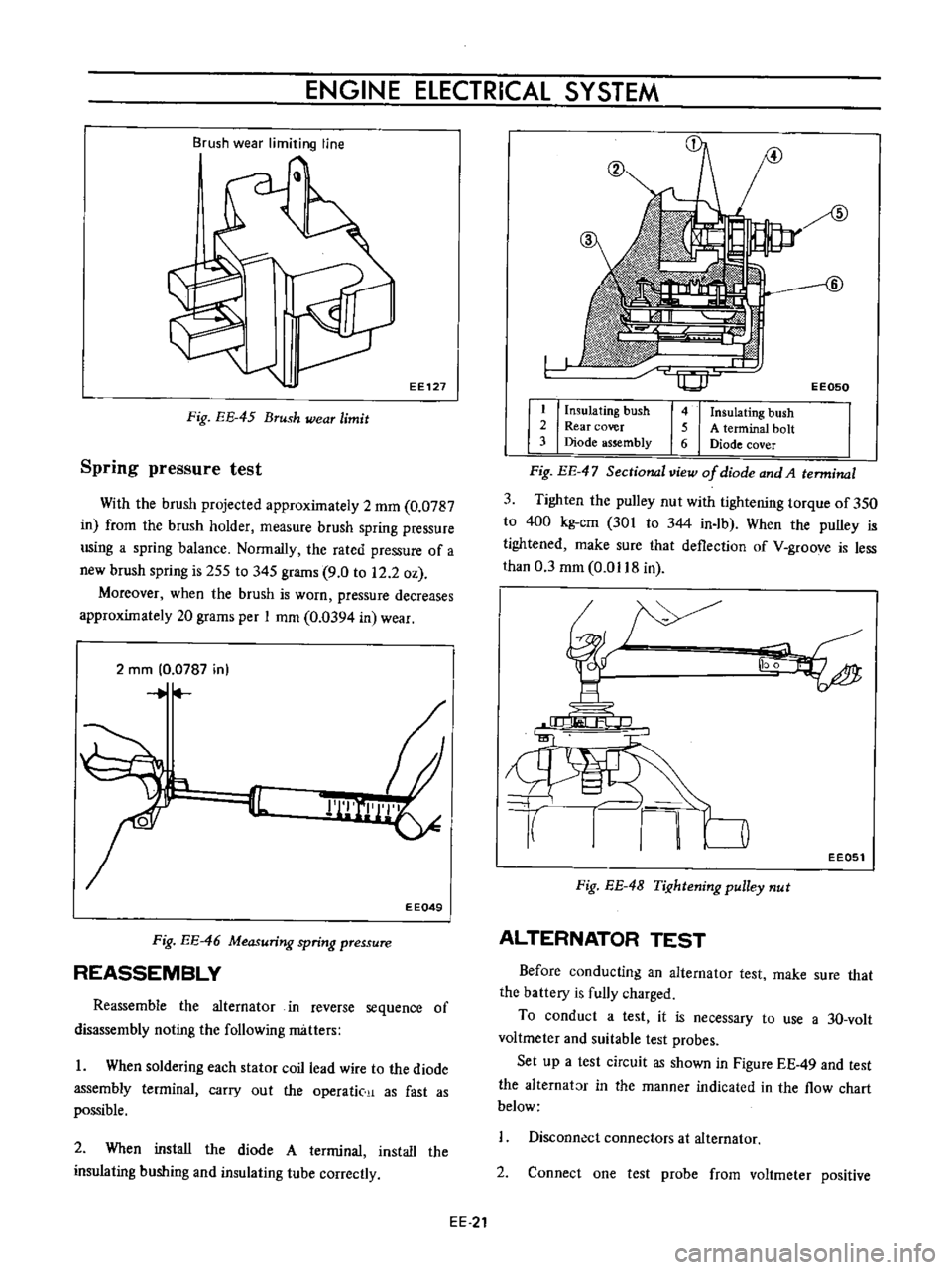
EE127
Fig
EE
45
Brush
wear
limit
Spring
pressure
test
With
the
brush
projected
approximately
2
mm
0
0787
in
from
the
brush
holder
measure
brush
spring
pressure
using
a
spring
balance
Normally
the
rated
pressure
of
a
new
brush
spring
is
255
to
345
grams
9
0
to
12
2
oz
Moreover
when
the
brush
is
worn
pressure
decreases
approximately
20
grams
per
I
mm
0
0394
in
wear
2
rnm
0
0787
in
r
II
EEQ49
Fig
EE
46
Measuring
spring
pressure
REASSEMBLY
Reassemble
the
alternator
in
reverse
sequence
of
disassembly
noting
the
following
matters
I
When
soldering
each
stator
coil
lead
wire
to
the
diode
assembly
terminal
carry
out
the
operatic
as
fast
as
possible
2
When
install
the
diode
A
terminal
install
the
insulating
bushing
and
insulating
tube
correctly
EE
21
EE050
I
Insulating
bush
2
Rear
cover
3
Diode
assembly
4
Insulating
bush
5
A
terminal
bolt
6
Diode
cover
Fig
EE
47
Sectional
view
of
diode
and
A
terminal
3
Tighten
the
pulley
nut
with
tightening
torque
of
350
to
400
kg
cm
301
to
344
in
Ib
When
the
pulley
is
tightened
make
sure
that
deflection
of
V
groove
is
less
than
0
3
mm
0
0118
in
EE051
Fig
EE
4B
TiJ
htening
pulley
nut
ALTERNATOR
TEST
Before
conducting
an
alternator
test
make
sure
that
the
battery
is
fully
charged
To
conduct
a
test
it
is
necessary
to
use
a
3D
volt
voltmeter
and
suitable
test
probes
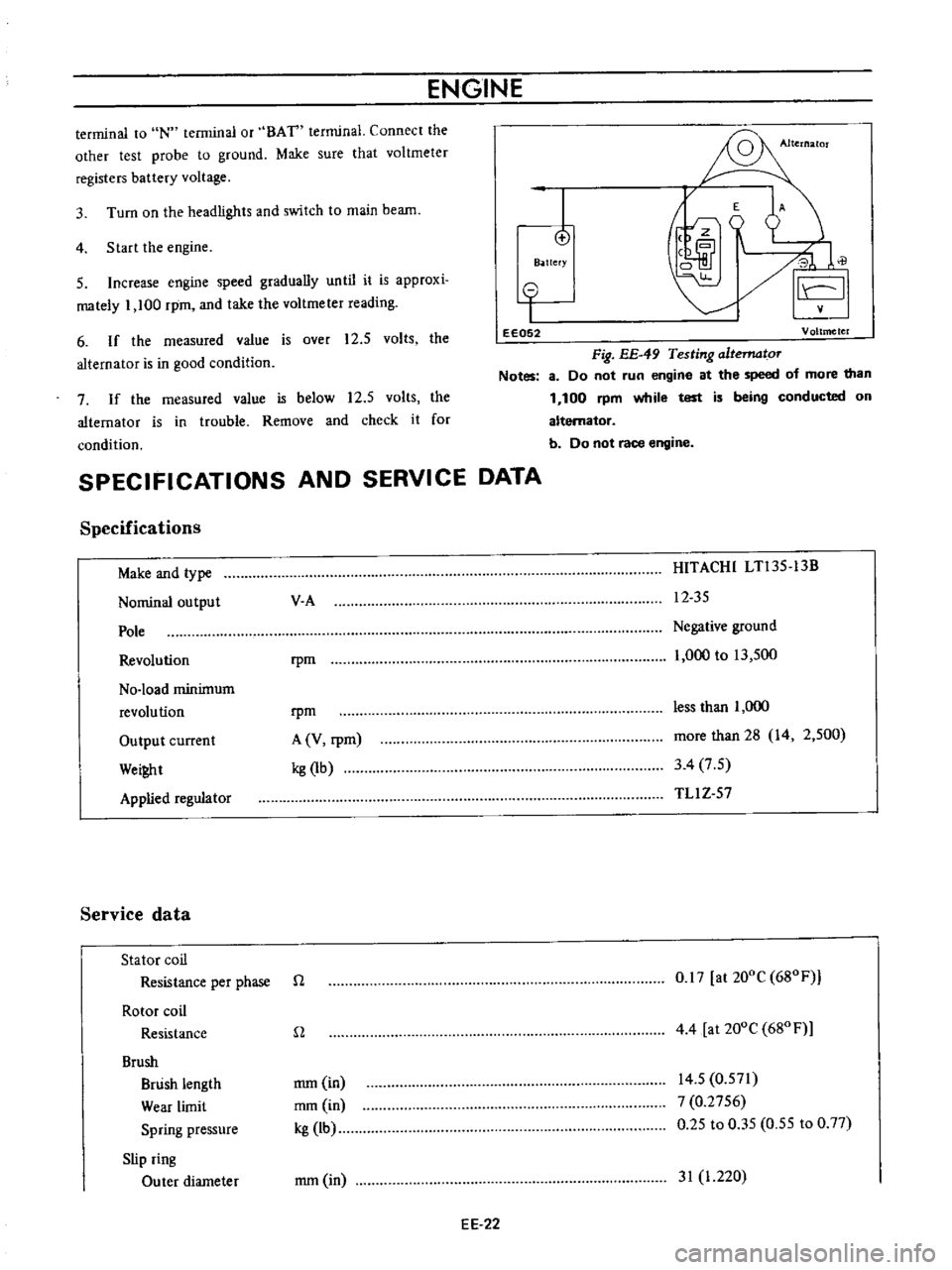
Set
up
a
test
circuit
as
shown
in
Figure
EE
49
and
test
the
alternator
in
the
manner
indicated
in
the
flow
chart
below
Disconn
ct
connectors
at
alternator
2
Connect
one
test
probe
from
voltmeter
positive
Page 442 of 513
ENGINE
terminal
to
IN
terminal
or
BAT
terminal
Connect
the
other
test
probe
to
ground
Make
sure
that
voltmeter
registers
battery
voltage
4
Start
the
engine
3
Turn
on
the
headlights
and
switch
to
main
beam
I
o
B
ttefY
E
A
J
0
il
I
5
Increase
engine
speed
gradually
until
it
is
approxi
mately
1
100
rpm
and
take
the
voltmeter
reading
6
If
the
measured
value
is
over
12
5
volts
the
alternator
is
in
good
condition
o
I
eE052
Voltmeter
Fig
EE
49
Testing
altematoT
Notes
8
Do
not
run
engine
at
the
speed
of
more
than
1
100
rpm
while
test
is
being
conducted
on
alternator
b
Do
not
race
engine
7
If
the
measured
value
is
below
12
5
volts
the
alternator
is
in
trouble
Remove
and
check
it
for
condition
SPECIFICATIONS
AND
SERVICE
DATA
Specifications
Make
and
type
Nominal
output
Pole
Revolution
No
load
minimum
revolution
Output
current
Wei
t
Applied
regulator
Service
data
Stator
coil
Resistance
per
phase
Rotor
coil
Resistance
Brush
Brush
length
Wear
limit
Spring
pressure
Slip
ring
Outer
diameter
V
A
HITACHI
LTl35
13B
12
35
rpm
Negative
ground
1
000
to
13
500
rpm
A
V
rpm
kg
1b
less
than
1
000
more
than
28
14
2
500
3
4
7
5
TLl
Z
57
n
0
17
at
200C
680F
n
4
4
at
200e
680
F
mm
in
mm
in
kg
lb
14
5
0
571
7
0
2756
0
25
to
0
35
0
55
to
0
77
mm
in
31
1
220
EE
22
Page 444 of 513
ENGINE
MEASUREMENT
OF
REGULATING
VOLTAGE
The
regulator
voltage
is
measured
with
the
alternator
When
measuring
voltage
with
regulator
mounted
on
vehicle
it
is
necessary
to
rotate
engine
at
high
speed
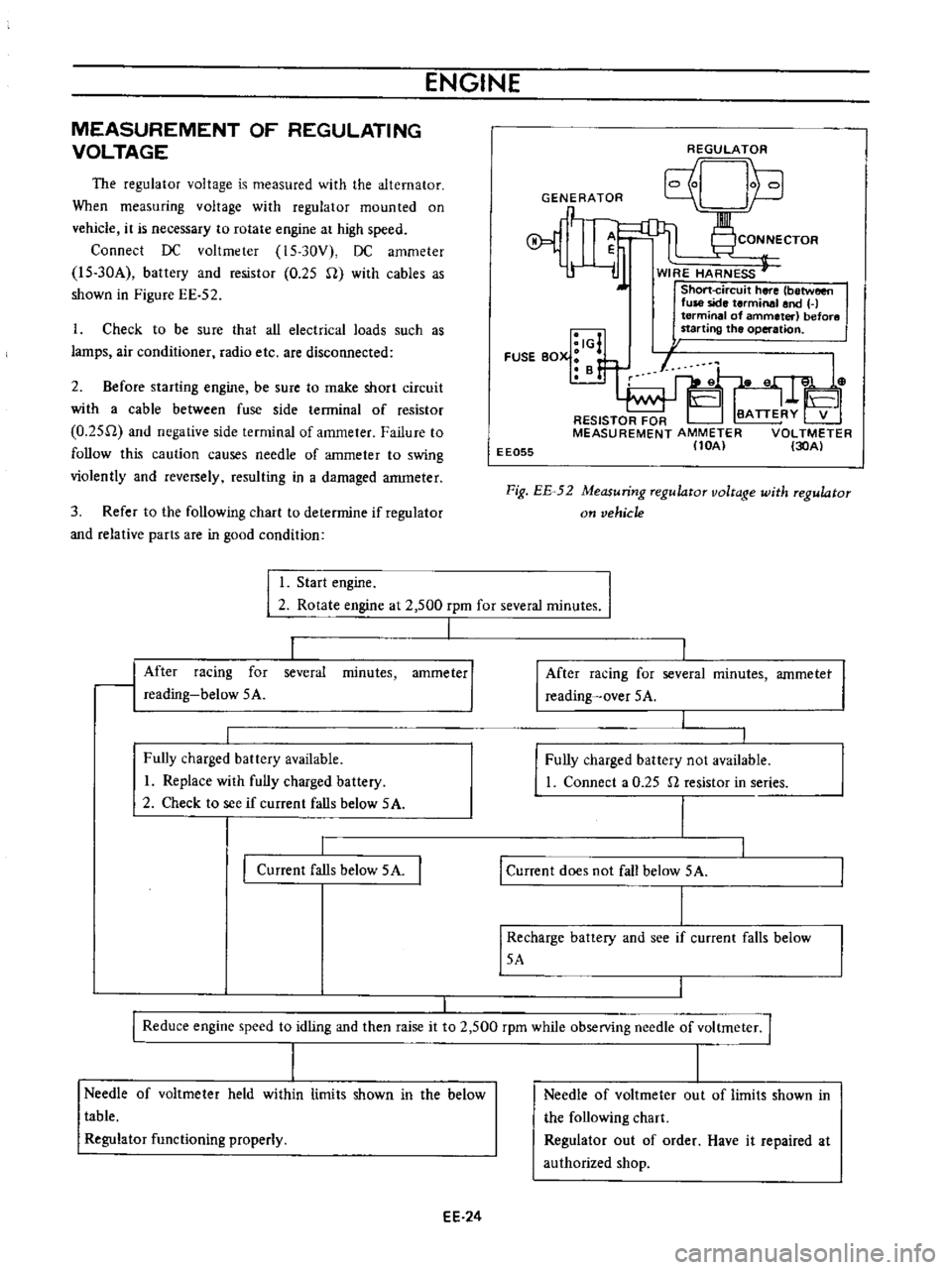
Connect
DC
voltmeter
15
30V
DC
ammeter
l5
30A
battery
and
resistor
0
25
U
with
cables
as
shown
in
Figure
EE
52
1
Check
to
be
sure
that
all
electrical
loads
such
as
lamps
air
conditioner
radio
etc
are
disconnected
2
Before
starting
engine
be
sure
to
make
short
circuit
with
a
cable
between
fuse
side
terminal
of
resistor
O
25U
and
negative
sIde
terminal
of
ammeter
Failure
to
follow
this
caution
causes
needle
of
ammeter
to
swing
violently
and
rever
ely
resulting
in
a
damaged
anuneter
3
Refer
to
the
following
chart
to
determine
if
regulator
and
relative
parts
are
in
good
condition
REGULATOR
Unh
GENERATOR
q
P
1
CONNECTOR
r
l
ij
WIRE
HARNESS
J
Short
circuit
here
between
fuse
side
terminal
and
H
terminal
of
ammeter
before
starting
the
operation
I
I
I
IG
FUSE
BOX
B
f
EE055
Fig
EE
52
Measuring
regulator
voltage
with
regulator
on
vehicle
I
Start
engine
I
2
Rotate
engine
at
2
500
rpm
for
several
minutes
I
1
minutes
ammeter
I
After
racing
for
reading
below
5A
several
Fully
charged
battery
available
I
Replace
with
fully
charged
battery
2
Check
to
see
if
current
falls
below
5A
Current
falls
below
5A
I
After
racing
for
several
reading
over
5A
minutes
ammetet
I
Fully
charged
battery
not
available
1
Connect
a
0
25
n
resistor
in
series
I
Current
does
not
fall
below
5A
I
Recharge
battery
and
see
if
current
falls
below
5A
I
I
Reduce
engine
speed
to
idling
and
then
raise
it
to
2
500
rpm
while
observing
needle
of
voltmeter
I
I
I
Needle
of
voltmeter
held
within
limits
shown
in
the
below
table
Regulator
functioning
properly
EE
24
Needle
of
voltmeter
out
of
limits
shown
in
the
following
chart
Regulator
out
of
order
Have
it
repaired
at
authorized
shop
Page 446 of 513
ENGINE
at
4
to
5
V
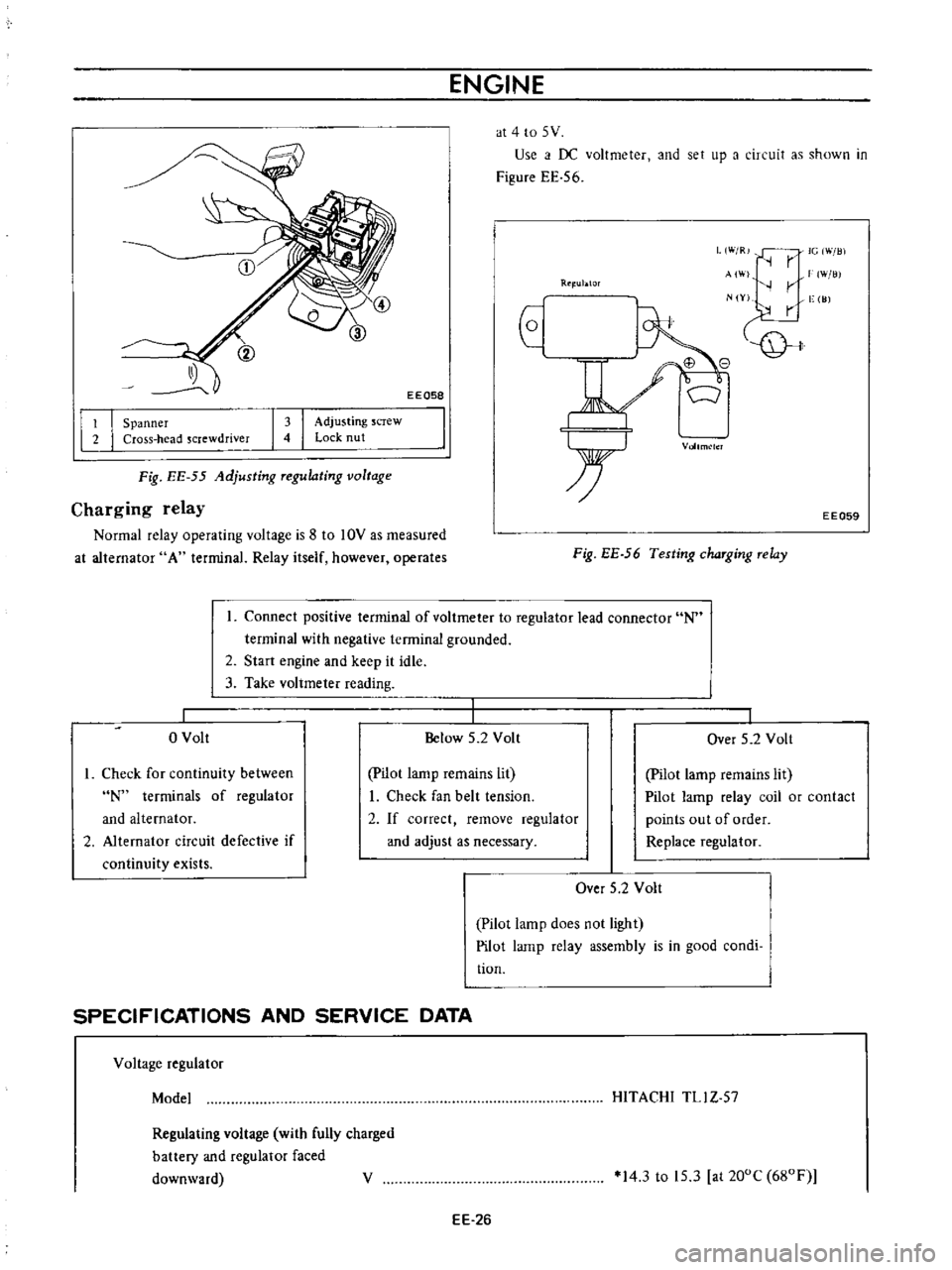
Use
i
f
DC
voltmeter
and
set
up
a
circuit
as
shown
in
Figure
EE
56
EEQ58
L
W
R
IG
Will
r
AI
W
lli
r
N
Y
vge
I
JJ
Rtl
ublOr
I
I
Spanner
Cross
head
screwdriver
I
I
Adjusting
screw
Lock
nut
Vollm
lcl
Fig
EE
55
Adjusting
Tegulating
voltage
Charging
relay
Normal
relay
operating
voltage
is
8
to
10V
as
measured
at
alternator
A
terminal
Relay
itself
however
operates
EE059
Fig
EE
56
Testing
chaTging
Telay
Connect
positive
terminal
of
voltmeter
to
regulator
lead
connector
N
terminal
with
negative
terminal
grounded
2
Start
engine
and
keep
it
idle
3
Take
voltmeter
reading
o
Volt
Below
5
2
Volt
I
Over
5
2
Volt
I
Check
for
continuity
between
N
terminals
of
regulator
and
alternator
2
Alternator
circuit
defective
if
continuity
exists
pilot
lamp
remains
lit
I
Check
fan
belt
tension
2
If
correct
remove
regulator
and
adjust
as
necessary
Pilot
lamp
remains
lit
Pilot
lamp
relay
coil
or
contact
points
out
of
order
Replace
regulator
Over
5
2
Volt
Pilot
lamp
does
not
light
Pilot
lamp
relay
assembly
is
in
good
condi
tion
SPECIFICATIONS
AND
SERVICE
DATA
Voltage
regulator
Model
HITACHI
TLl
Z
57
Regulating
voltage
with
fully
charged
battery
and
regulator
faced
downward
V
14
3
to
15
3
at
200C
680F
EE
26
Page 448 of 513
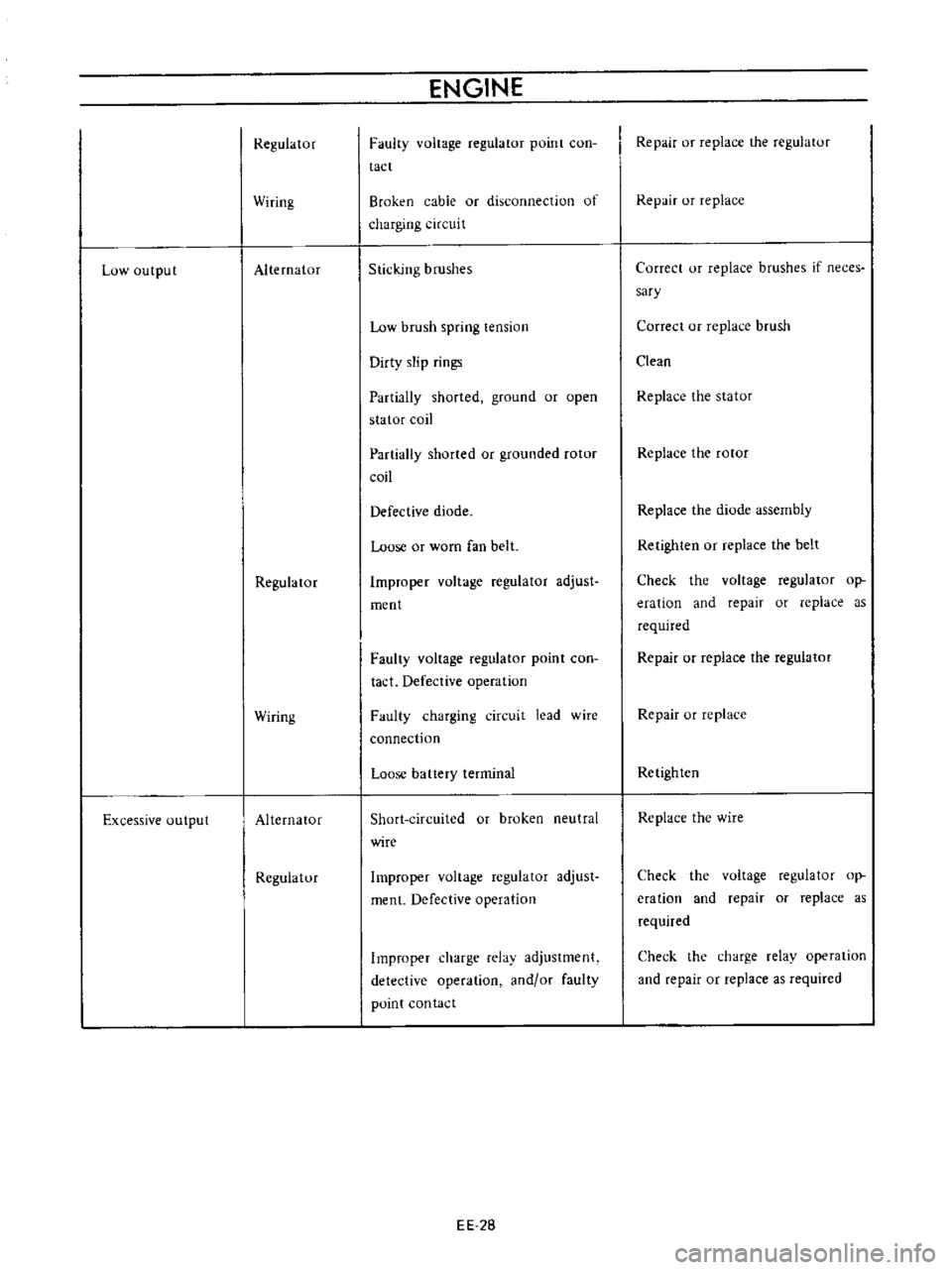
Low
output
Excessive
output
Regulator
Wiring
Alternator
Regula
tor
Wiring
Alternator
Regulatur
ENGINE
Faulty
voltage
regulator
point
con
tact
Broken
cable
or
disconnection
of
charging
cireui
t
Sticking
brushes
Low
brush
spring
tension
Dirty
slip
rings
Partially
shorted
ground
or
open
stator
coil
Partially
shorted
or
grounded
rotor
coil
Defective
diode
Loose
or
worn
fan
belt
Improper
voltage
regulator
adjust
ment
Faulty
voltage
regulator
point
con
tact
Defective
operation
Faulty
charging
circuit
lead
wire
connection
Loose
battery
terminal
Short
circuited
or
broken
neutral
wire
Improper
voltage
regulator
adjust
ment
Defective
operation
Improper
charge
relav
adjustment
detective
operation
and
or
faulty
point
contact
EE
28
Repair
or
replace
the
regulatur
Repair
or
replace
Correct
or
replace
brushes
if
neces
sary
Correct
or
replace
brush
Clean
Replace
the
stator
Replace
the
rotor
Replace
the
diode
assembly
Retighten
or
replace
the
belt
Check
the
voltage
regulator
op
eration
and
repair
or
replace
as
required
Repair
or
replace
the
regulator
Repair
or
replace
Retighten
Replace
the
wire
Check
the
voltage
regulator
op
eration
and
repair
or
replace
as
required
Check
the
charge
relay
operation
and
repair
or
replace
as
required
Page 449 of 513
ENGINE
ElECTRICAL
SYSTEM
IGNITION
CIRCUIT
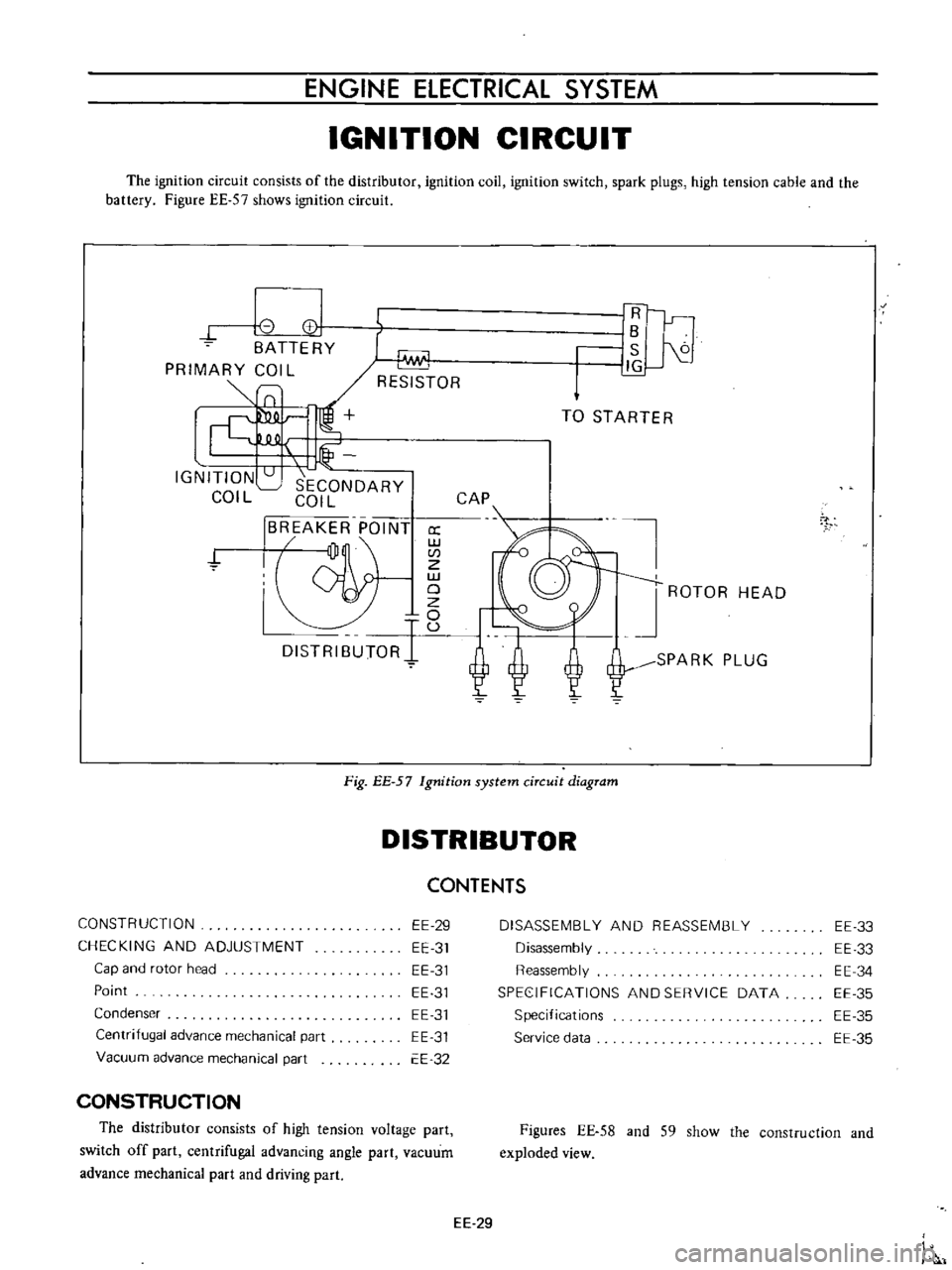
The
ignition
circuit
consists
of
the
distributor
ignition
coil
ignition
switch
spark
plugs
high
tension
cable
and
the
battery
Figure
EE
57
shows
ignition
circuit
8
I
CC
BATTERY
PRIMARY
COIL
SlO
Lf
IGNITION
SECONDARY
COIL
COIL
BREAKER
POINT
jJ
a
w
CI
Z
w
19
DISTRIBUTORI
U
1Fl
r
lB
S
J1G
TO
STARTER
CAP
ROTOR
HEAD
SPARK
PLUG
7
Fig
EE
57
Ignition
system
circuit
diagram
DISTRIBUTOR
CONSTRUCTION
CHECKING
AND
ADJUSTMENT
Cap
and
rotor
head
Point
Condenser
Centrifugal
advance
mechanical
part
Vacuum
advance
mechanical
part
EE
29
EE
31
EE
31
EE
31
EE
31
EE
31
EE
32
CONSTRUCTION
The
distributor
consists
of
high
tension
voltage
part
switch
off
part
centrifugal
advancing
angle
part
vacuum
advance
mechanical
part
and
driving
part
CONTENTS
DISASSEMBLY
AND
REASSEMBLY
Disassembly
Reassembly
SPEC
IFICATIONS
AND
SERVICE
DATA
Specifications
Service
data
EE
33
EE
33
EE
34
EE
35
EE
35
EE
35
Figures
EE
58
and
S9
show
the
construction
and
exploded
view
EE
29
Page 456 of 513
ENGINE
Weight
pivot
diameter
mm
in
Weight
hole
diameter
mm
in
Clearance
between
pivot
and
hole
mmOn
5
0
028
0
9
9
1
0011
1
005
1
6
1
0002
5
1
018
0
1969
0
0007
o
0
0
005
to
0
046
0
0002
to
0
0018
IGNITION
COIL
CONTENTS
DESCRIPTION
EE
36
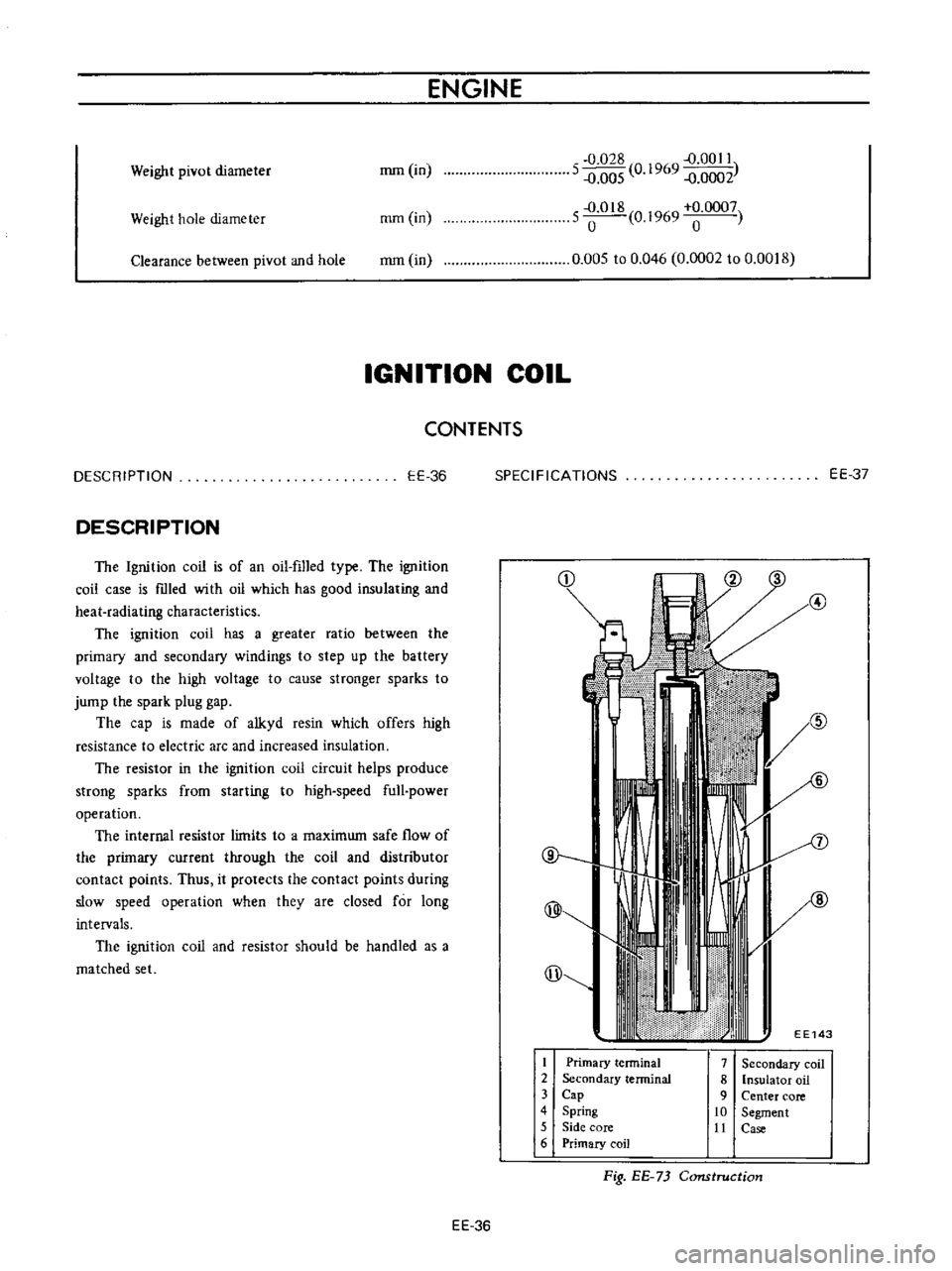
DESCRIPTION
The
Ignition
coil
is
of
an
oil
filled
type
The
ignition
coil
case
is
mted
with
oil
which
has
good
insulating
and
heat
radiating
characteristics
The
ignition
coil
has
a
greater
ratio
between
the
primary
and
secondary
windings
to
step
up
the
battery
voltage
to
the
high
voltage
to
cause
stronger
sparks
to
jump
the
spark
plug
gap
The
cap
is
made
of
alkyd
resin
which
offers
high
resistance
to
electric
arc
and
increased
insulation
The
resistor
in
the
ignition
coil
circuit
helps
produce
strong
sparks
from
starting
to
high
speed
full
power
operation
The
internal
resistor
limits
to
a
maximum
safe
flow
of
the
primary
current
through
the
coil
and
distributor
contact
points
Thus
it
protects
the
contact
points
during
slow
speed
operation
when
they
are
closed
for
long
intervals
The
ignition
coil
and
resistor
should
be
handled
as
a
matched
set
EE
36
SPECIFICATIONS
EE
37
@
@
@l
@
EE143
I
Primary
terminal
2
Secondary
terminal
3
Cap
4
Spring
5
Side
core
6
Primary
coil
7
Secondary
coil
8
insulator
oil
9
Center
core
10
Segment
tt
Case
Fig
EE
73
Construction
Page 467 of 513
CHASSIS
ENGINE
REMOVAL
AND
INSTALLATION
CONTENTS
PR
ECAUTIONS
REMOVAL
ERA
ERA
PRECAUTIONS
Be
sure
to
use
fender
cover
so
that
the
body
is
not
damaged
2
When
lifting
the
engine
or
when
jacking
up
the
engine
pay
attention
for
safety
and
carry
out
operation
correctly
so
that
the
parts
are
not
damaged
REMOVAL
I
Removing
hood
Open
the
hood
remove
four
installation
bolts
and
remove
the
hood
2
Disconnect
the
battery
cable
from
the
terminal
3
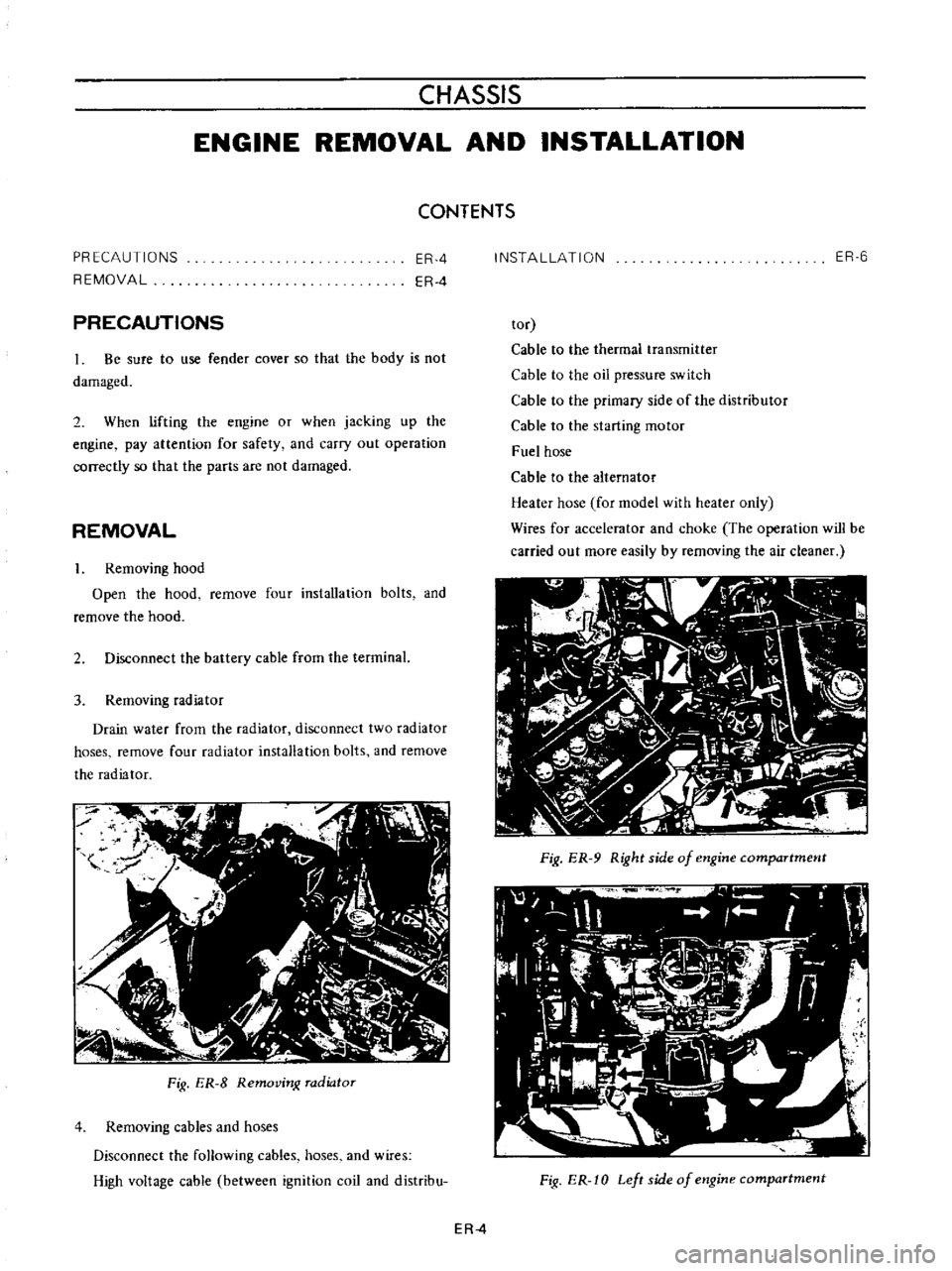
Removing
radiator
Drain
water
from
the
radiator
disconnect
two
radiator
hoses
remove
four
radiator
installation
bolts
and
remove
the
radiator
Fig
ER
8
Removin
radiator
4
Removing
cables
and
hoses
Disconnect
the
following
cables
hoses
and
wires
High
voltage
cable
between
ignition
coil
and
distribu
INSTAllATION
ER
6
tor
Cable
to
the
thermal
transmitter
Cable
to
the
oil
pressure
switch
Cable
to
the
primary
side
of
the
distributor
Cable
to
the
starting
motor
Fuel
hose
Cable
to
the
alternator
Heater
hose
for
model
with
heater
only
Wires
for
accelerator
and
choke
The
operation
will
be
carried
out
more
easily
by
removing
the
air
cleaner
Fig
ER
9
Right
side
of
engine
compartment
Fig
ER
10
Left
side
of
engine
compartment
ERA