ESP DATSUN B110 1973 Service Owner's Guide
[x] Cancel search | Manufacturer: DATSUN, Model Year: 1973, Model line: B110, Model: DATSUN B110 1973Pages: 513, PDF Size: 28.74 MB
Page 404 of 513
FUEl
SYSTEM
l
I
@
1J
w
I
I
I
I
1
1
1
t
2
3
4
5
6
7
8
9
10
tt
12
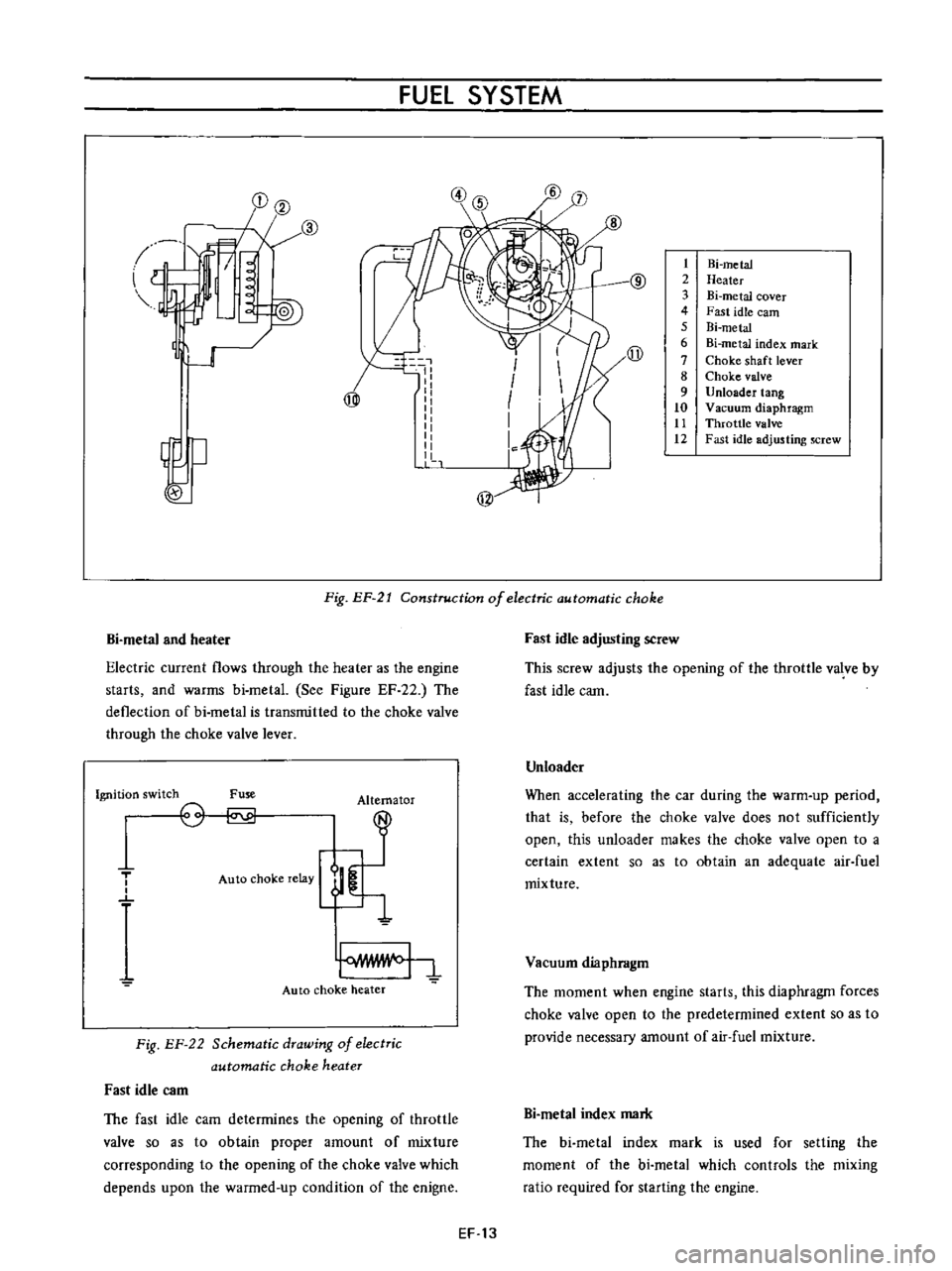
Hi
metal
Heater
Bi
metal
cover
Fast
idle
earn
Bi
metal
Bi
metal
index
mark
Choke
shaft
lever
Choke
valve
Unloader
tang
Vacuum
diaphragm
Throttle
valve
Fast
idle
adjusting
screw
j
@
Fig
EP
21
Construction
of
electric
automatic
choke
Bi
metal
and
heater
Electric
current
flows
through
the
heater
as
the
engine
starts
and
warms
bi
metal
See
Figure
EF
22
The
deflection
of
bi
metal
is
transmitted
to
the
choke
valve
through
the
choke
valve
lever
Ignition
switch
Fuse
Alternator
T
o
o
Auto
choke
relay
Auto
choke
heater
Fig
EF
22
Schematic
drawing
of
electric
automatic
choke
heater
Fast
idle
C3m
The
fast
idle
cam
determines
the
opening
of
throttle
valve
so
as
to
obtain
proper
amount
of
mixture
corresponding
to
the
opening
of
the
choke
valve
which
depends
upon
the
warmed
up
condition
of
the
enigne
Fast
idle
adjusting
screw
This
screw
adjusts
the
opening
of
the
throttle
valve
by
fast
idle
cam
Unloader
When
accelerating
the
car
during
the
warm
up
period
that
is
before
the
choke
valve
does
not
sufficiently
open
this
unloader
makes
the
choke
valve
open
to
a
certain
extent
so
as
to
obtain
an
adequate
air
fuel
mixture
Vacuum
diaphragm
The
moment
when
engine
starts
this
diaphragm
forces
choke
valve
open
to
the
predetermined
extent
so
as
to
provide
necessary
amount
of
air
fuel
mixture
Bi
metaI
index
mark
The
bi
metal
index
mark
is
used
for
setting
the
moment
of
the
bi
metal
which
controls
the
mixing
ratio
required
for
starting
the
engine
EF
13
Page 411 of 513
ENGINE
Y
Q
0
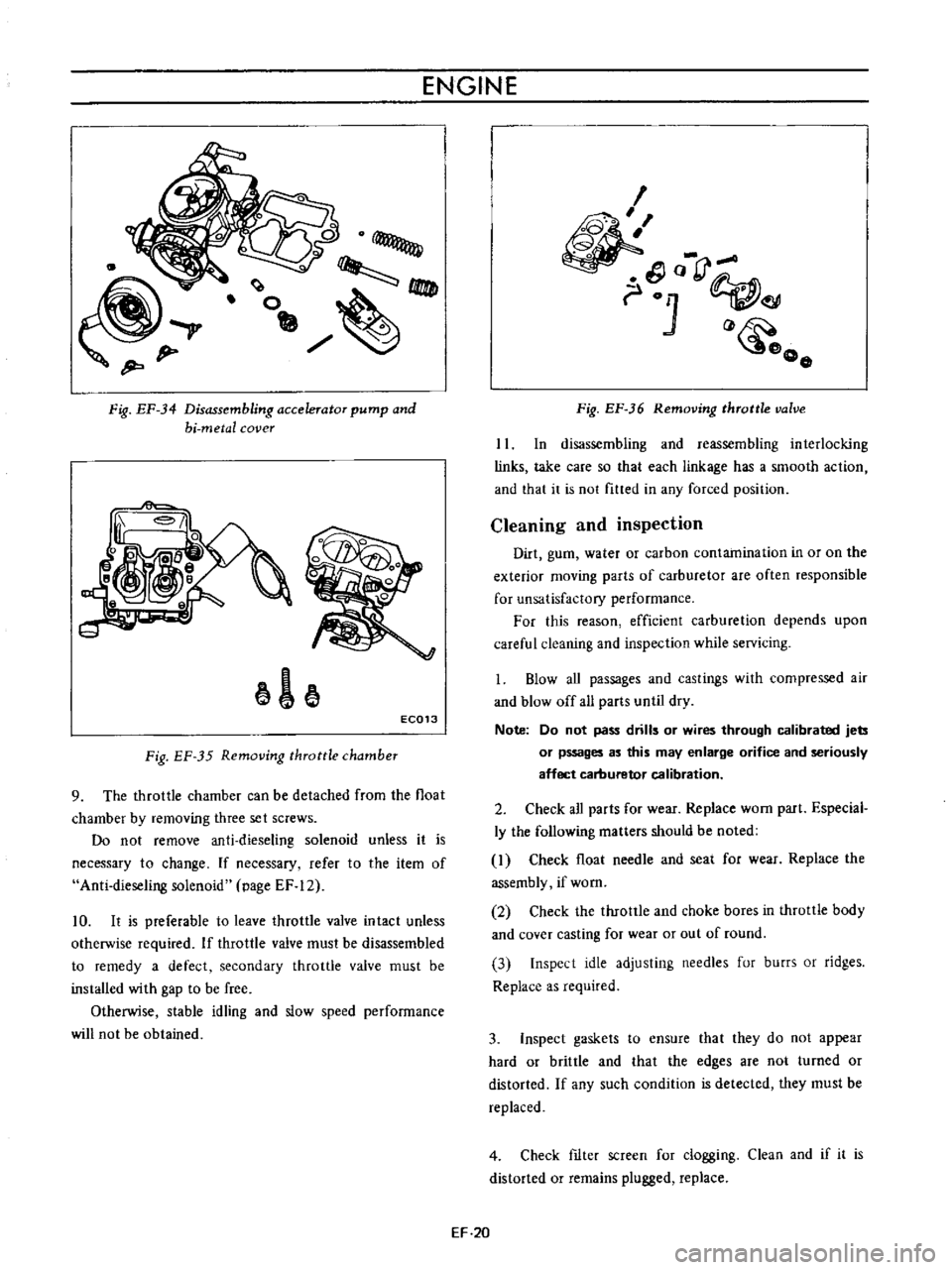
Fig
EF
34
Disassembling
accelerator
pump
and
hi
metal
cover
1
EC013
Fig
EF
35
Removing
throttle
chamber
9
The
throttle
chamber
can
be
detached
from
the
float
chamber
by
removing
three
set
screws
Do
not
remove
anti
dieseling
solenoid
unless
it
is
necessary
to
change
If
necessary
refer
to
the
item
of
Anti
dieseling
solenoid
page
EF
12
10
It
is
preferable
to
leave
throttle
valve
intact
unless
otherwise
required
If
throttle
valve
must
be
disassembled
to
remedy
a
defect
secondary
throttle
valve
must
be
installed
with
gap
to
be
free
Otherwise
stable
idling
and
slow
speed
performance
will
not
be
obtained
I
o
rJ
01
o
o
Fig
EF
36
Removing
throttle
valve
II
In
disassembling
and
reassembling
interlocking
links
take
care
so
that
each
linkage
has
a
smooth
action
and
that
it
is
not
fitted
in
any
forced
position
Cleaning
and
inspection
Dirt
gum
water
or
carbon
contamination
in
or
on
the
exterior
moving
parts
of
carburetor
are
often
responsible
for
unsatisfactory
performance
For
this
reason
efficient
carburetion
depends
upon
careful
cleaning
and
inspection
while
servicing
1
Blow
aU
passages
and
castings
with
compressed
air
and
blow
off
all
parts
until
dry
Note
Do
not
pass
drills
or
wires
through
calibrated
jets
or
pssages
as
this
may
enlarge
orifice
and
seriously
affect
carburetor
calibration
2
Check
all
parts
for
wear
Replace
worn
part
Especial
ly
the
following
matters
should
be
noted
I
Check
float
needle
and
seat
for
wear
Replace
the
assembly
if
worn
2
Check
the
throttle
and
choke
bores
in
throttle
body
and
cover
casting
for
wear
or
out
of
round
3
Inspect
idle
adjusting
needles
fur
burrs
or
ridges
Replace
as
required
3
Inspect
gaskets
to
ensure
that
they
do
not
appear
hard
or
brittle
and
that
the
edges
are
not
turned
or
distorted
If
any
such
condition
is
detected
they
must
be
replaced
4
Check
fIlter
screen
for
clogging
Clean
and
if
it
is
distorted
or
remains
plugged
replace
EF
20
Page 464 of 513
ENGINE
REMOVAL
INSTAllATION
ENGINE
MOUNTING
CONTENTS
FRONT
ENGINE
MOUNTING
Removal
Reinstallation
ER
1
ER
1
ER
2
REAR
ENGINE
MOUNTING
Removal
Reinstallation
ER
2
ER
2
ER
3
r
0
iQ
@
q
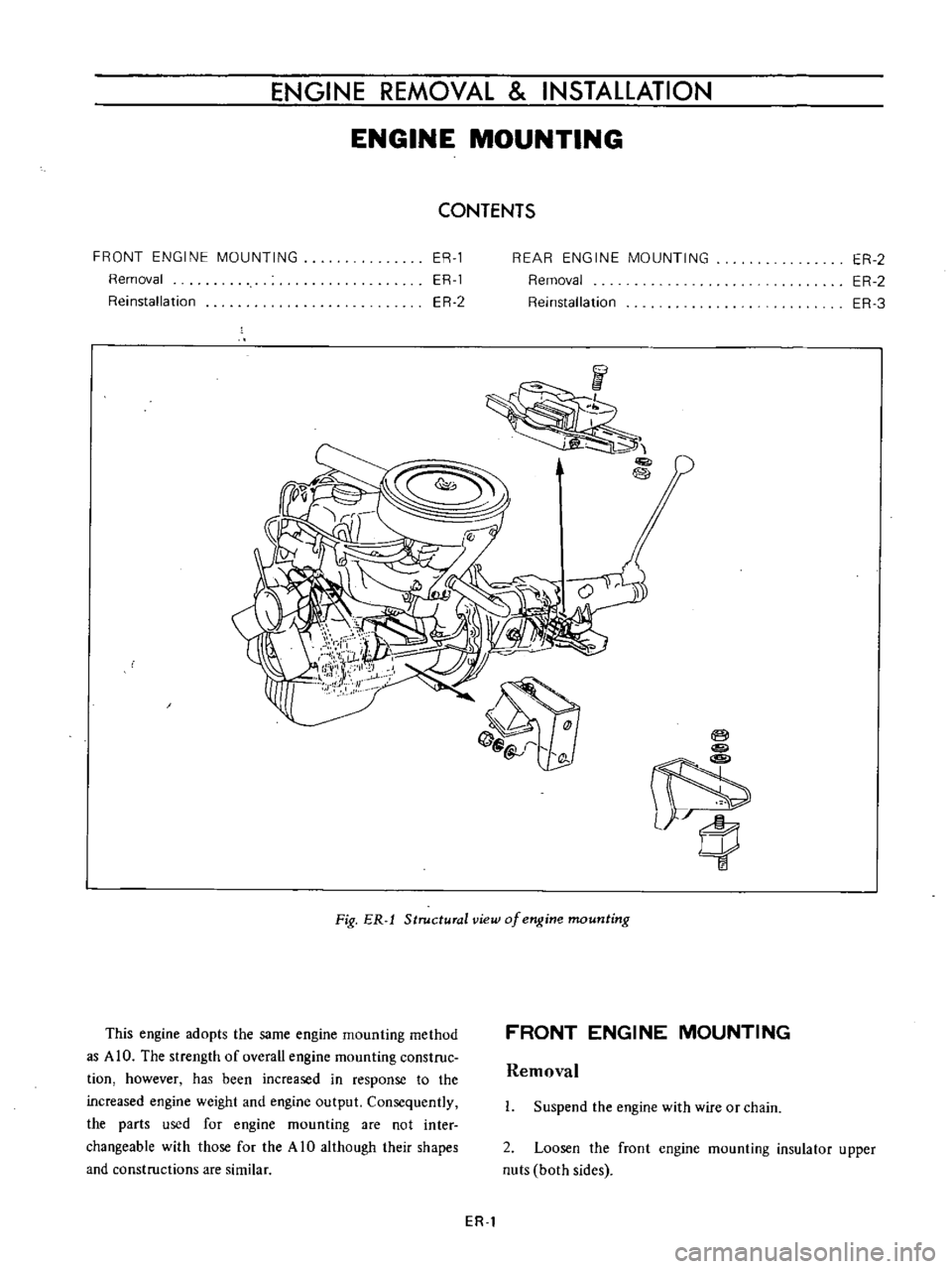
Fig
ER
1
Structural
view
of
engine
mounting
This
engine
adopts
the
same
engine
mounting
method
as
AIO
The
strength
of
overall
engine
mounting
construc
tion
however
has
been
increased
in
response
to
the
increased
engine
weight
and
engine
output
Consequently
the
parts
used
for
engine
mounting
arc
not
inter
changeable
with
those
for
the
A
10
although
their
shapes
and
constructions
are
similar
FRONT
ENGINE
MOUNTING
Removal
I
Suspend
the
engine
with
wire
or
chain
2
Loosen
the
front
engine
mounting
insulator
upper
nuts
both
sides
ER
1
Page 475 of 513
CLUTCH
J
I
I
Withdrawal
lever
2
Return
spring
I
31
Release
bearing
ST20610000
iwn
rm
hj
sf
W
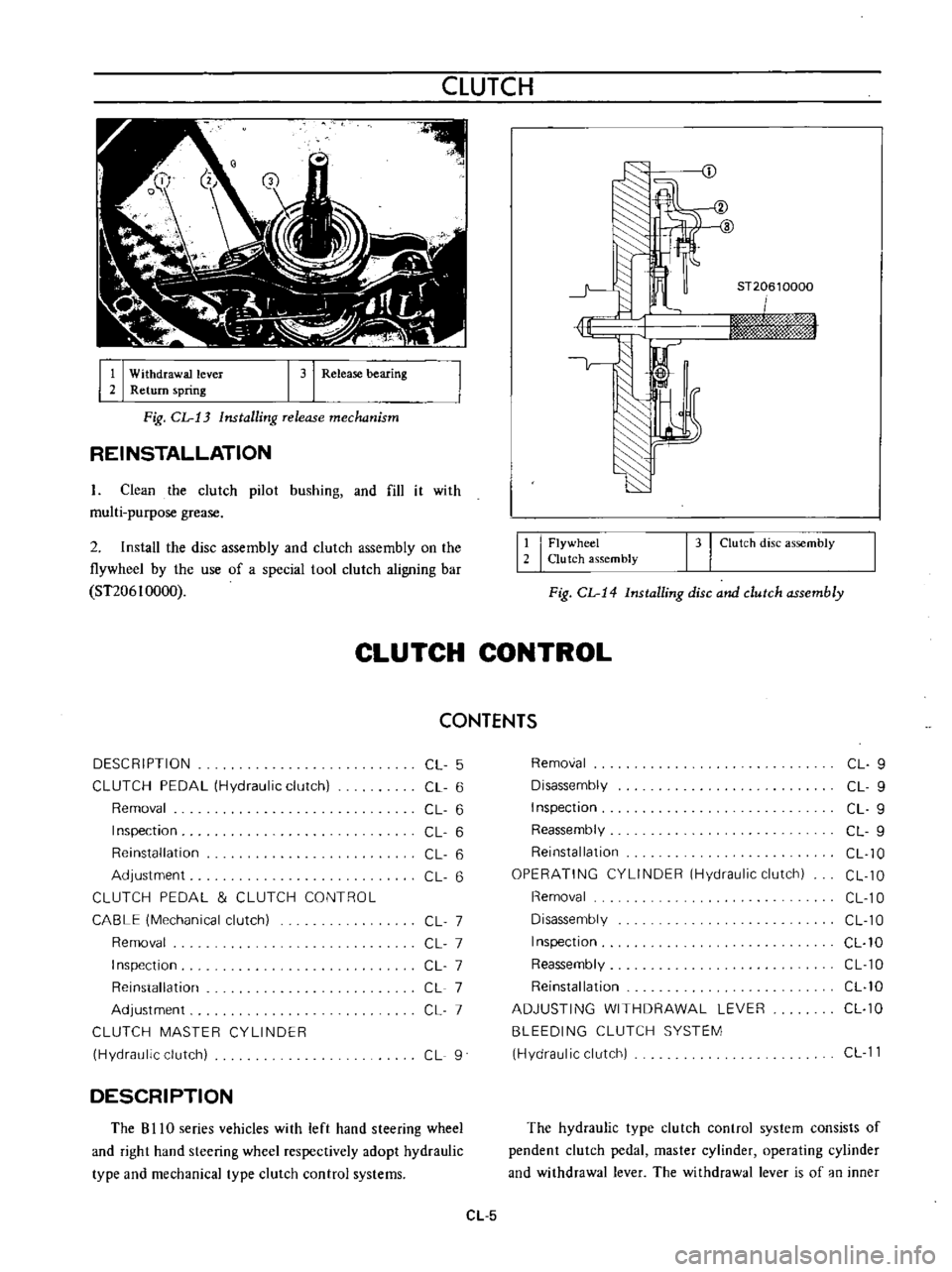
Fig
CL
13
Installing
release
mechanism
REINSTALLATION
L
Clean
the
clutch
pilot
bushing
and
fill
it
with
multi
purpose
grease
2
Install
the
disc
assembly
and
clutch
assembly
on
the
flywheel
by
the
use
of
a
special
tool
clutch
aligning
bar
ST206
I
0000
12
I
Flywheel
Clutch
assembly
131
Clutch
disc
assembly
Fig
CL
14
Installing
disc
and
clutch
assembly
CLUTCH
CONTROL
CONTENTS
DESCRIPTION
CL
5
Removal
CL
9
CLUTCH
PEDAL
Hydraulic
clutch
CL
6
Disassembly
CL
9
Removal
CL
6
Inspection
CL
9
Inspection
CL
6
Reassembly
CL
9
Reinstallation
CL
6
Reinstallation
CL
10
Adjustment
CL
6
OPERATING
CYLINDER
Hydraulic
clutch
CL
10
CLUTCH
PEDAL
CLUTCH
CONTROL
Removal
CL
10
CABLE
Mechanical
clutch
CL
7
Disassembly
CL
10
Removal
CL
7
Inspection
CL
10
Inspection
CL
7
Reassembly
CL
10
Reinstallation
CL
7
Reinstallation
CL
10
Adjustment
CL
7
ADJUSTING
WITHDRAWAL
LEVER
CL
10
CLUTCH
MASTER
CYLINDER
BLEEDING
CLUTCH
SYSTEM
Hydraulic
clutch
CL
9
Hydraulic
clutch
CL
11
DESCRIPTION
The
B
I
IO
series
vehicles
with
left
hand
steering
wheel
and
right
hand
steering
wheel
respectively
adopt
hydraulic
type
and
mechanical
type
clutch
control
systems
The
hydraulic
type
clutch
control
system
consists
of
pendent
clutch
pedal
master
cylinder
operating
cylinder
and
withdrawal
lever
The
withdrawal
lever
is
of
an
inner
CL
5
Page 480 of 513
CHASSIS
2
Apply
brake
fluid
sufficiently
to
the
cylinder
and
piston
and
assemble
them
Reinstallation
Reinstall
the
master
cylinder
assembly
in
reverse
sequence
of
removal
and
adjust
as
follows
I
Adjust
the
pedal
height
by
changing
the
push
rod
length
2
B
eed
air
out
of
the
hydraulic
system
OPERATING
CYLINDER
Hydraulic
clutch
Removal
Remove
the
return
spring
2
Disconnect
the
clutch
line
from
the
operating
cyl
inder
3
Disconnect
the
push
rod
from
the
withdrawal
lever
4
Release
two
bolts
used
to
mount
the
operating
cylinder
to
the
clutch
housing
Disassembly
1
Remove
the
dust
cover
2
Remove
the
snap
ring
and
all
other
parts
can
be
disassembled
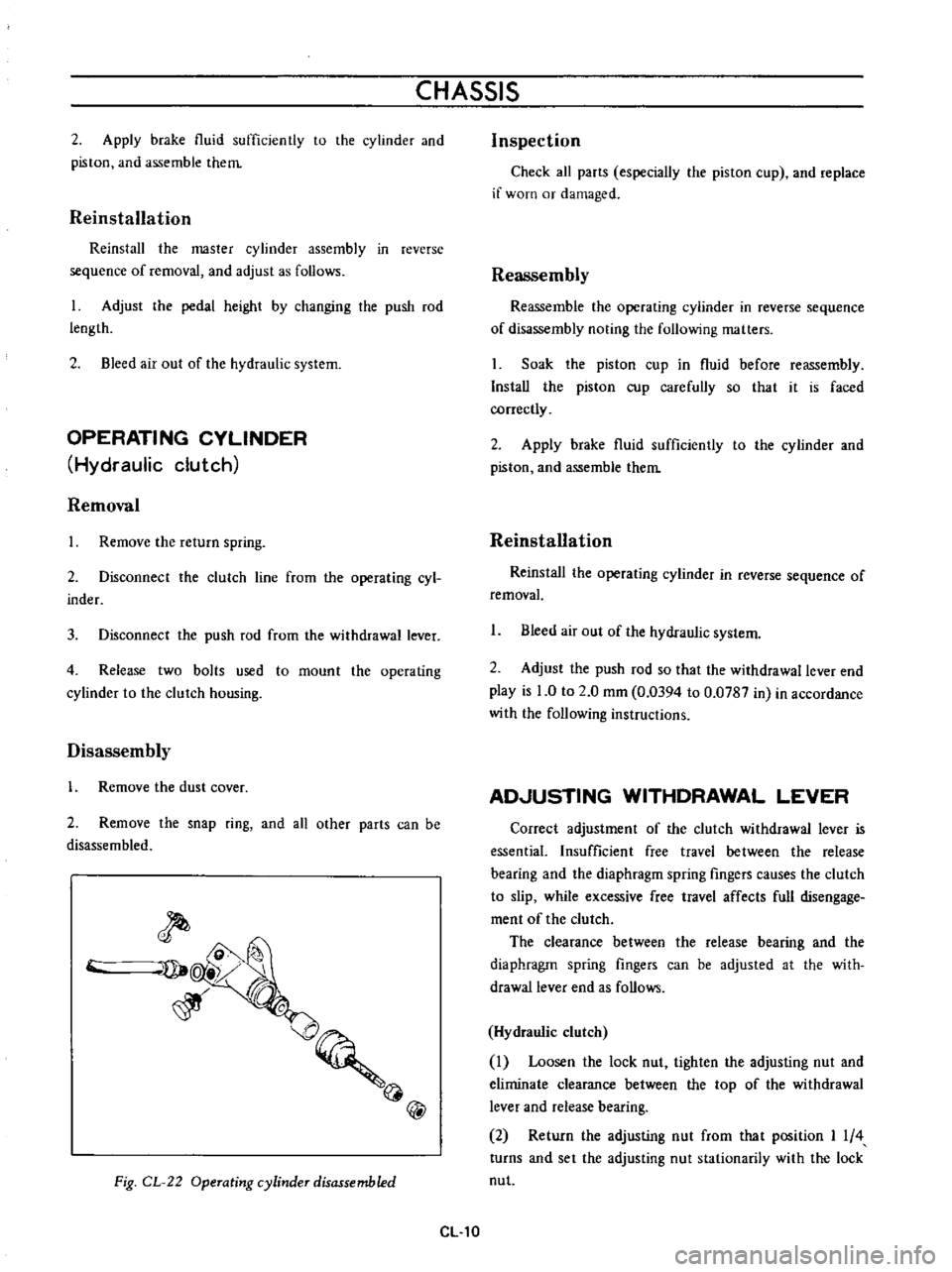
@
Fig
CL
22
Operating
cylinder
disassembled
CL
10
Inspection
Check
all
parts
especially
the
piston
cup
and
replace
if
worn
or
damaged
Reassembly
Reassemble
the
operating
cylinder
in
reverse
sequence
of
disassembly
noting
the
following
matters
Soak
the
piston
cup
in
fluid
before
reassembly
Install
the
piston
cup
carefully
so
that
it
is
faced
correctly
2
Apply
brake
fluid
sufficiently
to
the
cylinder
and
piston
and
assemble
them
Reinstallation
Reinstal
the
operating
cylinder
in
reverse
sequence
of
removal
1
Bleed
air
out
of
the
hydraulic
system
2
Adjust
the
push
rod
so
that
the
withdrawal
lever
end
play
is
0
to
2
0
mm
0
0394
to
0
0787
in
in
accordance
with
the
following
instructions
AD
USTING
WITHDRAWAL
LEVER
Correct
adjustment
of
the
clutch
withdrawal
lever
is
essential
Insufficient
free
travel
between
the
release
bearing
and
the
diaphragm
spring
fingers
causes
the
clutch
to
slip
while
excessive
free
travel
affects
full
disengage
ment
of
the
clutch
The
clearance
between
the
release
bearing
and
the
diaphragm
spring
fingers
can
be
adjusted
at
the
with
drawallever
end
as
follows
Hydraulic
clutch
Loosen
the
lock
nut
tighten
the
adjusting
nut
and
eliminate
clearance
between
the
top
of
the
withdrawal
lever
and
release
bearing
2
Return
the
adjusting
nut
from
that
position
I
4
turns
and
set
the
adjusting
nut
stationarily
with
the
lock
nut
Page 483 of 513
CLUTCH
Operating
cylinder
clutch
Operating
cylinder
diameter
T
Ilhtening
torque
19
05
mm
0
750
in
Clutch
assembly
securing
bolt
1
5
to
2
2
kg
m
10
8
to
15
9
ft
Ib
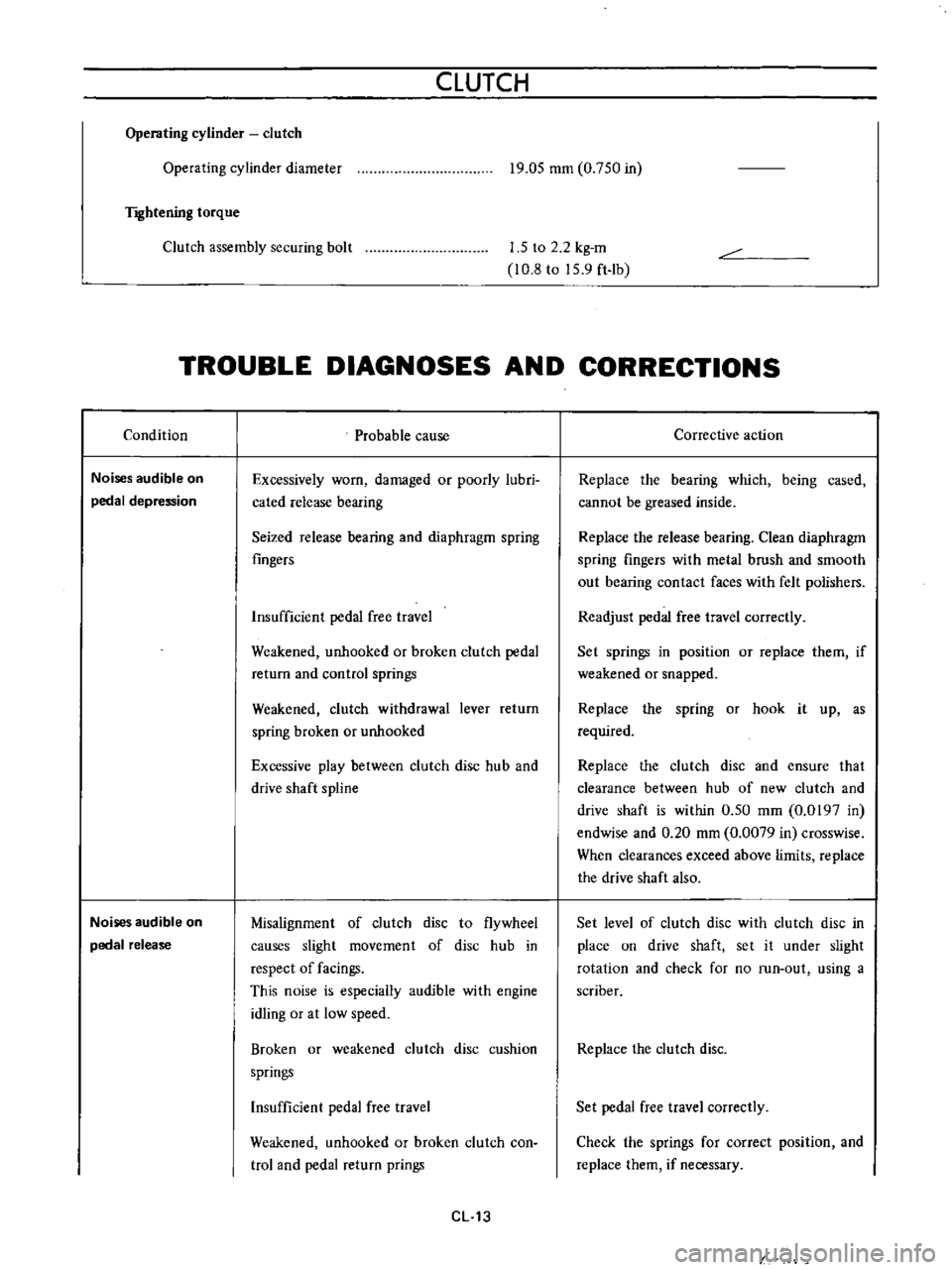
TROUBLE
DIAGNOSES
AND
CORRECTIONS
Condition
Noises
audible
on
pedal
depression
Noises
audible
on
pedal
release
Probable
cause
Excessively
worn
damaged
or
poorly
lubri
cated
release
bearing
Seized
release
bearing
and
diaphragm
spring
fingers
Insufficient
pedal
free
travel
Weakened
unhooked
or
broken
clutch
pedal
return
and
control
springs
Weakened
clutch
withdrawal
lever
return
spring
broken
or
unhooked
Excessive
play
between
clutch
disc
hub
and
drive
shaft
spline
Misalignment
of
clutch
disc
to
flywheel
causes
slight
movement
of
disc
hub
in
respect
of
facings
This
noise
is
especially
audible
with
engine
idling
or
at
low
speed
Broken
or
weakened
clutch
disc
cushion
springs
Insufficient
pedal
free
travel
Weakened
unhooked
or
broken
clutch
con
trol
and
pedal
return
prings
CL
13
Corrective
action
Replace
the
bearing
which
being
cased
cannot
be
greased
inside
Replace
the
release
bearing
Clean
diaphragm
spring
fingers
with
metal
brush
and
smooth
out
bearing
contact
faces
with
felt
polishers
Readjust
pedal
free
travel
correctly
Set
springs
in
position
or
replace
them
if
weakened
or
snapped
Replace
the
spring
or
hook
it
up
as
required
Replace
the
clutch
disc
and
ensure
that
clearance
between
hub
of
new
clutch
and
drive
shaft
is
within
0
50
mm
0
0197
in
endwise
and
0
20
mm
0
0079
in
crosswise
When
clearances
exceed
above
limits
replace
the
drive
shaft
also
Set
level
of
clutch
disc
with
clutch
disc
in
place
on
drive
shaft
set
it
under
slight
rotation
and
check
for
no
run
out
using
a
scriber
Replace
the
clutch
disc
Set
pedal
free
travel
correctly
Check
the
springs
for
correct
position
and
replace
them
if
necessary
Page 505 of 513
CHASSIS
5
Remove
the
speed
change
retainer
bolt
I
6
Remove
the
speed
change
retainer
2
7
Remove
the
2nd
top
change
lever
and
bush
13
from
the
control
rod
4
8
Lower
the
control
rod
so
that
the
control
lever
pin
comes
out
from
the
lower
bracket
5
and
withdraw
the
control
lever
pin
Note
low
the
control
rod
to
such
an
extent
that
the
con
b
ol
lever
pin
does
not
interfere
the
lower
bracket
9
Withdraw
the
control
rod
from
the
passenger
com
partment
10
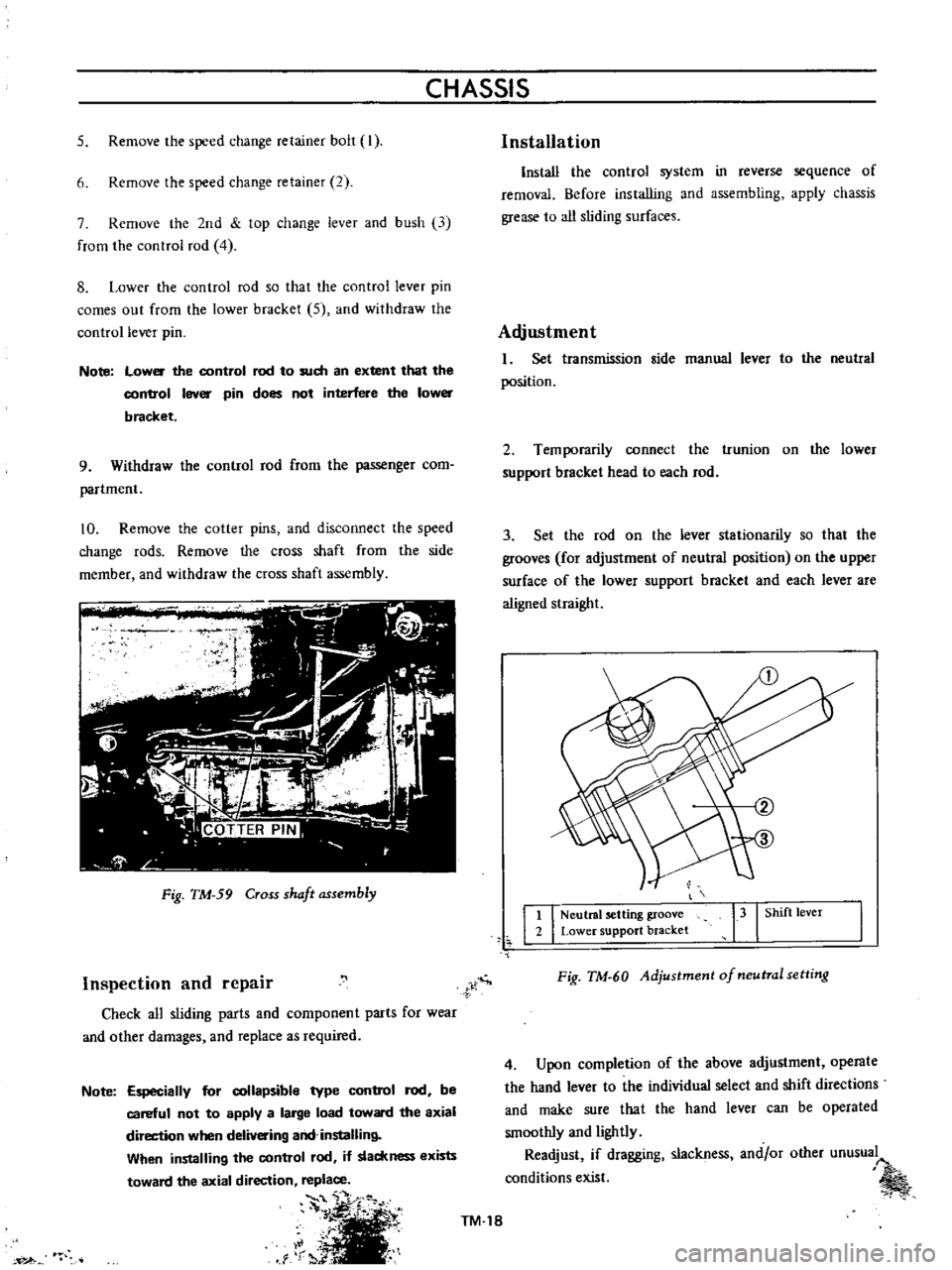
Remove
the
cotter
pins
and
disconnect
the
speed
change
rods
Remove
the
cross
shaft
from
the
side
member
and
withdraw
the
cross
shaft
assembly
Fig
TM
59
Cross
shaft
assembly
Inspection
and
repair
Check
all
sliding
parts
and
component
parts
for
wear
and
other
damages
and
replace
as
required
Note
Especially
for
collapsible
type
control
rod
be
careful
not
to
apply
a
large
load
toward
the
axial
direction
when
delivering
and
installing
When
installing
the
control
rod
if
slackness
exists
toward
the
axial
direction
replace
S
i
TM
18
C
1
rr
i
Al
Installation
Install
the
control
system
in
reverse
sequence
of
removal
Before
installing
and
assembling
apply
chassis
grease
to
all
sliding
surfaces
Adjustment
I
Set
transmission
side
manual
lever
to
the
neutral
position
2
Temporarily
connect
the
trunion
on
the
lower
support
bracket
head
to
each
rod
3
Set
the
rod
on
the
lever
stationarily
so
that
the
grooves
for
adjustment
of
neutral
position
on
the
upper
surface
of
the
lower
support
bracket
and
each
lever
are
aligned
straight
t
I
Neutral
setting
groove
2
Lower
support
bracket
13
I
Shift
lever
Fig
TM
60
Adjustment
of
neutral
setting
4
Upon
completion
of
the
above
adjustment
operate
the
hand
lever
to
the
individual
select
and
shift
directions
and
make
sure
that
the
hand
lever
can
be
operated
smoothly
and
lightly
Readjust
if
dragging
slackness
and
or
other
unusual
conditions
exist