oil change DODGE AVENGER 2008 User Guide
[x] Cancel search | Manufacturer: DODGE, Model Year: 2008, Model line: AVENGER, Model: DODGE AVENGER 2008Pages: 467, PDF Size: 7.16 MB
Page 380 of 467
Materials Added to Engine Oils
The manufacture strongly recommends against the addi-
tion of any additives (other than leak detection dyes) to
the engine oil. Engine oil is an engineered product and
it's performance may be impaired by supplemental ad-
ditives.
Disposing of Used Engine Oil and Oil Filters
Care should be taken in disposing of used engine oil and
oil filters from your vehicle. Used oil and oil filters,
indiscriminately discarded, can present a problem to the
environment. Contact your authorized dealer, service
station, or governmental agency for advice on how and
where used oil and oil filters can be safely discarded in
your area. ENGINE OIL FILTER
The engine oil filter should be replaced at every engine
oil change.
Engine Oil Filter Selection
All of this manufacturer's engines have a full-flow type
disposable oil filter. Use a filter of this type for replace-
ment. The quality of replacement filters varies consider-
ably. Only high quality filters should be used to assure
most efficient service. Mopar t Engine Oil Filters are high
quality oil filters and are recommended.
DRIVE BELT
At the mileage indicated in section 8: ªMaintenance
Scheduleº, replace the drive belt with a new drive belt.
NOTE: The belt must be routed correctly to ensure
proper drive function.378 MAINTAINING YOUR VEHICLE
Page 389 of 467
Keep the blade rubber out of contact with petroleum
products such as engine oil, gasoline, etc.
NOTE: Always refer to the wiper blade packaging for
specific installation instructions. Many wiper blade re-
placements fit multiple vehicles.
WINDSHIELD WASHERS
NOTE: Refer to the appropriate ªEngine Compartmentº
diagram in Section 7 for the location of the windshield
washer fluid reservoir.
The fluid reservoir for the windshield washers is located
in the engine compartment. Be sure to check the fluid
level in the reservoir at regular intervals. Fill the reservoir
with windshield washer solvent (not radiator antifreeze)
and operate the system for a few seconds to flush out the
residual water. WARNING!Commercially available windshield washer solvents
are flammable. They could ignite and burn you. Care
must be exercised when filling or working around
the washer solution.
EXHAUST SYSTEM
The best protection against carbon monoxide entry into
the vehicle body is a properly maintained engine exhaust
system.
If you notice a change in the sound of the exhaust system
or if exhaust fumes can be detected inside the vehicle or
when the underside or rear of the vehicle is damaged,
have a competent technician inspect the complete ex-
haust system and adjacent body areas for broken, dam-
aged, deteriorated, or mispositioned parts. Open seams
or loose connections could permit exhaust fumes to seep MAINTAINING YOUR VEHICLE 387
7
Page 390 of 467
into the passenger compartment. In addition, inspect the
exhaust system each time the vehicle is raised for an oil
change or lubrication. Replace as required.
WARNING!Exhaust gases can injure or kill. They contain carbon
monoxide (CO) which is colorless and odorless.
Breathing it can make you unconscious and can
eventually poison you. To avoid breathing CO, refer
to Exhaust Gas in the Safety Tips section of this
manual. COOLING SYSTEM
WARNING!² When working near the radiator cooling fan, dis-
connect the fan motor lead or turn the ignition
switch to the LOCK position. The fan is tempera-
ture controlled and can start at anytime the igni-
tion switch is in the ON position.
² You or others can be badly burned by hot coolant
or steam from your radiator. If you see or hear
steam coming from under the hood, don't open the
hood until the radiator has had time to cool. Never
try to open a cooling system pressure cap when the
radiator is hot.388 MAINTAINING YOUR VEHICLE
Page 397 of 467
WARNING!Riding the brakes can lead to brake failure and
possibly an accident. Driving with your foot resting
or riding on the brake pedal can result in abnormally
high brake temperatures, excessive lining wear, and
possible brake damage. You wouldn't have your full
braking capacity in an emergency.
Brake And Power Steering Hoses
When servicing the vehicle for scheduled maintenance,
inspect the surface of the hoses and nylon tubing for
evidence of heat and mechanical damage. Hard and
brittle rubber, cracking, tears, cuts, abrasions, and exces-
sive swelling suggest deterioration of the rubber. Particu-
lar attention should be made to examining those hose
surfaces nearest to high heat sources, such as the exhaust
manifold. Ensure nylon tubing in these areas has not melted or
collapsed.
Inspect all hose clamps and couplings to make sure they
are secure and no leaks are present.
NOTE:
² Often, fluids such as oil, power steering fluid, and
brake fluid are used during assembly plant operations
to ease the assembly of hoses to couplings. Therefore,
oil wetness at the hose-coupling area is not necessarily
an indication of leakage. Actual dripping of hot fluid
when systems are under pressure (during vehicle
operation) should be noted before a hose is replaced
based on leakage.
² Inspect the brake hoses whenever the brake system is
serviced and at every engine oil change. Inspect hy-
draulic brake hoses for surface cracking, scuffing, or
worn spots. If there is any evidence of cracking,
scuffing, or worn spots, the hose should be replaced MAINTAINING YOUR VEHICLE 395
7
Page 428 of 467
EMISSIONS CONTROL SYSTEM MAINTENANCE
The Scheduled Maintenance services listed in bold type,
must be done at the times or mileages specified to ensure
the continued proper functioning of the Emissions Con-
trol System. These, and all other maintenance services
included in this manual, should be done to provide best
vehicle performance and reliability. More frequent main-
tenance may be needed for vehicles in severe operating
conditions, such as dusty areas and very short trip
driving.
Inspection and service should also be done anytime a
malfunction is suspected.
NOTE: Maintenance, replacement, or repair of the emis-
sions control devices and systems on your vehicle may be
performed by any automotive repair establishment or
individual using any automotive part that has been
certified pursuant to U.S. EPA or in the State of Califor-
nia, California Air Resources Board regulations. MAINTENANCE SCHEDULE
The oil change indicator system will remind you that it is
time to take your vehicle in for scheduled maintenance.
On Electronic Vehicle Information Center (EVIC)
equipped vehicles, ªOil Change Requiredº will be dis-
played in the EVIC and a single chime will sound,
indicating that an oil change is necessary.
On Non-EVIC equipped vehicles, ªChange Oilº will flash
in the instrument cluster odometer and a single chime
will sound, indicating that an oil change is necessary.
Based on engine operation conditions, the oil change
indicator message will illuminate which means service is
required for your vehicle. Have your vehicle serviced as
soon as possible, within the next 500 mi (805 km).
NOTE:
² The oil change indicator message will not monitor the
time since the last oil change. Change your vehicle's426 MAINTENANCE SCHEDULES
8 M
A
I
N
T
E
N
A
N
C
E
S
C
H
E
D
U
L
E
S
Page 429 of 467
oil if it has been six months since your last oil change
even if the oil change indicator message is NOT
illuminated.
² Change your engine oil more often if you drive your
vehicle off-road for an extended period of time.
² Under no circumstances should oil change intervals
exceed 6,000 mi (10 000 km) or six months, whichever
comes first.
Your authorized dealer will reset the oil change indicator
message after completing the scheduled oil change. If a
scheduled oil change is performed by someone other
than your authorized dealer, the message can be reset by
referring to the steps described under ªOil Change
Requiredº under ªElectronic Vehicle Information Center
(EVIC)º in Section 4 or under ªOdometer/Trip Odom-
eterº under ªInstrument Cluster Descriptionsº in Section
4. At Each Stop for Fuel
² Check the engine oil level about five minutes after a
fully warmed engine is shut off. Checking the oil level
while the vehicle is on level ground will improve the
accuracy of the oil level reading. Add oil only when
the level is at or below the SAFE or MIN mark.
² Check the windshield washer solvent and add if
required.
Once a Month
² Check tire pressure and look for unusual wear or
damage.
² Inspect the battery and clean and tighten the terminals
as required.
² Check the fluid levels of coolant reservoir, brake
master cylinder, power steering, and automatic trans-
axle, and add fluid as needed. MAINTENANCE SCHEDULES 427
8 M
A
I
N
T
E
N
A
N
C
E
S
C
H
E
D
U
L
E
S
Page 430 of 467
NOTE: Six-speed AutoStick t Transaxle, if equipped, is
sealed therefore, checking the fluid level can only be
done by a certified dealership service center.
² Check all lights and other electrical items for correct
operation. At Each Oil Change
² Change the engine oil filter.
² Inspect the brake hoses and lines.
CAUTION!Failure to perform the required maintenance items
may result in damage to the vehicle.428 MAINTENANCE SCHEDULES
8 M
A
I
N
T
E
N
A
N
C
E
S
C
H
E
D
U
L
E
S
Page 431 of 467
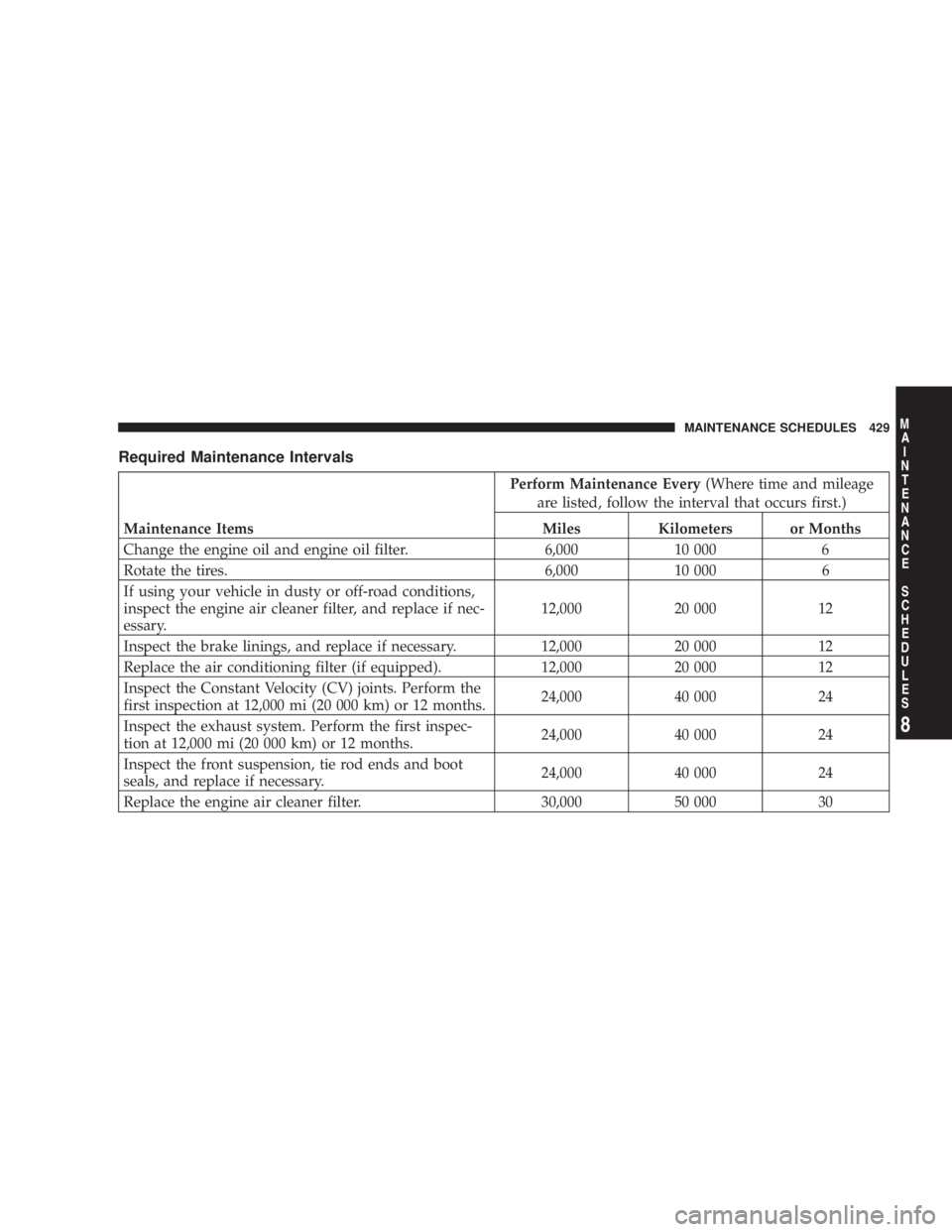
Required Maintenance Intervals
Perform Maintenance Every (Where time and mileage
are listed, follow the interval that occurs first.)
Maintenance Items Miles Kilometers or Months
Change the engine oil and engine oil filter. 6,000 10 000 6
Rotate the tires. 6,000 10 000 6
If using your vehicle in dusty or off-road conditions,
inspect the engine air cleaner filter, and replace if nec-
essary. 12,000 20 000 12
Inspect the brake linings, and replace if necessary. 12,000 20 000 12
Replace the air conditioning filter (if equipped). 12,000 20 000 12
Inspect the Constant Velocity (CV) joints. Perform the
first inspection at 12,000 mi (20 000 km) or 12 months. 24,000 40 000 24
Inspect the exhaust system. Perform the first inspec-
tion at 12,000 mi (20 000 km) or 12 months. 24,000 40 000 24
Inspect the front suspension, tie rod ends and boot
seals, and replace if necessary. 24,000 40 000 24
Replace the engine air cleaner filter. 30,000 50 000 30 MAINTENANCE SCHEDULES 429
8 M
A
I
N
T
E
N
A
N
C
E
S
C
H
E
D
U
L
E
S
Page 447 of 467
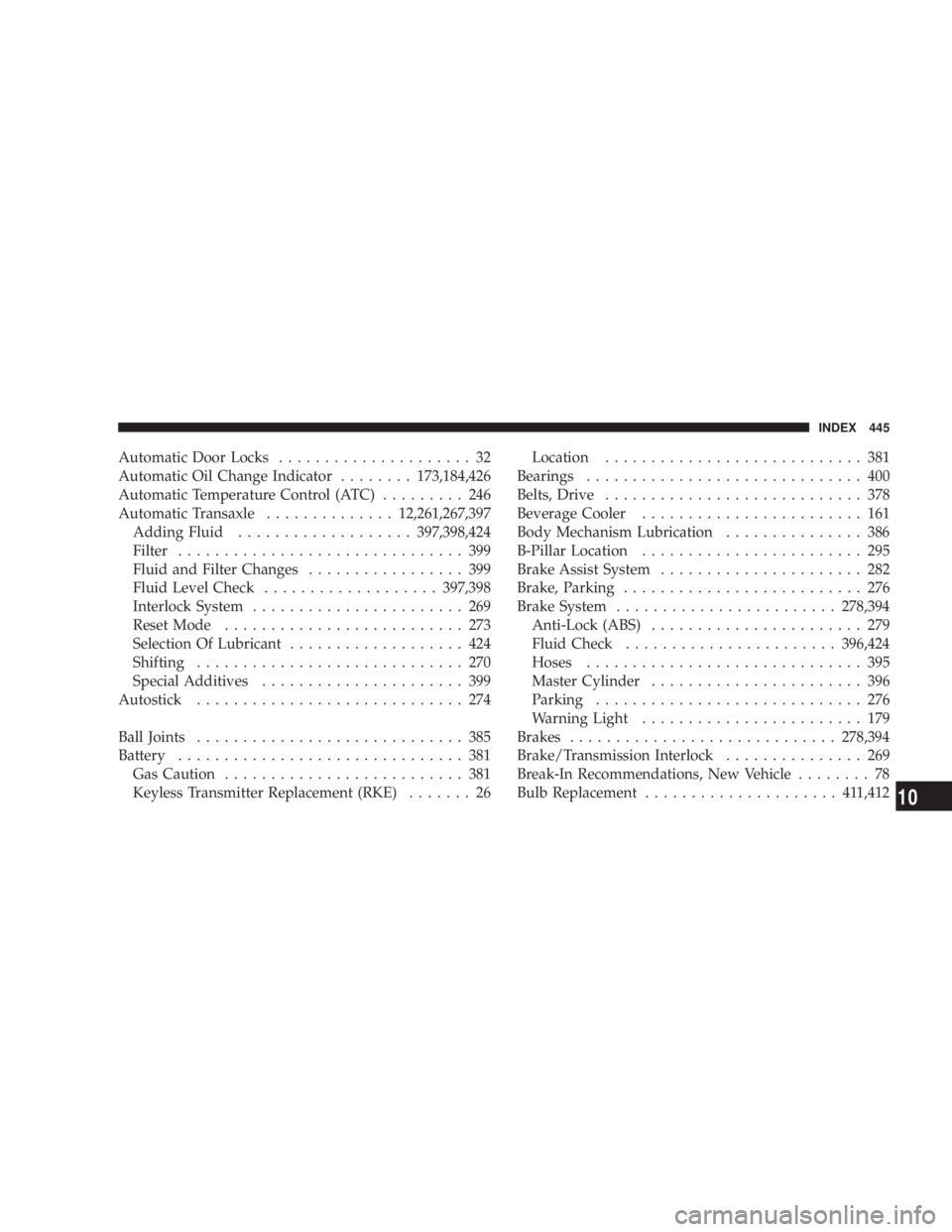
Automatic Door Locks ..................... 32
Automatic Oil Change Indicator ........ 173,184,426
Automatic Temperature Control (ATC) ......... 246
Automatic Transaxle .............. 12,261,267,397
Adding Fluid ................... 397,398,424
Filter ............................... 399
Fluid and Filter Changes ................. 399
Fluid Level Check ................... 397,398
Interlock System ....................... 269
Reset Mode .......................... 273
Selection Of Lubricant ................... 424
Shifting ............................. 270
Special Additives ...................... 399
Autostick ............................. 274
Ball Joints ............................. 385
Battery ............................... 381
Gas Caution .......................... 381
Keyless Transmitter Replacement (RKE) ....... 26 Location ............................ 381
Bearings .............................. 400
Belts, Drive ............................ 378
Beverage Cooler ........................ 161
Body Mechanism Lubrication ............... 386
B-Pillar Location ........................ 295
Brake Assist System ...................... 282
Brake, Parking .......................... 276
Brake System ........................ 278,394
Anti-Lock (ABS) ....................... 279
Fluid Check ....................... 396,424
Hoses .............................. 395
Master Cylinder ....................... 396
Parking ............................. 276
Warning Light ........................ 179
Brakes ............................. 278,394
Brake/Transmission Interlock ............... 269
Break-In Recommendations, New Vehicle ........ 78
Bulb Replacement ..................... 41 1,412 INDEX 445
10
Page 451 of 467
Cooling ............................. 388
Exhaust Gas Caution .................... 323
Fuel Requirements .................. 319,420
Jump Starting ......................... 358
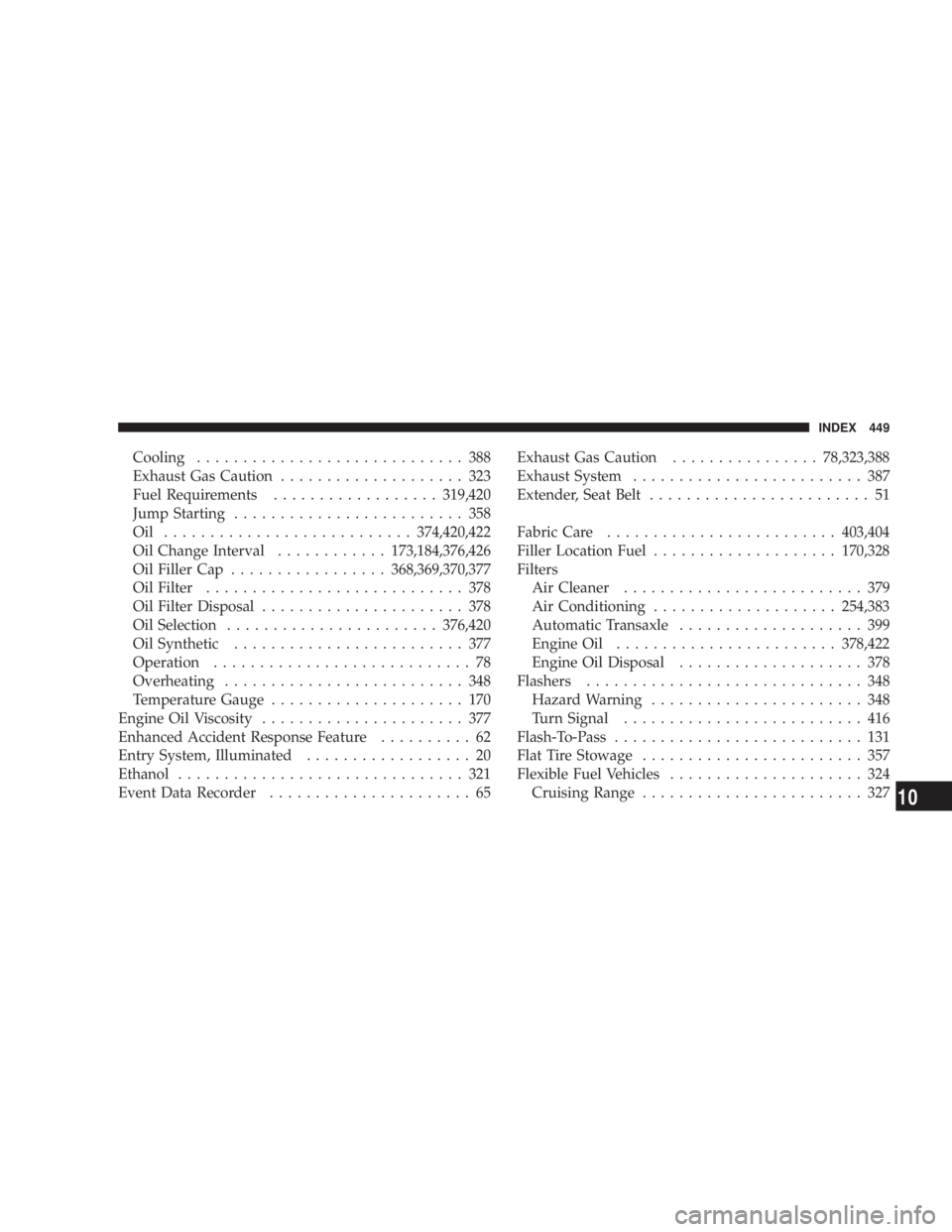
Oil ........................... 374,420,422
Oil Change Interval ............ 173,184,376,426
Oil Filler Cap ................. 368,369,370,377
Oil Filter ............................ 378
Oil Filter Disposal ...................... 378
Oil Selection ....................... 376,420
Oil Synthetic ......................... 377
Operation ............................ 78
Overheating .......................... 348
Temperature Gauge ..................... 170
Engine Oil Viscosity ...................... 377
Enhanced Accident Response Feature .......... 62
Entry System, Illuminated .................. 20
Ethanol ............................... 321
Event Data Recorder ...................... 65 Exhaust Gas Caution ................ 78,323,388
Exhaust System ......................... 387
Extender, Seat Belt ........................ 51
Fabric Care ......................... 403,404
Filler Location Fuel .................... 170,328
Filters
Air Cleaner .......................... 379
Air Conditioning .................... 254,383
Automatic Transaxle .................... 399
Engine Oil ........................ 378,422
Engine Oil Disposal .................... 378
Flashers .............................. 348
Hazard Warning ....................... 348
Turn Signal .......................... 416
Flash-To-Pass ........................... 131
Flat Tire Stowage ........................ 357
Flexible Fuel Vehicles ..................... 324
Cruising Range ........................ 327 INDEX 449
10