fuel DODGE CALIBER 2006 1.G User Guide
[x] Cancel search | Manufacturer: DODGE, Model Year: 2006, Model line: CALIBER, Model: DODGE CALIBER 2006 1.GPages: 322, PDF Size: 5.99 MB
Page 172 of 322

NAnti-Lock Brake System (ABS) Ð
If Equipped.........................186
mPower Steering........................188
mTire Safety Information..................189
NTire Markings........................189
NTire Identification Number (TIN)..........193
NTire Loading And Tire Pressure...........194
mTiresÐGeneral Information...............198
NTire Pressure.........................198
NTire Inflation Pressures.................199
NRadial-Ply Tires......................201
NCompact Spare Tire Ð If Equipped.........201
NLimited Use Spare Ð If Equipped.........202
NTire Spinning........................202
NTread Wear Indicators..................203
NLife Of Tire.........................204NReplacement Tires.....................204
NAlignment And Balance.................205
mTire Pressure Monitoring System (TPMS) -
Premium System Ð If Equipped
...........206
NTire Pressure Monitoring System (TPMS)
Operation...........................206
NGeneral Information...................209
mTire Chains...........................209
mSnow Tires...........................209
mTire Rotation Recommendations...........210
mFuel Requirements.....................211
NGasoline Engines.....................211
NReformulated Gasoline.................211
NGasoline/Oxygenate Blends..............211
NMMT In Gasoline.....................212
NMaterials Added To Fuel................212
172 STARTING AND OPERATING
Page 173 of 322

NFuel System Cautions..................213
NCarbon Monoxide Warnings..............213
mAdding Fuel..........................214
NFuel Filler Cap (Gas Cap)...............214
NLoose Fuel Filler Cap Message............216
mVehicle Loading.......................217
NGross Vehicle Weight Rating (GVWR).......217
mTrailer Towing........................217
NCommon Towing Definitions.............217
NTrailer Hitch Classification...............219NTrailer Towing Weights
(Maximum Trailer Weight Ratings).........220
NTrailer And Tongue Weight..............221
NTowing Requirements..................222
NTowing Tips.........................225
mRecreational Towing
(Behind Motorhome, Etc.)
................226
NTowing This Vehicle Behind Another Vehicle
(Flat Towing With All Four Wheels On The
Ground)............................226
STARTING AND OPERATING 173
5
Page 175 of 322
WARNING!
Do not attempt to push or tow your vehicle to get it
started. Vehicles equipped with an automatic trans-
axle cannot be started this way. Unburned fuel could
enter the catalytic converter and once the engine has
started, ignite and damage the converter and vehicle.
If the vehicle has a discharged battery, booster cables
may be used to obtain a start from another vehicle.
This type of start can be dangerous if done improp-
erly, so follow the procedure carefully. See section 6
of this manual for jump starting instructions.
Extremely Cold Weather (below220ÉF or229ÉC)
To insure reliable starting at these temperatures, use of an
externally powered electric engine block heater (available
from your dealer) is recommended.
If Engine Fails to Start
If the engine fails to start after you have followed the
ªNORMAL STARTINGº procedure, it may be flooded.
Push the accelerator pedal all the way to the floor and
hold it there. Crank the engine for no more than 15seconds. This should clear any excess fuel in case the
engine is flooded. Leave the ignition key in the ON
position, release the accelerator pedal and repeat the
ªNORMAL STARTINGº procedure.
WARNING!
Never pour fuel or other flammable liquid into the
throttle body air inlet opening in an attempt to start
the vehicle. This could result in flash fire causing
serious personal injury.
CAUTION!
To prevent damage to the starter, do not crank the
engine for more than 15 seconds at a time. Wait 10 to
15 seconds before trying again.
STARTING AND OPERATING 175
5
Page 178 of 322
WARNING!
Unintended movement of a vehicle could injure
those in and near the vehicle. As with all vehicles,
you should never exit a vehicle while the engine is
running. Before exiting a vehicle, you should always
shift the vehicle into P (Park), remove the key from
the ignition, and apply the parking brake. Once the
key is removed from the ignition, the transmission
shift lever is locked in the P (Park) position, securing
the vehicle against unwanted movement. Further-
more, you should never leave children unattended
inside a vehicle.
The following indicators should be used to ensure that
you have engaged the transmission shift lever into the P
(Park) position:
²When shifting into P (Park), firmly move the lever all
the way forward until it stops.
²Look at the shift indicator window on the console to
ensure it is in the P (Park) position.
²You must depress the brake pedal to move the shift
lever out of the P (Park) position.
CAUTION!
Before moving the shift lever out of P (Park), you
must turn the ignition from LOCK to ON so the
steering wheel and shift lever are released. Other-
wise, damage to the steering column or shifter could
result. You must also depress the brake pedal.
ªRº Reverse
Shift into this range only after the vehicle has come to a
complete stop.
ªNº Neutral
Engine may be started in this range.
ªDº
This should be used for most driving and provides the
best ratio for optimum driveability, fuel economy, and
performance.
178 STARTING AND OPERATING
Page 181 of 322
Never drive with your foot resting on the clutch pedal, or
try to hold the vehicle on a hill with the clutch pedal
partially engaged. This will cause abnormal wear on the
clutch.
Never shift into REVERSE until the vehicle has come to a
complete stop.
NOTE:During cold weather, until the transaxle lubri-
cant is warm, you may experience slightly higher shift
efforts. This is normal and not harmful to the transaxle.
Recommended Shift Speeds
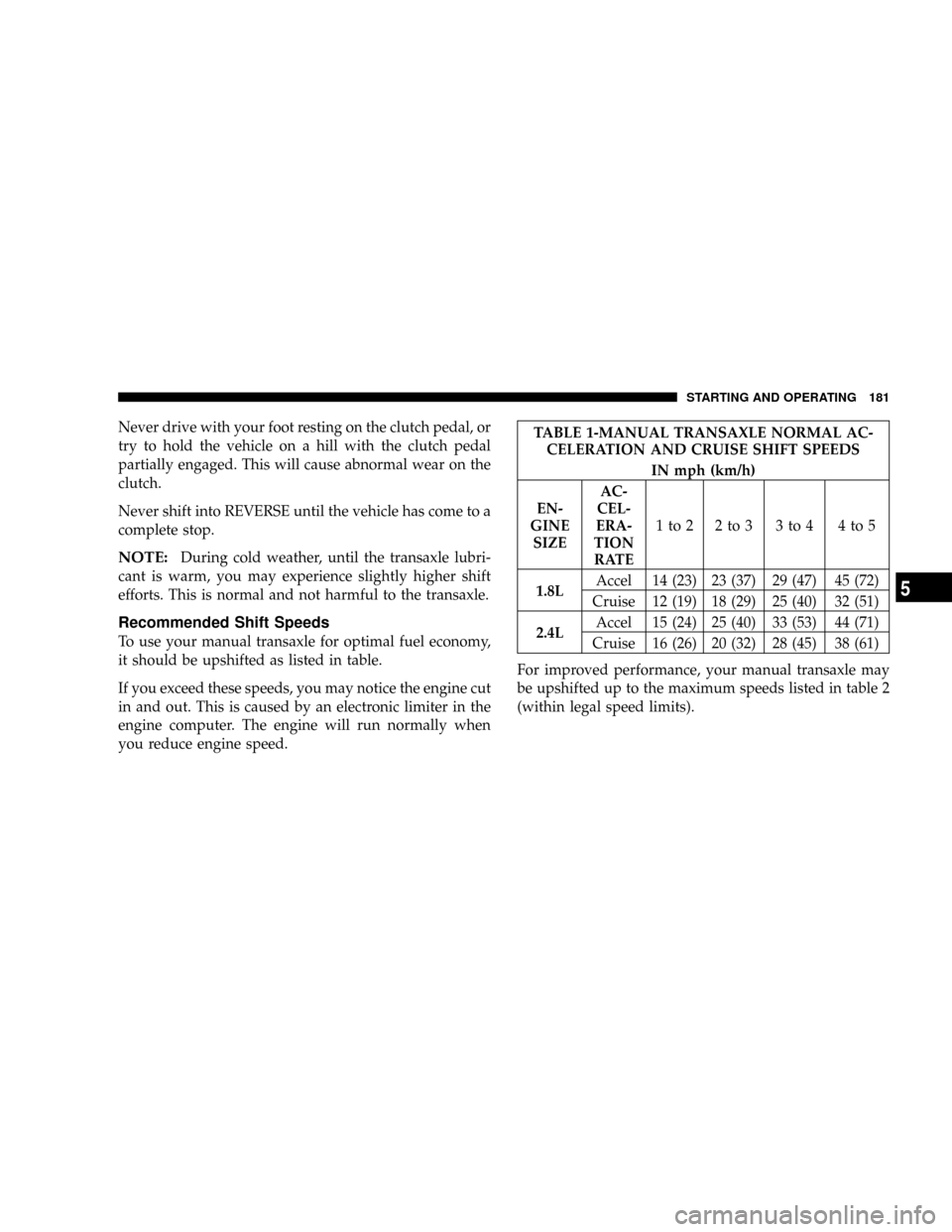
To use your manual transaxle for optimal fuel economy,
it should be upshifted as listed in table.
If you exceed these speeds, you may notice the engine cut
in and out. This is caused by an electronic limiter in the
engine computer. The engine will run normally when
you reduce engine speed.
TABLE 1-MANUAL TRANSAXLE NORMAL AC-
CELERATION AND CRUISE SHIFT SPEEDS
IN mph (km/h)
EN-
GINE
SIZEAC-
CEL-
ERA-
TION
RATE1to2 2to3 3to4 4to5
1.8LAccel 14 (23) 23 (37) 29 (47) 45 (72)
Cruise 12 (19) 18 (29) 25 (40) 32 (51)
2.4LAccel 15 (24) 25 (40) 33 (53) 44 (71)
Cruise 16 (26) 20 (32) 28 (45) 38 (61)
For improved performance, your manual transaxle may
be upshifted up to the maximum speeds listed in table 2
(within legal speed limits).
STARTING AND OPERATING 181
5
Page 182 of 322
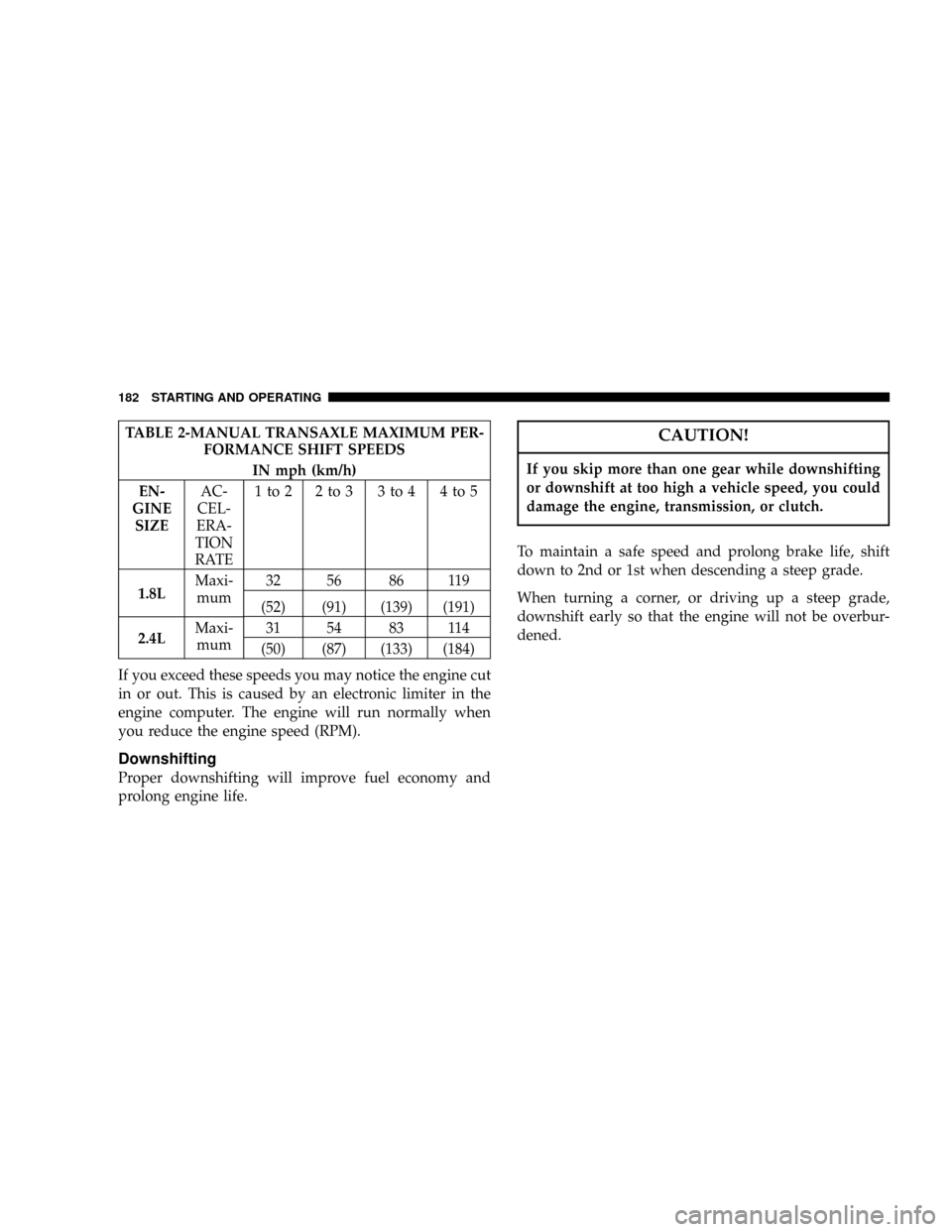
TABLE 2-MANUAL TRANSAXLE MAXIMUM PER-
FORMANCE SHIFT SPEEDS
IN mph (km/h)
EN-
GINE
SIZEAC-
CEL-
ERA-
TION
RATE1to2 2to3 3to4 4to5
1.8LMaxi-
mum32 56 86 119
(52) (91) (139) (191)
2.4LMaxi-
mum31 54 83 114
(50) (87) (133) (184)
If you exceed these speeds you may notice the engine cut
in or out. This is caused by an electronic limiter in the
engine computer. The engine will run normally when
you reduce the engine speed (RPM).
Downshifting
Proper downshifting will improve fuel economy and
prolong engine life.
CAUTION!
If you skip more than one gear while downshifting
or downshift at too high a vehicle speed, you could
damage the engine, transmission, or clutch.
To maintain a safe speed and prolong brake life, shift
down to 2nd or 1st when descending a steep grade.
When turning a corner, or driving up a steep grade,
downshift early so that the engine will not be overbur-
dened.
182 STARTING AND OPERATING
Page 199 of 322

2. EconomyÐ
Improper inflation pressures can cause uneven wear
patterns to develop across the tire tread. These abnormal
wear patterns will reduce tread life resulting in a need for
earlier tire replacement. Under inflation, also increases
tire rolling resistance and results in higher fuel consump-
tion.
3. Ride Comfort and Vehicle StabilityÐ
Proper tire inflation contributes to a comfortable ride.
Over inflation produces a jarring and uncomfortable ride.
Tire Inflation Pressures
The proper cold tire inflation pressure is listed either on
the face of the driver's door or on the driver's side ªBº
pillar.
Some vehicles may have Supplemental Tire Pressure
Information for vehicle loads that are less than the
maximum loaded vehicle condition. These pressure con-
ditions will be found in the ªSupplemental Tire Pressure
Informationº section of this manual.The pressure should be checked and adjusted as well as
inspecting for signs of tire wear or visible damage at least
once a month. Use a good quality pocket-type gauge to
check tire pressure. Do not make a visual judgement
when determining proper inflation. Radial tires may look
properly inflated even when they are under inflated.Tire Placard Location
STARTING AND OPERATING 199
5
Page 208 of 322

²The TPMS does not monitor the temporary spare tire.
²The TPMS should not be used as a tire pressure gauge
while adjusting your tire pressure.
²Driving on a significantly under-inflated tire causes
the tire to overheat and can lead to tire failure.
Under-inflation also reduces fuel efficiency and tire
tread life, and may affect the vehicle's handling and
stopping ability.
²The TPMS is not intended to replace normal tire care
and maintenance, or to provide warning of a tire
failure or condition. It is the driver 's responsibility to
maintain correct tire pressure, even if under-inflation
has not reached the level to trigger illumination of the
Tire Pressure Monitoring Telltale light.
Check TPM System Message
The Tire Pressure Monitoring Telltale Light will
flash on and off for 60 seconds and an audible
chime will sound when a system fault is detected.
The flash cycle will repeat every ten minutes, without an
audible chime until the fault condition no longer exists.The EVIC will display the ªCHECK TPM SYSTEMº
message for 3 seconds. In addition, a graphic will be
displayed indicating which of the Tire Pressure Monitor-
ing Sensor(s) is not being received.
If the ignition key is cycled, this sequence will repeat,
providing the system fault still exists. If the system fault
no longer exists, the Tire Pressure Monitoring Telltale
Light will no longer flash, and the9CHECK TPM SYS-
TEM9text message will no longer display.
Check TPM System Display
208 STARTING AND OPERATING
Page 211 of 322

FUEL REQUIREMENTS
GASOLINE ENGINES
Your vehicle is designed to meet all emis-
sion regulations and provide excellent fuel
economy when using high quality regular
unleaded gasoline with an octane rating of
87. The use of premium gasoline is not
recommended. The use of premium gaso-
line will provide no benefit over high quality regular
gasolines, and in some circumstances, may result in
poorer performance.
Light spark knock at low engine speeds is not harmful to
your engine. However, continued heavy spark knock at
high speeds can cause damage and immediate service is
required.
Poor quality gasoline can cause problems such as hard
starting, stalling and hesitations. If you experience these
symptoms, try another brand of gasoline (with the ap-
propriate octane rating for your engine) before consider-
ing service for the vehicle.
Reformulated Gasoline
Many areas of the country require the use of cleaner
burning gasoline referred to as ªReformulated Gasolineº.
Reformulated gasolines contain oxygenates, and are spe-
cifically blended to reduce vehicle emissions and im-
prove air quality.
The manufacturer supports the use of reformulated gaso-
lines. Properly blended reformulated gasolines will pro-
vide excellent performance and durability of engine and
fuel system components.
Gasoline/Oxygenate Blends
Some fuel suppliers blend unleaded gasoline with oxy-
genates such as 10% ethanol, MTBE, and ETBE. Oxygen-
ates are required in some areas of the country during the
winter months to reduce carbon monoxide emissions.
Fuels blended with these oxygenates may be used in
your vehicle.
STARTING AND OPERATING 211
5
Page 212 of 322

CAUTION!
DO NOT use gasolines containing Methanol or E85
Ethanol. Use of these blends may result in starting
and driveability problems and may damage critical
fuel system components.
Problems that result from using methanol/gasoline
blends are not the responsibility of the manufacturer.
While MTBE is an oxygenate made from Methanol, it
does not have the negative effects of Methanol.
MMT In Gasoline
MMT is a manganese containing metallic additive that is
blended into some gasoline to increase the octane num-
ber. Gasolines blended with MMT offer no performance
advantage beyond gasolines of the same octane number
without MMT. Gasolines blended with MMT have shown
to reduce spark plug life and reduce emission system
performance in some vehicles. The manufacturer recom-
mends using gasolines without MMT. Since the MMTcontent of gasoline may not be indicated on the pump,
you should ask your gasoline retailer whether or not
his/her gasoline contains MMT.
It is even more important to look for gasolines without
MMT in Canada, because MMT can be used at levels
higher than those allowed in the United States.
MMT is prohibited in Federal and California reformu-
lated gasolines.
Materials Added to Fuel
All gasoline sold in the United States is required to
contain effective detergent additives. Use of additional
detergents or other additives is not needed under normal
conditions and would result in additional cost. Therefore
you should not have to add anything to the fuel.
212 STARTING AND OPERATING