fuel DODGE CALIBER 2006 1.G Owner's Guide
[x] Cancel search | Manufacturer: DODGE, Model Year: 2006, Model line: CALIBER, Model: DODGE CALIBER 2006 1.GPages: 322, PDF Size: 5.99 MB
Page 247 of 322

If none of these apply to you, then change your engine
oil at every interval shown on schedule ªAº in the
maintenance schedule section of this manual.
NOTE:
Under no circumstances should oil change
intervals exceed 6000 miles (10 000 km) or 6 months
whichever comes first.
Engine Oil Selection - Non ACEA Categories
For best performance and maxi-
mum protection under all types of
operating conditions, the manu-
facturer only recommends engine
oils that are API certified and
meet the requirements of
DaimlerChrysler Material Stan-
dard MS-6395. Use Mopar or an
equivalent oil meeting the specifi-
cation MS-6395. These Certified Oils exhibit the Ameri-
can Petroleum Institute (API) Engine Oil Certification
Symbol on the front of the oil container. This symbol
means that the oil has been tested, certified and licensed
by the American Petroleum Institute (API) to meet the oil
standards required by the manufacturers.
Engine Oil Selection - ACEA Categories
For countries that use the ACEA European Oil Categories
for Service Fill Oils, use engine oils that meet the require-
ments of ACEA A1/B1, A3/B4 or A3/B3.
Engine Oil Viscosity (SAE Grade)
SAE 5W-20 engine oil is recommended for all operating
temperatures. This engine oil improves low tempera-
ture starting and vehicle fuel economy. Your engine oil
filler cap also states the recommended engine oil vis-
cosity grade for your engine.
Lubricants which do not have both, the engine oil certi-
fication mark and the correct SAE viscosity grade num-
ber should not be used.
Synthetic Engine Oils
There are a number of engine oils being promoted as
either synthetic or semi-synthetic. If you chose to use
such a product, use only those oils that are certified by
the American Petroleum Institute (API) to display the
symbol on the front of the container or the proper ACEA
category and show the recommended SAE viscosity
grade. Follow the maintenance schedule that describes
your driving type.
MAINTAINING YOUR VEHICLE 247
7
Page 248 of 322

Materials Added To Engine Oils
The manufacture strongly recommends against the addi-
tion of any additives (other than leak detection dyes) to
the engine oil. Engine oil is an engineered product and
it's performance may be impaired by supplemental ad-
ditives.
Disposing of Used Engine Oil
Care should be taken in disposing of used engine oil from
your vehicle. Used oil, indiscriminately discarded, can
present a problem to the environment. Contact your
dealer, service station, or governmental agency for advice
on how and where used oil can be safely discarded in
your area.
Engine Oil Filter
The engine oil filter should be replaced at every engine
oil change.
Engine Oil Filter Selection
All of this manufacturers engines have a full-flow type
disposable oil filter. Use a filter of this type for replace-
ment. The quality of replacement filters varies consider-
ably. Only high quality filters should be used to assure
most efficient service. Mopar Engine Oil Filters are high
quality oil filters and are recommended.
Engine Oil Requirements Ð Diesel Engines
Checking Oil Level
To assure proper engine lubrication, the engine oil must
be maintained at the correct level. Check the oil level at
regular intervals, such as every fuel stop.
The best time to check the engine oil level is about 5
minutes after a fully warmed engine is shut off or before
starting the engine after it has sat overnight.
Checking the oil while the vehicle is on level ground will
improve the accuracy of the oil level readings. Maintain
the oil level between the MIN and MAX markings on the
dipstick. Adding 1qt (1 liter) of oil when the reading is at
the MIN mark will result in a MAX reading on these
engines.
248 MAINTAINING YOUR VEHICLE
Page 249 of 322

Selecting Engine Oil
Viscosity:Grade 5W-40 is recommended.
Oil Quality:Use only Synthetic Diesel engine oils con-
forming to the most current version of ACEA A3/B4 or
A3/B4/C3.
Drive Belt Ð Check Condition
At the mileage shown in the maintenance schedules,
check the drive belt for condition.
Inspect the drive belt for evidence of cuts, cracks, or
glazing and replace belt if any sign of damage which
could result in belt failure.
The belt is self-tensioning and will not need adjustment.
Spark Plugs
Spark plugs must fire properly to assure engine perfor-
mance and emission control. New plugs should be in-
stalled at the specified mileage. The entire set should be
replaced if there is any malfunction due to a faulty spark
plug. Refer to the Engine data Label located under the
hood for the proper type of spark plug for use in your
vehicle.
Ignition Wiring System
The ignition cables should be kept clean and properly
connected. Terminals should be fully seated. Cracked,
damaged, or faulty cables should be replaced.
Catalytic Converter
The catalytic converter requires the use of unleaded fuel
only. Leaded gasoline will destroy the effectiveness of the
catalyst as an emission control device.
Under normal operating conditions, the catalytic con-
verter will not require maintenance. However, it is im-
portant to keep the engine properly tuned to assure
proper catalyst operation and prevent possible catalyst
damage.
MAINTAINING YOUR VEHICLE 249
7
Page 251 of 322
Check ventilation hose for indication of damage or
plugging deposits. Replace if necessary.
Fuel Filter
A plugged fuel filter can cause hard starting or limit the
speed at which a vehicle can be driven. Should an
excessive amount of dirt accumulate in the fuel tank,
frequent filter replacement may be necessary. The fuel
filters are located inside the fuel tank. See your dealer for
service.
Air Cleaner Element (Filter)
Under normal driving conditions, replace the filter at the
intervals shown on Schedule ªAº. If, however, you drive
the vehicle frequently under dusty or severe conditions,
the filter element should be inspected periodically and
replaced if necessary at the intervals shown on Schedule
ªBº.
WARNING!
The air cleaner can provide a measure of protection
in the case of engine backfire. Do not remove the air
cleaner unless such removal is necessary for repair or
maintenance. Make sure that no one is near the
engine compartment before starting the vehicle with
the air cleaner removed. Failure to do so can result in
serious personal injury.
Maintenance-Free Battery
You will never have to add water, nor is periodic main-
tenance required.
CAUTION!
When servicing the battery, always reinstall the
battery thermowrap. The thermowrap provides bat-
tery heat protection and will extend overall battery
life. Failure to reinstall the thermowrap can result in
evaporative loss of the battery fluid.
MAINTAINING YOUR VEHICLE 251
7
Page 260 of 322

²Make sure that the radiator and coolant recovery
bottle overflow hoses are not kinked or obstructed.
²Keep the front of the radiator clean. If your vehicle is
equipped with air conditioning, keep the front of the
condenser clean, also.
²Do not change the thermostat for summer or winter
operation. If replacement is ever necessary, install
ONLY the correct type thermostat. Other designs may
result in unsatisfactory coolant performance, poor gas
mileage, and increased emissions.
Hoses And Vacuum/Vapor Harnesses
Inspect surfaces of hoses and nylon tubing for evidence
of heat and mechanical damage. Hard or soft spots,
brittle rubber, cracking, tears, cuts, abrasions, and exces-
sive swelling indicate deterioration of the rubber
Pay particular attention to the hoses nearest to high heat
sources such as the exhaust manifold. Inspect hose rout-
ing to be sure hoses do not touch any heat source or
moving component that may cause heat damage or
mechanical wear.Insure nylon tubing in these areas has not melted or
collapsed
Inspect all hose connections such as clamps and cou-
plings to make sure the are secure and no leaks are
present.
Components should be replaced immediately if there is
any evidence of degradation that could cause failure.
Fuel System Connections
Electronic Fuel Injection high pressure fuel systems are
designed with tubes and special connects, connections
and clamps which have unique material characteristics to
provide adequate sealing and resist attack by deterio-
rated gasoline.
You are urged to use only the manufactures-specified
tubes, connections and clamps, or their equivalent in
material and specification, in any fuel system servicing.
Brake System
In order to assure brake system performance, all brake
system components should be inspected periodically.
Suggested service intervals can be found in the Mainte-
nance Section.
260 MAINTAINING YOUR VEHICLE
Page 278 of 322
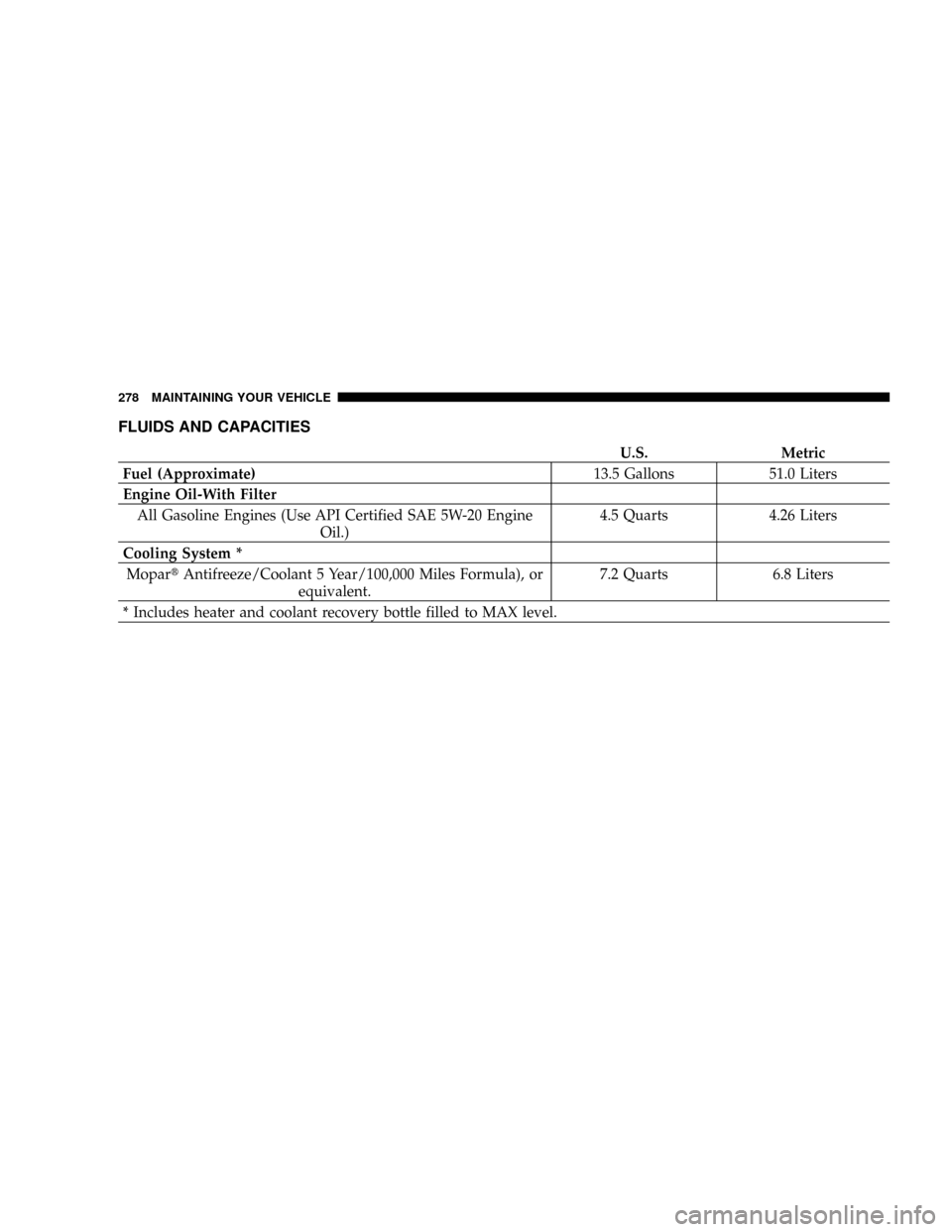
FLUIDS AND CAPACITIES
U.S. Metric
Fuel (Approximate)13.5 Gallons 51.0 Liters
Engine Oil-With Filter
All Gasoline Engines (Use API Certified SAE 5W-20 Engine
Oil.)4.5 Quarts 4.26 Liters
Cooling System *
MopartAntifreeze/Coolant 5 Year/100,000 Miles Formula), or
equivalent.7.2 Quarts 6.8 Liters
* Includes heater and coolant recovery bottle filled to MAX level.
278 MAINTAINING YOUR VEHICLE
Page 279 of 322
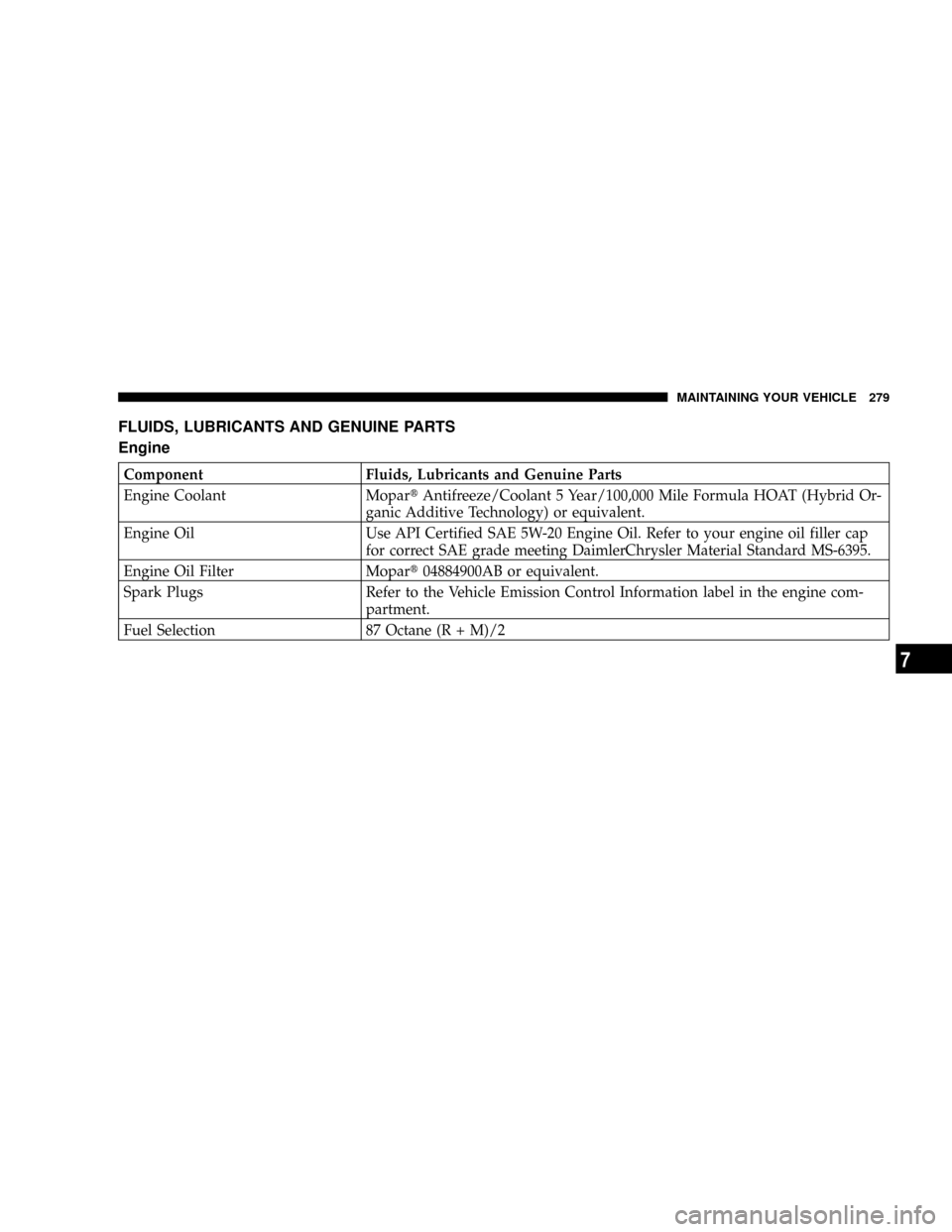
FLUIDS, LUBRICANTS AND GENUINE PARTS
Engine
Component Fluids, Lubricants and Genuine Parts
Engine Coolant MopartAntifreeze/Coolant 5 Year/100,000 Mile Formula HOAT (Hybrid Or-
ganic Additive Technology) or equivalent.
Engine Oil Use API Certified SAE 5W-20 Engine Oil. Refer to your engine oil filler cap
for correct SAE grade meeting DaimlerChrysler Material Standard MS-6395.
Engine Oil Filter Mopart04884900AB or equivalent.
Spark Plugs Refer to the Vehicle Emission Control Information label in the engine com-
partment.
Fuel Selection 87 Octane (R + M)/2
MAINTAINING YOUR VEHICLE 279
7
Page 283 of 322
NOTE:IfANYof these apply to you then change your
engine oil every 3,000 miles (5 000 km) or 3 months,
whichever comes first and follow schedule ªBº of the
9Maintenance Schedules9section of this manual.
NOTE:IfANYof these apply to you then change your
coolant every 102,000 miles (170 000 km) or 60 months,
whichever comes first and follow schedule ªBº of the
9Maintenance Schedules9section of this manual.
Second is ScheduleªAº. It is for vehicles that are not
operated under any of the conditions listed under Sched-
ule9B9.
Use the schedule that best describes your driving condi-
tions. Where time and mileage are listed, follow the
interval that occurs first.
NOTE:Under no circumstances should oil change
intervals exceed 6000 miles (10 000 km) or 6 months
whichever comes first.
CAUTION!
Failure to perform the required maintenance items
may result in damage to the vehicle.
At Each Stop for Fuel
²
Check the engine oil level about 5 minutes after a fully
warmed engine is shut off. Checking the oil level while
the vehicle is on level ground will improve the accu-
racy of the oil level reading. Add oil only when the
level is at or below the ADD or MIN mark.
²Check the windshield washer solvent and add, if
required.
Once a Month
²
Check tire pressure and look for unusual wear or
damage.
²Inspect the battery and clean and tighten the terminals
as required.
MAINTENANCE SCHEDULES 283
8
M
A
I
N
T
E
N
A
N
C
E
S
C
H
E
D
U
L
E
S
Page 308 of 322

ABS (Anti-Lock Brake System)............. 186
Adding Engine Coolant (Antifreeze)......... 257
Adding Fuel.......................... 214
Adding Washer Fluid..................82,102
Additives, Fuel........................ 212
Air Cleaner, Engine (Engine Air Cleaner Filter) . 251
Air Conditioner Maintenance.............. 253
Air Conditioning Controls................ 164
Air Conditioning, Operating Tips........... 168
Air Conditioning Refrigerant.............. 253
Air Conditioning System..............164,253
Air Pressure, Tires...................... 199
Airbag................................ 39
Airbag Deployment...................... 48
Airbag Light......................50,61,112
Airbag Maintenance...................... 50
Airbag, Side........................... 47
Alarm System (Security Alarm)..........24,112
Alignment and Balance.................. 205
All Wheel Drive (AWD).................. 183
Alterations/Modifications, Vehicle............ 6
Antenna, Satellite Radio.................. 161
Antifreeze (Engine Coolant).........256,278,279Capacities........................... 278
Disposal............................ 258
Anti-Lock Brake System (ABS)...........86,186
Anti-Theft Security Alarm (Theft Alarm)...... 24
Appearance Care....................... 265
Automatic Door Locks..................16,17
Automatic Transaxle...........9,174,176,229,263
Fluid Level Check..................... 263
Interlock System....................14,177
Overheating......................... 229
Selection Of Lubricant................. 263
Shifting............................ 177
Special Additives..................... 264
Autostick............................. 179
Ball Joints............................ 254
Battery............................... 251
Keyless Transmitter Replacement (RKE)..... 23
Belts, Drive........................... 249
Beverage Cooler........................ 103
Body Mechanism Lubrication.............. 254
B-Pillar Location....................... 194
Brake Assist System...................... 87
308 INDEX
Page 309 of 322

Brake Fluid........................... 280
Brake, Parking......................... 183
Brake System.......................185,260
Anti-Lock (ABS)....................86,186
Hoses.............................. 261
Master Cylinder...................... 262
Parking............................ 183
Warning Light....................... 117
Brakes............................185,260
Brake/Transmission Interlock.............. 177
Break-In Recommendations, New Vehicle...... 59
Bulb Replacement...................272,273
Bulbs, Light........................... 272
Calibration, Compass.................... 127
Capacities, Antifreeze (Engine Coolant)...... 278
Capacities, Fluid....................... 278
Caps, Filler
Fuel............................... 214
Oil (Engine)......................241,247
Car Washes........................... 266
Carbon Monoxide Warning............... 213
Cargo Area Cover....................... 98Cargo Area Features..................... 96
Cargo Compartment
Light............................... 96
Luggage Carrier...................... 102
Cargo Light............................ 96
Cargo Load Floor....................... 99
Cargo Tie-Downs........................ 99
Carrier, Luggage....................... 102
Catalytic Converter..................... 249
Caution, Exhaust Gas..................... 60
CD (Compact Disc) Player..........129,136,147
CD (Compact Disc) Player Maintenance...... 163
Cellular Phone......................... 163
Center High Mounted Stop Light........... 277
Chains, Tire........................... 209
Changing A Flat Tire.................... 230
Chart, Tire Sizing....................... 191
Check Engine Light (Malfunction Indicator
Light)............................... 243
Child Restraint......................... 52
Child Restraint Tether Anchors............. 56
Child Restraint with Automatic Belts......... 55
Child Safety Locks....................... 18
INDEX 309
10