fuel DODGE CALIBER 2006 1.G Owner's Manual
[x] Cancel search | Manufacturer: DODGE, Model Year: 2006, Model line: CALIBER, Model: DODGE CALIBER 2006 1.GPages: 322, PDF Size: 5.99 MB
Page 213 of 322

Fuel System Cautions
CAUTION!
Follow these guidelines to maintain your vehicle's
performance:
²The use of leaded gas is prohibited by Federal law.
Using leaded gasoline can impair engine performance,
damage the emission control system.
²An out-of-tune engine, or certain fuel or ignition
malfunctions, can cause the catalytic converter to
overheat. If you notice a pungent burning odor or
some light smoke, your engine may be out of tune or
malfunctioning and may require immediate service.
Contact your dealer for service assistance.
²The use of fuel additives which are now being sold as
octane enhancers is not recommended. Most of these
products contain high concentrations of methanol.Fuel system damage or vehicle performance problems
resulting from the use of such fuels or additives is not
the responsibility of the manufacturer.
NOTE:Intentional tampering with emissions control
systems can result in civil penalties being assessed
against you.
Carbon Monoxide Warnings
WARNING!
Carbon monoxide (CO) in exhaust gases is deadly.
Follow the precautions below to prevent carbon
monoxide poisoning:
²Do not inhale exhaust gases. They contain carbon
monoxide, a colorless and odorless gas which can kill.
Never run the engine in a closed area, such as a
garage, and never sit in a parked vehicle with the
engine running for an extended period. If the vehicle is
stopped in an open area with the engine running for
more than a short period, adjust the ventilation system
to force fresh, outside air into the vehicle.
STARTING AND OPERATING 213
5
Page 214 of 322

²Guard against carbon monoxide with proper mainte-
nance. Have the exhaust system inspected every time
the vehicle is raised. Have any abnormal conditions
repaired promptly. Until repaired, drive with all side
windows fully open.
²Keep the liftgate closed when driving your vehicle to
prevent carbon monoxide and other poisonous ex-
haust gases from entering the vehicle.
ADDING FUEL
Fuel Filler Cap (Gas Cap)
The gas cap is behind the fuel filler door, on the passen-
ger's side of the vehicle. If the gas cap is lost or damaged,
be sure the replacement cap is for use with this vehicle.
CAUTION!
Damage to the fuel system or emission control
system could result from using an improper fuel
tank filler tube cap (gas cap). A poorly fitting cap
could let impurities into the fuel system.
Fuel Filler Door
214 STARTING AND OPERATING
Page 215 of 322
CAUTION!
A poorly fitting gas cap may cause the Malfunction
Indicator Light to turn on.
CAUTION!
To avoid fuel spillage and overfilling, do not ªtop
offº the fuel tank after filling.
NOTE:When the fuel nozzle ªclicksº or shuts off, the
fuel tank is full.
WARNING!
²Never have any smoking materials lit in or near
the vehicle when the gas cap is removed or the
tank filled.
²Never add fuel when the engine is running. This
is in violation of most state and federal fire
regulations and will cause the malfunction indi-
cator light to turn on.
NOTE:Tighten the gas cap about 1/4 turn until you
hear one click. This is an indication that cap is properly
tightened.
If the gas cap is not tighten properly, the Malfunction
Indicator Light will come on. Be sure the gas cap is
tightened every time the vehicle is refueled.
STARTING AND OPERATING 215
5
Page 216 of 322
WARNING!
A fire may result if gasoline is pumped into a
portable container that is inside of a vehicle. You
could be burned. Always place gas containers on the
ground while filling.
Loose Fuel Filler Cap Message
If the vehicle diagnostic system determines that the fuel
filler cap is loose or improperly installed, a ªGASCAPº
message will be displayed in the Odometer/Trip Odom-
eter in the instrument cluster. Refer to ªInstrument
Cluster Descriptionº in Section 4 of this manual. Tighten
the fuel filler cap properly and press the odometer/trip
odometer reset button to turn the message off. If the
problem continues, the message will appear the next time
the vehicle is started. Refer to ªOnboard Diagnostic
System Ð OBDIIº in Section 7 of this manual for more
information.
CAUTION!
Damage to the fuel system or emission control
system could result from using an improper fuel
tank filler cap (gas cap). A poorly fitting cap could let
impurities into the fuel system.
WARNING!
²Never add fuel when the engine is running.
²Never have any smoking materials lit in or near
the vehicle when the fuel cap is removed or the
tank filled.
216 STARTING AND OPERATING
Page 226 of 322

Towing Tips Ð Electronic Speed Control (If
Equipped)
þ
Don't use in hilly terrain or with heavy loads.
þWhen using the speed control, if you experience speed
drops greater than 10 mph (16 km/h), disengage until
you can get back to cruising speed.
þUse speed control in flat terrain and with light loads to
maximize fuel efficiency.
Towing Tips Ð Cooling System
To reduce potential for engine and transmission over-
heating, take the following actions:
þCity Driving
When stopped for short periods of time, put transmission
in neutral and increase engine idle speed.
þHighway Driving
Reduce speed.
þAir Conditioning
Turn off temporarily.
þRefer to Cooling System Operating information in the
Maintenance section of this manual for more informa-
tion.
RECREATIONAL TOWING (BEHIND
MOTORHOME, ETC.)
Towing This Vehicle Behind Another Vehicle (Flat
towing with all four wheels on the ground)
CAUTION!
DO NOT flat tow this vehicle. Damage to the driv-
etrain will result.
NOTE:If the vehicle requires towing make sure all four
wheels are off the ground.
226 STARTING AND OPERATING
Page 234 of 322
JUMP-STARTING PROCEDURES DUE TO A LOW
BATTERY
WARNING!
Take care to avoid the radiator cooling fan whenever
the hood is raised. It can start anytime the ignition
switch is on. You can be hurt by the fan.
WARNING!
Do not attempt to push or tow your vehicle to get it
started. Vehicles equipped with an automatic trans-
axle cannot be started this way and may be damaged.
Unburned fuel could enter the catalytic converter
and once the engine has started, ignite and damage
the converter and vehicle. If the vehicle has a dis-
charged battery, booster cables may be used to ob-
tain a start from another vehicle. This type of start
can be dangerous if done improperly, so follow this
procedure carefully.
WARNING!
Wear eye protection and remove any metal jewelry
such as watch bands or bracelets that might make an
inadvertent electrical contact. You could be seriously
injured.
1. Wear eye protection and remove any metal jewelry
such as watch bands or bracelets that might make an
inadvertent electrical contact.
2. When boosting from a battery in another vehicle, park
that vehicle within booster cable reach but without
letting the vehicles touch. Set parking brake, place auto-
matic transaxle in PARK (manual transaxle in NEU-
TRAL) and turn ignition to OFF for both vehicles.
3. Turn off the heater, radio and all unnecessary electrical
loads.
4. Remove the air intake duct covering the battery, using
the two finger screws on the cover.
234 WHAT TO DO IN EMERGENCIES
Page 239 of 322

MAINTAINING YOUR VEHICLE
CONTENTS
mEngine Compartment Ð Gasoline Engines...241
mOnboard Diagnostic System Ð OBD II......242
NLoose Fuel Filler Cap Message............242
mEmissions Inspection And Maintenance
Programs
............................243
mReplacement Parts.....................244
mDealer Service........................244
mMaintenance Procedures.................245
NEngine Oil..........................245
NEngine Oil Requirements Ð Diesel Engines . . . 248
NDrive Belt Ð Check Condition............249
NSpark Plugs.........................249NIgnition Wiring System.................249
NCatalytic Converter....................249
NCrankcase Emission Control System........250
NFuel Filter..........................251
NAir Cleaner Element (Filter)..............251
NMaintenance-Free Battery................251
NAir Conditioner Maintenance.............253
NPower Steering Ð Fluid Check............253
NFront Suspension Ball Joints..............254
NBody Lubrication.....................254
NWindshield Wiper Blades................254
7
Page 240 of 322

NWindshield Washer Reservoir.............255
NExhaust System......................255
NCooling System.......................256
NHoses And Vacuum/Vapor Harnesses.......260
NFuel System Connections................260
NBrake System........................260
NAutomatic Transaxle...................263
NManual Transaxle.....................264
NRear Drive Assembly (Rda)± AWD Models
Only..............................264
NPower Transfer Unit (Ptu) ± AWD Models
Only..............................265
NAppearance Care And Protection From
Corrosion...........................265
mFuses/Integrated Power Module (IPM)......269
mVehicle Storage........................272
mReplacement Bulbs.....................272
mBulb Replacement......................273
NHeadlights/Front Parking/Front Turn Signal . . 273
NFog Lights..........................273
NTail Lights, Rear Turn Signals And Backup
Lights Ð Replacement..................274
NLicense Lights........................276
NCenter High-Mounted Stoplight...........277
mFluids And Capacities...................278
mFluids, Lubricants And Genuine Parts.......279
NEngine.............................279
NChassis............................280
240 MAINTAINING YOUR VEHICLE
Page 242 of 322

ONBOARD DIAGNOSTIC SYSTEM Ð OBD II
Your vehicle is equipped with a sophisticated onboard
diagnostic system called OBD II. This system monitors
the performance of the emissions, engine, and automatic
transmission control systems. When these systems are
operating properly, your vehicle will provide excellent
performance and fuel economy, as well as engine emis-
sions well within current government regulations.
If any of these systems require service, the OBD II system
will turn on the ªMalfunction Indicator Light.º It will
also store diagnostic codes and other information to
assist your service technician in making repairs. Al-
though your vehicle will usually be drivable and not
need towing, see your dealer for service as soon as
possible.CAUTION!
²Prolonged driving with the ªMalfunction Indica-
tor Lightº on could cause further damage to the
emission control system. It could also affect fuel
economy and driveability. The vehicle must be
serviced before any emissions tests can be per-
formed.
²If the ªMalfunction Indicator Lightº is flashing
while the engine is running, severe catalytic con-
verter damage and power loss will soon occur.
Immediate service is required.
Loose Fuel Filler Cap Message
After fuel is added, the vehicle diagnostic system can
determine if the fuel filler cap is loose or improperly
installed. A GASCAP message will be displayed in the
instrument cluster. Tighten the gas cap until a9clicking9
sound is heard. This is an indication that the gas cap is
properly tightened. Press the odometer reset button to
turn the message off. If the problem persists, the message
will appear the next time the vehicle is started. This
242 MAINTAINING YOUR VEHICLE
Page 245 of 322
WARNING!
You can be badly injured working on or around a
motor vehicle. Do only that service work for which
you have the knowledge and the proper equipment.
If you have any doubt about your ability to perform
a service job, take your vehicle to a competent
mechanic.
MAINTENANCE PROCEDURES
The pages that follow contain therequiredmaintenance
services determined by the engineers who designed your
vehicle.
Besides the maintenance items for which there are fixed
maintenance intervals, there are other items that should
operate satisfactorily without periodic maintenance.
However, if a malfunction of these items does occur, it
could adversely affect the engine or vehicle performance.
These items should be inspected if a malfunction is
observed or suspected.
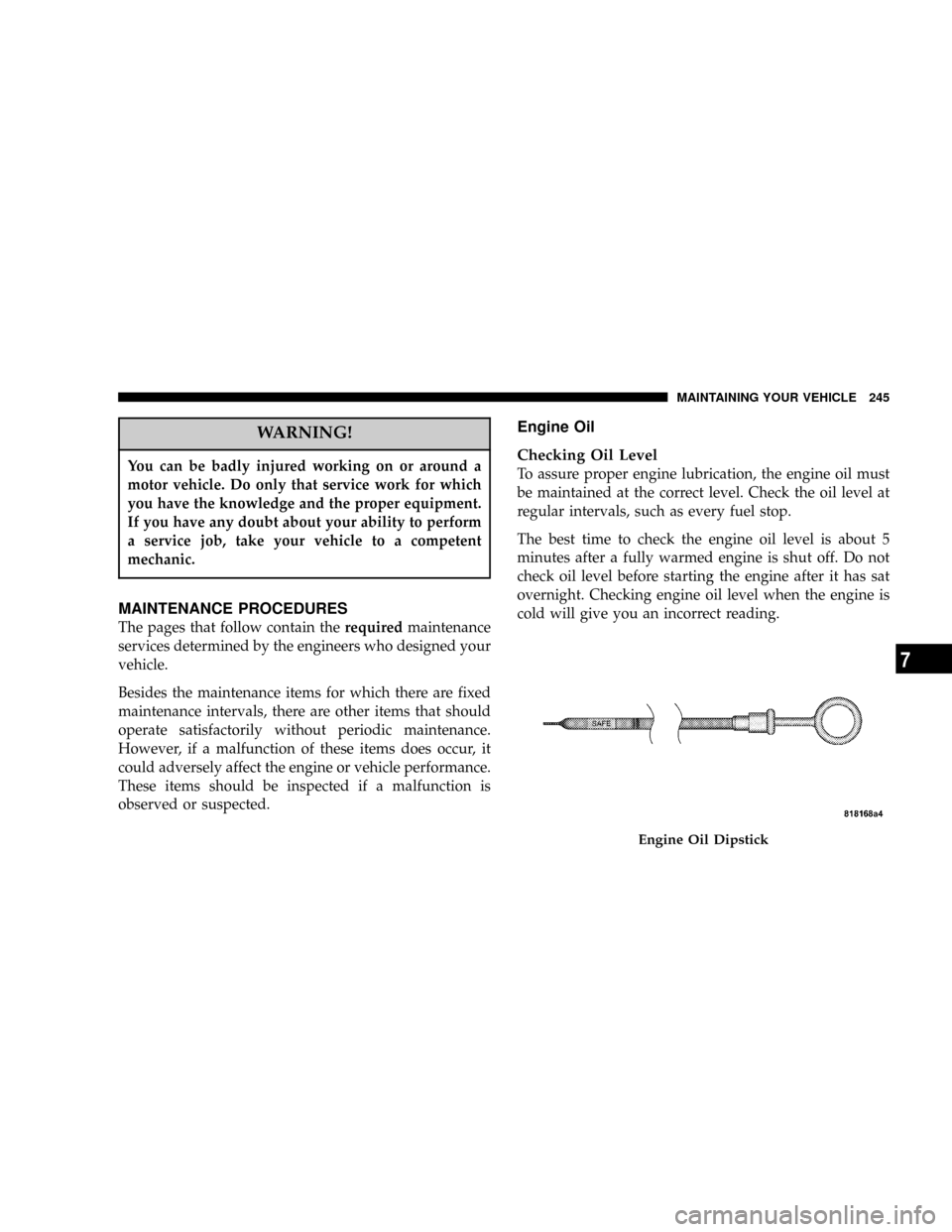
Engine Oil
Checking Oil Level
To assure proper engine lubrication, the engine oil must
be maintained at the correct level. Check the oil level at
regular intervals, such as every fuel stop.
The best time to check the engine oil level is about 5
minutes after a fully warmed engine is shut off. Do not
check oil level before starting the engine after it has sat
overnight. Checking engine oil level when the engine is
cold will give you an incorrect reading.
Engine Oil Dipstick
MAINTAINING YOUR VEHICLE 245
7