steering DODGE CALIBER SRT 2008 1.G Owners Manual
[x] Cancel search | Manufacturer: DODGE, Model Year: 2008, Model line: CALIBER SRT, Model: DODGE CALIBER SRT 2008 1.GPages: 373, PDF Size: 3 MB
Page 10 of 373
THINGS TO KNOW BEFORE STARTING YOUR VEHICLE
CONTENTS
mA Word About Your Keys..................12
NIgnition Key Removal...................12
NLocking Doors With The Key..............12
NKey-In-Ignition Reminder................12
mSentry Keyt...........................13
NReplacement Keys......................14
NCustomer Key Programming..............15
NGeneral Information....................16
mSteering Wheel Lock.....................16NTo Manually Lock The Steering Wheel.......16
NTo Release The Steering Wheel Lock.........17
mDoor Locks............................17
NManual Door Locks.....................17
NPower Door Locks Ð If Equipped..........18
NªChild-Protectionº Door Lock System (Rear
Doors)..............................21
mRemote Keyless Entry Ð If Equipped.........22
NTo Unlock The Doors And Liftgate..........23
2
Page 17 of 373
Repeat this procedure to program up to eight keys. If you
do not have a programmed Sentry Keyt, contact your
authorized dealer for details.
NOTE:If a programmed key is lost, see your authorized
dealer to have all remaining keys erased from the sys-
tem's memory. This will prevent the lost key from
starting your vehicle. The remaining keys must then be
reprogrammed. All vehicle keys must be taken to an
authorized dealer at the time of service to be repro-
grammed.
General Information
The Sentry Keytsystem complies with FCC rules Part 15
and with RSS-210 of Industry Canada. Operation is
subject to the following conditions:
²This device may not cause harmful interference.
²This device must accept any interference that may be
received, including interference that may cause undes-
ired operation.
STEERING WHEEL LOCK
Your manual transmission vehicle is equipped with a
passive steering wheel lock. This lock prevents steering
the vehicle without the ignition key. If the steering wheel
is moved no more than 1/2 turn in either direction and
the key is not in the ignition switch, the steering wheel
will lock.
To Manually Lock the Steering Wheel
With the engine running, turn the steering wheel upside
down, turn off the engine and remove the key. Turn the
steering wheel slightly in either direction until the lock
engages.
16 THINGS TO KNOW BEFORE STARTING YOUR VEHICLE
Page 18 of 373
To Release the Steering Wheel Lock
Insert the key in the ignition switch and start the engine.
If the key is difficult to turn, move the wheel slightly to
the right or left to disengage the lock.
NOTE:If you turned the wheel to the right to engage
the lock, you must turn the wheel slightly to the right to
disengage it. If you turned the wheel to the left to engage
the lock, turn the wheel slightly to the left to disengage it.
DOOR LOCKS
Manual Door Locks
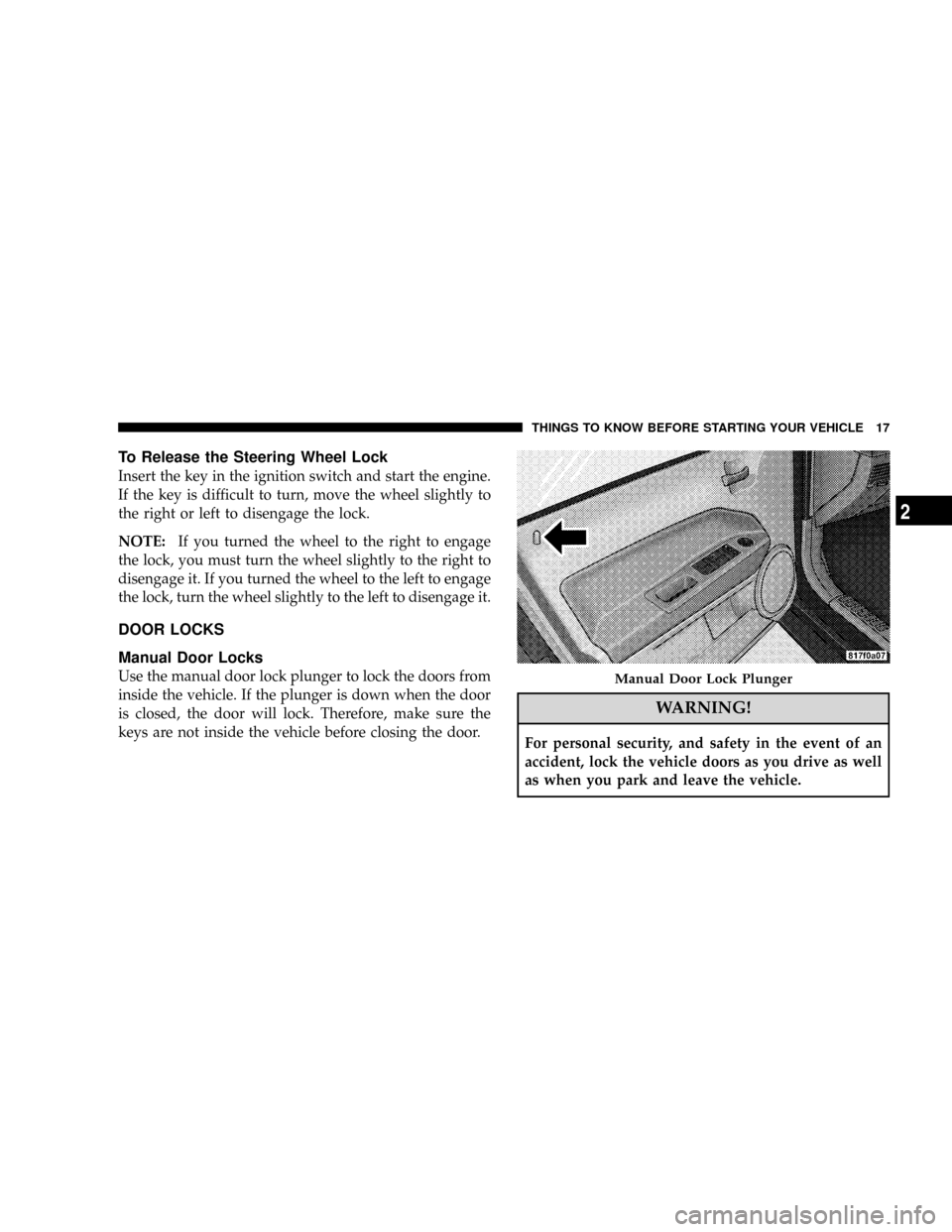
Use the manual door lock plunger to lock the doors from
inside the vehicle. If the plunger is down when the door
is closed, the door will lock. Therefore, make sure the
keys are not inside the vehicle before closing the door.
WARNING!
For personal security, and safety in the event of an
accident, lock the vehicle doors as you drive as well
as when you park and leave the vehicle.
Manual Door Lock Plunger
THINGS TO KNOW BEFORE STARTING YOUR VEHICLE 17
2
Page 45 of 373
NOTE:Watch for the Seat Belt Warning Light to turn on
while unbuckling and off while re-buckling the seat belt.
It may be necessary to retract the seat belt.
4. Turn the ignition switch to the LOCK position. A
single chime will sound to signify that you have success-
fully completed the programming.
The Enhanced Warning System (BeltAlert) can be reacti-
vated by repeating this procedure.
NOTE:Although the Enhanced Warning System
(BeltAlert) has been deactivated, the Seat Belt Warning
Light will continue to illuminate while the driver or front
passenger seat belt remains unbuckled.
Seat Belts And Pregnant Women
We recommend that pregnant women use the seat belts
throughout their pregnancy. Keeping the mother safe is
the best way to keep the baby safe.Pregnant women should wear the lap part of the belt
across the thighs and as snug across the hips as possible.
Keep the belt low so that it does not come across the
abdomen. That way the strong bones of the hips will take
the force if there is a collision.
Driver and Front Passenger Supplemental
Restraint System (SRS) - Airbag
This vehicle has airbags for both the driver and front
passenger as a supplement to the seat belt restraint
systems. The driver's front airbag is mounted in the
center of the steering wheel. The passenger's front airbag
is mounted in the instrument panel, above the glove
compartment. The words SRS AIRBAG are embossed on
the airbag covers.
44 THINGS TO KNOW BEFORE STARTING YOUR VEHICLE
Page 49 of 373
WARNING!
²Relying on the airbags alone could lead to more
severe injuries in a collision. The airbags work
with your seat belt to restrain you properly. In
some collisions the airbags won't deploy at all.
Always wear your seat belts even though you have
airbags.
²Being too close to the steering wheel or instrument
panel during front airbag deployment could cause
serious injury. Airbags need room to inflate. Sit
back, comfortably extending your arms to reach
the steering wheel or instrument panel.
²If the vehicle has side airbags, they also need room
to inflate. Do not lean against the door. Sit upright
in the center of the seat.The front airbag system consists of the following:
²Occupant Restraint Controller (ORC)
²Side Remote Acceleration Sensors (If Equipped)
²Airbag Warning Light
²Driver Airbag
²Front Passenger Airbag
²Supplemental Side Curtain Airbags above Side Win-
dows (If Equipped)
²Steering Wheel and Column
²Instrument Panel
²Interconnecting Wiring
²Seatbelt Reminder Light
²Knee Impact Bolsters
²Driver Inflatable Knee Blocker
48 THINGS TO KNOW BEFORE STARTING YOUR VEHICLE
Page 50 of 373
²Front Acceleration Sensors
²Driver and Front Passenger Seat Belt Pretensioners
How The Airbag System Works
²
TheOccupant Restraint Controller (ORC)determines
if a frontal collision is severe enough to require the
airbags to inflate. The front airbag inflators are de-
signed to provide different rates of airbag inflation
from direction provided by the ORC. This ORC will
detect roll over.
The ORC also monitors the readiness of the electronic
parts of the system whenever the ignition switch is in
the START or ON positions. These include all of the
items listed above except the knee bolster, the instru-
ment panel, and the steering wheel and column. If the
key is in the LOCK position, in the ACC position, or
not in the ignition, the airbags are not on and will not
inflate.The ORC also turns on the Airbag Warning
Light in the instrument panel for 6 to 8
seconds as a self-check when the ignition is
first turned on. After the self-check, the
Airbag Warning Light will turn off. If the ORC detects
a malfunction in any part of the system, it turns on the
Airbag Warning Light either momentarily or continu-
ously. A single chime will sound if the light comes on
again after initial start up.
WARNING!
Ignoring the AIRBAG light in your instrument panel
could mean you won't have the airbags to protect you
in a collision. If the light does not come on, stays on
after you start the vehicle, or if it comes on as you
drive, have the airbag system checked right away.
THINGS TO KNOW BEFORE STARTING YOUR VEHICLE 49
2
Page 51 of 373
²TheDriver and Passenger Airbag/Inflator Unitsare
located in the center of the steering wheel and the right
side of the instrument panel. When the ORC detects a
collision requiring the airbags, it signals the inflator
units. A large quantity of nontoxic gas is generated to
inflate the front airbags. Different airbag inflation rates
may be possible based on collision severity and occu-
pant size. The steering wheel hub trim cover and the
upper right side of the instrument panel separate and
fold out of the way as the bags inflate to their full size.
The bags fully inflate in about 50 - 70 milliseconds.
This is about half of the time it takes to blink your eyes.
The bags then quickly deflate while helping to restrain
the driver and front passenger. The driver's front
airbag gas is vented through vent holes in the sides of
the airbag. The passenger's front airbag gas is vented
through vent holes in the sides of the airbag. In this
way the airbags do not interfere with your control of
the vehicle.²TheSide Impact (SRS) Side Curtain Airbags (If
equipped)are designed to activate only in certain side
collisions.
The ORC module determines if a side collision is
severe enough to require the side airbags to inflate.
The side airbag control module will not detect roll
over, front or rear collisions.
The ORC Module monitors the readiness of the electronic
parts of the system whenever the ignition switch is in the
START or ON positions. These include all of the items
previously mentioned.
In moderate to severe side collisions, the side airbag
inflator on the crash side of the vehicle is triggered,
releasing a quantity of nontoxic gas. The side curtain
airbag moves at a very high speed and with such a high
force, that it could injure you if you are not seated
50 THINGS TO KNOW BEFORE STARTING YOUR VEHICLE
Page 54 of 373
WARNING!
Deployed airbags can't protect you in another colli-
sion. Have the airbags replaced by an authorized
dealer as soon as possible.
Enhanced Accident Response System
In the event of an impact that causes airbag deployment,
with the vehicle stopped, and the vehicle communication
network intact, and the power intact, the Enhanced Acci-
dent Response System performs the following functions:
²Cuts off fuel to the engine.
²Flashes hazard lights.
²Turns on the interior lamps which remain on as long as
the battery has power or until the ignition key is
removed.
²Unlocks the doors automatically.
Maintaining Your Airbag System
WARNING!
²Modifications to any part of the airbag system
could cause it to fail when you need it. You could
be injured because the airbags are not there to
protect you. Do not modify the components or
wiring, including adding any kind of badges or
stickers to the steering wheel hub trim cover or the
upper passenger side of the instrument panel. Do
not modify the front bumper, vehicle body struc-
ture, or frame.
²You need proper knee impact protection in a
collision. Do not mount or locate any aftermarket
equipment on or behind the knee impact bolster.
²It is dangerous to try to repair any part of the
airbag system yourself. Be sure to tell anyone who
works on your vehicle that it has airbags.
THINGS TO KNOW BEFORE STARTING YOUR VEHICLE 53
2
Page 68 of 373
Periodic Safety Checks You Should Make Outside
The Vehicle
Tires
Examine tires for excessive tread wear or uneven wear
patterns. Check for stones, nails, glass, or other objects
lodged in the tread. Inspect tread and sidewall for cuts or
cracks. Check wheel nuts for tightness, and tires (includ-
ing spare) for proper pressure.
Lights
Have someone observe the operation of exterior lights
while you work the controls. Check turn signal and high
beam indicator lights on the instrument panel.
Fluid Leaks
Check area under vehicle after overnight parking for fuel,
engine coolant, oil or other fluid leaks. Also, if gasoline
fumes are detected or fuel, power steering fluid, trans-
mission fluid or brake fluid leaks are suspected, the cause
should be located and corrected immediately.
THINGS TO KNOW BEFORE STARTING YOUR VEHICLE 67
2
Page 71 of 373
NManual Seat Height Adjustment...........104
NManual Lumbar......................105
NDriver's Seat Back Recline...............105
NAdjustable Head Restraints..............106
NFolding Rear Seat.....................107
NReclining Rear Seat Ð If Equipped.........108
mTo Open And Close The Hood.............109
mLights...............................110
NMap/Reading Lights...................110
NMulti-Function Control Lever.............111
NHeadlights, Parking Lights, Instrument Panel
Lights.............................111
NLights-On Reminder...................112NFog Lights Ð If Equipped...............113
NTurn Signals.........................113
NHighbeam/Lowbeam Select Switch.........114
NPassing Light........................115
mDaytime Running Lights (DRL) Ð If Equipped . . 115
NFunctionality........................115
mWindshield Wipers And Washers...........115
NWindshield Washers...................115
NMist Feature.........................116
NWindshield Wiper Operation.............117
NIntermittent Wiper System...............117
NAdding Washer Fluid..................118
mTilt Steering Column....................118
70 UNDERSTANDING THE FEATURES OF YOUR VEHICLE