light DODGE CARAVAN 2004 4.G Owners Manual
[x] Cancel search | Manufacturer: DODGE, Model Year: 2004, Model line: CARAVAN, Model: DODGE CARAVAN 2004 4.GPages: 397, PDF Size: 6.83 MB
Page 286 of 397
properly engaged in the described location.Do not raise
the vehicle until you are sure the jack is securely
engaged.
5. Raise the vehicle by turning the jack screw to the right,
using the swivel wrench. Raise the vehicle only until the
tire just clears the surface and enough clearance is
obtained to install the spare tire. Minimum tire lift
provides maximum stability.
WARNING!
Raising the vehicle higher than necessary can make
the vehicle less stable. It could slip off the jack and
hurt someone near it. Raise the vehicle only enough
to remove the tire.
6. Remove the wheel lug nuts, for vehicles with wheel
covers, remove the cover from the wheel by hand. Do not
pry the wheel cover off. Then pull the wheel off the hub.7. Install the spare wheel, for vehicles with wheel covers,
align the notch in the wheel cover with the valve stem on
the wheel. Install the cover on the wheel by hand only
and install the wheel lug nuts with the cone shaped end
of the nut toward the wheel. Lightly tighten the nuts. To
avoid the risk of forcing the vehicle off the jack, do not
tighten the lug nuts fully until the vehicle has been
lowered.
NOTE:Do not install the wheel cover on the compact
spare.
Do not use a hammer or force to install the wheel covers.
8. Lower the vehicle by turning the jack screw to the left.
9. Finish tightening the lug nuts. Push down on the
wrench while tightening for increased leverage. Alternate
nuts until each nut has been tightened twice. Correct
wheel nut tightness is 130 N´m (95 ft. lbs). If in doubt
286 WHAT TO DO IN EMERGENCIES
Page 296 of 397

NFront Suspension Ball Joints..............314
NSteering Shaft Seal....................314
NSteering Linkage......................315
NDrive Shaft Universal Joints..............315
NBody Lubrication.....................315
NWindshield Wiper Blades................316
NWindshield And Rear Window Washers.....316
NExhaust System......................317
NCooling System.......................318
NHoses And Vacuum/Vapor Harnesses.......322
NBrakes.............................323
NMaster Cylinder Ð ABS Brakes Brake Fluid
Level Check.........................324NFuel System Hoses....................326
NAutomatic Transmission................326
NAll Wheel Drive (AWD).................329
NFront And Rear Wheel Bearings...........330
NAppearance Care And Protection From
Corrosion...........................330
NCleaning The Instrument Panel And
Underseat Cup Holders.................334
mIntegrated Power Module (IPM)............336
mVehicle Storage........................337
mReplacement Light Bulbs.................338
mBulb Replacement......................339
NHeadlights..........................339
296 MAINTAINING YOUR VEHICLE
Page 297 of 397

NFront Park/Turn Signal And Sidemarker
Lights.............................340
NFront Fog Light......................341
NRear Tail, Stop, Turn Signal, Side Marker
And Back-Up Lights...................342
NCenter High Mounted Stop Light (CHMSL) . . . 343
NLicense Light........................343mFluid Capacities........................343
mRecommended Fluids, Lubricants And Genuine
Parts................................344
NEngine.............................344
NChassis............................345
MAINTAINING YOUR VEHICLE 297
7
Page 300 of 397

ONBOARD DIAGNOSTIC SYSTEM Ð OBD II
Your vehicle is equipped with a sophisticated onboard
diagnostic system called OBD II. This system monitors
the performance of the emissions, engine, and automatic
transmission control systems. When these systems are
operating properly, your vehicle will provide excellent
performance and fuel economy, as well as engine emis-
sions well within current government regulations.
If any of these systems require service, the OBD II system
will turn on the ªMalfunction Indicator Light.º It will
also store diagnostic codes and other information to
assist your service technician in making repairs. Al-
though your vehicle will usually be drivable and not
need towing, see your dealer for service as soon as
possible.CAUTION!
Prolonged driving with the ªMalfunction Indicator
Lightº on could cause further damage to the emis-
sion control system. It could also affect fuel economy
and driveability. The vehicle must be serviced before
any emissions tests can be performed.
If the ªMalfunction Indicator Lightº is flashing
while the engine is running, severe catalytic con-
verter damage and power loss will soon occur. Im-
mediate service is required.
300 MAINTAINING YOUR VEHICLE
Page 316 of 397

Windshield Wiper Blades
The rubber edges of the wiper blades and the windshield
should be cleaned periodically with a sponge or soft cloth
and a mild nonabrasive cleaner. This will remove accu-
mulations of salt or road film.
Operation of the wipers on dry glass for long periods
may cause deterioration of the wiper blades. Always use
washer fluid when using the wipers to remove salt or dirt
from a dry windshield.
Avoid using the wiper blades to remove frost or ice from
the windshield. Keep the blade rubber out of contact with
petroleum products such as engine oil, gasoline, etc.
Windshield and Rear Window Washers
The fluid reservoir for the windshield washers and the
rear window washer is shared. It is located in the engine
compartment and should be checked for fluid level at
regular intervals. Fill the reservoir with windshieldwasher solvent (not radiator antifreeze) and operate the
system for a few seconds to flush out the residual water.
The washer fluid reservoir will hold a full gallon of fluid
when the Low Washer Fluid Light illuminates.
316 MAINTAINING YOUR VEHICLE
Page 324 of 397
Insure nylon tubing in these areas has not melted or
collapsed.
Inspect all hose connections such as clamps and cou-
plings to make sure they are secure and no leaks are
present.
NOTE:Often, fluid such as oil, power steering fluid,
and brake fluid are used during assembly plant opera-
tions to facilitate the assembly of hoses to couplings.
Therefore, oil wetness at the hose-coupling area is not
necessarily an indication of leakage. Actual dripping of
hot fluid when systems are under pressure (during
vehicle operation), should be noted before hose is re-
placed based on leakage.
NOTE:Inspection of brake hoses should be performed
whenever the brake system is serviced and every engine
oil change. Inspect hydraulic brake hoses for surface
cracking, scuffing, or worn spots. If there is any evidence
of cracking, scuffing, or worn spots, the hose should bereplaced immediately! Eventual deterioration of the hose
can take place resulting in a possibility of a burst failure.
WARNING!
Worn brake hoses can burst and cause brake failure.
You could have an accident. If you see any signs of
cracking, scuffing, or worn spots, have the brake
hoses replaced immediately.
Master Cylinder Ð ABS Brakes Brake Fluid Level
Check
The fluid level in the master cylinder should be checked
when performing underhood services, or immediately if
the brake system warning light indicates system failure.
Clean the top of the master cylinder area before removing
the cap. Add fluid to bring the level up to the top of the
ªFULLº mark on the side of the master cylinder reservoir.
324 MAINTAINING YOUR VEHICLE
Page 338 of 397

REPLACEMENT LIGHT BULBS
LIGHT BULBS Ð Interior Bulb Number
Center & Rear Dome Light.................. 578
Center & Rear Reading Lights............... 578
Front Door Courtesy Light.................. 578
Front Header Reading Lights (If Equipped)...... 578
Instrument Cluster Lights.................PC74
Liftgate Light(s).......................... 578
Overhead Console Reading Lights..........PC579
Removable Console Light (If Equipped)......... 194
Visor Vanity Lights....................6501966
NOTE:For lighted switches, see your dealer for replace-
ment instructions.
All of the interior bulbs are glass wedge base or glass
cartridge types. Aluminum base bulbs are not approved
and should not be used for replacement.LIGHT BULBS Ð Exterior Bulb Number
Back-up, Tail, Stop, Turn Signal, & Sidemarker. . . 3057
Center High-Mounted Stop Light............. 921
Fog Light.............................9040
Front Side marker, Park/Turn Signal.........3157A
Headlight.............................9007
License................................ 168
338 MAINTAINING YOUR VEHICLE
Page 339 of 397

BULB REPLACEMENT
Headlights
1. Remove the three screws securing the headlight mod-
ule.
2. Turn the bulb socket retaining ring counterclockwise.3. Disconnect the electrical connector and replace the
bulb.
MAINTAINING YOUR VEHICLE 339
7
Page 340 of 397
CAUTION!
Do not touch the new bulb with your fingers. Oil
contamination will severely shorten bulb life. If the
bulb comes in contact with an oily surface, clean the
bulb with rubbing alcohol.
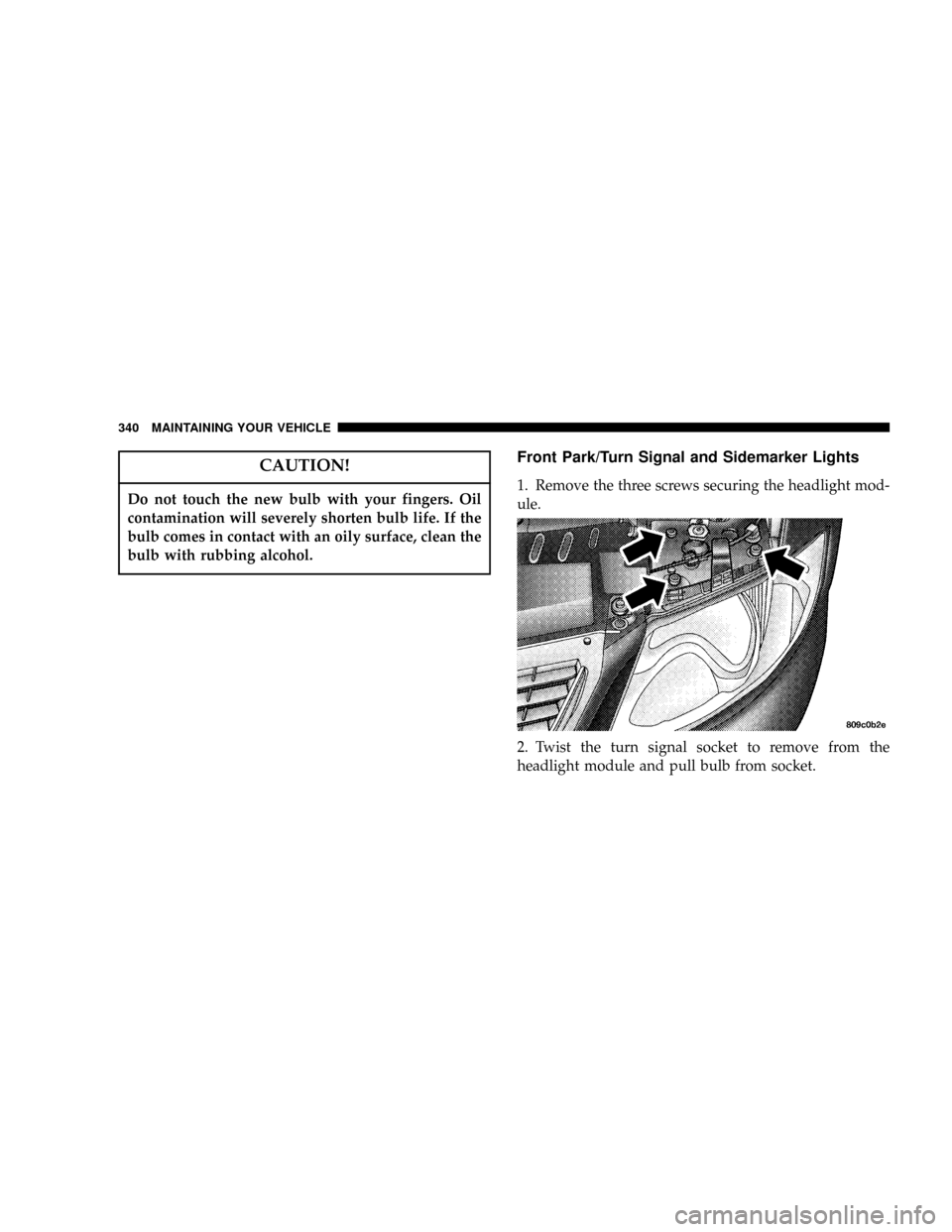
Front Park/Turn Signal and Sidemarker Lights
1. Remove the three screws securing the headlight mod-
ule.
2. Twist the turn signal socket to remove from the
headlight module and pull bulb from socket.
340 MAINTAINING YOUR VEHICLE
Page 341 of 397

3. Replace bulb, reinstall socket and then reinstall the
headlight module.
Front Fog Light
1. Reach behind the front fascia from under the vehicle.
2. Twist the front fog light bulb to remove from the fog
light module.
3. Disconnect the electrical connector and replace the
bulb.
CAUTION!
Do not touch the new bulb with your fingers. Oil
contamination will severely shorten bulb life. If the
bulb comes in contact with an oily surface, clean the
bulb with rubbing alcohol.
MAINTAINING YOUR VEHICLE 341
7