service DODGE CARAVAN 2004 4.G Owner's Guide
[x] Cancel search | Manufacturer: DODGE, Model Year: 2004, Model line: CARAVAN, Model: DODGE CARAVAN 2004 4.GPages: 397, PDF Size: 6.83 MB
Page 266 of 397

FUEL REQUIREMENTS
Your vehicle is designed to meet all emis-
sion regulations and provide excellent fuel
economy when using high quality regular
unleaded gasoline with an octane rating of
87. The use of premium gasoline is not
recommended. The use of premium gaso-
line will provide no benefit over high quality regular
gasolines, and in some circumstances, may result in
poorer performance.
Light spark knock at low engine speeds is not harmful to
your engine. However, continued heavy spark knock at
high speeds can cause damage and immediate service is
required. Engine damage resulting from operating with a
heavy spark knock may not be covered by the new
vehicle warranty.Poor quality gasoline can cause problems such as hard
starting, stalling and hesitations. If you experience these
symptoms, try another brand of ªregularº gasoline be-
fore considering service for the vehicle.
Over 40 automobile manufacturers around the world
have issued and endorsed consistent gasoline specifica-
tions (the World Wide Fuel Charter, WWFC) to define
fuel properties necessary to deliver enhanced emissions,
engine performance, and durability for your vehicle. The
manufacturer recommends the use of gasolines that meet
the WWFC specifications if they are available.
Reformulated Gasoline
Many areas of the country require the use of cleaner
burning gasoline referred to as ªReformulated Gasolineº.
Reformulated gasolines contain oxygenates, and are spe-
cifically blended to reduce vehicle emissions and im-
prove air quality.
266 STARTING AND OPERATING
Page 268 of 397

It is even more important to look for gasolines without
MMT in Canada, because MMT can be used at levels
higher than those allowed in the United States.
MMT is prohibited in Federal and California reformu-
lated gasolines.
Sulfur In Gasoline
Your vehicle may have been designed to meet California
low emission standards when using cleaner burning
California reformulated gasoline with low sulfur. This
vehicle may be sold nationwide. Your vehicle will oper-
ate satisfactorily on fuels meeting Federal specification,
but emission control system performance may be ad-
versely affected.
Gasoline sold outside of California is permitted to have
higher sulfur levels which may affect the performance of
the vehicle's catalytic converter. This may cause the
Malfunction Indicator Light to illuminate. The manufac-
turer recommends that you try a different brand ofunleaded gasoline having lower sulfur to determine if the
problem is fuel related prior to returning your vehicle to
an authorized dealer for service.
CAUTION!
If the Malfunction Indicator light is flash-
ing, immediate service is required. Refer to
the paragraph on the Onboard Diagnostics
System in section 7 of this manual.
Materials Added to Fuel
All gasoline sold in the United States is required to
contain effective detergent additives. Use of additional
detergents or other additives are not needed under
normal conditions and would result in additional cost.
Therefore you should not have to add anything to the
fuel.
268 STARTING AND OPERATING
Page 269 of 397

Fuel System Cautions
CAUTION!
Follow these guidelines to maintain your vehicle's
performance:
²The use of leaded gas is prohibited by Federal law.
Using leaded gasoline can impair engine performance,
damage the emission control system, and could result
in loss of warranty coverage.
²An out-of-tune engine, or certain fuel or ignition
malfunctions, can cause the catalytic converter to
overheat. If you notice a pungent burning odor or
some light smoke, your engine may be out-of-tune or
malfunctioning and may require immediate service.
Contact your dealer for service assistance.
²The use of fuel additives which are now being sold as
octane enhancers are not recommended. Most of these
products contain high concentrations of methanol.
Fuel system damage or vehicle performance problems
resulting from the use of such fuels or additives are not
the responsibility of the manufacturer and may not be
covered under the New Vehicle Warranty.
NOTE:Intentional tampering with emissions control
systems can result in civil penalties being assessed
against you.
Carbon Monoxide Warnings
WARNING!
Carbon monoxide (CO) in exhaust gases is deadly.
Follow the precautions below to prevent carbon
monoxide poisoning:
STARTING AND OPERATING 269
5
Page 273 of 397
²Vehicle Identification Number (VIN)
²Type of Vehicle
²Month Day and Hour of Manufacture (MDH)
The bar code allows a computer scanner to read the
Vehicle Identification Number (VIN).
Gross Vehicle Weight Rating (GVWR)
The GVWR is the total allowable weight of your vehicle.
This includes driver, passengers, and cargo. The total
load must be limited so that you do not exceed the
GVWR.
Gross Axle Weight Rating (GAWR)
The GAWR is the maximum capacity of the front and rear
axles. Distribute the load over the front and rear axles
evenly. Make sure that you do not exceed either front or
rear GAWR.
WARNING!
Because the front wheels drive and steer the vehicle,
it is important that you do not exceed the maximum
front or rear GAWR. A dangerous driving condition
can result if either rating is exceeded. You could lose
control of the vehicle and have an accident.
Overloading
The load carrying components (axle, springs, tires,
wheels, etc.) of your vehicle will provide satisfactory
service as long as you do not exceed the GVWR and front
and rear GAWR.
The best way to figure out the total weight of your
vehicle is to weigh it when it is fully loaded and ready for
operation. Weigh it on a commercial scale to insure that it
is not over the GVWR.
STARTING AND OPERATING 273
5
Page 274 of 397

Figure out the weight on the front and rear of the vehicle
separately. It is important that you distribute the load
evenly over the front and rear axles.
Overloading can cause potential safety hazards and
shorten useful service life. Heavier axles or suspension
components do not necessarily increase the vehicle's
GVWR.
Loading
To load your vehicle properly, first figure out its empty
weight, axle by axle and side by side. Store heavier items
down low and be sure you distribute their weight as
evenly as possible. Stow all loose items securely before
driving. If weighing the loaded vehicle shows that you
have exceeded either GAWR, but the total load is within
the specified GVWR, you must redistribute the weight.
Improper weight distribution can have an adverse effect
on the way your vehicle steers and handles and the way
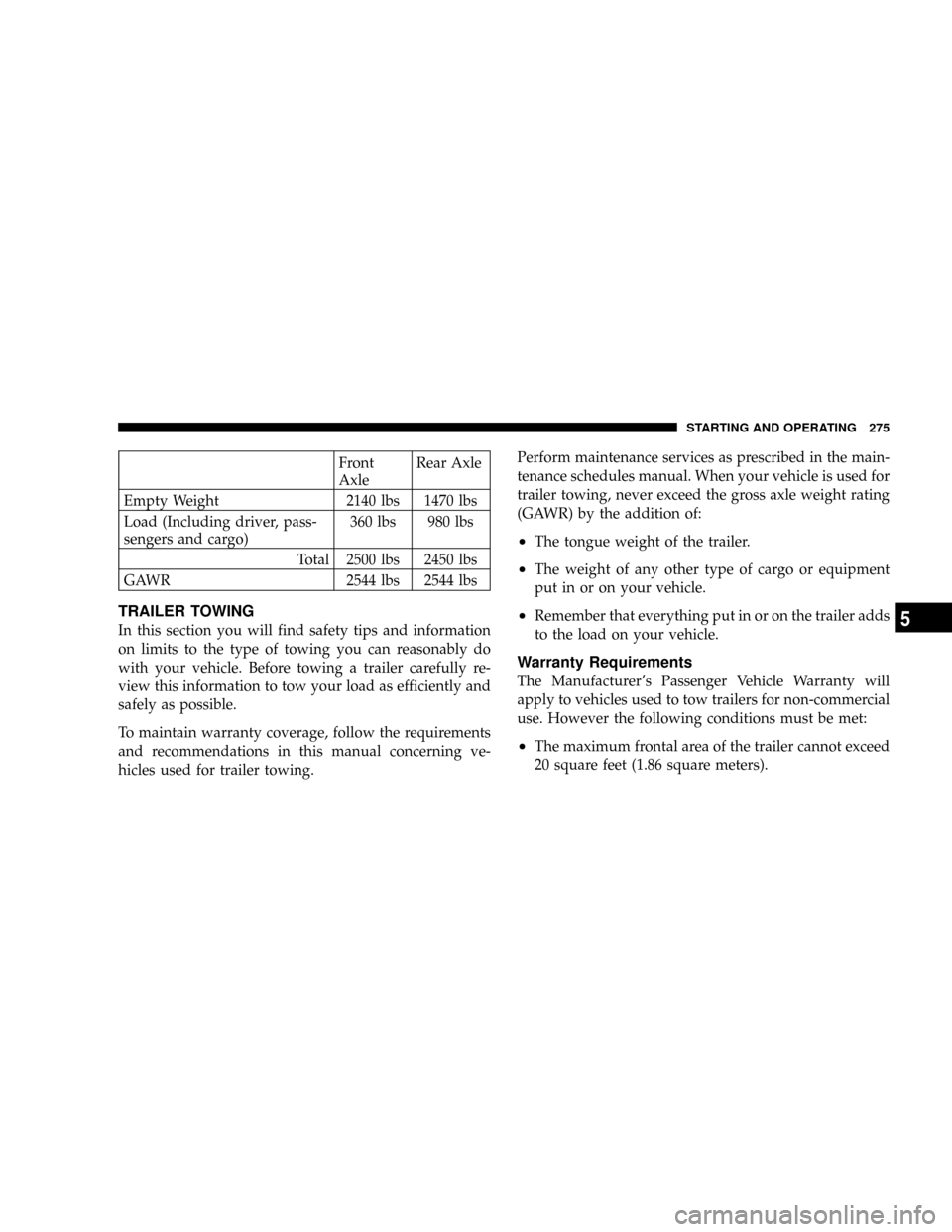
the brakes operate.A loaded vehicle is shown in the illustration. Note that
neither the GVWR or the GAWR capacities have been
exceeded.
274 STARTING AND OPERATING
Page 275 of 397
Front
AxleRear Axle
Empty Weight 2140 lbs 1470 lbs
Load (Including driver, pass-
sengers and cargo)360 lbs 980 lbs
Total 2500 lbs 2450 lbs
GAWR 2544 lbs 2544 lbs
TRAILER TOWING
In this section you will find safety tips and information
on limits to the type of towing you can reasonably do
with your vehicle. Before towing a trailer carefully re-
view this information to tow your load as efficiently and
safely as possible.
To maintain warranty coverage, follow the requirements
and recommendations in this manual concerning ve-
hicles used for trailer towing.Perform maintenance services as prescribed in the main-
tenance schedules manual. When your vehicle is used for
trailer towing, never exceed the gross axle weight rating
(GAWR) by the addition of:
²The tongue weight of the trailer.
²The weight of any other type of cargo or equipment
put in or on your vehicle.
²Remember that everything put in or on the trailer adds
to the load on your vehicle.
Warranty Requirements
The Manufacturer's Passenger Vehicle Warranty will
apply to vehicles used to tow trailers for non-commercial
use. However the following conditions must be met:
²The maximum frontal area of the trailer cannot exceed
20 square feet (1.86 square meters).
STARTING AND OPERATING 275
5
Page 281 of 397

IF YOUR ENGINE OVERHEATS
In any of the following situations, you can reduce the
potential for overheating by taking the appropriate ac-
tion.
²On the highways Ð Slow down.
²In city traffic Ð While stopped, put transaxle in
neutral, but do not increase engine idle speed.
NOTE:There are steps that you can take to slow down
an impending overheat condition. If your air conditioner
is on, turn it off. The air conditioning system adds heat to
the engine cooling system and turning off the A/C
removes this heat. You can also turn the Temperature
control to maximum heat, the Mode control to floor, and
the fan control to High. This allows the heater core to act
as a supplement to the radiator and aids in removing heat
from the engine cooling system.
CAUTION!
Driving with a hot cooling system could damage
your vehicle. If temperature gauge reads ªHº, pull
over and stop the vehicle. Idle the vehicle with the
air conditioner turned off until the pointer drops
back into the normal range. If the pointer remains on
the ªHº, turn the engine off immediately, and call for
service.
WHAT TO DO IN EMERGENCIES 281
6
Page 282 of 397
WARNING!
A hot engine cooling system is dangerous. You or
others could be badly burned by steam or boiling
coolant. You may want to call a service center if your
vehicle overheats. If you decide to look under the
hood yourself, see Section 7, Maintenance, of this
manual. Follow the warnings under the Cooling
System Pressure Cap paragraph.
JACKING AND TIRE CHANGING
WARNING!
²Getting under a jacked-up vehicle is dangerous.
The vehicle could slip off the jack and fall on you.
You could be crushed. Never get any part of your
body under a vehicle that is on a jack. If you need
to get under a raised vehicle, take it to a service
center where it can be raised on a lift.
²The jack is designed to use as a tool for changing
tires only. The jack should not be used to lift the
vehicle for service purposes. The vehicle should
be jacked on a firm level surface only. Avoid ice or
slippery areas.
282 WHAT TO DO IN EMERGENCIES
Page 287 of 397
about the correct tightness, have them checked with a
torque wrench by your dealer or at a service station.
10. Lower the jack to its fully closed position.
WARNING!
A loose tire or jack, thrown forward in a collision or
hard stop could endanger the occupants of the ve-
hicle. Always stow the jack parts and the spare tire in
the places provided.
11. Secure the flat or spare tire as follows:
²If your vehicle is equipped with cast aluminum
wheels, the center cap of the wheel must be re-
moved prior to flat tire stowage. Store the center cap
inside the glove box or other storage compartment.
²Turn the wheel so that the valve-stem is down. Slide
the wheel retainer through the center of the wheel
and position it properly across the wheel opening.
²For convenience in checking the spare tire inflation,
stow with the valve-stem toward the rear of the
vehicle.
²Using the jack-handle, rotate the drive nut to the
right until the wheel is drawn into place against the
underside of the vehicle.
²Continue to rotate the nut until you hear the mecha-
nism click three times. It cannot be overtightened.
Push against the tire several times to be sure it is
securely in place.
12. Stow jack and handle.
13. Check the tire pressure as soon as possible. Correct
pressure as required.
WHAT TO DO IN EMERGENCIES 287
6
Page 295 of 397

MAINTAINING YOUR VEHICLE
CONTENTS
m2.4L Engine...........................298
m3.3L/3.8L Engines......................299
mOnboard Diagnostic System Ð OBD II........300
mEmissions Inspection And Maintenance
Programs............................301
mReplacement Parts......................302
mDealer Service.........................302
mMaintenance Procedures..................303
NEngine Oil..........................303NEngine Oil Filter......................307
NDrive Belts Ð Check Condition And Tension . . 307
NSpark Plugs.........................308
NEngine Air Cleaner Filter................308
NEngine Fuel Filter.....................309
NCatalytic Converter....................309
NMaintenance-Free Battery................311
NAir Conditioner......................312
NPower Steering Ð Fluid Check............314
7