service DODGE CARAVAN 2008 5.G Workshop Manual
[x] Cancel search | Manufacturer: DODGE, Model Year: 2008, Model line: CARAVAN, Model: DODGE CARAVAN 2008 5.GPages: 531, PDF Size: 7.72 MB
Page 449 of 531
WARNING!
A hot exhaust system can start a fire if you park over
materials that can burn. Such materials might be
grass or leaves coming into contact with your exhaust
system. Do not park or operate your vehicle in areas
where your exhaust system can contact anything that
can burn.
In unusual situations involving grossly malfunctioning
engine operation, a scorching odor may indicate severe
and abnormal catalyst overheating. If this occurs, the
vehicle should be stopped, the engine shut off and the
vehicle allowed to cool. Thereafter, service, including a
tune-up to manufacturer's specifications, should be ob-
tained immediately.To minimize the possibility of catalyst damage:²Do not shut off the engine or interrupt the ignition
when the transaxle is in gear and the vehicle is in
motion.
²Do not try to start engine by pushing or towing the
vehicle.
²Do not idle the engine with any spark plug wires
disconnected or removed, such as when diagnostic
testing, or for prolonged periods during very rough
idling or malfunctioning operating conditions.
Exhaust System
The best protection against carbon monoxide entry into
the vehicle body is a properly maintained engine exhaust
system.
MAINTAINING YOUR VEHICLE 447
7
Page 452 of 531
AIR CONDITIONER MAINTENANCE
For best possible performance, your air conditioner
should be checked and serviced by an authorized dealer
at the start of each warm season. This service should
include cleaning of the condenser fins and a system
performance check. Drive belt tension should also be
checked at this time.WARNING!
²Use only refrigerants and compressor lubricants
approved by the manufacturer for your air condi-
tioning system. Some unapproved refrigerants are
flammable and can explode, injuring you. Other
unapproved refrigerants or lubricants can cause
the system to fail, requiring costly repairs. Refer to
Section 3 of the Warranty Information book for
further warranty information.
²The air conditioning system contains refrigerant
under high pressure. To avoid risk of personal
injury or damage to the system, adding refrigerant
or any repair requiring lines to be disconnected
should be done by an experienced repairman.
450 MAINTAINING YOUR VEHICLE
Page 453 of 531
Refrigerant Recovery And Recycling
R-134a Air Conditioning Refrigerant is a hydrofluoro-
carbon (HFC) that is endorsed by the Environmental
Protection Agency and is an ozone-saving product. How-
ever, the manufacturer recommends that air conditioning
service be performed by an authorized dealer or other an
authorized service facility using recovery and recycling
equipment.
NOTE:Use only manufacturer approved A/C System
Sealers, Stop Leak Products, Seal Conditioners, Compres-
sor Oil, or Refrigerants.
A/C Air Filter Ð If Equipped
Refer to the ªMaintenance Scheduleº in Section 8 of this
manual for A/C Air Filter service intervals.
WARNING!
Do not remove the A/C Air Filter while the blower is
operating or personal injury may result.
The A/C Air Filter is located in the fresh air inlet behind
the glove box. Perform the following procedure to re-
place the filter:
1. Open the glove box and remove all contents.
2. Push in on the sides of the glove box and lower the
door.
3. Pivot the glove box downward.
MAINTAINING YOUR VEHICLE 451
7
Page 454 of 531
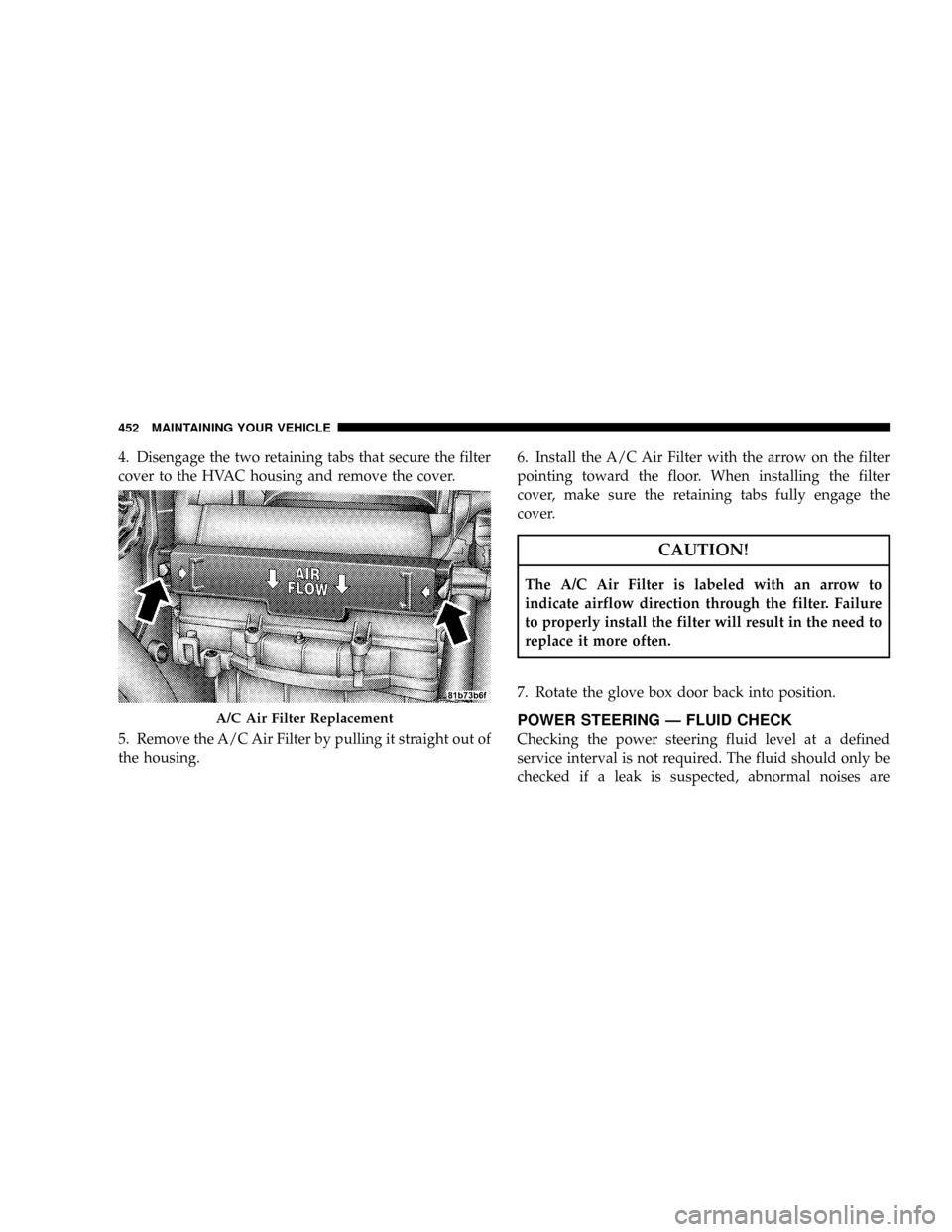
4. Disengage the two retaining tabs that secure the filter
cover to the HVAC housing and remove the cover.
5. Remove the A/C Air Filter by pulling it straight out of
the housing.6. Install the A/C Air Filter with the arrow on the filter
pointing toward the floor. When installing the filter
cover, make sure the retaining tabs fully engage the
cover.
CAUTION!
The A/C Air Filter is labeled with an arrow to
indicate airflow direction through the filter. Failure
to properly install the filter will result in the need to
replace it more often.
7. Rotate the glove box door back into position.
POWER STEERING Ð FLUID CHECK
Checking the power steering fluid level at a defined
service interval is not required. The fluid should only be
checked if a leak is suspected, abnormal noises are
A/C Air Filter Replacement
452 MAINTAINING YOUR VEHICLE
Page 456 of 531
DRIVE SHAFT UNIVERSAL JOINTS
Your vehicle has constant velocity universal joints. Peri-
odic lubrication of these joints is not required. However,
the joint boots should be inspected for external leakage or
damage when other maintenance is performed. If leakage
or damage is evident, the universal joint boot and grease
should be replaced immediately.
Continued operation could result in failure of the univer-
sal joint due to water and dirt contamination of the
grease. This would require complete replacement of the
joint assembly.
BODY LUBRICATION
Locks and all body pivot points, including such items as
seat tracks, doors, liftgate, sliding doors and hood hinges,
should be lubricated periodically to assure quiet, easy
operation and to protect against rust and wear. Prior to
the application of any lubricant, the parts concerned
should be wiped clean to remove dust and grit; afterlubricating excess oil and grease should be removed.
Particular attention should also be given to hood latching
components to ensure proper function. When performing
other underhood services, the hood latch, release mecha-
nism and safety catch should be cleaned and lubricated.
The external lock cylinders should be lubricated twice a
year, preferably in the Fall and Spring. Apply a small
amount of a high quality lubricant such as MopartLock
Cylinder Lubricant directly into the lock cylinder.
WINDSHIELD WIPER BLADES
The rubber edges of the wiper blades and the windshield
should be cleaned periodically with a sponge or soft cloth
and a mild nonabrasive cleaner. This will remove accu-
mulations of salt or road film.
Operation of the wipers on dry glass for long periods
may cause deterioration of the wiper blades. Always use
washer fluid when using the wipers to remove salt or dirt
from a dry windshield.
454 MAINTAINING YOUR VEHICLE
Page 461 of 531
WARNING!
²The warning words ªDO NOT OPEN HOTº on
the cooling system pressure cap are a safety pre-
caution. Never add coolant when the engine is
overheated. Do not loosen or remove the cap to
cool an overheated engine. Heat causes pressure to
build up in the cooling system. To prevent scald-
ing or injury, do not remove the pressure cap while
the system is hot or under pressure.
²Do not use a pressure cap other than the one
specified for your vehicle. Personal injury or en-
gine damage may result.
Disposal of Used Coolant
Used ethylene glycol-based engine coolant is a regulated
substance requiring proper disposal. Check with your
local authorities to determine the disposal rules for yourcommunity. To prevent ingestion by animals or children
do not store ethylene glycol-based engine coolant in open
containers or allow it to remain in puddles on the
ground. If ingested by a child, contact a physician
immediately. Clean up any ground spills immediately.
Coolant Level
The coolant bottle provides a quick visual method for
determining that the coolant level is adequate. With the
engine cold, the level of the coolant in the coolant
recovery bottle should be between the ranges indicated
on the bottle.
The radiator normally remains completely full, so there is
no need to remove the radiator cap unless checking for
coolant freeze point or replacing coolant. Advise your
service attendant of this. As long as the engine operating
temperature is satisfactory, the coolant bottle need only
be checked once a month.
MAINTAINING YOUR VEHICLE 459
7
Page 463 of 531
²Do not change the thermostat for summer or winter
operation. If replacement is ever necessary, install
ONLY the correct type thermostat. Other designs may
result in unsatisfactory coolant performance, poor gas
mileage, and increased emissions.
HOSES AND VACUUM/VAPOR HARNESSES
Inspect surfaces of hoses and nylon tubing for evidence
of heat and mechanical damage. Hard or soft spots,
brittle rubber, cracking, tears, cuts, abrasions, and exces-
sive swelling indicate deterioration of the rubber.
Pay particular attention to those hoses nearest to high
heat sources such as the exhaust manifold. Inspect hose
routing to be sure hoses do not come in contact with any
heat source or moving component which may cause heat
damage or mechanical wear.
Ensure nylon tubing in these areas has not melted or
collapsed.Inspect all hose connections such as clamps and cou-
plings to make sure they are secure and no leaks are
present.
Components should be replaced immediately if there is
any evidence of wear or damage that could cause failure.FUEL SYSTEM CONNECTIONS
The Electronic Fuel Injection high-pressure fuel system's
hoses and quick connect fittings have unique material
characteristics that provide adequate sealing and resist
attack by deteriorated gasoline.
You are urged to use only the manufacture specified
hoses with quick connect fittings, or their equivalent in
material and specification, in any fuel system servicing. It
is mandatory to replace any damaged hoses or quick
connect fittings that have been removed during service.
Care should be taken in installing quick connect fittings
to ensure they are properly installed and fully connected.
See your authorized dealer for service.
MAINTAINING YOUR VEHICLE 461
7
Page 464 of 531
BRAKES
In order to assure brake system performance, all brake
system components should be inspected periodically.
Suggested service intervals can be found in the Mainte-
nance Schedules.
WARNING!
Riding the brakes can lead to brake failure and
possibly an accident. Driving with your foot resting
or riding on the brake pedal can result in abnormally
high brake temperatures, excessive lining wear, and
possible brake damage. You wouldn't have your full
braking capacity in an emergency.
Brake And Power Steering Hoses
When the vehicle is serviced for scheduled maintenance,
inspect surface of hoses and nylon tubing for evidence of
heat and mechanical damage. Hard and brittle rubber,cracking, tears, cuts, abrasion, and excessive swelling
indicate deterioration of the rubber. Particular attention
should be made to examining those hose surfaces nearest
to high heat sources, such as the exhaust manifold.
Ensure nylon tubing in these areas has not melted or
collapsed.
Inspect all hose connections such as clamps and cou-
plings to make sure they are secure and no leaks are
present.
NOTE:Often, fluid such as oil, power steering fluid,
and brake fluid are used during assembly plant opera-
tions to facilitate the assembly of hoses to couplings.
Therefore, oil wetness at the hose-coupling area is not
necessarily an indication of leakage. Actual dripping of
hot fluid when systems are under pressure (during
vehicle operation), should be noted before hose is re-
placed based on leakage.
462 MAINTAINING YOUR VEHICLE
Page 465 of 531
NOTE:Inspection of brake hoses should be performed
whenever the brake system is serviced and every engine
oil change. Inspect hydraulic brake hoses for surface
cracking, scuffing, or worn spots. If there is any evidence
of cracking, scuffing, or worn spots, the hose should be
replaced immediately! Eventual deterioration of the hose
can take place resulting in a possibility of a burst failure.
WARNING!
Worn brake hoses can burst and cause brake failure.
You could have an accident. If you see any signs of
cracking, scuffing, or worn spots, have the brake
hoses replaced immediately.
Master Cylinder Ð Brake Fluid Level Check
The fluid level in the master cylinder should be checked
when performing underhood services, or immediately if
the brake system warning light indicates system failure.
Clean the top of the master cylinder area before removing
the cap. Add fluid to bring the level up to the top of the
ªFULLº mark on the side of the master cylinder reservoir.
Overfilling of fluid is not recommended because it may
cause leaking in the system.
Add enough fluid to bring the level up to the require-
ments described on the brake fluid reservoir. With disc
brakes, fluid level can be expected to fall as the brake
pads wear. However, low fluid level may be caused by a
leak and a checkup may be needed.
Use only manufacturer's recommended brake fluid, refer
to Fluids, Lubricants and Genuine Parts for correct fluid
type.
MAINTAINING YOUR VEHICLE 463
7
Page 466 of 531
WARNING!
²Overfilling the brake fluid reservoir can result in
spilling brake fluid on hot engine parts and the
brake fluid catching fire.
²Use of a brake fluid that has a lower initial boiling
point than the recommended MOPARtDOT 3
product or a brake fluid that is unidentified as to
FMVSS specification may result in sudden brake
failure during hard prolonged braking. You could
have an accident.
Use only brake fluid that has been in a tightly closed
container to avoid contamination from foreign matter or
moisture.
CAUTION!
Do not allow petroleum base fluid to contaminate the
brake fluid Ð all brake seal components could be
damaged causing partial or complete brake failure.
AUTOMATIC TRANSAXLE
The automatic transaxle and differential assembly are
contained within a single housing.
The fluid level in the automatic transaxle should be
checked whenever the vehicle is serviced. Operation with
an improper fluid level will greatly reduce the life of the
transaxle and the fluid.
All Four±Speed automatic transaxles are equipped with a
conventional filler tube and dipstick. If fluid is added, it
should be added through the filler tube.
464 MAINTAINING YOUR VEHICLE