check engine light DODGE CHALLENGER 2019 User Guide
[x] Cancel search | Manufacturer: DODGE, Model Year: 2019, Model line: CHALLENGER, Model: DODGE CHALLENGER 2019Pages: 532, PDF Size: 5.01 MB
Page 204 of 532
The best protection against carbon monoxide entry into the
vehicle body is a properly maintained engine exhaust
system.
Whenever a change is noticed in the sound of the exhaust
system, when exhaust fumes can be detected inside the
vehicle, or when the underside or rear of the vehicle is
damaged, have a competent mechanic inspect the complete
exhaust system and adjacent body areas for broken, dam-
aged, deteriorated, or mispositioned parts. Open seams or
loose connections could permit exhaust fumes to seep into
the passenger compartment. In addition, inspect the ex-
haust system each time the vehicle is raised for lubrication
or oil change. Replace as required.
Safety Checks You Should Make Inside The Vehicle
Seat Belts
Inspect the seat belt system periodically, checking for cuts,
frays, and loose parts. Damaged parts must be replaced
immediately. Do not disassemble or modify the system.
Front seat belt assemblies must be replaced after a collision.
Rear seat belt assemblies must be replaced after a collision
if they have been damaged (i.e., bent retractor, torn web-
bing, etc.). If there is any question regarding seat belt or
retractor condition, replace the seat belt.
Air Bag Warning Light
The Air Bag warning lightwill turn on for four to
eight seconds as a bulb check when the ignition switch
is first turned to ON/RUN. If the light is either not on
during starting, stays on, or turns on while driving,
have the system inspected at an authorized dealer as
soon as possible. After the bulb check, this light will
illuminate with a single chime when a fault with the Air
Bag System has been detected. It will stay on until the
fault is removed. If the light comes on intermittently or
remains on while driving, have an authorized dealer
service the vehicle immediately.
Refer to “Occupant Restraint Systems” in “Safety” for
further information.
Defroster
Check operation by selecting the defrost mode and place
the blower control on high speed. You should be able to
feel the air directed against the windshield. See an autho-
rized dealer for service if your defroster is inoperable.
Floor Mat Safety Information
Always use floor mats designed to fit your vehicle. Only
use a floor mat that does not interfere with the operation of
the accelerator, brake or clutch pedals. Only use a floor mat
202 SAFETY
Page 205 of 532
that is securely attached using the floor mat fasteners so it
cannot slip out of position and interfere with the accelera-
tor, brake or clutch pedals or impair safe operation of your
vehicle in other ways.
WARNING!
An improperly attached, damaged, folded, or stacked
floor mat, or damaged floor mat fasteners may cause
your floor mat to interfere with the accelerator, brake,
or clutch pedals and cause a loss of vehicle control. To
prevent SERIOUS INJURY or DEATH:
•ALWAYS securely attach
your floor mat using the
floor mat fasteners. DO NOT install your floor mat
upside down or turn your floor mat over. Lightly pull
to confirm mat is secured using the floor mat fasten-
ers on a regular basis.
• ALWAYS REMOVE THE EXISTING FLOOR MAT
FROM THE VEHICLE
before installing any other
floor mat. NEVER install or stack an additional floor
mat on top of an existing floor mat.
• ONLY install floor mats designed to fit your vehicle.
NEVER install a floor mat that cannot be properly
attached and secured to your vehicle. If a floor mat
(Continued)
WARNING! (Continued)
needs to be replaced, only use a FCA approved floor
mat for the specific make, model, and year of your
vehicle.
• ONLY use the driver ’s side floor mat on the driver ’s
side floor area. To check for interference, with the
vehicle properly parked with the engine off, fully
depress the accelerator, the brake, and the clutch
pedal (if present) to check for interference. If your
floor mat interferes with the operation of any pedal,
or is not secure to the floor, remove the floor mat
from the vehicle and place the floor mat in your
trunk.
• ONLY use the passenger ’s side floor mat on the
passenger ’s side floor area.
• ALWAYS make sure objects cannot fall or slide into
the driver ’s side floor area when the vehicle is
moving. Objects can become trapped under accelera-
tor, brake, or clutch pedals and could cause a loss of
vehicle control.
• NEVER place any objects under the floor mat (e.g.,
towels, keys, etc.). These objects could change the
(Continued)
5
SAFETY 203
Page 217 of 532
It is recommended for the operator to observe the follow-
ing driving behaviors during the new vehicle break-in
period:
0 to 100 miles (0 to 161 km):
•Do not allow the engine to operate at idle for an
extended period of time.
• Press the accelerator pedal slowly and not more than
halfway to avoid rapid acceleration.
• Avoid aggressive braking.
• Drive with the engine speed less than 3,500 RPM.
• Maintain vehicle speed below 55 mph (88 km/h) and
observe local speed limits.
100 to 300 miles (161 to 483 km):
• Press the accelerator pedal slowly and not more than
halfway to avoid rapid acceleration in lower gears (1st to
3rd gears).
• Avoid aggressive braking.
• Drive with the engine speed less than 5,000 RPM.
• Maintain vehicle speed below 70 mph (112 km/h) and
observe local speed limits. 300 to 500 miles (483 to 805 km):
•
Exercise the full engine rpm range, shifting manually
(paddles or gear shift) at higher rpms when possible.
• Do not perform sustained operation with the accelerator
pedal at wide open throttle.
• Maintain vehicle speed below 85 mph (136 km/h) and
observe local speed limits.
For the first 1500 miles (2414 km):
• Do not participate in track events, sport driving schools,
or similar activities during the first 1500 miles (2414 km).
NOTE: Check engine oil with every refueling and add if
necessary. Oil and fuel consumption may be higher
through the first oil change interval.
PARKING BRAKE
Before leaving the vehicle, make sure that the parking
brake is fully applied and place the gear selector in the
PARK or REVERSE (manual transmission only) position.
When the parking brake is applied and the ignition switch
is in the ON/RUN position, the “Brake Warning Light” in
the instrument cluster will illuminate.
6
STARTING AND OPERATING 215
Page 280 of 532
Shallow Standing Water
Although your vehicle is capable of driving through shal-
low standing water, consider the following Cautions and
Warnings before doing so.
WARNING!
•Driving through standing water limits your vehicle’s
traction capabilities. Do not exceed 5 mph (8 km/h)
when driving through standing water.
• Driving through standing water limits your vehicle’s
braking capabilities, which increases stopping dis-
tances. Therefore, after driving through standing
water, drive slowly and lightly press on the brake
pedal several times to dry the brakes.
• Failure to follow these warnings may result in inju-
ries that are serious or fatal to you, your passengers,
and others around you.
CAUTION!
• Always check the depth of the standing water before
driving through it. Never drive through standing
water that is deeper than the bottom of the tire rims
mounted on the vehicle.
• Determine the condition of the road or the path that
is under water and if there are any obstacles in the
way before driving through the standing water.
• Do not exceed 5 mph (8 km/h) when driving through
standing water. This will minimize wave effects.
• Driving through standing water may cause damage
to your vehicle’s drivetrain components. Always in-
spect your vehicle’s fluids (i.e., engine oil, transmis-
sion, axle, etc.) for signs of contamination (i.e., fluid
that is milky or foamy in appearance) after driving
through standing water. Do not continue to operate
the vehicle if any fluid appears contaminated, as this
may result in further damage. Such damage is not
covered by the New Vehicle Limited Warranty.
• Getting water inside your vehicle’s engine can cause
it to lock up and stall out, and cause serious internal
damage to the engine. Such damage is not covered by
the New Vehicle Limited Warranty.
278 STARTING AND OPERATING
Page 339 of 532
SCHEDULED SERVICING
3.6L And 5.7L Engines
Your vehicle is equipped with an automatic oil change
indicator system. The oil change indicator system will
remind you that it is time to take your vehicle in for
scheduled maintenance.
Based on engine operation conditions, the oil change
indicator message will illuminate. This means that service
is required for your vehicle. Operating conditions such as
frequent short-trips, trailer tow, extremely hot or cold
ambient temperatures, and E85 fuel usage will influence
when the “Change Oil” or “Oil Change Required” message
is displayed. Severe Operating Conditions can cause the
change oil message to illuminate as early as 3,500 miles
(5,600 km) since last reset. Have your vehicle serviced as
soon as possible, within the next 500 miles (800 km).
The “Oil Change Required” message will be displayed in
the instrument cluster and a single chime will sound,
indicating that an oil change is necessary.
Your authorized dealer will reset the oil change indicator
message after completing the scheduled oil change. If a
scheduled oil change is performed by someone other than
your authorized dealer, the message can be reset byreferring to “Instrument Cluster Display” in “Getting To
Know Your Instrument Panel” for further information.
NOTE:
Under no circumstances should oil change inter-
vals exceed 10,000 miles (16,000 km), 12 months or 350
hours of engine run time, whichever comes first. The 350
hours of engine run or idle time is generally only a concern
for fleet customers.
Severe Duty All Models
Change Engine Oil at 4,000 miles (6,500 km) or 350 hours of
engine run time if the vehicle is operated in a dusty and
off-road environment, or is operated predominantly at idle
or only very low engine RPM’s. This type of vehicle use is
considered Severe Duty.
Once A Month Or Before A Long Trip:
• Check engine oil level.
• Check windshield washer fluid level.
• Check tire pressure and look for unusual wear or
damage. Rotate tires at the first sign of irregular wear,
even if it occurs before your next scheduled service.
• Check the fluid levels of the coolant reservoir, brake
master cylinder, and power steering (if equipped) and
fill as needed.
• Check function of all interior and exterior lights.
8
SERVICING AND MAINTENANCE 337
Page 344 of 532
At Each Stop For Fuel
•Check the engine oil level. Refer to “Engine Compart-
ment” in this chapter for further information.
•
Check the windshield washer solvent and add if required.
Once A Month
• Check tire pressure and look for unusual wear or
damage.
• Inspect the battery, and clean and tighten the terminals
as required.
• Check the fluid levels of the coolant reservoir, brake
master cylinder, and add as needed. •
Check all lights and other electrical items for correct
operation.
At Each Oil Change
• Change the engine oil filter.
• Inspect the brake hoses and lines.
CAUTION!
Failure to perform the required maintenance items
may result in damage to the vehicle.
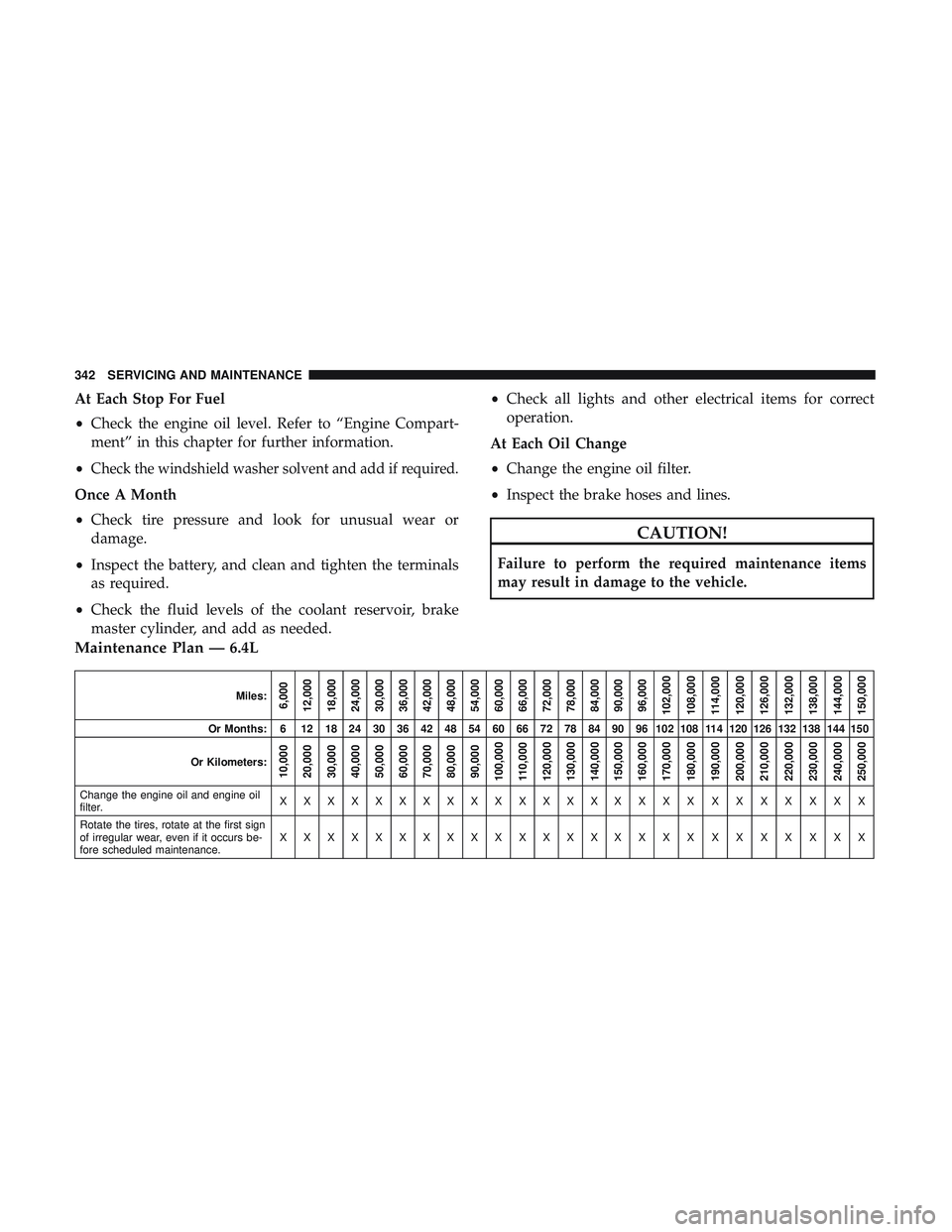
Maintenance Plan — 6.4L
Miles:6,000
12,000
18,000
24,000
30,000
36,000
42,000
48,000
54,000
60,000
66,000
72,000
78,000
84,000
90,000
96,000
102,000
108,000
114,000
120,000
126,000
132,000
138,000
144,000
150,000
Or Months: 6 12 18 24 30 36 42 48 54 60 66 72 78 84 90 96 102 108 114 120 126 132 138 144 150
Or Kilometers:
10,000
20,000
30,000
40,000
50,000
60,000
70,000
80,000
90,000
100,000
110,000
120,000
130,000
140,000
150,000
160,000
170,000
180,000
190,000
200,000
210,000
220,000
230,000
240,000
250,000
Change the engine oil and engine oil
filter. XXXXXXXXXXXXXXXXXXXXXXXXX
Rotate the tires, rotate at the first sign
of irregular wear, even if it occurs be-
fore scheduled maintenance. XXXXXXXXXXXXXXXXXXXXXXXXX
342 SERVICING AND MAINTENANCE
Page 358 of 532
Engine Air Cleaner Filter Selection
The quality of replacement engine air cleaner filters varies
considerably. Only high quality filters should be used to
assure most efficient service. Mopar engine air cleaner
filters are a high quality filter and are recommended.
T/A Air Filter Maintenance — If Equipped
Clean Engine Air Filter
The scheduled air filter cleaning interval is 30,000 miles
(48,280 km), or if in a dusty environment the engine air filter
should be checked periodically to ensure optimal air flow.
Cleaning your engine air filter with the recommended
Mopar Performance Air Filter Service Kit is not required if
you can still see any part the wire screen on the entire air
filter regardless of how dirty it may appear. When any part
of the wire screen is no longer visible on the air filter, that
is an indication it is time to clean the air filter.
1. Spray the air filter with the recommended Mopar airfilter cleaner and let sit for at least 10 minutes to loosen
dirt, before rinsing.
NOTE: Never use strong detergents, high pressure, or
gasoline on air filter. 2. Rinse the air filter with cool low-pressure water applied
from the inside (clean side) out in order to flush the dirt
out of the filter. Continue to rinse the filter until all
traces of the cleaner have been removed.
NOTE: It may be necessary to repeat steps 1 and 2 if the air
filter is not completely clean.
3. After rinsing the air filter, gently shake off the excess water and allow air filter to dry naturally. Do not apply
oil until air filter is completely dry.
NOTE: Do not use forced air pressure as it may damage the
filtering capabilities of the filter ’s microfibers and also void
its warranty.
4.
Using the Mopar Performance Air Filter Service Kit, spray
oil evenly along the crown of each filter pleat holding the
nozzle about 3 inches (76mm) away from the air filter. One
spray per 2 square inches (1,290 square mm) of air filter.
With one complete coat of oil, let it wick (saturate) for
about 20 minutes, and if required touch up any light areas
on either side of the filter.
Air Conditioner Maintenance
For best possible performance, your air conditioner should
be checked and serviced by an authorized dealer at the
start of each warm season. This service should include
356 SERVICING AND MAINTENANCE
Page 371 of 532
•Maintain engine coolant (antifreeze) concentration at a
minimum of 50% OAT coolant (conforming to
MS.90032) and distilled water for proper corrosion pro-
tection of your engine which contains aluminum com-
ponents.
• Make sure that the coolant expansion bottle overflow
hoses are not kinked or obstructed.
• Keep the front of the radiator clean. If your vehicle is
equipped with air conditioning, keep the front of the
condenser clean.
• Do not change the thermostat for Summer or Winter
operation. If replacement is ever necessary, install ONLY
the correct type thermostat. Other designs may result in
unsatisfactory engine coolant (antifreeze) performance,
poor gas mileage, and increased emissions.
Brake System
In order to assure brake system performance, all brake
system components should be inspected periodically. Refer
to the “Maintenance Plan” in this section for the proper
maintenance intervals.
WARNING!
Riding the brakes can lead to brake failure and possi-
bly a collision. Driving with your foot resting or riding
on the brake pedal can result in abnormally high brake
temperatures, excessive lining wear, and possible
brake damage. You would not have your full braking
capacity in an emergency.
Fluid Level Check — Brake Master Cylinder
Check the fluid level in the master cylinder immediately if
the brake system warning light indicates system failure.
Check the fluid level in the master cylinder when perform-
ing underhood services.
Clean the top of the master cylinder area before removing
the cap. Add fluid to bring the level up to the top of the
“FULL” mark on the side of the master cylinder reservoir.
Overfilling of fluid is not recommended because it may
cause leaking in the system.
8
SERVICING AND MAINTENANCE 369
Page 516 of 532
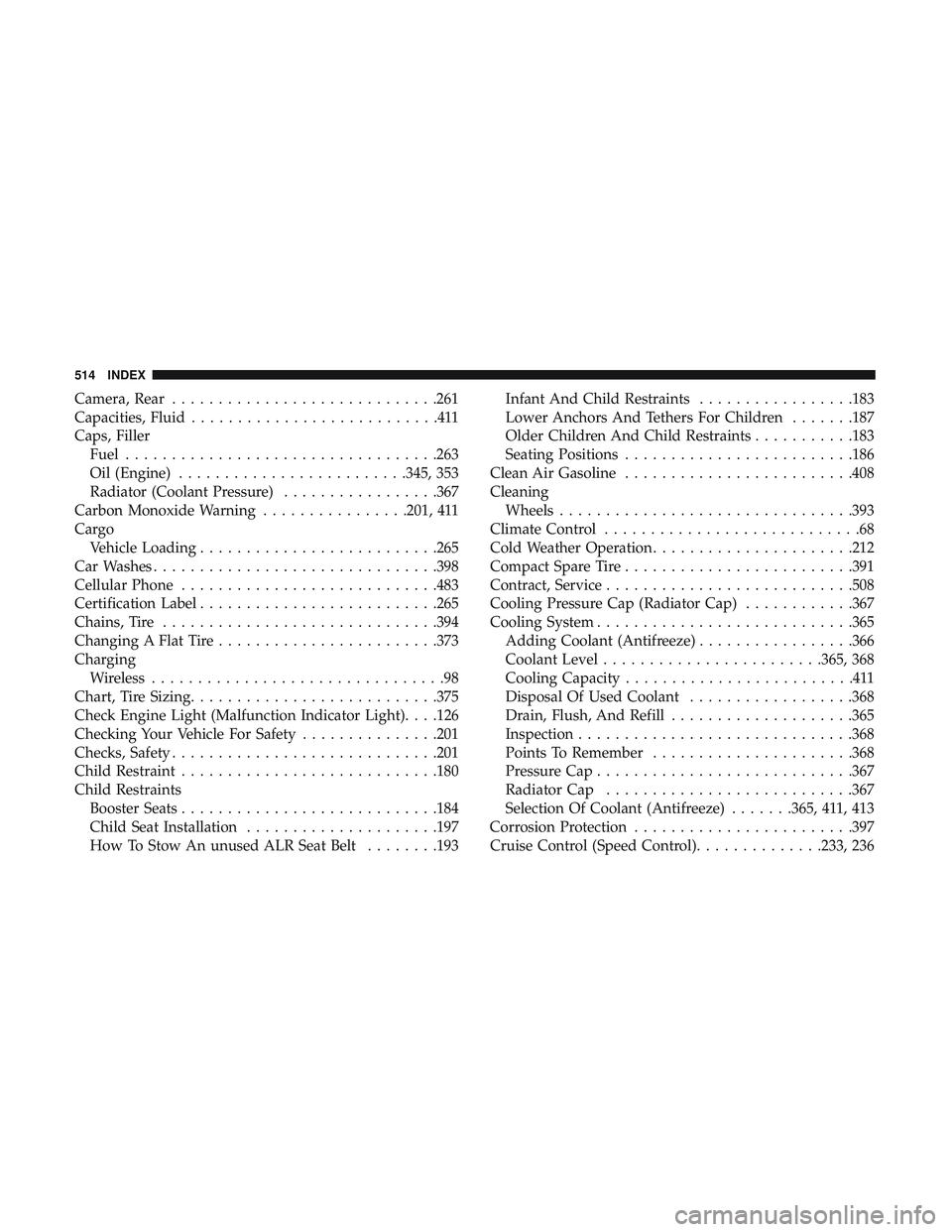
Camera, Rear............................ .261
Capacities, Fluid ...........................411
Caps, Filler Fuel ................................. .263
Oil (Engine) ........................ .345, 353
Radiator (Coolant Pressure) .................367
Carbon Monoxide Warning ................201, 411
Cargo Vehicle Loading ......................... .265
Car Washes .............................. .398
Cellular Phone ........................... .483
Certification Label ......................... .265
Chains, Tire ............................. .394
Changing A Flat Tire ....................... .373
Charging Wireless ................................98
Chart, Tire Sizing .......................... .375
Check Engine Light (Malfunction Indicator Light). . . .126
Checking Your Vehicle For Safety ...............201
Checks, Safety ............................ .201
Child Restraint ........................... .180
Child Restraints Booster Seats ........................... .184
Child Seat Installation .....................197
How To Stow An unused ALR Seat Belt ........193Infant And Child Restraints
.................183
Lower Anchors And Tethers For Children .......187
Older Children And Child Restraints ...........183
Seating Positions ........................ .186
Clean Air Gasoline ........................ .408
Cleaning Wheels ............................... .393
Climate Control ............................68
Cold Weather Operation ..................... .212
Compact Spare Tire ........................ .391
Contract, Service .......................... .508
Cooling Pressure Cap (Radiator Cap) ............367
Cooling System ........................... .365
Adding Coolant (Antifreeze) .................366
Coolant
Level ....................... .365, 368
Cooling Capacity .........................411
Disposal Of Used Coolant ..................368
Drain, Flush, And Refill ....................365
Inspection ............................. .368
Points To Remember ..................... .368
Pressure Cap ........................... .367
Radiator Cap .......................... .367
Selection Of Coolant (Antifreeze) .......365, 411, 413
Corrosion Protection ....................... .397
Cruise Control (Speed Control) ..............233, 236
514 INDEX
Page 518 of 532
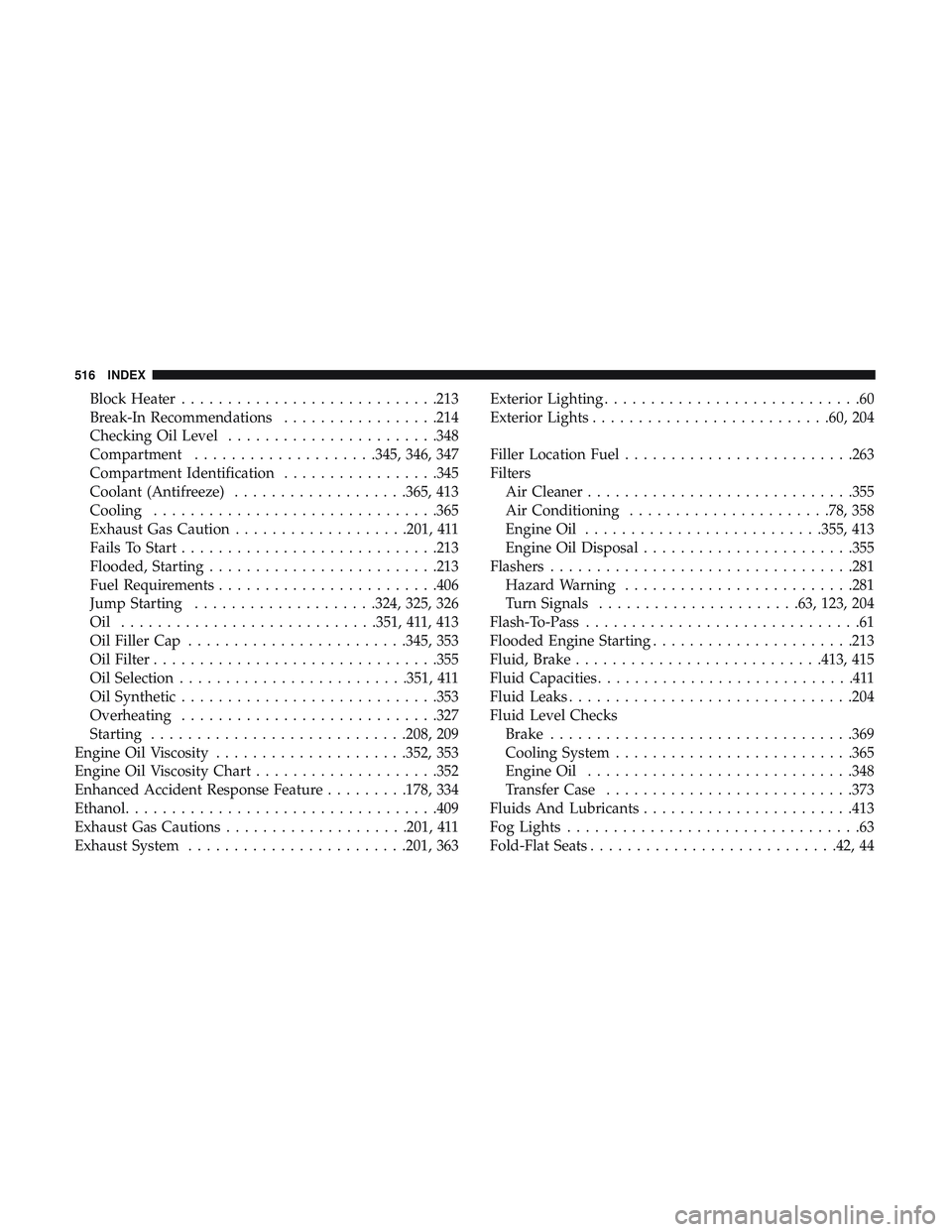
Block Heater........................... .213
Break-In Recommendations .................214
Checking Oil Level ...................... .348
Compartment ....................345, 346, 347
Compartment Identification .................345
Coolant (Antifreeze) ...................365, 413
Cooling .............................. .365
Exhaust Gas Caution ...................201, 411
Fails To Start ........................... .213
Flooded, Starting ........................ .213
Fuel Requirements ....................... .406
Jump Starting ....................324, 325, 326
Oil ........................... .351, 411, 413
Oil Filler Cap ....................... .345, 353
Oil Filter .............................. .355
Oil Selection ........................ .351, 411
Oil Synthetic ........................... .353
Overheating ........................... .327
Starting ........................... .208, 209
Engine Oil Viscosity .....................352, 353
Engine Oil Viscosity Chart ....................352
Enhanced Accident Response Feature .........178, 334
Ethanol ................................. .409
Exhaust Gas Cautions ....................201, 411
Exhaust System ....................... .201, 363Exterior Lighting
............................60
Exterior Lights ......................... .60, 204
Filler Location Fuel ........................ .263
Filters Air Cleaner ............................ .355
Air Conditioning ..................... .78, 358
Engine Oil ......................... .355, 413
Engine Oil Disposal ...................... .355
Flashers ................................ .281
Hazard Warning ........................ .281
Turn Signals ..................... .63,
123, 204
Flash-To-Pass ..............................61
Flooded Engine Starting ..................... .213
Fluid, Brake .......................... .413, 415
Fluid Capacities ............................411
Fluid Leaks .............................. .204
Fluid Level Checks Brake ................................ .369
Cooling System ......................... .365
Engine Oil ............................ .348
Transfer Case .......................... .373
Fluids And Lubricants ...................... .413
Fog Lights ................................63
Fold-Flat Seats .......................... .42, 44
516 INDEX