sport mode DODGE CHALLENGER 2022 User Guide
[x] Cancel search | Manufacturer: DODGE, Model Year: 2022, Model line: CHALLENGER, Model: DODGE CHALLENGER 2022Pages: 336, PDF Size: 16.47 MB
Page 184 of 336
182MULTIMEDIA
Sport Mode
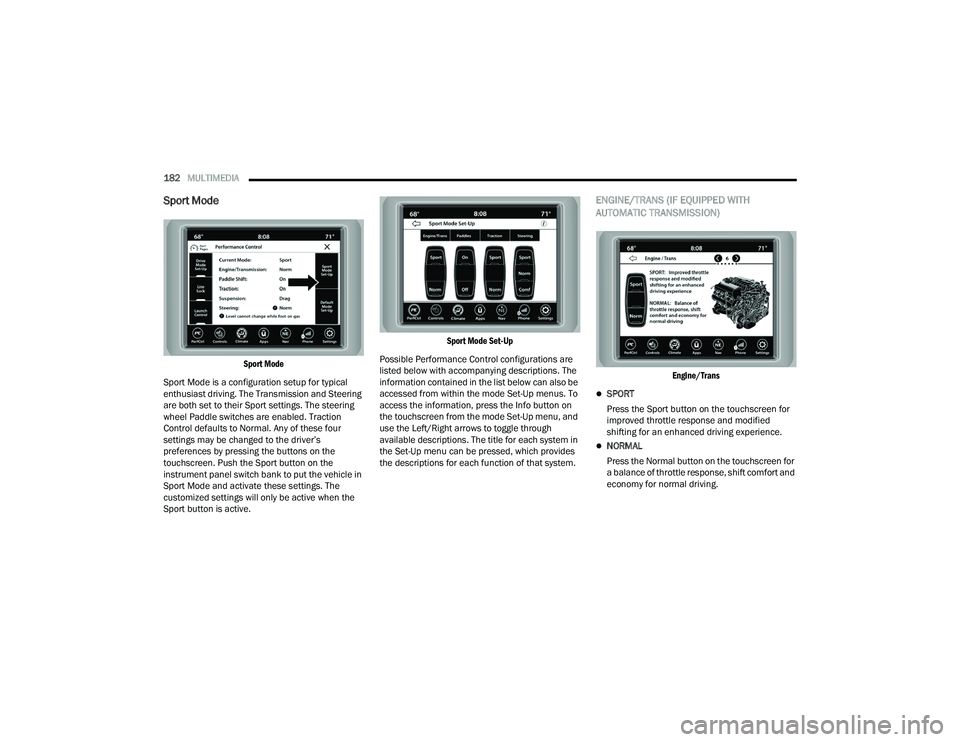
Sport Mode
Sport Mode is a configuration setup for typical
enthusiast driving. The Transmission and Steering
are both set to their Sport settings. The steering
wheel Paddle switches are enabled. Traction
Control defaults to Normal. Any of these four
settings may be changed to the driver’s
preferences by pressing the buttons on the
touchscreen. Push the Sport button on the
instrument panel switch bank to put the vehicle in
Sport Mode and activate these settings. The
customized settings will only be active when the
Sport button is active.
Sport Mode Set-Up
Possible Performance Control configurations are
listed below with accompanying descriptions. The
information contained in the list below can also be
accessed from within the mode Set-Up menus. To
access the information, press the Info button on
the touchscreen from the mode Set-Up menu, and
use the Left/Right arrows to toggle through
available descriptions. The title for each system in
the Set-Up menu can be pressed, which provides
the descriptions for each function of that system.
ENGINE/TRANS (IF EQUIPPED WITH
AUTOMATIC TRANSMISSION)
Engine/Trans
SPORT
Press the Sport button on the touchscreen for
improved throttle response and modified
shifting for an enhanced driving experience.
NORMAL
Press the Normal button on the touchscreen for
a balance of throttle response, shift comfort and
economy for normal driving.
22_LA_OM_EN_USC_t.book Page 182
Page 190 of 336
188SAFETY
(Continued)
ESC Operating Modes
Depending upon model and mode of operation, the
ESC system may have multiple operating modes.
ESC On
This is the normal operating mode for the ESC.
Whenever the vehicle is started, the ESC system
will be in this mode. This mode should be used for
most driving conditions. Alternate ESC modes
should only be used for specific reasons as noted
in the following paragraphs.Partial Off
This mode may be useful if the vehicle becomes
stuck. This mode may modify TCS and ESC
thresholds for activation, which allows for more
wheel spin than normally allowed.
To enter the “Partial Off” mode, momentarily push
the ESC OFF button and the ESC OFF Indicator
Light will illuminate. To turn the ESC on again,
momentarily push the ESC OFF button and the ESC
OFF Indicator Light will turn off.
NOTE:
For vehicles with multiple partial ESC modes,
the push and release of the switch will toggle
the ESC modes. Multiple attempts may be
required to return to "ESC On" mode.
Trailer Sway Control (TSC) is disabled when the
ESC system is in the “Partial Off” mode.
If Equipped — "ESC Sport" and "ESC Track" are
ESC “Partial Off” mode(s).
Full Off – If Equipped
This mode is intended for off-highway or off-road
use only and should not be used on any public
roadways. In this mode, TCS and ESC features are
turned off. To enter the “Full Off” mode, push and
hold the ESC OFF button for five seconds while the
vehicle is stopped with the engine running. After
five seconds, a chime will sound, the ESC OFF
Indicator Light will illuminate, and the “ESC OFF”
message will display in the instrument cluster. To
turn ESC on again, momentarily push the ESC OFF
button.
Vehicle modifications, or failure to properly
maintain your vehicle, may change the
handling characteristics of your vehicle, and
may negatively affect the performance of the
ESC system. Changes to the steering system,
suspension, braking system, tire type and size
or wheel size may adversely affect ESC perfor -
mance. Improperly inflated and unevenly worn
tires may also degrade ESC performance. Any
vehicle modification or poor vehicle mainte -
nance that reduces the effectiveness of the
ESC system can increase the risk of loss of
vehicle control, vehicle rollover, personal
injury and death.
WARNING!
WARNING!
When in “Partial Off” mode, the TCS functionality
of ESC (except for the limited slip feature
described in the TCS section) has been disabled
and the ESC OFF Indicator Light will be
illuminated. When in “Partial Off” mode, the
engine power reduction feature of TCS is
disabled, and the enhanced vehicle stability
offered by the ESC system is reduced.
WARNING!
In the ESC “Full Off” mode, the engine torque
reduction and stability features are disabled.
Therefore, enhanced vehicle stability offered
by the ESC system is unavailable. In an emer -
gency evasive maneuver, the ESC system will
not engage to assist in maintaining stability.
ESC “Full Off” mode is intended for
off-highway or off-road use only.
22_LA_OM_EN_USC_t.book Page 188
Page 202 of 336
200SAFETY
OCCUPANT RESTRAINT SYSTEMS
Some of the most important safety features in your
vehicle are the restraint systems:
OCCUPANT RESTRAINT SYSTEMS
F
EATURES
Seat Belt Systems
Supplemental Restraint Systems (SRS) Air Bags
Child Restraints
Some of the safety features described in this
section may be standard equipment on some
models, or may be optional equipment on others. If
you are not sure, ask an authorized dealer.
IMPORTANT SAFETY PRECAUTIONS
Please pay close attention to the information in
this section. It tells you how to use your restraint
system properly, to keep you and your passengers
as safe as possible. Here are some simple steps you can take to
minimize the risk of harm from a deploying air bag:
1. Children 12 years old and under should
always ride buckled up in the rear seat of a
vehicle with a rear seat.
If your vehicle is not equipped with a rear seat,
FCA US LLC recommends that you do not allow
children 12 years old and under to ride in your
vehicle.
2. A child who is not big enough to wear the vehicle seat belt properly must be secured in
the appropriate child restraint or
belt-positioning booster seat in a rear seating
position Ú page 216.
3. If a child from 2 to 12 years old (not in a rear-facing child restraint) must ride in the
front passenger seat, move the seat as far
back as possible and use the proper child
restraint Ú page 216.
4. Never allow children to slide the shoulder belt behind them or under their arm.
5. You should read the instructions provided with your child restraint to make sure that you are
using it properly.
6. All occupants should always wear their lap and shoulder belts properly. 7. The driver and front passenger seats should
be moved back as far as practical to allow the
front air bags room to inflate.
8. Do not lean against the door or window. If your vehicle has side air bags, and deployment
occurs, the side air bags will inflate forcefully
into the space between occupants and the
door and occupants could be injured.
9. If the air bag system in this vehicle needs to be modified to accommodate a disabled person,
see Úpage 319 for customer service contact
information.
WARNING!
Never place a rear-facing child restraint in
front of an air bag. A deploying passenger
front air bag can cause death or serious injury
to a child 12 years or younger, including a
child in a rear-facing child restraint.
Never install a rear-facing child restraint in the
front seat of a vehicle. Only use a rear-facing
child restraint in the rear seat. If the vehicle
does not have a rear seat, do not transport a
rear-facing child restraint in that vehicle.
22_LA_OM_EN_USC_t.book Page 200
Page 208 of 336
206SAFETY
Switchable Automatic Locking Retractors
(ALR)
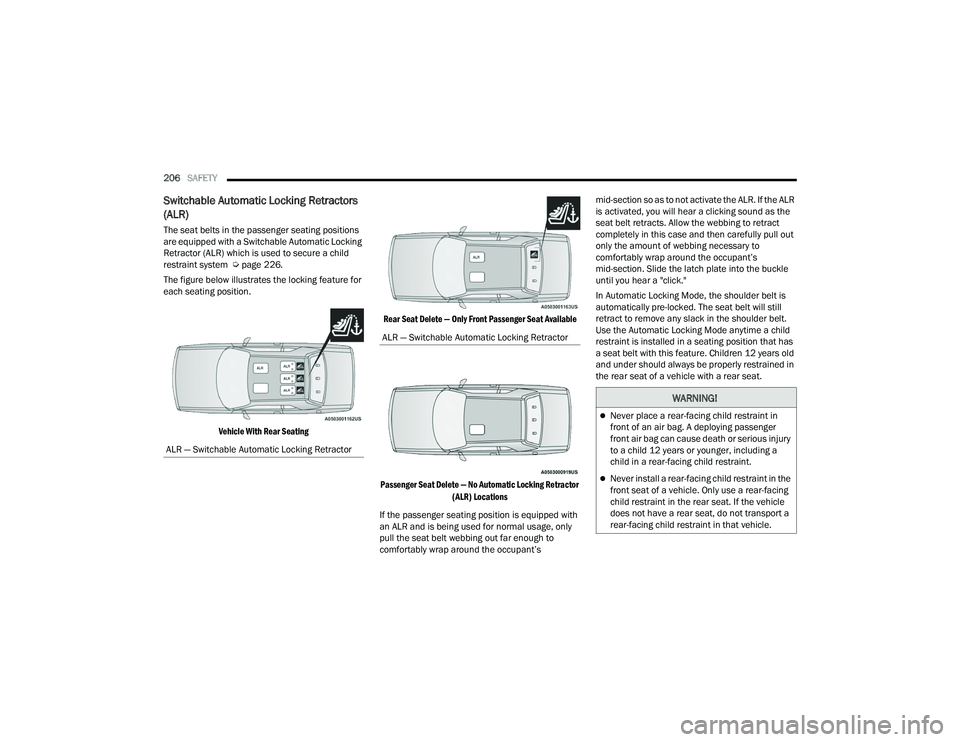
The seat belts in the passenger seating positions
are equipped with a Switchable Automatic Locking
Retractor (ALR) which is used to secure a child
restraint system Ú page 226.
The figure below illustrates the locking feature for
each seating position.
Vehicle With Rear Seating Rear Seat Delete — Only Front Passenger Seat Available
Passenger Seat Delete — No Automatic Locking Retractor (ALR) Locations
If the passenger seating position is equipped with
an ALR and is being used for normal usage, only
pull the seat belt webbing out far enough to
comfortably wrap around the occupant’s mid-section so as to not activate the ALR. If the ALR
is activated, you will hear a clicking sound as the
seat belt retracts. Allow the webbing to retract
completely in this case and then carefully pull out
only the amount of webbing necessary to
comfortably wrap around the occupant’s
mid-section. Slide the latch plate into the buckle
until you hear a "click."
In Automatic Locking Mode, the shoulder belt is
automatically pre-locked. The seat belt will still
retract to remove any slack in the shoulder belt.
Use the Automatic Locking Mode anytime a child
restraint is installed in a seating position that has
a seat belt with this feature. Children 12 years old
and under should always be properly restrained in
the rear seat of a vehicle with a rear seat.
ALR — Switchable Automatic Locking Retractor
ALR — Switchable Automatic Locking Retractor
WARNING!
Never place a rear-facing child restraint in
front of an air bag. A deploying passenger
front air bag can cause death or serious injury
to a child 12 years or younger, including a
child in a rear-facing child restraint.
Never install a rear-facing child restraint in the
front seat of a vehicle. Only use a rear-facing
child restraint in the rear seat. If the vehicle
does not have a rear seat, do not transport a
rear-facing child restraint in that vehicle.
22_LA_OM_EN_USC_t.book Page 206
Page 228 of 336
226SAFETY
Installing Child Restraints Using The
Vehicle Seat Belt
NOTE:If your vehicle is not equipped with a rear seat, FCA
US LLC recommends that you do not allow children
12 years old and under to ride in your vehicle. If the
rear seats are not present in your vehicle, NEVER
install a child restraint in these positions.
Child restraint systems are designed to be secured
in vehicle seats by lap belts or the lap belt portion
of a lap/shoulder belt. The seat belts in the passenger seating positions
are equipped with a Switchable Automatic Locking
Retractor (ALR) that is designed to keep the lap
portion of the seat belt tight around the child
restraint so that it is not necessary to use a locking
clip. The ALR retractor can be “switched” into a
locked mode by pulling all of the webbing out of the
retractor and then letting the webbing retract back
into the retractor. If it is locked, the ALR will make a clicking noise
while the webbing is pulled back into the retractor.
Refer to the “Automatic Locking Mode” description
on Ú
page 206 for additional information on ALR.
Please see the table below and the following
sections for more information.
Lap/Shoulder Belt Systems For Installing
Child Restraints In This Vehicle
NOTE:If your vehicle is not equipped with a rear seat, FCA
US LLC recommends that you do not allow children
12 years old and under to ride in your vehicle. If the
rear seats are not present in your vehicle, NEVER
install a child restraint in these positions.
WARNING!
Never place a rear-facing child restraint in
front of an air bag. A deploying passenger
front air bag can cause death or serious injury
to a child 12 years or younger, including a
child in a rear-facing child restraint.
Never install a rear-facing child restraint in the
front seat of a vehicle. Only use a rear-facing
child restraint in the rear seat. If the vehicle
does not have a rear seat, do not transport a
rear-facing child restraint in that vehicle.
WARNING!
Improper installation or failure to properly
secure a child restraint can lead to failure of
the restraint. The child could be badly injured
or killed.
Follow the child restraint manufacturer’s
directions exactly when installing an infant or
child restraint.
22_LA_OM_EN_USC_t.book Page 226
Page 232 of 336
230SAFETY
SAFETY TIPS
TRANSPORTING PASSENGERS
NEVER TRANSPORT PASSENGERS IN THE CARGO
AREA.
TRANSPORTING PETS
Air Bags deploying in the front seat could harm
your pet. An unrestrained pet will be thrown about
and possibly injured, or injure a passenger during
panic braking or in a collision. Pets should be restrained in the rear seat (if
equipped) in pet harnesses or pet carriers that are
secured by seat belts.
SAFETY CHECKS YOU SHOULD MAKE
I
NSIDE THE VEHICLE
Seat Belts
Inspect the seat belt system periodically, checking
for cuts, frays, and loose parts. Damaged parts
must be replaced immediately. Do not
disassemble or modify the system.
If your vehicle is involved in a collision, or if you
have questions regarding the seat belt or retractor
conditions, take your vehicle to an authorized FCA
dealer or authorized FCA Certified Collision Care
Program facility for inspection.
Air Bag Warning Light
The Air Bag Warning Light will turn on for
four to eight seconds as a bulb check
when the ignition switch is first placed in
the ON/RUN mode. If the light is either
not on during starting, stays on, or turns on while
driving, have the system inspected at an
authorized dealer as soon as possible. After the
bulb check, this light will illuminate with a single
chime when a fault with the Air Bag System has
been detected. It will stay on until the fault is removed. If the light comes on intermittently or
remains on while driving, have an authorized
dealer service the vehicle immediately
Ú
page 200.
Defroster
Check operation by selecting the defrost mode and
place the blower control on high speed. You should
be able to feel the air directed against the
windshield. See an authorized dealer for service if
your defroster is inoperable.
Floor Mat Safety Information
Always use floor mats designed to fit your vehicle.
Only use a floor mat that does not interfere with the
operation of the accelerator, brake or clutch
pedals. Only use a floor mat that is securely
attached using the floor mat fasteners so it cannot
slip out of position and interfere with the
accelerator, brake or clutch pedals or impair safe
operation of your vehicle in other ways.
WARNING!
Do not leave children or animals inside parked
vehicles in hot weather. Interior heat buildup
may cause serious injury or death.
It is extremely dangerous to ride in a cargo
area, inside or outside of a vehicle. In a colli -
sion, people riding in these areas are more
likely to be seriously injured or killed.
Do not allow people to ride in any area of your
vehicle that is not equipped with seats and
seat belts.
Be sure everyone in your vehicle is in a seat
and using a seat belt properly.
22_LA_OM_EN_USC_t.book Page 230
Page 245 of 336
IN CASE OF EMERGENCY243
(Continued)
When the Tire Service Kit sealant is in a liquid
form, clean water and a damp cloth will remove
the material from the vehicle or tire and wheel
components. Once the sealant dries, it can
easily be peeled off and properly discarded.
For optimum performance, make sure the valve
stem on the wheel is free of debris before
connecting the Tire Service Kit.
You can use the Tire Service Kit air pump to
inflate bicycle tires. The kit also comes with two
needles, located in the Accessory Storage
Compartment (on the bottom of the air pump)
for inflating sport balls, rafts, or similar inflat -
able items. However, use only the Air Pump
Hose (8) and make sure the Mode Select Knob
(6) is in the Air Mode when inflating such items
to avoid injecting sealant into them. The Tire
Service Kit Sealant is only intended to seal
punctures less than 1/4 inch (6 mm) diameter
in the tread of your tire.
Do not lift or carry the Tire Service Kit by the
hoses.
WARNING!
Do not attempt to seal a tire on the side of the
vehicle closest to traffic. Pull far enough off
the road to avoid the danger of being hit when
using the Tire Service Kit.
Do not use Tire Service Kit or drive the vehicle
under the following circumstances:
If the puncture in the tire tread is approxi -
mately 1/4 inch (6 mm) or larger.
If the tire has any sidewall damage.
If the tire has any damage from driving
with extremely low tire pressure.
If the tire has any damage from driving on
a flat tire.
If the wheel has any damage.
If you are unsure of the condition of the
tire or the wheel.
Keep Tire Service Kit away from open flames
or heat source.
A loose Tire Service Kit thrown forward in a
collision or hard stop could endanger the
occupants of the vehicle. Always stow the Tire
Service Kit in the place provided. Failure to
follow these warnings can result in injuries
that are serious or fatal to you, your passen -
gers, and others around you.
Take care not to allow the contents of Tire
Service Kit to come in contact with hair, eyes,
or clothing. Tire Service Kit sealant is harmful
if inhaled, swallowed, or absorbed through the
skin. It causes skin, eye, and respiratory irrita -
tion. Flush immediately with plenty of water if
there is any contact with eyes or skin. Change
clothing as soon as possible, if there is any
contact with clothing.
Tire Service Kit Sealant solution contains
latex. In case of an allergic reaction or rash,
consult a physician immediately. Keep Tire
Service Kit out of reach of children. If swal -
lowed, rinse mouth immediately with plenty of
water and drink plenty of water. Do not induce
vomiting! Consult a physician immediately.
WARNING!
7
22_LA_OM_EN_USC_t.book Page 243
Page 325 of 336
323
INDEX
A
About Your Brakes.................................. 86, 311ACC (Adaptive Cruise Control........................... 97Adaptive Cruise Control (ACC).......................... 97Adding Engine Coolant (Antifreeze)............... 272Adding Washing Fluid.................................... 261Additives, Fuel............................................... 313AdjustForward................................................ 32, 34Rearward.............................................. 32, 34Advance Phone Connectivity......................... 165Air Bag........................................................... 208Advance Front Air Bag............................... 208Air Bag Operation...................................... 210Air Bag Warning Light................................ 208Enhanced Accident Response......... 214, 253Event Data Recorder (EDR)....................... 253Front Air Bag............................................. 208If Deployment Occurs................................ 213Knee Impact Bolsters................................ 210Maintaining Your Air Bag System.............. 215Maintenance............................................. 215Redundant Air Bag Warning Light.............208Side Air Bags............................................. 210Transporting Pets...................................... 230
Air Bag Light.................................. 73, 208, 230Air Cleaner, Engine
(Engine Air Cleaner Filter)............................. 265Air Conditioner Maintenance........................ 266Air Conditioner Refrigerant........................... 266Air Conditioner System................................. 266Air Conditioning................................................ 51Air Conditioning Filter..............................55, 266Air Conditioning System................................... 51Air Conditioning, Operating Tips....................... 55Air Filter........................................................ 265Air PressureTires......................................................... 298AlarmArm The System.......................................... 21Rearm The System...................................... 21Security Alarm...................................... 21, 76Alarm SystemSecurity Alarm............................................. 21All Wheel Drive (AWD)................................... 276Alterations/ModificationsVehicle........................................................... 9Android Auto........................................ 167, 168Android Auto™
b
....................................... 167
Antifreeze (Engine Coolant).................. 272, 315Disposal.................................................... 273Anti-Lock Brake System (ABS)....................... 185Anti-Lock Warning Light...................................76Apple CarPlay....................................... 167, 170Apple CarPlay®
b
...................................... 169Arming SystemSecurity Alarm.............................................21Assist, Hill Start............................................. 189Audio Settings............................................... 152Audio Systems (Radio).................................. 122Auto Down Power Windows..............................60Automatic Door Locks......................................27Automatic Headlights.......................................46Automatic High Beams.....................................45Automatic Temperature Control (ATC)..............54Automatic Transmission...................................91Adding Fluid..................................... 276, 318Fluid And Filter Change............................. 276Fluid Change............................................. 276Fluid Level Check...................................... 275Fluid Type........................................ 276, 318Special Additives...................................... 275Automatic Transmission Limp
Home Mode..............................................27, 9411
22_LA_OM_EN_USC_t.book Page 323
Page 332 of 336
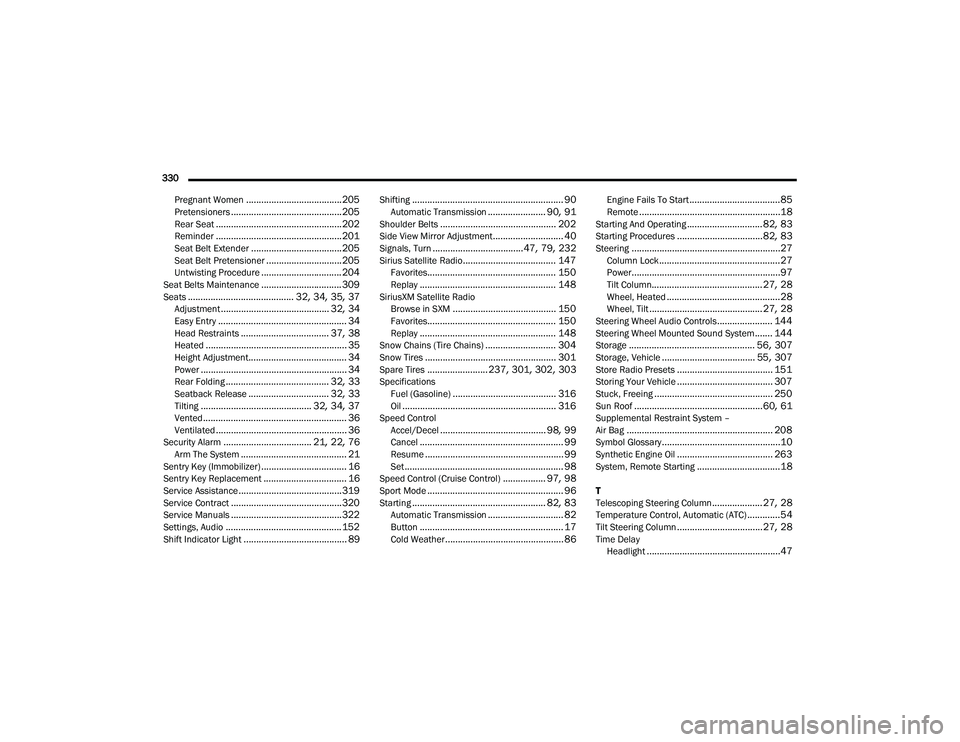
330 Pregnant Women
...................................... 205Pretensioners............................................ 205Rear Seat.................................................. 202Reminder.................................................. 201Seat Belt Extender.................................... 205Seat Belt Pretensioner.............................. 205Untwisting Procedure................................ 204Seat Belts Maintenance................................ 309Seats.......................................... 32, 34, 35, 37Adjustment........................................... 32, 34Easy Entry................................................... 34Head Restraints................................... 37, 38Heated........................................................ 35Height Adjustment....................................... 34Power.......................................................... 34Rear Folding......................................... 32, 33Seatback Release................................ 32, 33Tilting............................................ 32, 34, 37Vented......................................................... 36Ventilated.................................................... 36Security Alarm................................... 21, 22, 76Arm The System.......................................... 21Sentry Key (Immobilizer).................................. 16Sentry Key Replacement................................. 16Service Assistance......................................... 319Service Contract............................................ 320Service Manuals............................................ 322Settings, Audio.............................................. 152Shift Indicator Light......................................... 89
Shifting............................................................ 90Automatic Transmission....................... 90, 91Shoulder Belts.............................................. 202Side View Mirror Adjustment............................ 40Signals, Turn....................................47, 79, 232Sirius Satellite Radio..................................... 147Favorites................................................... 150Replay...................................................... 148SiriusXM Satellite RadioBrowse in SXM......................................... 150Favorites................................................... 150Replay...................................................... 148Snow Chains (Tire Chains)............................ 304Snow Tires.................................................... 301Spare Tires........................ 237, 301, 302, 303SpecificationsFuel (Gasoline)......................................... 316Oil............................................................. 316Speed ControlAccel/Decel.......................................... 98, 99Cancel......................................................... 99Resume....................................................... 99Set............................................................... 98Speed Control (Cruise Control)................. 97, 98Sport Mode...................................................... 96Starting..................................................... 82, 83Automatic Transmission.............................. 82Button......................................................... 17Cold Weather............................................... 86
Engine Fails To Start....................................85Remote........................................................18Starting And Operating..............................82, 83Starting Procedures..................................82, 83Steering...........................................................27Column Lock................................................27Power...........................................................97Tilt Column............................................ 27, 28Wheel, Heated.............................................28Wheel, Tilt.............................................27, 28Steering Wheel Audio Controls...................... 144Steering Wheel Mounted Sound System....... 144Storage.................................................. 56, 307Storage, Vehicle..................................... 55, 307Store Radio Presets...................................... 151Storing Your Vehicle...................................... 307Stuck, Freeing............................................... 250Sun Roof...................................................60, 61Supplemental Restraint System –
Air Bag.......................................................... 208Symbol Glossary...............................................10Synthetic Engine Oil...................................... 263System, Remote Starting.................................18
T
Telescoping Steering Column.................... 27, 28Temperature Control, Automatic (ATC).............54Tilt Steering Column..................................27, 28Time DelayHeadlight.....................................................47
22_LA_OM_EN_USC_t.book Page 330