lock DODGE CHARGER SRT 2007 6.G Manual PDF
[x] Cancel search | Manufacturer: DODGE, Model Year: 2007, Model line: CHARGER SRT, Model: DODGE CHARGER SRT 2007 6.GPages: 350, PDF Size: 5.51 MB
Page 208 of 350

ELECTRONIC BRAKE CONTROL SYSTEM
Your vehicle is equipped with an advanced electronic
brake control system commonly referred to as ESP. This
system includes the ABS (Anti-Lock Brake System), the
TCS (Traction Control System), the BAS (Brake Assist
System), and the ESP (Electronic Stability Program).
These systems work together to enhance both vehicle
stability and control in various driving conditions.
ABS (Anti-Lock Brake System)
This system aids the driver in maintaining vehicle control
under adverse braking conditions by controlling hydrau-
lic brake pressure. This prevents wheel lock-up to help
avoid skidding on slippery surfaces during braking. For
more information about ABS, refer to ªAnti-Lock Brake
Systemº in Section 5 of this manual.
WARNING!
The ABS (Anti-Lock Brake System) cannot prevent
the natural laws of physics from acting on the
vehicle, nor can it increase the traction afforded by
prevailing road conditions. The ABS cannot prevent
accidents, including those resulting from excessive
speed in turns, driving on very slippery surfaces, or
hydroplaning. Only a safe, attentive, and skillful
driver can prevent accidents. The capabilities of an
ABS-equipped vehicle must never be exploited in a
reckless or dangerous manner, which could jeopar-
dize the user's safety or the safety of others.
TCS (Traction Control System)
This system monitors the amount of wheel spin of each
driven wheel. If wheel spin is detected, brake pressure is
applied to the slipping wheel(s) and engine power is
reduced to provide enhanced acceleration and stability.
208 STARTING AND OPERATING
Page 209 of 350

BAS (Brake Assist System)
This system complements the Anti-Lock Brake System
(ABS) by optimizing the vehicle braking capability dur-
ing emergency braking maneuvers. This system detects
an emergency braking situation by sensing the rate and
amount of brake application and then applies optimum
pressure to the brakes. This can help reduce braking
distances.
Applying the brakes very quickly results in the best BAS
assistance. To receive the benefits of this system, you
must apply continuous brake pedal pressure during the
stopping sequence. Do not reduce brake pedal pressure
unless braking is no longer desired. Once the brake pedal
is released, the BAS is deactivated.WARNING!
The BAS (Brake Assist System) cannot prevent the
natural laws of physics from acting on the vehicle,
nor can it increase the traction afforded by prevail-
ing road conditions. The BAS cannot prevent acci-
dents, including those resulting from excessive
speed in turns, driving on very slippery surfaces, or
hydroplaning. Only a safe, attentive, and skillful
driver can prevent accidents. The capabilities of a
BAS-equipped vehicle must never be exploited in a
reckless or dangerous manner, which could jeopar-
dize the user's safety or the safety of others.
ESP (Electronic Stability Program)
This system enhances directional control and stability of
the vehicle under various driving conditions. The ESP
corrects for oversteering and understeering the vehicle
by applying the brake of the appropriate wheel. Engine
power may also be reduced to assist in counteracting the
condition of oversteer or understeer and help the vehicle
maintain the desired path.
STARTING AND OPERATING 209
5
Page 255 of 350
NOTE:The battery is stored under an access cover in
the trunk. Remote battery terminals are located in the
engine compartment for jump-starting.
1. Wear eye protection and remove any metal jewelry
such as watchbands or bracelets that might make an
inadvertent electrical contact.
2. When boost is provided by a battery in another
vehicle, park that vehicle within booster cable reach, but
do not allow the vehicles to touch one another.
WARNING!
Do not permit vehicles to touch each other as this
could establish a ground connection and personal
injury could result.
3. Set the parking brake, place the automatic transmis-
sion in PARK, and turn the ignition switch to the OFF (or
LOCK) position on both vehicles.
4. Turn off the heater, radio, and all unnecessary electri-
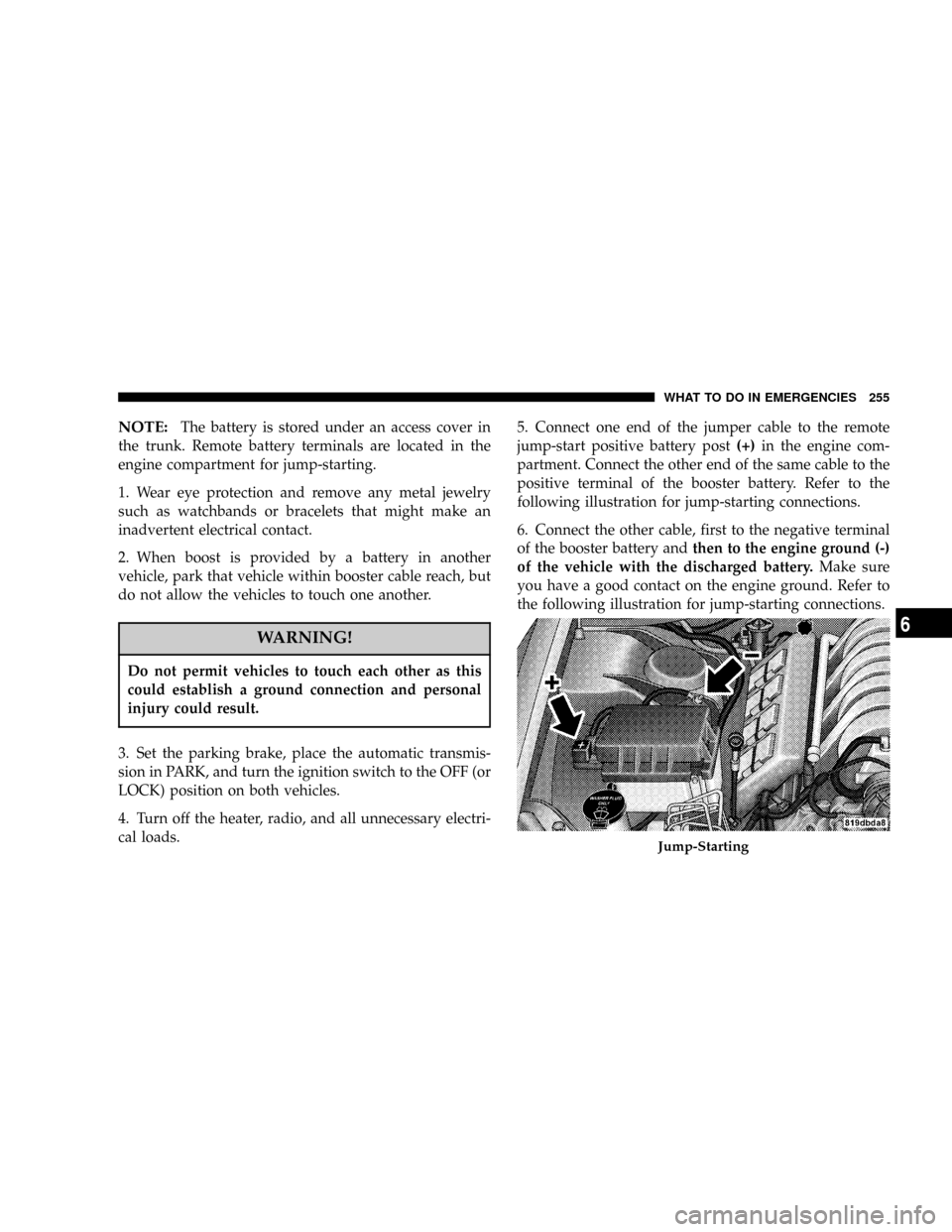
cal loads.5. Connect one end of the jumper cable to the remote
jump-start positive battery post(+)in the engine com-
partment. Connect the other end of the same cable to the
positive terminal of the booster battery. Refer to the
following illustration for jump-starting connections.
6. Connect the other cable, first to the negative terminal
of the booster battery andthen to the engine ground (-)
of the vehicle with the discharged battery.Make sure
you have a good contact on the engine ground. Refer to
the following illustration for jump-starting connections.
Jump-Starting
WHAT TO DO IN EMERGENCIES 255
6
Page 258 of 350

TOWING A DISABLED VEHICLE
WITHOUT THE IGNITION KEY
Special care must be taken when the vehicle is towed
with the ignition in the LOCK position. The only ap-
proved method of towing without the ignition key is
with a flat bed truck. Proper towing equipment is neces-
sary to prevent damage to the vehicle.
TOWING THIS VEHICLE BEHIND ANOTHER
VEHICLE (Flat towing with all four wheels on the
ground)
Flat towing of vehicles equipped with an automatic
transmission, is only permitted within the following
limitations:
With The Ignition Key
Your vehicle may be towed under the following condi-
tions: The gear selector must be in NEUTRAL, the
distance to be traveled must not exceed 30 miles (48 km),
and the towing speed must not exceed 30 mph (48km/h). Exceeding these towing limits may cause a trans-
mission geartrain failure. If the transmission is not op-
erative, or if the vehicle is to be towed more than 30 miles
(48 km), the vehicle must be transported using a flat bed
truck.
CAUTION!
²Do not attempt to tow this vehicle from the front
with sling type towing equipment. Damage to the
front fascia will result.
²If the transmission is not operative, or if the
vehicle is to be towed more than 30 miles (48 km),
then the only approved method of towing is with
a flat bed truck. Damage to the transmission may
result.
²Do not tow the vehicle from the rear. Damage to
the rear sheet metal, and fascia will occur.
²Do not push or tow this vehicle with another
vehicle as damage to the bumper fascia and trans-
mission may result.
258 WHAT TO DO IN EMERGENCIES
Page 276 of 350

Refer to the ªMaintenance Scheduleº in this manual for
the recommended air conditioning filter replacement
intervals.
Power Steering Ð Fluid Check
Checking the power steering fluid level at a defined
service interval is not required. The fluid should only be
checked if a leak is suspected, abnormal noises are
apparent, and/or the system is not functioning as antici-
pated. Coordinate inspection efforts through a certified
DaimlerChrysler Dealership.
WARNING!
Fluid level should be checked on a level surface and
with the engine off to prevent injury from moving
parts and to insure accurate fluid level reading. Do
not overfill. Use only manufacturer's recommended
power steering fluid.
If necessary, add fluid to restore to the proper indicated
level. With a clean cloth, wipe any spilled fluid from allsurfaces. Refer to ªFluids, Lubricants, and Genuine
Partsº in this section for the correct fluid type.
Front & Rear Suspension Ball Joints
The suspension ball joints should be inspected for exter-
nal leakage or damage when other maintenance is per-
formed.
Steering Linkage
The tie rod end ball joints should be inspected for
external leakage or damage when other maintenance is
performed.
Body Lubrication
Locks and all body pivot points, including seat tracks,
door hinges, trunk hinges, and hood hinges, should be
lubricated periodically to assure quiet, easy operation
and to protect against rust and wear. Prior to the appli-
cation of any lubricant, the parts concerned should be
wiped clean to remove dust and grit; after lubricating
excess oil and grease should be removed. Particular
attention should also be given to hood latching compo-
nents to insure proper function. When performing other
underhood services, the hood latch, release mechanism,
and safety catch should be cleaned and lubricated.
276 MAINTAINING YOUR VEHICLE
Page 277 of 350

The external lock cylinders should be lubricated twice a
year, preferably in the fall and spring. Apply a small
amount of a high quality lubricant such as MopartLock
Cylinder Lubricant or equivalent directly into the lock
cylinder.
Windshield Wiper Blades
The rubber edges of the wiper blades and the windshield
should be cleaned periodically with a sponge or soft cloth
and a mild nonabrasive cleaner. This will remove accu-
mulations of salt or road film.
Operation of the wipers on dry glass for long periods
may cause deterioration of the wiper blades. Always use
washer fluid when using the wipers to remove salt or dirt
from a dry windshield.
Avoid using the wiper blades to remove frost or ice from
the windshield. Keep the blade rubber out of contact with
petroleum products such as engine oil, gasoline, etc.
Windshield Washers
The windshield washer fluid reservoir is located in the
front of the engine compartment on the passenger side of
the vehicle. Be sure to check the fluid level at regular
intervals. Fill the reservoir with windshield washer sol-
vent (not radiator antifreeze) and operate the system for
a few seconds to flush out the residual water.
The fluid reservoir will hold nearly 1 gallon (4 liters) of
washer fluid when the message ªLow Washer Fluidº
appears in the Electronic Vehicle Information Center
(EVIC).
WARNING!
Commercially available windshield washer solvents
are flammable. They could ignite and burn you. Care
must be exercised when filling or working around
the washer solution.
MAINTAINING YOUR VEHICLE 277
7
Page 292 of 350

Cavity Car-
tridge
FuseMini
FuseDescription
1ÐÐÐ
2ÐÐÐ
3 Ð 15 Amp
BlueAdjustable Pedals - if
equipped
4 Ð 20 Amp
YellowAC Clutch/Horn
5ÐÐÐ
6 Ð 15 Amp
BlueFront Control Module
(FCM)
7 Ð 20 Amp
YellowFog Lights
8 Ð 15 Amp
BlueLights ± License, Park,
Side Marker, Stop, Turn
9 Ð 15 Amp
BlueFront Control Module
(FCM)
10 Ð 5 Amp
OrangePowertrain Control
Module (PCM)/StarterCavity Car-
tridge
FuseMini
FuseDescription
11 Ð 25 Amp
ClearAuto Shutdown/
Powertrain Control
Module (PCM)
12ÐÐÐ
13ÐÐÐ
14 Ð 25 Amp
ClearPowertrain Control
Module (PCM)
15 Ð 20 Amp
YellowInjectors, Ignition Coils
16ÐÐÐ
17 30 Amp
PinkÐ Anti-lock Brakes System
(ABS) Valves/
Powertrain Control
Module (PCM)
18 30 Amp
PinkÐ Windshield Wiper/
Washer
19 50 Amp
RedÐ Radiator Fan
292 MAINTAINING YOUR VEHICLE
Page 293 of 350

Cavity Car-
tridge
FuseMini
FuseDescription
20 20 Amp
BlueÐ Starter
21 50 Amp
RedÐ Anti-lock Brakes System
(ABS) Pump Motor
22 40 Amp
GreenÐ AC Clutch/Radiator Fan
High Ð Low
23ÐÐÐ
24 60 Amp
YellowÐ Radiator Fan
25 30 Amp
PinkÐ Front Control Module
(FCM)
26ÐÐÐ
27 30 Amp
PinkÐ Front Control Module
(FCM)CAUTION!
²When installing the Power Distribution Center
cover, it is important to ensure the cover is prop-
erly positioned and fully latched. Failure to do so
may allow water to get into the Power Distribu-
tion Center, and possibly result in an electrical
system failure.
²When replacing a blown fuse, it is important to
use only a fuse having the correct amperage
rating. The use of a fuse with a rating other than
indicated may result in a dangerous electrical
system overload. If a properly rated fuse contin-
ues to blow, it indicates a problem in the circuit
that must be corrected.
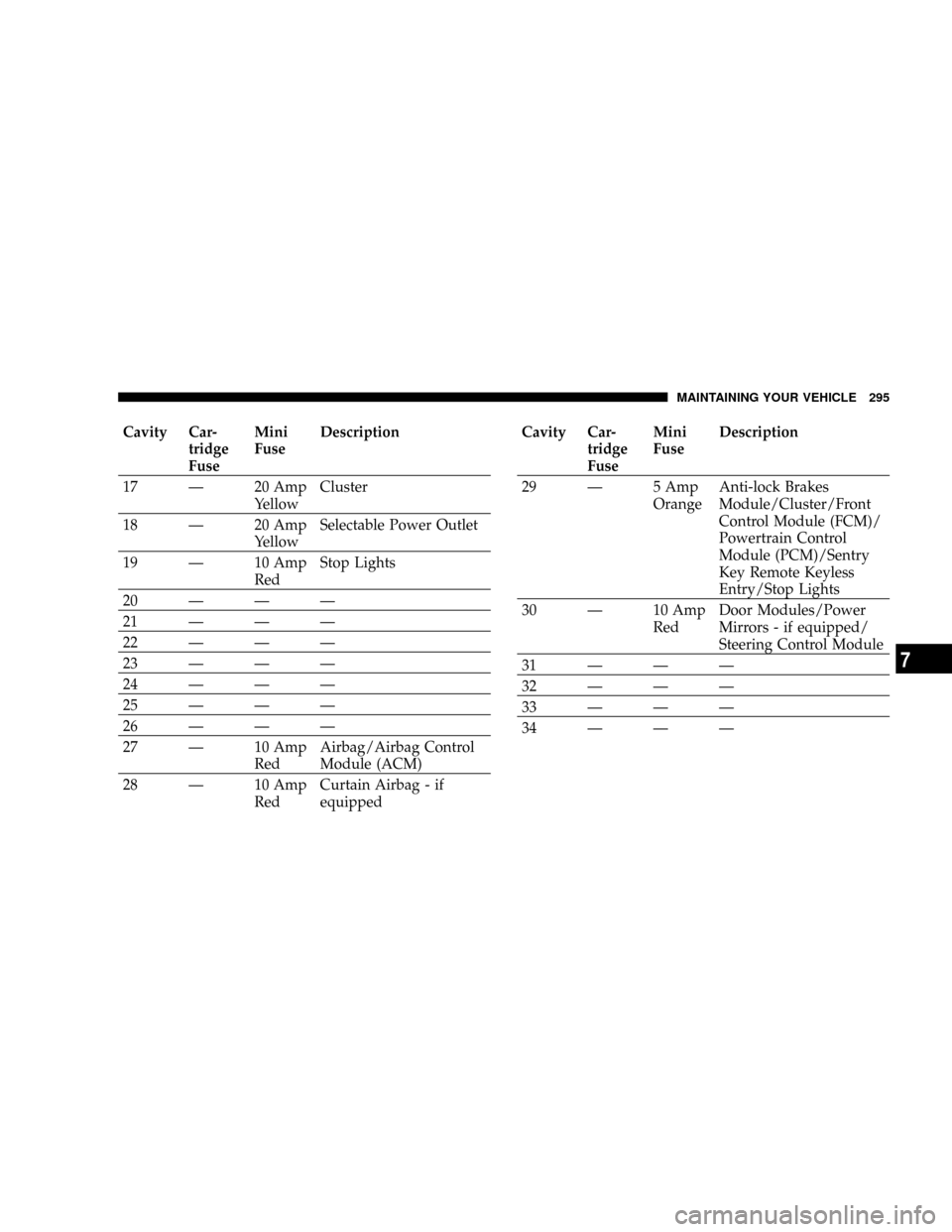
Fuses (Rear Power Distribution Center)
There is also a power distribution center located in the
rear compartment under the spare tire access panel. This
center contains fuses and relays.
MAINTAINING YOUR VEHICLE 293
7
Page 295 of 350
Cavity Car-
tridge
FuseMini
FuseDescription
17 Ð 20 Amp
YellowCluster
18 Ð 20 Amp
YellowSelectable Power Outlet
19 Ð 10 Amp
RedStop Lights
20ÐÐÐ
21ÐÐÐ
22ÐÐÐ
23ÐÐÐ
24ÐÐÐ
25ÐÐÐ
26ÐÐÐ
27 Ð 10 Amp
RedAirbag/Airbag Control
Module (ACM)
28 Ð 10 Amp
RedCurtain Airbag - if
equippedCavity Car-
tridge
FuseMini
FuseDescription
29 Ð 5 Amp
OrangeAnti-lock Brakes
Module/Cluster/Front
Control Module (FCM)/
Powertrain Control
Module (PCM)/Sentry
Key Remote Keyless
Entry/Stop Lights
30 Ð 10 Amp
RedDoor Modules/Power
Mirrors - if equipped/
Steering Control Module
31ÐÐÐ
32ÐÐÐ
33ÐÐÐ
34ÐÐÐ
MAINTAINING YOUR VEHICLE 295
7
Page 296 of 350

Cavity Car-
tridge
FuseMini
FuseDescription
35 Ð 5 Amp
OrangeAmplifier - if equipped/
Antenna/Ignition
Delay/Overhead
Console/Passenger Door
Lock & Express Power
Window Switch - if
equipped/Power Mir-
rors - if equipped/Rear
Defrost
36 Ð 20 Amp
YellowHands Free Phone - if
equipped/Media System
Monitor DVD - if
equipped/Radio/
Satellite Receiver - if
equipped
37 Ð 15 Amp
BlueTransmission - NAG1
38 Ð 5 Amp
OrangeCargo Light/Overhead
Console
39 Ð 10 Amp
RedHeated Mirrors - if
equippedCavity Car-
tridge
FuseMini
FuseDescription
40 Ð 10 Amp
RedHeated Seats - if
equipped/Inside Rear-
view Mirror
41 Ð 10 Amp
RedTire Pressure Monitoring
- if equipped
42 30 Amp
PinkÐ Front Blower Motor
43 30 Amp
PinkÐ Amplifier - if equipped/
Antenna/Rear Defrost
44 20 Amp
BlueÐ Amplifier - if equipped/
Front Control Module
(FCM)/Sunroof - if
equipped
*Cavities 11, 12, and 13 contain self-resetting fuses
(circuit breakers) that are only serviceable by an autho-
rized dealer. The Cluster is fused by the 25 amp circuit
breaker in Cavity 11. The Passenger Seat Switch is fused
by the 25 amp circuit breaker in Cavity 12. The Door
Modules and the Driver Express Power Window Switch
(if equipped) are fused by the 25 amp circuit breaker in
296 MAINTAINING YOUR VEHICLE