warning light DODGE CHARGER SRT 2015 7.G Workshop Manual
[x] Cancel search | Manufacturer: DODGE, Model Year: 2015, Model line: CHARGER SRT, Model: DODGE CHARGER SRT 2015 7.GPages: 595, PDF Size: 16.43 MB
Page 449 of 595
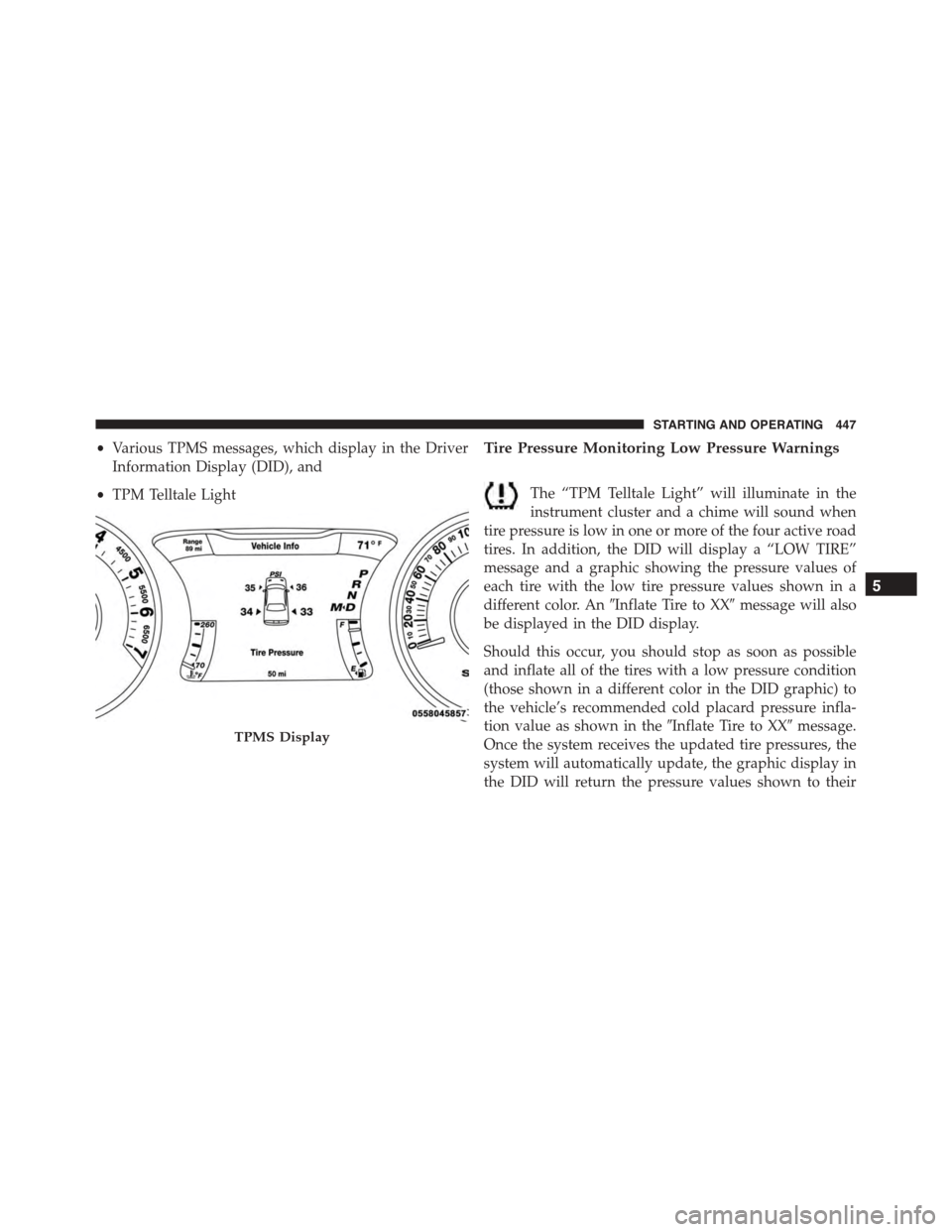
•Various TPMS messages, which display in the Driver
Information Display (DID), and
•TPM Telltale Light
Tire Pressure Monitoring Low Pressure Warnings
The “TPM Telltale Light” will illuminate in the
instrument cluster and a chime will sound when
tire pressure is low in one or more of the four active road
tires. In addition, the DID will display a “LOW TIRE”
message and a graphic showing the pressure values of
each tire with the low tire pressure values shown in a
different color. An#Inflate Tire to XX#message will also
be displayed in the DID display.
Should this occur, you should stop as soon as possible
and inflate all of the tires with a low pressure condition
(those shown in a different color in the DID graphic) to
the vehicle’s recommended cold placard pressure infla-
tion value as shown in the#Inflate Tire to XX#message.
Once the system receives the updated tire pressures, the
system will automatically update, the graphic display in
the DID will return the pressure values shown to their
TPMS Display
5
STARTING AND OPERATING 447
Page 450 of 595
original color, and the “TPM Telltale Light” will turn off.
The vehicle may need to be driven for up to 20 minutes
above 15 mph (24 km/h) in order for the TPMS to receive
this information.
Service TPMS Warning
If a system fault is detected, the “TPM Telltale Light” will
flash on and off for 75 seconds and then remain on solid.
The system fault will also sound a chime. In addition, the
DID will display a#SERVICE TPM SYSTEM#message for
a minimum of five seconds and then display dashes (- -)
in place of the pressure value to indicate which sensor is
not being received.
If the ignition switch is cycled, this sequence will repeat,
providing the system fault still exists. If the system fault
no longer exists, the “TPM Telltale Light” will no longer
flash, and the#SERVICE TPM SYSTEM#message will no
longer display, and a pressure value will display in place
of the dashes. A system fault can occur due to any of the
following:
1. Signal interference due to electronic devices or driving
next to facilities emitting the same radio frequencies as
the TPM sensors.
2. Installing aftermarket window tinting that contains
materials that may block radio wave signals.
3. Accumulation of snow or ice around the wheels or
wheel housings.
4. Using tire chains on the vehicle.
5. Using wheels/tires not equipped with TPM sensors.
The DID will also display a#SERVICE TPM SYSTEM#
message for a minimum of five seconds when a system
fault related to an incorrect sensor location fault is
detected. In this case, the#SERVICE TPM SYSTEM#
448 STARTING AND OPERATING
Page 452 of 595
low-pressure warning limit in any of the four active
road tires. The vehicle may need to be driven for up to
20 minutes above 15 mph (24 km/h) in order for the
TPMS to receive this information.
General Information
This device complies with Part 15 of the FCC rules and
RSS 210 of Industry Canada. Operation is subject to the
following conditions:
•This device may not cause harmful interference.
•This device must accept any interference received,
including interference that may cause undesired op-
eration.
The TPM sensors are regulated under one of the follow-
ing licenses:
United StatesMRXSSW4
Canada2546A-SSW4
FUEL REQUIREMENTS
6.2L Supercharged And 6.4L Engine
These engines are designed to meet all
emissions regulations and provide im-
proved fuel economy and performance
when using high-quality premium un-
leaded gasoline with an octane rating of 91
or higher.
Light spark knock at low engine speeds is not harmful to
your engine. However, continued heavy spark knock at
high speeds can cause damage and immediate service is
required.
Poor quality gasoline can cause problems such as hard
starting, stalling, and hesitations. If you experience these
symptoms, try another brand of gasoline before consid-
ering service for the vehicle. Engine damage resulting
from operating from operating with heavy spark knock
may void or not be covered by the new vehicle warranty.
450 STARTING AND OPERATING
Page 459 of 595
CAUTION!
To avoid fuel spillage and overfilling, do not “top
off” the fuel tank after filling.
WARNING!
•Never have any smoking materials lit in or near the
vehicle when the fuel door is open or the tank is
being filled.
•Never add fuel when the engine is running. This is
in violation of most state and federal fire regula-
tions and may cause the “Malfunction Indicator
Light” to turn on.
•A fire may result if fuel is pumped into a portable
container that is inside of a vehicle. You could be
burned. Always place fuel containers on the
ground while filling.
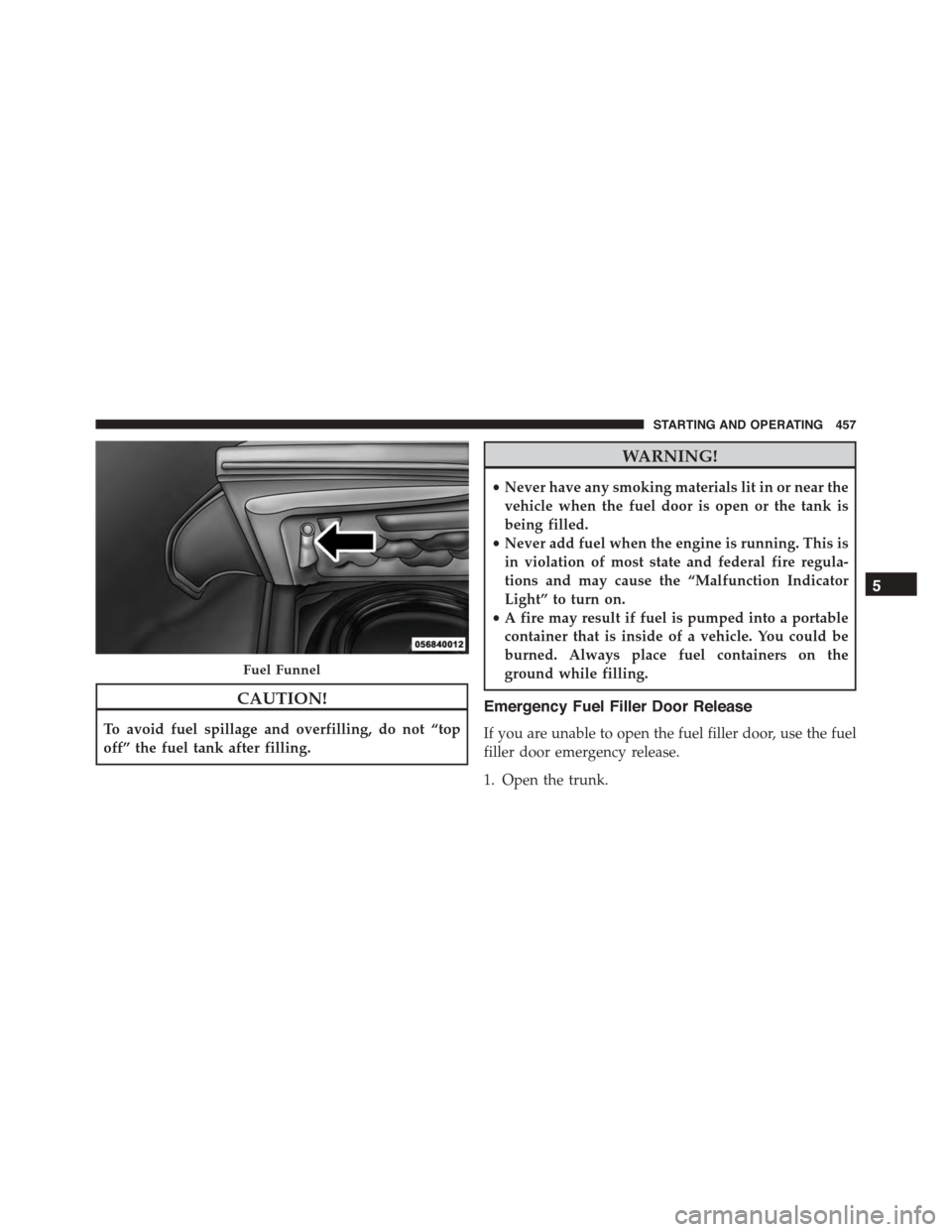
Emergency Fuel Filler Door Release
If you are unable to open the fuel filler door, use the fuel
filler door emergency release.
1. Open the trunk.
Fuel Funnel
5
STARTING AND OPERATING 457
Page 519 of 595
WARNING!
Riding the brakes can lead to brake failure and
possibly a collision. Driving with your foot resting or
riding on the brake pedal can result in abnormally
high brake temperatures, excessive lining wear, and
possible brake damage. You would not have your full
braking capacity in an emergency.
Master Cylinder — Brake Fluid Level Check
Check the fluid level in the master cylinder immediately
if the brake system warning light indicates system fail-
ure.
Check the fluid level in the master cylinder when per-
forming underhood services.
Clean the top of the master cylinder area before removing
the cap. Add fluid to bring the level up to the top of the
“FULL” mark on the side of the master cylinder reservoir.
Overfilling of fluid is not recommended because it may
cause leaking in the system.
Add enough fluid to bring the level up to the require-
ments described on the brake fluid reservoir. With disc
brakes, fluid level can be expected to fall as the brake
pads wear. However, low fluid level may be caused by a
leak and a checkup may be needed.
Use only manufacturer’s recommended brake fluid. Re-
fer to “Fluids, Lubricants, and Genuine Parts” in “Main-
taining Your Vehicle” for further information.
7
MAINTAINING YOUR VEHICLE 517
Page 547 of 595
CAUTION!
Do not touch the new bulb with your fingers. Oil
contamination will severely shorten bulb life. If the
bulb comes in contact with an oily surface, clean the
bulb with rubbing alcohol.
3. Disconnect the bulb from the socket assembly and
install the replacement bulb.
4. Reinstall the bulb and socket assembly into the head-
lamp assembly, and then turn it clockwise.
5. Reinstall the dust cap.
Front Low/High Beam Headlamp And Park/Turn
Lamp — Models With High Intensity Discharge
Headlamps (HID)
HID Headlamps
The headlamps are a type of high voltage discharge tube.
High voltage can remain in the circuit even with the
headlamp switch off and the key removed.Because of
this, you should not attempt to service a headlamp bulb
yourself. If a headlamp bulb fails, take your vehicle to
an authorized dealer for service.
WARNING!
A transient high voltage occurs at the bulb sockets of
HID headlamps when the headlight switch is turned
ON. It may cause serious electrical shock or electro-
cution if not serviced properly. See your authorized
dealer for service.
7
MAINTAINING YOUR VEHICLE 545
Page 568 of 595
We appreciate that you have made a major investment
when you purchased the vehicle. An authorized dealer
has also made a major investment in facilities, tools, and
training to assure that you are absolutely delighted with
the ownership experience. You will be pleased with their
sincere efforts to resolve any warranty issues or related
concerns.
WARNING!
Engine exhaust (internal combustion engines only),
some of its constituents, and certain vehicle compo-
nents contain, or emit, chemicals known to the State
of California to cause cancer and birth defects, or
other reproductive harm. In addition, certain fluids
contained in vehicles and certain products of compo-
nent wear contain, or emit, chemicals known to the
State of California to cause cancer and birth defects,
or other reproductive harm.
WARRANTY INFORMATION
See the Warranty Information Booklet, located on the
DVD, for the terms and provisions of Chrysler Group
LLC warranties applicable to this vehicle and market.
MOPAR® PARTS
MOPAR® fluids, lubricants, parts, and accessories are
available from an authorized dealer. They are recom-
mended for your vehicle in order to help keep the vehicle
operating at its best.
REPORTING SAFETY DEFECTS
In The 50 United States And Washington, D.C.
If you believe that your vehicle has a defect that could
cause a crash or cause injury or death, you should
immediately inform the National Highway Traffic Safety
Administration (NHTSA) in addition to notifying the
manufacturer.
566 IF YOU NEED CONSUMER ASSISTANCE
Page 574 of 595
About Your Brakes........................403
ABS (Anti-Lock Brake System)................406
Adaptive Cruise Control (ACC) (Cruise Control) . . .169
Adding Engine Coolant (Antifreeze)............512
Adding Fuel.............................455
Adding Washer Fluid......................506
Additives, Fuel...........................453
Adjustable Pedals.........................163
Air bag . . . . . . . . . . . . . . . . . . . . . . . . . . . . . . . . .57
Air Bag
Advance Front Air Bag....................58
Air Bag Components.....................57
Air bag Operation.......................60
Air Bag Warning Light....................69
Driver Knee Air Bag......................62
Enhanced Accident Response................68
Event Data Recorder (EDR).................72
Front Air Bag . . . . . . . . . . . . . . . . . . . . . . . . . . .57
If A Deployment Occurs...................67
Knee Impact Bolsters.....................61
Maintaining Your Air Bag System............71
Side Air Bags...........................62
Transporting Pets........................94
Air bag Deployment........................57
Air bag Light.............................69
Air bag Maintenance........................71
Air Cleaner, Engine (Engine Air Cleaner Filter) . . . .500
Air Conditioner Maintenance.................502
Air Conditioning..........................338
Air Conditioning Filter.....................348
Air Conditioning, Operating Tips..............346
Air Conditioning Refrigerant.................502
Air Conditioning System....................345
Air Pressure, Tires.........................430
Alarm
Arm The System........................19
Alarm Light.............................251
Alarm, Panic.............................23
572 INDEX
Page 575 of 595
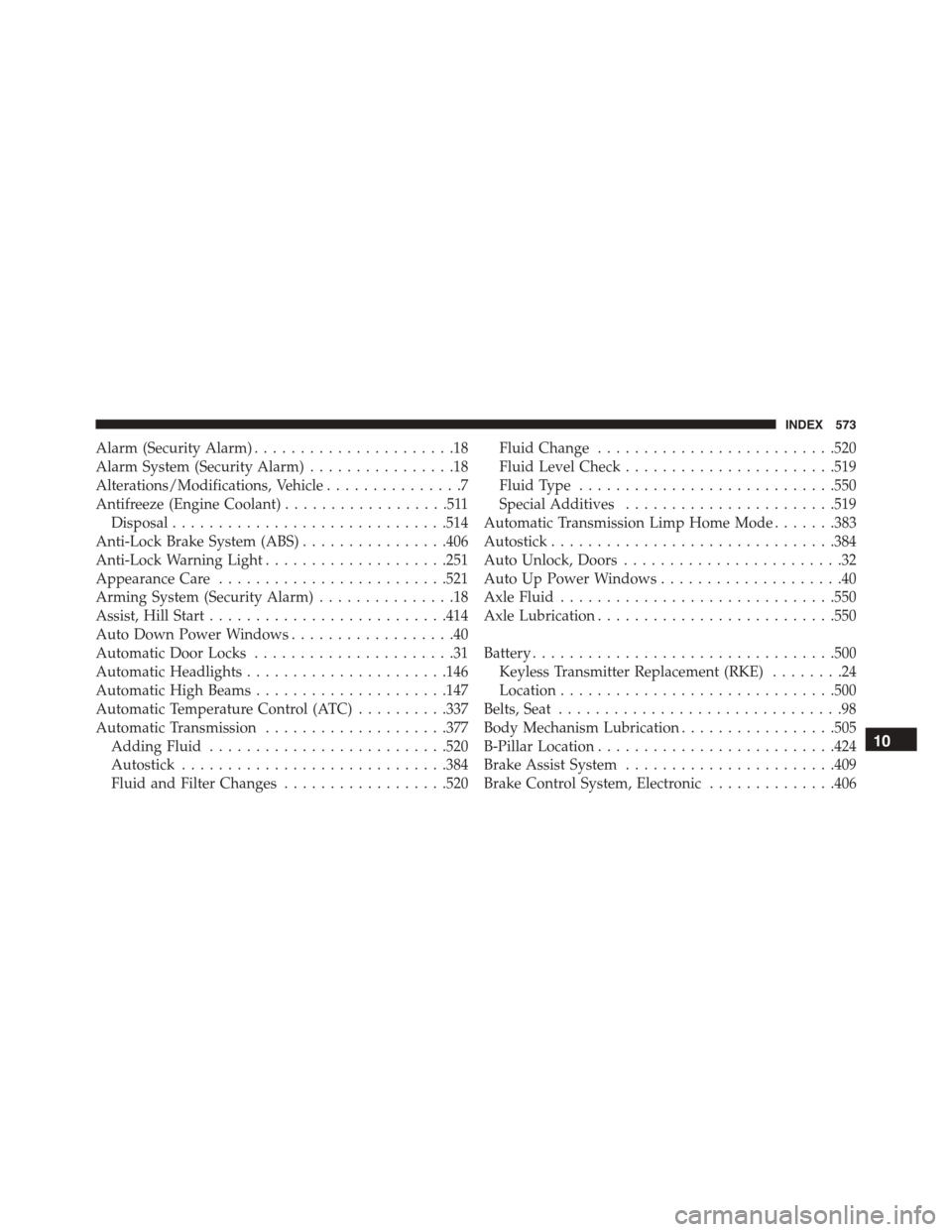
Alarm (Security Alarm)......................18
Alarm System (Security Alarm)................18
Alterations/Modifications, Vehicle...............7
Antifreeze (Engine Coolant)..................511
Disposal..............................514
Anti-Lock Brake System (ABS)................406
Anti-Lock Warning Light....................251
Appearance Care.........................521
Arming System (Security Alarm)...............18
Assist, Hill Start..........................414
Auto Down Power Windows..................40
Automatic Door Locks......................31
Automatic Headlights......................146
Automatic High Beams.....................147
Automatic Temperature Control (ATC)..........337
Automatic Transmission....................377
Adding Fluid..........................520
Autostick.............................384
Fluid and Filter Changes..................520
Fluid Change..........................520
Fluid Level Check.......................519
Fluid Type............................550
Special Additives.......................519
Automatic Transmission Limp Home Mode.......383
Autostick...............................384
Auto Unlock, Doors........................32
Auto Up Power Windows....................40
Axle Fluid..............................550
Axle Lubrication..........................550
Battery.................................500
Keyless Transmitter Replacement (RKE)........24
Location..............................500
Belts, Seat...............................98
Body Mechanism Lubrication.................505
B-Pillar Location..........................424
Brake Assist System.......................409
Brake Control System, Electronic..............406
10
INDEX 573
Page 576 of 595
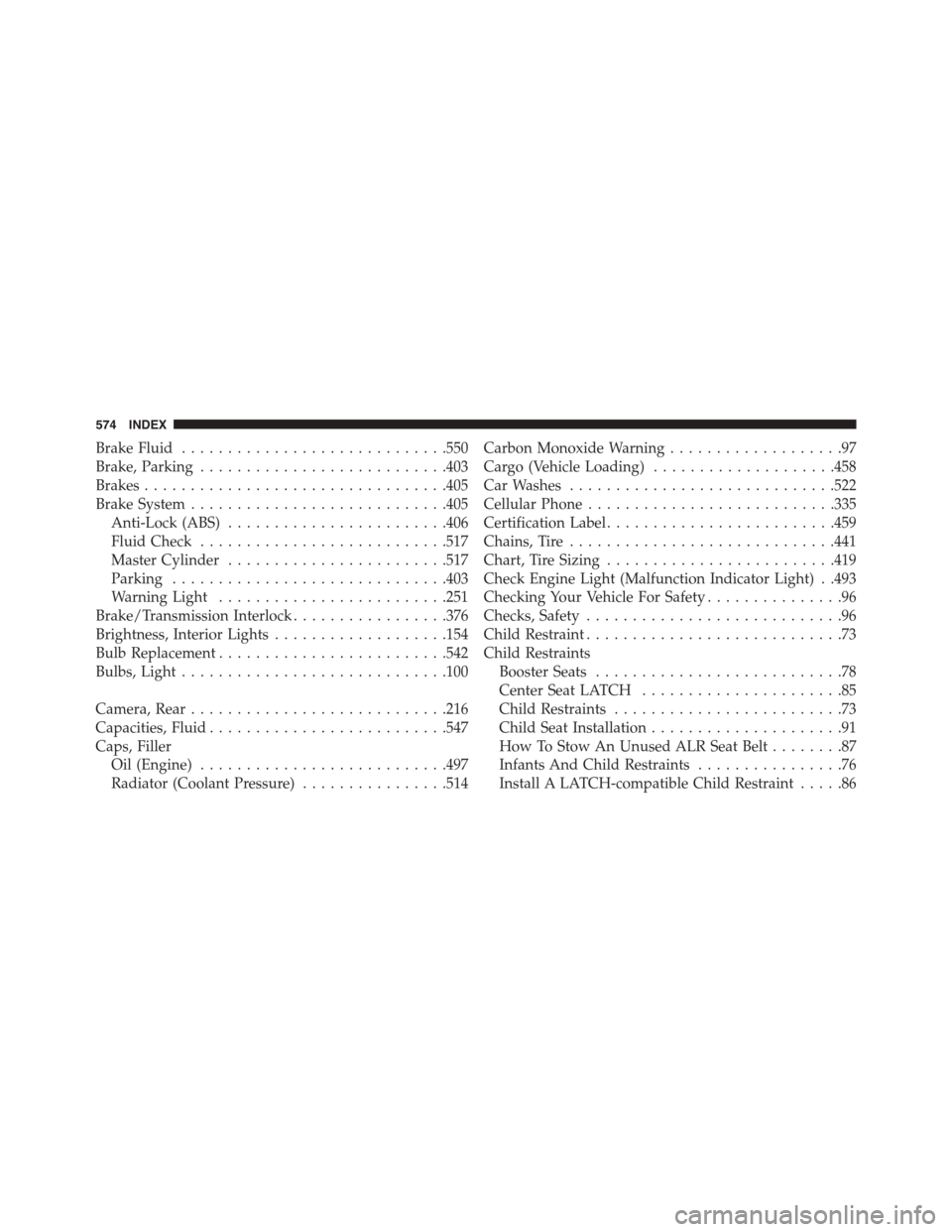
Brake Fluid.............................550
Brake, Parking...........................403
Brakes.................................405
Brake System............................405
Anti-Lock (ABS)........................406
Fluid Check...........................517
Master Cylinder........................517
Parking..............................403
Warning Light.........................251
Brake/Transmission Interlock.................376
Brightness, Interior Lights...................154
Bulb Replacement.........................542
Bulbs, Light.............................100
Camera, Rear............................216
Capacities, Fluid..........................547
Caps, Filler
Oil (Engine)...........................497
Radiator (Coolant Pressure)................514
Carbon Monoxide Warning...................97
Cargo (Vehicle Loading)....................458
Car Washes.............................522
Cellular Phone...........................335
Certification Label.........................459
Chains, Tire.............................441
Chart, Tire Sizing.........................419
Check Engine Light (Malfunction Indicator Light) . .493
Checking Your Vehicle For Safety...............96
Checks, Safety............................96
Child Restraint............................73
Child Restraints
Booster Seats...........................78
Center Seat LATCH......................85
Child Restraints.........................73
Child Seat Installation.....................91
How To Stow An Unused ALR Seat Belt........87
Infants And Child Restraints................76
Install A LATCH-compatible Child Restraint.....86
574 INDEX