brake DODGE CHARGER SRT 2015 7.G Manual PDF
[x] Cancel search | Manufacturer: DODGE, Model Year: 2015, Model line: CHARGER SRT, Model: DODGE CHARGER SRT 2015 7.GPages: 595, PDF Size: 16.43 MB
Page 481 of 595
WARNING!
•Take care to avoid the radiator cooling fan when-
ever the hood is raised. It can start anytime the
ignition switch is ON. You can be injured by
moving fan blades.
•Remove any metal jewelry such as watch bands or
bracelets that might make an inadvertent electrical
contact. You could be seriously injured.
•Batteries contain sulfuric acid that can burn your
skin or eyes and generate hydrogen gas which is
flammable and explosive. Keep open flames or
sparks away from the battery.
1. Set the parking brake, shift the automatic transmission
into PARK and place the ignition in the OFF position.
2. Turn off the heater, radio, and all unnecessary electri-
cal accessories.
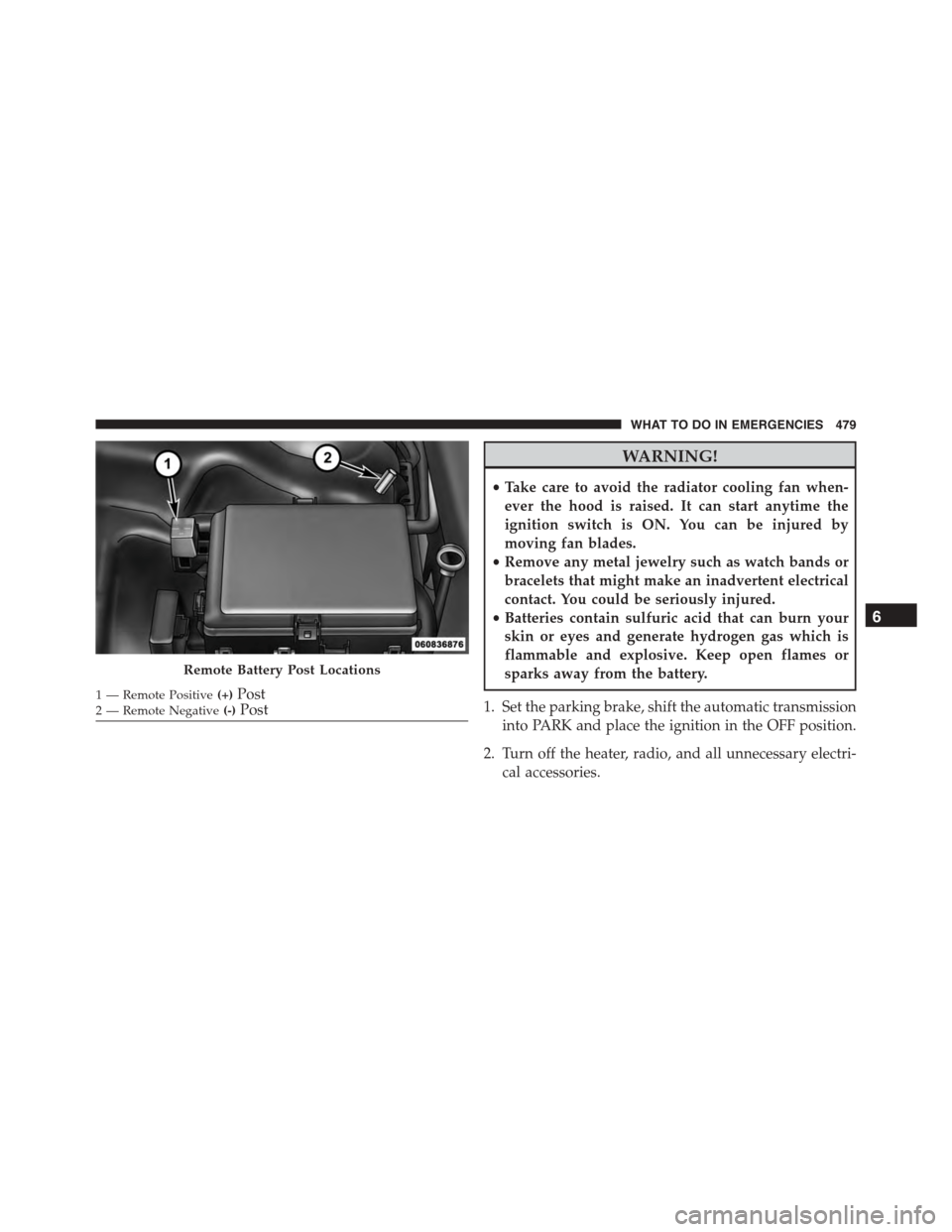
Remote Battery Post Locations
1 — Remote Positive(+)Post2—RemoteNegative(-)Post
6
WHAT TO DO IN EMERGENCIES 479
Page 482 of 595
3. If using another vehicle to jump-start the battery, park
the vehicle within the jumper cables reach, set the
parking brake and make sure the ignition is OFF.
WARNING!
Do not allow vehicles to touch each other as this
could establish a ground connection and personal
injury could result.
Jump-Starting Procedure
WARNING!
Failure to follow this jump-starting procedure could
result in personal injury or property damage due to
battery explosion.
CAUTION!
Failure to follow these procedures could result in
damage to the charging system of the booster vehicle
or the discharged vehicle.
Connecting The Jumper Cables
1. Connect the positive(+)end of the jumper cable to the
remote positive(+)post of the vehicle with the dis-
charged battery.
2. Connect the opposite end of the positive(+)jumper
cable to the positive(+)post of the booster battery.
3. Connect the negative(-)end of the jumper cable to the
negative(-)post of the booster battery.
4. Connect the opposite end of the negative(-)jumper
cable to the remote negative(-)post of the vehicle with
the discharged battery.
480 WHAT TO DO IN EMERGENCIES
Page 484 of 595
CAUTION!
Accessories plugged into the vehicle power outlets
draw power from the vehicle’s battery, even when not
in use (i.e., cellular phones, etc.). Eventually, if
plugged in long enough without engine operation,
the vehicle’s battery will discharge sufficiently to
degrade battery life and/or prevent the engine from
starting.
FREEING A STUCK VEHICLE
If your vehicle becomes stuck in mud, sand, or snow, it
can often be moved using a rocking motion. Turn the
steering wheel right and left to clear the area around the
front wheels. Push and hold the lock button on the shift
lever. Then shift back and forth between DRIVE and
REVERSE while gently pushing the accelerator. Use the
least amount of accelerator pedal pressure that will
maintain the rocking motion, without spinning the
wheels or racing the engine.
NOTE:Shifts between DRIVE and REVERSE can only be
achieved at wheel speeds of 5 mph (8 km/h) or less.
Whenever the transmission remains in NEUTRAL for
more than 2 seconds, you must push the brake pedal to
engage DRIVE or REVERSE.
CAUTION!
Racing the engine or spinning the wheels may lead to
transmission overheating and failure. Allow the en-
gine to idle with the transmission in NEUTRAL for at
least one minute after every five rocking-motion
cycles. This will minimize overheating and reduce
the risk of transmission failure during prolonged
efforts to free a stuck vehicle.
482 WHAT TO DO IN EMERGENCIES
Page 485 of 595
NOTE:Push the#ESC Off#switch, to place the Electronic
Stability Control (ESC) system in#Partial Off#mode,
before rocking the vehicle. Refer to “Electronic Brake
Control” in “Starting And Operating” for further infor-
mation. Once the vehicle has been freed, push the#ESC
Off#switch again to restore#ESC On#mode.
CAUTION!
•When “rocking” a stuck vehicle by shifting be-
tween DRIVE and REVERSE, do not spin the
wheels faster than 15 mph (24 km/h), or drivetrain
damage may result.
•Revving the engine or spinning the wheels too fast
may lead to transmission overheating and failure.
It can also damage the tires. Do not spin the wheels
above 30 mph (48 km/h) while in gear (no trans-
mission shifting occurring).
WARNING!
Fast spinning tires can be dangerous. Forces gener-
ated by excessive wheel speeds may cause damage, or
even failure, of the axle and tires. A tire could
explode and injure someone. Do not spin your vehi-
cle’s wheels faster than 30 mph (48 km/h) or for
longer than 30 seconds continuously without stop-
ping when you are stuck and do not let anyone near
a spinning wheel, no matter what the speed.6
WHAT TO DO IN EMERGENCIES 483
Page 486 of 595
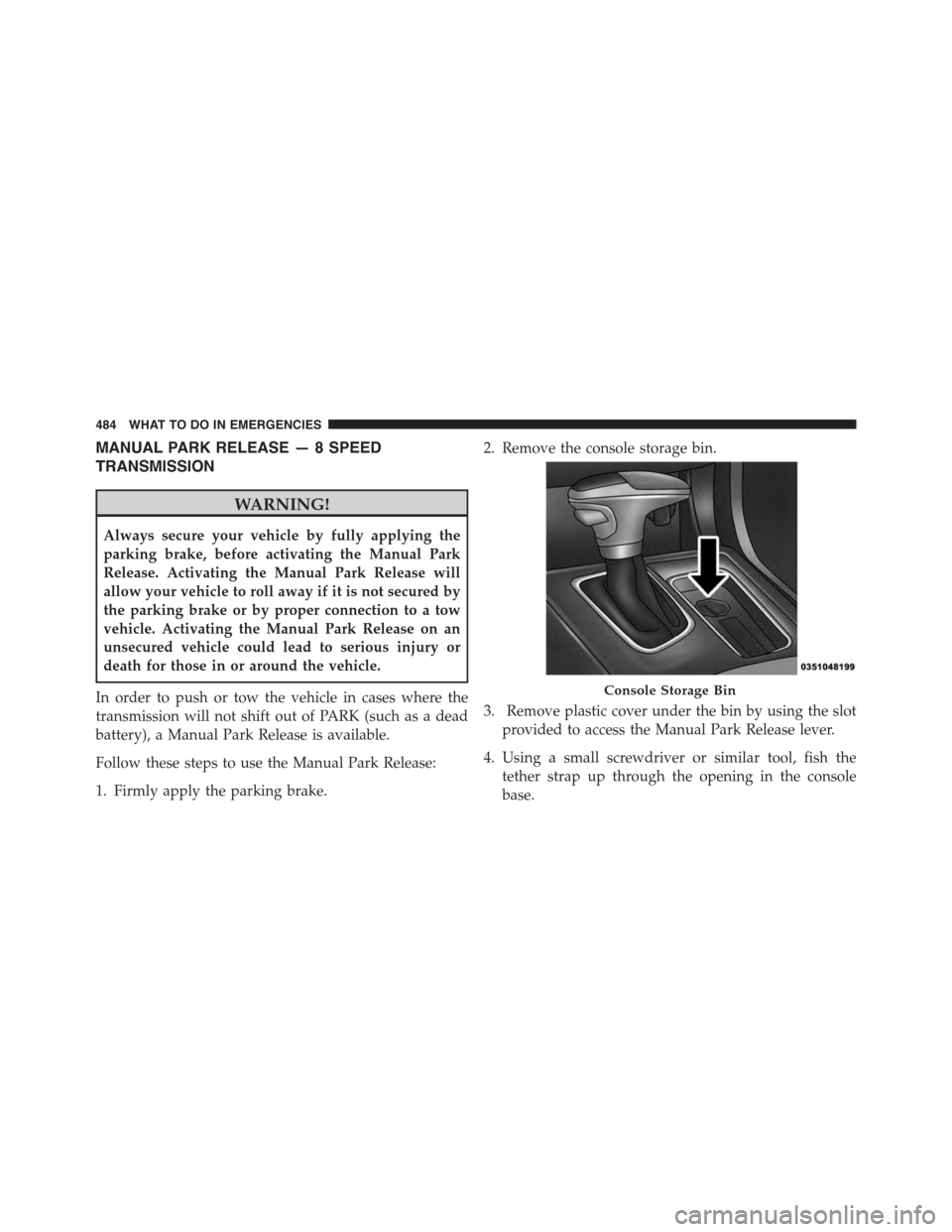
MANUAL PARK RELEASE — 8 SPEED
TRANSMISSION
WARNING!
Always secure your vehicle by fully applying the
parking brake, before activating the Manual Park
Release. Activating the Manual Park Release will
allow your vehicle to roll away if it is not secured by
the parking brake or by proper connection to a tow
vehicle. Activating the Manual Park Release on an
unsecured vehicle could lead to serious injury or
death for those in or around the vehicle.
In order to push or tow the vehicle in cases where the
transmission will not shift out of PARK (such as a dead
battery), a Manual Park Release is available.
Follow these steps to use the Manual Park Release:
1. Firmly apply the parking brake.
2. Remove the console storage bin.
3. Remove plastic cover under the bin by using the slot
provided to access the Manual Park Release lever.
4. Using a small screwdriver or similar tool, fish the
tether strap up through the opening in the console
base.
Console Storage Bin
484 WHAT TO DO IN EMERGENCIES
Page 487 of 595
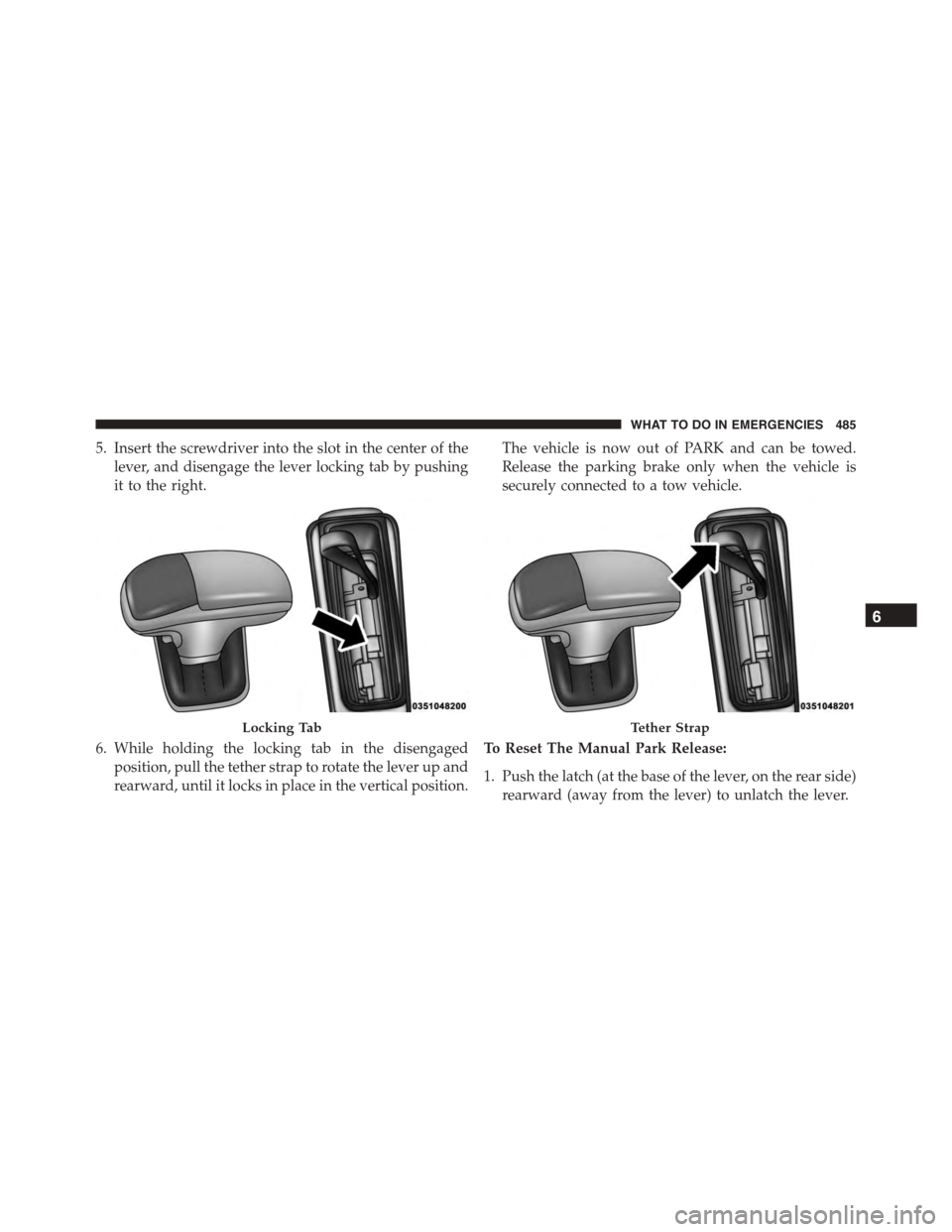
5. Insert the screwdriver into the slot in the center of the
lever, and disengage the lever locking tab by pushing
it to the right.
6. While holding the locking tab in the disengaged
position, pull the tether strap to rotate the lever up and
rearward, until it locks in place in the vertical position.
The vehicle is now out of PARK and can be towed.
Release the parking brake only when the vehicle is
securely connected to a tow vehicle.
To Reset The Manual Park Release:
1. Push the latch (at the base of the lever, on the rear side)
rearward (away from the lever) to unlatch the lever.
Locking TabTether Strap
6
WHAT TO DO IN EMERGENCIES 485
Page 491 of 595
MAINTAINING YOUR VEHICLE
CONTENTS
!ENGINE COMPARTMENT — 6.2L
SUPERCHARGED......................491
!ENGINE COMPARTMENT — 6.4L
(392 HEMI)...........................492
!ONBOARD DIAGNOSTIC SYSTEM — OBD II . .493
!EMISSIONS INSPECTION AND MAINTENANCE
PROGRAMS..........................493
!REPLACEMENT PARTS..................495
!DEALER SERVICE......................495
!MAINTENANCE PROCEDURES...........496
▫Engine Oil..........................497
▫Engine Oil Filter......................499
▫Engine Air Cleaner Filter................500
▫Maintenance-Free Battery...............500
▫Air Conditioner Maintenance.............502
▫Body Lubrication.....................505
▫Windshield Wiper Blades...............506
▫Adding Washer Fluid..................506
▫Exhaust System......................507
▫Cooling System......................509
▫Brake System........................516
7
Page 493 of 595
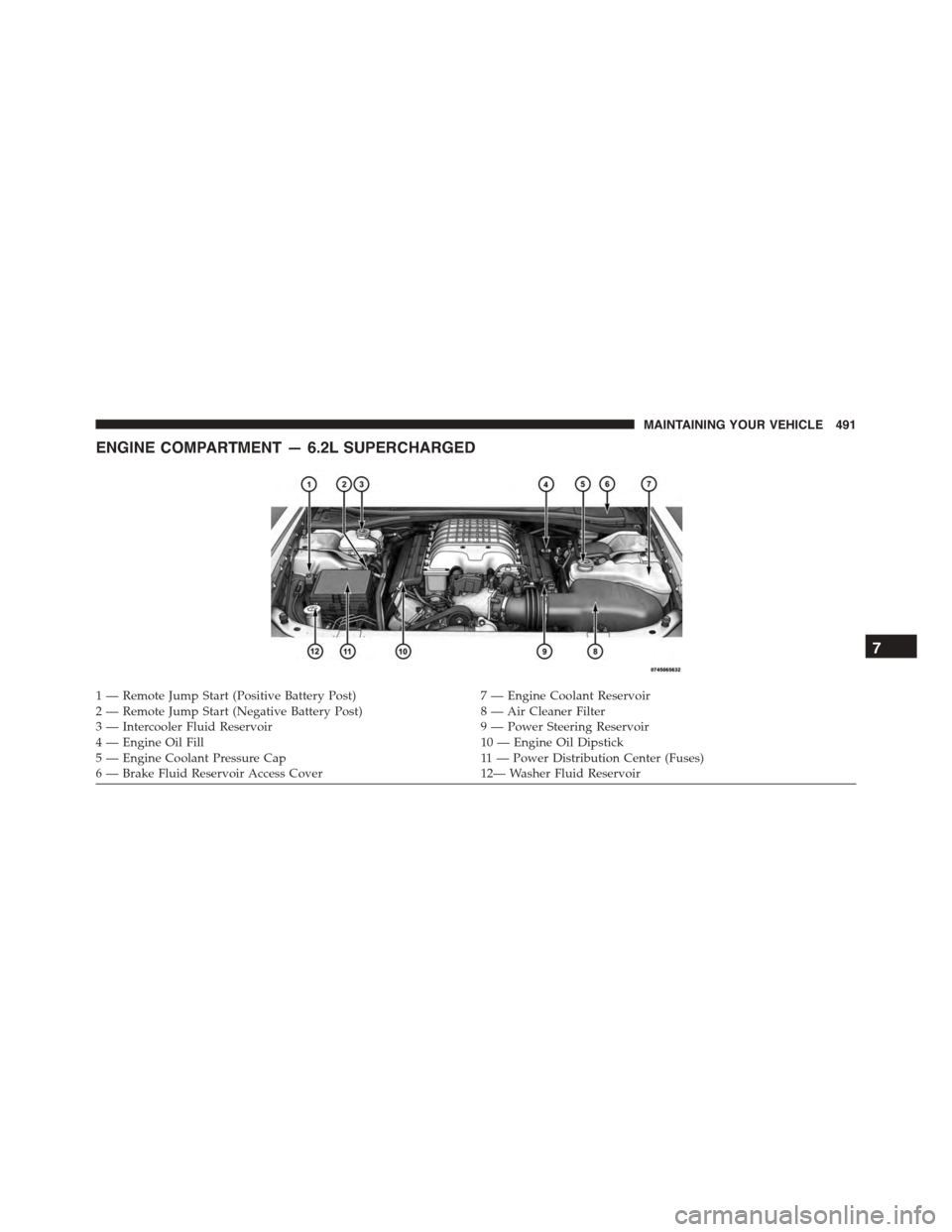
ENGINE COMPARTMENT — 6.2L SUPERCHARGED
1—RemoteJumpStart(PositiveBatteryPost)7—EngineCoolantReservoir2 — Remote Jump Start (Negative Battery Post)8 — Air Cleaner Filter3 — Intercooler Fluid Reservoir9 — Power Steering Reservoir4 — Engine Oil Fill10 — Engine Oil Dipstick5 — Engine Coolant Pressure Cap11 — Power Distribution Center (Fuses)6 — Brake Fluid Reservoir Access Cover12— Washer Fluid Reservoir
7
MAINTAINING YOUR VEHICLE 491
Page 494 of 595
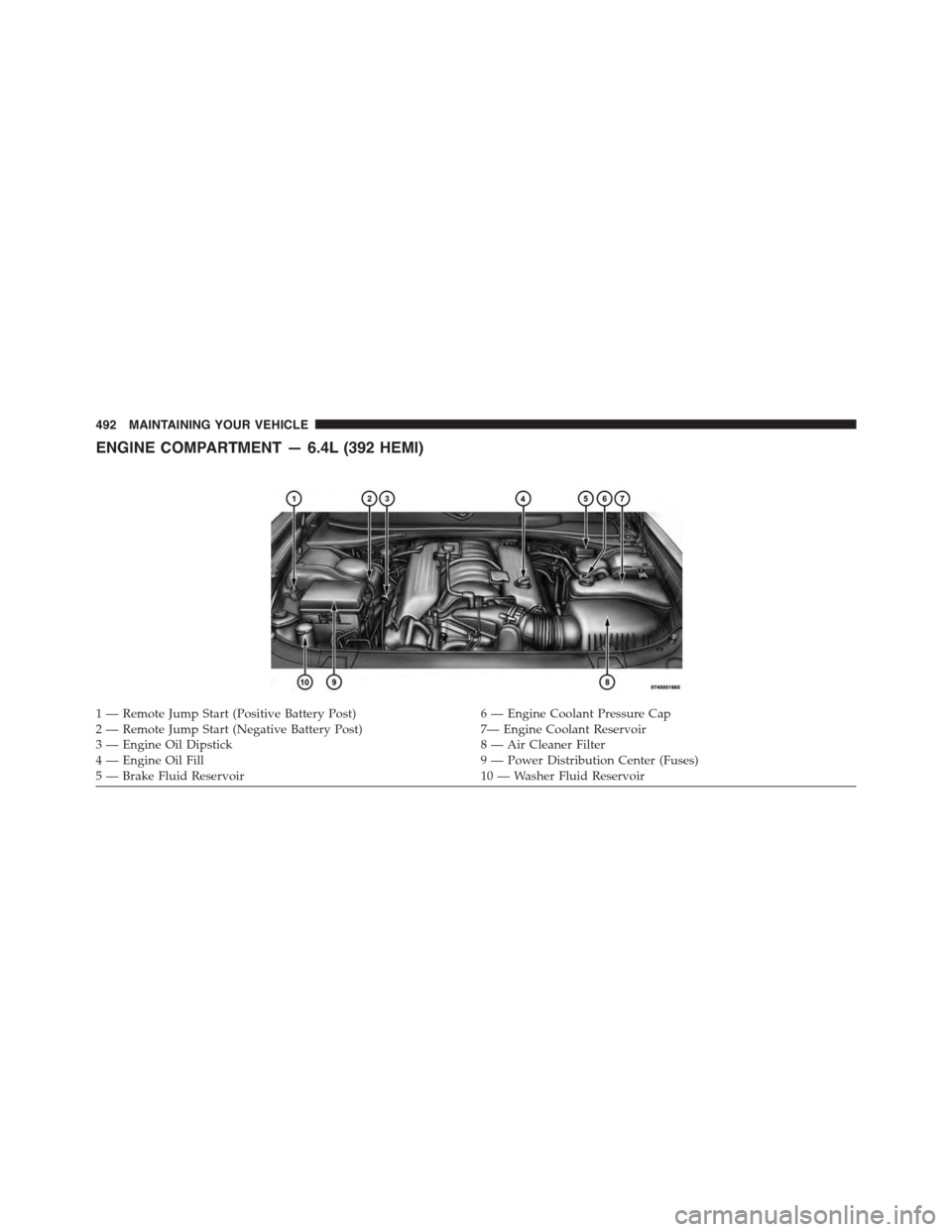
ENGINE COMPARTMENT — 6.4L (392 HEMI)
1—RemoteJumpStart(PositiveBatteryPost)6—EngineCoolantPressureCap2 — Remote Jump Start (Negative Battery Post)7— Engine Coolant Reservoir3 — Engine Oil Dipstick8 — Air Cleaner Filter4 — Engine Oil Fill9 — Power Distribution Center (Fuses)5 — Brake Fluid Reservoir10 — Washer Fluid Reservoir
492 MAINTAINING YOUR VEHICLE
Page 518 of 595
•Check the coolant freeze point in the radiator and in
the coolant expansion bottle. If engine coolant (anti-
freeze) needs to be added, the contents of the coolant
expansion bottle must also be protected against freez-
ing.
•If frequent engine coolant (antifreeze) additions are
required, the cooling system should be pressure tested
for leaks.
•Maintain engine coolant (antifreeze) concentration at a
minimum of 50% OAT coolant (conforming to
MS.90032) and distilled water for proper corrosion
protection of your engine which contains aluminum
components.
•Make sure that the coolant expansion bottle overflow
hoses are not kinked or obstructed.
•Keep the front of the radiator clean. If your vehicle is
equipped with air conditioning, keep the front of the
condenser clean.
•Do not change the thermostat for Summer or Winter
operation. If replacement is ever necessary, install
ONLY the correct type thermostat. Other designs may
result in unsatisfactory engine coolant (antifreeze)
performance, poor gas mileage, and increased emis-
sions.
Brake System
In order to assure brake system performance, all brake
system components should be inspected periodically.
Refer to the “Maintenance Schedule” for the proper
maintenance intervals.
516 MAINTAINING YOUR VEHICLE