belt DODGE DAKOTA 2009 3.G Owner's Manual
[x] Cancel search | Manufacturer: DODGE, Model Year: 2009, Model line: DAKOTA, Model: DODGE DAKOTA 2009 3.GPages: 449, PDF Size: 10.96 MB
Page 54 of 449
may be possible based on collision severity and occu-
pant size. The steering wheel hub trim cover and the
upper right side of the instrument panel separate and
fold out of the way as the bags inflate to their full size.
The bags fully inflate in about 50 - 70 milliseconds.
This is about half of the time it takes to blink your eyes.
The bags then quickly deflate while helping to restrain
the driver and front passenger. The driver's front
airbag gas is vented through vent holes in the sides of
the airbag. The passenger's front airbag gas is vented
through vent holes in the sides of the airbag. In this
way the airbags do not interfere with your control of
the vehicle.
²TheSide Impact SRS Window Bagsare designed to
activate only in certain side collisions. When the ORC
(with side impact option) detects a collision requiring
the window bags to inflate, it signals the inflators on
the crash side of the vehicle. A quantity of nontoxic gas
is generated to inflate the window bag. The inflatingwindow bag pushes the outside edge of the headliner
out of the way and covers the window. The airbag
forcefully inflates in about one quarter of the time it
takes to blink your eye. Make sure you are seated and
belted properly and do not position items in the area
where the window bag inflates. This especially applies
to children. The window bag is only about 3-1/2 in
(9 cm) thick when it is inflated.
NOTE:At no time should any supplemental restraint
system (SRS)-component or SRS related component, or
fastener, be modified or replaced with any part except
those which are approved by Chrylser LLC/Mopar.²TheKnee Impact Bolstershelp protect the knees of
the driver and the front passenger, and position every-
one for the best interaction with the front airbag.
52 THINGS TO KNOW BEFORE STARTING YOUR VEHICLE
Page 56 of 449
WARNING!
Deployed airbags and seat belt pretensioners cannot
protect you in another collision. Have the airbags,
and both front seat belt retractor assemblies (w/
pretensioners), replaced by an authorized dealer as
soon as possible.
Maintaining Your Airbag System
WARNING!
²Modifications to any part of the airbag system
could cause it to fail when you need it. You could
be injured if the airbag system is not there to
protect you. Do not modify the components or
wiring, including adding any kind of badges or
stickers to the steering wheel hub trim cover or the
upper right side of the instrument panel. Do not
modify the front bumper, vehicle body structure,
or add aftermarket side steps or running boards.
²You need proper knee impact protection in a
collision. Do not mount or locate any aftermarket
equipment on or behind the knee bolsters.
(Continued)
54 THINGS TO KNOW BEFORE STARTING YOUR VEHICLE
Page 59 of 449
court with legal jurisdiction (i.e., pursuant to a warrant).
A copy of the data will be provided to the custodial entity
upon request. General data, that does not identify par-
ticular vehicles or crashes, may be released for incorpo-
ration in aggregate crash databases, such as those main-
tained by the U.S. government and various states. Data of
a potentially sensitive nature, such as would identify a
particular driver, vehicle, or crash, will be treated confi-
dentially. Confidential data will not be disclosed by
Chrylser LLC to any third party, except when:
1. Used for research purposes, such as to match data
with a particular crash record in an aggregate database,
provided confidentiality of personal data is thereafter
preserved
2. Used in defense of litigation involving a Chrylser LLC
product
3. Requested by police under a legal warrant4. Otherwise required by law.
Data Parameters that May Be Recorded:
²Diagnostic trouble code(s) and warning lamp status
for electronically-controlled safety systems, including
the airbag system
²9Time9of airbag deployment (in terms of ignition
cycles and vehicle mileage)
²Airbag deployment level (if applicable)
²Impact acceleration and angle
²Seat belt status
²Brake status (service and parking brakes)
²Accelerator status (including vehicle speed)
²Engine control status (including engine speed)
²Transmission gear selection
THINGS TO KNOW BEFORE STARTING YOUR VEHICLE 57
2
Page 60 of 449
²Cruise control status
²Traction/stability control status
²Tire pressure monitoring system status (if equipped).
Child Restraint
Everyone in your vehicle needs to be buckled up all the
time - babies and children, too. Every state in the United
States, and all Canadian provinces, require that small
children ride in proper restraint systems. This is the law,
and you can be prosecuted for ignoring it. Children
12 years and younger should ride properly buckled up in
a rear seat, if available. According to crash statistics,
children are safer when properly restrained in the rear
seats rather than in the front.
There are different sizes and types of restraints for
children from newborn size to the child almost large
enough for an adult seat belt. Always check the child seatowner's manual to ensure you have the right seat for
your child. Use the restraint that is correct for your child.
Infants and Small Children
²
Safety experts recommend that children ride
rearward-facing in the vehicle until they are at least
one year old and weigh at least 20 lbs (9 kg). Two types
of child restraints can be used rearward facing: infant
carriers and9convertible9child seats.
²The infant carrier is only used rearward-facing in the
vehicle. It is recommended for children who weigh up
to about 20 lbs (9 kg).9Convertible9child seats can be
used either rearward-facing or forward-facing in the
vehicle. Convertible child seats often have a higher
weight limit in the rearward-facing direction than
infant carriers do, so they can be used rearward-facing
by children who weigh more than 20 lbs (9 kg) but are
less than one year old. Both types of child restraints are
held in the vehicle by the seat belt or the LATCH child
58 THINGS TO KNOW BEFORE STARTING YOUR VEHICLE
Page 61 of 449
restraint anchorage system. (Refer to ªLATCH - Child
Seat Anchorage Systemº in this section.)
²Rearward-facing child seats mustNEVERbe used in
the front seat of a vehicle with a front passenger airbag
that does not have a switch to turn the airbag Off. An
airbag deployment could cause severe injury or death
to infants in this position.
Older Children and Child Restraints
²Children who weigh more than 20 lbs (9 kg), and who
are older than one year, can ride forward-facing in the
vehicle. Forward-facing child seats and convertible
child seats used in the forward-facing direction are for
children who weigh 20 to 40 lbs (9 to 18 kg), and are
older than one year old. These child seats are also held
in the vehicle by the seat belt or the LATCH child
restraint anchorage system. (Refer to ªLATCH - Child
Seat Anchorage Systemº in this section.)
²The belt-positioning booster seat is for children weigh-
ing more than 40 lbs (18 kg), but who are still too small
to fit the vehicle's seat belts properly. If the child
cannot sit with knees bent over the seat cushion while
the child's back is against the seatback, they need a
belt-positioning booster seat. The child and booster
seat are held in the vehicle by the lap/shoulder belt.
Children Too Large for Booster Seats
²Children who are large enough to wear the shoulder
belt comfortably, and whose legs are long enough to
bend over the front of the seat when their back is
against the seat back should use the lap/shoulder belt
in a rear seat.
²Make sure that the child is upright in the seat.
²The lap portion should be low on the hips and as snug
as possible.
THINGS TO KNOW BEFORE STARTING YOUR VEHICLE 59
2
Page 62 of 449
²Check belt fit periodically. A child's squirming or
slouching can move the belt out of position.
²If the shoulder belt contacts the face or neck, move the
child closer to the center of the vehicle. Never allow a
child to put the shoulder belt under an arm.
For additional information, refer to www.seatcheck.org.
WARNING!
²Improper installation can lead to failure of an
infant or child restraint. It could come loose in a
collision. The child could be badly injured or
killed. Follow the manufacturer's directions ex-
actly when installing an infant or child restraint.
(Continued)
WARNING! (Continued)
²A rearward-facing infant restraint should only be
used in a rear seat of a vehicle that does not have
an airbag off switch. A rearward-facing infant
restraint in the front seat may be struck by a
deploying passenger airbag, which may cause se-
vere or fatal injury to the infant.
Here are some tips for getting the most out of your child
restraint:
²Before buying any restraint system, make sure that it
has a label certifying that it meets all applicable Safety
Standards. The manufacturer recommends that you
try a child restraint in the vehicle seats where you will
use it before you buy it.
²The restraint must be appropriate for your child's
weight and height. Check the label on the restraint for
weight and height limits.
60 THINGS TO KNOW BEFORE STARTING YOUR VEHICLE
Page 63 of 449
²Carefully follow the instructions that come with the
restraint. If you install the restraint improperly, it may
not work when you need it.
²The Extended Cab first, and Club/Crew Cab second
row outside seating positions, have cinching latch
plates. These are designed to keep the lap portion tight
around the child restraint so that it is not necessary to
use a locking clip. If the seat belt has a cinching latch
plate, pulling up on the shoulder portion of the
lap/shoulder belt will tighten the belt. The cinching
latch plate will keep the belt tight, however, any seat
belt system will loosen with time, so check the belt
occasionally and pull it tight, if necessary.
²Buckle the child into the restraint exactly as the
manufacturer's instructions tell you.
²When your child restraint is not in use, secure it in the
vehicle with the seat belt or remove it from the vehicle.Do not leave it loose in the vehicle. In a sudden stop or
collision, it could strike the occupants or seatbacks and
cause serious personal injury.
LATCH - Child Seat Anchorage System (Lower
Anchors and Tether for CHildren) Ð if equipped
Each vehicle is equipped with the child restraint anchor-
age system called LATCH, which stands for Lower
Anchors and Tethers for CHildren. The LATCH system
provides for the installation of the child restraint without
using the vehicle's seat belts, instead securing the child
restraint using lower anchorages and upper tether straps
from the child restraint to the vehicle structure. LATCH-
compatible child restraint systems are now available.
However, because the lower anchorages are to be intro-
duced over a period of years, child restraint systems
having attachments for those anchorages will continue to
also have features for installation using the vehicle's seat
belts. Child restraints having tether straps and hooks for
THINGS TO KNOW BEFORE STARTING YOUR VEHICLE 61
2
Page 64 of 449
connection to the top tether anchorages have been avail-
able for some time. For some older child restraints, many
child restraint manufacturers offer add-on tether strap
kits or retro-fit kits. You are urged to take advantage of all
the available attachments provided with your child re-
straint in any vehicle.
Extended Cab
²The Extended Cab front and right rear (if equipped
with a rear seat) passenger seating positions have
lower anchorages for LATCH-equipped child
restraints.Crew Cab
²The Crew Cab second row seat has lower anchorages
that are capable of accommodating LATCH-
compatible child seats having flexible, webbing-
mounted lower attachments at all three seating posi-
tions. Child seats with fixed lower attachments must
be installed in the outboard positions only. Regardless
of the specific type of lower attachment, NEVER install
LATCH compatible child seats such that two seats
share a common lower anchorage. If you are installing
LATCH-compatible child restraints in adjacent rear
seating positions, you can use the LATCH anchors or
the vehicle's seat belt for the outboard position, but
you must use the vehicle's seat belt at the center
position.
62 THINGS TO KNOW BEFORE STARTING YOUR VEHICLE
Page 65 of 449
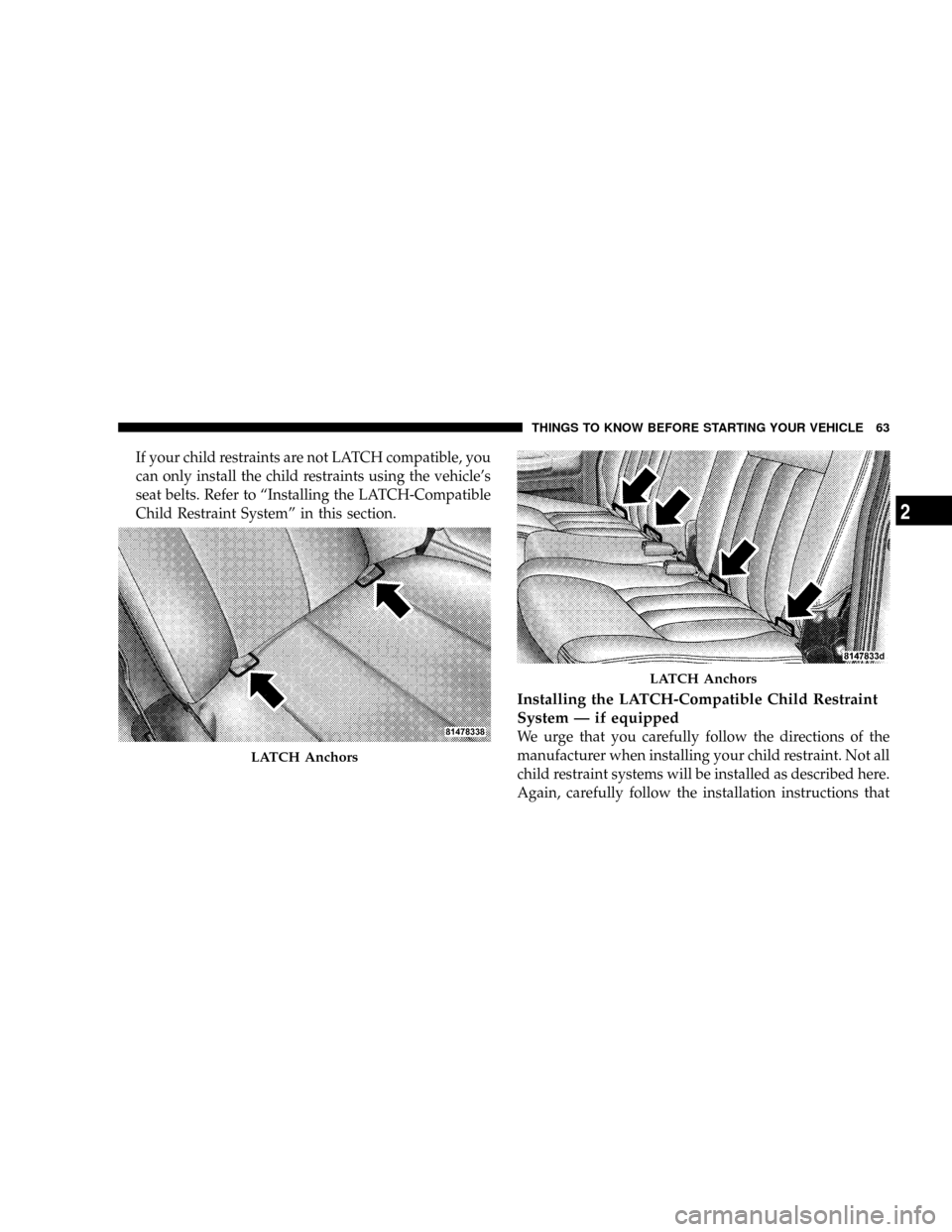
If your child restraints are not LATCH compatible, you
can only install the child restraints using the vehicle's
seat belts. Refer to ªInstalling the LATCH-Compatible
Child Restraint Systemº in this section.
Installing the LATCH-Compatible Child Restraint
System Ð if equipped
We urge that you carefully follow the directions of the
manufacturer when installing your child restraint. Not all
child restraint systems will be installed as described here.
Again, carefully follow the installation instructions that
LATCH Anchors
LATCH Anchors
THINGS TO KNOW BEFORE STARTING YOUR VEHICLE 63
2
Page 66 of 449
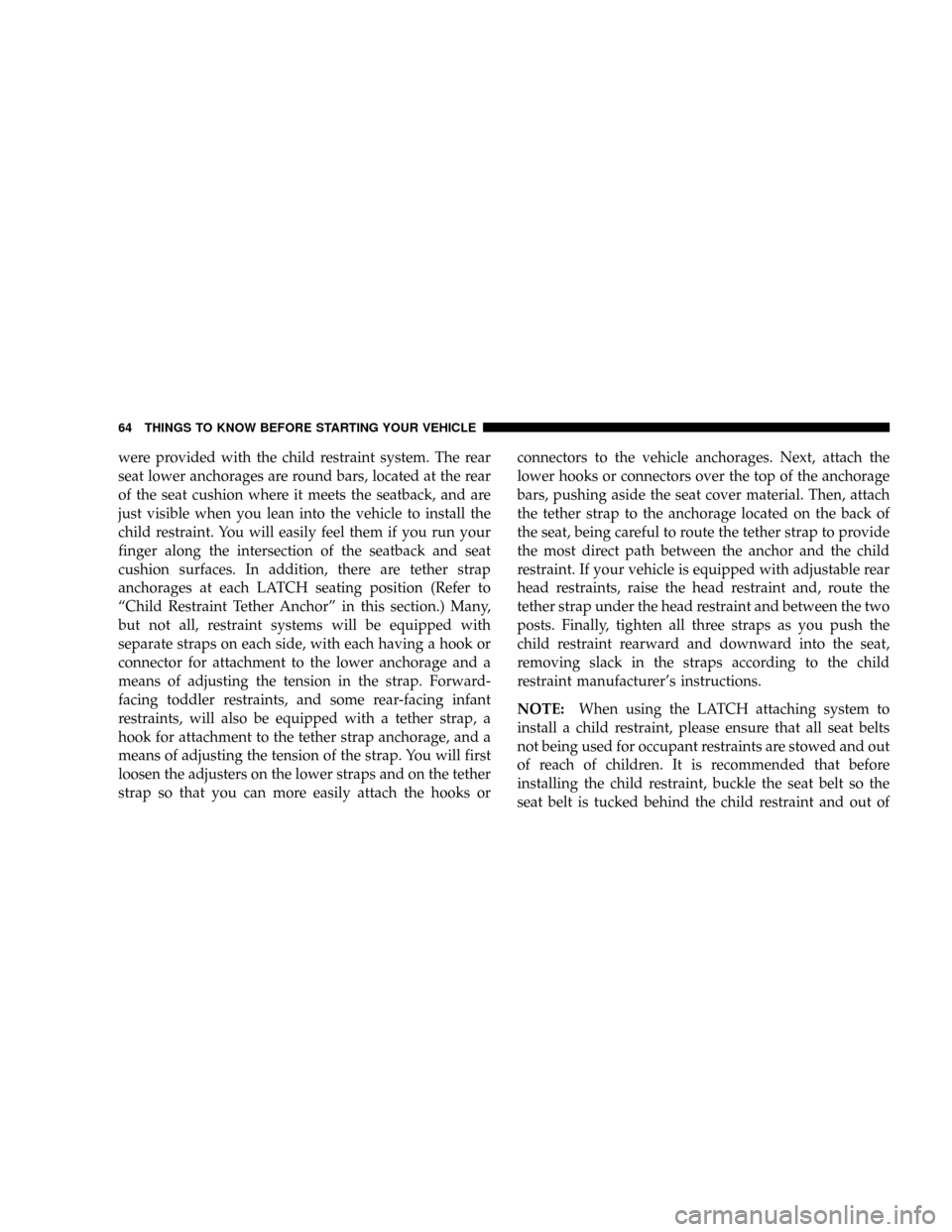
were provided with the child restraint system. The rear
seat lower anchorages are round bars, located at the rear
of the seat cushion where it meets the seatback, and are
just visible when you lean into the vehicle to install the
child restraint. You will easily feel them if you run your
finger along the intersection of the seatback and seat
cushion surfaces. In addition, there are tether strap
anchorages at each LATCH seating position (Refer to
ªChild Restraint Tether Anchorº in this section.) Many,
but not all, restraint systems will be equipped with
separate straps on each side, with each having a hook or
connector for attachment to the lower anchorage and a
means of adjusting the tension in the strap. Forward-
facing toddler restraints, and some rear-facing infant
restraints, will also be equipped with a tether strap, a
hook for attachment to the tether strap anchorage, and a
means of adjusting the tension of the strap. You will first
loosen the adjusters on the lower straps and on the tether
strap so that you can more easily attach the hooks orconnectors to the vehicle anchorages. Next, attach the
lower hooks or connectors over the top of the anchorage
bars, pushing aside the seat cover material. Then, attach
the tether strap to the anchorage located on the back of
the seat, being careful to route the tether strap to provide
the most direct path between the anchor and the child
restraint. If your vehicle is equipped with adjustable rear
head restraints, raise the head restraint and, route the
tether strap under the head restraint and between the two
posts. Finally, tighten all three straps as you push the
child restraint rearward and downward into the seat,
removing slack in the straps according to the child
restraint manufacturer's instructions.
NOTE:When using the LATCH attaching system to
install a child restraint, please ensure that all seat belts
not being used for occupant restraints are stowed and out
of reach of children. It is recommended that before
installing the child restraint, buckle the seat belt so the
seat belt is tucked behind the child restraint and out of
64 THINGS TO KNOW BEFORE STARTING YOUR VEHICLE