wheel DODGE DURANGO 2005 2.G Owner's Guide
[x] Cancel search | Manufacturer: DODGE, Model Year: 2005, Model line: DURANGO, Model: DODGE DURANGO 2005 2.GPages: 416, PDF Size: 14.25 MB
Page 238 of 416
WARNING!
•Anti-lock system (ABS) cannot prevent the natu-
ral laws of physics from acting on the vehicle, nor
can it increase braking or steering efficiency be-
yond that afforded by the condition of the vehicle
brakes and tires or the traction afforded.
•The ABS cannot prevent accidents, including
those resulting from excessive speed in turns,
following another vehicle too closely, or hydro-
planing. Only a safe, attentive, and skillful driver
can prevent accidents.
•The capabilities of an ABS equipped vehicle must
never be exploited in a reckless or dangerous
manner which could jeopardize the user’s safety
or the safety of others.
When you are in a severe braking condition involving
use of the Anti-lock Brake system, you will experience
some pedal drop as the vehicle comes to a stop. This is
the result of the system reverting to the base brake
system.
Engagement of the Anti-lock Brake System may be
accompanied by a pulsing sensation. You may also hear a
clicking noise. These occurrences are normal, and indi-
cate that the system is functioning properly.
POWER STEERING
Your power steering system will provide mechanical
steering capability if power assist is lost.
If for any reason the hydraulic pressure is interrupted, it
will still be possible to steer your vehicle. Under these
conditions you will experience an increase in steering
effort and a noticeable amount of “free play” in the
steering wheel.
238 STARTING AND OPERATING
Page 239 of 416
ROCKING THE VEHICLE
If vehicle becomes stuck in snow, sand, or mud, it can
often be moved by a rocking motion. Move the gear
selector rhythmically between FIRST and REVERSE,
while applying slight pressure to the accelerator.
The least amount of accelerator pedal pressure to main-
tain the rocking motion without spinning the wheels or
racing the engine is most effective. Allow the engine to
idle with the transmission selector in NEUTRAL for at
least one minute after every five rocking-motion cycles.
This will minimize overheating and reduce the risk of
transmission failure during prolonged efforts to free a
stuck vehicle.
TIRE SAFETY INFORMATION
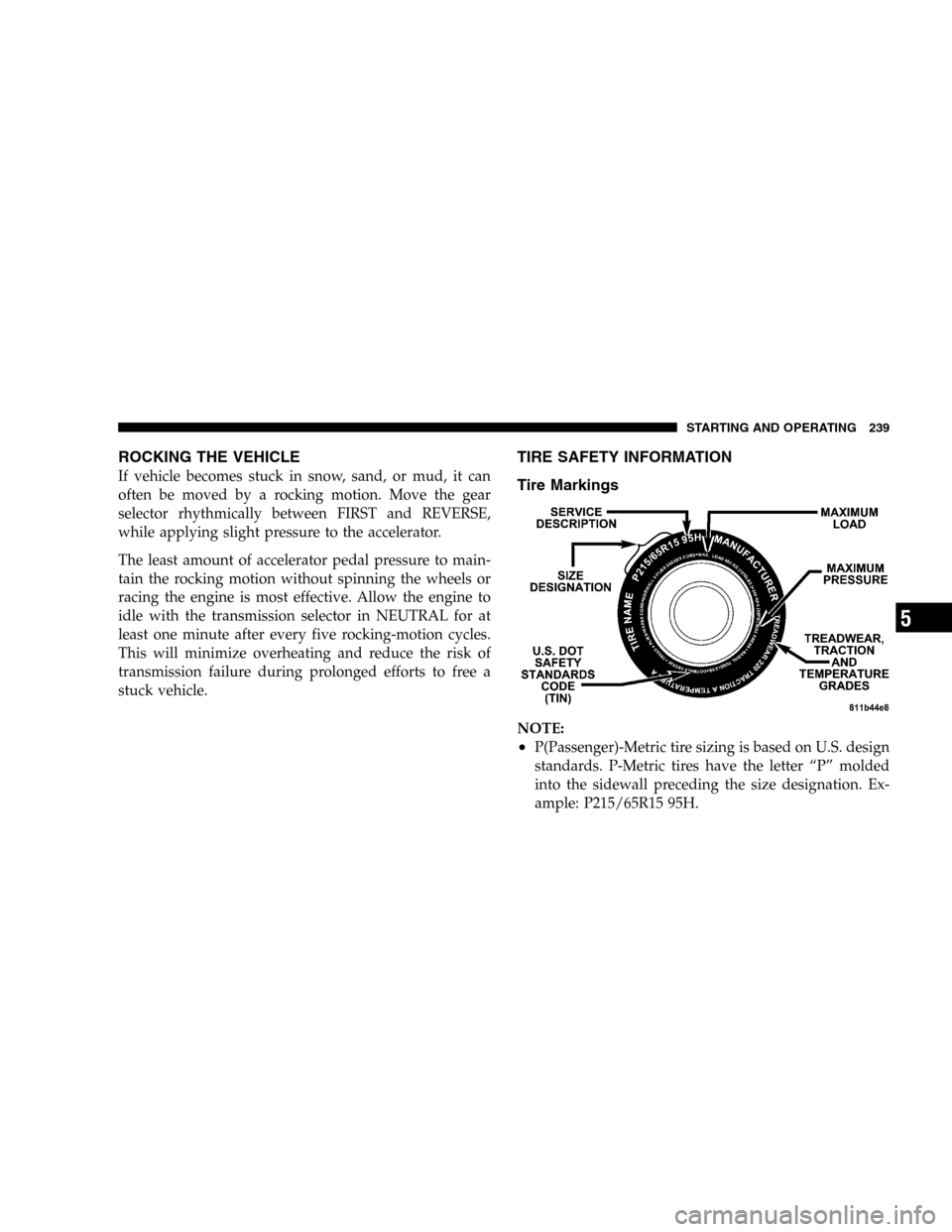
Tire Markings
NOTE:
•P(Passenger)-Metric tire sizing is based on U.S. design
standards. P-Metric tires have the letter “P” molded
into the sidewall preceding the size designation. Ex-
ample: P215/65R15 95H.
STARTING AND OPERATING 239
5
Page 252 of 416
Radial-Ply Tires
WARNING!
Combining radial ply tires with other types of tires
on your vehicle will cause your vehicle to handle
poorly. The instability could cause an accident. Al-
ways use radial ply tires in sets of four (or 6, in case
of trucks with dual rear wheels). Never combine
them with other types of tires.
Cuts and punctures in radial tires are repairable only in
the tread area because of sidewall flexing. Consult your
authorized tire dealer for radial tire repairs.
Compact Spare Tire — If Equipped
The compact spare is for temporary emergency use with
radial tires. It is engineered to be used on your style
vehicle only. Since this tire has limited tread life, the
original tire should be repaired (or replaced) and rein-
stalled at the first opportunity.
WARNING!
Temporary use spare tires are for emergency use
only. With these tires, do not drive more than 50 mph
(80 km/h). Temporary-use spare tires have limited
tread life. When two or more tread wear indicators
appear in adjacent grooves, the temporary use spare
tire needs to be replaced. Be sure to follow the
warnings which apply to your spare. Failure to do so
could result in spare tire failure and loss of vehicle
control.
252 STARTING AND OPERATING
Page 253 of 416
Do not install a wheel cover or attempt to mount a
conventional tire on the compact spare wheel, since the
wheel is designed specifically for the compact spare.
Do not install more than one compact spare tire/wheel
on the vehicle at any given time.
CAUTION!
Because of the reduced ground clearance, do not take
your vehicle through an automatic car wash with the
compact spare installed. Damage to the vehicle may
result.
Limited Use Spare — If Equipped
The limited use spare tire is for temporary emergency use
on your vehicle. This tire is identified by a limited use
spare tire warning label located on the limited use spare
tire and wheel assembly. This tire may look like the
original equipped tire on the front or rear axle of your
vehicle, but it is not. Installation of this limited use spare
tire affects vehicle handling. Since it is not the same tire,
replace (or repair) the original tire and reinstall on vehicle
at the first opportunity.
STARTING AND OPERATING 253
5
Page 254 of 416
WARNING!
The limited use spare tires are for emergency use
only. Installation of this limited use spare tire affects
vehicle handling. With this tire, do not drive more
than 60 mph (100 km/h). Keep inflated to the cold
tire inflation pressure listed on either your tire
placard or limited use spare tire and wheel assembly.
Replace (or repair) the original tire at the first
opportunity and reinstall it on your vehicle. Failure
to do so could result in loss of vehicle control.
Tire Spinning
When stuck in mud, sand, snow, or ice conditions, do not
spin your vehicle’s wheels above 35 mph (55 km/h).
See the paragraph on Freeing A Stuck Vehicle in Section
6 of this manual.
WARNING!
Fast spinning tires can be dangerous. Forces gener-
ated by excessive wheel speeds may cause tire dam-
age or failure. A tire could explode and injure
someone. Do not spin your vehicle’s wheels faster
than 35 mph (55 km/h) when you are stuck. And
don’t let anyone near a spinning wheel, no matter
what the speed.
Tread Wear Indicators
Tread wear indicators are in the original equipment tires
to help you in determining when your tires should be
replaced.
254 STARTING AND OPERATING
Page 256 of 416
WARNING!
•Do not use a tire, wheel size or rating other than
that specified for your vehicle. Some combinations
of unapproved tires and wheels may change sus-
pension dimensions and performance characteris-
tics, resulting in changes to steering, handling, and
braking of your vehicle. This can cause unpredict-
able handling and stress to steering and suspen-
sion components. You could lose control and have
an accident resulting in serious injury or death. Use
only the tire and wheel sizes with load ratings
approved for your vehicle.
•Never use a tire with a smaller load index or
capacity, other than what was originally equipped
on your vehicle. Using a tire with a smaller load
index could result in tire overloading and failure.
You could lose control and have an accident.
•Failure to equip your vehicle with tires having
adequate speed capability can result in sudden tire
failure and loss of vehicle control.
CAUTION!
Replacing original tires with tires of a different size
may result in false speedometer and odometer read-
ings.
Alignment And Balance
Poor suspension alignment may result in:
•Fast tire wear.
•Uneven tire wear, such as feathering and one-sided
wear.
•Vehicle pull to right or left.
Tires may also cause the vehicle to pull to the left or right.
Alignment will not correct this condition. See your dealer
for proper diagnosis.
256 STARTING AND OPERATING
Page 257 of 416
Improper alignment will not cause vehicle vibration.
Vibration may be a result of tire and wheel out-of-
balance. Proper balancing will reduce vibration and
avoid tire cupping and spotty wear.
SUPPLEMENTAL TIRE PRESSURE INFORMATION
A light load vehicle condition is defined as two passen-
gers {150 lbs (68 kg) each} plus 200 lbs (91kg) of cargo.
Cold tire inflation pressures for a lightly loaded vehicle
will be found on a “Supplemental Tire Pressure Inflation”
label located on the face of the driver’s door or in the Tire
Information Pressures pamphlet in the glove box.
TIRE CHAINS
Use “Class S” chains on Durango, or other traction aids
that meet SAE Type “S” specifications.
NOTE:Chains must be the proper size for the vehicle,
as recommended by the chain manufacturer.
CAUTION!
To avoid damage to your vehicle, tires or chains, observe the
following precautions:
•Because of limited chain clearance between tires and other
suspension components, it is important that only chains in
good condition are used. Broken chains can cause serious
vehicle damage. Stop the vehicle immediately if noise occurs
that could suggest chain breakage. Remove the damaged parts
of the chain before further use.
•Install chains as tightly as possible and then retighten after
driving about 1/2 mile (0.8 km).
•Do not exceed 45 mph (72 km/h).
•Drive cautiously and avoid severe turns and large bumps,
especially with a loaded vehicle.
•Do not install tire chains on front wheels of 4x2 vehicles.
•Do not drive for a prolonged period on dry pavement.
•Observe the tire chain manufacturer’s instructions on method
of installation, operating speed, and conditions for usage.
Always use the lower suggested operating speed of the chain
manufacturer if different than the speed recommended by the
manufacturer.
STARTING AND OPERATING 257
5
Page 258 of 416
These cautions apply to all chain traction devices, includ-
ing link and cable (radial) chains.
Tire chain use is permitted only on the rear tires of
Durango trucks.
NOTE:The use of class “S” chains is permitted on
Durangos with P245/70R17 tires.
CAUTION!
Do not use tire chains on 4x4 Durango trucks
equipped with P265/65R17 tires. There may not be
adequate clearance for the chains and you are risking
structural or body damage to your vehicle. Do not
use tire chains on the 4X2 front wheels of Durango
models. There may not be adequate clearance for the
chains and you are risking structural or body dam-
age to your vehicle.
SNOW TIRES
Snow tires should be of the same size and type construc-
tion as the front tires. Consult the manufacturer of the
snow tire to determine any maximum vehicle speed
requirement associated with the tire. These tires should
always be operated at the vehicle maximum capacity
inflation pressures under any load condition.
While studded tires improve performance on ice, skid
and traction capability on wet or dry surfaces may be
poorer than that of non-studded tires. Some states pro-
hibit studded tires; therefore, local laws should be
checked before using these tire types.
258 STARTING AND OPERATING
Page 269 of 416
Gross Axle Weight Rating (GAWR)
The GAWR is the maximum permissible load on the front
and rear axles. The load must be distributed in the cargo
area so that the GAWR of each axle is not exceeded.
Each axle GAWR is determined by the component in the
system with the lowest load carrying capacity (axle,
springs, tires, or wheels).
Heavier axles or suspension components sometimes
specified by purchasers for increased durability do not
necessarily increase the vehicle’s GVWR.
Tire Size
This is the minimum allowable tire size for your vehicle.
Replacement tires must be equal to the load capacity of
this tire size.
Rim Size
This is the rim size that is appropriate for the tire size
listed.
Inflation Pressure (Cold)
This is the cold tire inflation pressure for your vehicle for
all loading conditions up to full GAWR.
Curb Weight
The curb weight of a vehicle is defined as the total weight
of the vehicle with all fluids, including vehicle fuel, at full
capacity conditions, and with no occupants or cargo
loaded into the vehicle. The front and rear curb weight
values are determined by weighing your vehicle on a
commercial scale before any occupants or cargo are
added.
Loading
The actual total weight and the weight of the front and
rear of your vehicle at the ground can best be determined
by weighing it when it is loaded and ready for operation.
The entire vehicle should first be weighed on a commer-
cial scale to insure that the GVWR has not been exceeded.
The weight on the front and rear of the vehicle should
STARTING AND OPERATING 269
5
Page 273 of 416
WARNING!
Improper towing can lead to an injury accident.
Follow these guidelines to make your trailer towing
as safe as possible:
•Be sure the trailer is loaded heavier in front, with 60%
to 65% of the weight in front of the axle(s). Loads
balanced over the wheels or heavier in the rear can
cause the trailer to swayseverelyside to side which
will cause loss of control of vehicle and trailer. Failure
to load trailers heavier in front is the cause of many
trailer accidents.
•Donotinterconnect the hydraulic brake system of
your vehicle with that of the trailer. This could cause
inadequate braking and possible personal injury.
•Trailer brakes are recommended for trailers over 1,000
lbs (454 kg) and required for trailers in excess of 2,000
lbs. (907 kg).
•Use an approved trailer harness and connector. If a
hitch is ordered, the proper wiring will be provided.
•When hauling cargo or towing a trailer, do not over-
load your vehicle or trailer. Overloading can cause a
loss of control, poor performance or damage to brakes,
axle, engine, transmission, steering, suspension, chas-
sis structure or tires.
•Make certain that the load is secured in the trailer and
will not shift during travel. When trailering cargo that
cannot be fully secured, dynamic load shifts can occur
that may be difficult for the driver to control.
•All trailer hitches should be professionally installed on
your vehicle.
STARTING AND OPERATING 273
5