air condition DODGE DURANGO 2008 2.G Owner's Manual
[x] Cancel search | Manufacturer: DODGE, Model Year: 2008, Model line: DURANGO, Model: DODGE DURANGO 2008 2.GPages: 481, PDF Size: 7.75 MB
Page 359 of 481
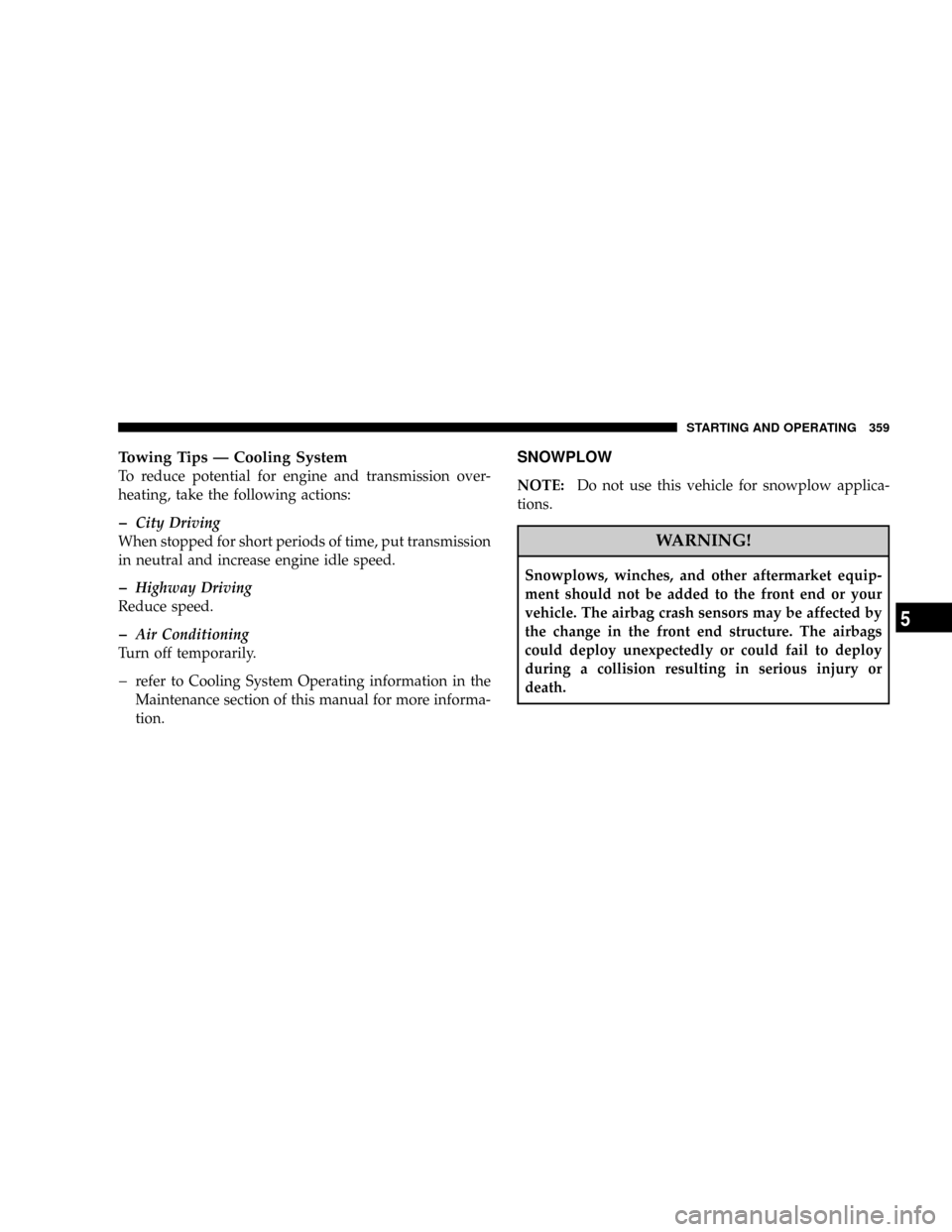
Towing Tips Ð Cooling System
To reduce potential for engine and transmission over-
heating, take the following actions:
þCity Driving
When stopped for short periods of time, put transmission
in neutral and increase engine idle speed.
þHighway Driving
Reduce speed.
þAir Conditioning
Turn off temporarily.
þrefer to Cooling System Operating information in the
Maintenance section of this manual for more informa-
tion.
SNOWPLOW
NOTE:Do not use this vehicle for snowplow applica-
tions.
WARNING!
Snowplows, winches, and other aftermarket equip-
ment should not be added to the front end or your
vehicle. The airbag crash sensors may be affected by
the change in the front end structure. The airbags
could deploy unexpectedly or could fail to deploy
during a collision resulting in serious injury or
death.
STARTING AND OPERATING 359
5
Page 381 of 481
MAINTAINING YOUR VEHICLE
CONTENTS
mEngine Compartment 3.7L V6..............384
mEngine Compartment 4.7L V-8..............385
mEngine Compartment 5.7L HEMI V-8.........386
mOnboard Diagnostic System Ð OBD II........387
NLoose Fuel Filler Cap Message............388
mEmissions Inspection And Maintenance
Programs............................388
mReplacement Parts......................390
mDealer Service.........................390mMaintenance Procedures..................391
NEngine Oil..........................391
NEngine Oil Filter......................394
NDrive Belts Ð Check Condition And Tension . . 394
NSpark Plugs.........................395
NEngine Air Cleaner Filter................395
NEngine Fuel Filter.....................396
NCatalytic Converter....................396
NMaintenance Free Battery................397
7
Page 382 of 481
NPower Steering Ð Fluid Check............399
NAir Conditioner Maintenance.............399
NFront Suspension Ball Joints..............400
NDrive Shaft Constant Velocity Joints........401
NBody Lubrication.....................401
NWindshield Wiper Blades................401
NWindshield And Rear Window Washers.....402
NExhaust System......................402
NCooling System.......................403
NEmission Related Components............409
NBrake System........................410
NAutomatic Transmission................411
NTransfer Case........................414NAxles..............................414
NAppearance Care And Protection From
Corrosion...........................415
mFuse Block............................420
NFuses (Interior).......................421
NFuses (Power Distribution Center).........424
NFuses (Integrated Power Module)..........427
mVehicle Storage........................429
mReplacement Light Bulbs.................430
mBulb Replacement......................430
NHeadlights/Parking/Turn Signal..........430
NRear Side Marker, Tail Lights, Turn Signals
And Backup Lights Ð Replacement........432
NLicense Lights........................436
382 MAINTAINING YOUR VEHICLE
Page 392 of 481
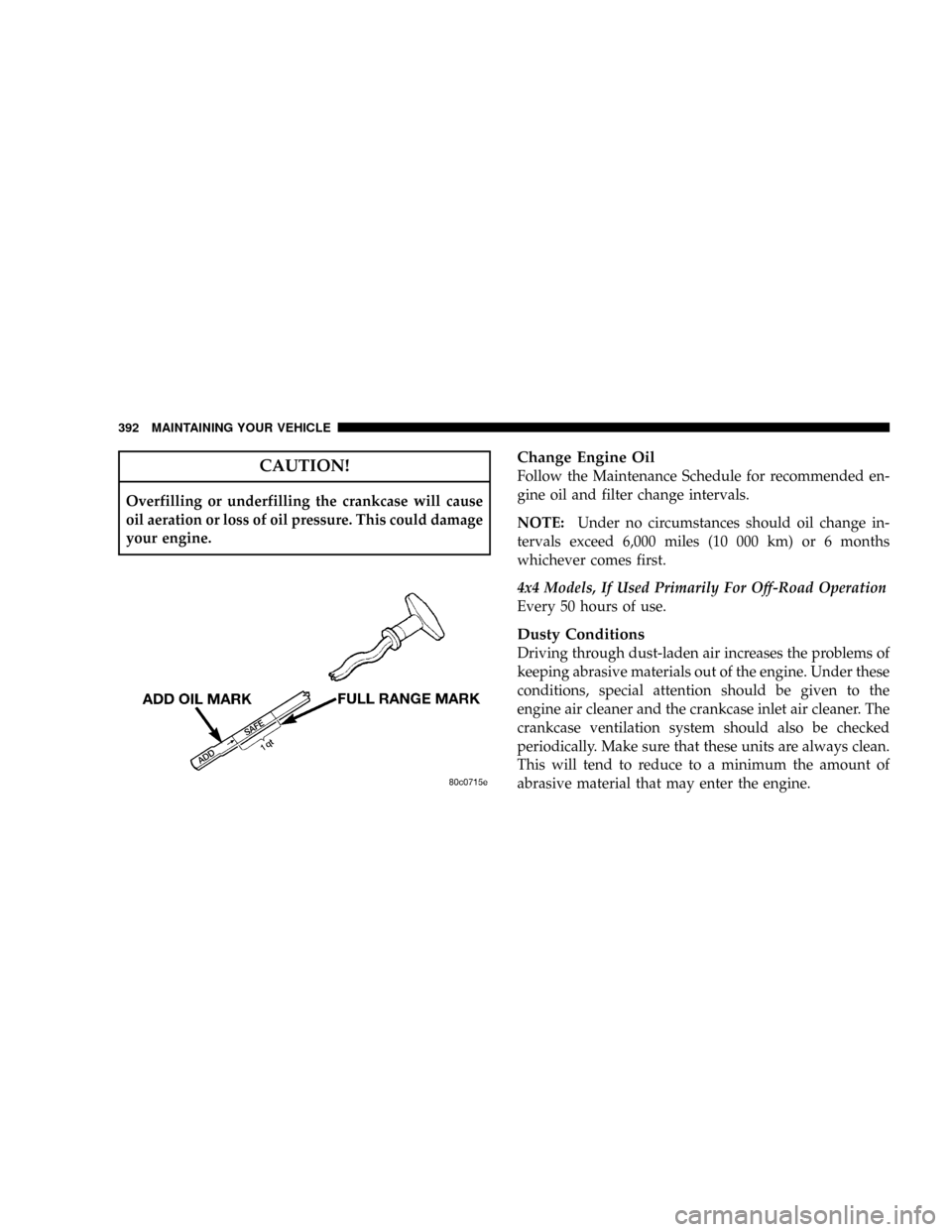
CAUTION!
Overfilling or underfilling the crankcase will cause
oil aeration or loss of oil pressure. This could damage
your engine.
Change Engine Oil
Follow the Maintenance Schedule for recommended en-
gine oil and filter change intervals.
NOTE:Under no circumstances should oil change in-
tervals exceed 6,000 miles (10 000 km) or 6 months
whichever comes first.
4x4 Models, If Used Primarily For Off-Road Operation
Every 50 hours of use.
Dusty Conditions
Driving through dust-laden air increases the problems of
keeping abrasive materials out of the engine. Under these
conditions, special attention should be given to the
engine air cleaner and the crankcase inlet air cleaner. The
crankcase ventilation system should also be checked
periodically. Make sure that these units are always clean.
This will tend to reduce to a minimum the amount of
abrasive material that may enter the engine.
392 MAINTAINING YOUR VEHICLE
Page 394 of 481
Synthetic Engine Oils
You may use synthetic engine oils provided the recom-
mended oil quality requirements are met, and the recom-
mended maintenance intervals for oil and filter changes
are followed.
Materials Added to Engine Oils
The manufacture strongly recommends against the addi-
tion of any additives (other than leak detection dyes) to
the engine oil. Engine oil is an engineered product and
it's performance may be impaired by supplemental ad-
ditives.
Disposing of Used Engine Oil And Oil Filters
Care should be taken in disposing of used engine oil and
oil filters from your vehicle. Used oil and oil filters,
indiscriminately discarded, can present a problem to the
environment. Contact your dealer, service station, or
governmental agency for advice on how and where used
oil and oil filters can be safely discarded in your area.
Engine Oil Filter
The engine oil filter should be replaced at every engine
oil change.
Engine Oil Filter Selection
The manufacturer's engines have a full-flow type oil
filter. Use a filter of this type for replacement. The quality
of replacement filters varies considerably. Only high
quality filters should be used to assure most efficient
service. MopartEngine Oil Filters are a high quality oil
filter and are recommended.
Drive Belts Ð Check Condition and Tension
Belt tension is controlled by means of an automatic
tensioner. No belt tension adjustments are required.
However, belt and belt tensioner condition should be
inspected at the specified intervals, and replaced if re-
quired. See your authorized dealer for service. At the
mileage indicated in the maintenance schedule, all belts
and tensioner should be checked for condition. Improper
394 MAINTAINING YOUR VEHICLE
Page 399 of 481
Power Steering Ð Fluid Check
Checking the power steering fluid level at a defined
service interval is not required. The fluid should only be
checked if a leak is suspected, abnormal noises are
apparent, and/or the system is not functioning as antici-
pated. Coordinate inspection efforts through a certified
DaimlerChrysler Dealership.9
WARNING!
Fluid level should be checked on a level surface and
with the engine off to prevent injury from moving
parts and to insure accurate fluid level reading. Do
not overfill. Use only manufacturers recommended
power steering fluid.If necessary, add fluid to restore to the proper indicated
level. With a clean cloth, wipe any spilled fluid from all
surfaces. Refer to Fluids, Lubricants, and Genuine Parts
for correct fluid type.
Air Conditioner Maintenance
For best possible performance, your air conditioner
should be checked and serviced by an Authorized Dealer
at the start of each warm season. This service should
include cleaning of the condenser fins and a performance
test. Drive belt tension should also be checked at this
time.
MAINTAINING YOUR VEHICLE 399
7
Page 400 of 481
WARNING!
²Use only refrigerants and compressor lubricants
approved by the manufacturer for your air condi-
tioning system. Some unapproved refrigerants are
flammable and can explode, injuring you. Other
unapproved refrigerants or lubricants can cause
the system to fail, requiring costly repairs. Refer to
Section 3 of the Warranty Information book for
further warranty information.
²The air conditioning system contains refrigerant
under high pressure. To avoid risk of personal
injury or damage to the system, adding refrigerant
or any repair requiring lines to be disconnected
should be done by an experienced repairman.NOTE:Use only manufacturer approved A/C System
Sealers, Stop Leak Products, Seal Conditioners, Compres-
sor Oils and Refrigerants.
Refrigerant Recovery and Recycling
R-134a Air Conditioning Refrigerant is a hydrofluorocar-
bon (HFC) that is endorsed by the Environmental Pro-
tection Agency and is an ozone-saving product. How-
ever, the manufacturer recommends that air conditioning
service be performed by dealers or other service facilities
using recovery and recycling equipment.
Front Suspension Ball Joints
The ball joints and seals should be inspected whenever
the vehicle is serviced for other reasons. Damaged seals
should be replaced to prevent leakage or contamination
of the grease.
400 MAINTAINING YOUR VEHICLE
Page 408 of 481
²Do not overfill the coolant recovery bottle.
²Check coolant freeze point in the radiator and in the
coolant recovery bottle. If antifreeze needs to be
added, contents of coolant recovery bottle must also be
protected against freezing.
²If frequent coolant additions are required, or if the
level in the coolant recovery bottle does not drop when
the engine cools, the cooling system should be pres-
sure tested for leaks.
²Maintain coolant concentration at 50% HOAT engine
coolant (minimum) and distilled water for proper
corrosion protection of your engine which contains
aluminum components.
²Make sure that the radiator and coolant recovery
bottle overflow hoses are not kinked or obstructed.
²Keep the front of the radiator clean. If your vehicle is
equipped with air conditioning, keep the front of the
condenser clean, also.
²Do not change the thermostat for summer or winter
operation. If replacement is ever necessary, install
ONLY the correct type thermostat. Other designs may
result in unsatisfactory coolant performance, poor gas
mileage, and increased emissions.
408 MAINTAINING YOUR VEHICLE
Page 415 of 481

NOTE:The presence of water in the gear lubricant will
result in corrosion and possible failure of differential
components. Operation of the vehicle in water, as may be
encountered in some off-highway types of service, will
require draining and refilling the axle to avoid damage.
Rear Axle
Rear Axle fluid levels should be 7/8 in. (22mm) +/- 1/4
in. (6 mm) below the fill hole for 8 1/4 in., and 9 1/4 in.
axles should be 1 5/8 in (31mm) +/- 1/4 in. (6 mm)
Front Axle
Front Axle fluid level should be 3/4 in. (20 mm) +/- 1/4
in. (6 mm) below the level of the fill hole.
Appearance Care and Protection from Corrosion
Protection of Body and Paint from Corrosion
Vehicle body care requirements vary according to geo-
graphic locations and usage. Chemicals that make roads
passable in snow and ice, and those that are sprayed ontrees and road surfaces during other seasons, are highly
corrosive to the metal in your vehicle. Outside parking,
which exposes your vehicle to airborne contaminants,
road surfaces on which the vehicle is operated, extreme
hot or cold weather and other extreme conditions will
have an adverse effect on paint, metal trim, and under-
body protection.
The following maintenance recommendations will enable
you to obtain maximum benefit from the corrosion
resistance built into your vehicle.
What Causes Corrosion?
Corrosion is the result of deterioration or removal of
paint and protective coatings from your vehicle.
The most common causes are:
²Road salt, dirt and moisture accumulation.
²Stone and gravel impact.
MAINTAINING YOUR VEHICLE 415
7
Page 423 of 481
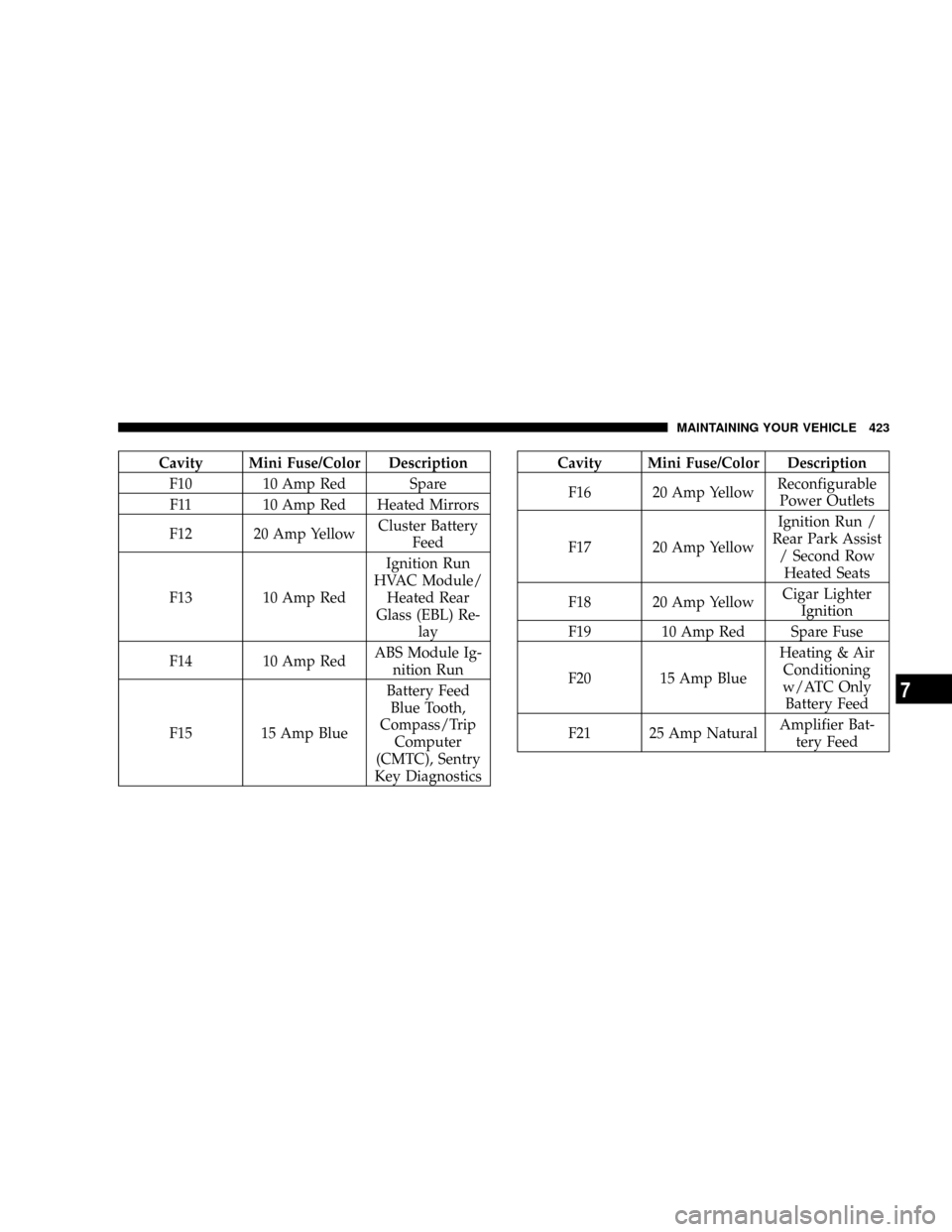
Cavity Mini Fuse/Color Description
F10 10 Amp Red Spare
F11 10 Amp Red Heated Mirrors
F12 20 Amp YellowCluster Battery
Feed
F13 10 Amp RedIgnition Run
HVAC Module/
Heated Rear
Glass (EBL) Re-
lay
F14 10 Amp RedABS Module Ig-
nition Run
F15 15 Amp BlueBattery Feed
Blue Tooth,
Compass/Trip
Computer
(CMTC), Sentry
Key DiagnosticsCavity Mini Fuse/Color Description
F16 20 Amp YellowReconfigurable
Power Outlets
F17 20 Amp YellowIgnition Run /
Rear Park Assist
/ Second Row
Heated Seats
F18 20 Amp YellowCigar Lighter
Ignition
F19 10 Amp Red Spare Fuse
F20 15 Amp BlueHeating & Air
Conditioning
w/ATC Only
Battery Feed
F21 25 Amp NaturalAmplifier Bat-
tery Feed
MAINTAINING YOUR VEHICLE 423
7